
Jean Laffite could have been a model for Pirates of the Caribbean. Variously called the “gentleman pirate,” the “terror of the Gulf” and the “hero of New Orleans,” his life is shrouded in myth.

Death of pirate Jean Laffite from “The Pirates Own Book” by Charles Ellms, 1837
Pirate or privateer?
Jean Laffite was probably born around 1782 in a village in Bordeaux, France. His older half-brother Pierre was born around 1770 to the same father but a different mother. Their father was a middle-class merchant and trader. Both brothers received some basic schooling. They started their seafaring career on the Gironde estuary, on vessels owned by or trading with their father. They left France around 1800 and wound up in the French colony of Saint-Domingue (present-day Haiti), where they worked as merchants and privateers.
Piracy was the unlawful taking of one privately-owned vessel by another. Privateering, on the other hand, was a legitimate way for a pirate to ply his trade during war. To help finance the war effort while damaging the economy of its enemies, a government would issue “letters of marque and reprisal” (essentially government licences) to qualified private vessels. This authorized them to capture enemy merchant ships. The privateers armed, equipped and crewed their ships at their own expense. They also posted a cash bond as a guarantee that they would observe the rules of war and respect civilian life. Privateers were supposed to bring their prizes into a port of the country that granted them the letters of marque, or the port of a friendly nation. There an admiralty court was supposed to examine the ship’s papers, listen to testimony and consider other evidence to decide whether the prize had been lawfully taken. If the court awarded possession of the prize to its captors, the prize ship and its cargo were sold. The proceeds were shared among the privateer crew, investors and the government whose flag the privateer flew.
During the Napoleonic Wars, almost all pirates became privateers, since letters of marque were easy to obtain. Privateers were not scrupulous about the nationality of their prizes. The English and the French preyed on each other, and both preyed on Spain. European privateers – including Jean Laffite – frequently captured American vessels, ignoring the rights of the weak, neutral United States.
Jean Laffite moves to New Orleans
In 1803 France lost Saint-Domingue in a slave revolt. Many French privateers, including the Laffite brothers, went to New Orleans. Napoleon had just sold the enormous territory of Louisiana – which had been under French, and then Spanish, rule – to the United States. American officials did not search ships as carefully as their Spanish predecessors had. Privateers wanting to come into New Orleans to unload goods and slaves, or to take on men and arms, would often pretend to be making an emergency stop for repairs. Another ruse was to bypass the customs inspector at the Balize (at the mouth of the Mississippi) and smuggle goods into points on the Mississippi below New Orleans. From there they could be taken to the city for disposal. Local merchants were happy to buy goods with no duty attached. The French and Creole (descendants of the French and Spanish) population welcomed privateers’ wares. The district court winked at piracies committed in local waters.
In December 1811, in response to a letter to the Louisiana Gazette that had complained about the introduction of illicit cargoes to New Orleans, a privateer calling himself “The Agent of the Freebooters” wrote:
Your paper of Wednesday contained a letter written by some idiot [who] makes a great outcry against a few honest fellows of us, who are using extraordinary exertions to punish the common enemy, the British and their allies, the Spaniards… Does he wish to discourage our profession and put an end to trade altogether? Cannot the booby perceive that without us there would not be a bale of goods at market; and does he not see, by the open manner in which our business is done, that the government of the United States has no objection either to the fitting out of our prizes and the sale of their cargoes, without troubling ourselves about the payment of duties; which I assure you we would find extremely inconvenient when we sell so low for real cash in these hard times. (1)
Pierre and Jean Laffite became the ringleaders of a sprawling operation based on an island in Barataria Bay, south of New Orleans. They controlled every stage of the business, from capturing goods on the high seas to distributing and selling smuggled merchandise. They didn’t bother to obtain legitimate letters of marque for their vessels. It was easier and more profitable to dispose of captured cargo illegally. They organized regular auctions at places like the “Temple” (halfway between Barataria and New Orleans), where they sold trafficked slaves and smuggled goods at bargain prices. Jean Laffite oversaw operations in Barataria. Pierre Laffite remained in New Orleans to maintain connections with local merchants and officials.
Saved by the Battle of New Orleans
The Laffites’ activities caused growing problems for the United States government, which was obliged to protect neutral commerce in American waters. In March 1813, Louisiana Governor William Claiborne issued a formal proclamation against the Barataria “banditti.” He offered a $500 reward for the capture of Jean Laffite. Laffite responded by posting a signed handbill offering a $1,000 reward for the capture of the governor.
The following year the authorities arrested and indicted Pierre Laffite. Hoping to take advantage of the situation, the British tried to bribe Jean Laffite and his men into joining their planned attack on New Orleans as part of the War of 1812. Laffite used the British offer to try to get Pierre out of jail. On September 4, 1814, he wrote to Louisiana legislator Jean Blanque:
Though proscribed by my adoptive country, I will never let slip any occasion of serving her, or of proving that she has never ceased to be dear to me…. You will see from [the British documents] the advantages I might have derived from that kind of association. I may have evaded the payment of duties to the custom house; but I have never ceased to be a good citizen; and all the offence I have committed, I was forced to by certain vices in our laws…. I presume…to hope that such proceedings may obtain amelioration of the situation of my unhappy brother, with which view I recommend him particularly to your influence. (2)
Laffite put the point more directly in a letter to Governor Claiborne:
I tender my services to defend [Louisiana against the British]; and the only reward I ask is that a stop be put to the proscription against me and my adherents, by an act of oblivion for all that has been done hitherto. (3)
This had no immediate effect, as Pierre had already broken out of jail. Claiborne proceeded with an already-planned expedition to destroy the Barataria smuggling base, which the navy did on September 16.
By October, however, General Andrew Jackson, tasked with the defence of New Orleans, was eager for any help he could find. He particularly wanted men and gunflints, which the Laffites had in abundance. Both Jean and Pierre Laffite were assigned to Jackson’s staff, acting mainly as couriers. Their men performed well against the British attack on January 8, 1815. Jackson praised them in his congratulatory address to the army. The Laffites and their followers had been promised a full presidential pardon. The charges of smuggling and piracy were dropped. It is questionable whether the pirates made a decisive difference to the outcome of the Battle of New Orleans. They made up a very small proportion of Jackson’s forces. However, had Laffite chosen to help the British, the results of the battle could have been quite different.
Spies for Spain
The Laffites’ next money-making scheme entailed serving as spies for Spain in the Mexican War of Independence. The brothers became party to a plan to assist the Mexican revolutionaries through a land campaign against Texas and a maritime assault at Tampico. Rather than risk themselves in the adventure, they fed Spain information about the insurgents’ plans. With their earnings from Spain, they hoped to re-establish their fleet, and they hoped that Spain might allow them to privateer as a cover for their espionage.
In 1816 Jean Laffite and his friend Arsène Latour undertook a secret mapping expedition on behalf of Spain. They traversed the Missouri Territory (later the Arkansas Territory) to the navigable headwaters of the Arkansas River, a journey of over 1,500 miles. You can read about this expedition in the Encyclopedia of Arkansas History & Culture.
In April 1817, Jean Laffite gained control of Galveston Island, a largely uninhabited part of Spanish Texas. He developed it into a new smuggling base. The colony (named Campeche) eventually numbered as many as 300 men and a few women. Laffite issued letters of marque that authorized ships sailing from Galveston as privateers, with permission to attack ships from any nation. His admiralty court legalized all prizes. Though ostensibly operating under the flag of the Mexican revolutionaries, Laffite provided no aid to the revolution. Thousands of slaves were illegally smuggled from Texas to Louisiana via Laffite’s operation at Galveston.
In January 1818, a group of Napoleon’s exiled French supporters landed at Galveston en route to found a military colony on the Trinity River. Laffite gave them a place to stay and some provisions. The Bonapartists were wary of their neighbours. As a young Frenchman wrote:
It was difficult for some of us to live mixed in with a horde of real brigands. (4)
The settlers continued up the Trinity and established the “Champ d’Asile.” By July, the colony had foundered and the survivors returned to Galveston, where they set up camp not far from Laffite’s village. While they were there, Galveston Island was hit by a hurricane. Jean Laffite used his own resources to feed the Bonapartists. He helped them return to New Orleans, thus earning their gratitude. He may have contemplated handing them over to Spain, though by that point the Spaniards – frustrated with Laffite’s double-dealing – had dropped the Laffites from their payroll.
The hurricane badly weakened Laffite’s operation. He got a slight boost in 1819 when James Long – a former US Army surgeon who succeeded in occupying Nacogdoches and proclaimed himself President of the short-lived Republic of Texas – appointed him “governor and commander-in-chief of the Island of St. Luis and the Port of Galveston.” Long empowered Laffite to grant letters of marque against Spanish shipping. Meanwhile, intelligence furnished by the Laffites helped Spain attack Long and expel the filibusters.
Life after Galveston
By then the US government wanted Laffite’s establishment broken up. They were afraid it could start an international incident that would put at risk the Transcontinental Treaty (also known as the Adams-Onis Treaty) of 1819, which settled the boundary between the United States and New Spain (Mexico). The agreement obligated Washington to prevent American citizens, and expeditions backed by Americans, from making incursions into Spanish territory.
The USS Enterprise was sent to Galveston to remove Jean Laffite from the Gulf. Laffite agreed to leave without a fight. He departed on May 7, 1820, setting fire to most of the settlement. Pierre Laffite wound up the business in New Orleans. He sailed south to the Yucatan Peninsula, where he died of a fever on November 9, 1821 after a gunfight with Spanish soldiers and civilians (see my post about George Schumph and the death of Pierre Laffite).
Jean Laffite established a base along the coast of Cuba and continued to sail as a pirate, taking Spanish ships in the Gulf of Mexico. In April 1822, he was captured after attacking an American ship. The Americans turned him over to Cuban authorities, who released him. He sailed to Colombia, where the government was commissioning private armed vessels in a naval auxiliary. The Colombians gave Laffite a commission and a 42-ton schooner, called the General Santander. He would be allowed to take prizes, and to share in the proceeds. In February 1823, Laffite attempted to take what appeared to be two Spanish merchant vessels near Omoa, Honduras. They turned out to be privateers or warships and returned heavy fire. Wounded in the battle, Jean Laffite is believed to have died just after dawn on February 5, approximately age 40. He was buried at sea in the Gulf of Honduras.
A gentleman pirate
Though Jean Laffite was a strict disciplinarian with his men, he was not known for wanton acts of cruelty. He never ransomed the crews he captured; he always released them. An American merchant who traded with Laffite recalled:
I was never…treated with more courtesy and kindness than I was by the dreaded and much abused pirate, Laffite. He was a fine, well-proportioned man, about six feet high, with the bearing and manner of a refined and cultivated gentleman, affable and pleasant. (5)
Jean had a son with his mistress, Catherine Villard, on November 4, 1815. The boy, named Jean Pierre, died in October 1832. Pierre had many children with Catherine’s sister Marie.
Napoleon in America is based on one of many unsubstantiated tales about Jean Laffite. According to the story behind Napoleon House, pirates associated with Laffite were planning to rescue Napoleon from exile on St. Helena and bring him to New Orleans to live. On the day they planned to sail, they learned that Napoleon had died.
Jean’s name remains preserved in the town of Jean Lafitte, Louisiana, and in the Jean Lafitte National Historic Park and Preserve. You will notice that his last name is often spelled “Lafitte.” However, as Jean and Pierre themselves always spelled their name “Laffite,” that is the spelling used in Napoleon in America.
You can find a large number of internet articles about Jean Laffite. Most of them contain inaccuracies and some use images that are not (but purport to be) of Laffite. If you’re interested in some of the misconceptions about him, see the “Talk:Jean Lafitte” page on Wikipedia. The Laffite Society of Galveston has a good website. Pam Keyes has written an excellent article about Laffite’s role in the Battle of New Orleans on the Historia Obscura website. If you want to learn more about the Laffite brothers, read the well-researched The Pirates Laffite: The Treacherous World of the Corsairs of the Gulf, by William C. Davis (2005).
You might also enjoy:
Nicolas Girod and the History of Napoleon House in New Orleans
George Schumph and the Death of Pierre Laffite
Pirate Consorts: Marie and Catherine Villard
What happened to the Bonapartists in America? The Story of Louis Lauret
Narcisse & Antonia Rigaud: Survivors of the Champ d’Asile
Jim Bowie Before the “Gaudy Legend”
- Alfred Toledano Wellborn, “The Relations between New Orleans and Latin America, 1810-1824,” Louisiana Historical Quarterly, Vol. 22, No. 3 (July 1939), p. 754.
- Arsène Lacarrière Latour, Historical Memoir of the War in West Florida and Louisiana in 1814-1815, translated by H.P. Nugent (Philadelphia, 1816), Appendix, p. xii.
- Ibid., p. xiv.
- Jack Autrey Dabbs, “Additional Notes on the Champ-d’Asile,” The Southwestern Historical Quarterly, Vol. 54, No. 3 (Jan. 1951), p. 353.
- Charles W. Hayes, Galveston: History of the Island and the City (Galveston, 1974), Volume 1, p. 43.
One of France’s finest collections of old masters can be found in Ajaccio, Corsica, in the Palais Fesch. The museum is named after its benefactor, Napoleon’s uncle Joseph Fesch. Fesch was a good-natured luxury-lover who used his takings from Napoleon’s stint in power to amass a huge amount of paintings. Thanks to Napoleon, Fesch was also a cardinal in the Catholic Church. He got caught in the struggle between Napoleon and Pope Pius VII, and tried to soften Napoleon’s policy towards the church.

Cardinal Joseph Fesch by Jules Pasqualini
One of the Bonapartes
Joseph Fesch was born in Ajaccio on January 3, 1763. His father, Franz Fesch, was a lieutenant in a Swiss regiment that formed part of a French force serving in Corsica, under arrangements with the Republic of Genoa (Corsica was then part of Genoa). His mother, Angela Pietrasanta, was the widow of Giovanni Ramolino and the mother of Letizia Ramolino. In 1764, Letizia married Charles Bonaparte and went on to give birth to Napoleon and his siblings (see Napoleon’s family tree). In 1765, Franz and Angela had a second child, a daughter named Paola Brigida, who may have married a compatriot of her father named Bürkly in Basel, or – more likely – died in infancy. She does not feature in the Napoleonic literature.
“Uncle Fesch,” on the other hand, – only six years older than Napoleon – was very much a part of Letizia’s household. He entered the seminary of Aix-en-Provence in 1781, was ordained as a priest in 1785, and became the archdeacon of Ajaccio cathedral at age 24.
When Letizia and her family fled Corsica for Toulon in 1793, Fesch accompanied them. As the Catholic Church was suppressed during the French Revolution, Fesch was compelled to unfrock himself and engage in other occupations. Napoleon wrote of him in 1795:
[H]e is just what he always was, building castles in the air and writing me six-page letters on some meticulous point of speculation. The present means no more to him than the past, the future is all in all. (1)
When Napoleon was given command of the French Army of Italy, he found Fesch a post as a commissary. Basically Fesch was involved in contracting the army’s supplies, a role in which he turned a tidy profit for himself.
Fesch’s fortunes continued to rise when Napoleon became First Consul. Fesch returned to the cloth and helped Napoleon and Pope Pius VII negotiate the Concordat of 1801, which reestablished the Catholic Church in France. As a reward, in 1802 he was made Archbishop of Lyon. The following year he became Cardinal Fesch.
Between church and state
Napoleon sent the new cardinal to Rome as France’s ambassador to the Holy See. Assisting Cardinal Fesch as secretary of the legation was the writer/diplomat François-René de Chateaubriand, who soon quarreled with his boss and wrote an imprudent memo to Napoleon accusing Fesch of incapacity, parsimony and (almost) treason. Napoleon remained loyal to his uncle and booted Chateaubriand to Switzerland.
Fesch was instrumental in convincing the reluctant Pope to officiate at Napoleon’s imperial coronation at Notre Dame on December 2, 1804. Napoleon rewarded Fesch with the grand cordon of the Legion of Honour, the title and 40,000 franc salary of Grand Almoner of the Empire, and a seat in the French senate.
In late 1805-early 1806 relations between Napoleon and the Pope deteriorated. They clashed over a range of political and religious issues. Their competing positions are nicely summed up in this exchange.
Napoleon to Pope Pius VII, February 13, 1806:
Your Holiness is sovereign of Rome, but I am Emperor. All my enemies ought to be your enemies…. As the head of our religion, I shall always have a filial deference for your Holiness, but I am accountable to God, who made use of my arms to re-establish religion. And how can I see it compromised by the dilatoriness of Rome without groaning? (2)
Pope Pius VII to Napoleon, March 21, 1806:
[T]he Holy Father…does not recognize and has never recognized, in his states, any power superior to his own, and…no emperor has any rights over Rome. (3)
Cardinal Fesch was caught in the middle, trying unsuccessfully to reconcile the two men and annoying both in the process. This extract, from a letter dated January 30, 1806, gives a sense of Napoleon’s view of his uncle (and of women):
My Cousin, – I have found your reflections upon Cardinal Ruffio very mean and puerile. You behave like a woman at Rome. You did wrong to advise the cardinal to come to Paris. You meddle with things which you do not understand. (4)
In May 1806 Napoleon recalled Cardinal Fesch from Rome. In 1808 Napoleon made several papal provinces part of his puppet Kingdom of Italy. In 1809 he annexed the remainder of the Papal States to the French Empire, leaving the Pope only his palaces. In response, Pius VII excommunicated Napoleon. Acting on his own initiative, an ambitious French general (Étienne Radet) kidnapped the Pope. Napoleon was furious, but decided not to release the Holy Father. He kept him under house arrest first in Savona, then at Fontainebleau. Pius VII did not return to Rome until May 1814, when the Allied forces freed him. For details of this downward spiral, see the article by Peter Hicks entitled “Napoleon and the Pope: From the Concordat to the Excommunication” on Napoleon.org.
Opposed to Napoleon’s imprisonment of the Pope, Fesch in 1809 refused to accept the archbishopric of Paris. In 1811, he opened a council of the Gallican (French national) church with a declaration of fidelity to the papacy. Napoleon forced him to retire to Lyon.
I have been informed, that when Napoleon was one day speaking to his uncle about the Pope’s obstinacy, the Cardinal made some observations to him on his (Bonaparte’s) conduct to the Holy Father, upon which Napoleon flew into a passion, and said that the Pope and he were two old fools. (5)
Napoleon’s anger towards his uncle gradually diminished. Fesch had always been a good companion to Letizia; the two often lived together. Fesch also served as a general point of correspondence for the Bonaparte family. Affable and tolerant, he was the medium through which Napoleon’s mother and siblings frequently addressed Napoleon, and through which Napoleon often addressed them and tried to boss them around. Though Napoleon did not think particularly highly of Fesch’s abilities, he enjoyed him as a foil, and Fesch accepted the role. At the Tuileries Palace in 1812 or 1813, the valet Saint-Denis recounted,
Every Sunday there was a family dinner. The Emperor enjoyed arguing various theological points with Cardinal Fesch, and it was rarely that his arguments did not nonplus His Eminence. (6)
Austrian Foreign Minister Clemens von Metternich wrote:
Cardinal Fesch was a curious compound of bigotry and ambition. A sincere devotee, he yet was not far from believing Napoleon to be an instrument of heaven and a being almost supernatural. He thought his reign was written in the book of destiny, and looked on his flights of ambition as so many decrees of God. (7)
Happy in Rome
During Napoleon’s first abdication (1814), Cardinal Fesch went to Rome. When Napoleon escaped from Elba, Fesch returned to France and resumed his duties at Lyon. Upon Napoleon’s final abdication (1815), Fesch returned to Rome. He lived at the Palazzo Falconieri. Letizia lived with him until 1818, when she moved to the Palazzo Rinuccini (where you will find Fesch dozing in Napoleon in America).
Through his appointments and profiteering on state and church property, Fesch had amassed a fortune. Throughout his career, he spent lavishly on luxury goods and the fine arts. His collection of paintings included some 16,000 canvasses, mainly Italian works from the Renaissance to the 18th century, and many fine works of the Flemish and Dutch schools. He would buy whole lots with the hope of finding a piece of rare value. His gallery occupied three stories of his palace. Letizia irritably regarded his collection as a “mania.”
A visitor to Rome in late 1817 wrote:
Cardinal Fesch has a very fine collection of pictures, one of the most valuable at Rome; the best Rubens I ever saw, – many fine Rembrandts, Vandykes [sic], Morillos, and a beautiful Titian…. The Cardinal happened to be at Rome when I visited his collection, and there were several strangers present. He joined in the conversation; talking about the pictures like a man who knew the language of connoisseurship, and appeared as merry and jocular as he had been demure the day before…. He wants to sell his pictures for a life-annuity of three thousand guineas, meaning, he says, to live five-and-twenty years! (8)
Earlier, the same visitor had observed the cardinal at a service at which the Pope officiated.
Cardinal Fesch was more particularly an object of attention to foreign spectators, and all could vouch for his exemplary devotion; not one of their Eminences, I am sure, prayed with more fervor. I heard him muttering over his book most part of the time, with great unction, lifting up his eyes at intervals, and casting them down again on his book without ever glancing aside to the right or the left, and crossing himself very often. Notwithstanding all this he is en surveillance, in consequence of having rather slyly eloped during the hundred days to join his nephew in France. (9)
Unlike most of Napoleon’s relatives, Fesch gives the impression of being a jolly fellow.
The cardinal is liberal and affable to all strangers who may be desirous of going over his residence. There is nothing stern or intolerant about him. In person he is described as being tall, but not commanding; in manners, if not dignified, at least not arrogant: smooth faced, calm featured, comely and portly; with the sleekness of good humour and good situation in every muscle. (10)
Though Fesch never again set foot in France, he remained archbishop of Lyon because the Pope would not comply with French demands that he be deposed. He donated generously to charities in Lyon.
Cardinal Fesch participated in the papal conclaves of 1823 (which elected Pope Leo XII), 1829 (Pope Pius VIII) and 1830-31 (Pope Gregory XVI). In later years, his piety gave way to a mysticism that came close to superstition. It is said he went barefoot in the dust at the head of processions of penitents. As described in my post about Napoleon’s mother, Fesch was easy prey for the Austrian mystic who convinced him and Letizia that Napoleon had been spirited off St. Helena.
Cardinal Joseph Fesch died on May 13, 1839 in Rome, at the age of 76. In addition to leaving a large number of his paintings to Ajaccio, he bequeathed part of his collection to the city of Lyon.
You might also enjoy:
Napoleon’s Mother, Letizia Bonaparte
Joseph Bonaparte: From King of Spain to New Jersey
Lucien Bonaparte, Napoleon’s Scandalous Brother
Elisa Bonaparte Baciocchi, Napoleon’s Capable Sister
Louis Bonaparte, Napoleon’s Defiant Puppet
How Pauline Bonaparte Lived for Pleasure
Napoleon II: Napoleon’s Son, the King of Rome
Living Descendants of Napoleon and the Bonapartes
- R.F. Delderfield, The Golden Millstones: Napoleon’s brothers and sisters (New York, 1964), p. 22.
- D.A. Bingham, A Selection from the Letters and Despatches of the First Napoleon, Vol. II (London, 1884), p. 216.
- C.S. Phillips, The Church in France, 1789-1848: A Study in Revival (New York, 1929), p. 88.
- Bingham, A Selection from the Letters and Despatches of the First Napoleon, Vol. II, p. 208.
- Louis Antoine Fauvelet de Bourrienne, Private Memoirs of Napoleon Bonaparte, Vol. II (Philadelphia, 1831), p. 338.
- Louis Étienne Saint-Denis, Napoleon from the Tuileries to St. Helena, translated by Frank Hunter Potter (New York and London, 1922), p. 10.
- Richard Metternich, ed., Memoirs of Prince Metternich, 1773-1815, Vol. 1 (New York, 1881), p. 311.
- Louis Simond, A Tour in Italy and Sicily (London, 1828), pp. 201-202.
- Ibid., p. 200.
- The Court and Camp of Bonaparte (New York, 1835), p. 32.

Letizia Bonaparte by Jacques Sablet
Napoleon’s mother Letizia Bonaparte was a pragmatic, stoical and domineering woman who saw the world from the perspective of a Corsican clan. She was devoted to her children and expected them to be devoted to her, and to each other, in return. Years of hardship left her tough and thrifty, with a keen business sense and a habit of hoarding money. She once told Napoleon, “It’s not poverty I’m afraid of, it’s the shame.” (1)
Though they had their disagreements, Letizia was the one person Napoleon always treated with respect. “[M]y mother … is worthy of every sort of admiration,” he said, and he seemed to mean it. (2)
A Corsican beauty
Maria Letizia Ramolino was born on August 24, 1750 in Ajaccio, Corsica, which was then part of the Republic of Genoa. She came from a reputable Lombard family that had been in Corsica for generations. Letizia’s father died when she was five. Her mother remarried and gave birth to two more children, including Letizia’s half-brother Joseph Fesch, whom Letizia helped raise. Letizia received no formal education.
On June 2, 1764, when she was not quite 14, Letizia married 18-year-old Carlo Maria Buonaparte (Charles Bonaparte), a law student from Corsica. He was attracted as much by Letizia’s generous dowry as by her good looks. The couple went on to have 13 children, eight of whom survived infancy: Joseph, Napoleon, Lucien, Elisa, Louis, Pauline, Caroline and Jérôme (for their birth dates, spouses and children, see Napoleon’s family tree).
In 1768, France gained possession of Corsica. Charles Bonaparte was a supporter of Pasquale Paoli, a Corsican patriot and revolutionary leader who fought the French attempt to take over the island. Letizia insisted on accompanying Charles and Paoli on their guerrilla campaigns, even though Joseph was still a baby and she was pregnant with Napoleon. She is said to have later recounted:
I carried my Napoleon in my womb with the same joy, the same calm happiness, the same serenity that I experienced later, when I held him in my arms, and fed him at my breast. My mind was entirely occupied by the dangers of his father and those of Corsica. To gather news of the army, I quitted the safe retreat of our steep rocks, to which the women had been consigned, and ventured on to the very fields of battle. I heard the bullets whistling about my ears, but I knew no fear, since I trusted in the protection of the Holy Virgin, to whom I had dedicated my Napoleon. (3)
Napoleon said of this time:
She faced everything – the privations and the fatigue. She endured everything. There was a man’s head on her woman’s body. (4)
The family eventually returned to Ajaccio, where Letizia gave birth (see my post about the myths and facts surrounding Napoleon’s birth). Charles took a position with the new French administration. Through assiduous courtship of the French, he gained various appointments and favours. This rising income was not much help to his wife, as Charles had extravagant tastes and spent or gambled everything he earned. The burdens of looking after the house, property and children fell entirely upon Letizia. She devoted herself to the duty. “When I became the mother of a family, I consecrated myself entirely to its proper direction, and I did not leave my house except to attend Mass.” (5) She ruled her brood with a stern, but affectionate hand.
In 1784 she wrote Napoleon, who had written Charles from the military academy at Brienne complaining about never receiving any pocket money:
I received your letter, my dear boy, and if the handwriting and the signature hadn’t proved it came from you, I would never have believed that you were the author of it. You are the dearest of my children, but if I ever receive a similar epistle from you I will have nothing more to do with my Napoleon. Wherever did you get the idea that a son, no matter what a situation may be, is entitled to write to his father as you did? You can thank heaven that your father was away from home. If he had seen your letter, he would have set off for Brienne at once to punish an impudent and naughty son for such insolence…. Your loving mother, Letizia Buonaparte (6)
Poverty-stricken widow
Charles died of stomach cancer on February 24, 1785, leaving the family in debt. With the four youngest children still at home, Letizia Bonaparte kept the family afloat. She managed this through a combination of thrift, charity and the small sums Napoleon sent from his meagre lieutenant’s salary. In 1788, in a letter to the Minister of War in an unsuccessful attempt to secure Louis’s admission to a French military school, Letizia wrote:
Charged with the education of eight children, widow of a man who always served the King and the administration of the affairs of the Island of Corsica, who sacrificed considerable sums in order to further the views of the Government, deprived of resources, it is at the foot of the Throne and in your sensitive and virtuous heart that she hopes to find them. Eight children, Monseigneur, shall be the organ of the prayers which she will address to Heaven for your preservation. (7)
In 1793, when Napoleon turned against Paoli, the family was forced to flee to the French mainland. Letizia and the younger children lived in poverty in Marseilles, relying on hand-outs for food. Napoleon bombarded military and civil authorities with entreaties to come to the aid of his “unfortunate family.” Eventually Letizia benefited from a grant for Corsican refugees, as well as from Napoleon’s rising fortunes. When Napoleon was promoted to the rank of general of brigade, he installed his mother and sisters in a comfortable country-house close to Antibes. When he became commander of the Army of the Interior in 1796, he sent some of his new-found wealth to his mother, enabling her to move into one of the finest homes in Marseilles. In 1797, Letizia was able to return to Casa Buonaparte, the family home in Ajaccio.
Madame Mère
Though Letizia Bonaparte did not often intercede in political affairs, she took a meddling interest in her children’s lives, particularly their choice of spouses. She was angered by Napoleon’s marriage, in 1796, to the widow Josephine de Beauharnais, on which she was not consulted. Letizia regarded Josephine as a woman of easy morals, expensive tastes and indifferent character. She also thought Josephine was too old to bear Napoleon children (a matter on which she proved correct). The tension between his mother and his wife dogged Napoleon throughout his marriage to Josephine. Though Letizia did not object to Napoleon’s second wife, Marie Louise, she did not particularly like her, and later blamed her for denying the Bonaparte family access to Napoleon’s son, the King of Rome.
Letizia tried to mediate the many disputes between Napoleon and his siblings. Though she entreated her other children to display loyalty towards Napoleon, she often took his siblings’ side when she felt Napoleon had been too harsh. She believed all her children should benefit from Napoleon’s success. She did not hesitate to let Napoleon know when she disapproved of something he had done.
Letizia was affronted when Napoleon, on assuming the title of Emperor in 1804, did not grant her a title equal to or above that of those he granted to his brothers and sisters, who became princes and princesses. Joseph Fesch wrote on her behalf to Napoleon in July 1804:
Your mother has started for the waters of Lucca. Her health is undermined by moral affections, rather than any physical disposition… She was greatly distressed to learn, from the gazettes, the advent of the Empire…. She is under the impression that your Imperial Majesty prefers all the family to her. (8)
Letizia was given the title “Madame Mère de Sa Majesté l’Empereur” (Madam Mother of His Majesty, the Emperor), an official place at Napoleon’s right hand (ahead of all the princes), and an increased allowance. Still, she boycotted Napoleon’s coronation in protest at his failure to include Lucien in the imperial succession (Napoleon objected to Lucien’s marriage). Napoleon ordered Jacques-Louis David to include Letizia in his well-known painting of the coronation nonetheless.
Napoleon allowed his mother and uncle to exercise some supervision over the affairs of Corsica. The prefect of the island received orders not to make any appointment without consulting Letizia or Fesch.
It is to be feared that this system can scarcely have conduced to efficiency, since the prejudice which Letizia and, in a less degree, her brother always cherished against those who had taken part against the Bonapartes in 1793 must have excluded from the administration many persons whose character and abilities would have ordinarily ensured their promotion; while, at the same time, others with nothing to recommend them save some distant relationship to the Imperial Family found themselves selected for lucrative and important posts. (9)
Letizia amassed a large fortune by letting her children and patrons spend money on her, while she saved her own. She was always aware of the precariousness of Napoleon’s position. She reportedly said:
Rings adorn fingers but they may fall off and the fingers remain. (10)
Exile in Rome
When Napoleon’s rule came to an end in 1814, Letizia travelled to Italy with Fesch. Pope Pius VII granted them refuge in Rome. The terms of Napoleon’s abdication guaranteed Letizia 300,000 francs a year. She wisely liquidated her French property before it was taken from her. She joined Napoleon in exile on Elba, and helped to finance his retinue.
Napoleon’s valet Louis Étienne Saint-Denis had this to say about Letizia on Elba:
Madame Mère must have been a beauty of the first rank in her youth. Her face was well modeled, with regular features. Her mouth was neither too large nor too small, her lips were thin, her nose almost straight, her eyes brown, large, brilliant, and very expressive. There was always some haughtiness and severity in her look. But the beauty of her features lost part of its effect because of the thick layer of paint which she put on her cheeks. This did not harmonize with her age, which required great naturalness in the color of her skin. Too much rouge does not go well with wrinkles. On ordinary weekdays her dress was simple, though rich. She ordinarily wore a little bonnet ornamented with flowers. On Sundays and holidays, when she was in full dress to come to the palace, she had on a toque with feathers. On these occasions she wore very fine diamonds. I knew nothing about her household arrangements; I know that she was very religious and was said to be very miserly. When she spoke French she had a very marked Italian accent. She said very little. (11)
The night before his escape from Elba, Napoleon allegedly asked his mother for her advice. She reportedly told him:
Go my son, fulfil your destiny, you were not made to die on this island. (12)
Letizia Bonaparte returned to France during the Hundred Days. In 1815, after Napoleon’s defeat at Waterloo and second abdication, she returned to Rome. She still had considerable wealth, enabling her to buy the Palazzo Rinuccini (Rinuccini Palace) in 1818. She wanted to join Napoleon in exile on St. Helena, or otherwise alleviate the hardship and isolation of his imprisonment. At General Bertrand’s request, and after getting permission from the British, she sent two priests, a doctor and a cook to join Napoleon’s entourage.
In early 1819, Letizia and Fesch became convinced by Madame Kleinsmuller – an Austrian clairvoyant who said the Virgin Mary appeared to her every night to bring news of the Emperor – that Napoleon had been removed from St. Helena and was doing well. On July 31, 1819 Fesch wrote to Count de Las Cases:
You must have gathered from all our letters how certain we are of the deliverance and the time it occurred; although the gazettes and the English still insinuate he is at St. Helena, we have reason to believe he is no longer there and, though we do not know where he is or when he will give signs of life, we have enough proof for persisting in our beliefs and even for hoping that, before long, we shall learn and be humanly certain of it all. There can be no doubt that the gaoler of St. Helena is making Count Bertrand write to you as though he still held Napoleon in his clutches. (13)
As alluded to in Napoleon in America, Pauline and Louis attempted to persuade their mother and uncle of the falseness of these beliefs. Pauline wrote on July 11, 1821:
I’ve had much to put with these last two years, through my uncle, mother and Colonna, letting themselves be guided by a scheming woman, a German and a spy for the Austrian Court, who says the Madonna appears to her and told her the Emperor was no longer there. It’s all the wildest nonsense! The Cardinal [Fesch] has almost gone mad, for he openly says the Emperor is no longer at St. Helena, that he has had revelations as to where he is. Louis and I have done all we could during the past two years to eradicate the effects of this sorceress, but all to no purpose. My uncle hid from us the letters and news he received from St. Helena and told us that this silence ought to be enough to convince us. Mama is very devout and gives a lot to this woman, who is in league with her confessor, who is himself the instrument of yet other priests. It’s all a horrible intrigue. (14)
Pauline finally managed to convince Letizia of the error of her ways. It was too late. When, on July 22, 1821, Letizia learned that Napoleon had died on St. Helena on May 5, she apparently let out a sharp cry, fell to the floor unconscious, and then refused to see anyone for days. She wrote to British Foreign Minister Castlereagh asking for Napoleon’s remains to be sent to her, but received no reply.
Letizia Bonaparte spent her remaining years quietly in Rome, rarely going out, except to attend Mass. She always wore black, in mourning both for Napoleon and for Elisa, who died in August 1820. She experienced more sorrow with Pauline’s death in 1825. The death of Napoleon’s son in 1832 was a further blow. By this time Letizia was an invalid (she fell and fractured her thigh in 1830, leaving her unable to walk) and totally blind. When, after the July 1830 revolution in France, a French Deputy proposed putting forward a motion to lift the ban on her residing in France, Letizia thanked him but refused. She did not want an exemption to be made for her and not her children.
Letizia Bonaparte died in Rome on February 2, 1836, age 85. In 1851 her body was taken to Corsica and buried in her native Ajaccio.
You might also enjoy:
10 Interesting Facts About Napoleon’s Family
Joseph Bonaparte: From King of Spain to New Jersey
Lucien Bonaparte, Napoleon’s Scandalous Brother
Elisa Bonaparte Baciochhi, Napoleon’s Capable Sister
Louis Bonaparte, Napoleon’s Defiant Puppet
How Pauline Bonaparte Lived for Pleasure
Caroline Bonaparte Murat, Napoleon’s Treasonous Sister
Napoleon’s Art-Collecting Uncle, Cardinal Fesch
- Alain Decaux, Napoleon’s Mother, translated by Len Ortzen (London, 1962), p. 68.
- Dormer Creston (Dorothy Julia Baynes), In Search of Two Characters: Some Intimate Aspects of Napoleon and His Son (London, 1945), p. 4.
- H. Noel Williams, The Women Bonapartes, Vol. 1 (New York, 1909), pp. 19-20.
- Decaux, Napoleon’s Mother, p. 19.
- Williams, The Women Bonapartes, Vol. 1, p. 33.
- Decaux, Napoleon’s Mother, p. 45.
- Williams, The Women Bonapartes, Vol. 1, pp. 66-67.
- Ibid., p. 373.
- Ibid., Vol. 2, p. 251.
- Clara Tschudi, The Great Napoleon’s Mother (New York, 1900), p. 245.
- Louis Étienne Saint-Denis, Napoleon: From the Tuileries to St. Helena, translated by Frank Hunter Potter (New York and London, 1922), p. 80.
- Monica Stirling, Madame Letizia: A Portrait of Napoleon’s Mother (New York, 1961), p. 210.
- Decaux, Napoleon’s Mother, p. 249.
- Gilbert Martineau, Madame Mère, Napoleon’s Mother (John Murray, 1978), p. 159.
Pauline Bonaparte was known for her beauty, impulsivity and frivolity. She counted a famous French actor among her lovers, bathed in milk baths, and married a wealthy Italian prince. All of this was thanks to her brother, Napoleon, whom she adored.
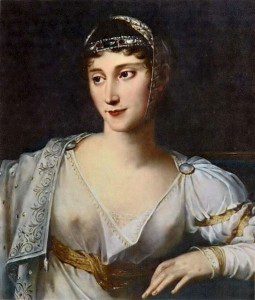
Pauline Bonaparte by Robert Lefèvre, 1806
A spoiled child
Pauline Bonaparte was born in Ajaccio, Corsica on October 20, 1780. The sixth child in the Bonaparte family, she was 11 years younger than Napoleon (see Napoleon’s family tree). Napoleon later said that he and Pauline had been the spoiled children of the family.
Responsibility was not Pauline’s strong suit. She received no formal education and had zero intellectual leanings. Her interests were frivolous. She was a great flirt, and took enormous pride in her appearance, particularly her pale skin and lovely hands and feet. (Napoleon, too, was proud of his delicately shaped hands).
Marriage to General Leclerc
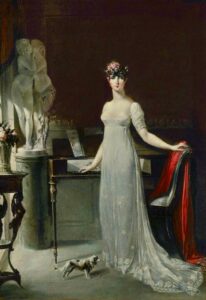
Pauline Bonaparte, circa 1800
Although Pauline wanted to marry someone else, Napoleon arranged for her to wed French officer Victoire Leclerc.
General Bonaparte was working in his room at Milan; Leclerc was on the staff and took advantage of a screen to express his love for Pauline in rather too unceremonious a fashion. General Bonaparte hears a noise, gets up and sees. The marriage was celebrated without losing a moment. (1)
Whether or not this is true, Pauline and Leclerc were married on June 14, 1797. They had a son, Dermide, on April 20, 1798. Napoleon named the boy after a hero in his favourite epic, Ossian.
In 1801, Napoleon appointed Leclerc Governor-General of Saint-Domingue (present-day Haiti) and sent him to put down a rebellion there. Pauline and Dermide went too. Though Pauline was not pleased about being so far from Europe, she made the best of it. She took numerous lovers and started a menagerie of native animals. But it was a miserable stay. The uprising continued. The French were struck with yellow fever. The entire family became ill. Leclerc died on November 2, 1802. Pauline and Dermide returned to France with his remains.
Marriage to Prince Borghese
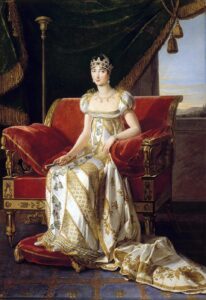
Pauline Bonaparte by Marie-Guillemine Benoist, 1808
Wanting to consolidate ties with French-occupied Italy, Napoleon found Pauline another husband in the form of Prince Camillo Borghese, a wealthy Roman nobleman who turned out to be as shallow and feckless as she was. They married on August 28, 1803. Pauline’s lack of seriousness, apparent disdain for her husband, and hints of infidelity did not go down well with the Romans. Napoleon wrote to her on April 6, 1804:
Madame and Dear Sister, – I have learned with pain that you have not the good sense to conform to the manners and customs of the city of Rome; that you show contempt for the inhabitants, and that your eyes are unceasingly turned towards Paris. Although occupied with vast affairs I nevertheless desire to make known my wishes, and I hope that you will conform to them.
Love your husband and his family, be amiable, accustom yourself to the usages of Rome, and put this in your head, that if you follow bad advice you will no longer be able to count upon me. You may be sure that you will find no support in Paris, and that I shall never receive you there without your husband. If you quarrel with him it will be your fault, and France will be closed to you. You will sacrifice your happiness and my esteem. (2)
Death of Pauline’s son
Pauline’s health continued to trouble her. Borghese suggested that they visit the baths of Pisa. Pauline wanted to bring Dermide, but her husband advised against it. Instead the six-year-old stayed with Borghese’s brother. On August 14, 1804, in Pauline’s absence, the boy died of fever and convulsions. Pauline blamed Borghese for Dermide’s death. She wrote to Napoleon:
The blow has been so severe. Despite summoning all my courage, I find no strength to withstand it. My health is altered visibly and my husband is so alarmed he wants to take me to France, hoping that the change of air, and the pleasure of being near you, will be beneficial… Paris at this moment, where all is rejoicing, is not the place for a soul as sad as mine. In all other circumstances it would have been a great pleasure for me to witness your coronation, but fate pursues me in too cruel a manner to allow me such enjoyment. (3)
In the end Pauline attended Napoleon’s coronation, though she objected to having to hold the train of Josephine’s dress. She disliked both Josephine and Napoleon’s second wife, Marie Louise.
In 1806 Napoleon made Pauline Bonaparte Borghese the Princess and Duchess of Guastalla, in Italy. A wag said, “It is small, no doubt, but even a molehill is too much for the Princess Borghese to administer.” (4) Pauline soon sold the duchy to Parma for six million francs, keeping only the title of Princess.
Borghese commissioned a well-known statue of Pauline by the most famous Italian sculptor of the time, Antonio Canova. She decided to pose nude as Venus Victrix, thus appalling her husband. When someone asked whether she was uncomfortable being naked before the artist, Pauline replied, “Ah, but there was a fire in the room.” (5)

Sculpture of Pauline Bonaparte Borghese as Venus Victrix, by Antonio Canova, 1805-1808
How contemporaries viewed Pauline Bonaparte
The poet Antoine Arnault said Pauline Bonaparte had:
No more deportment than a schoolgirl, talking inconsequentially, laughing at nothing and at everything, she contradicted the most serious people and put out her tongue at her sister-in-law when Josephine wasn’t looking. She nudged my knee when I didn’t pay enough attention to her rattling on and attracted to herself from time to time those ferocious glances with which her brother recalled the most intractable men to order…. [S]he had no principles and was likely to do the right thing only by caprice. (6)
Clemens von Metternich, who got to know Pauline Bonaparte when he was Austria’s ambassador to Paris, wrote:
Pauline was as handsome as it is possible to be; she was in love with herself, and her only occupation was pleasure. Of amiable character and extreme good-nature, Napoleon entertained a different sentiment for her from that with which he regarded the rest of his family. ‘Pauline,’ he has often told me, ‘Pauline never asks me for anything.’ The Princess Borghese, on her side, used to say, ‘I do not care for crowns; if I had wished for one, I should have had it; but I left that taste to my relations.’ She had a veneration for Napoleon which almost amounted to worship. (7)
Later, King Louis XVIII’s friend Madame du Cayla was asked about Pauline by Caroline, Princess of Wales. Du Cayla said:
‘[S]he has as much grace as beauty and is a perfect nymph in size and figure.’ Caroline replied, ‘A nymph, but not quite a vestal?’ ‘Good heaven! Madam,’ returned du Cayla, ‘the world is very wicked: the Princess Pauline has too much merit not to have adorers. She may have distinguished, perhaps, two or three, and twenty or thirty are charged upon her.’ (8)
With Napoleon in exile
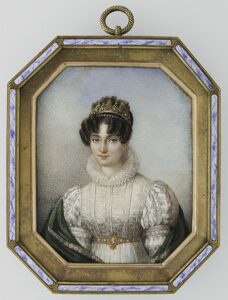
Pauline Bonaparte by Jean-Baptiste Isabey, between 1812 and 1814
Pauline Bonaparte did not have a happy marriage, but – like her brother Louis – she stayed in it at Napoleon’s insistence. Prince Borghese’s wealth and title came in handy. Though the two remained married, they lived separately. When Napoleon was exiled to Elba in 1814, Pauline liquidated her assets and joined her brother there. She was the only one of Napoleon’s siblings to do so. Pauline became the life and soul of Napoleon’s entourage and generously helped him meet his expenses.
Napoleon’s valet Louis Étienne Saint-Denis wrote of Pauline on Elba:
Her person, from what could be seen, had all the beautiful proportions of the Venus di Medici. Nothing was lacking to her but a little youth, for the skin of her face was beginning to be wrinkled, but the few defects which resulted from age disappeared under a slight coating of cosmetic which gave more animation to her pretty features. Her eyes were charming and very lively, her teeth were admirable, and her hands and feet were of the most perfect model. She always dressed most carefully, and in the style of a young girl of eighteen. She always said that she was ill, out of sorts; when she had to go up or down stairs she had herself carried on a square of red velvet having a stick with handles on each side, and yet if she was at a ball she danced like a woman who enjoys very good health. She dined with the Emperor and he liked to tease and poke fun at her. One evening she was so angry with what the Emperor had said to her that she rose from table and went away with tears in her eyes. The irritation did not last long, for the Emperor went up to see her that evening or the next morning and the little feeling of annoyance quickly disappeared. (9)
Last years in Rome
Although Pauline wanted to join Napoleon in France for his “Hundred Days” return to power in 1815, she was detained by the Austrians in Italy. After Napoleon’s defeat at the Battle of Waterloo and subsequent exile to St. Helena, Pauline moved to Rome. This is where we find her in Napoleon in America, along with her mother Letizia, her brothers Louis and Lucien, and her uncle Joseph Fesch.
Pauline had an apartment in the Palazzo Borghese. She also acquired a villa, dubbed the Villa Paolina (Paulina), which is now the French Embassy to the Holy See. She had the building and gardens extensively renovated. The Villa became renowned for Pauline’s hospitality, taste and splendour. She received many distinguished visitors and every week played hostess to a spectacular ball, concert, soiree or play.
In 1820, Elizabeth Patterson Bonaparte (the American ex-wife of Napoleon’s youngest brother, Jerome) wrote to her father regarding Pauline.
She is about thirty-seven years of age, the handsomest woman in Europe of her age, excessively luxurious, consequently expensive in her habits, said to be extremely capricious in her attachments… [S]he occupies a superb palace, receives the homage of all strangers of distinction: pleasure is the sole pursuit in Italy. Her modes of existence are magnificent, although capricious and spoiled by adulation, which in a beautiful woman and a princess is very natural. They say she is good au fond. (10)
Pauline continued to suffer from bouts of ill health. She also fretted about Napoleon and hoped to secure his release or to join him in exile. On July 11, 1821, she wrote to British Prime Minister Lord Liverpool:
The disease to which [Napoleon] is a victim is fatal at St. Helena, and it is in the name of all the members of the Emperor’s family that I demand of the English Government a change of climate for him. If so reasonable a request is met with a refusal it will be equivalent to passing a death sentence, and in this case I ask leave to set out for St. Helena, to go and rejoin the Emperor, in order to minister to him in his last moments. (11)
News had not yet reached Rome that Napoleon had died on May 5th.
Death of Pauline Bonaparte
Pauline’s health worsened. In 1824, she prevailed upon the Pope to help her reconcile with her husband, who had been living in Florence with a mistress. She spent her final months with Borghese, dying on June 9, 1825, at the age of 44. The cause of death was given as a tumor on the stomach. Pauline Bonaparte Borghese is buried at the Basilica of Santa Maria Maggiore in Rome.
You might also enjoy:
10 Interesting Facts about Napoleon’s Family
Napoleon’s Mother, Letizia Bonaparte
Caroline Bonaparte Murat, Napoleon’s Treasonous Sister
Elisa Bonaparte Baciocchi, Napoleon’s Capable Sister
Louis Bonaparte, Napoleon’s Defiant Puppet
Lucien Bonaparte, Napoleon’s Scandalous Brother
Joseph Bonaparte: From King of Spain to New Jersey
Napoleon’s Art-Collecting Uncle, Cardinal Fesch
Napoleon’s Son: Napoleon II, the King of Rome
- Hector Fleischmann, Pauline Bonaparte and Her Lovers (London, 1914), p. 61.
- D.A. Bingham, A Selection from the Letters and Despatches of the First Napoleon, Vol. II (London, 1884), p. 70.
- Flora Fraser, Venus of Empire: The Life of Pauline Bonaparte (London, 2009), p. 121.
- R. F. Delderfield, The Golden Millstones: Napoleon’s Brothers and Sisters (New York, 1964), p. 108.
- M. De Jouy, The Hermit in Italy, Vol. 1 (London, 1825), p. 78.
- Fraser, Venus of Empire, pp. 24-25.
- Richard Metternich, ed., Memoirs of Prince Metternich, 1773-1815, Vol. 1 (New York, 1881), p. 310.
- The Gentleman’s Magazine and Historical Chronicle, Vol. 99 (London, 1829), p. 249.
- Louis Étienne Saint-Denis, Napoleon: From the Tuileries to St. Helena, translated by Frank Hunter Potter, (New York and London, 1922), p. 81.
- Eugène Lemoine Didier, The Life and Letters of Madame Bonaparte (New York, 1879), pp. 55-57.
- Fleischmann, Pauline Bonaparte and Her Lovers, pp. 247-248.

Louis Bonaparte by Charles Howard Hodges, 1809
Napoleon’s younger brother Louis Bonaparte failed to become the great soldier Napoleon had trained him up to be, or even the pliable puppet Napoleon would have settled for. Instead, he became an irritable hypochondriac and literary dilettante who fathered another emperor.
Napoleon’s pupil
Charles and Letizia Bonaparte had eight children (see Napoleon’s family tree), of which Louis Bonaparte was the fifth. Born on September 2, 1778 in Ajaccio, Louis was nine years younger than Napoleon. He was still a baby when the latter left Corsica to start school in France. On his visits home, Napoleon developed a fondness for Louis, so much so that he decided to take charge of the boy’s education.
In January 1791, Napoleon took Louis to France to share his quarters in the barracks at Auxonne. Napoleon acted as the boy’s tutor and provided for him out of his small pay as an artillery lieutenant. A few months later Napoleon wrote to his older brother Joseph:
[Louis] is studying hard and learning to write French. I am teaching him mathematics and geography and he is reading history. He will be an excellent pupil. All the women round here love him. He has quite the proper French manner; when he goes into company he bows with grace and says the correct things with as much gravity and dignity as if he were thirty. I can easily see that he will be the best of the four of us, and at least none of us will have had so fine an education…. He is a charming pupil and works because he likes it rather than from self-respect. (1)
Twelve-year-old Louis was less enthusiastic about the project. Napoleon made him work hard, and Louis missed Corsica. He wrote to Joseph suggesting that he might come home.
Louis Bonaparte the soldier
Napoleon had decided that Louis should become a soldier. In January 1794, as a freshly promoted artillery general, Napoleon attached Louis to his staff with the rank of sub-lieutenant. He continued to provide Louis with instruction, and briefly sent him to the artillery school at Châlons. Napoleon wrote to Joseph:
I miss Louis badly; he was a great help to me… Now he is not here, I can attend only to the most important things. (2)
Napoleon obtained a commission for Louis as a lieutenant in the 4th Artillery Regiment. Louis was assigned to Napoleon’s staff as his aide-de-camp. Louis bore himself bravely in the Italian campaign of 1796-97 and was promoted to the rank of captain.
By 1796, however, Louis was starting to suffer from the bouts of illness (real and imagined) and depression that would plague him for the rest of his life. He did not want to go on the Egyptian campaign, but Napoleon told him he must forget a love affair (which Napoleon ended by marrying the girl off to someone else), stop talking about devoting himself to poetry and literature, and be a soldier.
Louis Bonaparte served as Napoleon’s aide-de-camp in Egypt, leaving early when Napoleon sent him back to France to deliver messages. He took no part in Napoleon’s November 1799 coup d’état in France, but shared in its benefits, receiving a promotion to Chef de Brigade of the 5th Dragoons. This was no benefit to the regiment: Louis declared he was ill, took the waters at Aix, wrote poems in Paris, and avoided the campaign against the Austrians.
Napoleon refused to admit his promising pupil had become a dreamy hypochondriac. In late 1800 he said:
There is no longer any need of our worrying our minds about looking for my successor. I have found one. It is Louis. He has none of the defects of my other brothers, and he has all their good qualities. (3)
Marriage to Hortense
Napoleon and his wife Josephine determined that Louis should marry Josephine’s daughter, Hortense de Beauharnais. Neither Louis nor Hortense felt any attraction for each other, but they could not resist the pressure to wed. They were married on January 4, 1802 and their first son, Napoleon-Charles, was born on October 10 of that year. Louis – who had by now joined his regiment as a preferable alternative to being with Hortense – was promoted to brigadier general the following April. A second son, Napoleon-Louis, was born on October 11, 1804.
When Napoleon became Emperor and it became increasingly clear that he and Josephine could not produce an heir, they proposed to adopt Napoleon-Charles as a means of securing the imperial succession. Both Louis and Hortense objected. Louis had an angry discussion with Napoleon in which he said he refused to see his son set above him, made independent of him, and taught to despise him. He threatened to leave France, taking little Napoleon with him:
[W]e shall see if even you will dare in the face of the world to tear the son away from his father. (4)
King of Holland
In 1806 Napoleon made Louis Bonaparte the King of Holland, intending him to be a figurehead (Holland was given the choice of being annexed outright by France, or of preserving its independence by accepting the rule of one of the imperial princes). The Dutch made the best of the situation and gave Louis a loyal welcome. Louis adopted the country as his own, used the Dutch form of his name (Lodewijk), tried to learn Dutch, and showed uncharacteristic energy in busying himself with plans for his kingdom, which did not coincide with those of his brother. To cite one small example, in response to Louis’s introduction of the rank of marshal, Napoleon wrote:
Do you think a French general of division would take orders from your Dutch marshals? You are aping French organization, though your circumstances are utterly different. Why not begin by establishing the conscription and having a real army? (5)
Hortense disliked living in Holland. Making matters worse, four-year-old Napoleon-Charles died on May 5, 1807. Hortense became ill with grief and returned to France. On April 20, 1808, she gave birth to another son, Louis-Napoleon. Louis – who was intensely jealous of his wife’s friends – did not believe the child was his.
Napoleon bled Holland to finance his military campaigns and stripped it of troops for his planned invasion of Russia. When England attempted to capture Antwerp and Flushing in the Walcheren Campaign of 1809, Louis was in no position to defend his kingdom. Napoleon choked Dutch trade in an attempt to prevent British goods from entering the continent. Struggling hopelessly to preserve a show of independence, Louis drifted into a position of open hostility against Napoleon.
In late 1809 Napoleon told Louis he planned to annex Holland. If he agreed, Louis could either return to live in France as a Prince and Constable of the Empire, or Napoleon would find him another throne in Germany. If he resisted, there would be war and no compensation for his dethronement. Napoleon said:
Holland is nothing but an English colony, more hostile to France than England herself. I mean to eat up Holland! (6)
Louis attempted to negotiate a compromise that would leave him the Dutch crown, but Napoleon was already moving French troops into Holland. Louis did not want to preside over the ruin of the country. On July 1, 1810, he abdicated in favour of five-year-old Napoleon-Louis, who in theory reigned for eight days as Louis II before Napoleon annexed Holland to France.
Self-imposed exile
Louis Bonaparte fled to the baths of Töplitz in Bohemia and wrote to Francis I asking for permission to reside in the Austrian empire. Louis assumed from his French property the title of Count of St. Leu, the name by which he henceforth wished to be known. Though Napoleon insisted that he return to France, Louis settled at Graz, the capital of Styria, south of Vienna. There he became something of a hermit, seeing few people except his doctors, whom he changed from time to time, and with whom he quarreled.
In 1812, as Napoleon was brought to ruin in Russia, Louis printed for circulation among his friends a volume of original poems and translations from Horace, as well as a long-winded romance entitled Marie ou les peines de l’amour (Maria, or the Torments of Love). The heroine was a Dutch girl. His health continued to be poor. For most of that year he suffered from a partial paralysis of his right hand. To write he wore a glove to which a pen was attached. His mother urged him to make peace with Napoleon and return to France, but Louis had no interest in being near his brother or his wife. Though Napoleon would not permit them to divorce, by that time Hortense and Louis had definitely split, and she had taken a lover, the Count de Flahaut (generally thought to be Talleyrand’s illegitimate son), with whom she had illegitimate child, the future Duke of Morny.
In early 1813, in correspondence with Napoleon, Louis commiserated over the disasters of the Grand Armée and suggested he be restored to his kingdom, where he could give loyal support to the Empire. Napoleon wrote back:
Your sons are growing up and have need of their father’s presence. Come back, then, without any further delay, and I shall receive you, not as the brother you offended, but as the brother who educated you. As to your ideas of my affairs, they are incorrect. I have a million men under arms, and two hundred million francs in my treasury to uphold the integrity of the territory of the Confederation of the Rhine and of my allies, and to win success for the plans I have formed for the happiness of my people. Holland is French forever. It is the outcome of our territory, the delta of our rivers; it can be prosperous only with France, and it knows this well. If you remain in France, you are not separated from Holland, but if by separating yourself from Holland you mean renouncing all claim to govern it, you have already by your own act abandoned it when you abdicated. (7)
Louis clung to the hope of restoring his fallen throne and insisted he was still king, whose rights both Napoleon and the coalition against France ought to recognize. When it became clear Austria was going to join the coalition against Napoleon, Louis left Graz for Switzerland. When the allies approached Switzerland, Louis went to France, arriving in Paris on January 1, 1814. When Napoleon left to fight the invaders, Louis bid him goodbye and wished him good fortune in the coming campaign. Napoleon spoke to him kindly and told him he could help Joseph in Paris.
Invalid in Italy
After Napoleon’s abdication, Louis Bonaparte went to Italy. Louis asked Hortense – who remained in Paris with their sons – to send Napoleon-Louis to him, but she refused. Louis began an action in the Paris courts to compel her to give him custody of the boy. In March 1815, the tribunal ruled in his favour, but Hortense took no notice. In 1817, she moved to the estate of Arenenberg in Switzerland. Louis did eventually obtain custody of Napoleon-Louis and devoted much time and thought to his education.
Apart from his perpetually troublesome health and his son, Louis focused on his writing. In 1820 he published Historical Documents and Reflections on the Government of Holland, in three volumes, containing a detailed defence of his administration. The title page features the motto: “Do what you ought. Happen what may.” Writing in the third person about himself, Louis observes:
The fulfilment of his duty was the constant rule of his conduct; his endeavour was to injure no one: and to this first impulse of his heart he sacrificed prosperity, repose, and even reputation…. [H]e always deserved their esteem and the esteem of all good men, and that nothing is more unmerited or unjust than the sort of distrust with which a man is surrounded and watched, who has grown old before his time, who has been sufficiently tried by a life full of difficulties and troubles, whom rank and fortune have only served to render more susceptible, and in whose sentiments, no fears, no vicissitudes, no interests could effect the slightest change. But in troublous times, moderate men are sure to suffer; seeking to avoid excess, they are necessarily exposed to the attacks of all parties; and it may almost be said that there are periods when our country is nothing more than a name, the ties of blood are only prejudices, and duties the portion of dupes! (8)
Not surprisingly, the work angered Napoleon, who was then in exile on St. Helena. In his will, Napoleon wrote:
I pardon Louis for the libel he published in 1820; it is full of false assertions and falsified documents. (9)
In 1821 – the year in which Napoleon in America finds him grumbling up the stairs to his mother’s salon – Louis Bonaparte was living in Rome, where his mother, his sister Pauline and his Uncle Joseph Fesch also lived. Louis had the Palazzo Mancini and a villa at Albano. His brother Lucien lived north of Rome at Canino.
In 1826 Louis left Rome for Florence, where he spent the rest of his life as an invalid. He and Joseph arranged the marriage of Napoleon-Louis to Joseph’s daughter Charlotte. Napoleon-Louis and Louis-Napoleon became involved in plots to drive the Austrians out of Italy and establish a republican government in Rome. On March 17, 1831, while the brothers were fleeing Italy due to a crackdown on revolutionary activity, Napoleon-Louis died, age 26. The official cause was listed as measles, but he may have suffered a bullet wound at Forli.
In 1836 Louis-Napoleon tried to orchestrate a coup against King Louis Philippe of France, but was captured in his initial uprising at Strasbourg. He took refuge in Switzerland, then travelled to London, Brazil and New York before hurrying back to Switzerland to be with Hortense when she died on October 5, 1837. Louis-Napoleon attempted a second coup at Boulogne in 1840. This time he was imprisoned in the fortress of Ham with Charles de Montholon.
Louis Bonaparte had nothing to do with his son’s insurrections. He spent his final, crippled years on a couch or in a wheelchair in the garden of his villa at Florence, or at Leghorn, where he was taken for the sea air. In 1840 he was allowed to visit the Netherlands, where he travelled incognito. Some of the Dutch found out he was their former king, which led to a cheering crowd under his hotel window. Louis was quite moved.
Louis-Napoleon’s imprisonment came as a severe blow to his father. Louis Bonaparte sent letters to France asking for an amnesty for his son, or at least for his temporary release on parole so he could see him. In 1846 a pathetic letter from Louis reporting a marked increase in his infirmities spurred Louis-Napoleon to devise a means of escape from Ham. In May 1846, he slipped out wearing a disguise and fled to London, but found it impossible to obtain a passport for Florence.
Louis Bonaparte died on July 25, 1846, age 68, without seeing his son. He was buried at Saint-Leu-la-Forêt, Île-de-France. Louis-Napoleon became the heir to the Bonaparte dynasty and later ruled France as Napoleon III.
You might also enjoy:
Joseph Bonaparte: From King of Spain to New Jersey
Lucien Bonaparte, Napoleon’s Scandalous Brother
How Pauline Bonaparte Lived for Pleasure
Elisa Bonaparte Baciocchi, Napoleon’s Capable Sister
Napoleon’s Children, Part I (a post about Hortense de Beauharnais and her brother Eugène)
10 Interesting Facts about Napoleon’s Family
Living Descendants of Napoleon and the Bonapartes
- April 4, 1791. John Eldred Howard, ed., Letters and Documents of Napoleon, Vol. 1 (New York, 1961), pp. 25-26.
- Sept. 6, 1795. Ibid., p. 60.
- A. Hilliard Atteridge, Napoleon’s Brothers (London, 1909), p. 72.
- Ibid., p. 105.
- Jan. 2, 1807. Ibid., p. 178.
- Ibid., p. 234.
- Jan. 17, 1813. Ibid., p. 314.
- Louis Bonaparte, Historical Documents and Reflections on the Government of Holland, Vol. I (London, 1820), pp. 8-9.
- D. A. Bingham, ed., A Selection from the Letters and Despatches of the First Napoleon, Vol. 3 (London, 1884), p. 427.

Clemens von Metternich by Thomas Lawrence, 1815
As Austrian foreign minister from 1809 to 1848, Clemens von Metternich was a major player in European affairs for twice as long as Napoleon Bonaparte. A closet admirer of the French Emperor, Metternich was concerned to show himself as the man who had outwitted Napoleon.
Ambassador to France
Clemens (or Klemens) von Metternich was born in Coblenz on May 15, 1773. He came from an old aristocratic family whose members had held many high offices in the Holy Roman Empire. After studying philosophy, law and diplomacy, he followed his father into a diplomatic career.
Metternich was appointed Austrian ambassador to France in 1806, after Austria’s humiliating defeat at the Battle of Austerlitz and considerable loss of territory in the Treaty of Pressburg.
My position was a peculiar one. I was placed at the most prominent post for observing the movement of which the Emperor of the French was the centre. I represented at his court a great monarch, whose kingdom had yielded under the force of circumstances, but which was ready to rise on the first opportunity. I was penetrated with the feeling of danger to my country, if it entered on a new war with France without having more probable chances of success; and I conceived that my task consisted in playing the part of a quiet and impartial spectator – impartial, so far as this might be possible to a man of feeling, at a an epoch when the world was passing through a social transformation…. My impartial attitude gained me the confidence of the most prominent men of different parties, beginning with Napoleon himself. (1)
Metternich saw Napoleon frequently. He wrote in detail about these encounters in his memoirs. In Metternich’s view, France needed discipline and Napoleon was the man to provide it.
There is no more useless labour than to point out that Bonaparte was an excellent man. He is in no wise wicked as this word is understood in common life. He has too much practical understanding for that. He is a very strong man, and in the different setting of another age, he would have become a very great man. (2)
Napoleon was less impressed with Metternich. At one gathering he reportedly unloaded him onto his sister Caroline (who became one of Metternich’s lovers) with the remark:
Entertain this simpleton, we are wanted elsewhere. (3)
When war resumed between France and Austria in early 1809, Metternich was arrested and briefly confined as a reprisal for the Austrian detention of two French diplomats. Napoleon defeated Austria at the Battle of Wagram (July 1809). He took more territory and money from her in the Treaty of Schönbrunn.
It was while Napoleon was at Schönbrunn Palace to negotiate the treaty that a 17-year-old German patriot named Friedrich Staps was caught planning to assassinate him with a kitchen knife – an encounter to which Napoleon refers in Napoleon in America. Staps was arrested and executed.
Metternich as Foreign Minister
In October 1809 Clemens von Metternich became Austria’s foreign minister. His goal was to keep Austria afloat until Napoleon could be thwarted.
I foresaw that neither [Napoleon] nor his undertakings would escape the consequence of rashness and extravagance. The when and the how I could not pretend to determine. Thus my reason pointed out to me the direction I had to take in order not to interfere with the natural development of the situation and to keep open for Austria the chances which the greatest of all powers – the power of circumstances – might offer, sooner or later, under the strong government of its monarch, for the much-threatened prosperity of the Empire. (4)
Metternich attempted to erode Napoleon’s power. He arranged the marriage of Napoleon to Marie Louise, the daughter of Austrian Emperor Francis I. Though Metternich credited the French with initiating the marriage, the French chargé d’affaires in Vienna said it was Metternich who first raised the prospect.
Metternich successfully duped Napoleon into thinking that Austria supported France’s 1812 invasion of Russia. Meanwhile, Austria secretly encouraged a Russian victory (you can read the details of Metternich’s machinations on the Age of the Sage website). After the French retreat, Metternich dropped the cover of neutrality. He led Austria into outright alliance with the coalition against Napoleon. In a famous encounter described on the Past Now website, Metternich and Napoleon met for the last time on June 26, 1813 in Dresden. According to Metternich, he told Napoleon that the latter was finished.

Metternich and Napoleon meeting in Dresden on June 26, 1813
With Austria on their side, Russia, Prussia and Britain were able to overthrow Napoleon in 1814. As a reward for his success, Francis I made Metternich a hereditary Prince of the Austrian Empire. Metternich would have liked to see France governed by a regency under Marie Louise, but the Bourbon restoration proposed by Russia, England and the French diplomat Talleyrand won the day.
The post-Napoleonic world
The victors gathered at the Congress of Vienna, where Clemens von Metternich exercised considerable influence on the proceedings. The Congress was interrupted by Napoleon’s escape from Elba and his subsequent defeat at the Battle of Waterloo.
Metternich believed that Europe’s stability depended on a balance of power among the great powers. His aim (and that of Francis I – the two operated in tandem) was to preserve Austria’s internal peace and external power. Metternich got the allies to endorse Austrian hegemony in central Europe and Italy.
Clemens von Metternich had an aristocratic view of the international order. Kings were meant to govern and people to be governed. He dreaded revolution, liberalism and nationalism. The 1815 peace settlement was designed to contain the restlessness of the masses. Talleyrand quipped that
Austria is the House of Lords of Europe; as long as she remains undissolved, she will keep down the Commons. (5)
Metternich established a system of periodic Congresses, in which the great powers could meet to consider how to suppress revolution. The 1822 Congress of Verona appears as a setting in Napoleon in America. Metternich was a diplomat, not a strategist. He operated a on a day-to-day basis, rather than according to some grand scheme. Underlying all of his negotiations was a belief in the virtue of balance between governments, and between classes within society.
In 1821, Clemens von Metternich became the Austrian Court Chancellor and Chancellor of State (essentially the Austrian Prime Minister). He oversaw the detention of Napoleon’s son, the Duke of Reichstadt. He is said to have forbidden the Duke’s wintering in Naples, which could possibly have cured the young man’s fatal tuberculosis.
Although Metternich’s system was tested by revolutions in 1830-31, he remained the arbiter of continental European politics until March of 1848, when he was compelled to resign owing to a revolution in Vienna. Metternich and his family went into exile. They visited England, where the Duke of Wellington tried to keep Metternich entertained. They then moved to Brussels. In 1851, Clemens von Metternich was allowed to return to Vienna. He died there on June 11, 1859 at the age of 86.
Metternich the man
It is generally thought that Metternich’s finest days were as an adversary to Napoleon. Metternich himself looked fondly back on the Napoleonic period. On August 15, 1820, Napoleon’s birthday, he wrote:
Today is the Feast of the great exile. If he were still on the throne and there was only he in the world, how happy it would make me. (6)
Metternich had a very high opinion of himself, an estimation he did not hesitate to share with others. Descriptions of Metternich by his contemporaries include “pompous pedant,” “infatuated with his own merit,” “a clever manipulator of diplomatic trickery,” and “mad with love, pride, and selfishness.” (7)
Metternich possessed elegance, a ready wit, expensive habits, and a love for parties and salons. Married three times, he also had many lovers, including Napoleon’s sister Caroline, as well as Dorothea von Lieven, the wife of the Russian ambassador to England. Wilhelm von Humboldt complained:
All that interests Metternich is arranging entertainments and tableaux vivants for the Court. He is quite capable of keeping a couple of ambassadors waiting, while he watches his daughter dance and chats amiably with the ladies. Only trifles are serious for him; and serious business he treats as a trifle. (8)
Metternich was very fond of his many children, who reciprocated his affection. He was no stranger to tragedy, losing two of his daughters to tuberculosis in the space of three months in 1820. His first wife and eldest son also died from the disease.
Clemens von Metternich wrote voluminously. His memoirs were edited and published by his son Richard, who served as Austrian ambassador to the court of Napoleon III. They contain considerable self-justification. In the end, Metternich wanted to be seen as the man who masterminded Napoleon’s downfall.
I do not think it was a good inspiration of Napoleon’s which called me to functions which gave me the opportunity of appreciating his excellences, but also the possibility of discovering the faults which at last led him to ruin and freed Europe from the oppression under which it languished. (9)
You might also enjoy:
Francis I of Austria: Napoleon’s Father-in-Law
Marie Louise of Austria, Napoleon’s Second Wife
The Marriage of Napoleon and Marie Louise
Napoleon II: Napoleon’s Son, the King of Rome
Caroline Augusta, Empress of Austria
Adam Albert von Neipperg: Lover of Napoleon’s Wife
Dangers of Walking in Vienna in the 1820s
A 19th-Century Austrian Christmas (includes a description of a party at the Metternichs)
- Richard Metternich, ed., Memoirs of Prince Metternich, 1773-1815, Volume 1 (New York, 1881), p. 46.
- Richard Metternich, ed., Memoirs of Prince Metternich, 1773-1815, Volume 4 (London, 1880), p. 6. He wrote this in 1823, upon reading the Count de Las Cases’s admiring memoirs of Napoleon.
- G.A.C. Sandeman, Metternich (New York, 1911), p. 45.
- George Bruce Malleson, Life of Prince Metternich (Philadelphia, 1888), p. 63.
- M.G. Pallain, ed., The Correspondence of Prince Talleyrand and King Louis XVIII During the Congress of Vienna, Volume 1 (London, 1881), p. xvi.
- Alan Palmer, Metternich (London, 1972), p. 192.
- Tom Holmberg, Review of Metternich: the Autobiography, 1773-1815, on the Napoleon Series website, April 2005, http://www.napoleon-series.org/reviews/biographies/c_metternich.html, accessed January 19, 2014.
- Palmer, Ibid., p. 132.
- Clemens von Metternich, The Autobiography, 1773-1815 (Welwyn Garden City, 2004), p. 67.
Napoleon had only one legitimate child: his son Napoleon François Charles Joseph Bonaparte, also known as the King of Rome, Napoleon II, the Prince of Parma and the Duke of Reichstadt. Napoleon’s son did not hold all of those titles at the same time, and you can tell whether someone was a supporter of Napoleon based on how they referred to the boy after 1815. Napoleon’s son’s nickname was l’Aiglon, or the Eaglet, since one of Napoleon’s symbols was the eagle.

Napoleon II, styled King of Rome, later Duke of Reichstadt, by Thomas Lawrence, 1818-1819
The birth of Napoleon’s son
Napoleon II was the son of Napoleon and his second wife, Marie Louise. He was born, with much difficulty, on March 20, 1811, at the Tuileries Palace in Paris. A salvo of one hundred cannons broke the news to the city of Paris. Cheers erupted at the 22nd retort; 21 shots would have meant the baby was a girl. The balloonist Sophie Blanchard ascended to drop leaflets announcing the birth.

Napoleon presents the King of Rome to the dignitaries of the Empire, by Georges Rouget
The baby’s public baptism at Notre Dame Cathedral in June entailed the most sumptuous procession the Empire had yet produced, to the grumblings of some poverty-stricken Parisians. Napoleon pronounced the boy the King of Rome, a title that had belonged to the House of Habsburg (Marie Louise’s family) until Napoleon broke up the Holy Roman Empire.
A gilded life in France

Napoleon’s son, the King of Rome, by Pierre-Paul Prud’hon
Expensive gifts were lavished on Napoleon’s son (including this cradle, from the city of Paris) and he had a large retinue of servants. Napoleon cherished and fussed over the baby. He enjoyed being with him, in contrast to Marie Louise, who loved her son but seemed afraid to handle him. The valet Saint-Denis recounted:
One day the Emperor took the little king in his arms after his breakfast, as was his custom, caressed him, played some little tricks on him, and said to the Empress, turning toward her, ‘Here! Kiss your son!’ I do not remember now whether the Empress kissed the prince, but she replied in a tone almost of repugnance and disgust, ‘I do not see how anybody can kiss a child.’ The father was very different; he never stopped kissing and caressing his beloved son. (1)
Baron de Méneval wrote:
Whether the Emperor was sitting in his favourite love seat…reading an important report, or whether he was going to his desk…to sign a dispatch, every word of which had to be carefully weighed, his son, either seated on his knees or pressed close to his breath, never left his arms…. Sometimes, dismissing the great thoughts that occupied his mind, he would lie down on the floor beside his cherished son, playing with him like another child. (2)
Napoleon’s idea of play was not necessarily fun for Napoleon junior. As Count de Las Cases recorded:
[Napoleon] would sometimes take his son in his arms, and embrace him with the most ardent demonstrations of paternal love. But most frequently his affection would manifest itself by playing teasing or whimsical tricks. If he met his son in the gardens, for instance, he would throw him down or upset his toys. The child was brought to him every morning at breakfast time, and he then seldom failed to besmear him with everything within his reach on the table. (3)
A biographer of Napoleon II added:
[Napoleon] would place his Majesty the King of Rome in front of a looking-glass and make faces at him. If the little fellow – frightened at the sight – cried, Napoleon would pretend to scold him: ‘How, sir, you are crying! What, a king, and crying! Fie, fie, how shocking!’ Once he thrust his hat on the child’s head so that it came down over his nose and also buckled his sword round him. He laughed heartily when the little feet got into difficulties with the long sword and the baby tottered comically from side to side. (4)
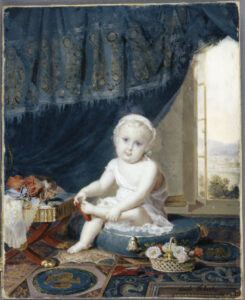
The King of Rome trying to put on a slipper, by Aimée Thibault, circa 1812
The child’s favourite toys were flags, trumpets, drums and a large toy horse with a red velvet saddle. Napoleon’s sister Caroline sent the boy a small caleche driven by two lambs, which he drove along the walks at the Tuileries. Napoleon had him fitted with a Mameluke costume and a uniform of the National Guard. Napoleon planned to build an elaborate palace for the King of Rome, across the river from where the Eiffel Tower now stands.
No throne for Napoleon II
This golden world came crashing down in 1814. The last time little Napoleon saw his father was on January 24 of that year. He was not yet three years old. When Napoleon abdicated on April 4, he named his son the new Emperor of the French. The child in theory gained the title Napoleon II. However, the coalition partners who defeated Napoleon refused to allow Napoleon’s son to become his father’s successor. On April 6, Napoleon was compelled to abdicate unconditionally, renouncing his and his descendants’ rights to the French throne.
Upon Napoleon’s exile to Elba, Marie Louise and their son went to her father’s court in Austria. When Napoleon escaped from Elba and returned to France in 1815, they did not join him. After losing the Battle of Waterloo, Napoleon again abdicated in favour of Napoleon II. The boy was theoretically Emperor of the French from June 22 to July 7, until the Allies entered Paris and restored Louis XVIII to the throne.
From a Frenchman to a German
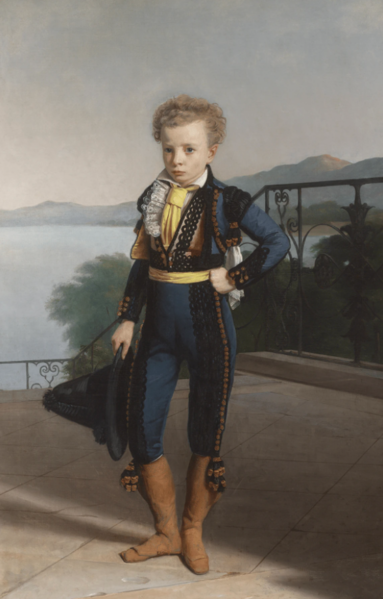
Napoleon II, attributed to Johann Peter Kraft, 1818
The Congress of Vienna made Marie Louise the Duchess of Parma. Her son assumed the title of Prince of Parma, although the Treaty of Paris (1817) made sure that he could never succeed her. He did not accompany her to Parma to live. He was not even allowed to visit her there, for fear that his appearance might revive hope in the adherents of Napoleon’s fallen dynasty. Marie Louise, meanwhile (unbeknownst to her son), started a family with her Austrian lover, Count von Neipperg, and rarely visited Vienna. Napoleon II saw Marie Louise only four times from the time she left for Parma through June of 1826.
Instead, Napoleon’s son was brought up under the watchful eye of his maternal grandfather, Francis I of Austria. Francis decided the boy should be called Franz, after himself, and aimed to turn him into a German. The French caregivers who had come with the child from Paris (including the mother of Napoleon’s valet Louis Marchand) were gradually dismissed. It was thought that they exerted too strong a French influence on him. On leaving, Baron de Méneval asked the boy if he had any messages for his father. The four-year-old said, “You will tell him that I still love him very much.” (5)
Francis had to deal with the very real threats of the boy’s abduction or assassination. It was reported that Napoleon had offered a considerable sum to anyone who would bring his son to him. The Austrians feared the child’s French attendants might disguise him as a girl (he had beautiful blond curls) and spirit him away. Meanwhile, French ultra-royalists proclaimed that a rope should be kept in readiness for the child. They offered a sizeable reward to anyone who would assassinate him.
Francis worked hard to try to prevent Franz from becoming the focus of Bonapartist hopes. This was expected of him by the other courts of Europe, but also reflected Francis’s personal distaste for Napoleon. Franz was not brought up to hate his father. However, he was taught to think of him as a soldier of fortune who had ravaged Europe and brought ruin to his country. Although Franz was naturally curious about Napoleon, he was not given a lot of details about his father’s career until after Napoleon’s death in 1821. Still, even at an early age, Franz managed to glean a fair amount. It is said that one day a visiting Austrian military commander named three illustrious persons as the greatest military leaders of the time. The young Franz listened attentively, then interrupted, “I know a fourth that you haven’t mentioned.” “Who is that?” asked the general. “My father,” Franz shouted, before running away. (6)
The tutor who was tasked with telling Franz that Napoleon had died wrote:
I chose the quiet hour of evening, and saw more tears wept than I should have expected from a child who had never seen or known his father. (7)
As I tried to make clear in my novel, Napoleon in America, Napoleon thought often about his son while in exile. He regretted that neither Marie Louise nor Francis sent any news of the boy. Before leaving Napoleon II’s service, Marchand’s mother sent a lock of the child’s hair to Marchand on St. Helena. Napoleon asked Marchand to place this in his travel kit. Later, when sent a bust of Napoleon II by a sculptor from Livorno, Napoleon said:
For me, this bust is worth more than millions. Put it on the table in the drawing room, so that I may see it every day. (8)
Though lonely, Franz was by no means deprived. He was much loved by the Austrian imperial family, including by Francis and his fourth wife, Caroline Augusta, who treated him as a son. At meals, Franz would sit next to the Emperor. He often visited his grandfather in the latter’s study. In 1818 Francis gave Franz the title of Duke of Reichstadt. He ensured that the boy received a first-rate education, under the supervision of his governor, Maurice Dietrichstein. Though not the most diligent student, Franz was intelligent, inquisitive and lively, and by all accounts charming, when he chose to be. Dietrichstein wrote, “Nothing is more seductive than his face and his talk when he wants to be agreeable.” (9)
Franz became very close to Princess Sophie of Bavaria, the wife of his uncle Franz Karl. Their oldest son, Franz Joseph, became Emperor of Austria, and their second son, Maximilian, became Emperor of Mexico. The assassination of their grandson, Franz Ferdinand, led to World War I. Franz and Sophie spent hours in each other’s company. There were rumours that they had an affair, though this is unlikely.
Franz took an interest in soldiering from a very young age. Once old enough, he began a military career, as detailed by Tom Vance (author of the fascinating non-fiction books, Napoleon in America: Essays in Biography and Popular Culture and Francis Bonaparte, A Military Life: An American View of Napoleon II) in “The Eaglet in Uniform: the Military Service of Napoleon II” on the Napoleon Series website.
The early death of Napoleon II
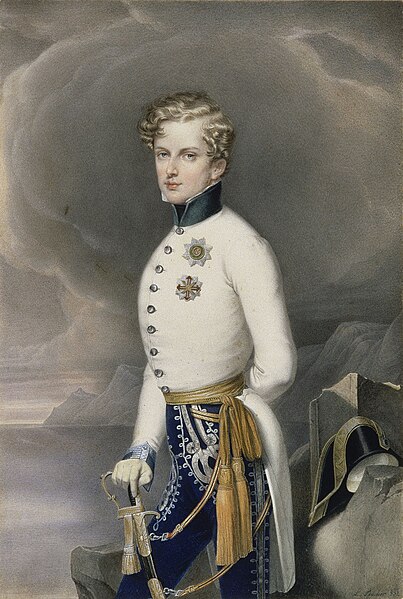
Napoleon II, also known as Franz, Duke of Reichstadt, by Leopold Bucher, 1832
This career, sadly, was cut short when Franz contracted an illness that turned out to be tuberculosis. In his last days he reportedly said:
Must I end so young a life that is useless and without a name? My birth and my death – that is my whole story. (10)
Napoleon II died at Schönbrunn Palace on July 22, 1832, age 21. Marie Louise was with him. Francis was not. See my post about Napoleon’s son’s death. Prompted by the desire to secure souvenirs of their beloved Duke of Reichstadt, the Viennese crowded into his room and carried off whatever they could lay hands on, including his hair.
On December 15, 1940, the remains of Napoleon II were transferred from Vienna to Les Invalides in Paris, as a gift to France from Adolf Hitler. They rested for a while beside those of Napoleon, then were moved to the lower church. Napoleon II’s heart and intestines remained in Vienna. They reside respectively in urns at the Habsburg Heart Crypt (Hofburg Palace) and the Ducal Crypt (St. Stephen’s Cathedral).
For information about Napoleon’s stepchildren, see my post about Eugène and Hortense de Beauharnais. If you are interested in his illegitimate children, see my post about Léon Denuelle and Alexandre Walewski.
You might also enjoy:
The Perilous Birth of the King of Rome
Anecdotes of Napoleon’s Son, the King of Rome
The Death of Napoleon’s Son, the Duke of Reichstadt
Maurice Dietrichstein, Governor of Napoleon’s Son
The Palace of the King of Rome
A Tomb for Napoleon’s Son in Canada
Marie Louise of Austria, Napoleon’s Second Wife
Living Descendants of Napoleon and the Bonapartes
- Louis Étienne Saint-Denis, Napoleon from the Tuileries to St. Helena; Personal Recollections of the Emperor’s Second Mamluke and Valet, Louis Etienne St. Denis (known as Ali), translated by Frank Hunter Potter (New York and London, 1922), p. 6.
- Claude François de Méneval, Napoléon et Marie-Louise, Vol. 1 (Paris, 1844), pp. 446-47.
- Emmanuel Auguste Dieudonné de Las Cases, Memoirs of the Life, Exile, and Conversations of the Emperor Napoleon, Vol. 3 (New York, 1855), pp. 316-17.
- Edward de Wertheimer, The Duke of Reichstadt (London, 1906), p. 47.
- Claude François de Méneval, Napoléon et Marie-Louise, Vol. 3 (Paris, 1845), p. 205.
- Guillaume-Isidore de Montbel, Le Duc de Reichstadt (Paris, 1836), p. 122.
- Wertheimer, Ibid., p. 286.
- Louis-Joseph Marchand (Proctor Jones, ed.), In Napoleon’s Shadow: Being the First English Language Edition of the Complete Memoirs of Louis-Joseph Marchand, Valet and Friend of the Emperor, 1811-1821 (San Francisco, 1998), p. 495.
- Dorothy Julia Baynes [Dormer Creston], In Search of Two Characters: Some Intimate Aspects of Napoleon and His Son (London, 1945), p. 323.
- Octave Aubry, Napoleon II: The King of Rome, translated by Elisabeth Abbott (London, 1933), p. 256.

Francis I of Austria (Francis II, Holy Roman Emperor)
When you marry into the Austrian royal family, you might expect some benefits from the situation – say, perhaps, that Austria will not attack you. But no such luck, as Napoleon discovered in 1813, when Francis I of Austria joined the leaders of Great Britain, Russia, Prussia and Sweden in their coalition against France. But then Napoleon had a history of fighting Austria, and had already divested his father-in-law of a good portion of his kingdom.
Francis I of Austria started out as Emperor Francis II (Franz II), the head of the Habsburg monarchy and ruler of the Holy Roman Empire. He led Austria into the French Revolutionary Wars, and later joined the Second and Third Coalitions against Napoleon. Napoleon defeated the Third Coalition at the Battle of Austerlitz in 1805. He then reorganized a chunk of Francis’s territory into the French-controlled Confederation of the Rhine. With little left of the Holy Roman Empire, Francis dissolved it and was reduced to being Emperor Francis I of Austria. As such, he continued to oppose Napoleonic France, losing more battles and more territory.
Marie Louise marries the enemy
In 1809 Napoleon decided to divorce his first wife, Josephine, because she was incapable of providing him with an heir. In casting about for a suitable replacement from one of Europe’s royal houses, he settled on Francis I’s 18-year-old eldest child, Marie Louise. On January 10, 1810, the date of Napoleon’s divorce, Marie Louise wrote to a friend:
I see talk of Napoleon’s separation from his wife, I think I even hear that I am named to replace her, but in that one is mistaken, because Napoleon is too afraid of being refused and too intent on doing us more harm to make such a demand, and Papa is too good to force me on a point of such importance. (1)
She was mistaken. According to Austrian Foreign Minister Clemens von Metternich, he and Francis saw in the marriage the prospect of “an interval of quiet for the recruiting of our forces.” (2) Francis asked Metternich to ask Marie Louise what she wanted. Marie Louise replied, “What does my father wish?” When told that her father wanted to know what she wished, Marie Louise said,
I wish only what it is my duty to wish…. Ask my father to consult his duty as a ruler, and to subordinate to that any interests connected with my person.
When he heard this, Francis said,
I am not surprised at what you tell me from my daughter; I know she is too good for me to expect her to do otherwise…. My consent to the marriage would secure to the Empire some years of political peace, which I can devote to the healing of its wounds. All my powers are devoted to the welfare of my people. I cannot, therefore, hesitate in my decision. Send a courier to Paris and say that I accept the offer for the hand of my daughter, but with the express reservation that on neither side shall any condition be attached to it; there are sacrifices which must not be contaminated with anything approaching to a bargain. (3)
Having never met each other, Napoleon and Marie Louise were married by proxy in Vienna on March 11, 1810. This was followed by civil and religious ceremonies in Paris on April 1 and 2. For details about the weddings, see my article on the marriage of Napoleon and Marie Louise.
Francis was surprised that Marie Louise seemed happy with Napoleon. He said,
Whatever she says, I cannot stomach that creature. (4)
More war against Napoleon
Things were cozy for a few years. Marie Louise produced a son, Napoleon François, born on March 20, 1811. Napoleon doted on the boy and Francis grew very fond of his grandson. But strategic interests reigned supreme. In 1813, Austria joined Britain, Russia and Prussia and other members of the Sixth Coalition in the war against Napoleon. When Napoleon was exiled to Elba in 1814, Marie Louise hoped that she and her son could join him. Francis refused, citing his need to accede to the wishes of the Allied sovereigns. Meanwhile Napoleon had sent Marie Louise to Vienna, hoping she could prevail upon her father to secure leniency for him. Instead Francis placed her in the care of Count von Neipperg. Neipperg seduced Marie Louise (see my article about that here). When Napoleon escaped from Elba, Marie Louise wrote to the Congress of Vienna protesting that she was in no way complicit with her husband. She placed herself under the protection of France’s enemies.
In recognition of the role Austria played in Napoleon’s defeat, Francis, represented by Metternich, presided over the Congress of Vienna. This meeting of European leaders was convened to restore traditional rulers to the lands Napoleon had conquered. It aimed at achieving long-term peace through the creation of a balance of power in Europe. With the rulers of Russia and Prussia, Francis I of Austria established the Holy Alliance. The ostensible aim was to instill Christian values in European political life. In practice the Alliance opposed democratic, revolutionary and secularist tendencies across the continent.
Francis’s family
Francis was born on February 12, 1768, in Florence, the eldest son of Leopold, Grand Duke of Tuscany and future Holy Roman Emperor, and Archduchess Maria Louisa of Spain. He had 15 siblings. Marie Antoinette was his father’s younger sister. This made Francis a cousin of the Duchess of Angoulême. In 1784, Francis joined his uncle, Emperor Joseph II, in Vienna. With no surviving children, Joseph knew that Francis would eventually inherit the imperial throne. He took charge of Francis’s development, providing him with a strict routine and a disciplined education. Francis worked diligently and studied hard. Sent to join an army regiment in Hungary, he enjoyed the military routine and became a seasoned soldier.
In 1788, Joseph II arranged Francis’s marriage to Duchess Elisabeth of Württemberg. She died in childbirth in 1790. The baby died 16 months later. Francis was married again, this time to his cousin, Maria Theresa of Naples. She bore him 12 children, of whom 7 reached adulthood. After her death in 1808, Francis married another cousin, Maria Ludovika of Austria-Este, who died childless in 1815. The following year Francis married Caroline Augusta of Bavaria. The English diplomat Frederick Lamb said she was “ugly, clever and amiable, and as the Emperor expresses it: ‘She can stand a push, the other was nothing but air.’” (5)
Francis was a devoted family man and an affectionate father and grandfather. A key point in the “Political Testament” he left for his son and heir Ferdinand was:
Preserve unity in the family and regard it as one of the highest goods. (6)
Francis’s will also insisted that Ferdinand, once he became emperor, had to consult Archduke Louis – Francis’s brother and Ferdinand’s uncle – on every aspect of internal policy. On foreign policy, he had to consult Metternich. Probably because of his parents’ genetic closeness – double first cousins – Ferdinand suffered from a variety of debilitating conditions, including hydrocephalus and epilepsy. The Mad Monarchist has done a touching post on him.
Francis as monarch
Francis inherited the imperial throne on March 1, 1792, at the age of 24. As a monarch, Francis was an unwavering absolutist. He believed his authority was granted by God. He opposed the ideology behind the French Revolution. He feared calls for liberty and equality, and strongly opposed the influence of revolutionary thought in Austria. European liberals deemed him a tyrant.
To govern his vast, multi-ethnic lands, Francis relied on extreme centralization and the most extensive bureaucracy in Europe. One of Metternich’s colleagues said “administration has taken the place of government.” (7) The press was heavily censored. Secret police were rife. Foreigners, intellectuals and even members of Francis’s own family were spied upon. Cultural life was overshadowed by political control. Francis was by nature suspicious and did not delegate much. He conducted policy on the basis of his own decisions, consulting with whomever he thought necessary. He believed that all his subjects needed was material well-being and good laws.
A blockhead vs. strength of character
Napoleon said Francis I of Austria was “a child governed by his ministers, a weak and false prince, and a good and religious man, but a blockhead occupied only with botany and gardening.” (8)
Metternich speaks of his “immovable strength of character.”
[R]ipened by nature in the school of experience, ever dispassionate in his conclusions, never withholding a calm judgment, always acknowledged and respected the reasons for and against everything: holding his army well in hand, this monarch was always raised above inferior ends and the play of passion. (9)
Francis was unimaginative, unpretentious and commonsensical, with a sardonic sense of humour. He had simple tastes and preferred a quiet life. He rode in an old-fashioned green calèche. He dressed in a shabby brown coat and hat. He had a conservatory full of plants, where he liked to garden. He was fond of making sealing wax and cooking toffee on the royal stove. He greeted his subjects affably in a broad Viennese dialect. Though Metternich smoothed his utterances in print, Francis suffered from verbal tics, of which I have tried to capture a slight sense in Napoleon in America.
Francis I of Austria died on March 2, 1835 of a sudden fever. He was 67 years old. His tomb is in the Habsburg Imperial Crypt in Vienna.
You might also enjoy:
Clemens von Metternich: The man who outwitted Napoleon?
Marie Louise of Austria, Napoleon’s Second Wife
The Marriage of Napoleon and Marie Louise
Napoleon II: Napoleon’s Son, the King of Rome
Adam Albert von Neipperg: Lover of Napoleon’s Wife
Caroline Augusta, Empress of Austria
Archduke Franz Karl of Austria
Of Sealing Wax and Emperor Francis
Visiting the Habsburg Imperial Crypt
Dangers of Walking in Vienna in the 1820s
- Correspondance de Marie Louise, 1799-1847 (Vienna, 1887), p. 141.
- Dorothy Julia Baynes (Dormer Creston), In Search of Two Characters: Some Intimate Aspects of Napoleon and His Son (London, 1945), p. 151.
- Richard Metternich, ed., Memoirs of Prince Metternich, 1773-1815, Vol. 1 (New York, 1881), pp. 73-74.
- Alan Palmer, Metternich (London, 1972), p. 86.
- http://en.wikipedia.org/wiki/Caroline_Augusta_of_Bavaria Accessed Oct. 31, 2014.
- Andrew Wheatcroft, The Habsburgs: Embodying Empire (London, 1996), p. 254.
- A.J.P. Taylor, The Habsburg Monarchy 1809-1918 (London, 1990), p. 44.
- Edith E. Cuthell, An Imperial Victim: Marie Louise, Vol. II (London, 1912), p. 15.
- Memoirs of Prince Metternich, p. 127.
The Duke and Duchess of Angoulême, each the child of a French king, were married cousins who led lives of disappointment, exile and sorrow.

Louis Antoine, Duke of Angoulême
Louis Antoine, Duke of Angoulême, was born on August 6, 1775, the son of the Count of Artois (who later became King Charles X) and Marie Thérèse of Savoy. He is less well known than his cousin and wife, Marie-Thérèse, Duchess of Angoulême, who was born at Versailles on December 19, 1778. She was the eldest child of King Louis XVI and Marie Antoinette, and the only one of their offspring to survive the French Revolution.

Marie Thérèse, Duchess of Angoulême, by Antoine-Jean Gros, 1817
Marie-Thérèse (or Madame Royale, as she was then known) was imprisoned in the Temple, the remains of a medieval fortress in Paris, from August 13, 1792 to December 18, 1795, the eve of her seventeenth birthday. During this time her parents were guillotined and her younger brother – imprisoned in a separate room and neglected – died of illness. She herself suffered terribly.

Louis Antoine d’Artois, Duke of Angoulême, by Joseph Boze, 1785
On her release from prison, Marie-Thérèse was taken to Vienna (her mother was a member of the Austrian royal family). She then joined her uncle Louis XVIII in exile in Mitau, in present-day Latvia, where he was living as a guest of the Russian Tsar. Louis XVIII wanted Marie-Thérèse to marry the Duke of Angoulême. She readily agreed, as it was a project her parents had favoured, although she could not remember ever having seen her cousin. They were married on June 10, 1799 at Jelgava Palace.

Marie-Thérèse of France (Madame Royale), the future Duchess of Angoulême, by Adolf Ulrik Wertmüller, 1786
An unhappy couple
In Napoleon in America, King Louis XVIII at one point looks to his nephew, the Duke of Angoulême, for support, but is disappointed in the result. That about sums up the poor Duke’s life. He lacked his father’s charm and manners, and had a sickly appearance. Even a partisan of the royal family described him as “small, ugly and awkwardly built. He has very little brains and speaks in an uneducated manner.” (1)
The Duke of Angoulême was widely thought to be impotent or homosexual. There were rumours, probably unfounded, that the Duke ill-treated the Duchess. In public they were courteous to each other. Marshal Macdonald wrote:
[T]hose…who had opportunity for observation, noticed that the young couple were very affectionate and treated each other with the greatest deference and regard. (2)
In any case, the Duchess of Angoulême was already sorrowful. She said it would have been better to share in her family’s deaths than to live “condemned to cry.” (3) In fact, she maintained a strict reserve and didn’t cry often, at least not in front of others. Louis XVIII wrote to the Count of Artois after their niece’s arrival at Mitau, “When she speaks of her misfortunes, tears do not come easily, from habit, as she contained herself to not give her jailers the barbaric pleasure of seeing her cry.” (4)
In 1807-08, the Duke and Duchess of Angoulême moved to Britain with Louis XVIII and the Count of Artois. They remained there until 1814. The Duke of Angoulême had joined the French émigré army in 1792. He led an unsuccessful royalist uprising in the Vendée and commanded a regiment of Bavarian cavalry in the battle of Hohenlinden in 1800. In March 1814, when it looked like Napoleon was going to be defeated, the Duke of Angoulême sailed to Bordeaux, which had already declared its support for Louis XVIII. The Duchess accompanied Louis XVIII to France in April, after the latter was proclaimed king.
The only man of her family
When Napoleon escaped from Elba and returned to France in March 1815, the Duke of Angoulême led the French army in the southern Rhône valley. Abandoned by most of his officers, he had to surrender to General Grouchy. Napoleon spared the Duke’s life by allowing him to be conducted to Spain. Meanwhile the Duchess of Angoulême was trying to rally the troops in Bordeaux. They agreed to defend her, but would not oppose Napoleon’s men. She finally agreed to leave on an English ship once she realized the royalist cause was lost. Napoleon, when told of her courage, said, “She is the only man of her family.” (5) The Duchess of Angoulême called Napoleon “the usurper” and “the criminal.”

Arrival of the Duke and Duchess of Angoulême in Bordeaux, 1815, by Boccia
Marie-Thérèse sailed to England, landing at Plymouth on April 19, 1815. From there she went to London. At the end of May, she briefly joined Louis XVIII in Ghent, before returning to London. Meanwhile, her husband remained in Spain.
The Duke and Duchess of Angoulême returned to France after Napoleon’s defeat at the Battle of Waterloo. The Duchess was tenderly attached to Louis XVIII, although she frequently disagreed with him. The Duke was more in sympathy with the king. To his family’s great pride, in 1823 Angoulême led a French invasion of Spain to restore a Bourbon cousin, Ferdinand VII, to the Spanish throne. (That part of Napoleon in America is not fiction – read about the invasion here.)

Reunion of the Duke and Duchess of Angoulême after his return from Spain in 1823, by Étienne Barthélémy Garnier
In 1824, Louis XVIII died and the Count of Artois became King Charles X of France. The Duke of Angoulême became heir to the French throne (the Dauphin) and his wife became the Dauphine – the last one France ever had.
Neither had deep intellectual resources. The Duchess did not care for clever people, the Duke was very shy, and both were extremely pious. The Duchess developed a reputation for haughtiness. Chateaubriand wrote of her refusal to speak to him:
Silence from the orphan of the Temple can never be deemed ingratitude. Heaven has a right to the earth’s worship and owes nothing to anyone. (6)
The Duchess of Angoulême liked simplicity in her rooms and her dress. She banished from court the luxurious clothing of the Napoleonic period, preferring her ladies to wear simple white dresses. She dressed herself and did her own toilette, as she had done in prison.
King for 20 minutes
When Charles X lost his throne in the July Revolution of 1830, he abdicated in favour of the Duke of Angoulême. The Duke reigned for 20 minutes as King Louis XIX of France before abdicating in favour of his nephew Henri, the Duke of Bordeaux. Unfortunately for the Bourbons, the Chamber of Deputies pronounced the Duke of Orléans (Louis Philippe) their new king. Yet again the royal family went into exile. They lived first in Edinburgh, and then at Prague Castle, where they maintained the etiquette of the Paris court on a greatly reduced scale.
When Chateaubriand saw the Duke of Angoulême in 1833, he wrote:
I found him looking older and thinner. He was dressed in a shabby blue coat, buttoned high to the throat; it was too big for him and looked as if it had been bought at a second-hand shop; I felt terribly sorry for the poor Prince.
The Duke seemed ashamed of his lack of action during the July Revolution. He reportedly said, “There is no mouse-hole small enough to hide me,” and “[l]et no one speak of me; let no one be concerned about me; I am nothing; I wish to be nothing.” (7)
Chateaubriand continued to Carlsbad, where the Duchess of Angoulême was taking the waters. This time she was happy to speak with him. Of his meal with her, he wrote:
The dinner was so meagre and ill-cooked that I rose from the table dying of hunger. It was served in her own salon, for she had no dining-room.
After dinner, she sat looking out the window, commenting on the passers-by.
It interested me to see Marie-Thérèse, the Princess of thrones and scaffolds, come down from her lofty position to gossip like other women about the habits of the neighbours; I observed her with a kind of philosophic tenderness. (8)
Leniency towards each other’s failings
The Duke and Duchess of Angoulême both remained greatly attached to Charles X. They nursed him through his final illness and death in 1836. The couple lived an austere and monotonous life as trusted friends who shared each other’s sadness. They detached themselves from any political activity and turned increasingly to mysticism. The Marquis de Villeneuve observed:
[T]he couple had become august not only by sorrow nobly borne, but also by the strength of the bond between them, which included absolute leniency towards each other’s failings. (9)
The Duke of Angoulême died of sepsis on June 3, 1844 at the age of 68. After his death, the Duchess settled outside Vienna at Schloss Frohsdorf, where Napoleon’s sister Caroline Murat had earlier lived in exile. Marie-Thérèse spent her days walking, reading, sewing and praying. Her niece and nephew, Louise and Henri, on whom she doted, joined her there.
The Duchess of Angoulême died of pneumonia on October 19, 1851. She was buried next to her husband in the Bourbon crypt at the Kostanjevica Monastery in Slovenia. Two months later, Napoleon’s nephew, Louis-Napoléon Bonaparte, staged a coup d’état in France. He went on to rule as Napoleon III.
You might also enjoy:
The Count of Artois, Charles X of France
Louise Marie Thérèse d’Artois: Mademoiselle of France
Henri d’Artois, Unready to be King
When the King of France Lived in England
François d’Orléans, Prince of Joinville: Artist & Sailor
- Joseph Turquan, Madame Royale: The Last Dauphine, edited and translated by Lady Theodora Davidson (London, 1910), p. 115.
- Ibid., p. 161.
- Susan Nagel, Marie-Thérèse, Child of Terror (New York, 2008), p. 157.
- Ibid., p. 211.
- George Muir Bussey, History of Napoleon, Vol. 2 (London, 1840), p. 516.
- François-René de Chateaubriand, Mémoires d’outre-tombe, Vol. IV (Paris, 1851), p. 161.
- François-René de Chateaubriand, Mémoires d’outre-tombe, New Edition, Vol. VI (Paris, 1910), p. 72.
- Ibid., pp. 144-145.
- Turquan, Madame Royale, p. 332.
Charles Philippe, the Count of Artois – later Charles X of France – was a wastrel and a reactionary whose behaviour helped to discredit French royalty. As is evident in Napoleon in America, he became a royal pain in the side of his brother, Louis XVIII.

Charles X of France (the Count of Artois) by Robert Lefèvre, 1826
Not expected to be king
Artois was born on October 9, 1757 at the Palace of Versailles. He was a member of the House of Bourbon and the grandson of King Louis XV. With his father and three older brothers ahead of him in line for the throne, no one expected Artois would ever be king. He received no formal education and led an idle and undisciplined life at court. When his grandfather died in 1774 (his father and eldest brother having already passed away), Artois’s brother became King Louis XVI.
The Don Juan of Versailles
The Count of Artois was said to be handsome, charming, generous and impulsive. He was a horseman, a gambler and a playboy – the “Don Juan” of Versailles. (1) Artois was a close friend of Louis XVI’s wife, Marie Antoinette. The two of them indulged in expensive frivolities, like the construction of the Château de Bagatelle. Their activities highlighted the gulf between the royal family and ordinary French people, and added to the unrest that sparked the French Revolution.
In November 1773 Artois married Marie Thérèse of Savoy (the sister of Louis XVIII’s wife). They had two sons: Louis Antoine, the Duke of Angoulême and Charles Ferdinand, the Duke of Berry. The marriage was a dynastic alliance rather than a love match. You can read about Artois’s true love for the married Louise de Polastron on Elena Maria Vidal’s Tea at Trianon blog.
After the storming of the Bastille in July 1789, the Count of Artois and his family left France. He lived briefly in Italy and in Germany before settling in England in 1792. The Prince Regent (later George IV) gave him a generous allowance. Artois lived in London and Edinburgh with Louise. His wife remained on the continent (she died in Austria in 1805). When Louise died of tuberculosis in 1804, Artois reportedly swore a vow of perpetual chastity and became devoted to religion. Nonetheless, it sounds like he retained some of his earlier spirit. In October 1811, Countess Harriet Granville wrote from her estate of Trentham in Staffordshire: “Monsieur forgets we are all beyond our teens and plays at bo-peep, etc. with Lady Stafford and me.” (2)

The Count of Artois, by Henri-Pierre Danloux, 1798
Head of the ultra-royalists
In January 1814, the Count of Artois went to southern France to join the coalition against Napoleon. When the latter abdicated in early April, Artois acted as Lieutenant General of France until Louis XVIII could arrive from England. The Bourbons made clumsy and unpopular attempts to reverse the results of the French Revolution. When Napoleon escaped from Elba and landed in France in March 1815, he was welcomed by the French people. The royal family was again compelled to flee. They were restored to the throne a second time after Napoleon’s defeat at Waterloo in June 1815.
During the Second Restoration Artois emerged as the leader of the ultra-royalists, the party of extreme reaction. He said he “would rather be a woodcutter than reign in the fashion of the King of England.” (3) He disliked Louis XVIII’s Charter and despised the Chambers of Deputies and Peers. French diplomat Pierre de Blacas wrote in 1815:
The Count of Artois has retained from his youth only the lack of character and the feebleness of his spirit; he has ceased to be lovable and light, brilliant and polite. The sworn enemy of liberal ideas, devout and ambitious, this prince burns with desire to become king, but king the way his forefathers were, that is to say, without a constitutional charter. (4)
After the Duke of Berry was assassinated by a fanatic in 1820, the ultra-royalists gained the upper hand. Artois had earlier set up a network of agents and collaborators across France, which functioned as a parallel government to that of Louis XVIII. The king was weary and ultimately gave up trying to resist his brother.
Artois as Charles X of France

Charles X of France in his coronation robes, by François Gérard, 1825
When Louis XVIII died on September 16, 1824, the Count of Artois became King Charles X of France. At first it appeared that power had softened him. He set out to charm his people. For a while he succeeded, by loosening press censorship among other things. He held a coronation at the cathedral of Reims on May 29, 1825.
Like Louis XVIII, Charles X faced the difficult task of reconciling the old nobility with the reality that many Frenchmen had benefited from the changes brought about by the Revolution and Napoleon. He was less adroit than his brother, however. Charles X believed that nostalgia for the ancien régime was more widespread than it actually was. Determined to crush disloyalty and irreligion, he passed laws that strengthened the power of the nobility and the clergy.
In 1830, following the victory of the opposition in parliamentary elections, Charles X suspended the constitution. He dissolved the Chamber of Deputies, censored the press, restricted suffrage and called for new elections. This provoked the so-called July Revolution, a Parisian uprising against the crown. Charles was forced to abdicate on August 2. He abdicated in favour of his son, the Duke of Angoulême, who promptly abdicated in favour of Henri d’Artois, the son of the Duke of Berry. Charles X went to England. However the Duke of Orléans, a Bourbon cousin, was chosen as “King of the French” and reigned as King Louis Philippe.
Charles settled in Prague. He then moved to what is now Slovenia. Charles X of France died of cholera on November 6, 1836, at the age of 79. His tomb is in the Bourbon crypt of the Church of the Annunciation of Mary, in the Kostanjevica (Castagnevizza) Monastery in Nova Gorica, Slovenia.
You might also enjoy:
The Duke and Duchess of Angoulême
Louise Marie Thérèse d’Artois: Mademoiselle of France
Henri d’Artois, Unready to be King
Watching French Royals Eat: The Grand Couvert
Watching French Kings Rise: The Grand Lever
What did the Duke of Wellington think of Louis XVIII? (and Charles X of France)
When the King of France Lived in England
- D.W. Brogan, The French Nation from Napoleon to Pétain, 1814-1940 (New York, 1957), p. 11.
- F. Leveson Gower, ed., Letters of Harriet Countess Granville, Vol. 1 (London, 1894), p. 21.
- Alfred Cobban, A History of Modern France, Vol. 2, 1799-1871, 2nd edition (Harmondsworth, 1965), p. 73.
- Mémoires et Souvenirs du Général Maximien Lamarque, Vol. II (Paris, 1835), p. 39.
Louis XVIII le Desiré (the Desired), King of France, was born in the wrong place and time. He had to flee his country as his brother and sister-in-law were guillotined in the French Revolution. He then spent years shuffling around Europe while Napoleon ran France. Louis XVIII barely had time to warm the throne before he again had to flee Paris, after the humiliation of watching his army desert him for Napoleon.

Louis XVIII of France, by Robert Lefèvre, 1822
When writing Napoleon in America, I must confess to developing a fondness for Louis XVIII. I put this down to a combination of feeling sorry for the guy and an admiration for his stoicism and his ability to keep a sense of humour in lousy circumstances. People generally made fun of him. He was said to be “as big as a barrel” (1). Playing on the French pronunciation of his title – Parisians called him “Louis des huîtres” (Oyster Louis). (2)
An unexpected king
Louis XVIII never expected to become king. He was born Louis Stanislas Xavier, a member of France’s ruling House of Bourbon, on November 17, 1755 at the Palace of Versailles. He was given the title of Count of Provence. His grandfather, Louis XV, was king of France. Louis’s father died in 1765, so when Louis XV died in 1774, Louis’s older brother became King Louis XVI.
Revolution and exile

The Count of Provence (future Louis XVIII), by Adélaïde Labille-Guiard, 1788
During the French Revolution, Louis and his wife, Marie Joséphine of Savoy, fled to the Austrian Netherlands. When Louis XVI was executed in January 1793, Louis (the Count of Provence) declared himself regent for his nephew, Louis Charles. In the eyes of the royalists, this young son of Louis XVI and Marie Antoinette was now Louis XVII. In practice the boy was a prisoner in the Temple. When he died there at age 10 in 1795, the Count of Provence took the title Louis XVIII.
In exile, Louis XVIII moved with his entourage through Germany, Italy, Russia and Prussia before winding up in England in 1807. He stayed briefly at Gosfield Hall in Essex, and then settled into Hartwell House in Buckinghamshire. His niece, the Duchess of Angoulême (Louis XVI’s daughter), and her husband, the Duke of Angoulême (son of Louis’s younger brother, the Count of Artois), accompanied him. The Count of Artois also lived in England, but preferred to stay in London. The Prince Regent (later George IV) was generous to the exiled Bourbons, granting them large allowances.
In 1800, Louis XVIII wrote to Napoleon (then First Consul of France), urging him to restore the Bourbons to the throne. Not surprisingly, Napoleon refused.
Louis XVIII’s wife Marie Joséphine died in 1810. Though they were said not to be close (you can read about one well-known spat on the This is Versailles blog), he did miss her. In early 1811, he wrote:
I am already at the point where I believe I shall remain – ‘no more tears – no more pangs of sorrow,’ but a sincere regret, a void in my life which I feel a hundred times a day. A thought occurs to me – sad, or gay, or indifferent – no matter, a recollection of something old, or an emotion at something new; I find myself saying mechanically I must tell HER this, and then I recollect my loss, the illusion vanishes, and I say to myself, the day of those soft intercourses is gone for ever. All this does not hinder my sleeping and eating, nor taking part in the conversation, nor even laughing when the occasion occurs; but the sad thought that she is gone forever mixes itself with everything, and, like a drop of wormwood in food or drink, embitters the flavour without entirely destroying it. (3)
Louis XVIII’s first restoration
After the allied troops entered Paris in 1814, forcing Napoleon’s abdication, Louis XVIII assumed the throne of France. On the balcony of the Tuileries Palace Pavilion d’Horloge, in response to the acclamations of the crowd, Louis pressed the Count of Artois and the Duchess of Angoulême theatrically to his heart. During these embraces he grumbled: “Scoundrels! Jacobins! Brutes!” The Duchess burst out laughing, which caused the people to cheer even more. (4)
Regarding the Tuileries Palace, Louis told Clemens von Metternich, the Austrian Foreign Minister:
It must be allowed that Napoleon was a very good tenant; he made everything most comfortable; he has arranged everything excellently for me. (5)
The occupying armies demanded that Louis rule not as an absolute monarch like his forebears, but as a constitutional monarch. Louis viewed the royal authority as derived from God rather than from a contract between king and people. He thus made the constitution (the Charte or Charter of 1814) a free grant of the King, instead of an agreement between him and his subjects. This gave him more power than the British king. Still, the Charter included many progressive provisions and established a legislature composed of the Chamber of Deputies and the Chamber of Peers.
When Napoleon escaped from Elba and returned to France in March 1815, Louis was not particularly worried. However, there were still many Bonapartists in the French army and they quickly defected to their Emperor. Louis again fled Paris for the Netherlands. After Napoleon’s defeat at the Battle of Waterloo in June 1815, the allies decided that Louis XVIII should be restored to the French throne.
Louis XVIII’s second restoration
During the second restoration, the Bourbons purged Napoleon’s supporters from the government and the military. Several prominent Bonapartists were executed. In general, though, Louis wanted to avoid bloodshed. He had learned from Napoleon’s successful return to France the danger posed by the ambitions and prejudices of the ultra-royalists, led by the Count of Artois, who wanted to reclaim their privileges under the ancien régime. Louis XVIII tried to reconcile the progress of the Revolution with the return to monarchy. Unfortunately, the ultra-royalists gained the upper hand after the Count of Artois’s son, the Duke of Berry, was assassinated in 1820.
Louis spent the latter part of his life (except when carried behind four galloping horses for his daily drive through the streets of Paris) in an armchair behind his writing table, helpless and in almost continual pain. Still he was able to jest:
My walk today from my dressing-room was extremely weakly, so that I gave up my intention of receiving the Ambassadors standing, not wishing ‘to show the nations Mithridates destroyed,’ so I told everyone this. But when I had lunched I felt rather more strength. I made a little trial, and this succeeded, which encouraged me. After Mass, I had myself rolled to the door of the throne-room. There I got up and walked to my armchair, where I waited for the gentlemen; and when they had finished their salutes, which I did not wish to receive standing, as that would have been too tiring, I got on to my legs again, and made the tour of Europe; then I bowed and went to get again into my chair where it was waiting for me. … [T]he essential thing is not to appear too ridiculous and I flatter myself that I was not that. (6)

Presentation to King Louis XVIII, by François d’Orléans, Prince of Joinville
Louis was a prodigious reader. He wrote a dissertation on Horace, his favourite author, whom he frequently quoted. He also translated Walpole’s Historic Doubts on the Life and Reign of Richard III.
Louis XVIII suffered from obesity, gout and gangrene. He died on September 16, 1824 at the Tuileries Palace in Paris at the age of 68. To read his last words, see my post on last words of famous people. Unlike Napoleon, Louis XVIII died while still ruling, the only French monarch of the 19th century to do so. His grave is at the Basilica of St. Denis in Paris. As Louis had no children, he was succeeded by the Count of Artois, known as Charles X.
Though Louis was painted in his coronation robes (see the image above), he was never crowned. Read Napoleon in America to find out why.
You might also enjoy:
When the King of France Lived in England
What did the Duke of Wellington think of Louis XVIII?
The 1823 French Invasion of Spain
Watching French Royals Eat: The Grand Couvert
Watching French Kings Rise: The Grand Lever
The Count of Artois: Charles X of France
The Duke and Duchess of Angoulême
Louise Marie Thérèse d’Artois: Mademoiselle of France
Henri d’Artois, Unready to be King
The Tuileries Palace under Napoleon I and Louis XVIII
François d’Orléans, Prince of Joinville: Artist & Sailor
- Mary F. Sanders, Louis XVIII (New York, 1910), p. 26.
- Louis Antoine Fauvelet de Bourrienne, Memoirs of Napoleon Bonaparte, Vol. 3 (London, 1885), p. 268.
- London Quarterly Review, Vol. LVI (April and June 1836), p. 167.
- Joseph Turquan, Madame Royale: The Last Dauphine (London, 1910), p. 154.
- Clemens von Metternich, The Autobiography, 1773-1815 (Welwyn Garden City, 2004), p. 243.
- Sanders, Louis XVIII, p. 324.

Sir Arthur Wellesley, Duke of Wellington, by Sir Thomas Lawrence, 1814
Napoleon Bonaparte and Field Marshal Arthur Wellesley never met or corresponded, and they fought only one battle directly against each other, on June 18, 1815. The fact that it was the Battle of Waterloo, which resulted in Napoleon’s permanent removal from the French throne, cemented them together in history.
They were the same age
Arthur Wellesley – better known as the Duke of Wellington, a title he was granted in 1814 – was born in Dublin on May 1, 1769, the same year as Napoleon. He joined the British Army in 1787 and served in the Netherlands, India and Denmark before rising to prominence in the Peninsular War. He led the allied forces to victory against the French in Spain, and served as Britain’s ambassador to France after Napoleon’s first abdication in 1814. Louis XVIII was very fond of Wellington. The feeling was not entirely reciprocated.
When the Duke of Wellington was later asked if he saw Napoleon on the opposite heights at Waterloo, he said, “No, I could not – the day was dark – there was a great deal of rain in the air.” (1)
It is claimed that during the battle a British artillery officer came to Wellington to tell him that he had a clear a view of Napoleon and several guns pointing in that direction. Wellington replied, “No! I’ll not allow it. It is not the business of commanders to be firing upon one another.” (2) As Andrew Roberts notes in Napoleon and Wellington (2001), Napoleon needed to be defeated in the field. If he had been killed in an “ungentlemanly” fashion, people would always have suspected that he would have won the battle. Afterwards, Wellington refused to allow Napoleon to be handed over to the Prussians, who were keen to execute him.
Wellington’s opinion of Napoleon
Wellington did not consider Napoleon to be a gentleman. He commonly referred to him as “Buonaparte,” using a spelling and pronunciation that emphasized Napoleon’s non-French lineage. In 1835 Wellington wrote:
Buonaparte’s whole life, civil, political, and military, was a fraud. There was not a transaction, great or small, in which lying and fraud were not introduced…. Of flagrant lies, the most important in the military branch of his life that I can now recollect are – first, the expedition from Egypt into Syria, which totally failed, and yet on his return to Egypt was represented to the army there as a victory…. The next was the battle of Eylau. This he represented as a great victory. It is true that the Allied army retired after the battle. So did Buonaparte. … I should think that Spain would afford you instances of fraud in his political schemes and negotiations. … Buonaparte’s foreign policy was force and menace, aided by fraud and corruption. If the fraud was discovered, force and menace succeeded; and in most cases the unfortunate victim did not dare to avow that he perceived the fraud. (3)
However, he later said to the same correspondent:
I have seen most of the other marshals and I have no doubt that, as a general, Buonaparte was the best of them…and with his prestige worth forty thousand men. (4)
As Roberts points out, Wellington could not disparage Napoleon’s military skill without lessening his own achievements.
Napoleon’s opinion of Wellington
Napoleon referred to Wellington as a representative of the “English oligarchy.” He blamed him for his exile to St. Helena, even though Wellington – who had spent a month on the island in 1805 – had nothing to do with the choice of that remote location.
One of Napoleon’s companions on St. Helena, the Count de Las Cases, writes that in general Napoleon disliked speaking of Wellington. “He seemed carefully to avoid pronouncing his opinion on him; feeling, no doubt, the impropriety of publicly depreciating the General who had triumphed over him.” (5) On one occasion when Napoleon did pronounce on Wellington, his remarks were not complimentary:
[I]t is very certain that I gave [Wellington] a terrible quarter of an hour [at Waterloo]. This usually constitutes a claim on noble minds; his was incapable of feeling it. My fall, and the lot that might have been reserved for me, afforded him the opportunity of reaping higher glory than he has gained by all his victories. But he did not understand this. Well, at any rate, he ought to be heartily grateful to old Blücher; had it not been for him, I know not where his Grace might have been today; but I know that I, at least, should not have been at St. Helena. Wellington’s troops were admirable, but his plans were despicable; or should I rather say, that he formed none at all. He had placed himself in a situation in which it was impossible he could form any; and by a curious chance, this very circumstance saved him. If he could have commenced a retreat, he must infallibly have been lost. He certainly remained master of the field of battle; but was his success the result of his skill? He has reaped the fruit of a brilliant victory; but did his genius prepare it for him? His glory is wholly negative. His faults were enormous. He, the European Generalissimo, to whose hands so many interests were entrusted, and having before him an enemy so prompt and daring as myself, left his forces dispersed and slumbered in a capital until he was surprised. And yet such is the power of fatality! (6)
For more of Napoleon’s thoughts regarding the Battle of Waterloo, see my post on that subject.
In his will Napoleon left 10,000 francs to a former imperial army soldier named Cantillon who had been accused, and acquitted, of attempting to assassinate Wellington in Paris in 1818.
The Duke of Wellington after Waterloo
Although best known as a military commander, the Duke of Wellington was also a Tory politician. During the time in which Napoleon in America is set, Wellington was serving in Lord Liverpool’s cabinet as Master-General of the Ordnance. This meant he was responsible for British artillery, engineers, fortifications, military supplies, transport and field hospitals, among other things. He later served twice as Prime Minister of Great Britain, in 1828-1830 and again briefly in 1834. In his later years he was Commander-in-Chief of the British Army, a post he held until his death on September 14, 1852 at the age of 83. For an image of the Duke of Wellington on his deathbed, and to read his last words, see my post on the last words of famous people.
Sean Grass describes Wellington’s extravagant funeral in BRANCH: Britain, Representation and Nineteenth-Century History. Some 1.5 million people lined the streets and 10,000 guests packed St. Paul’s Cathedral. Every parish church in England tolled its bells. Tennyson wrote a fulsome ode to mark the occasion:
For this is England’s greatest son,
He that gain’d a hundred fights,
Nor ever lost an English gun.
For more about the Duke of Wellington, Adventures in Historyland has posted a fine Duke of Wellington reading list.
You might also enjoy:
The Duke of Wellington’s Shooting Adventures
When the Duke of Wellington met Napoleon’s Wife
What did the Duke of Wellington think of Louis XVIII?
Giuseppina Grassini, Mistress of Napoleon & Wellington
The Duke of Wellington and Women
The Duke of Wellington and Children
Assassination Attempts on the Duke of Wellington
The Duke of Wellington and Religion
Charades with the Duke of Wellington
What did Napoleon say about the Battle of Waterloo?
The Wellington Door Knocker & Other Door Knocker History
- Earl Philip Henry Stanhope, Notes of Conversations with the Duke of Wellington, 1831-1851 (London, 1889), p. 19.
- The Twelve Great Battles of England (London, 1861), p. 179. Another version of the story has the officer saying, “There’s Buonaparte, Sir. I think I can reach him, may I fire?” and Wellington responding, “No, no. Generals commanding armies have something else to do than to shoot at one another.” G.R. Gleig, The Life of Arthur Duke of Wellington (London, 1869), p. 267.
- Louis J. Jennings, ed., The Croker Papers: The Correspondence and Diaries of the Late Right Honourable John Wilson Croker, Vol. 2 (London, 1885), p. 286.
- Ibid., Vol. 3, p. 277.
- Emmanuel-Auguste-Dieudonné Las Cases, Memoirs of the Life, Exile and Conversations of the Emperor Napoleon, Vol. 4 (New York, 1855), p. 160
- Ibid., p. 161.

Lord Liverpool by Sir Thomas Lawrence, exhibited 1827
In Napoleon in America, the first head of government to learn of Napoleon’s escape from St. Helena is the Prime Minister of Great Britain, Lord Liverpool.
A rapid rise
Lord Liverpool was born Robert Banks Jenkinson on June 7, 1770. His father, Charles Jenkinson, was an advisor to King George III. His mother, Amelia Watts, was the part-Indian daughter of an East India Company official. She died one month after Robert was born.
After receiving a good education, Liverpool (who was known as Lord Hawkesbury from 1796 until his father’s death in 1808) became a politician. Helped by his father’s influence, he rose quickly through the Tory ranks and held a number of Cabinet posts before becoming Prime Minister in 1812.
More work than play
The impression one gets of Lord Liverpool from accounts written by his contemporaries is of an honest, hard-working, conscientious man and a skilled Parliamentary speaker, though not exactly a social success.
Writing from King George IV’s pavilion at Brighton on March 11, 1822, Dorothea von Lieven (wife of the Russian ambassador to England) called him “the oddest figure imaginable. He has been making the most amusing blunders.” (1) On another occasion she recounted:
Today, I had a long and solemn dinner at Lord Liverpool’s. He amused us by the odd fancy of jumping over the back of a big sofa, on which I was seated, and establishing himself on a little footstool in front of me. The great Liverpool hovered and then settled on the ground, looking very comic. (2)
Another visitor said of Coombe Wood, Liverpool’s country home near Kingston upon Thames:
This is unquestionably the dullest house in which I ever passed a day, yet one is obliged perpetually to begin fresh subjects, which usually drop to the ground without effect. (3)
Earlier the same correspondent had found Liverpool
chatty, full of anecdote, and evidently anxious to please. (4)
George Canning, who served under Liverpool as Foreign Secretary and succeeded him as Prime Minister, said:
He speaks as much above his talents, as he talks (in common conversation) below them. But he is not either a Ninny – or a great and able man. He has useful powers of mind, great industry, and much information. (5)
Charles Greville wrote:
Lord Liverpool is a model of fairness, impartiality and candour. (6)
Lord Liverpool and Napoleon
Even before becoming Prime Minister, Lord Liverpool was well-acquainted with Napoleon. He served as Foreign Secretary from 1801 to 1804, and as War Secretary from 1809 to 1812. In the latter position he was responsible for the Duke of Wellington’s forces in Spain. As Prime Minister, Liverpool oversaw the final battles of the Napoleonic Wars, Napoleon’s first abdication and escape from Elba, and Napoleon’s defeat at the Battle of Waterloo in 1815.
Liverpool wished to hand Napoleon over to France to be tried as a rebel. When the government of Louis XVIII refused, Liverpool accepted responsibility for Napoleon’s fate on behalf of the allies. This led to a complicated legal debate over Britain’s right to send Napoleon into permanent exile, which is described in “Napoleon: An Extraordinary Rendition,” by Norman Mackenzie. Liverpool wanted to avoid stirring up the Whig pot of sympathy for Napoleon. Ultimately an Act of Indemnity was drawn up and Napoleon was sent to St. Helena, the place recommended by John Barrow, Second Secretary to the Admiralty. (7)
Although there were some shaky post-war years, Liverpool eventually succeeded in guiding Britain back to prosperity. His interest in painting and sculpture led to the foundation of the National Gallery in 1824. Liverpool suffered a stroke in February 1827, which forced him to resign as Prime Minister. He died of another stroke on December 4, 1828, at the age of 58. Liverpool Street in London is named after him.
You might also enjoy:
The Duke of Wellington: Napoleon’s Nemesis
Dorothea Lieven, a Diplomat in Skirts
How did Napoleon escape from Elba?
What did Napoleon say about the Battle of Waterloo?
When the King of France lived in England
How to Throw a Party in Regency London
- Peter Quennell, ed., The Private Letters of Princess Lieven to Prince Metternich, 1820-1826 (New York, 1938), p. 160.
- Dorothea von Lieven to Prince Metternich, June 2, 1820, Ibid., p. 37.
- Charles W. Wynn to the Duke of Buckingham, January 14, 1824, in Richard P. Grenville, Memoirs of the Court of George IV. 1820-1830, Volume 2 (London, 1859), p. 33.
- Charles W. Wynn to the Duke of Buckingham, Dec. 13, 1823. Ibid., p. 19.
- Dorothy Marshall, The Rise of George Canning (London, 1938), p. 290.
- Charles Greville, The Greville Memoirs: A Journal of the Reigns of King George IV and King William IV, Volume 1 (London, 1875), p. 38.
- Norman Gash, Lord Liverpool (London, 1984), p. 121.

Louis-Joseph Marchand by Jean-Baptiste Mauzaisse
When Napoleon disappears from his Saint Helena residence of Longwood in Napoleon in America, there is one other person missing: Napoleon’s valet, Louis-Joseph-Narcisse Marchand.
A devoted servant
Louis-Joseph Marchand was born into a middle-class family in Paris on March 28, 1791. His mother, Marie-Marguerite Broquet, became a nurse to Napoleon’s and Marie Louise’s son, the King of Rome. Marchand’s sister Henriette was one of Marie Louise’s wardrobe girls. In 1811, Marchand entered the imperial household as a domestic servant. When Napoleon’s first valet, Louis Constant Wairy, deserted Napoleon in 1814, General Henri Bertrand chose Marchand to replace him.
Marchand’s devotion to Napoleon, like that of Bertrand and Louis Étienne Saint-Denis, was remarkable. He went with Napoleon to Elba, returned to France with Napoleon during the Hundred Days, remained faithful to Napoleon after the latter’s defeat at the Battle of Waterloo, and accompanied Napoleon to St. Helena. He served there until Napoleon’s death on May 5, 1821.
Marchand kept notes throughout these years. They were published in French in two volumes in 1952 and 1955 (Mémoires de Marchand) and in English in 1998 (In Napoleon’s Shadow). These are considered to be among the more trustworthy accounts written by people surrounding Napoleon. For more about Marchand’s memoirs, see this article by Chantal L’Heurot-Prévot on Napoleon.org. For a discussion of the validity of the various Napoleonic memoirs, see “The Truth About Memoires” by Max Sewell on The Napoleon Series website.
Marchand was the perfect servant: discreet, loyal, intelligent and kind. He idolized Napoleon, who was not an easy man to serve. Marchand did everything he could to maintain Napoleon’s comfort and illusion of power when the latter was reduced to the status of an English prisoner on St. Helena. Marchand lays it on a bit thick in the following passage, which describes how he and his comrades arranged things in Napoleon’s temporary lodgings at The Briars, home of East India Company official William Balcombe and his family. But it illustrates the tenor of Marchand’s thought.
It was there that the master of the world, abandoned to his fate, was to reside for two months. He would have to wait for his intended house, located in the most sterile portion of the island, to be finished. Faced with such great misfortune, we understood that the time for self-denial had arrived. We did not fail in this, we took care of everything, and the Emperor was served in Saint Helena with the same zeal, the same care, and the same attentiveness as at the Tuileries in his time of splendor. Nothing was too much for us to achieve this end, the single and only goal of our desires, happy to prove to him such a well-deserved devotion at any price. (1)
Marchand’s private life
Marchand’s time on St. Helena was not one of complete self-denial. He had an affair with an English sergeant’s daughter, Esther Henrietta Vesey or Vizey (1801-1838), with whom he fathered two children: James Octave, born on June 3, 1817, and (probably) Thomas John James Louis, born on April 18, 1821. (2) Marchand also liked to sketch and to paint, particularly landscapes. He always carried a notebook and a pencil with him on his walks.

View of Longwood House, attributed to Louis-Joseph Marchand, 1819
Marchand proudly recounted how Napoleon admired one of his watercolours of Longwood House (given to Tristan de Montholon and later destroyed in a fire in Brussels).
That evening when he went back into his private quarters, the Emperor spoke to me of that drawing with great praise, which it certainly did not deserve…. The Emperor had found it remarkably accurate in its lines, and with perfect colors: ‘It is exactly the poor vegetation of Longwood and its wilted lawn. You have missed your calling,’ he said to me, placing his hand on my cheek.
‘Sire,’ I said to him, ‘I have nothing to complain about in this position which fate has placed me, and more people envy me for this than would be the case with my painting.’ After that time, if it happened that I was not there when he called for me, he never failed to say: ‘If you chase away that which comes naturally, it gallops right back: he has probably returned to his paintbrushes.’ This often turned out to be true. (3)
Napoleon recognized that he was fortunate to have Marchand’s care. When the valet was struck with an intestinal disease in early 1819, Napoleon had a bed set up for him in the dining room, where Marchand could be more comfortable than in his overheated room in the garret. Saint-Denis wrote:
Every morning the Emperor did not fail to ask how he was, as well during the day. When he went to walk in his gardens, if he happened to pass through the dining room, he would come up to the sick man’s bed and say to him, ‘Well, Mam’zelle Marchand, is the princess coming to see you? Has she sent to know how you are? Look out, she may be unfaithful to you.’…([Esther] came to Longwood habitually every week with her little boy….) When he learned that the doctor was giving mercury to Marchand he said: ‘These devils of English doctors treat their patients as they treat horses. Well, if [Dr.] Verling cures him, that is all that I ask.’ (4)
Marchand also described this episode. He concluded, “I…learned with some pleasure that being accustomed to my care, [Napoleon] had felt deprived of it during my illness. ‘Saint-Denis and Noverraz also offered care, even devotion,’ he said of them, ‘but they don’t know my habits as Marchand does.’” (5) Napoleon’s attitude was probably inspired as much by fear of abandonment as by affection, although he was clearly fond of Marchand and often called him “my boy.”
Napoleon’s death and beyond
Louis-Joseph Marchand provided a detailed description of Napoleon’s last days.
On May 4, the Emperor refused all help offered to him. He continued to drink water and wine with sugar, or sugar water flavored with orange blossoms: these were the only drinks that appeared to please him. Each time I served them to him, he answered me with these words: ‘That is very good, my boy.’ He often vomited what he took, the retching became more frequent. He made an effort to get up. Dr. Antommarchi tried to prevent him from doing so, but he pushed him away, appeared very upset by the attempts to constrain him, and demanded to be left alone…. Around 10 o’clock, he seemed to be asleep under the mosquito netting that had been lowered…. The Emperor made an effort to vomit: I immediately raised the mosquito netting to offer him a small silver basin into which he vomited a blackish liquid, after which his head fell back onto the pillow. The hiccups that had appeared at intervals became much more frequent, and delirium set in; the Emperor pronounced a lot of inarticulate words that were translated ‘France,… my son,… the army…. These were the last words we were to hear. (6)
On his deathbed, Napoleon gave Marchand the title of count and named him a trustee of his will and codicils. He bequeathed 400,000 francs to Marchand, with the words “the services he has rendered me are those of a friend.” He also said that Marchand should marry the daughter of an officer of the Old Imperial Guard.
Back in Paris, the Montholons recommended Mathilde (born on March 30, 1805), the daughter of Napoleonic General Michel Silvestre Brayer. In 1816, General Brayer had been sentenced to death by the Bourbon regime and had fled to the United States, where he joined the Chilean independence movement. For several years he commanded the Chilean Independence Army under the name of Miguel Brayer, until his return to France in 1821. Brayer’s name is sometimes mentioned in connection with plots to rescue Napoleon from St. Helena.
Louis-Joseph Marchand married Mathilde Brayer on November 15, 1823. You can see a portrait of her on the Muzéo website. They had one child, Malvina, born in September 1824. She married in 1845 and had four children.
Marchand was present on the 1840 voyage to return Napoleon’s remains from Saint Helena to France. Otherwise, he “led a discreet and quiet life in Paris, welcomed with open arms by all who kept the imperial cult.” (7) Napoleon’s nephew, Napoleon III, confirmed Marchand’s title of count in 1869 and made him an officer of the Legion of Honour. Louis-Joseph Marchand died at his summer residence in Trouville on June 19, 1876, at the age of 85. Mathilde died on January 21, 1881, age 75. There is a tantalizing suggestion, laid out here in French, that she might have visited Montevideo in 1843.
You might also enjoy:
Napoleon’s Arrival at Saint Helena
Louis Étienne Saint-Denis: Napoleon’s French Mameluke
Charles de Montholon: Napoleon’s Murderer or Devoted Bonapartist?
Achille & Joseph Archambault: Napoleon’s Grooms on St. Helena
Vignettes of Napoleon’s Final Months
What were Napoleon’s last words?
What happened to Napoleon’s body?
- Louis-Joseph Marchand (Proctor Jones, ed.), In Napoleon’s Shadow: Being the First English Language Edition of the Complete Memoirs of Louis-Joseph Marchand, Valet and Friend of the Emperor, 1811-1821 (San Francisco, 1998), p. 350.
- Marchand is listed as James’s father on the latter’s birth registration. Thomas’s father is not listed on his birth registration, but he was born just two weeks before Napoleon’s death. Marchand had already left St. Helena by the time Esther registered Thomas’s birth (June 14, 1821), which would have made it difficult for her to list him as the father. Thomas told his wife and children that he was Louis-Joseph Marchand’s son. I am indebted to Thomas’s great-granddaughter, Liz Hall (nee Hopkins), for this information; she has diligently researched the connection and kindly shared what she found with me. Both James and Thomas left St. Helena for South Africa after their mother’s death. James became a seaman and died in Cape Town on February 14, 1849 (thanks to Liz Hall for finding and sharing the death registration). Thomas died in Port Elizabeth on July 16, 1908. There is no evidence that either of them ever tried to contact their father.
- Louis-Joseph Marchand, In Napoleon’s Shadow, p. 444.
- Louis Étienne Saint-Denis, Napoleon from the Tuileries to St. Helena, translated by Frank Hunter Potter (New York and London, 1922), p. 194.
- Marchand, In Napoleon’s Shadow, p. 559.
- Marchand, In Napoleon’s Shadow, p. 678.
- Marchand, In Napoleon’s Shadow, p. xxiv.

A mameluke from the Imperial Guard of the Grande Armée, by Hippolyte Bellangé, 1843
Napoleon called Louis Étienne Saint-Denis (his French-born servant) Mameluke Ali and required him to dress in the style of the mamelukes, the slave horsemen of the Ottoman Empire. Saint-Denis went to Russia with Napoleon, joined Napoleon on Elba, returned to France for the “Hundred Days,” and accompanied Napoleon into exile on St. Helena, where he served as second valet and as Napoleon’s librarian.
From Versailles to the Emperor
Louis Étienne Saint-Denis was born on September 22, 1788 at Versailles, where his father served King Louis XVI as an overseer of the royal stables. His mother was the daughter of an officer of the royal kitchens. According to family lore, Saint-Denis’ maternal grandfather once made a bird cage out of nougat, containing a real bird. The concoction was placed on the table at a court fête. When the nougat was broken, the bird flew out and perched on Marie Antoinette’s head. (1)
Saint-Denis became a clerk in a notary’s office in Paris. In 1806, his father secured him a position in Napoleon’s stables. In December 1811, Saint-Denis entered the Emperor’s personal service.
I was taught to make the bed of the master of Europe, and to arrange everything that he needed, and which he might ask for in his apartment. At breakfast I waited on the Emperor directly; at dinner I gave the pages who waited the plates, the knives and forks and the dishes which they had to hand. It did not take me long to master my new employment…which [demanded doing] nothing three-quarters of the day. (2)
Appointed a Mameluke

Louis-Étienne Saint-Denis
Louis Étienne Saint-Denis was an assistant to Napoleon’s bodyguard and valet, Roustam Raza. Born in Tbilisi, Georgia, to Armenian parents, Roustam (or Roustan or Rustam or Rostom) was captured by slave dealers when he was a boy. After being sold into slavery at Constantinople, he was taken to Egypt and enrolled as a Mameluke (or Mameluk or Mamluke or Mamluk).
The Mamelukes were the slave horsemen of the Ottoman Empire. In 1768, they became the rulers of Egypt. Although the Mameluke cavalry was among the best in the East, it was no match for the French army, which invaded Egypt under the command of then General Bonaparte in 1798. Still, Napoleon was impressed by the Mamelukes’ courage and fighting skills. He formed a special Mameluke corps in the French army, eventually attached to the Chasseurs-à-Cheval of the Imperial Guard. For details, see “The Georgian Mameluks in Egypt” by Alexander Mikaberidze on the Napoleon Series website and/or, in French, the discussion on the “Histoire Pour Tous” site.
While Napoleon was in Egypt, Sheik El-Becri of Cairo gave him the gift of an Arabian horse and Roustam. Napoleon appreciated Roustam’s dedication, enjoyed his exoticism and viewed him as a living testimony to his oriental campaign. Roustam served Napoleon from 1799 until the Emperor’s first abdication in 1814. Roustam did not accompany Napoleon to Elba. He later claimed that he feared Napoleon would commit suicide, and that he would be blamed for his death. Napoleon, however, viewed Roustam’s failure to join him in exile as a betrayal. When Napoleon returned to power in 1815, he refused to take Roustam back into service. For some of Roustam’s memories of Napoleon, see this May 7, 1911 New York Times article.
Since Saint-Denis was appointed as a second to Roustam, Napoleon made Saint-Denis a Mameluke, insisted that he be dressed as a Mameluke, and gave him the name of Ali. As “Mameluke Ali,” Saint-Denis went to Russia with Napoleon, joined Napoleon on Elba, returned to France for the “Hundred Days,” and accompanied Napoleon into exile on St. Helena, where he served as second valet and as Napoleon’s librarian. On October 18, 1819, Saint-Denis married Mary Hall, a young English Catholic who was governess to the Bertrand children. On July 31, 1820 they had a daughter, Clémence, whose godparents were Charles de Montholon and Fanny Bertrand. In Napoleon in America, Louis Étienne Saint-Denis is one of the members of Napoleon’s household questioned by Governor Hudson Lowe about Napoleon’s disappearance from his residence of Longwood.
After Napoleon’s death in 1821, Saint-Denis returned to France with his family. Though Napoleon left Saint-Denis a sizeable sum in his will, this was not paid immediately. To make ends meet, Saint-Denis left Mary and Clémence temporarily at Versailles, while he worked at a riding school in Paris. A second daughter, Isabelle, was born June 11, 1826, and a third, Napoléone Mathilde, was born in 1827. Eventually the family moved to Sens, in Burgundy.
Recollections of Napoleon
Saint-Denis did not take any notes during his service with Napoleon. It was only when he had settled at Sens that he began to write his recollections for his family. These were published in 1922 as Napoleon from the Tuileries to St. Helena; Personal Recollections of the Emperor’s Second Mamluke and Valet, Louis Etienne St. Denis (known as Ali) (French title: Souvenirs du Mameluck Ali sur l’Empereur Napoléon). They provide a generally admiring but often endearingly frank portrayal of Napoleon, as in this passage from St. Helena:
In a moment of irritation the Emperor wished to dress or undress or needed something. He was angry with Marchand and me, I don’t remember why, and said to Marchand, ‘Since you are not willing to wait on me, send me Gentilini; he will wait on me.’ I do not recollect what happened next, but it all ended like the others, whether on one side or the other. There were a few hours of sulkiness, after which the Emperor came back to his habitual good humor and we went on with our service for him as if nothing had happened. (3)
Saint-Denis’ description of Napoleon’s brief flourish of gardening on St. Helena in 1819 is also amusing, as illustrated by these excerpts.
Never had Longwood been so animated as it was while we were working in these gardens; the activity seemed to have revived us. Before, we had lived in a sort of torpor…. [The Emperor] rose at five or half past, and waited very impatiently till the sentries had been withdrawn, to go into the garden. He had the windows of his apartments opened and went to walk in the grove, talking with the valet on duty. As soon as the sun appeared on the horizon he would have everybody waked up. When I was not on duty he would call me by throwing little lumps of earth against the windows of my room, which opened on the grove. ‘Ali! Ali! You sleep!’ and singing, ‘You will sleep more comfortably when you have gone in again,’ he would go on with the song. At the same moment I would open the window. ‘Come, lazybones,’ he would cry when he saw me, “don’t you see the sun?’ Another time he would say, more simple, ‘Ali! Ali! Ah! Ah! Allah! It is day!’ (4)
The result of making the gardens was, for the Emperor, that he kept his people busy, that he amused himself, that he got gardens and walks about his house where he felt at home, and that he removed the guards to a distance, for previously they had been under his very windows. As for the product, it was nil, except that once in a while he had a little bowl of salad, a little dish of beans or peas and a bunch of radishes on his table. As for fruit, there were only peaches, and the Emperor did not eat them. When the Emperor saw something on his table which came from his garden he would say: ‘After all, our trouble has not been wholly lost. Our gardens are feeding us.’ We could not help smiling. ‘What, rascal, are you smiling?’ the Emperor would say, looking at one of those who were waiting on him, and he would smile himself. (5)
In 1840, Saint-Denis was part of the expedition to St. Helena to retrieve Napoleon’s remains and return them to France. He kept a journal of this trip, published as Journal inédit du retour des Cendres (for a discussion of this in French, see Irène Delage’s interview with Jacques Jourquin on the Napoleon Foundation website). In 1854, he was made a knight of the Legion of Honour. Louis Étienne Saint-Denis died on May 3, 1856 at the age of 67. He left to the city of Sens some articles he had preserved in memory of his Emperor, including some books with notations by Napoleon, a cockade from Napoleon’s hat, and a piece of the St. Helena coffin. He wrote:
My daughters should always remember that the Emperor was my benefactor and, consequently, theirs; the greater part of what I possess I owe to his kindness. (6)
You might also enjoy:
Louis-Joseph Marchand: Napoleon’s Valet and Friend
Could Napoleon have escaped from St. Helena?
What did Napoleon like to wear?
What did Napoleon like to read?
What happened to Napoleon’s body?
Napoleon at the Pyramids: Myth versus Fact
- Professor G. Michaut, “Introduction,” in Louis Étienne Saint-Denis, Napoleon from the Tuileries to St. Helena; Personal Recollections of the Emperor’s Second Mamluke and Valet, Louis Etienne St. Denis (known as Ali), translated by Frank Hunter Potter, New York and London: Harper & Brothers, 1922, p. vii.
- Louis Étienne Saint-Denis, Napoleon from the Tuileries to St. Helena, pp. 2-4.
- Saint-Denis, Napoleon from the Tuileries to St. Helena, p. 122.
- Saint-Denis, Napoleon from the Tuileries to St. Helena, p. 208.
- Saint-Denis, Napoleon from the Tuileries to St. Helena, p. 211.
- Saint-Denis, Napoleon from the Tuileries to St. Helena, p. xii.

General Charles de Montholon, around 1840, by Edouard Pingret
In Napoleon in America, when Sir Hudson Lowe confronts the residents of Longwood with questions about Napoleon’s disappearance, among those denying any knowledge of the Emperor’s escape is Count Charles-Jean-François-Tristan de Montholon. Often fingered as Napoleon’s potential murderer, Montholon devoted years of service to Napoleon and his nephew, Napoleon III.
Napoleon’s poisoner?
Like Lowe, Charles de Montholon has a bad reputation. While Lowe’s star has risen over the years, Montholon’s has sunk. This is mainly due to the theory that Napoleon died of arsenic poisoning and that Montholon was the most likely poisoner. This accusation – first put forward by a Swedish dentist, Sten Forshufvud, in 1961 and widely promulgated by Canadian businessman Ben Weider – is summarized on the International Napoleonic Society website.
A Frenchman, René Maury, has advanced an alternative version. He argues that Montholon poisoned Napoleon not with the intent to kill him, but to make him so sick that the British would be compelled to remove Napoleon from St. Helena. The poisoning theory gained enough traction to be accepted as a reasonable hypothesis in some well-regarded biographies of Napoleon, including those by Frank McLynn and Alan Schom.
The claim that Napoleon was killed by arsenic has been convincingly refuted in a number of scientific studies. See, for example, “Hair Analysis Deflates Napoleon Poisoning Theories” by William J. Broad in the New York Times. (1) Michael Sibalis, a history professor at Wilfrid Laurier University, provides an excellent account of why conspiracy theories about Napoleon’s death (as well as his purported escape from St. Helena) thrive.
Montholon the embellisher
Charles de Montholon’s reputation did not start out high. Montholon had a tendency to embellish his record with unsubstantiated facts. Among the British officers on St. Helena, he was known as “Liar,” a nickname Albert Benhamou traces back to a remark Napoleon made to Dr. Barry O’Meara in February 1816. Hudson Lowe said of Montholon:
[I]t was impossible for a person to express himself more clearly, or to explain himself with more correctness than Count Montholon did when he thought it was necessary to do so; but if he wished to insinuate anything – to drop any remark – to state any doubtful circumstance upon which he was desirous to evade reply, his pronunciation became rapid, indistinct, and he spoke in so muttering a tone, that it became difficult to catch his meaning, or to follow exactly what he said. (2)
Montholon, who was born on July 21, 1783 in Paris, said that he first met Napoleon in late 1792 on Corsica. Montholon’s stepfather, the French diplomat Charles-Louis Huguet de Sémonville, was temporarily stationed there. Montholon later claimed the future Emperor gave him – then age 9 – some preliminary instruction in artillery. (3)
In 1797, Montholon joined the French army. Although he wrote later of his brilliant service in the campaigns of the Empire, detailing wounds and feats of arms, he in fact – thanks to Sémonville’s influence –served as a staff officer. He moved up the ranks without having to command in combat. (4) In 1807, Montholon became an aide-de-camp to Napoleon’s Chief of Staff, Marshal Berthier. In 1809, he was promoted to the rank of colonel. Thanks to his friendship with Napoleon’s stepson Eugène de Beauharnais, Montholon secured a post as chamberlain in Josephine’s household. In early 1812 he was named ambassador to the Grand Duke of Würzburg, brother of the Emperor of Austria and uncle of Napoleon’s second wife, Marie Louise. Diplomacy suited him better than military life.
In 1808 Charles de Montholon became romantically involved with Albine-Hélène de Vassal, a woman three years his senior. Albine hailed from a French family of minor nobility and was on her second marriage. She left her husband to live with Montholon. On October 3, 1810 they had a son named Tristan. Albine’s husband demanded a divorce and Montholon was eager to wed her, but Napoleon opposed the marriage on account of Albine’s matrimonial past. Montholon took advantage of Napoleon’s passage through Würzburg, on his way to Russia, to request permission to marry a niece “of President Séguier” of the Supreme Court, without spelling out that the lady in question was Albine. When Napoleon assented, Montholon hurried back to Paris and married his love. Napoleon learned of the marriage at Moscow in October 1812. He was furious and removed Montholon from his diplomatic post.
Throughout 1813, when Napoleon was short of officers because of losses in the Russian campaign, Montholon avoided service by pleading injury and illness. In March 1814, he was given command of the department of the Loire. With the regiments that had taken refuge there, he helped to fight the advancing Austrians. He also took personal possession of 5,970 francs that were intended to pay his troops.
With Napoleon’s abdication and exile to Elba in April 1814, Montholon solicited and received the rank of general from the government of Louis XVIII. He indicated that he would serve the king as faithfully as his forebears had served Henri II. Fortunately Napoleon returned from Elba just as the matter of the stolen payroll was derailing Montholon’s career. As soon as the Bourbons fled France, Montholon assured Napoleon of his undying devotion. He was confirmed in the rank of general, though he played no significant role during the Hundred Days.
Montholon on St. Helena
After Napoleon’s defeat at the Battle of Waterloo in 1815, Charles de Montholon inserted himself in Napoleon’s retinue. He became one of the few officers allowed to accompany the Emperor to St. Helena. Albine and Tristan went with him. Initially thinking they were going just to England, Albine left their eight-month-old son Charles-Frédéric (1814-1886) in the care of her sister. She also left behind 11-year-old Edouard, a son from her previous marriage.
Once on St. Helena, the pretty and vivacious Albine became Napoleon’s mistress. Napoleon was most likely not the father of Napoléone (known as Lili), conceived en route to the island and born on June 18, 1816. He probably was the father of Joséphine, born on January 26, 1818. Albine was also rumoured to have had other liaisons on the island, most notably with English Lieutenant Basil Jackson (not to be confused with Major Edward Jackson, who contributed to Engelbert Lutyens’ troubles). In July 1819, Albine left St. Helena, taking the three children with her. Napoleon’s valet, Louis Marchand, described it thus:
Countess de Montholon was seriously ill, and Dr. Verling had declared that the climate would prevent her recovery. Her departure was decided following a consultation that was submitted to the Emperor. This departure would deprive the Emperor of a person whom he valued, and his social life was to be completely disrupted. Through her wit, to which the Emperor had become pleasantly accustomed, she provided some distraction to his work, and the time he spent with her played a large part in his daily routine. Her children, through their games, broke up the monotony of Longwood; a great void was to follow, for him and for the colony. (5)
As John Tyrrell notes on his blog, Napoleon was probably less concerned about losing Albine than about the prospect of losing Montholon. But Montholon agreed to stay on St. Helena. He told Napoleon that “Madame de Montholon does not want to add to her regrets at leaving Your Majesty that of depriving him of the services I may be able to offer him here.” (6)
Indeed, with the earlier departures of Count de Las Cases and General Gourgaud from the island, Montholon had become of great value to Napoleon. The other remaining officer, General Henri Bertrand, lived separately from Longwood and thus returned to his wife and family every evening. As Marchand put it, “Count de Montholon became entirely the Emperor’s man, and this sacrifice was even more complete when the countess’ health forced her to return to Europe.” (7) Louis Étienne Saint-Denis, Napoleon’s second valet, corroborated this:
Since the countess had gone away M. de Montholon had become the man necessary to the Emperor. He was always at his orders, entirely at his service, night as well as day. (8)
Montholon dearly missed his wife and children. He wrote Albine frequent long and loving letters to which she replied rather less ardently. To the great regret of both of them, young Joséphine died in Brussels in 1820. As Napoleon’s health declined, Montholon devoted himself to trying to relieve the suffering of his master. He served, in Marchand’s words, “with an abnegation and a devotion that came to an end only with His Majesty’s death.” (9) Montholon profited from this devotion. Less than three weeks before his death, Napoleon wrote a new will in the sole presence of Montholon, of which Montholon was the principal beneficiary.
Helping Napoleon III
After Napoleon’s death on May 5, 1821, Charles de Montholon returned to Europe. He rejoined Albine and the children, and embarked on a life of grandeur. He bought a hotel in Paris and joined numerous business ventures, none of them very successful. By the late 1820s, he was bankrupt, with a debt of almost 4 million francs. In 1828, Albine – who had tolerated Montholon’s affair with a chambermaid, resulting in the birth of an illegitimate son, Charles, in 1823 – left him. Compounding misfortune, their son Tristan, who joined the French cavalry in 1830, was killed on a campaign in Algeria in September 1831.
Threatened with prison for his debts, Montholon took refuge abroad. He hoped to rally Austrian Chancellor Clemens von Metternich to the idea of placing Napoleon’s son, the Duke of Reichstadt, on the French throne. When the Duke died in July 1832, Montholon switched his Bonaparte leanings to the cause of Louis-Napoléon (the future Napoleon III), the son of Napoleon’s brother Louis and Josephine’s daughter Hortense. Montholon appears to have had nothing to do with Louis-Napoléon’s attempted coup at Strasbourg in 1836, but he did join an attempt at Boulogne-sur-Mer in August 1840. The coup failed and both men were sentenced to imprisonment – Louis-Napoléon for life, Montholon for 20 years – in the fortress of Ham in the department of the Somme.
Their captivity was not particularly onerous. Montholon was authorized to receive, and then to live with, Caroline Jane O’Hara (1802-1886). She was an Irishwoman he had met and lived with in London, and who passed as his wife. In April 1843, they had a son, Charles-Jean-Tristan. It was at Ham that Montholon wrote his memoirs of St. Helena, drawing from the writings of his predecessors (Las Cases, O’Meara, Antommarchi) and aided by the literary flourishes of Alexandre Dumas. Meanwhile, Louis-Napoléon had two sons with O’Hara’s laundress, Alexandrine Vergeot.
In May 1846 Louis-Napoléon escaped by disguising himself in the clothes of a mason named Badinguet, who was working at the fortress. Montholon claimed to know nothing about the plot. As there no longer seemed to be any reason to confine him, he was released. He and his new family retired to Saint-Germain-en-Laye. In 1849, Montholon married Caroline, enabled by Albine’s death in March 1848.
After the overthrow of King Louis Philippe in the French revolution of February 1848, Montholon offered his service to the new French Republic. He proclaimed his belief in democratic principles and supported Louis-Napoléon’s election to the presidency that December. In 1849, Montholon was elected to the legislative assembly as a deputy of the Charante-Inférieure. He continued to be short of funds and did not hesitate to ask Louis-Napoléon for assistance. The latter – who seized dictatorial powers in December 1851 – finally gave him a gift of 50,000 francs in 1852. Charles de Montholon died in Paris on August 21, 1853 at the age of 70. Although his children requested his interment at the Invalides (an honour paid to General Bertrand), the request was denied. Montholon was buried in the family cemetery at Bouray-sur-Juine in northern France.
Albine’s memoirs of St. Helena were published in 1901, under the auspices of her grandson, as Souvenirs de Sainte-Hélène par la Comtesse de Montholon, 1815-1816.
Montholon’s and Albine’s daughter Napoléone lived until 1907. In the late 19th century she decided to honour her mother by having Albine’s embalmed corpse exhumed and displayed in a glass-covered sarcophagus in the crypt of the Chapelle des Pénitents Bleus in Montpellier.
Though Charles de Montholon certainly had his faults, and his initial adherence to Napoleon was probably motivated by the prospect of fame and fortune, he served the Emperor devotedly on St. Helena and remained faithful to the Bonaparte cause for the remainder of his life. Jacques Macé has tried to restore Montholon’s reputation in L’honneur retrouvé du général de Montholon (Paris, 2000). There is no English-language biography of Charles de Montholon.
You might also enjoy:
10 Myths About Napoleon Bonaparte
Assassination Attempts on Napoleon Bonaparte
Napoleon’s Illegitimate Children
What were Napoleon’s last words?
What happened to Napoleon’s body?
- See also Alessandro Lugli et al., “Napoleon Bonaparte’s gastric cancer: a clinicopathologic approach to staging, pathogenesis, and etiology,” Nature Clinical Practice Gastroenterology & Hepatology, Vol. 4 (2007), pp. 52-57; and J. Thomas Hindmarsh and John Savory, “The Death of Napoleon, Cancer or Arsenic?” Clinical Chemistry, Vol. 54, No. 12 (December 2008), pp. 2092-2093. For an older study of Napoleon’s case presented as a modern clinicopathologic conference, see Robert E. Gosselin, “Exhuming Bonaparte,” Dartmouth Medicine, Vol. 27, No. 3 (Spring 2003), pp. 38-47, 61.
- William Forsyth, History of the Captivity of Napoleon at St. Helena (London, 1853), Vol. 3, p. 224.
- Charles de Montholon, Récits de la captivité de l’Empereur Napoléon à Sainte-Hélène (Paris, 1847), Vol. 1, pp. lxxxii-lxxxiii. His wife’s version of the story says Napoleon gave him some math lessons – see Albine de Montholon, Maurice Fleury, Souvenirs de Sainte-Hélène par la Comtesse de Montholon, 1815-1816 (Paris, 1901), pp. 11-12.
- Jacques Macé, “Le General Montholon, Un fidèle bonapartiste, de Sainte-Hélène au fort de Ham,” Conférence prononcée le 22 septembre 2001 au Musée de l’Armée à Paris devant la Délégation Paris-Île de France du Souvenir Napoléonien, http://napoleon1er.perso.neuf.fr/Montholon.html, accessed November 14, 2013.
- Louis-Joseph Marchand (Proctor Jones, ed.), In Napoleon’s Shadow: Being the First English Language Edition of the Complete Memoirs of Louis-Joseph Marchand, Valet and Friend of the Emperor, 1811-1821 (San Francisco, 1998), p. 564.
- Ibid., p. 565.
- Ibid., p. 520.
- Louis Étienne St. Denis, Napoleon: From the Tuileries to St. Helena (New York and London, 1922), p. 249.
- Marchand, In Napoleon’s Shadow, p. 581.
In the opening chapter of Napoleon in America, Napoleon gives a gift to Arthur Bertrand. Arthur was the son of General Henri-Gatien Bertrand (1) and his wife Fanny. Arthur became a favourite of Napoleon during the latter’s exile on St. Helena.

Detail of “The Death of Napoleon” by Charles de Steuben. Arthur Bertrand is peeking over Napoleon’s left arm.
General Henri Bertrand
General Henri Bertrand (1773-1844), a skilled engineer, joined the French army before Napoleon became ruler of France. Bertrand’s courage during the Egyptian expedition attracted Napoleon’s attention. Thereafter, Bertrand accompanied Napoleon on most of his campaigns.
After the Battle of Austerlitz (1805), Napoleon made Bertrand his aide-de-camp. In 1808 he gave him the title of Count. In 1813 Bertrand became Grand Marshal of the Palace. General Bertrand went with Napoleon into exile on Elba in 1814. He returned with him to France in 1815 and held a command at the Battle of Waterloo. After Napoleon’s defeat, Bertrand agreed to accompany the Emperor into exile on St. Helena.
Lady Malcolm, wife of Admiral Pulteney Malcolm, who was Commander-in-Chief of the St. Helena station in 1816-17, described Bertrand as “a kind husband and father” who “does not give the idea of a man of talents.” (2) Fanny Bertrand said of her husband:
There is not another Bertrand in the world. I think the mould for making such men is broken. He is perfect in every respect. Do you want a distinguished officer and the personification of fidelity to his master – see Bertrand: do you want a model for a good son and relative, a tender husband and father, a sincere friend and charming man in society – you will find all this united in him! (3)
Napoleon likened the steadfast, stoical Bertrand to Virgil’s “fidus Achates” – Aeneas’s faithful companion in the Aeneid. (4)
Fanny Bertrand
An “elegant, pleasing woman,” (5) Fanny Bertrand (1785-1836) was the daughter of General Arthur Dillon, an Irish officer who served in the French army during the ancien régime and the French Revolutionary wars. He was guillotined in 1794. Fanny’s mother was Laure de Girardin de Montgérald, a wealthy Creole from Martinique who was a distant cousin of Napoleon’s first wife Josephine and the mistress of Josephine’s first husband, Alexandre de Beauharnais. Fanny solicited Josephine’s help in finding a husband. Napoleon presented her with Bertrand. They were married on September 16, 1808 at the home of Josephine’s daughter Hortense.
At the time of Napoleon’s 1815 abdication, Bertrand and Fanny had three children: Napoleon (b. June 13, 1809), Hortense (b. Nov. 18, 1810) and Henri (b. Oct. 5, 1811). The Bertrands agreed to share Napoleon’s exile before they knew his final destination. They hoped, like Napoleon, that it would be England. When Fanny learned, off the coast of England, that the British were planning to send Napoleon to Saint Helena, she became hysterical. Fearing her children would die on the island, she pleaded with Napoleon not to accept Bertrand as one of the few allowed to accompany him. She even attempted to jump overboard.
Though Fanny reconciled herself to her family’s fate, she hoped their stay on the island would be short. In June 1816, she spoke to Lady Malcolm of:
the disagreeableness of their situation, the inconvenience of St. Helena, without roads to make intercourse possible, even if they could have society. She said that hers had been the gayest house in Paris – ‘What a contrast to this frightful solitude’; and added, she hoped they would go to England in October; the months she had passed at St. Helena were like years. (6)
On January 17, 1817, Fanny gave birth to a fourth child, Arthur. She introduced the baby to Napoleon as the first Frenchman to enter Longwood without the governor’s permission. Napoleon laughed and replied, “And a fine and healthy one at that.” (7)
Arthur Bertrand, Napoleon’s favourite
As Thomas Vance details on the Napoleon Series website, Napoleon was fond of all the children in the Longwood entourage. Arthur Bertrand became his favourite. Glimpses of the two of them in the various St. Helena memoirs provide an amusing contrast to the often formidable portrait of Napoleon as Emperor.
One day, the Emperor wanted to have the noisy company of Countess Bertrand’s children at lunch. Saint-Denis told me the luncheon had gone very well, but that towards the end they started throwing bread balls at each other. The Emperor had taken the youngest on his knees, and was kissing and teasing him as he was pulling at his ears. (8)
When Napoleon insisted that Hortense Bertrand have her ears pierced in an outdoor operation, Arthur was greatly alarmed.
He clinched [sic] his fists, and stamped with indignation, declaring that he would not allow his sister to be hurt. ‘You little rogue,’ said Napoleon, ‘if you are not quiet, I will have your ears bored also. Come, be obedient.’ (9)
In January 1821 Napoleon had a seesaw installed in the Longwood billiard room. Bertrand thought it was some kind of war machine. He asked whether it could be used to scale a rampart. Napoleon at first claimed it was a swing to amuse the children. He then admitted it was for his own use, to get more exercise. Bertrand recounts:
Arthur Bertrand went to see the Emperor, who showed him the seesaw and told him that it was a gun. Afterwards he and the Grand Maréchal got up on it to amuse the child. Napoleon had been on it for a quarter of an hour in the morning and didn’t feel any the better for it. (10)
In the best-known vignette, Napoleon gives Arthur a pony. This was recounted by Napoleon’s first valet, Louis-Joseph Marchand.
A city resident had come to Longwood riding a small pony, and Arthur…asked the Emperor to buy it for him. As he spoke only English, the Emperor told him in that tongue: ‘Come at noon.’ But as was his habit, he went back inside, leaving the children to continue their games, got undressed and soon fell asleep. I was leaving the Emperor’s bedroom quietly when the fort cannon announced the hour of noon, and in the bathroom I found young Arthur fighting with Noverraz to enter the Emperor’s bedroom. I feared my refusal would make him cry and awaken His Majesty: I therefore made him understand that the Emperor was sleeping, and if he agreed to be good, I would let him enter and wait for His Majesty to awaken. ‘Yes,’ he answered; I took him by the hand, he went near the bed where the Emperor was resting, saw he was sleeping, then sat on the rug and stayed with me almost an hour, playing alone and noiselessly. When the Emperor awoke, he was quite surprised to find him there: ‘There you are, Arthur, what do you want, my boy?’
‘You tell me gun fire.’ I was not aware of the promise made to him.
‘What does he say?’ the Emperor asked.
‘He is telling Your Majesty that he told him to come back when the gun went off.’
‘Take him to Montholon, to find out what he wants.’ At that very moment, Count de Montholon was announced at the Emperor’s bedroom; he learned that during lunch he had told the child to come at noon, and he would buy him the little pony. ‘Gun fire’ was the cannon announcing that hour, and he came to claim the promise made to him. ‘Indeed! What a memory,’ said the Emperor, ‘is the horse still there?’ Count de Montholon, who had discussed the price with the owner, assured him it was. ‘But,’ said the Emperor, caressing the child and embracing him, ‘do you have any money?’
‘Yes, I have two dollars.’
‘That is not enough.’
‘Papa give everything!’
‘But Papa Bertrand has no money.’
‘I have plenty gold.’
‘Will you be good?’
‘Yes.’
“How much does he want for this horse?’ the Emperor asked General Montholon.
‘Fifty louis [1000 francs], Sire.’
‘Give this boy 1,200 francs,’ the Emperor said to me. I went upstairs to get the money that was locked up in a bag. The child was four years old, and on seeing me arrive, he held out his pinafore to catch the money. ‘You won’t be able to carry it.’
‘Yes, yes.’ I put the money gently in his pinafore to test his strength. He turned rapidly and, accompanied by Count de Montholon, he went to purchase the horse he wished to buy. Riding his horse, and held up by Count de Montholon, he came back almost immediately to the Emperor’s door, to thank His Majesty. Later on, having fallen from the horse, he no longer wanted it and switched back to his burro, a much quieter mount and more responsive to his wishes. The horse was given to Napoleon Bertrand, the eldest of the children, who sometimes accompanied the Emperor when his mother rode in the carriage with him. (11)
Life after Napoleon
After Napoleon’s death in May 1821, the Bertrands left St. Helena. They stayed for a time in London, and then returned to France. In 1840, Arthur Bertrand, along with his father, was part of the expedition to St. Helena to return Napoleon’s remains to Paris. Arthur wrote a book about the experience. In it, he admitted he had only a very vague memory of his early years on the island. He did recollect his childhood astonishment at seeing Napoleon shoot a large East India Company cow that had strayed into Napoleon’s garden. (12)
In later life, Arthur Bertrand is best known for his affair with the French actress Elisabeth Rachel Félix, otherwise known as Mademoiselle Rachel. She was also the mistress of Napoleon’s illegitimate son Alexandre Colonna-Walewski, as well as two of Napoleon’s nephews, one of whom later became Napoleon III. John Tyrrell details the relationship on his Reflections on a Journey to St. Helena blog. In 1848, Rachel and Arthur had a son, Gabriel-Victor Félix, whom Arthur never acknowledged. Arthur Bertrand died in 1871 at the age of fifty-four.
You might also enjoy:
Louis Étienne Saint-Denis: Napoleon’s French Mameluke
Louis-Joseph Marchand: Napoleon’s Valet and Friend
Charles de Montholon: Napoleon’s Murderer or Devoted Bonapartist?
Achille & Joseph Archambault: Napoleon’s Grooms on St. Helena
Napoleon’s Arrival at St. Helena
What happened to Napoleon’s body?
- If you search the internet you will find confusion over Bertrand’s middle name – Gatien or Gratien? – which extends even to his published journals. In Napoleon at St. Helena: The Journals of General Bertrand from January to May of 1821, deciphered and annotated by Paul Fleuriot de Langle, translated by Frances Hume (Garden City: Doubleday, 1952), the title page credits Bertrand as Henri-Gratien whereas the inner flaps of the (original) dust jacket call him Henri-Gatien. A proofreading error run amok? Lally Brown, who lived in the Bertrands’ cottage on St. Helena and has written the wonderful The Countess, Napoleon and St. Helena: In Exile with the Emperor 1815 to 1821, advises that the Bertrand Museum at Châteauroux refers to him as Henri-Gatien, as does the St. Helena church register in which Arthur’s birth is recorded.
- Arthur Wilson, ed. A Diary of St. Helena: The Journal of Lady Malcolm (1816, 1817) (London, 1929), p. 22.
- George Leo de St. M. Watson, A Polish Exile with Napoleon (London, 1912), p. 234
- Napoleon Bonaparte, Recueil de Pièces Authentiques sur le Captif de Sainte-Hélène (Paris, 1822), Vol. 4, p. 355.
- Wilson, A Diary of St. Helena: The Journal of Lady Malcolm (1816, 1817), p. 21.
- Ibid., p. 21.
- Louis-Joseph Marchand (Proctor Jones, ed.), In Napoleon’s Shadow: Being the First English Language Edition of the Complete Memoirs of Louis-Joseph Marchand, Valet and Friend of the Emperor, 1811-1821 (San Francisco, 1998), p. 485.
- Ibid., p. 608.
- John Stevens Cabot Abbott, The History of Napoleon Bonaparte (New York, 1883), Vol. 2, p. 627.
- Bertrand, Napoleon at St. Helena, p. 47.
- Marchand, In Napoleon’s Shadow, pp. 617-618.
- Arthur Bertrand, L’Expédition de Sainte-Hélène en 1840 (Paris, 1841), pp. 93, 102-103. He also recounts the tales of the horse (p. 104), the ear piercing (p. 112) and the seesaw (p. 115).

Napoleon Bonaparte by Anne-Louis Girodet de Roussy-Trioson
Excluding artists, religious figures, royals with numbers attached, and people from a period or culture in which last names were not commonly used, Napoleon is one of the few historical figures readily identifiable by only his first name. Who was Napoleon Bonaparte?
Facts about Napoleon Bonaparte
Napoleon Bonaparte was born in Corsica (a French island off the coast of Italy) on August 15, 1769. He trained as a French artillery officer and led some successful campaigns during the French Revolution. In November 1799 he staged a coup d’état and took over the French government. He was crowned Emperor of the French in December 1804.
Napoleon conquered a large part of Europe, but failed in his attempts to conquer Spain and Russia. In April 1814, he was forced off the throne by a European coalition. Napoleon was exiled to Elba (another island off the Italian coast). He escaped from Elba in February 1815 and returned to France, where he again ruled for a period known as the “Hundred Days.” Once again Napoleon fought the European coalition that was allied against him. He lost the Battle of Waterloo in June 1815. Napoleon was exiled to St. Helena (a remote British island in the South Atlantic), where he died on May 5, 1821.
You will find lots of information about Napoleon on this website, including “Was Napoleon good or bad?”, “What was Napoleon’s goal?”, “10 Interesting Facts about Napoleon Bonaparte” and “10 More Interesting Napoleon Facts.” There is also plenty of information about Napoleon’s family, including “10 Interesting Facts about Napoleon’s Family.”
If you would like more information about Napoleon’s life and times, dive into the following websites.
Top 10 websites about Napoleon Bonaparte
Napoleon.org
A treasure trove maintained by the Fondation Napoléon, with a fantastic digital library.
The Napoleon Series
Another excellent site, full of Napoleonic goodies.
NapoleonicWars.net
Summaries of Napoleonic events, a teacher’s zone (including lesson plans), and a discussion forum.
Napoleon Bonaparte: The Podcast
Over 46 hour-long episodes, each covering a period of Napoleon’s life and career.
The McGill University Napoleon Collection
A wonderful collection of prints, monographs, maps, etc.
Napoleon, His Army and Enemies
Armies, battles, strategy, tactics, commanders, uniforms, maps.
Napoleonic Guide
Also military focused.
Napoleon & Empire
The French version of the site is more extensive than the English.
Reflections on a Journey to St. Helena
John Tyrrell’s musings on St. Helena, Napoleon’s exile and English attitudes towards Napoleon.
Société d’Études Historiques Révolutionnaires et Impériales
In French, for diehard researchers, source of documents (archives, objects, listings) devoted to the period 1789-1815.
You might also enjoy:
What did Napoleon like to read?
What did Napoleon like to eat and drink?
We must confess that fate, which sports with man, makes merry work with the affairs of this world.
Napoleon Bonaparte