
While Napoleon Bonaparte provided rich fodder for caricaturists throughout his reign, his exile to Elba in 1814 occasioned a burst of gleeful activity among the cartoonists of the time. England had been fighting against France for over 20 years. Audiences there were jubilant about Napoleon’s defeat and receptive to anything that made fun of the fallen French Emperor. Here’s a look at some caricatures related to Napoleon’s sojourn on Elba.
Caricatures of Napoleon’s departure for Elba
The Elbaronian Emperor going to take possession of his new Territory

This caricature by George Cruikshank was published in London on April 23, 1814. Napoleon stands locked in a cage on wheels, pulled by a mounted Cossack. At the top of the cage are his broken crown, sceptre and sword. Napoleon says: “Oh! D-n these Cossacks,” referring to his disastrous Russian campaign. In the title, the word “Hell” is crossed out in favour of “El,” which becomes “Elbaronian.”
The Journey of a Modern Hero to the island of Elba

Published in England in May 1814, this caricature shows Napoleon seated backwards on a donkey on the road from Fontainebleau (where he signed his abdication) to Elba. The ‘promenade des ânes’ was a traditional method of social punishment in France. Husbands who were thought to be battered or dominated by their wives were publicly humiliated by being trotted around backwards on a donkey while holding its tail. The text emerging from Napoleon’s mouth is one of his well-known quotes: “A throne is only made of wood and cover’d in velvet.” The donkey’s rear says: “The greatest events in human life is turn’d to a puff.” The saddle reads: “Materials for the history of my life and exploits” and “A budget of mathematical books for my study at ELBA.” The verse at the bottom reads:
Farewell my brave soldiers, my eagles adieu;
Stung with my ambition, o’er the world ye flew:
But deeds of disaster so sad to rehearse
I have lived – fatal truth for to know the reverse.
From Moscow to Lipsic [Leipzig]; the case it is clear
I was sent back to France with a flea in my ear.A lesson to mortals regarding my fall:
He grasps at a shadow, by grasping at all.
My course it is finish’d my race it is run,
My career it is ended just where it begun.
The Empire of France no more it is mine.
Because I can’t keep it I freely resign.
Départ pour l’Ȋle d’Elbe

Lest you think the English had a monopoly on poking fun at Napoleon, here’s a French etching from 1814. Above Napoleon are his titles: Emperor of the French, King of Italy, etc. In the background are Egypt, Elba and a burning Moscow, reminders of his defeats. The bees (one of Napoleon’s symbols) fly away from him. The signboard in the bottom right says: “La Chétive Pécore. S’enfla si bien, quelle creva.” This is a line from a French fable by Jean de La Fontaine about the frog that wished to be as big as the ox: “The silly animal swelled so much that it burst.”
Caricatures of Napoleon on Elba
Nap Dreading his Doleful Doom or His Grand Entry in the Isle of Elba
 This cartoon by Thomas Rowlandson (published April 25, 1814) shows Napoleon standing dejected on Elba, with its grossly caricatured inhabitants. Napoleon says, “Ah woe is me seeing what I have and seeing what I see.” The large woman standing with her arm on his shoulder says, “Come cheer up my little Nicky, I’ll be your Empress.” A man wearing a turban (a reference to Napoleon’s mameluke valet) is seated next to “Boney’s Baggage.”
Boney and his new Subjects at Elba

In this English caricature from June 1814, Napoleon stands outside a wooden hovel reviewing a motley crew. He says, “Gentlemen my friends despise & d—n England Russia Prussia Germany & Sweden & obey me & I will make Kings of you all.”
Boney at Elba or a Madman’s Amusement

In this cartoon, published in London on April 20, 1814, Napoleon lights a straw cannon aimed at straw opponents identified as Russia, Prussia, Austria and Sweden. He says: “Now these fellows shall know what the Conqueror of the World can do. Corporal! D— you Sir, don’t you blow up the Bridge till I order you.” His companion says: “Ah Diable Mai you was, burn Le Materiel, you burn your playthings.” A fisherman watching from the shore says: “He will frighten all the fish and burn my boat. I’ll be off in time.” Papers on the ground reveal a “Project to invade the Moon” and a grant of 600,000 from the Senate. The tower of “Elba Babel” stands in the background. The verse at the bottom reads:
So high he’s mounted in his airy Throne,
That now the wind is got into his Head,
And turns his brain to Frenzy. – Dryden
Little Boney Gone to Pot

This caricature by George Cruikshank was published on May 12, 1814. Napoleon is seated on a chamber pot inscribed the “Imperial Throne.” A demon encourages him to take his own life: “If you have one Spark of Courage left! take this.” Napoleon replies: “Perhaps I may, if you’ll take the flint out.” The book is inscribed: “A Triti – on the Itch! by Doctor Scratch.”
Das neue Elba (The New Elba)

This cartoon by the Bavarian Johann Michael Voltz shows the representatives of England, Russia, Austria and Prussia watching Napoleon in a cage as he attempts to devour the world. The cages around Napoleon contain wild animals, and the whole display is labelled Malmaison – a reference to his former wife Josephine’s menagerie.
The Sorrows of Boney, or Meditations in the Island of Elba

In this caricature, published in London on April 15, 1814, Napoleon sits crying on an island labelled “Elba.” Heavily guarded in the background is the “Continent of Europe.”
Caricatures of Napoleon’s escape from Elba
The Fox and the Goose or Boney Broke Loose

This cartoon, published in England on March 17, 1815, shows Napoleon (the fox) running towards Paris as news of his escape reaches European leaders at the Congress of Vienna (the geese). The signs on the wall behind them read: “Vienna – Gazette extraordinary – Notice: The Bull Bait will begin at 4 & the Ball at 8 this Eveng” and “A Plan for the Security of Europe to be Taken into Consideration the first thing after the Bull Bait.” A man who is probably supposed to be Colonel Neil Campbell, the British representative on Elba, shouts, “Stole away!!! Stole away!!!” A goose asks, “What do You do when you have caught Vermin?” The owl replies, “Why—Kill ’em to be sure—you goose!!” The sign on the French coast reads: “Gentlemen accommodated to Dover for only 20 Guineas!! NB Pay beforehand.” The verse at the bottom says: “Return of the Host!!! / John Bull’s dinner lost / And a flight to the coast!!”
Boney’s Return from Elba or the Devil among the Tailors

This caricature by George Cruikshank, published on March 21, 1815, shows Napoleon interrupting the rulers of Europe in a tailor’s workshop. He says, “Don’t disturb yourselves shopmates – I have only popped myself here as a cutter out. Where is my Wife & son Father Francis?” Francis I, Emperor of Austria, kneeling on the right says, “I will send an Answer shortly.” Bernadotte, Crown Prince of Sweden (standing at far left) says: “This looks like another subsidy.” Prussian King Frederick William (seated at left): “You have cut out a little work for us to be sure but D—me if you shall be foreman here.” Prussian General Blücher (holding a large pair of scissors): “Cutter out indeed!!! Yes yes I’ll cut you out Master Boney.” French King Louis XVIII (on the floor immediately in front of Napoleon): “Help! Help! Oh! Oh! I am knock’d off my Perch.” The text on the bag beside him reads: “Cabbage Bag—i.e Diamonds Precious Stones &c &c.” John Bull (stooping over Louis XVIII): “Never fear Old Boy I’ll help you up again as for that rascal Boney I’ll sow him up presently.” Pope Pius VII (on the floor on the right): “Oh! Curse the fellow! I wish I had the Power of a Bull I’d kick him to hell. D–me if it isn’t enough to make a saint swear.” The King of Holland (in the pointy hat): “Donder & Blixen das is de Devil.” Tsar Alexander of Russia (standing at far right): “I’ll take a few Cossack measures to him.” French Foreign Minister Talleyrand’s legs can be seen beneath the bench at the left, beside a book: “The Tailors A Tragedy For Warm Weather.” The verse below reads:
Hush’d was the din of Arms & fierce debate,
Janus once more had clos’d his Temple gate;
Assembled Congress fix’d the flattering Plan
For Europes safety & the Peace of Man
When like a Tiger, stealing from his den,
And gorg’d with blood, yet seeking blood again;
From Elbas Isle the Corsican came forth,
Making his sword the measure of his worth
Hence Plunder, force & cunning, blast his fame
And sink the Hero in the Robber’s name;
Hence guiltless Louis from his throne is hurl’d
And discord reigns triumphant o’er the World
Swift as the vivid lightning’s shock,
The Exile darts from Elba’s Rock!
And like the Thunderbolt of fate
Dethrones a King! transforms a State!!
L’enjambée impériale (The Imperial Stride)

In this French cartoon from April 1815, Louis XVIII and his family (the Count of Artois, the Duke and Duchess of Angoulême, the Duke of Berry) watch as Napoleon steps from Elba to France. They say: “Let’s get out of here”; “Let’s send the Guards to put him outside”; “That man will make his way”; “Let’s give him some calottes,” a play on words, as a calotte is a bonnet (as in Jacobin bonnets), but also slap in the face, and similar to culotte, a reference to the radical mob during the Revolution; and “Let’s make him a little war.”
You might also enjoy:
Caricatures of Napoleon on St. Helena
How did Napoleon escape from Elba?
Able was I ere I saw Elba: 19th-Century Palindromes & Anagrams
What did Napoleon really look like?
10 Interesting Facts about Napoleon
Boney the Bogeyman: How Napoleon Scared Children
Supporters of Napoleon in England
In April 1814, with a European coalition occupying Paris, Napoleon Bonaparte was forced to abdicate the French throne. He was sent into exile on Elba, a small Mediterranean island located 260 km (160 miles) south of France and 10 km (6 miles) west of the Italian coastline. Ten months later, in one of those life-is-stranger-than-fiction episodes, Napoleon managed to spirit himself off the island and regain the French crown. How did Napoleon escape from Elba?

Napoleon leaving Elba, by Joseph Beaume, 1836
Why Elba?
Napoleon signed his abdication on April 6, 1814, at the Palace of Fontainebleau, on the understanding that suitable provisions would be made for him and his family. Negotiations were entered into between Armand de Caulaincourt, supported by Marshals Ney and MacDonald, on behalf of Napoleon, and the Russian representative, Karl Nesselrode, on behalf of the coalition. According to Caulaincourt, “The question of the residence of the Emperor was discussed with great animation.” (1) The coalition and the French provisional government wanted to keep Napoleon at a distance, while Napoleon wanted to be close to France and Italy. Caulaincourt suggested Corsica, Corfu, Sardinia or Elba. The French were unwilling to give Napoleon Corsica. The House of Savoy didn’t want to part with Sardinia. Corfu was considered to be too close to Greece.
Caulaincourt favoured Elba, a French possession, because of its climate and its fortifications. It would give Napoleon some protection against attack or assassination. Napoleon’s opponents were concerned about Elba’s proximity to Italy, which was “still under the spell of Napoleon.” (2) Caulaincourt took the matter directly to Tsar Alexander of Russia, who took his side.
Alexander raised no other opposition than its nearness to Italy, but himself wanting to avoid prolonging the fight, and wanting to see Napoleon consent to the abdication, which he believed he had the means to continue to dispute, he did not completely reject this accommodation, which must, in his opinion, please Napoleon because of its climate and language. (3)
The Treaty of Fontainebleau was signed by the representatives of Russia, Prussia and Austria on April 11, and by Napoleon’s representatives two days later. Napoleon attempted suicide before signing the treaty. Napoleon was allowed to retain his title of Emperor and was given sovereignty over Elba. His wife Marie Louise was given the Duchies of Parma, Placentia and Guastalla. Napoleon was to receive an income of 2 million francs a year, and members of the Bonaparte family were promised pensions. These were to be paid by the French government, which would soon be in the hands of Bourbon King Louis XVIII.
Emperor Francis I of Austria (Marie Louise’s father) was not pleased. Elba had been taken from Tuscany and annexed to France by Napoleon in 1802. Now that Napoleon was defeated, Francis considered the island to be part of Austria’s Italian interests. He wrote to Austrian Foreign Minister Clemens von Metternich on April 12:
The important thing is to remove Napoleon from France, and God grant that he may be sent very far away. I do not approve of the choice of the Island of Elba as a residence for Napoleon; they take it from Tuscany, they dispose of what belongs to my family, in favour of foreigners. Besides, Napoleon remains too near to France and to Europe. (4)
British Foreign Secretary Lord Castlereagh was also not keen on the choice.
I should have wished to substitute another position in lieu of Elba for the seat of Napoleon’s retirement, but none having the quality of security, on which he insisted, seemed disposable to which equal objections did not occur, and I did not feel that I could encourage the alternative which M. de Caulaincourt assured me Bonaparte repeatedly mentioned, namely, an asylum in England. (5)
Napoleon’s life on Elba
 The night of April 28, 1814, Napoleon boarded the British frigate Undaunted at Fréjus on the French coast. He arrived off Elba’s main harbour of Portoferraio on May 3. The next day he disembarked.
Napoleon busied himself as best he could in his miniature kingdom, some 100 km (60 miles) in circumference, population 12,000. He established his palace and other residences, designed a new flag, reorganized the island’s administration, extended roads, improved fortifications, and issued a stream of directives regarding agriculture and other matters, down to the smallest detail. He organized his army and a tiny navy. His mother Letizia and his sister Pauline moved to Elba, occasioning the arrangement of concerts, balls and theatre performances. His mistress Marie Walewska came to visit, along with his illegitimate son, Alexandre Walewksi. Though Napoleon hoped that Marie Louise and their young son would join him, that was not to be (see my post about Marie Louise’s lover).
For a man who had ruled an empire, Elba was a huge comedown. Napoleon soon grew bored, as did the members of his court and the soldiers he had brought with him from France.
Less than two years had elapsed since the Emperor had led an army of half a million men across Europe. He was now forming brigades consisting of two mules and a Corsican horse, three mules and a Corsican horse, three French horses and two Elban horses. … It was with the deliberate intention of deceiving himself that he made use of the word ‘brigade.’ A conscientious acceptance of facts might have unhinged the brain. (6)
Napoleon also ran into money problems. It quickly became apparent that Louis XVIII had no intention of paying the annual 2 million francs promised in the Treaty of Fontainebleau. Once the money Napoleon had brought with him from France ran out, the income on Elba would be insufficient to cover his substantial expenses. In November 1814, Colonel Neil Campbell – the British commissioner on the island whose job it was to keep an eye on Napoleon – wrote to Lord Castlereagh:
If pecuniary difficulties press upon him much longer, so as to prevent his vanity from being satisfied by the ridiculous establishment of a court which he has hitherto supported in Elba, and if his doubts are not removed, I think he is capable of crossing over to Piombino [the closest town in Italy] with his troops, or of any other eccentricity. But if his residence in Elba and his income are secured to him, I think he will pass the rest of his life there in tranquillity. (7)
In December, Campbell wrote:
The Intendant-General of the island of Elba informs me that Napoleon’s troops and vessels cost him one million of francs per year, while all his sources of revenue…will not net four hundred thousand this year. In addition to the discharging of a number of servants lately, he has reduced to one-half the salary of his surgeon, treasurer, and some others who hold civil appointments in his household, and who accompanied him from Fontainebleau. (8)
In early February 1815, Campbell noted:
For some time past Napoleon has suspended his improvements, as regards roads and the finishing of his country residence. This is, I think, on account of the expense. Some of the roads, as well as a bridge built entirely for his own use, and unconnected with the public, have yet, by his order, been paid for entirely by the inhabitants [of Elba]. (9)
Napoleon’s attempts to get people to work without pay, and to collect taxes for periods preceding his possession of the island, alienated the Elbans. In fact, Napoleon had sufficient private funds to cover his expenses for at least another year, and he could have borrowed money or laid off some of his Guard (the Treaty of Fontainebleau limited him to 400 men, and he had come with almost 700). Though Napoleon’s financial situation is thought to have played some part in his decision to leave Elba, it was not the only reason.
The decision to leave
When Napoleon was in his final exile on St. Helena, he told his followers that he had already been thinking of leaving Elba even when he was still at Fontainebleau.
The abdication of Fontainebleau had been merely conditional, in my innermost thoughts. Davout, the Duke of Bassano, and Caulaincourt were aware of it. They alone were the confidants of my hope in the resurrection of the Empire; like me, they believed that the Bourbons were incorrigible, that they would return to what they had been when they left, feudal kings. (10)
In conversations on Elba, Napoleon indicated that he expected the Bourbons would not remain in power for long. In May 1814, he gave them six months, after which he expected he would be sent for “to tranquilise the country.” (11) Through informants, visitors and smuggled communications (mail destined for him was opened and much of it confiscated), he kept abreast of what was happening in France. He knew the Bourbon government was unpopular.
As early as June 1814 there were rumours on Elba that Napoleon was making arrangements to leave the island. In July, Campbell referred to how Napoleon’s “schemes begin to connect themselves so openly with the neighbouring continent,” and how “all possible means are taken to disseminate the idea of Bonaparte’s future return to influence and power.” (12) In August, it was reported in France that Napoleon had actually left the island. In September, spies reported that preparations were being made for Napoleon’s departure from Portoferraio.
That same month, the Congress of Vienna began meeting to draw up the map of the post-Napoleonic world. One of the points under discussion was Napoleon’s future. It was recognized that Napoleon was too close to continental Europe, but there was no consensus on what to do about him. On October 13, French Foreign Minister Talleyrand wrote to Louis XVIII:
A very decided intention of removing Bonaparte from the island of Elba is manifesting itself. As yet no one has any settled idea of a place in which to put him. I have proposed one of the Azores; it is five hundred leagues from any coast. Lord Castlereagh seems inclined to think that the Portuguese might be induced to agree to such an arrangement but when it comes to be discussed, the question of money [to compensate Portugal for giving up an island, and to provide for Napoleon] will turn up again. (13)
St. Helena, Saint Lucia and Trinidad were mentioned in informal conversations. In a meeting with Campbell on January 14, 1815, Napoleon
spoke of the statements which had appeared in some of the newspapers respecting his removal to St. Helena or St. Lucia, in a way which showed his belief in them, said he would not consent to being transported from Elba, but would resist the attempt by force to the last. (14)
The account Napoleon gave at St. Helena regarding his decision to leave Elba cites a fear of being deported, the failure to pay him, and opinion in France.
Napoleon was residing at the Island of Elba, on the faith of treaties, when he learned that at the Congress of Vienna some idea was entertained of transporting him from Europe. None of the articles of the treaty of Fontainebleau were fulfilled. The public papers informed him of the state of feeling in France, and he accordingly formed his determination. (15)
Regarding conditions in France, in mid-February 1815, Napoleon learned of a conspiracy in favour of the Duke of Orleans.
The auditor Fleury de Chaboulon brought me the news. Davout was particularly urgent for my immediate return. ‘If you hesitate,’ he wrote me, ‘everything is lost, no more hope is possible. The Duke of Orleans will accept the crown.… Davout was quite right, there was not a moment to lose; it was necessary at any price for my presence to reawaken the people’s love for me, before the Orleanist conspiracy exploded; because the coronation of the Duke of Orleans would have been for many people, and especially for the foreign powers, a sort of compromise between the Revolution and the Restoration. (16)
Historian Philip Dwyer argues that “Napoleon left Elba not to save France, but to save himself from oblivion.” (17)
Napoleon’s escape from Elba

Napoleon’s return from the Isle of Elba by Ambroise-Louis Garneray. Napoleon’s ship Inconstant, on the right, crosses the path of the French ship Zéphir.
Nothing in the Treaty of Fontainebleau stipulated that Napoleon had to stay on Elba. As an independent monarch, he was in theory entitled to complete freedom of action. He might go where he pleased, provided he obtained a passport or other permission to land on foreign soil. Unlike his later situation on St. Helena, Napoleon was not under guard, merely under watch, and a loose one at that. Practically, however, it was well understood that Napoleon was expected to remain on Elba, and that his departure from the island would be treated as an assault on the peace of Europe.
On February 16, the day Fleury de Chaboulon left Elba, Neil Campbell left for Livorno on HMS Partridge, carrying a dispatch for Lord Castlereagh in which he expressed his anxiety about Napoleon’s intentions. Napoleon immediately issued orders to prepare the Inconstant, a brig of about 300 tons, for a sea voyage, though he did not specify the destination. She was to be painted like an English ship. She was to be re-armed and furnished with biscuit, rice, vegetables, cheese, brandy, wine and water for 120 men for three months. She was to carry as many boats as possible. The army was prepared. The Imperial cash was put in strong boxes for a voyage. Napoleon let very few people in on his plans. He continued to issue orders and act as though life was continuing as normal on Elba.
On the night of February 23, the Partridge returned to Elba, without Campbell, and anchored in the harbour at Portoferraio. Napoleon ordered the Inconstant to put out to sea so its condition would not be discovered. He directed the soldiers of the Guard to set to work gardening, so the ship’s captain would notice nothing unusual. The Partridge left on the afternoon of the 24th, the captain having told Napoleon’s staff that he planned to collect Campbell from Livorno on the 26th. After the Partridge left, Napoleon placed an embargo on all shipping, including fishing boats, so that anyone inclined to alert the outside world to his plans was unable to leave the island.
On February 25, Napoleon met with Elba’s chief dignitaries and formally announced his impending departure. He prepared proclamations, which were printed that evening, to be ready for distribution in France.
On Sunday, February 26, Napoleon announced that the departure would take place that evening. The embarkation began at 5 pm. At 7 pm, Napoleon embraced his mother and his sister at the Mulini Palace. He drove to the quay in Pauline’s small carriage (his was on the ship), with his generals and household following on foot. The crowd gave some faint-hearted cheers as he boarded the felucca Caroline and was taken to the Inconstant. At 8 pm, the firing of a cannon signalled departure.
Napoleon’s flotilla consisted of the Inconstant, which normally carried 18 guns and now had 26; the French merchant brig Saint Esprit, hired for the occasion; the bombard Étoile, with 6 guns; the Caroline, and three smaller vessels. On these boats were some 1,150 people: 600 Old Guard (grenadiers, chasseurs, sailors, gunners); 100 Polish Lancers (with their saddles but not their horses); 300 members of the Corsican Battalion; 50 gendarmes (mostly Italians and Corsicans); and 100 civilians, including servants. (18) Each ship carried Napoleon’s Elban flag.
Barely out of Portoferraio, the flotilla was becalmed. By dawn it had travelled only 10 km (6 miles). Light winds continued to be a problem. Passing north of the island of Capraia on February 27, the Inconstant spotted the Melpomène, one of two French frigates whose job was to patrol the waters between Corsica and Elba. The Melpomène did not approach the flotilla, however, and the French frigate Fleur-de-Lys, cruising northwest of Capraia, did not even see Napoleon’s little navy.
That afternoon, the French brig Zéphir spotted the flotilla and came close enough for its Captain Andrieux to have a brief conversation with Captain Taillade of the Inconstant.
[Andrieux] hailed and Taillade, according to Napoleon’s instructions, gave the name of the ship. ‘Where are you going?’ ‘To Leghorn [Livorno],’ came the answer; ‘and you?’ Still prompted by Napoleon, Taillade replied: ‘To Genoa. Have you any commissions for me there?’ ‘No thank you. And how is the great man?’ Napoleon told him to shout back: ‘He is wonderfully well.’ So they separated. (19)
On the morning of February 28, Campbell arrived back at Elba on the Partridge to discover that Napoleon and his troops had left. He didn’t know where Napoleon had gone, and no one in Napoleon’s household would tell him. He sent an English visitor in a fishing boat to Livorno with the news. Campbell boarded the Partridge to sail for Antibes on the south coast of France. On the way, the Partridge encountered the Fleur-de-Lys. The French captain said the Imperial flotilla could not have passed him without being observed. He convinced Campbell to spend time searching around Capraia for Napoleon.
At dawn on March 1, 1815, the flotilla was off the cape of Antibes. The French tricolour was hoisted. At 1 pm the vessels were at anchor at Golfe-Juan, between Cannes and Antibes. The disembarkation commenced.
Napoleon made it all the way to Paris without a shot being fired against him. On March 20, he entered the capital and began his second term on the French throne. In June 1815, he lost the Battle of Waterloo and had to abdicate again. He was sent into exile on the remote South Atlantic island of St. Helena, from which there was no escape, except in Napoleon in America.
With regard to the failure of the British government to prevent Napoleon’s escape from Elba, Lord Castlereagh told the House of Commons on April 7, 1815:
The Allied Powers who concurred in the treaty of Fontainebleau never intended to exercise a police, or any system of espionage either within or without the residence which they had ceded to him; it was never in their contemplation to establish a naval police to hem him in, or prevent this man’s committing himself, as he has done, to his fortunes; in fact, if they were so inclined, they were without the means of enforcing such a system, for the best authorities were of opinion that it was absolutely and physically impossible to draw a line of circumvallation around Elba; and for this very conclusive reason, that, considering the variation of weather, and a variety of other circumstances, which could not be controlled, the whole British navy would be inadequate for such a purpose. If this force had been actually there, they could not have circumscribed Buonaparte in the manner in which some persons expected he should have been, without a violation of the treaty which had been granted him. (20)
On his return to Britain, Campbell was summoned to a private interview with the Prince Regent. The Prince cleared him of all blame for Napoleon’s escape from Elba. In 1826, Campbell was appointed Governor of Sierra Leone, where he died on August 14, 1827.
For more about Napoleon’s time on Elba, see “Napoleon on Elba – An Exile of Consent” by Peter Hicks in Napoleonica. La Revue. Neil Campbell’s memoir, Napoleon at Fontainebleau and Elba (1869), is available for free on the Internet Archive, as is the book Napoleon in Exile: Elba by Norwood Young (1914).
You might also enjoy:
When Napoleon Attempted Suicide
Caricatures of Napoleon on Elba
10 Interesting Facts About Napoleon Bonaparte
10 More Interesting Napoleon Facts
10 Myths About Napoleon Bonaparte
Could Napoleon have escaped from St. Helena?
Assassination Attempts on Napoleon Bonaparte
What did Napoleon say about the Battle of Waterloo?
Able was I ere I saw Elba: 19th-Century Palindromes & Anagrams
- Armand de Caulaincourt, Recollections of Caulincourt, Duke of Vicenza, Vol. II (London, 1838), p. 86.
- Ibid., p. 86.
- Armand de Caulaincourt, Mémoires du général de Caulaincourt, duc de Vicence, Vol. III (Paris, 1933), p. 226.
- Norwood Young, Napoleon in Exile: Elba (London, 1914), p. 43.
- Ibid., p. 48.
- Ibid., p. 150.
- Neil Campbell, Napoleon at Fontainebleau and Elba (London, 1869), p. 319.
- Ibid., p. 344.
- Ibid., p. 354.
- Charles de Montholon, Récits de la Captivité de l’Empereur Napoléon à Sainte-Hélène, Vol. I (Paris, 1847), p. 225.
- Napoleon in Exile: Elba, p. 257.
- Napoleon at Fontainebleau and Elba, pp. 266, 268.
- G. Pallain, ed., The Correspondence of Prince Talleyrand and King Louis XVIII During the Congress of Vienna (New York, 1881), p. 26.
- Napoleon at Fontainebleau and Elba, p. 352.
- Emmanuel de Las Cases, Memoriale de Sainte Hélène: Journal of the Private Life and Conversations of the Emperor Napoleon at Saint Helena, Vol. III, Part 6 (London, 1823), pp. 156-157.
- Récits de la Captivité de l’Empereur Napoléon à Sainte-Hélène, Vol. I, pp. 225-226.
- Philip Dwyer, Citizen Emperor: Napoleon in Power (New Haven & London, 2013), p. 522.
- Napoleon in Exile: Elba, p. 309.
- Ibid., p. 312.
- Archibald Alison, Lives of Lord Castlereagh and Sir Charles Stewart (Edinburgh and London, 1861), p. 325.
Though not as well-known as Napoleon’s last words, here are the reported last words uttered by some of the other famous historical figures who appear in Napoleon in America.

Death of John Quincy Adams, February 23, 1848. “This is the last of Earth. I am content.”
Louis XVIII
King of France. Died suffering from obesity, gout and gangrene at the Tuileries Palace in Paris on September 16, 1824, at the age of 68. Louis XVIII had a long, slow decline, and many of the things he is claimed to have said in his dying days sound like official propaganda. The most credible account is from his good friend Madame du Cayla. She wrote that after receiving the last rites on September 13, Louis said goodbye to his family, expressed his regrets at leaving them, and told them to remain united and to love each other in good fortune as well as bad. He said, “I bless you; may God bless you too.” He then said to the Duke of Bordeaux, the three-year-old grandson of Louis’s brother and successor, the Count of Artois:
May you, my child, be wise, and happier than your parents. (1)
Maximilien Sébastien Foy
French general and politician, noted for his courage during the French Revolutionary and Napoleonic Wars. Died of an aneurism of the heart in Paris on November 28, 1825, age 50.
The nearer the fatal moment approached, the more did his kindness manifest itself to those around him. Wishing again to breathe the pure air, and see once more the light of the sun, his nephews carried him in a chair to the window, which was open; but feeling himself sinking, he said to them: ‘My good friends, put me upon the bed, God will do the rest.’ These were his last words. Two minutes after, his body rendered up to the Author of all things the great soul that it had received from him. (2)
George Canning
Britain’s shortest-serving prime minister. Died at Chiswick House in London on August 8, 1827, of inflammation of the kidneys, age 57.
For the last three days, he was somewhat relieved from the excruciating pain he had before suffered. Not that it is true, as was said in the newspapers at the time, that his cries could be heard at some considerable distance from the house. During one day, however, they were heard by the servants below. He was frequently insensible; and during that time, the words, ‘Spain – Portugal,’ were constantly on his lips. (3)
Stephen Girard
French-born banker and philanthropist who became one of the richest Americans of all time. Died of pneumonia in Philadelphia on December 26, 1831, age 81.
A friend of his who sat in his chamber an hour in the morning of the day of his death represents him to have been altogether unconscious of his condition, and incapable of recognizing those around him. But a short time before he died, he got out of bed and walked across the room to a chair; but almost immediately returned to his bed, placing his hand to his head, and exclaiming, ‘how violent is this disorder! How very extraordinary it is!’ These were the last words he spoke, to be understood – and soon after expired; thus verifying the opinion, which he had always entertained, that nature would remove him from this scene of existence, as she had brought him into it, without his care, consciousness, or co-operation. (4)
Napoleon II

Napoleon’s son, the Duke of Reichstadt, on his deathbed, engraved by Franz Xavier Stöber
Napoleon’s son, the King of Rome, Duke of Reichstadt. Died of tuberculosis at Schönbrunn Palace in Vienna on July 22, 1832, age 21.
Suddenly the Baron [Moll] felt the Duke clutch at his arm convulsively with one hand, while with the other he beat his breast and ejaculated with great effort: ‘Poultices, blisters!’ These were his last words. Hardly had he spoken them before his eyes grew fixed and glazed; the convulsive movements of his body relaxed, and he fell into a state of torpor. (5)
Gilbert du Motier, the Marquis de Lafayette
Hero of the American and French revolutions. Died in Paris on May 20, 1834, at the age of 76, after being afflicted with a succession of illnesses (pneumonia, ischury, gout).
Four or five days previously to his death, Lafayette felt oppressed, and became melancholy…. This feeling, however, was of short duration: he soon regained his serenity, and the hope of recovery again lighted up the expression of his countenance. Towards this period of his malady, he observed to me, ‘Quinine and the fever, my dear Doctor, are battling together: give me plenty of quinine, that it may gain the upper hand.’ The next morning he repeated the same idea: ‘I fear,’ added he, ‘that the quinine is in the wrong, and that I shall be obliged to pay the costs of the suit.’ ‘What would you have?’ said he to me a few moments afterwards; ‘life is like the flame of a lamp: when the oil is out the light is extinguished, and all is over.’ On the last day but one before his death, when the visits of strangers were forbidden, Lafayette said to his grandson, M. Jules de Lasteyrie, ‘You will tell the good Princess de Belgiojoso how grateful I feel for her visits, and how much I suffer at being deprived of them.’
…. On the 20th of May…the seriousness of the symptoms increased…. A few moments before he breathed his last, Lafayette opened his eyes, and fixed them with a look of affection on his children, who surrounded his bed, as if to bless them and bid them an eternal adieu. He pressed my hand convulsively, experienced a slight degree of contraction in the forehead and eye-brows, and drew in a deep and lengthened breath, which was immediately followed by a last sigh. (6)
John Quincy Adams

Sketch of John Quincy Adams, taken on his deathbed in the rotunda of the Capitol at Washington by Arthur J. Stansbury, 1848
Sixth president of the United States. Died on February 23, 1848, at the age of 80, in Washington, from a massive stroke.
On Monday, the [21st] of February, at half-past one o’clock, the venerable John Quincy Adams…while in his seat in the House of Representatives, was stricken down by paralysis, and borne to the Speaker’s room in the Capitol. It had been the earnest wish of his heart to die like Chatham in the midst of his labors, and that wish was accomplished literally. ‘This is the last of Earth. I am content!’ was the last memorable sentence that he uttered. The expiring statesman was placed on a cot-bed, with his head toward the west. In this condition, breathing calmly, except at intervals, and manifesting no signs of pain, he lingered, for the most part insensible, for fifty-four hours. (7)
John C. Calhoun
Seventh vice president of the United States. Died of tuberculosis in Washington on March 31, 1850, age 68.
No immediate danger was apprehended until Saturday [March 30]. On that evening he frequently remarked that he was sinking and requested [his son] John to place his watch and papers in his trunk, soon after his pulse was completely gone. He spoke the last words about 6 AM yesterday morning[,] ‘I am very comfortable.’ His eyes continued bright, and his count[en]ance as expressive as ever for an hour afterwards, and he was conscious to the last moment. (8)
Marie-Thérèse-Charlotte, Duchess of Angoulême
Madame Royale, eldest child of King Louis XVI and Marie Antoinette, and the only one of their offspring to survive the French Revolution. Died of pneumonia at Schloss Frohsdorf outside Vienna on October 19, 1851, age 72.
‘Lord, I humbly ask pardon for my fault,’ was her unceasing cry. ‘O God, come in aid to thy humble servant in this the hour of eternal judgement,’ was her fervent prayer. She gradually ceased to be able to recognize those around her; but the voice of the Duke of Bordeaux, as he whispered affectionately in her ear, seemed ever to revive her. Her hand lay in his as she uttered a feeble, ‘farewell,’ after which she never again spoke. (9)
(Yes, that is the same Duke of Bordeaux who received Louis XVIII’s last words. He was Marie-Thérèse’s nephew.)
Arthur Wellesley, Duke of Wellington

Arthur Wellesley, first Duke of Wellington on his deathbed. Lithograph after a drawing by Sir T. Lawrence, 1852. Source: Wellcome Images
British general and politician. Died on September 14, 1852, at Walmer Castle, age 83, from the complications of a stroke.
After the surgeon left the castle, Kendall [Wellington’s valet]…prepared some tea, and, pouring three or four table spoonfuls into a saucer, asked the Duke if he would take a little. The Duke replied, ‘Yes, if you please.’ These are the last words he ever spoke. He had some difficulty in raising himself to take the tea. Kendall, observing this, placed his hand behind him, and assisted him….
About noon a fresh attack, shown in the exhausted state of the patient by shivering only, came on; and from that time hardly any sign of animation could be detected. (10)
You might also enjoy:
What were Napoleon’s last words?
What happened to Napoleon’s body?
The Death of Napoleon’s Son, the Duke of Reichstadt
A Tomb for Napoleon’s Son in Canada
Drinking Cold Water & Other 19th-Century Causes of Death
Cancer Treatment in the 19th Century
- Madame du Cayla, Mémoires d’une femme de qualité sur Louis XVIII, Vol. IV (Paris, 1829), p. 402.
- “Obituary – General Foy,” The Gentleman’s Magazine and Historical Chronicle, Vol. 96, January 1826, p. 86.
- The New Monthly Magazine and Literary Journal, Vol. 32, Part II (London, 1831), p. 404.
- Stephen Simpson, Biography of Stephen Girard, with his Will Affixed (Philadelphia, 1832), p. 211.
- Edward De Wertheimer, The Duke of Reichstadt (London, 1906), p. 419.
- Jules Cloquet, Recollections of the Private Life of General Lafayette (London, 1835), pp. 275-276.
- Epes Sargent, The Life and Public Services of Henry Clay, New York, 1848, p. 113.
- Extract from a letter written on April 1, 1850 by Calhoun’s secretary, Joseph Scoville, to Calhoun’s son-in-law, Thomas Clemson, in Clyde N. Wilson and Shirley Bright Cook, eds., The Papers of John C. Calhoun, Vol. 27 (Columbia, 2003), p. 256.
- Romer, Filia Dolorosa. Memoirs of Marie-Thérèse Charlotte, Duchess of Angoulême, Vol. II (London, 1852), p. 395.
- Alfred R. Cooke, Wellington: The Story of His Life, His Battles and Political Career (London, 1852), pp. 227-228.
The custom of celebrating St. Valentine’s Day came to America with English and German settlers. Though mass-produced valentine cards did not appear in the United States until the mid-19th century, handmade valentines were exchanged as early as the Revolutionary War. Here’s a peek at how St. Valentine’s Day was celebrated in the early 19th century, as gleaned from American newspapers of the time.

The Origins of St. Valentine’s Day
From the Aurora & Pennsylvania Gazette (Philadelphia), February 20, 1829.
We have been requested to state, for the benefit of this inquiring age, the origin and antiquity of the celebration of St. Valentine’s Day, or St. Valentine’s Eve – a celebration which appears to have experienced such a revival during the last few years in several of our cities and country villages. For the benefit of the ladies, and only for them, have we expended a little research on this highly important subject….
The feast corresponding with our St. Valentine’s Day was called Lupercalia by the Romans. A number of very singular ceremonies were observed by the ancients during that celebration, and many of them were uncouth and barbarous, though congenial to that age. It is said by some writers that Lupercalia was the name given to it, from the circumstance of a wolf being immolated on that occasion. Perhaps in these ancient days they considered a raw bachelor, just looking out for a spouse, as rude and rugged as that animal is known to be in the forest. The bachelors of the present day are, however, as respectable, agreeable, polite, attentive and gallant a set of animals as ever existed. The splendid preparations made for the ladies during the last week, in proving this, does them immortal honour.
The Bachelor’s Ball
From the Macon Telegraph (Georgia), January 30, 1830 (reprinting an article from the New York Courier).
We have ascertained the fact that the bachelors are moving around the city and actually making preparations for the celebration of St. Valentine’s Day…. They have positively crawled out of their flannels – trimmed their whiskers – shaved the growth of ages – straightened the vertebrae, and bound them up in cloaks, ten yards wide, to keep the cold weather at a distance during the approaching festival.
We had the greatest difficulty in the world to worm out of these fellows their movements. A love intrigue – a political movement, is as easily plucked out of the steeled hearts of the beau monde, or the costive heads of the politician. Yet we managed the matter to a miracle. It was done in this way. Several of the bachelors got married last summer. They actually went over to the enemy, as they call it in their fantastic language, ‘bag and baggage – scrip and scrippage.’ The awful ceremony of separating the button from the badge was performed before the blushing face of beauty. The committee, clad in the deepest mourning, with white kerchiefs and long faces, assembled on the occasion, and went through the official act with fear and trembling. ‘Have mercy upon us!’ said one shrivelled youth of forty. ‘Don’t spill blood!’ said another. ‘Spare the innocent victim,’ said a third. ‘The very heavens weep a few sad drops,’ said a fourth….
Around the room – or rather the chancel of the temple – were assembled the gay youth, the lovely maiden, the venerable parent, the aunt that writes her nieces’ birth day on the first leaf of the Bible, and the uncle that buys a drum on New Year’s day for his nevey. To them it was amusement and sport. Not so to the poor bachelors. They were losing their comrades by that fell ravager upon single blessedness – matrimony. They cut the button and turned their bleeding brother loose upon the world of nuptial love and blessedness. Yet they entreated the fair conqueror to permit the conquered to remain until their ranks could be filled up with recruits – for there are vacancies in the committee. Out of the abundant goodness of the female heart – the heart which is worth a kingdom, an empire, a continent – nay, the ‘great globe itself – they were permitted to stay on the committee during the present year. Accordingly, we desired a cousin to ask another cousin who had a second cousin who had married one of the committee, to worm out of her husband what the rogues – or as Mrs. Royall would call them – the delightful rascals were about. She coaxed and pleaded … and prayed and scolded…. It was done, and here is the result of her pious labour.
A regular meeting of the committee has been held, and their names called over – their strength mustered and marshalled for next month. A sub-committee has been appointed to taste the ‘wine and WITTLES,’ another to provide the music, another to decorate the ballroom of the City Hotel, another to prepare badges and devices, another to get up tickets and small arrangements. In short, everything is under way, and they are now gallantly marching onward to the ‘eighteenth.’ The beauty and splendour – the neatness and elegance of the occasion are to be of a superior order to any preceding one. We give the ladies fair warning to hold themselves in readiness. The picked youth of the city, such as will make loving husbands, kind fathers, and happy grandfathers, are to be present, if God prosper them. Every useful and elegant attraction will be collected in one choice spot; and every disagreeable banished to the unhappy desert of would-be good society. So the fair, like the ‘gallant Invincibles,’ are requested to ‘make ready.’
A Valentine’s Day Poem
From the Maryland Gazette and Political Intelligencer (Annapolis), February 14, 1822, a poem entitled “To the Reader – On Valentine’s Day,” written by A. Bachelor.
The feathr’d Masters of the grove,
Devote this joyous day to love
And careless ’bout the wintry wind,
Each seeks a Partner, mild and kind,
His wayward destiny to share
Throughout the remnant of the year.
And why not I, whose constant heart,
Has long endur’d the pungent smart
Of shaft, in charms of Maiden fair,
Deep steep’d and deeper planted there,
This day, pray her from whom were ta’en
The poisons which the God’s dart stain,
In pity, her fair hand to give,
And thus, the aching wound relieve?
Reader, I’ll tell thee why – This charming Maid
Might grant the boon, and I’d be doom’d to WED.
Heed not the fop, who loves himself
From the Maryland Gazette and Political Intelligencer (Annapolis), March 12, 1818.
The first inventor of this custom [of celebrating St. Valentine’s Day]…must have been some benevolent female, who studied to encourage the intercourse of the sexes; for by such means intimacies might arise, productive of love and marriage engagements; or otherwise the first design of those lots was that those who shared in the dances and diversions might have their proper partners assigned, without hazarding the confusion & displeasure which must necessarily arise in the liberty of choice.
The following beautiful stanzas by Mrs. Robinson are an exception:
No tales of love to you I send,
No hidden flame discover,
I glory in the name of friend,
Disclaiming that of lover
And now while each fond sighing youth,
Repeats his vows of love and truth,
Attend to this advice of mine –
With caution choose a Valentine.Heed not the fop, who loves himself,
Nor let the rake your love obtain,
Choose not the miser for his pelf,
The drunkard heed with cold disdain;
The profligate with caution shun,
His race of ruin soon is run,
To none of these your heart incline,
Nor choose from them a Valentine.But should some generous youth appear,
Whose honest mind is void of art,
Who shall his maker’s laws revere,
And serve Him with a willing heart;
Who owns fair Virtue for his guide,
Nor from her precepts turn aside;
To him at once your heart resign,
And bless your faithful Valentine.Though in this wilderness below
You still imperfect bliss shall find,
Yet such a friend shall share each woe,
And bid you be to Heaven resigned;
While Faith unfolds the radiant prize,
And Hope still points beyond the skies,
At life’s dark storms you’ll not repine,
But bless the day of Valentine.
The poem was actually written by British poet Charlotte Richardson (1775-1825) in 1802.
You might also enjoy:
Fanny Fern on Marriage in the 19th Century
Charles & Delia Stewart: An Ill-Assorted Match
Morganatic Marriage: Left-Handed Royal Love
Francisco Maynes was a Spanish-born Catholic priest and occasional military chaplain who served in Texas in the early 19th century under Spanish, and then Mexican, rule. Maynes proved quite successful in petitioning the San Antonio town council for land that belonged to the former Spanish missions, thus establishing a precedent for local clergymen to become land speculators. In Napoleon in America, Father Maynes insists he is ready to give his life to prevent Napoleon from entering San Antonio.

Mission San Juan Capistrano, around which Father Francisco Maynes acquired land. Painting by Hermann Lungkwitz, 1856.
Frontier priest
Francisco Manuel Maynes was born on November 5, 1761 in the province of Soria, Spain, the son of Juan Maynes and Maria Cruz Utrilla. He was ordained in 1793 in Seville. Maynes liked to be addressed as Bachiller, the honorific title of a secular priest, in recognition of his university education. At some point Francisco Maynes travelled to New Spain (Mexico). In 1808, he was appointed as a chaplain to the presidial and “flying” (mobile) companies of Texas and Coahuila. These were the military formations manning the garrisons (presidios) and frontier outposts of this vast region. Military chaplains were responsible for celebrating mass on feast days, administering the sacraments, performing marriage ceremonies for soldiers and officers, and accompanying the troops on expeditions.
In 1808 Francisco Maynes began his service at Atascosito, a Spanish settlement and military outpost on the Trinity River near the site of present-day Liberty, Texas. In August 1809 he was transferred to Santísima Trinidad de Salcedo, a small military-civilian settlement on the east bank of the Trinity River, near present-day Madisonville. In February 1810, when the Spanish government solicited a donation of funds for defence, Father Maynes was one of the largest contributors from Trinidad.
Later that year, Texas Governor Manuel Salcedo visited the eastern frontier and asked Father Maynes to provide a written report on his pastoral charge.
Maynes characterized the Spanish inhabitants of Trinidad as loyal subjects of their King and country, devout Apostolic Roman Catholics, breeders of horses, mules, cattle, and hogs, and planters of corn, beans, pumpkins, watermelons, and other crops. The foreign inhabitants he stated were more prone to live in the country than the town and preferred hunting, breeding horses, mules, cattle and hogs. They cultivated corn, beans, watermelons, pumpkins, greens, and some cotton. Some were devoted to drinking when they came to the settlement, but they were generally peaceful and respectful of the country and the Catholic religion.
Maynes also wrote eloquently about the prospects of the land. Native trees, fruits, nuts, and medicinal plants were described, maritime prospects outlined, and a silk-worm industry suggested. He also said the surrounding Indian tribes were peaceful and industrious. (1)
In contrast, the priest at the neighbouring parish of Nacogdoches described his charge as “a village without order, morality, or Christianity. He deplored the lack of education, poverty (due in his estimation to restrictions of trade with their nearest Louisiana markets), and the quartering of the soldiers in private homes, which he said led to moral dissolution.” (2)
Revolution
In January 1811, the Mexican war for independence reached the province of Texas. A retired militia captain named Juan Bautista de las Casas led a successful coup d’état in San Antonio de Béxar (present-day San Antonio) and arrested Governor Salcedo.
When the news reached Trinidad, the settlers declared themselves in favor of Casas. Because of his friendship with Salcedo, Father Maynes was arrested and taken to San Antonio. Though his property was seized, Maynes was otherwise treated with respect. Casas was soon toppled and Maynes was released.
In 1813, Trinidad was destroyed in revolutionary violence and Father Maynes moved to Natchitoches, Louisiana where he became the priest of St. Francis Catholic Church (Maynes mistakenly appears in some transcribed Natchitoches parish records as Father Francisco Magnes). In 1817, he caused a church to be built at Alexandria, Louisiana.
Presidial chaplain
Francisco Maynes remained in Natchitoches until after Mexico gained its independence. In 1822, he was again appointed as a presidial chaplain, this time to the San Antonio military company of Alamo de Parras. He arrived in San Antonio in November 1822. Since Father Refugio de la Garza, priest of the San Antonio parish (San Fernando), was on a leave of absence from 1822 to 1824 as a Texas delegate to the Mexican Congress, Father Maynes also assumed pastoral care for the parish. In addition to administering the sacraments, he was responsible for endorsing the citizenship of Protestant American settlers who sought to become Mexicans by marrying Mexican women and converting to Catholicism.
In August 1823, Texas empresario Stephen Austin tried to secure Francisco Maynes’ services for his colonists. He petitioned Texas governor José Antonio Saucedo.
The neighbors of the Rio Colorado and Bravo say that since they have been here they have had no spiritual pastor. Their children have not been baptised, there have been no marriage ceremonies and many have died without the ministrations of a priest. If possible they would like to have Father Maynes, chaplain of the company of Bexar and a priest well known by many of them and who speaks the English and French. He will set them a good moral example which should exist amongst the colonists and instruct the youth in the dogmas of the Roman Catholic religion. (3)
To his colonists, Austin wrote:
I wish the settlers to remember that the Roman Catholic is the religion of this nation. I have taken measures to have Father Miness [Maynes] formerly of Natchitoches, appointed our Curate, he is a good man and acquainted with the Americans. We must all be particular on this subject and respect the Catholic religion with all that attention due to its sacredness and to the laws of the land. (4)
Saucedo forwarded the request to the relevant bishop, who replied:
I am very sorry not to be able to send Father Maynes, for he has a position, being chaplain to the troops and you want a missionary priest. (5)
There were no missionary priests available. The dissolution of the Franciscan missions in Texas, which had started under Spanish rule, was completed with an 1823 Mexican directive requiring “full and complete secularization.” (6) The directive reserved only the church buildings for the diocese. The San Antonio ayuntamiento (municipal council) assumed the job of distributing the land, water rights and tangible assets of the abandoned missions.
Landowner
Frontier priests were poorly paid. They often added to their meagre earnings through secular activities such as ranching. Francisco Maynes thus joined the scramble of applicants petitioning the ayuntamiento for land. In 1824, he received one of the most generous land grants at Mission San Juan Capistrano, south of San Antonio. In 1827 he augmented his holdings at the mission. Maynes may have set a precedent, as Father Garza – notorious for neglecting his spiritual duties – also enriched himself in this fashion.
Late in life Maynes adopted an orphaned immigrant, Jacob Linn, who was born in Bavaria in 1825. Jacob’s parents had died on the voyage to Texas, and his sister died shortly after arriving in San Antonio. Father Francisco Maynes died in September 1834 at the age of 72, the victim of a cholera epidemic. He left the majority of his estate to young Jacob.
You might also enjoy:
San Antonio in the Early 1800s
Stephen F. Austin, the Founder of Anglo-American Texas
José Antonio Díaz de León, the Last Franciscan Missionary in Texas
Texas Revolutionary José Francisco Ruiz
Texas Governor José Félix Trespalacios
Texas Pioneer Josiah Hughes Bell
Jim Bowie Before the “Gaudy Legend”
- Jean L. Epperson, “Trinidad de Salcedo: A Lost Texas Town,” Journal of the Houston Archeological Society, Number 107 (December 1993), p. 19.
- Ibid., p. 19.
- William Stuart Red, The Texas Colonists and Religion, 1821-1836 (Austin, 1924), p. 33.
- Eugene C. Barker, ed., Annual Report of the American Historical Association for the Year 1919: Vol. II: The Austin Papers, Part 1 (Washington, 1924), p. 680.
- The Texas Colonists and Religion, 1821-1836, p. 35.
- Félix D. Almaráz, Jr., “San Antonio’s Old Franciscan Missions: Material Decline and Secular Avarice in the Transition from Hispanic to Mexican Control,” The Americas, Vol. 44, No. 1 (July 1987), p. 4.
Napoleon Bonaparte had two wives: Josephine (Rose de Beauharnais) and Archduchess Marie Louise of Austria. Here’s what Napoleon’s wives thought of each other.
Josephine’s view of Marie Louise

Empress Josephine in coronation costume by François Gérard, 1807-08
Josephine was born in Martinique on June 23, 1763 as Marie Josèphe Rose Tascher de La Pagerie. Her first husband, Alexandre de Beauharnais, was guillotined during the Reign of Terror. Josephine married Napoleon on March 9, 1796, when she was 32 and he was 26. Though Josephine already had two children (Eugène and Hortense) from her first marriage, she was unable to produce an heir for Napoleon. This troubled him once he became Emperor of the French. On December 16, 1809, Napoleon had the marriage dissolved, much to Josephine’s regret.
Napoleon had already been looking around the royal families of Europe for a new, fertile wife. He settled on Marie Louise, the eldest child of Emperor Francis I of Austria, head of the House of Habsburg. They were married in Vienna on March 11, 1810. Napoleon – who had never seen Marie Louise – was in Paris at the time, so the bride’s uncle, Archduke Charles, stood in as Napoleon’s proxy.
Marie Louise was conducted in triumph to France, where civil and religious marriage ceremonies were held on April 1 and 2. Since Josephine’s home at the Chateau de Malmaison was near Paris, Napoleon gave his ex-wife the Château de Navarre near Évreux, some 50 miles away, with the understanding she would stay there and avoid the marriage celebrations.
Napoleon continued to write to Josephine occasionally, addressing her as “my love.” In September 1810, he advised her that the new Empress was pregnant. It was suggested to Josephine that she leave Paris during Marie Louise’s confinement. Josephine was thus at Navarre on March 20, 1811, when the ringing of bells and booming of cannons announced the birth of Napoleon’s and Marie Louise’s son, the King of Rome. Josephine wrote to Napoleon:
Amid the numerous felicitations you receive from every corner of Europe…can the feeble voice of a woman reach your ear, and will you deign to listen to her who so often consoled your sorrows and sweetened your pains, now that she speaks to you only of that happiness in which all your wishes are fulfilled! … I can conceive every emotion you must experience, as you divine all that I feel at this moment; and though separated, we are united by that sympathy which survives all events.
I should have desired to learn of the birth of the King of Rome from yourself, and not from the sound of the cannon of Evreux, or the courier of the prefect. I know, however, that in preference to all, your first attentions are due to the public authorities of the State, to the foreign ministers, to your family, and especially to the fortunate Princess who has realized your dearest hopes. She cannot be more tenderly devoted to you than I; but she has been enabled to contribute more toward your happiness by securing that of France. She has then a right to your first feelings, to all your cares; and I, who was but your companion in times of difficulty – I cannot ask more than a place in your affection far removed from that occupied by the Empress Maria Louisa. Not till you shall have ceased to watch by her bed, not till you are weary of embracing your son, will you take the pen to converse with your best friend – I will wait. (1)
Josephine also wrote to Marie Louise from Navarre.
While you were only the second spouse of the Emperor, I deemed it becoming to maintain silence toward your Majesty. That reserve, I think, may be laid aside, now that you are become the mother of an heir to the Empire. You might have had some difficulty in crediting the sincerity of her whom perhaps you regarded as a rival; you will give faith to the felicitations of a Frenchwoman, for you have bestowed a son upon France. Your amiableness and sweetness of disposition have gained you the heart of the Emperor – your benevolence merits the blessings of the unfortunate – the birth of a son claims the benedictions of all France. (2)
Marie Louise’s view of Josephine

Empress Marie Louise by Jean-Baptiste Isabey, 1810
While Josephine was willing to cultivate cordial relations with Marie Louise, the latter was not about to reciprocate. Marie Louise (b. December 12, 1791) was only 18 when she married Napoleon (he was then 40), and she was jealous of her predecessor. Though Napoleon hoped he could introduce his two wives, it was not to be.
‘I wished one day to take [Marie Louise] to Malmaison,’ said the Emperor, ‘but she burst into tears when I made the proposal. She said she did not object to my visiting Josephine, only she did not wish to know it. But whenever she suspected my intention of going to Malmaison, there was no stratagem which she did not employ for the sake of annoying me. She never left me; and as these visits seemed to vex her exceedingly, I did violence to my own feelings and scarcely ever went to Malmaison. Still, however, when I did happen to go, I was sure to encounter a flood of tears and a multitude of contrivances of every kind.’ (3)
Marie Louise’s anxiety made it hard for Napoleon to grant Josephine’s wish to see his son. The meeting finally took place in secret, at the Château de Bagatelle, a small royal palace in the Bois de Boulogne near Paris. Napoleon was not there. Madame de Montesquiou, the King of Rome’s governess, brought the young prince.
This was unknown to Empress Marie Louise, who was animated by a feeling of jealousy based on fear of the influence that a woman he had greatly loved could have on the mind of her husband. The excellent princess [Josephine] could not restrain her tears at the sight of a child who reminded her of painful memories and the deprivation of a happiness Heaven had refused her; she kissed him with emotion; she seemed to revel in the illusion produced by the thought that she lavished her caresses on her own child; she never ceased to admire his strength and his grace, and could not detach herself from him. The times during which she held him on her lap seemed to her very short. (4)
Josephine died on May 29, 1814, at the age of 50, when Napoleon was in exile on Elba. Marie Louise outlived both Napoleon, who died in 1821, and their son, who died in 1832. She died on December 17, 1847, at the age of 56. Click here to see a photo of Marie Louise taken earlier that year.
You might also enjoy:
What did Napoleon think of women?
Marie Louise of Austria, Napoleon’s Second Wife
The Marriage of Napoleon and Marie Louise
The Perilous Birth of the King of Rome
Napoleon II: Napoleon’s Son, the King of Rome
Adam Albert von Neipperg, Lover of Napoleon’s Wife
Francis I of Austria: Napoleon’s Father-in-Law
When Princess Caroline Met Empress Marie Louise
When the Duke of Wellington Met Napoleon’s Wife
10 Interesting Facts About Napoleon
What were Napoleon’s last words?
The Josephine Delusion: A Woman Who Thought She Was Napoleon’s Wife
- John S.C. Abbott, Confidential Correspondence of the Emperor Napoleon and the Empress Josephine (New York, 1856), pp. 306-307.
- Ibid., pp. 309-310.
- Emmanuel de Las Cases, Memoriale de Sainte Hélène: Journal of the Private Life and Conversations of the Emperor Napoleon at Saint Helena, Vol. II, Part 3 (London, 1823), pp. 303-304.
- Claude-François de Méneval, Napoléon et Marie-Louise: Souvenirs Historiques de M. Le Baron Méneval (Paris, 1843), Vol. I, p. 323.

José Francisco Ruiz
José Francisco Ruiz was a Mexican soldier who fought for Mexico’s independence from Spain and later supported Texas’s struggle for independence from Mexico. He is most noted for being one of only two native-born Texans to sign the 1836 Texas Declaration of Independence, even though he was “horrified” by the idea. Ruiz spent considerable time among the Texas Indians, most notably the Comanches. He was well thought of by the Indians and was influential in brokering peace agreements with several Texas tribes. Ruiz thus appears as the Mexican Indian administrator in Napoleon in America.
Mexican revolutionary
José Francisco Ruiz was born around January 28, 1783, in San Antonio de Béxar (now San Antonio, Texas), which was then part of Spanish-ruled Mexico. He was the son of Juan Manuel Ruiz and María Manuela de la Peña. At some point Ruiz left San Antonio to receive an education at a college in Spain. When he returned in 1803, he was appointed the first schoolmaster of San Antonio. On March 8, 1804, he married Maria Joséfa Hernandez, with whom he had three children. Ruiz tended his father’s ranch and served in various official capacities in San Antonio, including regidor (town councilman) in 1805 and procurador (town attorney) in 1809.
In 1811, José Francisco Ruiz joined the Béxar Provincial Militia with the rank of lieutenant. The Mexican revolution had begun the year before. In 1813, Ruiz became one of the insurgents seeking independence from Spain. He fought in the Battle of Medina on August 18, 1813, in which Spanish troops defeated rebel forces.
With a price on his head, Ruiz fled to the United States with some family members. Ruiz’s nephew, José Antonio Navarro, later wrote:
[E]ver since the Year of 1813, and particularly since the unfortunate Battle of the Medina, my [Un]cle Francisco Ruiz, my Brother-in-Law [Juan Martín de] Veramendi, my aforesaid Brother Angel, and even ourselves the minors of the family have fallen into a horrid persecution on the part of all the Spanish officers devoted to the cause of their King. The names of Ruiz, Veramendi and Navarro was the mark of ignominy, the alarm of treason, and of all evil that could be invoked against the holy cause and the rights of the King of Spain….
[M]y Uncle Ruiz, my brother-in-law…and myself may be said wandering, in the State of Louisiana; behold here a family scattered and persecute[d by?] so many disasters. (1)
Indian agent

Comanche Indians by George Catlin. José Francisco Ruiz was instrumental in helping the Mexican government make peace with the Comanches and other tribes in the 1820s.
In the spring of 1821, José Francisco Ruiz was offered a pardon by the Spanish government in Mexico City, on the condition that he help make peace with the Comanche Indians. Ruiz had spent time among the Comanches and was thought to have considerable influence with them. When Mexico gained its independence later that year, the new government took up the initiative. Gaspar López, Commandant General of the Eastern Interior Provinces, wrote to Texas Governor José Félix Trespalacios. He said that he had written to Ruiz and others,
who are all residing at Natchitoches [in Louisiana], not only inducing them to restore themselves to their country and families, the Independence of the Republic being now proclaimed, but also urging them to make use of their acquaintance and influence with the warlike Indians; so that after having attained the emancipation of our beloved country, we may see them laying down their arms and becoming friendly, with the understanding that the new government established on a liberal basis and principles, shall accede to their propositions, in order to put an end to the effusion of the blood of the inhabitants of these provinces. (2)
Ruiz convinced the Comanche leaders to proceed to San Antonio, where they agreed to a truce in August 1822. Ruiz then accompanied a Comanche delegation to Mexico City to sign a formal treaty. In 1824, when the Mexican government made money available for presents to be distributed under the terms of the treaty, Ruiz was appointed the distributor. He was, in effect, the Indian agent at San Antonio.
Meanwhile, Ruiz continued to manage his large ranch holdings in the area. He also received a promotion to the rank of lieutenant colonel in the Mexican army. In December 1826, he was sent to Nacogdoches to help put down the Fredonian Rebellion. As the commander in Nacogdoches, Ruiz was instrumental in making peace with the Waco and Tawakoni tribes in mid-1827.
Ruiz returned to San Antonio in 1828. He assisted the Mexican Boundary Commission, led by General Manuel de Mier y Terán, in its travels through Comanche territory. He also wrote an influential “Report on the Indian tribes of Texas in 1828.”
In 1830, Ruiz was dispatched with the Álamo de Parras company to establish a military post on the Brazos River, called Fort Tenoxtitlán. The aim was to provide a base for the settlement of Mexican colonists and to prevent illegal American immigration and smuggling. The post suffered from isolation, hostile Indians and desertions. Ruiz was also troubled by the fact that he was not allowed to let Americans – for whom he felt sympathy – settle within his jurisdiction. In a letter to Stephen Austin dated November 26, 1830, Ruiz expressed discouragement.
Friend, I am tired already with my destiny in such a short time; it seems to me that I shall last little time with it [his post at Tenoxtitlán]. I realize that my separation from a military career is in my best interest, because I am not of the sort to be commanding during calamitous times, and much less at a point so advanced and without recourse for already there is a shortage of troops and following that there will be a shortage of necessities…. And do not ignore the fact that I detest the Indians for I know what they are, and only put up with them because the circumstances demand prudence…. (3)
The following year, Ruiz wrote to Mexican Vice President Anastasio Bustamante requesting retirement or a permanent leave from the army because of failing health. In August 1832, Ruiz received orders to abandon Fort Tenoxtitlán and move his troops back to San Antonio. He officially retired from the army at the end of that year. He devoted himself to managing his substantial ranches along the San Antonio and Brazos Rivers.
Texas revolutionary
When the Texas Revolution broke out in 1835, José Francisco Ruiz allied with those who were seeking independence from Mexico. He told his nephew José Antonio Navarro:
The die is cast, and something will be done in a few months towards effecting a separation of Texas from the Mexican Republic. I feel horrified at the idea of having to pronounce this anathema on our dear country. I have fought and shed my blood in my youth for Mexico and Mexican liberty; and, although advanced in years, I would offer her the aid of my arm, if I had the least glimmering of hope that this unhappy country could be capable of self-government. But I have lost all hope for her: I see her ruin and inevitable degradation. I have military honors (you know it well) and receive a pension from the Government of Mexico. I will lose it all rather than go to Mexico and unite myself to the ranks of that oppressive army. (4)
On March 2, 1836 Ruiz and Navarro signed the Texas Declaration of Independence. They were the only native-born Texans to do so. Ruiz’s son, Francisco Antonio Ruiz, then alcalde (mayor) of San Antonio, was an important eyewitness to the Battle of the Alamo.
José Francisco Ruiz represented the San Antonio district as its senator in the first Congress of the Republic of Texas (1836-37). He died of hydropsy (edema) in San Antonio on January 19, 1840, at the age of 57. He is buried in San Fernando Cemetery Number 1. His former house is on the grounds of the Witte Museum in San Antonio.
You might also enjoy:
Texas Governor José Félix Trespalacios
Stephen F. Austin, the Founder of Anglo-American Texas
Texas Pioneer Josiah Hughes Bell
Jim Bowie Before the “Gaudy Legend”
Cherokee Indian Chief Bowles (Duwali) and his Tragic Quest for Land
San Antonio in the Early 1800s
- Charles Adams Gulick, Jr., and Katherine Elliott, eds., The Papers of Mirabeau Buonaparte Lamar, Vol. 3 (Austin, 1923), p. 598.
- Nora Elia Cantu Rios, “José Francisco Ruiz, Signer of the Texas Declaration of Independence,” M.A. Thesis, Texas Tech University, 1970, p. 27.
- Eugene C. Barker, ed., Annual Report of the American Historical Association for the Year 1919: Vol. II: The Austin Papers, Part 1 (Washington, 1924), pp. 541-542. Letter translated by Nora Elia Cantu Rios in “José Francisco Ruiz, Signer of the Texas Declaration of Independence,” pp. 34-35.
- Jacob de Cordova, Texas: Her Resources and Her Public Men (Philadelphia, 1858), p. 149.
Did you know that a tomb originally intended for Napoleon’s son is sitting in a Canadian cemetery? Napoleon’s son, otherwise known as Napoleon II, the King of Rome or Duke of Reichstadt, died of tuberculosis in Vienna on July 22, 1832, at the age of 21 (see my article about his death). Since his mother, Marie Louise, was the Duchess of Parma, a burial monument for the young man was constructed in Italy. When the Duke of Reichstadt was interred in the Habsburg family crypt at the Capuchin Church in Vienna, the Italian monument was left unused.

Napoleon’s son, the Duke of Reichstadt, on his deathbed, engraved by Franz Xavier Stöber
Over 20 years later, William Venner, a prosperous merchant from the city of Quebec, came across the magnificently sculpted monument on a business trip to Europe. Venner had been born in Quebec on September 12, 1813. His father, also named William Venner (1785-1872), was a native of Devonshire who served on garrison duty in Lower Canada with Britain’s 10th Royal Veteran Battalion during the Napoleonic Wars. In 1812, William Venner senior married Ursule Boutin, from Saint-Gervais, at the Anglican cathedral in Quebec City. After William junior, Ursule gave birth to seven more boys and then a girl. William senior converted to Catholicism in 1825. Ten years later, William Venner junior married Mary LeVallée, with whom he had 14 children. Venner became a Catholic in 1842. (1)
Venner thought the tomb for Napoleon’s son would make a lovely mausoleum for his family. He bought it for a sum approaching $50,000 and had it transported to Canada in pieces. It arrived in Quebec City in 1858.
The Italian monument, in white Carrara marble, consisted of a sarcophagus topped with a statue of a grieving Greek goddess and a draped urn. Venner hired local architect and engineer Charles Bailliargé to design and build an even grander monument, incorporating the Italian tomb. Venner wanted it installed at the recently-opened Catholic cemetery of Saint-Charles, which had also been laid out by Bailliargé.

The Venner monument at Saint-Charles cemetery in Quebec City
Built with Montreal stone, the monument resembles a small Corinthian temple. It is composed of six columns covered by three stacked pedestals decorated with carved laurel crowns, surmounted by the Italian urn. The whole thing rests on a thick, high pedestal decorated with bas-relief motifs. Bailliargé engaged skilled craftsmen to carve wooden models to guide the stone cutters. The Italian statue was placed in the centre of the temple. A crypt was constructed underneath, large enough to hold 30 lead coffins. A stone and iron fence was erected around the perimeter, precisely matching the fence Baillairgé was putting in front of the Cathedral of Notre-Dame de Québec. (2) The iron gate is ornamented with spirals and circles.
The Venner mausoleum was inaugurated in 1861, the year of Ursule’s death. It was the most sumptuous cemetery monument in Quebec at the time. An 1875 guidebook noted:
St. Charles Cemetery, on the Lorette road, is beautifully situated on the banks of the river St. Charles, near Scott’s bridge…. The great pines which adorn it impart to that cemetery a gloomy appearance which becomes very well the place and its object…. There are some fine and costly monuments to be seen in this cemetery, and the visitor shall not fail to notice that erected for the family of W. Venner, esquire. The statue is a splendid piece of sculpture. (3)
Sadly, the Mediterranean goddess succumbed to the Quebec winters. In the early 20th century, the original marble statue was replaced by a bronze Sacred Heart of Mary statue, made in France.
In 1876, William Venner married his second wife, Philomène Langevin (b. 1843). Venner died on October 27, 1890, at the age of 77. He and many other members of his family are buried in the crypt. One of Venner’s sons, also named William (1836-1905), was suspected of being involved in the assassination of Canadian politician Thomas D’Arcy McGee in 1868, though he was never accused of the crime. (4) One of Venner’s granddaughters, Irma LeVasseur (1878-1864), was the first female French Canadian doctor. The tomb remains the property of Venner’s descendants. If you would like to see it, the old part of Saint-Charles cemetery is at 1120, Saint-Vallier Ouest in Quebec City. There are more photos of the Venner monument on the Culture et Communications Québec website.

The tomb of Napoleon’s son in Les Invalides. Photo credit: Didier Grau, http://www.napoleon-empire.net/personnages/napoleon_II.php
As for Napoleon’s son, his remains were transferred to Paris in 1940, a gift to France from Adolf Hitler. They rested for a while beside those of Napoleon in Les Invalides, before being moved to the lower church. The Duke of Reichstadt’s heart and intestines remained in Vienna, where they reside respectively in urns at the Habsburg Heart Crypt (Hofburg Palace) and the Ducal Crypt (St. Stephen’s Cathedral).
You might also enjoy:
Napoleon II: Napoleon’s Son, the King of Rome
The Perilous Birth of the King of Rome
Anecdotes of Napoleon’s Son, the King of Rome
The Death of Napoleon’s Son, the Duke of Reichstadt
The Palace of the King of Rome
What happened to Napoleon’s body?
Were there Canadians at the Battle of Waterloo?
Canada and the Louisiana Purchase
- Pierre Prévost, “Tombeau royal pour un fils de Saint-Gervais,” Au fil des ans: Bulletin de la Société historique de Bellechasse, Vol. 21, No. 4, Automne 2009, p. 20.
- Christina Cameron, Charles Baillairgé: Architect and Engineer (Montreal and Kingston, 1989), p. 109.
- Jean Langelier, The Quebec and Lower St. Lawrence Tourist’s Guide (Quebec, 1875), p. 130.
- Jean-Marie Lebel, “Dans un cimetière de Québec, le tombeau de l’Aiglon,” Cap-aux-Diamants: La revue d’histoire du Québec, No. 81, 2005, p. 43.
José Félix Trespalacios, an insurgent who fought for Mexico’s independence from Spain, became the first governor of Texas in newly-independent Mexico in 1822. As such, he has to deal with the arrival of Napoleon Bonaparte on the Texas frontier in Napoleon in America. Trespalacios was a hard-working and optimistic governor. He established the first Texas bank, negotiated an agreement with the Cherokees, supported Stephen Austin’s colony, and introduced the first printing press to Texas. His term was short, however, and most of his innovations came to naught.

Early San Antonio
A Mexican revolutionary
José Félix Trespalacios was born in Chihuahua, Mexico in 1781. He was the son of Francisco Antonio Trespalacios, a Spanish immigrant who served several times as the alcalde (mayor) of Chihuahua. At the time, Mexico was under Spanish rule. When the war for Mexican independence broke out in 1810, José Félix Trespalacios joined the militia. Though he was supposed to be supporting the royalists, his sympathies lay with the rebels. In 1814, Trespalacios was elected alcalde of Chihuahua. In November of that year he was arrested and tried for conspiring to provoke a rebellion. His initial death sentence was commuted to ten years in prison. Trespalacios escaped (possibly in Havana) and joined a rebel band fighting in the Mexican countryside. Sometime between 1816 and 1819, Trespalacios was again captured and imprisoned. For a second time he escaped. His wife, Ana María García Roiz, assisted in one or both of his escapes.
The Long Expedition
José Félix Trespalacios wound up in New Orleans, where he joined James Long’s 1820 filibustering expedition to Texas. Trespalacios was named military commander of the expedition. It was thought that putting a Mexican in nominal charge would give the venture political legitimacy and financial support.
It was agreed…that Trespalacios should be invested with the chief command on the condition of his obtaining a recognition of the enterprise from some of the newly created juntos in the Interior, and a due authority from them for its prosecution. This was readily effected through some of the Mercantile houses in New Orleans; and the arrangements thus entered into, being communicated to General Long, he very readily assented to them, as the best means of nationalizing his proceedings and rendering them acceptable to the people of the United States, as well as to the Mexican nation. He was also encouraged to believe that the finances of the enterprise might be a little improved. Trespalacios himself was very sanguine of being able to retain resources from the Interior; and accordingly addressed various letters to the Insurgent Chiefs, invoking their pecuniary assistance. (1)
At Long’s outpost on Bolivar Point, Trespalacios
was received with a warm and generous welcome; heightened, no doubt, by the timely supply of provisions and clothing which he brought with him. His presence had a tranquilizing effect. He was a tall, sedate and dignified man, gentlemanly in his deportment, kind in his expressions and liberal in his dealings. He assumed command without giving offense to any, and entered upon the discharge of his duties, with a promptness, zeal and sound discretion which inspired general confidence, and gave new life and animation to the garrison…. There was but one draw-back to the general jubilee; and that was the disposition of the new Commander to set them to work instead of fighting…. It was their contempt of the vulgar pursuits of industry which had led them to adopt the more glorious profession of arms. (2)
As the expedition was low on funds, Trespalacios issued treasury notes to the soldiers in payment of their dues. The men’s joy at getting paid turned to anger when they discovered that the notes were not accepted by New Orleans merchants.
There was no deception, however, practiced on the part of Trespalacios neither in this; nor indeed in any other matter; for his conduct was always frank, liberal and up-right…. The provisions at Bolivar Point being nearly exhausted, it became necessary for Trespalacios to repair to New Orleans for fresh supplies. Previous to his first debarkation from this City he addressed a communication to some of his Revolutionary compatriots of Mexico, appealing to them for pecuniary aid for the prosecution of his purposes…. On his arrival, however, to his great discomfort and confusion he finds that his friends had not responded to his communication; and as his chief reliance was upon them, for the necessary means to supply the wants at Bolivar, as well as to meet his own daily, individual expenses, he soon found himself entangled in a labyrinth of difficulties from which it was no easy matter to extricate himself…. Some fifty of the persons attached to the enterprise had accompanied him to New Orleans, for the purpose, probably of rioting upon their Treasury Notes; and finding on their arrival that Trespalacios possessed neither credit nor resources, and that the Scrip which he had issued to them, was valueless and worthless, they took no pains to conceal their dissatisfaction nor hesitated to conspire against him. (3)
News of the revolutionary Plan of Iguala reached the Long Expedition in July 1821. Trespalacios sailed with Ben Milam down the Mexican coast, hoping to contact rebel leaders Agustín de Iturbide and Vicente Guerrero. Their plan was to join the republican forces, raise funds, and move back up the coast to unite with Long’s forces. Upon landing at Veracruz, they were imprisoned by royalists on suspicion of conspiring to proclaim a republican form of government. They were eventually freed and went to Mexico City, where Iturbide had become president of the provisional governing junta of newly-independent Mexico. Milam was opposed to Iturbide, while Trespalacios supported him.
As described in more detail in my post about Ben Milam, James Long was killed in mysterious circumstances in Mexico City on April 8, 1822. Milam suspected that Trespalacios had plotted the murder. He considered this suspicion confirmed when Iturbide appointed Trespalacios as governor of the province of Texas. Milam and other Long sympathizers planned to intercept and kill Trespalacios on his way to Texas. However, two of the men warned Trespalacios of the plot. Milam and his associates were arrested.
Governor of Texas
José Félix Trespalacios arrived in San Antonio de Béxar, the capital of Texas, in August 1822. His wife, whom he had not seen for years, joined him in October. One of his first acts was to order a detachment of soldiers to gather the remains of the bodies of the republican warriors killed in the Battle of Medina in 1813 – still scattered across the battlefield – and bury them under an oak tree on the site. His first proclamation to the inhabitants of Texas read:
You are free: as such, you may criticize my actions without fear of being inconvenienced neither in body nor in your opinion…. You are going to freely engage with other Nations, and I hope that your social virtues will instill confidence and make credible this new nation that will soon appear on the face of the Universe. (4)
Texas was thinly populated and underdefended. San Antonio and La Bahía del Espíritu Santo (Goliad) had only 250 poorly equipped soldiers between them. The chaos of the independence war meant that these frontier troops had often gone without pay or supplies. In October 1822, Trespalacios convinced the San Antonio ayuntamiento (town council) to establish a bank to issue paper notes to cover soldiers’ salaries until Mexico City could send their wages in silver. The Banco Nacional de Texas (Texas National Bank) issued approximately 12,000 pesos, in two installments in November and December 1822, to be backed by the silver due from the central government. Bank operations were suspended in early 1823, when Iturbide decided Mexico should issue its own paper currency. He decreed that Texas paper should be exchanged for Mexican. Holders of the Texas notes refused, arguing that Trespalacios had guaranteed payment in specie. It wasn’t until 1830 that the remaining Texas notes were finally exchanged for coin.
In November 1822, José Félix Trespalacios signed a treaty with the Cherokee Indians, as described in my post about Cherokee Chief Bowles (Duwali). Trespalacios wrote about this, and his other activities and concerns, in a letter to Stephen Austin on December 15, 1822.
As soon as I arrived here as Governor of this province I endeavoured to promote its welfare. I directed the inhabitants of the Colorado to appoint an alcalde of their own choice to administer justice, and organize the militia to oppose the Karankawas or other intruders who might attack their persons or their property. I provided the wants of some distant settlements who petitioned for the protection of the Government. The presence of several Indian chiefs in this place gave me the opportunity to bring to an understanding nations who had been heretofore at war. Though the plan of colonization is not yet known I am confident it shall be drawn up upon liberal principles and will afford to industrious emigrants the advantage of a rich soil fit for every kind of crops. I expect shortly a strong reinforcement of troops and intend to visit with them the province and leave detachments at the most important points to protect the settlers and travellers. While I am waiting with anxiety the means of contributing to the final happiness of this section of the Empire I feel myself somewhat disappointed in my expectations in seeing a band of villains, Spaniards and Americans, actually engaged in stealing mules and horses and so bring them with impunity to the United States. The existence of this set of robbers cannot be but prejudicial to the inhabitants of both countries, therefore I take the liberty to ask your opinion upon the measures which are better calculated to stop such criminal a traffic. (5)
The promised reinforcement of troops from the central government never arrived. In December 1822, Mexican generals Antonio López de Santa Anna and Guadalupe Victoria signed the Plan of Vera Cruz, aimed at abolishing Iturbide’s monarchy and transforming Mexico into a republic. On March 19, 1823, Iturbide resigned. The Texans were slow to catch on to the new state of affairs, in part because the news took some time to reach them. On March 21, Trespalacios wrote to his commanding officer enclosing a petition that proclaimed the San Antonians’ loyalty to Iturbide. When Santa Anna threatened to send troops against them, the Texans amended their views.
Earlier in his term, Trespalacios had ordered equipment for a printing press to “facilitate the spread of the arts and enlightenment.” Previously, proclamations from the governor had been handwritten and posted for those who could read. On April 9, 1823, Trespalacios published 20 copies of the first known imprint from the press: a prospectus – in both Spanish and English – for a newspaper called El Correo de Texas. In it, Trespalacios expressed anger at Spain for having prevented the circulation of knowledge in Texas, and for not establishing schools or supporting the arts and industry. Even as he proclaimed the birth of freedom, however, Trespalacios forwarded a regulation from Mexico City that prohibited the introduction and circulation of books criticizing the Catholic Church. (6)
With Iturbide out of office, Trespalacios received notice that he was relieved of his duties too. He officially resigned on April 17, 1823. The new government would be a federal republic, not a monarchy. Before Trespalacios’s departure from San Antonio, the Texans elected him to represent them on the newly formed deputation (council) of the Eastern Interior Provinces in Monterrey. Upon arriving there, Trespalacios sold his printing press to the deputation for 3,500 pesos. There would be no printing press in Texas again until 1829.
Trespalacios later served as a senator from Chihuahua to the Mexican National Congress from January 10, 1831, to December 1, 1833. He was commandant general and inspector of Chihuahua from January 10, 1833, until his retirement from the army on December 15, 1834. José Félix Trespalacios died at Allende, Chihuahua, on August 4, 1835, age 54.
You might also enjoy:
San Antonio in the Early 1800s
Cherokee Indian Chief Bowles (Duwali) and his Tragic Quest for Land
The Karankawa Indians of Texas
Stephen F. Austin, the Founder of Anglo-American Texas
Texas Pioneer Josiah Hughes Bell
Texas Revolutionary José Francisco Ruiz
Jim Bowie Before the “Gaudy Legend”
Jean Laffite: Mexican Gulf Pirate and Privateer
Felipe de la Garza, the General who Captured Iturbide
- Charles Adams Gulick, Jr., ed., The Papers of Mirabeau Buonaparte Lamar, Vol. 2 (Austin, 1922), pp. 93-94.
- Ibid., p. 97.
- Ibid., p. 99.
- Raúl Coronado, A World Not to Come: A History of Latino Writing and Print Culture (Cambridge and London, 2013), pp. 277-78.
- Eugene C. Barker, ed., Annual Report of the American Historical Association for the Year 1919: Vol. II: The Austin Papers, Part 1 (Washington, 1924), p. 560.
- A World Not to Come, pp. 281-285.
New Year’s Day was a more important festival than Christmas in 19th century France. Families gathered, friends visited and gifts were exchanged (see New Year’s Day in Paris in the 1800s). It was thanks to Napoleon that January 1st was celebrated in France. The New Year’s celebrations had been abandoned in 1793, when the French Republican calendar was adopted. Each Republican year started on the autumnal equinox in September, without fanfare. Napoleon’s official celebration of New Year’s Day in 1800 assured the French people that the Revolution was over.

New Year’s Day, Paris, 1807, by Philibert Louis Debucourt
As quickly as the announcement was made, bakers and confectioners filled their windows with hastily created delicacies including, not surprisingly, ‘bonbons à la Bonaparte.’ Carriages lined the streets, and one visitor to Paris wrote that he had not seen anything in a long time quite as humorous as eight young gentlemen crammed into a carriage and then piling out along with their celebratory food and drink. Carnivals reopened, masked dances were scheduled again, and the streets were filled with activity. (1)

Napoleon on St. Helena, by Charles de Steuben, 1828
Napoleon’s first New Year’s Day in exile on St. Helena in 1816 was much less lively. According to Count de Las Cases:
On New Year’s Day we all assembled about ten o’clock in the morning, to present the compliments of the season to the Emperor. He received us in a few moments. We had more need to offer him wishes than congratulations. The Emperor wished that we should breakfast and spend the whole day together. He observed that we were but a handful in one corner of the world, and that all our consolation must be our regard for each other. We all accompanied the Emperor into the garden, where we walked about until breakfast was ready. At this moment, his fowling-pieces, which had hitherto been detained by the Admiral [Cockburn], were sent back to him. This measure, on the part of the Admiral, was only another proof of the new disposition which he had assumed towards us. The guns could be of no use to the Emperor; for the nature of the ground, and the total want of game, rendered it impossible that he could enjoy even a shadow of diversion in shooting. There were no birds except a few pigeons among the gum-trees, and these had already been killed, or forced to migrate, by the few shots that Gen. Gourgaud and my son had amused themselves in firing. (1)
Napoleon sent the Balcombe family, with whom he had stayed prior to moving to Longwood House, some presents. Their daughter Betsy recollected:
The emperor possessed among his suite the most accomplished confiseur in the world. Mr. Piron daily supplied his table with the most elaborate, and really sometimes the most elegant designs in patisserie – spun sugar, and triumphal arches, and amber palaces glittering with prismatic tints that looked as if they had been built for the queen of the fairies, after her majesty’s own designs. Napoleon often sent us in some of the prettiest of these architectural delicacies, and I shall always continue to think the bon-bons from the atelier of Monsieur Piron more exquisite than anything I ever tasted….
On New Year’s Day a deputation, consisting of the son of General Bertrand, Henri, and Tristram [Tristan], Madame Montholon’s little boy, arrived with a selection of bon-bons for us, and Napoleon observed that he had sent his Cupidons to the Graces. The bon-bons were placed in crystal baskets, covered with white satin napkins, on Sevres plates. (2)
Betsy later added:
We always made a point of riding to Longwood every New Year’s day, to wish the emperor a happy new year, and we dined with him or Madame Bertrand, though more frequently with the former. I recollect one New Year’s day I had been anticipating a present from the emperor all morning, and as the day wore on, my hopes began to wax faint, and I was beginning to make up my mind to have nothing new and pretty to feast my eyes upon, when Napoleon himself waddled into Madame Bertrand’s room, where my sister and I were seated, and perhaps rather enviously viewing some elegant souvenirs of which the emperor had made the countess a present that morning. In his hand were two beautiful Sèvres cups, exquisitely painted, one representing himself in Egypt, in the dress of a Mussulman; upon the other was delineated an Egyptian woman drawing water. ‘Here, Mesdemoiselles Betsee and Jane, are two cups for you; accept them as a mark of the friendship I entertain for you both, and for your kindness to Madame Bertrand.’ (4)
Happy New Year!

You might also enjoy:
Caricatures of Napoleon on St. Helena
Bonypart Pie and Questions for Christmas
Napoleon’s Arrival at St. Helena
Could Napoleon have escaped from St. Helena?
New Year’s Day in Paris in the 1800s
New Year Wishes from the 19th Century
New Year’s Day in 19th-Century New York
The New Year’s Day Reflections of John Quincy Adams
- Susan P. Conner, The Age of Napoleon (Westport, CT, 2004), p. 73
- Emmanuel de Las Cases, Memoriale de Sainte Hélène: Journal of the Private Life and Conversations of the Emperor Napoleon at Saint Helena, Vol. 1, Part 2 (New York, 1823), p. 45.
- Lucia Elizabeth Balcombe Abell, Recollections of the Emperor Napoleon, during the First Three Years of His Captivity on the Island of St. Helena (London, 1844), p. 79.
- Ibid., pp. 148-149.
There is no mention of Napoleon Bonaparte doing anything special for his first Christmas in exile on St. Helena. One of his companions, Count de Las Cases, wrote on December 25, 1815:
The Emperor, who had not been well the preceding evening, was still indisposed this morning, and sent word that it would be impossible for him to receive the officers of the 53rd [regiment], as he had appointed. He sent for me about the middle of the day, and we again perused some chapters of the Campaign of Italy. (1)
Napoleon nonetheless occasioned some Christmas cheer in England, judging from a seasonal recipe appearing in a London newspaper.

The Christmas Hamper by Robert Braithwaite Martineau
A French Pie
Take a St. Helena Cock past crowing, Bonypart and all, smoke him and baste him; season him with Savory, and a few Malta pickles; of French plums (say Orleans) take as many as you can lay hands on; take from the Chamber of Pears (or Peers) about a dozen that are not sound, hang them up in the open air for a short time, then take them down and cut them in pieces; add a little sour Rhenish wine; and if the whole becomes too tart, sweeten it with a French Berry – be sure to take the Berry out again; let the crust be made of the flower of the late French army; expose it to a hot fire, and it will be a dish fit to set before the King. (2)

Le pâté indigeste, a caricature of the 1815 Congress of Vienna. The Duke of Wellington, the King of Prussia, and the Emperors of Russia and Austria sit around the table. Napoleon is on it. Louis XVIII is under it.
Questions for Christmas
The same newspaper offered the following Christmas questions, submitted by a reader.
Mr. Editor – Having been for several years a very prying and inquisitive observer of every thing out of the common course of things which this great city presents, I have been enabled to divine or to discover reasonable explanations of many things which less curious persons are contented to receive as they pass for matters quite simple, although very difficult to be accounted for; or if the difficulty occurs to them, to leave it unenlightened by investigation or inquiry. … [B]eing desirous to inspire others with the same ingenious and useful fancy that animates and directs my researches, and willing, at the same time, to receive information even from the moderately-gifted in point of intellect, I beg leave to submit the following questions, which may be put in the round of Christmas puzzles, in any society that may be disposed to admit them….
Q.1. Why do the hackney-coachmen, exclusively of all the inhabitants of London, wear wooden-soled shoes, sitting as they always do, high and dry, upon their coach-boxes, and never having occasion to walk in the mud, against which these clumsy timber foot-cases seem designed to be preservatives?
Q.2. Why is there always a clock in a cake-shop, and in no other except those of clock and watch-makers, pastry being of all commodities the least accustomed and the most unfit to be consumed against time?
Q.3. Why is Brawn sold by the fishmongers, and by them alone, being made of a material which, to use SHAKESPEAR’s language, although ‘very antient’ is, of all others in the world, perhaps the most ‘un-fishlike?’
When these important points are satisfactorily elucidated, you may receive some more to be submitted to the same illuminating tribunals. – A LONDONER (3)
Merry Christmas!
You might also enjoy:
Christmas Gift Ideas from the 19th Century
Celebrating a 19th-Century Christmas
Christmas Eve in Early 19th-Century Pennsylvania
A 19th-Century Spanish Christmas
A 19th-Century Austrian Christmas
Christmas in Mexico in the 1800s
What did Napoleon like to eat and drink?
Boney the Bogeyman: How Napoleon Scared Children
Napoleon’s Arrival at St. Helena
Napoleon’s First New Year’s Day on St. Helena
Charades with the Duke of Wellington
- Emmanuel de Las Cases, Memoriale de Sainte Hélène: Journal of the Private Life and Conversations of the Emperor Napoleon at Saint Helena, Vol. 1, Part 2 (New York, 1823), p. 33.
- The Morning Post (London, England), December 28, 1815, p. 4.
- Ibid.

Chief Bowles (Duwali)
Cherokee Indian Chief Duwali or Di’Wali, also known as John Bowles or Bowl, was born around 1756, possibly in North Carolina. He is thought to have been the son of a Scotch or Scotch-Irish trader and a Cherokee woman. It is claimed that Bowles’ father was killed by white settlers when Bowles was a boy, and that the son killed his father’s murderers in revenge when he was 14. Bowles never learned how to read or write, and could not speak English. Late in his life, he was described as being “somewhat tanned in color,” and having “neither the hair nor the eyes of an Indian. His eyes were gray, his hair was of a dirty sandy color; and his was an English head.” (1)
Early life
In 1792, John Bowles became chief of the Chickamauga tribe of Cherokees in the town of Running Water (now Whiteside), Tennessee. Two years later, Bowles was involved in a murderous altercation with some white men, known as the Muscle Shoals massacre. Bowles and his warriors fled up the St. Francis River to southeastern Missouri, where they were joined by other Cherokees. They lived in the St. Francis valley until 1811, when the area was struck by a large earthquake. Taking this as a sign from the Great Spirit to leave the area, the tribe moved into territory between the Arkansas and White Rivers in present-day Arkansas. Unfortunately, Bowles settled on land that was not part of the territory retained by the Cherokees in treaties signed with the United States in 1817 and 1819. He had to move again.
Move to Texas
In the winter of 1819-20, Chief Bowles, along with sixty of his men and their families, journeyed to Texas, which was then part of Mexico and under Spanish rule. They eventually settled about fifty miles north of Nacogdoches, in land traditionally populated by the Caddo tribe (see my post about Dehahuit). They were soon joined by other Cherokees. A Mexican census taker reported in 1821 that the Caddos “are rivals of the Cherokees; they were jealous of the influence that these were going to acquire; and in all their conversations with the Mexicans, they manifest their disgust at the introduction of foreign savages.” (2) Horse thefts and revenge killings kept the two bands on the verge of war for at least a decade. This is the environment in which Napoleon smokes the peace pipe with Bowles in Napoleon in America.
Bowles shared leadership of the Texas Cherokees with Richard Fields, another less than full-blooded Native American who served as the tribe’s diplomatic chief. Though the Cherokees had permits from Spanish officials allowing them to live in Texas, they did not own their land. After Mexico achieved its independence, Fields led a Cherokee delegation to the provincial capital, San Antonio, seeking a land grant from Mexican officials. Texas Governor José Félix Trespalacios proved sympathetic. In November 1822 he signed an agreement that allowed the Cherokees to remain on their land in exchange for guarding against American incursions and smuggling. Trespalacios wrote to the area’s commandant:
The Cherokee Nation, according to their statement, numbers fifteen thousand souls; but there are within the borders of Texas only one hundred warriors and two hundred women and children. They work for their living, and dress in cotton-cloth, which they themselves manufacture. They raise cattle and horses and use firearms. Many of them understand the English language. In my opinion, they ought to be useful to the Province, for they immediately became subject to its laws, and I believe will succeed in putting a stop to carrying stolen animals to the United States, and in arresting those evil-doers that infest the roads. (3)
Trespalacios gave Fields and five other Cherokees permission to travel to Mexico City to request written title to their land from Mexican Emperor Agustín de Iturbide. Soon after their arrival, Iturbide was overthrown. Although the new Mexican government gave a vague verbal promise to uphold the treaty signed with Trespalacios, the Cherokee delegation had to return to Texas without written title.
In 1825, American empresario Haden Edwards was granted land that included territory claimed by the Cherokees. Fields supported Edwards’ efforts to secede from Mexico and form a separate Republic of Fredonia, based on an agreement that land would be divided between the Native Americans and the Anglo-Americans. Bowles doubted Fields’ judgement and refused to take part in the uprising. After the rebellion collapsed in 1827, he and other Cherokee leaders had Fields executed for putting the tribe at risk.
Chief Bowles continued to seek title to Cherokee land, without success. An 1833 petition addressed to the Secretary of State of Coahuila and Texas noted:
The tribe at present numbers about 150 families, the total number of persons being about 800. The property of the Cherokees, consisting of about 3,000 head of cattle; about the same number of hogs and 500 or 600 horses. The subscribers inform you that the said tribe lives chiefly by tilling the soil and raising cattle. (4)
The Texas Revolution: Hopes raised and dashed

Map showing the territory in Texas set aside for the Cherokees according to an 1836 treaty. Source: Albert Woldert, “The Last of the Cherokees in Texas, and the Life and Death of Chief Bowles,” Chronicles of Oklahoma, Vol. 1, No. 3 (June 1923).
When the Texas Revolution began in 1835, both the Mexicans and the Texans sought to draw the Cherokees to their side, or at least keep them neutral. In February 1836, Texan General Sam Houston signed a treaty with the Cherokees that promised them land between the upper Sabine, Angelina and Neches Rivers, an area smaller than they actually occupied. Two months later, Texas won its independence from Mexico.
Although Houston became president of the Republic of Texas, the Texas senate refused to ratify his treaty with the Cherokees. Mexican agents promised the Cherokees land and plunder if they would attack the Texans. Though Chief Bowles tried to maintain good relations with both the Mexicans and the Texans, a strong pro-Mexico faction arose among his people. In 1838, the Texans captured papers that compromised Bowles and other Cherokee chiefs. Later that year, a band of Cherokee warriors massacred a group of white Texan settlers. When Mirabeau B. Lamar became president of Texas, he ordered the Cherokees out. They were instructed to move north of the Red River, to Indian Territory in the United States, “peaceably if they would, by compulsion if they must.” (5)
John H. Reagan, who was present when Chief Bowles gave his response to Lamar’s message, writes:
Bowles stated that his young men were for war, and that they believed that they could whip the whites. He said all the council was for war except himself and Big Mush, one of his chiefs. He said he knew that in the end the whites would whip them, but, he added, ‘It will cost you a bloody frontier war for ten years.’ ….
Bowles asked time for his people to make and gather their crops, but was informed by [the Indian agent] Mr. Lacy that he had no authority to act outside of the letter of the President. Bowles said if he fought, the whites would kill him; and if he refused to fight, his own people would kill him. He added that to him personally it mattered little, that he was eighty-three years old, and by the laws of nature could live but little longer; but that he felt a great interest in the future of his wives (he had three of them) and his children. His tribe, he said, had always been true to him, and though he differed with them in opinion, he would stand by them. The council ended with the understanding that war was to follow. (6)
The Battle of the Neches, which pitted about 500 Texans against 800 Native Americans, took place on July 15 and 16, 1839, between present-day Tyler and Ben Wheeler, Texas. Reagan, who fought on the Texan side, provides this account:
Chief Bowles displayed great courage in these battles. In the second engagement he remained on the field on horseback, wearing a military hat, silk vest, and handsome sword and sash which had been presented to him by President Houston. He was a magnificent picture of barbaric manhood and was very conspicuous during the whole battle, being the last to leave the field when the Indians retreated. His horse, however, was now disabled, and he dismounted, after having been wounded himself. As he walked away he was shot in the back and fell. Then, as he sat up with his face toward us, I started to him with a view to secure his surrender. At the same time my captain, Bob Smith, with a pistol in his hand, ran toward him from farther down the line. We reached him at the same instant, and realizing what was imminent, I called, ‘Captain, don’t shoot him.’ But he fired, striking Bowles in the head, and killing him instantly. (7)
Chief John Bowles (Duwali) died on July 16, 1839. His body was left on the battlefield. In 1936, a marker to Chief Bowles’ memory was placed on a plain above the Neches River about 13 miles west of Tyler, Texas. The inscription reads: “On this site the Cherokee Chief Bowles was killed on July 16, 1839 while leading 500 Indians of various tribes against 500 Texans – the last engagement between Cherokees and whites in Texas.” You can see photos of the site on Paul Ridenour’s website. The Texas State Library and Archives Commission website provides an image and transcription of a letter Bowles sent to Sam Houston, dated August 16, 1836.
You might also enjoy:
The Karankawa Indians of Texas
Texas Governor José Félix Trespalacios
Indian Interpreter Gaspard Philibert
Frontier Colonel James B. Many
Jim Bowie before the “Gaudy Legend”
When the Great Plains Indians met President Monroe
- John H. Reagan, Memoirs with Special Reference to Secession and the Civil War, edited by Walter Flavius McCaleb (New York and Washington, 1906), p. 35.
- David LaVere, The Texas Indians (College Station, 2004), p. 165.
- Emmet Starr, History of the Cherokee Indians and Their Legends and Folk Lore (Oklahoma City, 1921), pp. 189-190.
- Albert Woldert, “The Last of the Cherokees in Texas, and the Life and Death of Chief Bowles,” Chronicles of Oklahoma, Vol. 1, No. 3 (June 1923), p. 192.
- Memoirs with Special Reference to Secession and the Civil War, p. 29.
- Ibid., pp. 30-32.
- Ibid., p. 34.

Longwood House, Napoleon’s residence on St. Helena
On December 10, 1815, former French Emperor Napoleon Bonaparte moved to Longwood House on the British island of St. Helena. He was confined there until his death, five-and-a-half years later. What did Napoleon think of Longwood?
Satisfied at first
Napoleon arrived, as a British prisoner, at St. Helena in October 1815 with such little advance notice that there had not been time to prepare a secure long-term residence for him (see my post about Napoleon’s arrival at St. Helena). The island’s East India Company governor, Colonel Mark Wilks, recommended Longwood House – a rambling one-story farmhouse that was serving as a summer residence for the island’s lieutenant-governor Colonel John Skelton and his wife. Longwood lay on a windswept plateau about five miles from the island’s main settlement of Jamestown. It had the advantages of being isolated and clear of large vegetation, and thus easy to keep an eye on. It was also near a plain called Deadwood, where the regiment guarding Napoleon could live.
The day after his arrival, Napoleon went with British Admiral George Cockburn to look at the place. According to Napoleon’s valet Louis-Joseph Marchand:
The Emperor arrived at Longwood, and was not particularly enchanted with the house that enjoyed no shade or water, and was exposed to the southeast wind that prevailed there constantly, and was quite strong at the present time. He immediately realized all the work remaining to be done for him to take up residence there, and paid little attention to everything the admiral would say regarding construction projects and improvements. The only advantage he saw there for himself was that it was a plateau extending several miles that would allow him to ride and even go out in his carriage if they were willing to cut paths through the woods of gum trees that stood a short distance from the house. (1)
While Napoleon stayed at the Briars, carpenters and crew from HMS Northumberland, aided by soldiers, repaired and enlarged Longwood House to accommodate Napoleon, his companions and servants. On December 10, Napoleon moved in.
At the entrance of Longwood, we found a guard under arms, who rendered the prescribed honours to the august captive. The Emperor’s horse…was startled at the sound of the drum; he refused to pass the gate, and it was only by the help of the spur that his rider succeeded in forcing him to advance….
The Admiral [Cockburn] took great pains to point out to us even the minutest details at Longwood. He had superintended all the arrangements, and some things were even the work of his own hands. The Emperor was satisfied with everything, and the Admiral seemed highly pleased. (2)
Marchand, who had arrived ahead of Napoleon, noted:
The Emperor changed nothing in my arrangement of the furniture. In place of a large bed that had been put in his room, he told me to substitute his field bed, as it was an old friend he preferred to all others. This change was made while he was in his bath into which he had jumped with childish joy. The bathtub was a tremendous oak chest lined with lead. It required an exceptional quantity of water, and one had to go a half mile away and transport it in a barrel. I informed the Emperor that it had taken an extremely long time to heat this bath, as the furnace was much too inadequate for the bathtub. A few days later, due to Dr. O’Meara’s efforts, another bathtub was brought from town that held less water…. (3)

View of Longwood House, attributed to Louis-Joseph Marchand, 1819
Unhappy to the end
Napoleon and his suite soon became unhappy with their new quarters. Complaints included the damp and stuffy rooms, a rat infestation, the lack of shade, and exposure to the wind. Conditions at Longwood became a constant source of irritation between Napoleon and St. Helena’s new governor, General Hudson Lowe, who arrived in April 1816. Napoleon thought he should have been offered the governor’s residence, Plantation House, an elegant, well-furbished mansion set in a beautiful park, like an English country house.
On July 8, 1816, General Charles de Montholon wrote to Governor Lowe on behalf of Napoleon:
Longwood is the most unhealthy part of the island. There is no water, no vegetation, no shade. It has never been possible to establish a kitchen garden there: the soil is parched up by the wind: in consequence this part of the island is wild and uninhabited. If the Emperor had been settled at Plantation House, where there are fine trees, water, and gardens, he would there have been as well placed as this wretched country will allow…. The idea of adding wings to the bad building of Longwood, would involve all kinds of inconveniences. It would be enlarging a ruin, and occasioning for five or six months all the annoyance of workmen. Nothing is wished for at Longwood, but repairs. For two months it has rained into the rooms of Count Las Cases and Baron Gourgaud, rendering those lodgings very unwholesome. There should be at Longwood a reservoir of water, to serve, in case of fire. The roofs are mostly of pitched paper; and a single spark might burn down the house. A great quantity of linen, and other effects, have been rendered useless by the rats; and for this want of wardrobes and drawers. The books, brought by the Newcastle, have been, for fifteen days, exposed to the same damage, for want of bookcases or shelves, to place them on, &c. (4)
Longwood had always been intended as a temporary residence for Napoleon. In 1818, construction began on a new house for him, not far from the old one. Napoleon wanted nothing to do with it. His second valet, Louis Étienne Saint-Denis, observed:
Before the work was begun the governor had sent the plan of the house and all its outbuildings to General de Montholon, that he might submit them to the Emperor, who would make any changes and corrections in them which he should consider necessary. But the Emperor would not hear of these plans spoken of and even had the governor told that he earnestly begged him to let him alone; that he, Napoleon, did not need any house other than that in which he lived, which was all that he needed for the time which was left him to life; that when the building was ready he would need nothing but a coffin. (5)
By January 1821, the new Longwood House was finished.
[T]he Emperor, in spite of the disgust he felt at the idea of changing his residence, decided to go and become acquainted with the place which was destined for him…. He examined everything in the greatest detail, praised the good arrangement of the apartments, their size and their character as a whole, but found that his quarters were not well fitted for his use; he found that he was too far from his valets de chamber, whom he liked to have under his hand. According to the English custom, everything had been sacrificed to the master. Except for some garrets, which were over his rooms, there was not a spot near him where Marchand could be lodged.
After going over and examining everything, the Emperor went home and told M. de Montholon what he desired to have done in order to have two members of his household service near him, Marchand and me. The details of what His Majesty wished were transmitted to the governor. The workmen had hardly finished the changes which His Majesty had ordered when the illness which was to take him from us assumed a very serious character. (6)

Distant view of Longwood, by R. Cocking, from a sketch by C.I. Latrobe, 1818
Napoleon died on May 5, 1821, in the original Longwood House. After going through a period of dilapidation, the house was restored and is now a museum owned by the French government. There is more information and photos of Longwood on the Saint Helena Island Info website. For some great photos of the bicentennial re-enactment of Napoleon’s move to Longwood, visit What The Saints Did Next. New Longwood House was destroyed in 1947. To read more about it, see John Tyrrell’s Reflections on a Journey to St. Helena. For a look at Napoleon’s expense account at Longwood, see the excellent article by Lally Brown on A Covent Garden Gilflurt’s Guide to Life.
Longwood House is where the opening chapter of Napoleon in America takes place. You can read that chapter here.
You might also enjoy:
Napoleon’s Arrival at St. Helena
Could Napoleon have escaped from St. Helena?
Napoleon’s First New Year’s Day on St. Helena
What were Napoleon’s last words?
Caricatures of Napoleon on St. Helena
Napoleon and the Ice Machine on St. Helena
Vignettes of Napoleon’s Final Months
What were Napoleon’s last words?
What happened to Napoleon’s body?
- Louis-Joseph Marchand (Proctor Jones, ed.), In Napoleon’s Shadow (San Francisco, 1998), pp. 343-344.
- Emmanuel de Las Cases, Memoriale de Sainte Hélène: Journal of the Private Life and Conversations of the Emperor Napoleon at Saint Helena, Vol. 1, Part 2 (New York, 1823), p. 16.
- In Napoleon’s Shadow, p. 369.
- Observations on Lord Bathurst’s Speech in the House of Peers on March 18, 1817 (London, 1818), pp. 96-97.
- Louis Étienne Saint-Denis, Napoleon from the Tuileries to St. Helena, translated by Frank Hunter Potter, (New York and London, 1922), p. 230.
- Ibid., pp. 252-253.
Dehahuit was the great chief of the Caddo Indians who lived in what is now southwest Arkansas, western Louisiana and eastern Texas in the early 19th century. As his tribes were positioned on the disputed border between Spanish-held Mexico and the United States, Dehahuit became a shrewd diplomat. He was skilful at playing the Spaniards and the Americans off against one another. Dehahuit aimed to gain the best gifts, trading terms and protection from each, as well as respect for the independence and integrity of traditional Caddo lands. In Napoleon in America, Dehahuit hopes to obtain the same concessions from Napoleon.

Caddo Indians Chasing Buffalo, Cross Timbers, Texas, by George Catlin
The “most civilized” Indians
Dehahuit was probably born in southwest Arkansas in the last half of the 18th century. He said he was the son of the great chief Tinhioüen. Dehahuit became chief of the Kadohadacho, the most prominent of the Caddo tribes, sometime around 1800. By this time he was living near Sodo Lake on the present-day Texas-Louisiana border. In his 1820 “Report on the Barbarous Indians of the Province of East Texas,” Spanish official Juan Antonio Padilla wrote of the Caddos:
In this tribe, there is a leader or chief called a Gran Cadó, whom nearly all the friendly nations recognize as a superior. This office is usually hereditary, and holds its titles or commissions con medalla ever since the time when Louisiana was a Spanish possession. Considering the fact that they are heathens, the moral customs of these natives are good, since they are not ambitious like the Comanches nor deceitful like the Lipanes. They live by farming and hunting. … They enjoy social intercourse, dislike theft, and treat Spaniards well, entertaining them in their houses and aiding them in every possible manner. They are faithful in keeping their contracts. … They, of all the Indians, perhaps, are the most civilized. (1)
Dr. John Sibley, the American Indian agent in Natchitoches, Louisiana, also held a favourable view of the Caddos. Sibley cultivated a good relationship with Dehahuit. In January 1810 he wrote to the US Secretary of War:
[T]he Spaniards made an irruption into the country on this side [of] the River Sabine, went to the Caddo Nation, menaced the Indians, cut down & took away with them a United States flag which I had given the Caddo chief…& committed many other acts of outrage in the face, & within the knowledge of all the Indian tribes, who saw likewise our forbearance, which they construed into cowardice, or impotence in us, which had such an effect upon the Indians that they refused to go with me.…. But the great Caddo Chief never withdrew from me his particular confidence & friendship, who is a man of more importance than any other ten chiefs on this side of the Mississippi within my agency, with this man who has a strong mind I have frequent long & friendly conversations, in which I have entertained him in an account of the wars & politicks of the world, the present & probable state of Spain etc. I believe now he would readily consent to make you a visit & it appears to me it would be politic at this time to have it effected. For if the French should finally succeed in destroying the government of Spain in Europe they will put in motion every engine to gain an interest in these Spanish provinces & will no doubt have their emissaries among the Indians who have always had a predilection for them. (2)
Intrusions on Caddo lands
Dehahuit repeatedly complained to Sibley about the intrusion on Caddo lands by American settlers and immigrant Indian tribes. He complained about the raids being committed on the Caddos by the Osages and the Choctaws, who were based in the United States. Dehahuit also wanted Sibley to stop American traders from giving whiskey to his tribesmen. Whereas the French and the Spanish rarely offered alcohol in their exchanges with the Indians, the Americans showed no such restraint. This resulted in a drinking problem among the Caddos and other tribes. Though Sibley was sympathetic, he was unable to stop this.
Inconveniences arise having the factory [trading post] in the little town of Natchitoches, bringing the Indians amongst the citizens where there are so many shops or places where spiritous liquors are sold, all our vigilance is ineffectual in keeping them from intoxication, & disturbing the village, and there when in that state frequently robbed of their property by negroes & unprincipled white men. (3)
Sibley hoped to be of more use in helping Dehahuit improve the Caddos’ farming skills. In May 1813 he wrote to the War Secretary:
The Caddo Chief has lately informed me that he wished to live more in the family way & asks for some assistance (viz). Some good man to be procured to live amongst them who could keep their tools in order, teach them how to plow, to manage stock etc. … This man is a very important character & his nation generally well behaved people, & the nations to the West as far as River Grand almost entirely under his influence. Should you think proper to allow me to be at some small expense to assist him to carry his wishes into effect it will give me great pleasure to do so. (4)
Dehahuit used his influence to persuade other Indian tribes not to support the British against the Americans during the War of 1812. By the end of the decade, however, Dehahuit had become less friendly towards the United States. Americans and other Indians continued to move onto Caddo land. Dehahuit tried to establish a pan-Indian confederacy to strengthen his bargaining power with the United States. However, the immigrant Indians had no desire to put themselves under his leadership, and the Americans did not regard the alliance as a deterrent. When the Cherokees under Chief Duwali migrated into northeast Texas in 1819, they settled on land claimed by the Caddos. As more Cherokees arrived, they claimed to be the spokesman for east Texas Indians. Dehahuit regarded this role as his own. The two nations grappled for power. Dehahuit and the Caddos lost ground.
After Dehahuit’s death
As American settlers and land speculators carved up western Louisiana and Arkansas, the Caddos found their land being taken from them. Dehahuit died in March 1833. His successor possessed little of Dehahuit’s power and charisma. Two years after Dehahuit’s death, the US government pressured the Caddos into giving up their claims to land within the United States (approximately one million acres) in exchange for $80,000: $30,000 to be paid in good and horses, and $10,000 in cash every year for five years. The Caddos received very little of this. The treaty bound them to move outside the borders of the United States. Most moved to east Texas, where they found themselves outnumbered by the Cherokees and distrusted by the Anglo-Texans.
To learn more about the Caddos in Louisiana, read “5 Ways to gain a glimpse in Caddo Nation’s influence” in the Shreveport Times.
You might also enjoy:
Cherokee Indian Chief Bowles (Duwali) and his Tragic Quest for Land
The Karankawa Indians of Texas
Indian Interpreter Gaspard Philibert
A Buffalo Hunt & Other Buffalo History Tidbits
Texas Governor José Félix Trespalacios
Frontier Colonel James B. Many
General Charles Lallemand: Invader of Texas
Jim Bowie Before the “Gaudy Legend”
Jean Laffite: Mexican Gulf Pirate and Privateer
When the Great Plains Indians Met President Monroe
- Mattie Austin Hatcher and Juan Antonio Padilla, “Texas in 1820,” The Southwestern Historical Quarterly, 23, No. 1 (July 1919), pp. 47-48.
- Julia Kathryn Garret, “Dr. John Sibley and the Louisiana-Texas Frontier, 1803-1814 (Continued),” The Southwestern Historical Quarterly, 47, No. 4 (April 1944), p. 389.
- Julia Kathryn Garret, “Dr. John Sibley and the Louisiana-Texas Frontier, 1803-1814,” The Southwestern Historical Quarterly, 45, No. 3 (Jan. 1942), p. 300.
- Julia Kathryn Garret, “Dr. John Sibley and the Louisiana-Texas Frontier, 1803-1814 (Continued),” The Southwestern Historical Quarterly, 49, No. 3 (Jan. 1946) pp. 426-427.

Choctaw village in Louisiana, by François Bernard
Gaspard Philibert, Napoleon’s Indian interpreter in Napoleon in America, appears in the historical record thanks to Dr. John Sibley, a Massachusetts-born physician who moved to Louisiana in 1802, the year before Napoleon sold the territory to the United States. Sibley settled in Natchitoches, where he worked initially as a surgeon on contract with the Department of War to care for the new US troops stationed in the area. In 1805, Sibley was commissioned as the Indian Agent for Orleans Territory and the region south of the Arkansas River.
Sibley’s job was to keep an eye on the Indian tribes between the Red River and the Sabine River, and as far west as Matagorda Bay. His aim was to keep the Indians at peace both among themselves and with the white settlers in Louisiana. He also wanted to keep the Indians friendly towards the United States, in case they were needed as allies in a war against Spain or Britain. One of the means of doing this was to divert the Indian trade from the Spaniards, who were then in possession of Mexico (which included Texas), to the United States. At Sibley’s recommendation, an Indian factory was set up at Natchitoches to compete with the Spanish factory at Nacogdoches. The “factories” were trading posts, where Indians could exchange furs for manufactured goods, such as clothing, weapons and agricultural equipment. Sibley was also given $3,000 worth of goods each year to offer as presents to the Indians. He was instructed to protect the Indians in their trade, to prevent the sale of whisky to them, to keep the Indians in their villages, to prevent the whites from intruding on Indian land, and to promote agriculture among the Indians.
At some point Sibley hired Gaspard Philibert as his Indian interpreter. Philibert was a Frenchman who apparently knew the local Indian languages well enough, but did not speak English. (1) He had been in Louisiana since at least 1786, as he is listed as a witness to a marriage at Natchitoches in January of that year, and – as Luc Gaspard Philibert – as a godparent in a baptism in December. (2)

Expenses of John Sibley’s Indian department for the last quarter of 1810, showing Gaspard Philibert’s salary. Source: Julia Kathryn Garret, “Dr. John Sibley and the Louisiana-Texas Frontier, 1803-1814 (Continued),” The Southwestern Historical Quarterly, Vol. 48, No. 1 (July 1944), p. 71.
On May 10, 1809, Sibley wrote from Natchitoches to the Secretary of War:
The bill was drawn to pay to Mr. Gaspard Philebere $270 for nine months service as interpreter of Indian languages, for which I hold his duplicate receipt for nine months preceding 30th March 1809.…
Since the first day of January last I have in addition to the $30 a month salary to Mr. Philebere the Indian interpreter given him two rations a day which the contractor here has issued on my order. This addition was made in consequence of Mr. Philebere having got married & finding his salary insufficient for his support & could have done better than remain in our service without that addition. He is a faithful, honest, sober, attentive man, & can interpret for any Indians who visit us & there are within the limits of my agency more than twenty different tribes of Indians, most of whom speak languages peculiar to each tribe & he serves in a double capacity; as interpreter to me & likewise to the factory; & is never out of the way when he is wanted; his place could not be well supplied in any other one man. I hope therefore this additional small allowance to his salary will meet your approbation. (3)
Philibert was still in Sibley’s employ in 1814, as on October 6 of that year Sibley wrote:
I have this day drawn on you for the sum of two hundred & thirty dollars in favor of Gaspard Philebere, Indian interpreter at this place for six months salary…to which I have added fifty dollars as compensation to Mr. Philebere for boarding the Caddo Chief and his wife when they have come to Natchitoches on business…which I think very reasonable. (4)
Sibley was removed from his position as Indian Agent in 1814. Philibert continued to serve his successors, one of whom (Colonel John Jamison, appointed in January 1816) had to hire a French interpreter so he could understand what Philibert was saying. (5)
In an 1822 audit provided by Secretary of War John C. Calhoun to the House of Representatives, “Gasper Philibert” is listed as being an interpreter with the Red River agency, with an annual compensation of $420. (6) I don’t know what happened to Gaspard Philibert after that.
You might also enjoy:
Cherokee Indian Chief Bowles (Duwali) and his tragic quest for land
The Karankawa Indians of Texas
Frontier Colonel James B. Many
General Charles Lallemand: Invader of Texas
Jim Bowie before the “gaudy legend”
Jean Laffite: Mexican Gulf pirate and privateer
When the Great Plains Indians met President Monroe
- Joyce Purser, “The administration of Indian Affairs in Louisiana, 1803-1820,” Louisiana History, Vol. 5, No. 4 (1964), p. 415.
- Elizabeth Shown Mills, Natchitoches, 1729-1803: Abstracts of the Catholic Church Registers of the French and Spanish Post of St. Jean Baptiste Des Natchitoches in Louisiana (New Orleans, 1977), pp. 142, 173.
- Julia Kathryn Garret, “Dr. John Sibley and the Louisiana-Texas Frontier, 1803-1814 (Continued),” The Southwestern Historical Quarterly, Vol. 47, No. 3 (Jan. 1944), pp. 321-322.
- Julia Kathryn Garret, “Dr. John Sibley and the Louisiana-Texas Frontier, 1803-1814 (Continued),” The Southwestern Historical Quarterly, Vol. 49, No. 4 (Apr. 1946), p. 610.
- “The administration of Indian Affairs in Louisiana, 1803-1820,” p. 415.
- American State Papers: Documents, Legislative and Executive of the Congress of the United States: Indian Affairs, Vol. II (Washington, 1834), p. 365.
When I was researching Napoleon in America character James Many, I came across an amusing piece of satire in the March 9, 1852 edition of the Richmond, Virginia Daily Dispatch. It appeared on the same page as the description of Many’s Mardi Gras funeral, under the headline: “Aunt Hetty on Matrimony.” Though no byline was given, further digging revealed that the author was Sara Payson Willis, writing under the pen name of Fanny Fern. I had stumbled onto the work of the first female newspaper columnist in the United States, and one of the most highly paid authors in mid-19th century America. Before I talk about Sara, here’s the article that caught my attention – and there’s even a mention of Napoleon.
Aunt Hetty on Matrimony

“The Discord,” 1865. A marriage dispute over who wears the pants.
‘Now, girls,’ said Aunt Hetty, ‘put down your embroidery and worsted work; do something sensible, and stop building air-castles, and talking of lovers and honey-moons. It makes me sick; it is perfectly antimonial. Love is a farce; matrimony is a humbug; husbands are domestic Napoleons, Neroes, Alexanders,—sighing for other hearts to conquer, after they are sure of yours. The honey-moon is as short-lived as a lucifer-match; after that you may wear your wedding-dress at breakfast, and your night-cap to meeting, and your husband wouldn’t know it. You may pick up your own pocket-handkerchief, help yourself to a chair, and split your gown across the back reaching over the table to get a piece of butter, while he is laying in his breakfast as if it was the last meal he should eat in this world. When he gets through he will aid your digestion,—while you are sipping your first cup of coffee,—by inquiring what you’ll have for dinner; whether the cold lamb was all ate yesterday; if the charcoal is all out, and what you gave for the last green tea you bought. Then he gets up from the table, lights his cigar with the last evenings paper, that you have not had a chance to read; gives two or three whiffs of smoke,—which are sure to give you a headache for the afternoon,—and, just as his coat-tail is vanishing through the door, apologizes for not doing ‘that errand’ for you yesterday,—thinks it doubtful if he can to-day,—‘so pressed with business.’ Hear of him at eleven o’clock, taking an ice-cream with some ladies at a confectioner’s, while you are at home new-lining his coat-sleeves. Children by the ears all day; can’t get out to take the air; feel as crazy as a fly in a drum. Husband comes home at night; nods a ‘How d’ye do, Fan?’ boxes Charley’s ears; stands little Fanny in the corner; sits down in the easiest chair in the warmest nook; puts his feet up over the grate, shutting out all the fire, while the baby’s little pug nose grows blue with the cold; reads the newspaper all to himself; solaces his inner man with a cup of tea, and, just as you are laboring under the hallucination that he will ask you to take a mouthful of fresh air with him, he puts on his dressing-gown and slippers, and begins to reckon up the family expenses; after which he lies down on the sofa, and you keep time with your needle, while he sleeps till nine o’clock. Next morning, ask him to leave you a ‘little money,’ he looks at you as if to be sure that you are in your right mind, draws a sigh long enough and strong enough to inflate a pair of bellows, and asks you ‘what you want with it, and if a half-a-dollar won’t do?’ Gracious king! as if those little shoes, and stockings, and petticoats could be had for half-a-dollar! O, girls! set your affections on cats, poodles, parrots or lap-dogs; but let matrimony alone. It’s the hardest way on earth of getting a living. You never know when your work is done. Think of carrying eight or nine children through the measles, chicken-pox, rash, mumps, and scarlet fever,—some of them twice over. It makes my head ache to think of it. O, you may scrimp and save, and twist and turn, and dig and delve, and economize and die; and your husband will marry again, and take what you have saved to dress his second wife with; and she’ll take your portrait for a fire-board!
‘But, what’s the use of talking? I’ll warrant every one of you’ll try it the first chance you get; for, somehow, there’s a sort of bewitchment about it. I wish one half the world were not fools, and the other half idiots.’ (1)
Sara Payson Willis Parton (Fanny Fern)

Sara Payson Parton (Fanny Fern), around 1866
Sara Payson Willis was born on July 9, 1811 in Portland, Maine. Her father was newspaper owner and Calvinist Nathaniel Willis. As a girl, Sara proofread and wrote articles for Willis’s religious papers, the Boston Recorder and The Youth’s Companion. She married at the age of 26. After her husband died, leaving her with no money and two young daughters (her first child had died of meningitis), she remarried, at her father’s insistence. This proved to be a “terrible mistake.” (2) Her new husband was insanely jealous of her interest in anything outside the home, and Sara did not love him. Two years later, she left him. As this was the mid-19th century, when women were expected to put up with unpleasant marriages, this left her estranged from her family, a victim of slander, and without funds.
After reluctantly relinquishing her elder daughter to her first husband’s parents, Sara turned to writing to support herself and her youngest child. In 1851, she succeeded in selling an article called “The Model Husband” (a satire about men’s shortcomings) to the Boston newspaper Olive Branch. Other articles followed, under the pseudonym of Fanny Fern, chosen in part because of Sara’s notoriety. Newspapers and periodicals across the United States and England began printing Fanny Fern’s humorous, irreverent articles.
In 1853, she published her first book: Fern Leaves from Fanny’s Portfolio, a collection of articles, including “Aunt Hetty on Matrimony.” The book is a mix of humour, satire, sentimentality, melodrama and sermon, dealing for the most part with relations among men, women and children.
In “A Talk About Babies,” Fanny Fern responded to the phrase: “Baby carts on narrow sidewalks are awful bores, especially to a hurried business man.”
Are they? Suppose you, and a certain pair of blue eyes, that you would give half your patrimony to win, were joint proprietors of that baby! I shouldn’t dare to stand very near you, and call it a ‘nuisance.’ It’s all very well for bachelors to turn up their single-blessed noses at these little dimpled Cupids; but just wait till their time comes! See them the minute their name is written ‘Papa,’ pull up their dickies, and strut off down the street, as if the Commonwealth owed them a pension! (3)
In “The Best of Men Have Their Failings,” Fanny wrote:
I’ve always warped to the opinion that good men were as safe as homeopathic pills. … You don’t suppose they ever lift their beavers to a long purse, and turn their backs to a thread-bare coat? You don’t suppose they ever bestow a charity to have it trumpeted in the newspapers? … You don’t suppose they ever put doubtful-looking bank bills in the contribution box? You don’t suppose they ever pay their minister’s salary in consumptive hens and damaged turkeys?” (4)
She even addressed the wife of Napoleon III (the son of Napoleon’s brother Louis) in “To the Empress Eugenia.”
It is my female opinion, that those ‘two thousand franc’ pocket handkerchiefs will be pretty well tear-stained before you get through with them. You ambitious little monkey! You played your card to perfection. I like you for that, because I like to see everything thoroughly done, if it is only courting; but if you don’t get tired to death of that old roué, my name is not Fanny. He bears about as much resemblance to his ‘uncle,’ as Tom Thumb does to the Colossus of Rhodes. He is an effeminate, weak-minded, vacillating, contemptible apology for a man; —never has done anything worthy the name of Napoleon, that I ever heard of. Keep him under your thumb, you beautiful little witch, or your pretty head may pay the forfeit, —who knows? (5)
At a time when women were expected to confine themselves to home and family, and cultivate virtues such as piety and submissiveness (the so-called cult of domesticity), Fanny’s sharp pen held refreshing appeal for a largely female audience. Fern Leaves from Fanny’s Portfolio became a bestseller, with over 70,000 copies sold in the first year.
In 1852, Fanny Fern replied to a reader who praised her humour:
You labor under the hallucination that I felt merry when I wrote all that nonsense! Not a bit of it; it’s a way I have when I can’t find a razor handy to cut my throat. (6)
Though Fanny’s best pieces are the humorous ones, a fair amount of Fern Leaves consists of tear-jerkers or morality tales that endorse a sentimental view of domestic life and religion. For example, “An Infidel Mother” cautions:
Suppose death come. You fold away the little, useless robes; you turn with a filling eye from toys and books and paths those little feet have trod; you feel ever the shadowy clasp of a little hand in yours… O, where can you go for comfort then, if you believe not that the ‘good Shepherd’ folds your lamb to his loving breast? (7)
And in “How Husbands May Rule,” Fanny concluded – without irony, this time – “there are some husbands worth all the sacrifices a loving heart can make!” (8)
Three years after Sara’s first essay was published, she was hired to write one essay a week for the New York Ledger for the unprecedented sum of $100 per column. By 1855, “Fanny Fern” was the highest-paid columnist in the United States and a national celebrity.
In 1856, Sara got married for a third time, to James Parton, who was 11 years her junior. They remained together until her death from cancer on October 10, 1872. Sara Payson Willis Parton is buried in Mount Auburn Cemetery in Cambridge, Mass. She wrote a number of books, the best known of which is the fictional autobiography Ruth Hall (1854). You can read Fern Leaves from Fanny’s Portfolio and Fanny Fern’s other works for free on the Internet Archive.
You might also enjoy:
Charles & Delia Stewart: An Ill-Assorted Match
Elizabeth Patterson Bonaparte, Napoleon’s American Sister-in-Law
Dorothea Lieven, a Diplomat in Skirts
Louisa Adams, First Foreign-Born First Lady
Joseph Hopkinson, Joseph Bonaparte’s Great Friend (see the section on Emily Hopkinson’s wit)
Spring Cleaning in the 19th Century (includes Fanny Fern’s thoughts thereon)
Exercise for Women in the early 19th Century
Some 19th-Century Money-Saving Tips
Some 19th-Century Packing Tips
Valentine’s Day in Early 19th-Century America
Was Madame de Genlis Napoleon’s spy?
The Josephine Delusion: A Woman who thought she was Napoleon’s Wife
- Fanny Fern (Sara Payson Willis), Fern Leaves from Fanny’s Port-Folio (Auburn and Buffalo, 1853), pp. 377-379.
- Joyce W. Warren, Fanny Fern: An Independent Woman (New Brunswick, 1992), p. 83.
- Fern Leaves from Fanny’s Port-Folio, p. 89.
- Ibid., p. 399.
- Ibid., p. 386.
- Fanny Fern: An Independent Woman, p. 100.
- Fern Leaves from Fanny’s Port-Folio, p. 195.
- Ibid., p. 119.

“The little red man rocking his son. Here is my darling son who has given me so much satisfaction.” French caricature mocking Napoleon’s supposed superstition about the Red Man. Copyright McGill University.
Napoleon Bonaparte was born in Corsica, an island known at the time for the “egregious superstition” of its inhabitants. (1) A 19th century guidebook observed that the Corsicans “believe in the mal’occhio, or ‘evil eye,’ and in witchcraft as sturdily as their ancestors of the sixteenth century.” (2) While Napoleon did not believe in witchcraft, he was prone to more everyday superstitions and has been credited with some fantastical beliefs. Here’s a summary of the superstitions attributed to Napoleon.
Josephine
Napoleon thought his first wife Josephine brought him good luck.
He became accustomed to associate the idea of her influence with every piece of good fortune which befell him. This superstition, which she kept up very cleverly, exerted great power over him for a long time; it even induced him more than once to delay the execution of his projects of divorce. (3)
When Napoleon’s police minister Joseph Fouché suggested to Josephine in 1807 that she should agree to a divorce in the interests of France, Josephine reported the conversation to Napoleon and told him she was afraid of bringing him bad luck if she left him. Napoleon let the matter drop, at least temporarily. The marriage was annulled in late 1809-early 1810.
Napoleon’s lucky star
Napoleon believed that he was guided by a lucky star. French psychiatrist Alexandre Brierre de Boismont relates an anecdote told to him in 1846 by a Monsieur Passy, who claimed to have it heard directly from General Jean Rapp. Upon returning from the siege of Danzig in 1806, General Rapp entered Napoleon’s office and found the Emperor so absorbed he didn’t notice Rapp’s presence. When Rapp made a noise, Napoleon turned around, seized Rapp by the arm and said, pointing to the sky:
Do you see up there? … That is my star. There it is, shining before you. It has never left me. I see it in all great moments. It commands me to go forward, and that is always a sign of good luck for me. (4)
Marshal Auguste de Marmont writes of the star in his memoirs. He claims that one day at the palace of Fontainebleau, Napoleon was arguing with his uncle, Cardinal Joseph Fesch.
At the end, the Emperor took [Fesch] by the hand, opened the window, and led him onto the balcony. ‘Look up there,’ he said, ‘do you see anything?’ ‘No,’ replied Fesch, ‘I see nothing.’ ‘Well, then, learn to hold your tongue,’ the Emperor went on. ‘I see my star; it is that which guides me. Do not compare your weak and imperfect faculties to my superior organization.’ (5)
In exile on St. Helena, Napoleon referred to his lucky star in a conversation with Count de Las Cases.
[E]very individual about me well knows how careless I am in regard to self-preservation. Accustomed from the age of eighteen to lie exposed to the cannon-ball, and knowing the inutility of precautions, I abandoned myself to my fate. When I came to the head of affairs, I might still have fancied myself surrounded by the danger of the field of battle; and I might have regarded the conspiracies that were formed against me as so many bomb-shells. But I followed my old course; I trusted to my lucky star; and left all precautions to the police. I was perhaps the only sovereign in Europe who dispensed with a bodyguard. (6)
Napoleon periodically searches the sky for his star in Napoleon in America.
Omens
Napoleon regarded some incidents as omens. During the Italian campaign of 1796-1797, he carried a miniature portrait of Josephine. When the glass on the portrait accidentally broke, Napoleon turned pale with dread and said:
Either my wife is very ill or she is unfaithful. (7)
He thought the rain at the Battle of Dresden was “an evil presage,” though the French ultimately triumphed. (8)
During a ball given by the Prince of Schwartzenberg in honour of the marriage of Napoleon and Marie Louise in 1810, the ballroom caught on fire and many guests were killed. Napoleon’s valet Constant reports that the Emperor
expressed his fear to me that this dreadful catastrophe was the presage of events more dire; and for a long while he was thus apprehensive. Three years afterwards, during the deplorable Russian campaign, news reached the Emperor of the destruction of the army corps commanded by Prince de Schwartzenberg, who was among the killed. Luckily the news was false, but when first the Emperor heard it, he exclaimed, as if in reply to a thought which had long haunted him, ‘So the ill omen was meant for him!’ (9)
Louis Étienne Saint-Denis, one of Napoleon’s valets on St. Helena, writes:
Toward the middle of the last fortnight [of Napoleon’s life] a little comet was seen in the west, almost imperceptible; it was said that it had a very long tail (as for me, I saw nothing of the comet or its tail). It was visible about seven or eight o’clock and appeared upon the horizon. When the Emperor heard of this apparition, he said, ‘It comes to mark the end of my career.’ (10)
Numbers and Dates
Napoleon disliked Fridays and the number 13. If he had a choice, he would never begin a journey on a Friday, or on the 13th of the month. On the other hand, he regarded some dates as particularly auspicious. After winning the Battle of Austerlitz in 1805, Napoleon considered December 2 one of his lucky dates, especially since his coronation had occurred on the same day the year before. He similarly decided that June 14, the day of his victory at the Battle of Marengo in 1800, was a lucky one, and he chose the same day to give battle at Friedland in 1807. In 1815, after escaping from Elba, he timed his return to Paris so he would enter the city on March 20, the same day as the birth of his son four years earlier.
The Red Man

“The Red Man stops the last efforts of the tyrant, death offering the only means of escape from his exile.” French caricature from 1815-1816. Source: Gallica – Bibliothèque nationale de France.
It has often been said that Napoleon periodically saw a phantom called the Red Man. Here’s a summary of the tale, as reported in February 1815, before Napoleon made his escape from Elba.
The following singular story was circulated almost immediately after the fall of Napoleon and with the credulous obtained ready belief. … The gentleman from whom this curious communication was received heard it related, with the following particulars, on the 1st of January, at Paris, where he spent the whole of the winter: The 1st of January, 1814, early in the morning, Napoleon shut himself up in his cabinet, bidding Count Molé, then Counsellor of State…to remain in the next room, and to hinder any person whatever from troubling him while he was occupied in his cabinet…. He had not long retired to his study when a tall man, dressed all in red, applied to Molé, pretending that he wanted to speak to the Emperor. He was answered that it was not possible. ‘I must speak to him; go and tell him that it is the Red Man who wants him and he will admit me.’ Awed by the imperious and commanding tone of that strange personage, Molé obeyed reluctantly and trembling, executed his dangerous errand. ‘Let him in,’ said Bonaparte sternly. Prompted by curiosity, Mole listened at the door, and overheard the following curious conversation.
The Red Man said, ‘This is my third appearance before you. The first time we met was in Egypt, at the battle of the Pyramids. The second, after the battle of Wagram. I then granted you four years more, to terminate the conquest of Europe, or to make a general peace; threatening you, that if you did not perform one of these two things, I would withdraw my protection from you. Now I am come, for the third and last time, to warn you that you have now but three months to complete the execution of your designs, or to comply with the proposals of peace offered you by the Allies; if you do not achieve the one, or accede to the other, all will be over with you – so remember it well.’ Napoleon then expostulated with him to obtain more time, on the plea that it was impossible, in so short a space, to reconquer what he had lost, or to make peace on honourable terms.
‘Do as you please,’ said the Red Man, ‘but my resolution is not to be shaken by entreaties, nor otherwise, and I go.’ He opened the door. The Emperor followed, entreating him but to no purpose. The Red Man would not stop any longer. He went away, casting on his Imperial Majesty a contemptuous look, and repeating in a stern voice. ‘three months – no longer.’
Napoleon made no reply; but his fiery eyes darted fury, and he returned sullenly into his cabinet, which he did not leave the whole day. Such were the reports that were spread in Paris three months before the fall of Napoleon Bonaparte, where they caused an unusual sensation, and created a superstitious belief among the people that he had dealings with infernal spirits, and was bound to fulfil their will or perish. …
Who the Red Man really was has never been known; but that such a person obtained an interview with him, seems to be placed beyond a doubt. Even the French papers, when Bonaparte was deposed, recurred to the fact, and remarked that his mysterious visitant’s prophetic threat had been accomplished. (11)
Other versions of the legend say the Red Man advised Napoleon against invading Russia, and appeared to him at his coronation, and on the eve of the Battle of Waterloo. However, the stories probably say more about French folklore and the gullibility of the French public at the time than about Napoleon’s superstitions. His career had been so incredible that many people were inclined to ascribe his rise and fall to supernatural agency.
In fact, the Red Man was a French ghost who had long been said to haunt the Tuileries Palace. He reportedly appeared before Catherine de Medici, Henri IV, Louis XIV and Louis XVI at critical moments of their lives, typically just before something horrible was about to happen to them, particularly their death. After Napoleon’s demise, the Red Man supposedly showed himself before the assassination of the Duke of Berry, and appeared to Louis XVIII on his deathbed. (12)
Was Napoleon unusually superstitious?
Given the many contemporary accounts of Napoleon’s life, it’s surprising there are not more firsthand references to his superstitious beliefs. This leads one to think he actually did most things without being unduly influenced by superstition. Napoleon’s secretary Baron Méneval writes:
I must also speak of that tendency to superstition which has been attributed to Napoleon; for it is a generally accepted idea that he was under the spell of superstitious beliefs…. Endowed with a vast genius and a vivid imagination, Napoleon may have, at times, taken pleasure in straying into the regions of the world of speculation as a diversion from the realities of life. But so lofty an intellect, so positive a mind, could not admit the prescience of the future, the inversion of the laws of nature, nor let himself be carried away by a sterile love of the marvellous.… Luck had no place in the conception of any of his plans. Before finally deciding upon them he would subject them to the minutest scrutiny; every hazard, even the most improbable, being discussed and provided for. (13)
Las Cases notes that on St. Helena:
The Emperor could not sufficiently express his surprise at the conviction which he had obtained, that several of those who surrounded him and formed his court, believed the greatest part of the many absurdities and idle reports which had been circulated respecting himself… Such as…[that he] was addicted to the superstitions of forebodings and fatality…. (14)
Regarding whether Napoleon was superstitious, Méneval concludes:
Like all superior geniuses he had faith in his destiny. His successes, from the very outset of his career, followed by still greater and even unexpected successes, had inspired him with the idea that he was called to play a part on the world’s stage…. But what is the superstition which is attributed to great men? Is it a belief in occult and undefined powers? Is it, on the contrary, the faith which they have in themselves, or in an intuitive perception of their own value? … that inner feeling, which led Napoleon, for example, to consider himself a divine instrument charged with a mission on earth, and fated to march onward without fear, and with the certainty of success, under its powerful protection. When Napoleon used to say that the cannon ball that was to kill him had not yet been cast, he did not yield to a feeling of fatalism; he considered that his providential mission had not yet been fulfilled. (15)
To learn about a good luck charm designed by Napoleon, see “Napoleon’s Talisman” by Randy Jensen on the Napoleon Series. To read about a superstition involving Napoleon’s second wife Marie Louise and a crow, see History of the 18th and 19th Centuries.
You might also enjoy:
10 Interesting Facts About Napoleon Bonaparte
10 Myths About Napoleon Bonaparte
What did Napoleon (really) look like?
What did Napoleon like to read?
What did Napoleon like to eat and drink?
What was Napoleon’s favourite music?
Boney the Bogeyman: How Napoleon Scared Children
The Girl with Napoleon in her Eyes
Napoleon at the Pyramids: Myth versus Fact
Assassination Attempts on Napoleon Bonaparte
- The Monthly Review, Vol. 56 (London, January-June 1777), p. 535.
- William Henry Davenport Adams, The Mediterranean Illustrated (London, 1877), p. 68.
- Paul de Rémusat, Memoirs of Madame de Rémusat, 1802-1808, Vol. I (London, 1880), p. 13.
- Alexandre Brierre de Boismont, Des Hallucinations, ou Histoire raisonnée des apparitions, des visions, des songes, de l’extase, du magnétisme et du somnambulisme (Paris, 1862), p. 46.
- Auguste de Marmont, Mémoires du maréchal Marmont, duc de Raguse de 1792 à 1841, Vol. 3 (Paris, 1857), p. 340.
- Emmanuel Auguste Dieudonné Las Cases, Journal of the Private Life and Conversations of the Emperor Napoleon at St. Helena, Vol. 2, Part III (London, 1824), p. 8.
- Auguste de Marmont, Mémoires du maréchal Marmont, duc de Raguse de 1792 à 1841, Vol. 1 (Paris, 1857), p. 115.
- Armand Augustin Louis de Caulaincourt, Napoleon and His Times (Philadelphia, 1838), Vol. I, p. 172.
- Louis Constant Wairy, Memoirs of Constant on the Private Life of Napoleon, his Family and his Court, translated by Percy Pinkerton, Vol. 3 (London, 1896), pp. 236-237.
- Louis Étienne Saint-Denis, Napoleon from the Tuileries to St. Helena, translated by Frank Hunter Potter (New York and London, 1922), p. 267.
- Sylvanus Urban, The Gentleman’s Magazine and Historical Chronicle, Vol. 85 (London, February 1815), p. 123.
- American Notes and Queries: A Medium of Intercommunication for Literary Men, General Readers, Etc., Vol. 2 (Philadelphia, January 5, 1889), pp. 110-111.
- Claude-François de Méneval, Memoirs to Serve for the History of Napoleon I From 1802 to 1815, translated by Robert H. Sherard, Vol. 1 (London, 1895), pp. 378-379.
- Journal of the Private Life and Conversations of the Emperor Napoleon, Vol. 2, Part III, p. 128.
- Memoirs to Serve for the History of Napoleon I From 1802 to 1815, Vol. 1, pp. 378-381.

Illustration of Zebulon Pike’s adventures exploring the upper Mississippi, where Pike encountered James B. Many in 1806. Source: The Boy’s Story of Zebulon M. Pike, edited by Mary Gay Humphreys (New York, 1911)
Colonel James B. Many, the US Army officer who is sent to investigate Napoleon’s activities in Napoleon in America, spent most of his career on America’s western frontier. His life was typical of that of many frontier officers during the first half of the 19th century: protecting settlers, dealing with Indians, guarding against foreign intrusions, and charting a vast territory in which transportation and communications were difficult, all the while making do with few resources from Washington.
Bloody Americans
James B. Many was born in Delaware around 1775. In 1798, he entered the United States Army as a first lieutenant in the Second Regiment of Artillerists and Engineers. After the United States purchased the Louisiana territory from Napoleon in 1803, Many was sent to Arkansas Post to formally accept the transfer of Fort San Esteban – renamed Fort Madison by the Americans – and the surrounding region in early 1804.
In April 1806, Zebulon Pike, on his expedition to find the source of the Mississippi River, encountered Many at what is now Rock Island, Illinois, north of St. Louis.
[W]e observed a barge under sail, with the United States flag, which, upon our being seen, put to shore on the large island, about three miles above Stony river, where I also landed. It proved to be Captain Many, of the artillery, who was in search of some Osage prisoners among the Sacs and Reynards. He informed me that at the village of Stony Point the Indians had evinced a strong disposition to commit hostilities; that he was met at the mouth of the river by an old Indian, who said that all the inhabitants of the village were in a state of intoxication, and advised him to go up alone: this advice, however, he had rejected. That when they arrived there, they were saluted by the appellation of the Bloody Americans, who had killed such a person’s father, and such a person’s mother, brother, &c.; the women carried off the guns and other arms, and concealed them: that he had then crossed the river opposite to the village, and was followed by a number of Indians, with pistols under their blankets: that they would listen to no conference whatever relative to the delivery of the prisoners; but demanded, insolently, why he wore a plume in his hat; and declared that they looked upon it as a mark of war, and immediately decorated themselves with their ravens’ feathers, worn only in cases of hostility. (1)
After spending a number of years in New Orleans, Many was transferred in 1814 to Sackett’s Harbor, New York. The change was not to his liking. On November 27 of that year he wrote to James Monroe (then Secretary of State and Secretary of War), asking to be ordered to New Orleans or Mobile for duty. He said he had served 8 or 9 years in the South and, being accustomed to the climate, he flattered himself he would be useful there. (2)
Many was granted leave (his first in 14 years) and went to Charleston, where he was put in charge of troops in the harbour. By August 1816 he was back in New Orleans, sending an estimate for the amount of clothing and funds necessary to equip the four companies of artillery stationed in the Eighth Military Department. In December 1817, he wrote that he had been ill and was “greatly in want of officers…. I want men & have no recruiting funds.” In September 1821, he asked for a leave of absence, saying, “I have had but two furloughs in 23 years service, and those but for a short time.” (3)
Fort Jesup
In 1822, Many became lieutenant-colonel of the Seventh Infantry Regiment. The following year, he assumed command of newly-established Cantonment Jesup (later called Fort Jesup), which is where he has his fictional encounter with Napoleon and his men. Clergyman Timothy Flint met Colonel Many there.
We were most hospitably welcomed at ‘Cantonment Jessup,’ a post within twenty-five miles of the Sabine, and situation the farthest to the southwest of any in the United States. They have very comfortable quarters, two companies of soldiers, and a number of very gentlemanly officers, the whole under the command of Col. Many. … It produced singular sensations, to see all of the pomp and circumstance of military parade, and to hear the notes of the drum and the fife, breaking the solitude of the wilderness of the Sabine. (4)
The fort, located 22 miles southwest of Natchitoches, Louisiana, was close to the Mexican border. Its purpose was to guard against incursions from Mexico, and to protect frontier settlements from domestic disturbances. When, in 1827, the War Department considered abandoning Fort Jesup and creating a new fortification further west, Colonel Many argued against the move:
[Y]ou can always have an efficient force at [Fort Jesup]…ready to move in any direction..[and its location is] well calculated to protect the planters and others on the Red River against their slaves. (5)

The kitchen at Fort Jesup, the only original structure remaining at the historic site, where James B. Many served as commanding officer for many years.
In 1824-25, Many was posted to Fort Gibson and Fort Towson in Oklahoma, and to Fort Smith, Arkansas. In 1833, he led an expedition from Fort Gibson with instructions
to ascend the Blue and Washita [Rivers], and scour the country between North Fork of the Canadian and Red rivers where white soldiers had never been seen. They were ordered to drive to the west any Comanche or Wichita Indians found there and if possible, to induce some of their chiefs to come to Fort Gibson for a conference where they might be impressed by the power of the United States in order to give security to the emigrating Indians. (6)
When nearing the Red River, one of Many’s men was captured by Pawnee Indians and carried away. Many and his force pursued the Indians for 12 days, until they were forced to abandon the hunt due to lack of food. Though the American was later killed, and Many returned without any hostages to impress with white men’s prowess, he claimed the expedition succeeded in driving back the Pawnees, thus providing more security for friendly Indians.
By 1836, Many was again commandant at Fort Jesup, in charge of the Third Infantry. General Sam Houston, as President of the Republic of Texas, called on Many for troops in August 1838, to help deal with a rebellion of Mexicans and Indians around Nacogdoches. Later that year, Colonel Many marched from Fort Jesup to expel about 160 Texans who had crossed the US frontier.
In 1843, the new town of Many, Louisiana was named after the popular Fort Jesup commandant, who reportedly “served as genial host for many cotillions, band concerts, parties and gatherings to glamorize the social life of the post where civilians were always welcome.” (7)
A Mardi Gras funeral
Though Colonel James B. Many retained command of the Third Infantry Regiment until he died, he in practice retired sometime before 1845. Lieut. Col. Ethan Allen Hitchcock called on him in New Orleans in March of that year and noted: “He seemed in pretty good health, but had not been in active command of the regiment for many years.” (8) When Hitchcock again called on Many four months later, he described him as “on sick leave from old age and its disabilities.” (9)
James B. Many died on February 23, 1852 in New Orleans, in his 70s (the 1850 US census gives his birth year as 1775, which would make him 76 or 77; a newspaper death notice gives his age at death as 70).
A rather singular incident took place whilst the funeral cortege of the veteran officer was moving slowly on its way to the cemetery. As it wheeled up Rampart street, it was met by the joyous and brilliant procession of hundreds of masquers and spectators, who were celebrating Mardi Gras. Here was a contrast – a scene in the everyday drama of life, the more startling for its naked truth and undeniable want of exaggeration. … The fantastic genius who imagined and engraved the ‘Dance of Death’ could not surpass that scene even in his strangest delineation of the armed skeleton ever present in man’s gayest hours. The impression it produced was instantaneous and general. The most frivolous participater in the follies of the masquerade could not resist the influence of an instantaneous awe and solemnity. The brilliant strains of music ceased; laughter and jests were hushed; and as the masquerade silently and decorously turned into a side street, and swept quietly away, the funeral procession moved slowly on its way towards the cemetery, amid the impressive silence of hundreds on hundreds of spectators. (10)
You might also enjoy:
Cherokee Indian Chief Bowles (Duwali) and his tragic quest for land
Jim Bowie before the “gaudy legend”
- Zebulon Montgomery Pike, Exploratory Travels through the Western Territories of North America (Denver, 1889), p. 122.
- Carolyn Thomas Foreman, “Colonel James B. Many, Commandant at Fort Gibson, Fort Towson and Fort Smith,” Chronicles of Oklahoma, Vol. 19, No. 2 (June 1941), p. 121.
- Ibid., p. 121.
- Timothy Flint, Recollections of the Last Ten Years Passed in Occasional Residences and Journeyings in the Valley of the Mississippi (Boston, 1826), pp. 371-372.
- Junius P. Rodriguez, “Complicity and Deceit: Lewis Cheney’s Plot and Its Bloody Consequences,” in Michael A. Bellesiles, ed., Lethal Imagination: Violence and Brutality in American History (New York, 1999), p. 141.
- Grant Foreman, Pioneer Days in the Early Southwest (Cleveland, 1926), p. 104.
- Viola Carruth, Sabine Index, Many, La., April 21, 1999, http://files.usgwarchives.net/la/sabine/history/many.txt accessed September 19, 2015.
- A. Croffut, ed., Fifty Years in Camp and Field, Diary of Major-General Ethan Allen Hitchcock, US (New York, 1909), p. 190.
- Ibid., p. 193.
- The Daily Dispatch, Richmond, VA, March 9, 1852, p. 4, quoting the New Orleans Picayune.
Lieutenant Colonel Arnaud Texier de la Pommeraye was a Bonapartist who, after 30 years in the French army, wound up scraping a living in the United States after 1815. He taught languages and wrote grammar texts in Philadelphia. In Napoleon in America, Texier de la Pommeraye has a chance to exercise his military talents once again.

Bombardment and taking of Valenciennes, July 28, 1793. Arnaud Texier de la Pommeraye fought in the battle (which the French lost) and wrote a book about it.
Fighting for France
Arnaud Texier de la Pommeraye was born on September 3 or 4, 1768 in Poitiers, France. He was the second oldest of Pierre and Rose Texier de la Pommeraye’s 13 children. His name suggests a noble origin, and judging from his subsequent writings, he received a good education. Texier de la Pommeraye joined the French army in 1784. He served in the Regiment of the Dauphin until 1786, and then, during 1787-89, in the French navy off the coasts of Spain, Portugal and the Levant. In 1792, after the French Revolution, Texier de la Pommeraye became a captain of the 2nd battalion of the National Guard of Vienne, the French department in which Poitiers is located. He fought at the Battle of Jemappes in Belgium. Wounded in the shoulder in May 1793, Texier de la Pommeraye nonetheless distinguished himself during the siege of Valenciennes. Later that year, commanding the 23rd battalion of chasseurs à pied, he was twice wounded when fighting against counter-revolutionary forces in the Vendée. (1)
Texier de la Pommeraye was subsequently part of the army that crossed the Rhine in 1797. As such, he became privy to documents of the Austrian chancery that were seized by the French, including correspondence between French General Pichegru and the Prince of Condé, which indicated that the former was plotting in favour of the monarchy’s restoration.
In June 1797, in Paris, Texier de la Pommeraye married Marie-Françoise Hermann (born in 1774). They had five children: Jacques (born in 1798), Victor (1800), Françoise (1804), Emile (1806) and Félix (1807).
Texier de la Pommeraye was part of the force Napoleon assembled in 1803-1805 with the intention of invading England. In June 1804, he was promoted to major and made a member of the Legion of Honour. He subsequently served in Switzerland, the Netherlands and in Spain. After Napoleon’s first abdication in 1814, Texier de la Pommeraye retired from the army, receiving the pay of a lieutenant colonel. He resumed service when Napoleon escaped from Elba in 1815. Though it’s not clear what he did during the Hundred Days, Texier de la Pommeraye’s support for Napoleon probably resulted in the loss of his full pension (see my post about demi-soldes). At any rate, he felt the need to leave France. He received a passport to go to the United States in August 1816.
Exile in the United States
Along with other exiled Bonapartists, Texier de la Pommeraye joined the Society for the Cultivation of the Vine and Olive, to which the US Congress granted land in Alabama in 1817 (see my post about the Bonapartists in America). If Texier de la Pommeraye actually visited the grant, he did not stay there long. In 1818 he sold his allotment and settled in Philadelphia. Short of funds, he tried to sell a politically sensitive document regarding the Pichegru conspiracy to French diplomats. (2) He did not join Charles Lallemand’s expedition to Texas.
To earn a living, Texier de la Pommeraye became a language teacher. He advertised as follows:
M. Texier de la Pommeraye, teacher of the French, Spanish and Latin languages, No. 12 North Eighth near Market Street, has the honor of informing his friends and the public, that his classes in French, Spanish and Latin commenced on Monday the 5th of September, inst. He will continue as formerly to give private lessons at his own house, or abroad if required. M. de la Pommeraye will omit no exertions to merit a continuance of that favor and confidence of which he has had so many honorable proofs. (3)

Arnaud Texier de la Pommeraye’s ad in a Philadelphia newspaper
In December 1822, Texier de la Pommeraye published Abridgment of a French and English Grammar, a textbook for English students wanting to learn French. On the title page, he styled himself as “Late Commander in Chief of the Staff of a Division (Corps d’armée) of the French army.” He wrote:
It is by the advice of many gentlemen of Philadelphia, whose judgment I highly value, that I have been induced to publish this abridgment of the larger treatise on grammar already announced, and which I expect will appear early in April next. I seize with eagerness the opportunity of dedicating this elementary work to the youth of Philadelphia. Should it also meet the approbation of their parents, I shall feel myself amply recompensed for the care and labour of its preparation. (4)
The work included an analysis by Texier de la Pommeraye of the life of Ben Franklin (in both French and English), with the note:
We do not think that there exists, for the contemplation of youth, a better model than the life of Franklin. (5)
Texier de la Pommeraye had to borrow money to have the book printed. Supporters included Pennsylvania Congressman Samuel D. Ingham and Philadelphia banker Stephen Girard. In 1826, Texier de la Pommeraye published another book for students of the French language (Lecteur français, amusant et instructif, proper aux jeunes étudians qui ont déjà acquis une certaine connaissance de la langue française). He dedicated it to Joseph Bonaparte’s daughter Zénaïde, who lived with her father and her husband Charles in the Philadelphia area from 1823 to 1828 (see my post about Joseph’s American exile). Zénaïde or Joseph may have subsidized the publication.
During the Marquis de Lafayette’s 1824-25 visit to the United States, Texier de la Pommeraye welcomed Lafayette to Philadelphia on behalf of the French residents of the city:
General, the French and descendants of the French established in Philadelphia gather around you so you can witness the joy they feel to see you in their midst, on this land that was the theatre of your first work for the sacred cause of liberty. … Born on the same soil as you, they cannot help but experience noble pride in seeing lavished on a Frenchman the unanimous testimony of love and recognition…of this great and illustrious nation, in which so many Frenchmen have found a new country, which is no less dear to them than that in which they were born. (6)
However dear Texier de la Pommeraye found the United States, he returned to France after the July Revolution of 1830, which removed Bourbon King Charles X from the throne. Texier de la Pommeraye’s wife died in 1831. In 1839, he published a detailed account of the siege of Valenciennes (Relation du siège et du bombardement de Valenciennes, en Mai, Juin & Juillet 1793).
Arnaud Texier de la Pommeraye died on November 30, 1843 in Belleville, France (south of Niort), at the age of 75.
You might also enjoy:
What happened to the Bonapartists in America? The Story of Louis Lauret
Napoleonic General Henri Lallemand: Improving the US Artillery
Simon Bernard: Napoleon’s General in the US Army
What did Americans think of the Napoleonic exiles?
Lafayette’s Visit to America in 1824-25
- Information about Texier de la Pommeraye’s early military career comes from F. Babié, Archives de L’Honneur, ou Notices sur la vie militaire, Vol. III (Paris: Laurens, 1805), pp. 283-286.
- Rafe Blaufarb, Bonapartists in the Borderlands: French Exiles and Refugees on the Gulf Coast, 1815-1835 (Tuscaloosa, 2005), p. 244.
- Aurora and Franklin Gazette, Philadelphia, September 15, 1825.
- Arnaud Texier de la Pommeraye, Abridgment of a French and English Grammar (Philadelphia, 1822), front matter.
- Ibid., p. 270.
- Charles Ogé Barbaroux, Voyage du Général Lafayette aux États-Unis d’Amérique en 1824 et 1825 (Paris, 1826), pp. 96-97. Texier de la Pommeraye delivered this address on October 1, 1824.

Ben Milam
Ben Milam is primarily known for his role in the Texas Revolution, particularly his leadership and death in the capture of San Antonio in December 1835. His earlier adventures in Texas are even more interesting.
A frontier youth
Benjamin Rush Milam was born in Frankfort, Kentucky, on October 20, 1788. He was the fifth of Moses and Elizabeth Pattie (Boyd) Milam’s six children. Growing up on the frontier, Milam received little or no formal schooling. When war broke out between the United States and England in 1812, he enlisted and served for four months in an infantry regiment of the Kentucky militia.
After the war, Ben Milam wound up in New Orleans. Hoping to sell a cargo of flour, he and some friends sailed from New Orleans to Maracaibo, on the coast of Venezuela. Yellow fever broke out, afflicting Milam and killing the captain and many crew. The vessel was also severely damaged in a storm. Milam wrote:
The waves were as high as the hills around Frankfort, and surged clear over our decks. (1)
Long Expedition
By 1818, Ben Milam had made his first foray into Texas, which was then part of Mexico. He traded with Comanche Indians at the head of the Colorado River. The following year, in New Orleans, Milam met José Félix Trespalacios (a Mexican revolutionary) and James Long (an American doctor). They were planning an expedition to help the Mexican revolutionaries gain independence from Spain. Long had just returned from an earlier filibustering expedition to Texas. When they left for Texas in 1820, Milam joined them.
Long’s party went to Bolivar Point, across from Galveston Island. It is claimed they saw pirate Jean Lafitte’s ships leaving Galveston for the final time (see my post about Laffite). When news of the revolutionary Plan of Iguala reached them in July 1821, Milam and Trespalacios sailed down the Mexican coast, hoping to contact rebel leaders Agustín de Iturbide and Vicente Guerrero. Their plan was to join the republican forces, raise funds, and move back up the coast to unite with Long’s forces.
While they were gone, Long marched with 52 men to La Bahía (present-day Goliad, Texas). On October 4, 1821, they seized the town. The commanding officer of the presidio (Francisco García) had failed to post sentries. A royalist force was promptly dispatched from San Antonio to retake La Bahía. On October 8, Long and his party surrendered. After being taken to San Antonio as prisoners, they were transferred to Monterrey.
Milam and Trespalacios fared little better. Upon landing at Veracruz, they were imprisoned by royalists on suspicion of conspiring to proclaim a republican form of government. They were eventually freed and went to Mexico City. Agustín de Iturbide had become president of the provisional governing junta of newly-independent Mexico. Milam was opposed to Iturbide, while Trespalacios supported him.
Long’s death
With the collapse of the Spanish colonial government, Long was freed and he, too, went to Mexico City. Iturbide offered to retain Long in the Mexican army, but Long refused. He favoured a republican Mexico and opposed Iturbide’s plans to become emperor. Long had been in Mexico City only a short while when, on April 8, 1822, he was shot and killed. An American who was in the city at the time wrote:
I found General Long in this city, with a few of his officers, engaged in settling their claims. The General had brought them, with great perseverance, nearly to a close, and a favorable issue – when, yesterday morning about 8, he proceeded to the quarters of Col. O Riley (which are in the inquisition) to consult with him on the subject. The General was alone, and as he entered the gate, the Cadet on sentry there, shot him through the lungs, and he expired immediately. A vail of mistry hangs this black transaction which time alone can unmask. (2)
Another contemporary account provides the following details:
[Long] rose early on the 8th to take chocolate with Col. O Riley according to appointment. … He had a passport granted by the Govt. to the full freedom of passing & repassing by all centinels & guards. On his arrival at the gate of the Inquisition guarded by 40 soldiers they demanded his passport; he attempted to take it from his pocket and was fired upon by the guard; the ball passed thro’ his body & he expired directly.
From the evidence collected immediately after the melancholy occurrence, it appears that General Long, by virtue of his rank, as well as by special permission, had the privilege of free access to the quarters of his friend, and had exercised the right hitherto without…molestation; but that on the morning of his death, he was for the first time challenged by the centinel, (a young cadet who had been posted at the gate that very morning) to whom he replied in English that he was an officer, entitled to the privilege of passing; and apprehending no further difficulty, was about to advance when he was suddenly repulsed with indignity and blows, and presently shot down by the centinel under the pretext that the General was about to draw his weapons with a view of effecting an entry by force & violence. The body was searched immediately after the act, and no weapons of any description, except a small pen-knife, was found upon it. In a few days Major Milam collected the leading facts in the case and addressed Iturbede upon the subject, inclosing the testimony in a document of singular boldness, in which he denounces the conduct of the cadet as deliberate assassination, and calls upon his ‘Most Serene Highness’ (a title which we suppose he used in derision) to order an investigation of the foul transaction. (3)
Milam suspected that Long’s murder had been plotted by Trespalacios. He believed this suspicion was confirmed when Iturbide appointed Trespalacios as Governor of Texas.
The fidelity of Trespalacios to his Chief was rewarded by the office of Governor General of Texas; a station which Milam accused him of obtaining by some intrigue with the Regency against General Long; a charge which Trespalacios repelled, and in turn, accusing Milam of having aspired to the office himself, ascribed his hostility to disappointed ambition. There is no evidence that either was right. That Milam neither sought nor desired the office, is evident from his whole course of conduct towards Iturbide, which was marked by decided hostility and disrespect. Nor, is there any just grounds to believe that Trespalacios resorted to unjustifiable or improper means to secure the situation, or that he had entertained any feelings of rivalry or jealousy toward General Long. The truth seems to be, that he and Milam had become excited by party animosities and mutually indulged in suspicion and recrimination. (4)
Ben Milam vowed to avenge Long’s death. He and other Long sympathizers left for Monterrey, planning to intercept and kill Trespalacios on his way to Texas. Two of the men warned Trespalacios of the plot. As a result, Milam and his associates were arrested and escorted back to Mexico City. They remained in prison until November 1822, when they were released thanks to the intervention of President James Monroe’s special envoy to Mexico, Joel R. Poinsett (after whom the poinsettia is named). Milam and co. were transported to Norfolk, Virginia on the US warship John Adams.
In my novel Napoleon in America, when Milam hitches up with Jim Bowie in the hope of taking advantage of Napoleon’s activities in Texas, his motives are related to his hostility towards Trespalacios.
Return to Mexico
In 1824 Ben Milam returned to Mexico City. Iturbide had been deposed, and Trespalacios was no longer Texas governor. He and Milam patched up their differences. Trespalacios even helped Milam obtain Mexican citizenship. In his application, Milam referred to the sacrifices he had made for the cause of Mexican emancipation.
In fact after having suffered privations and inexplicable miseries in those lonely deserts, I went in 1821 for the purpose of again offering my services and I remained in it until the ex-Emperor Iturbide, having been declared absolute, had me arrested without my knowing why, and I had to stay for six months in prison, afterwards making me go out of the country without even furnishing me a peso for expenditure on the way, compensating me in this way for the services I had alleged. But having come to the time when this country has established a just and free government, I ask that your Highness will have the kindness to admit me into the multitude of citizens of the Republic, granting me letters of citizenship in compensation for the services and sacrifices I made in favor of the cause of independence. (5)
Ben Milam wanted Mexican citizenship so he could obtain land in Texas. He became a Mexican citizen on June 24, 1824. On January 12, 1826, Milam received permission to establish a colony between the Guadalupe and Colorado Rivers. According to Milam’s empresario contract, within the next six years he was obliged to bring 300 families “of industrious habit” to Texas. (6) Milam also became the agent for an Englishman, Arthur G. Wavell, who had a contract to settle 500 families on the Red River. A letter from Milam to Poinsett dated August 28, 1825 gives some indication of the conditions in Texas at the time:
At present the country is in rather a unpleasant situation on account of the Comanche Indians who has again commenst their Savaige wars on the frontier inhabitants of this Stait. They have murderd severil families laterly & stole maney horses etc. I have been in the frontiers of Texas for some time and have observd that the Stait of Louisianna have lost a grait maney slaives that have taken refuge in this Republick of Mexico. The evill arising from this to the oaners [owners] and such citizens as may hereafter be in the saim situation is obvious, and as Texas forms a protection at all times as well as the territory of new Leone and Tamilepas and in short all frontier bordering on the U.S. are apt and posibly inosently to admit not only slaves but every class of depridators and refugees. It farther appears that maney parts of this country rather encourage and harbour such delinquents or refugees and outlaws as abscond from our country to this, not being able to live under one of the best governments existing. I am sorry to trouble you with those remarks on the subject but being well aware of your capasity to forsee the evil that will arise, not only to this country but also to those colonies that are forming from the U.S. (7)
In Texas, Ben Milam met Annie McKinney, to whom he became engaged sometime after 1826. Just before they were to be married, Milam was compelled to travel south to meet Wavell in Mexico; and then, in 1828, to travel to England to deal with problems arising from some silver mines that he and Wavell owned. When Annie didn’t hear from Milam, she thought he had died or changed his mind. Thus when Milam returned to Texas in 1829, toting a mahogany table and silverware for his bride-to-be, he learned that she had married somebody else. He gave the gifts to her younger sister, Eliza, who had married Milam’s nephew. He reportedly told her:
I haven’t any time for women anyway; my country needs me. (8)
In April 1830 the Mexican Congress passed a law prohibiting further immigration of United States citizens into Texas. Milam was thus not able to introduce the required number of settlers specified in his empresario contract before it expired in 1832. None of Milam’s other ventures, including the mines in Mexico and an attempt to develop timber tracts on the Trinity River, fared any better. He did, in 1831, succeed in improving navigation on the Red River by removing enough of the Great Raft (a gigantic log jam) to run a steamboat up the river. Until then the upper part of the river had been navigable only by canoes and small, flat-bottomed boats.
Ben Milam and the Siege of Bexar
In 1835, Ben Milam joined the Texan revolt against Mexico. After successfully taking Goliad in October, the goal of the small volunteer army was to occupy San Antonio. On December 4, 1835, Milam learned that a majority of the Texas force had decided not to attack San Antonio as planned, but to retire to winter quarters. Milam thought this would be a disaster for the independence cause. He “drew a line and in stentorian voice appealed to his countrymen then present to follow him in storming and taking the town, and exclaimed: ‘Who will follow Old Ben Milam?’” (9) Some 300 volunteers pledged to follow him to victory or death. The Siege of Bexar (San Antonio) began the next day. On December 7, 1835, Ben Milam was killed by a Mexican sniper’s bullet to his forehead. He was 47 years old. Milam was buried where he was shot, in the courtyard of the Veramendi house. In 1848 his remains were moved to a cemetery on the site of what is today known as Milam Park in San Antonio.
You might also enjoy:
San Antonio in the Early 1800s
Texas Governor José Félix Trespalacios
Jim Bowie Before the “Gaudy Legend”
Jean Laffite: Mexican Gulf Pirate and Privateer
Presidio Commander Francisco García
General Jean Joseph Amable Humbert: Soldier, Lothario, Filibuster
Felipe de la Garza, the General who Captured Iturbide
Davy Crockett on How to Get Elected
- Lois Garver, “Benjamin Rush Milam,” The Southwestern Historical Quarterly, Vol. 38, No. 2 (Oct. 1934), p. 81.
- Charles Adams Gulick, Jr., ed., The Papers of Mirabeau Buonaparte Lamar, Vol. II (Austin, 1922), p. 120.
- Ibid., pp. 121-122. The guard who shot Long was put on trial and condemned to a few months in prison. He was promoted shortly after his release.
- Ibid., p. 119.
- “Benjamin Rush Milam,” p. 98.
- Ibid., p. 102.
- George R. Nielsen, “Ben Milam and United States and Mexican Relations,” The Southwestern Historical Quarterly, Vol. 73, No. 3 (Jan. 1970), p. 394.
- “Benjamin Rush Milam,” p. 107.
- John Henry Brown, History of Texas, Vol. I (Austin, 1895), p. 416.
Former French Emperor Napoleon Bonaparte arrived at St. Helena, his final place of exile, in October 1815. What were his first impressions of the island, and what did the inhabitants think of him?

HMS Northumberland and HMS Myrmidon entering James Bay, St. Helena, Oct. 1815, by Thomas Shepherd, 1827
First impressions
After being defeated at the Battle of Waterloo and abdicating the French throne, Napoleon gave himself up to the British. The British government decided to imprison him on the remote South Atlantic island of St. Helena. On August 8, 1815, Napoleon left Plymouth Harbour on the Royal Navy’s ship Northumberland. St. Helena came into view over two months later, on October 14, as a small dark dot on the horizon. The following day, the Northumberland dropped anchor off the island’s main settlement of Jamestown. British naval surgeon William Warden observed:
The morning was pleasant, and the breeze steady: at dawn we were sufficiently near to behold the black peak of St. Helena. Between eight and nine, we were close under the Sugar-Loaf Hill. The whole of the French party had quitted their cabins, with the exception of Napoleon, and taken their respective stations…. We did not see Napoleon until the ship had anchored in front of the Town. About eleven he made his appearance. He ascended the poop, and there stood, examining with his little glass the numerous cannon which bristled in his view….
While he stood there, I watched his countenance with the most observant attention, and it betrayed no particular sensation. He looked as any other man would look at a place which he beheld for the first time. (1)
Napoleon’s valet, Louis-Joseph Marchand, wrote:
Contrary to his normal practice, the Emperor got dressed early to go up on deck and get an overall view of the island, which he could only see imperfectly from the porthole in his cabin. He had before him a sketch of that part of the island where we were; he had told me to bring it along, and I had given it to him, heavy with sorrow. Once dressed, he went up on deck with his small spyglass in hand. One could not see the town, hidden by a terrace that followed the contours of the bay; one could only see the square church tower through the foliage, sitting between two enormous bare rocks that rose perpendicularly above the sea to a considerable height and seemed to be equipped with gunnery units on several levels.…
After watching for a few moments, the Emperor went back into his cabin without comment, allowing no one to guess what was transpiring in his soul. (2)
Count Emmanuel de Las Cases also remarked on Napoleon’s lack of expression.
The Emperor viewed the prospect through his glass. I stood behind him. My eyes were constantly fixed upon his countenance, in which I could perceive no change; and yet he saw before him, perhaps his perpetual prison! – perhaps his grave! (3)
Another of Napoleon’s companions, General Gaspard Gourgaud, noted in his diary for October 15 that Napoleon was not entirely complacent at the prospect of his new abode.
I was in the Emperor’s cabin as we approached the island. He said: ‘It seems no charming place to live in. I should have done better to stay in Egypt. I should now have been Emperor of the whole Orient.’ (4)
Napoleon goes ashore
Rear Admiral George Cockburn, the commander of HMS Northumberland, and Brigadier General George Bingham, commander of the troops sent to guard Napoleon, went ashore to look for a dwelling large enough to temporarily accommodate Napoleon and his 26 companions. They settled on a house belonging to Henry Porteous, superintendent of the East India Company gardens.
On October 17, Napoleon and his party disembarked. John Glover, Admiral Cockburn’s secretary, noted:
Maréchal Bertrand went on shore in the afternoon to arrange the lodging, but Bonaparte, at his own particular request, delayed disembarking until it was dark, to avoid the gaze of the inhabitants, who were crowded on the wharf to see a person who had heretofore kept nations in a state of warfare and dread for nearly twenty years. (5)
Las Cases described the scene on the Northumberland.
After dinner, the Emperor, accompanied by the Grand Marshal, got into a boat to go ashore. By a remarkable and irresistible impulse, the officers all assembled on the quarter-deck, and the greater part of the crew on the gangways. This was not the effect of curiosity, which an acquaintance of three months’ duration could not fail to have removed, and which was not succeeded by the liveliest interest. The Emperor, before he stepped into the boat, sent for the captain of the vessel, and took leave of him, desiring him at the same time to convey his thanks to the officers and crew. These words appeared to produce a great sensation on all by whom they were understood or to whom they were interpreted. The remainder of the Emperor’s suite landed about eight o’clock. We were accompanied by several of the officers, and every one on board seemed to be sincerely affected at our departure. (6)
What the Saints saw

The Natives of Saint Helena Island Flee Before Their New Sovereign/Napoleon’s Triumphal Arrival in his New Kingdom
Because of the slowness of communications, the inhabitants of St. Helena – then numbering some 5,000, including over 1,000 slaves – had not heard of Napoleon’s escape from Elba, or of the Battle of Waterloo, let alone of the choice of their island to house the world’s most famous conqueror, until a few days previous. That news came via the Havannah, Icarus and Ferret, ships that had left Plymouth Harbour with the Northumberland, but had arrived ahead of it.
Betsy Balcombe, the then 13-year-old daughter of an East India Company superintendent, described the sensation this produced.
We heard one morning an alarm gun fired from Ladder Hill, which was the signal that a vessel was in sight, off the island. The same evening, two naval officers arrived at the Briars, one of whom was announced as Captain D., commanding the Icarus man-of-war. He requested to see my father, having intelligence of importance to communicate to him. On being conducted to him, he informed him that Napoleon Bonaparte was on board the Northumberland, under the command of Sir George Cockburn, and within a few days’ sail of the island. The news of his escape from Elba, and the subsequent eventful campaign had, of course, not reached us, and I remember well how amazed and incredulous they all seemed to be at the information. Captain D. was obliged more than once to assure them of the correctness of his statement. My own feeling at the intelligence was excessive terror, and an undefined conviction that something awful would happen to us all, though of what nature I hardly knew.…
The earliest idea I had of Napoleon was that of a huge ogre or giant, with one large flaming red eye in the middle of his forehead, and long teeth protruding from his mouth, with which he tore to pieces and devoured naughty little girls, especially those who did not know their lessons…. The name of Bonaparte was still associated, in my mind, with every thing that was bad and horrible. I had heard the most atrocious crimes imputed to him; and if I had learned to consider him as a human being, I yet still believed him to be the worst that had ever existed. Nor was I singular in these feelings; they were participated by many much older and wiser than myself; I might say, perhaps, by a majority of the English nation. Most of the newspapers of the day described him as a demon; and all those of his own country who lived in England were of course his bitterest enemies; and from these two sources alone we formed our opinion of him. (7)
For two days St. Helena residents gathered at the wharf, waiting to see Napoleon. Each night they returned home disappointed. Finally, on the 17th, the “ogre” appeared. Betsy described the moment.
It was nearly dark when we arrived at the landing-place, and shortly after, a boat from the Northumberland approached, and we saw a figure step from it on the shore, which we were told was the emperor, but it was too dark to distinguish his features. He walked up the lines between the Admiral and General Bertrand, and enveloped as he was in his surtout, I could see little, but the occasional gleam of a diamond star, which he wore on his heart. The whole population of St. Helena had crowded to behold him, and one could hardly have believed that it contained so many inhabitants. The pressure became so great that it was with difficulty way could be made for him, and the sentries were at last ordered to stand with fixed bayonets at the entrance from the lines to the town, to prevent the multitude from pouring in. Napoleon was excessively provoked at the eagerness of the crowd to get a peep at him, more particularly as he was received in silence though with respect. I heard him afterwards say how much he had been annoyed at being followed and stared at ‘comme une bête feroçe’ [like a wild beast]. (8)
Settling in
Napoleon did not like the Porteous house, in which the Duke of Wellington had stayed on an earlier voyage from India (the building was destroyed by a fire in 1862).
It was extremely clean. It was however not practical, because of its smallness and its position, and did not allow the Emperor to move about inside without being seen by passersby, nor to go out without finding himself suddenly in contact with the inhabitants of the few nearby houses making up what was called the town. (9)
On October 18, Napoleon went with Admiral Cockburn to examine Longwood House, which had been selected as his long-term residence. He was not particularly enchanted with it. In any case, the house needed to be renovated and enlarged before it could accommodate Napoleon and his retinue. On the way there, he noticed a small house that struck him as charming. This was the Briars, home of Betsy Balcombe and her family. Napoleon stopped there on his return, and asked if he could stay there instead of returning to Jamestown. The Balcombes graciously agreed, so Napoleon lived in a pavilion at the Briars until December 10, 1815, when he moved to Longwood. He remained there until his death on May 5, 1821. If you’re curious about what might have happened if Napoleon had escaped from St. Helena, read Napoleon in America.
You might also enjoy:
Could Napoleon have escaped from St. Helena?
Why didn’t Napoleon escape to the United States?
What did Napoleon say about the Battle of Waterloo?
Napoleon’s First New Year’s Day on St. Helena
Caricatures of Napoleon on St. Helena
Napoleon and the Ice Machine on St. Helena
What were Napoleon’s last words?
Boney the Bogeyman: How Napoleon Scared Children
- William Warden, Letters Written on Board His Majesty’s Ship the Northumberland and at Saint Helena (London, 1816), pp. 213-215, 101.
- Louis-Joseph Marchand (Proctor Jones, ed.), In Napoleon’s Shadow (San Francisco, 1998), p. 339.
- Emmanuel de Las Cases, Memoirs of the life, exile, and conversations of the Emperor Napoleon, Vol. 1, (New York, 1855), pp. 154-155.
- Gaspard Gourgaud, Talks of Napoleon at St. Helena, translated by Elizabeth Wormeley Latimer, 2nd edition (Chicago, 1904), p. 33.
- John R. Glover, Taking Napoleon to St. Helena, From the Century Illustrated Monthly Magazine of October and November, 1893, p. 90.
- Memoirs of the life, exile, and conversations of the Emperor Napoleon, Vol. 1, p. 156.
- Lucia Elizabeth Balcombe Abell, Recollections of the Emperor Napoleon, during the First Three Years of His Captivity on the Island of St. Helena (London, 1844), pp. 10-13.
- Ibid., pp. 14-15.
- In Napoleon’s Shadow, p. 341.
Though French Emperor Napoleon Bonaparte had no musical talent (see 10 Interesting Facts about Napoleon), he thoroughly enjoyed music. Napoleon valued music both for the pleasure it gave him, and because it could serve political ends. He wrote:
Among all the fine arts, music is the one which exercises the greatest influence upon the passions, and is the one which the legislator should most encourage. A musical composition created by a master-hand makes an unfailing appeal to the feelings, and exerts a far greater influence than a good work on morals, which convinces our reason without affecting our habits. (1)
What kind of music did Napoleon like best?

Detail from the Coronation of Napoleon by Jacques-Louis David. Napoleon’s favourite composer Giovanni Paisiello wrote a mass and Te Deum for the occasion.
Napoleon’s favourite songs
According to Napoleon’s valet Louis Constant Wairy:
[Napoleon] was passionately fond of music, especially of Italian music; and like all great amateurs he was very hard to please. He would like to have sung himself if he could, but he had no ear whatever, yet this did not prevent him from occasionally humming snatches of melodies which had impressed him. It was usually in the morning that these reminiscences came to him, and he treated me to such tunes while he was being dressed. The air that I most frequently heard him murder was the “Marseillaise.” The Emperor used also to whistle at times, though not loudly. The air of “Malbrook” [Marlbrough s’en va-t-en guerre] if whistled by His Majesty was for me a sure sign that the army would soon leave for the front. I remember that he never whistled so much, nor seemed so gay, as at the moment of starting on the Russian campaign. (2)
Napoleon’s private secretary Baron de Méneval wrote:
When he grew weary of reading poetry, he would begin to sing loudly, but out of tune. When nothing vexed him, or when he was satisfied with the subject of his meditations, his choice of songs reflected it. It would be the airs of Devin de village or other old operas. One of his favorite melodies had for its subject a young girl whose lover cures her of the bite of a winged insect…. It ended with the line: ‘Un baiser de sa bouche en fut le médecin.’
When he was in a more serious mood, he would sing verses of hymns or of revolutionary cantatas, such as the Chant du départ, Veillons au salut de l’empire; or he would warble the two lines: ‘Qui veut asservir l’univers / Doit commencer par sa patrie!’ (He who would subdue the universe / Should begin with his own country.) (3)
When Napoleon was in exile on St. Helena, his young friend Betsy Balcombe played and sang “Ye banks and braes” for him.
When I finished, he said it was the prettiest English air he had ever heard. I replied it was a Scottish ballad, not English; and he remarked, he thought it too pretty to be English: ‘their music is vile—the worst in the world. …. He expressed a great dislike to French music, which, he said, was almost as bad as the English, and that the Italians were the only people who could produce an opera. (4)
The music of Paisiello

Napoleon’s favourite composer Paisiello at the clavichord, by Élisabeth Vigée Le Brun, 1791
When it came to opera, Napoleon’s favourite composer was the Italian Giovanni Paisiello (1740-1816). In Napoleon in America, Napoleon attends a concert in New Orleans that features Paisiello’s music. In Napoleon’s own novella Clisson et Eugénie (1795), the autobiographical main character says of his beloved:
Eugénie was like a piece by Paisiello; only those with souls attuned to his music are transported by it. The common people remain untouched. (5)
When Paisiello – then chapel master for Ferdinand IV, the King of the Two Sicilies – composed music for the funeral of General Hoche in 1797, Napoleon called him the greatest of contemporary composers. (6) In 1801, Napoleon invited Paisiello to Paris to compose and conduct music for his private orchestra. The 71-year-old was reluctant to leave Naples, but Ferdinand persuaded him to go in the interests of improving Franco-Neapolitan relations. Though Napoleon was pleased, Paisiello’s first French opera, Proserpine, did not please Parisians. Under the pretext that the climate did not suit his wife, Paisiello asked for permission to return to Naples in 1803. There he served as chapel master for Napoleon’s brother Joseph when he was King of Naples, and for Joseph’s successor, Joachim Murat, husband of Napoleon’s sister Caroline.
Paisiello composed the mass and Te deum for Napoleon’s 1804 coronation. He wrote numerous religious works for Napoleon’s and Joseph’s chapels. Every year he sent Napoleon a sacred composition for his birthday. He also presented Archduchess Marie Louise of Austria with a song on the occasion of her marriage to Napoleon in 1810.
Napoleon’s favourite Paisiello tunes were the finale from Il Re Teodoro, the duo from La Molinara (Frà l’inchiostro e la farina) and the air from Nina, o sia la pazza per amore (Agitata frà mille pensieri). (7)
According to Paisiello, the Emperor liked his music “because it did not prevent his thinking of other things.” (8)
For more Napoleonic music
To listen to the kind of music that Napoleon’s soldiers would have heard, visit David Ebsworth’s website. To hear music from Napoleon’s 100 Days (his brief return to the throne after escaping from Elba in 1815), see the University of Warwick’s website. The Napoleon Series website offers a list of Napoleonic and French Revolutionary music available on recordings.
You might also enjoy:
Songs about Napoleon Bonaparte
Napoleon’s Castrato: Girolamo Crescentini
Giuseppina Grassini, Mistress of Napoleon & Wellington
What did Napoleon like to wear?
What did Napoleon like to eat and drink?
What did Napoleon like to read?
10 Interesting Facts about Napoleon Bonaparte
- J.-G. Prod’homme and Frederick H. Martens, “Napoleon, Music and Musicians,” The Musical Quarterly, Vol. 7, No. 4 (Oct. 1921), p. 584.
- Louis Constant Wairy, Memoirs of Constant on the Private Life of Napoleon, his Family and his Court, translated by Percy Pinkerton, Vol. 3 (London, 1896), pp. 16-17.
- Claude-François Méneval, Mémoires pour server à l’histoire de Napoléon Ier depuis 1802 jusqu’à 1815, Vol. 1 (Paris, 1894), pp. 425-426.
- Lucia Elizabeth Balcombe Abell, Recollections of the Emperor Napoleon, during the First Three Years of His Captivity on the Island of St. Helena (London, 1844), pp. 25-26.
- K. Peters, “The Music at the Coronation of Napoleon and Josephine,” Napoleon.org, http://www.napoleon.org/en/reading_room/articles/files/peters_coronation_music.asp, accessed October 2, 2015.
- “Napoleon, Music and Musicians,” p. 585.
- Castil-Blaze, L’Opéra-Italien de 1549 à 1856 (Paris, 1856), p. 320.
- Sutherland Edwards, The Life of Rossini (London, 1869), p. 279.

John C. Calhoun by Charles Bird King, 1822
John C. Calhoun, a South Carolina planter and politician who never doubted the necessity of slavery, has often been judged harshly. TIME put him on the list of the worst vice presidents in America’s history. Calhoun’s career was long, complex and accomplished. He served in the House of Representatives (1811-1817) and the Senate (1832-1843, 1845-1850). He was also secretary of war (1817-1825), secretary of state (1844-45), and vice president (1825-1832). Calhoun was a vigorous promoter of states’ rights and a strong advocate for the South. In Napoleon in America, he appears as the US Secretary of War, with a hawkish interest in Napoleon’s activities.
Voice of the South
John Caldwell Calhoun was born near Abbeville, South Carolina on March 18, 1782. He was the fourth child of Scots-Irish immigrant Patrick Calhoun and his second wife Martha Caldwell. His parents and a beloved sister died when he was an adolescent. Raised in the South Carolina backwoods, Calhoun learned how to cultivate cotton and other crops. He remained a planter throughout his life.
At the age of 20, John C. Calhoun entered Yale, where he studied law. He married his cousin, Floride. They went on to have ten children, seven of whom lived to adulthood. Calhoun was a caring family man, though his wife and offspring were frequent sources of concern. In 1810, Calhoun was elected to the House of Representatives. Virginia Congressman John Randolph coined the term “war hawk” to describe Calhoun, Henry Clay and a number of other young Southerners and Westerners who joined Congress at the time. They were hostile to Britain and resentful of the Royal Navy’s interference in American shipping. They accused Britain of encouraging Indian attacks on the American frontier. The war hawks drew the United States into the War of 1812.
John C. Calhoun as War Secretary
When President James Monroe appointed John C. Calhoun as Secretary of War in December 1817, the United States Army numbered some 8,000 men. They were responsible for defending an area of almost 2 million square miles. Morale was bad, pay was low, and discipline was harsh. There was no chief of staff, no centralized headquarters and no chain of command, except through the war secretary. The acquisition of uniforms, rations, powder and shot was contracted out as needed by individual supply officers. This meant dependence on local suppliers who charged monopoly prices for goods of poor quality. There was considerable anti-military sentiment among the American public.
Calhoun centralized staff responsibilities in Washington. He established a surgeon general, a judge advocate general and a quartermaster general. Rations and supplies were purchased in bulk and stored at depots and arsenals throughout the country. Calhoun improved coastal defences and defence of the frontier. He also pushed for government funding of military education for poor, but ambitious young men.
Rich men, being already at the top of the ladder, have no further motive to climb. It is that class of the community who find it necessary to strive for elevation, that furnishes you with officers. (1)
Calhoun transformed the Military Academy at West Point from a run-down army outpost into a national centre for military education. He supported the American career of French General Simon Bernard, and promoted US Army adoption of the Treatise on Artillery written by General Henri Lallemand.
Calhoun was keen on improvements to communications and transportation.
We occupy a surface prodigiously great in proportion to our numbers. The common strength is brought to bear with great difficulty on the point that may be menaced by an enemy…. Good roads and canals, judiciously laid out, are the proper remedy. In the recent war, how much did we suffer for the want of them! (2)
Calhoun urged Congress to fund a standing army, instead of relying on untrained militia augmented during war. His ultimate objective was an army with a core of professionally trained, well-paid officers. In peacetime, they could plan and man a set of coastal and frontier fortifications. They could also help construct the network of roads and waterways needed for defense and national growth.
As war secretary, Calhoun was also responsible for the management of Indian affairs. In 1824, he unilaterally created the Bureau of Indian Affairs. Calhoun personally supervised the negotiation and ratification of 38 treaties with Indian tribes. Later in his career, he became an outspoken advocate of the US annexation of Texas, which gained independence from Mexico in 1836.
John C. Calhoun perpetually wanted to become president, but the office remained out of his grasp. Instead he became vice president in the administration of John Quincy Adams. In 1828, Calhoun was re-elected to that office, serving under President Andrew Jackson, with whom he had a falling out in the “Petticoat Affair,” also known as the Peggy Eaton Affair. That episode is well described on Feather Schwartz Foster’s Presidential History Blog.
The cast-iron man

Daguerreotype of John C. Calhoun by Matthew Brady, 1849
Nineteenth-century British writer Harriet Martineau described Calhoun as follows.
Mr. Calhoun, the cast-iron man, who looks as if he had never been born and never could be extinguished, would come in sometimes to keep our understandings upon a painful stretch for a short while, and leave us to take to pieces his close, rapid, theoretical, illustrated talk, and see what we could make of it.… He meets men, and harangues them by the fireside as in the Senate; he is wrought like a piece of machinery, set a going vehemently by a weight, and stops while you answer; he either passes by what you say, or twists it into a suitability with what is in his head, and begins to lecture again…. Relaxation is no longer in the power of his will. I never saw any one who so completely gave me the idea of possession…. His moments of softness in his family, and when recurring to old college days, are hailed by all as a relief to the vehement working of the intellectual machine; a relief equally to himself and others. (3)
British journalist Sarah Maury portrayed Calhoun as:
The champion of Free Trade; a Slaveholder and Cotton Planter; the vindicator of State Rights, and yet a firm believer in the indestructibility of the Federal Union; now the advocate of war, and now of peace; now claimed as a Whig; now revered as a Democrat; now branded as a Traitor; now worshipped as a Patriot; now assailed as a Demon; now invoked as a Demi-god; now withstanding Power; and how the people; now proudly accepting office, now as proudly spurning it; now goading the Administration, now resisting it; now counselling, now defying the Executive; … [H]is country has been his sole engrossing passion…he has never wasted time; each moment has been and is employed in usefulness. (4)
Posterity decided against him
John C. Calhoun died of tuberculosis in Washington on March 31, 1850, at the age of 68. His last words were, “I am very comfortable” (see my post about last words of famous people). He was buried in St. Philip’s churchyard in Charleston, South Carolina. His copious writings – The Papers of John C. Calhoun, edited by Robert L. Meriwether and Clyde N. Wilson (Columbia: University of South Carolina Press) – span 28 thick volumes. They are worth looking at if you are interested in United States history in the first half of the 19th century, the political thought of the period, and daily life in the South and in Washington. Delve into any of the volumes and you will be drawn into Calhoun’s thought process, his political machinations and his domestic activities. He can be refreshingly candid. For example, writing to James Henry Hammond on January 25, 1840, Calhoun says:
You must not suppose, in taking the course I have, that I am governed by confidence in the men or party with which we are acting…. My reliance is on the power, which circumstances has [sic] placed in our control, and to maintain it, the most potent means is to keep the government poor. An exhausted treasury is the most effective remedy for the deep seated disease, which has so long afflicted the body politick, and to it we owe whatever symptoms there are of returning health. With a full treasury, the Democratick [sic] party ever will become, as it lately was, a spoil party; but empty the treasury, and withhold the means of rewarding partisan services, and you force them to return to principles…. Very different is the case with the opposite party. They are and ever have been incorrigibly wrong from the begin[nin]g. Individually it is highly respectable for the most part, but as a party, we can hope for nothing from it, unless indeed a long continued exclusion from power, should reform it. As yet, it has had but little influence that way. (5)
The many letters to and from Calhoun’s family give a softer picture of the man. To his son Patrick, then a cadet at West Point, Calhoun wrote on August 4, 1838:
Your sister, I suppose, gave you all the incidents of our journey home. The weather was very warm and we had the accident of the stage turning over at the very commencement of our journey, but which was in other respects free from any mishap. On our arrival home, we had the pleasure of finding all well, with a good crop. Since our return, there has been several weeks of very warm & dry weather, which has burnt the corn crop, but still the prospect is good. The cotton was but little burnt and looks very well.
Since our return home your Uncle William, & Uncle James Ed accompanied by Floride Noble & Sarah, your uncle William’s daughter, made us a visit. Your two uncles have returned, but left the two young ladies with us, so that we have a house full, with much cheerful company. Your Uncle William is not in good health, and looks a good deal broken. Your uncle James looks well, and brought up with him, in his wagon, a splendid Piano, as a present to your sister. The boys are all going to school to Mr. Weyland. They are doing well. The melon crop has failed in a great measure, but there will be an abundant crop of grapes & peaches, and we only wish you were here with us to enjoy them with the rest of the family. (6)
Calhoun’s Washington home, Oakly, is now known as Dumbarton Oaks. His South Carolina plantation, Fort Hill, became the Clemson University campus (Thomas Green Clemson married Calhoun’s daughter Anna Maria).
John C. Calhoun’s most important constitutional and political writings are available at the Online Library of Liberty. Two good biographies are John C. Calhoun and the Price of Union, by John Niven (1988) and John C. Calhoun: A Biography, by Irving H. Bartlett (1993). For more about Calhoun’s family life, see Ernest McPherson Lander, Jr., The Calhoun Family and Thomas Green Clemson: The Decline of a Southern Patriarchy (1983). Irving Bartlett concludes:
Posterity decided against Calhoun’s argument for the indefinite protection of slavery more than 130 years ago. What he had to say about the need in popular governments like our own to protect the rights of minorities, about the importance of choosing leaders with character, talent, and the willingness to speak hard truths to the people, and about the enduring need, in a vast and various country like our own, for the people themselves to develop and sustain both the civic culture and the institutional structures which contribute to their lasting interest is as fresh and significant today as it was in 1850. (7)
You might also enjoy:
When People Knew How to Speak: Oratory in the 19th Century
Henry Clay, a Perfect Original
Simon Bernard, Napoleon’s General in the US Army
Napoleonic General Henri Lallemand: Improving the US Artillery
John Quincy Adams and Napoleon
When the Great Plains Indians met President Monroe
The Presidential Election of 1824
- John C. Calhoun, First Speech on the Military Academies Bill, House of Representatives, January 2, 1816.
- John C. Calhoun, Speech on the Bill for Internal Improvement, House of Representatives, February 4, 1817.
- Harriet Martineau, Retrospect of Western Travel, Vol. I (London, 1838), pp. 147-48.
- Sarah Mytton Maury, The Statesmen of America in 1846 (Philadelphia, 1847), p. 169.
- Clyde N. Wilson, ed., The Papers of John C. Calhoun, Vol. XV, 1839-1841 (Columbia, 1983), p. 61.
- Clyde N. Wilson, ed., The Papers of John C. Calhoun, Vol. XIV, 1837-1839 (Columbia, 1981), pp. 399-400.
- Irving H. Bartlett, John C. Calhoun: A Biography (New York & London, 1993), p. 383.

James Monroe by William James Hubbard
When Napoleon Bonaparte lands in New Orleans in Napoleon in America, James Monroe is president of the United States. Imagining how he might have reacted to Napoleon’s request for asylum required looking into what he thought about Napoleon.
A Francophile
James Monroe was born in Westmoreland County, Virginia on April 28, 1758. He fought in the American Revolution, during which he became friends with the Marquis de Lafayette. After the war, Monroe – along with his friend and political ally Thomas Jefferson – criticized the American government’s coolness towards revolutionary France. As a senator, Monroe wrote a series of essays calling on Americans to aid their French republican allies.
Whoever owns the principles of one revolution must cherish those of the other; and the person who draws a distinction between them is either blinded by prejudice, or boldly denies what at the bar of reason he cannot refute. (1)
In 1794, to appease the Jeffersonians in Congress, President George Washington appointed James Monroe as American minister to France. Monroe arrived in Paris just after the end of the Reign of Terror. He tried to assure the French government of American neutrality in the war between France and Britain. He also tried to present the French Revolution in a favourable light to Americans, emphasizing the progress the French were making towards republicanism.
Monroe enrolled his daughter Eliza (born in 1786) in the elite Parisian boarding school run by Madame Campan. There she became a friend of Hortense de Beauharnais, the daughter of Napoleon’s first wife Josephine. Napoleon’s sister Caroline was also a student at the school.
Monroe and his wife Elizabeth helped to obtain the release of Madame de Lafayette from prison. They also purchased considerable French furniture, porcelain and plate, which they brought back to the United States after Monroe’s appointment ended in December 1797.
Monroe returned to France in 1803, when President Jefferson appointed him a special envoy to negotiate the purchase of New Orleans. Monroe and the American minister to France, Robert R. Livingston, succeeded in buying all of the Louisiana Territory.
Conversations with Napoleon
On May 1, 1803, the day after signing the Louisiana Purchase Treaty, Monroe was presented to First Consul Napoleon Bonaparte, who peppered him with questions.
When the Consul came round to me, Mr. Livingston presented me to him, on which the Consul observed that he was glad to see me…. ‘You have been here 15 days?’ I told him I had. ‘You speak French?’ I replied ‘A little.’ ‘You had a good voyage?’ Yes. ‘You came in a frigate?’ No in a merchant vessel charged for the purpose. Col. Mercer was presented; says he ‘He is Secretary of legation?’ No but my friend. He then made enquiries of Mr. Livingston & his secretary how their families were, and then turned to Mr. Livingston & myself & observed that our affairs should be settled.
We dined with him. After dinner when we retired into the saloon, the first Consul came up to me and asked whether the federal city grew much. I told him it did. ‘How many inhabitants has it?’ It is just commencing, there are two cities near it, one above, the other below, on the great river Potomack, which two cities if counted with the federal city would make a respectable town, in itself it contains only two or three thousand inhabitants. ‘Well; Mr. Jefferson, how old is he?’ About sixty. ‘Is he married or single?’ He is not married. ‘Then he is a [boy].’ No he is a widower. ‘Has he children?’ Yes two daughters who are married. ‘Does he reside always at the federal city?’ Generally. ‘Are the public buildings there commodious, those for the Congress and President especially?’ They are. ‘You the Americans did brilliant things in your war with England, you will do the same again.’ We shall, I am persuaded, always behave well when it shall be our lot to be in war. ‘You may probably be in war with them again.’ I replied I did not know, that that was an important question to decide when there would be an occasion for it. (2)
Monroe was presented to Napoleon again on June 24, for the purpose of taking leave of him. Monroe had accepted an appointment as American minister to Great Britain (where Nicholas Biddle served him as a temporary secretary). Napoleon said:
‘You are about going to London?’ I told him I had lately received the orders of the President, in case our affairs here were amicably adjusted, to repair to London – that the resignation of our Minister there, & there being no one charged with our affairs made it necessary that I should go immediately that I was ordered before my departure to call & assure him of the respect & esteem which the President & United States entertained for him & the French nation, & of his earnest desire to preserve peace & friendship with them.
He said that no one wished more than him the preservation of a good understanding &c that the cession he had made was not so much on account of the price given, as motives of policy &c. He wished friendship between the Republics. That he regarded the President as a virtuous enlightened man, a friend of liberty and equality &c. That we must not give our flag to the British. (3)
On December 2, 1804, passing through Paris on his way to Spain, James Monroe (with Elizabeth) attended Napoleon’s coronation at Notre Dame Cathedral. By then differences over the Spanish Floridas had cooled Napoleon’s relationship with the United States. The Monroes’ names were struck from the invitation list. After Monroe protested, two invitations arrived placing them “in the gallery, in a great measure out of sight, and not with those in our grade, the Foreign Ministers.” (4)
Napoleon’s downfall
In 1811, Monroe became Secretary of State under President James Madison. America’s relations with both Britain and France were strained. In the attempt to strangle each other’s trade, the warring Europeans were seizing neutral American ships and their cargoes. In 1809, Monroe had written to Jefferson:
Both [France and England] wish our overthrow or at least that of our free system of government. … From Bonaparte himself I have recd. much kindness & attention of which proofs have been afforded by his notice of me to others since I left the country. For the nation I have high consideration & respect & for many friends there the sincerest regard. But these circumstances will not blind me to the dangers, or make me insensible to what I owe my country. (5)
In 1814, Monroe and Madison were pleased to learn of Napoleon’s abdication.
It is utterly repugnant to the interests of the United States that France should acquire the preponderance over the powers of the continent to which the emperor of France evidently aspired. … The danger to which we have alluded…is now at an end. Another object, connected with the future fortune of France claims attention. To what precise limits she ought to be reduced is a question in which we take no part. We will express our wish only that she may not be reduced (an event we deem altogether improbable) below the condition of a great nation. (6)
When news of Napoleon’s return to France from Elba reached Washington, Monroe was so alarmed at “the overweaning ambition & gigantic usurpations of Bonaparte” that he urged Madison to delay reductions in the army and call a special session of Congress. (7) Madison thought such action premature. Monroe was relieved when Napoleon was defeated at the Battle of Waterloo. He had not expected Napoleon’s removal would be so easy. Both Monroe and Madison prudently ignored Joseph Bonaparte’s presence in the United States after 1815.
James Monroe as president
In March 1817, James Monroe took up office as the fifth president of the United States. He put together a capable cabinet, including John Quincy Adams as Secretary of State and John C. Calhoun as War Minister. Monroe was not a distinguished speaker and relied heavily on personal contact to exert influence. Though he never enjoyed anything like Jefferson’s popularity, he was widely respected. Attorney General William Wirt wrote of Monroe:
His countenance, when grave, has rather the expression of sternness and irascibility; a smile, however (and a smile is not unusual with him in a social circle) lights it up to very high advantage, and gives it a most impressive and engaging air of suavity and benevolence. … He is a man of soft, polite, and even assiduous attentions…. Nature has given him a mind neither rapid nor rich; and therefore, he cannot shine on a subject which is entirely new to him. But to compensate him for this, he is endued with a spirit of restless emulation, a judgement strong and clear, and a habit of application which no difficulties can shake, no labours can tire. (8)
Monroe regarded the European monarchies as hostile to the American republic. He believed the United States should do whatever it could to make European governments regard it as a nation of consequence. Monroe set out to strengthen America’s defences, the weaknesses of which had been revealed in the War of 1812. He had no qualms about hiring Napoleonic General Simon Bernard to improve the country’s fortifications. Monroe defined American boundaries vis-à-vis Britain and Spain, acquiring territory from the latter. Though officially neutral on the question, Monroe was in favour of the revolutions in Spain’s American colonies and never doubted that the Latin Americans would win their freedom. He took steps to suppress piracy and the slave trade. In 1823, he enunciated what became known as the Monroe Doctrine (you’ll see how that unfolds in the sequel to Napoleon in America).
Monroe’s affinity for France was evident in his refurbishment of the White House, to which British troops had set fire in 1814. He ordered furniture, carpets and decorations from France, including Empire chairs adorned with gold eagles (the symbol of Napoleon), handsome mantelpieces and Empire clocks. James Fenimore Cooper described a dinner at the Monroe White House in 1825.
The conversation was commonplace, and a little sombre. … The dinner was served in the French style, a little Americanized. The dishes were handed round, though some of the guests, appearing to prefer their own customs, very coolly helped themselves to what they found at hand. Of the attendants there were a good many. They were neatly dressed, out of livery, and sufficient. To conclude, the whole entertainment might have passed for a better sort of European dinner party, at which the guests were too numerous for general, or very agreeable discourse, and some of them too new to be entirely at their ease. (9)
James Monroe retired from the presidency in March 1825. He was succeeded by John Quincy Adams. On July 4, 1831, Monroe died from heart failure and tuberculosis in New York, where he was living with his daughter Maria. He was 73 years old. Originally buried in the New York City Marble Cemetery, his body was re-interred to the Hollywood Cemetery in Richmond, Virginia in 1858. For more about the life and presidency of James Monroe, see the websites of the Miller Center and the James Monroe Museum.
You might also enjoy:
The Humour of President James Monroe
When the Great Plains Indians Met President Monroe
John Quincy Adams and Napoleon
Simon Bernard, Napoleon’s General in the US Army
Canada and the Louisiana Purchase
The Presidential Election of 1824
Lafayette’s Visit to America in 1824-25
A Skeleton City: Washington DC in the 1820s
- Monroe writing as “Aratus” in Dunlap’s American Daily Advertiser, November 9, 1791.
- Stanislaus Murray Hamilton, ed., The Writings of James Monroe, Vol. IV, 1803-1806 (New York, 1900), pp. 15-16.
- Ibid., pp. 39-40.
- Harlow G. Unger, The Last Founding Father: James Monroe and a Nation’s Call to Greatness (Philadelphia, 2009), p. 180.
- Stanislaus Murray Hamilton, ed., The Writings of James Monroe, Vol. V, 1807-1816 (New York, 1901), pp. 98-99.
- Barent Gardenier, ed., The Examiner, Vol. II (New York, May 28, 1814), p. 20.
- The Writings of James Monroe, Vol. V, p. 330.
- “Character of James Monroe,” The Theophilanthropist, No. 4 (New York, April 1810), pp. 138-139.
- James Fenimore Cooper, Notions of the Americans, Vol. II (Philadelphia, 1833), p. 55.

George Canning by Richard Evans
George Canning, who appears as Britain’s foreign secretary in Napoleon in America, was a clever, ambitious and controversial politician who held important government posts during the Napoleonic Wars and aftermath. He later became the country’s shortest-serving prime minister. A skilful propagandist, Canning promoted the scathing caricatures of Napoleon that appeared in Britain at the time. In 1809 George Canning fought a duel with the war secretary, Lord Castlereagh, which severely damaged his career.
Humble origins
George Canning was born on April 11, 1770, in London. His father (also named George) was an impoverished Irish barrister who died on his son’s first birthday. To support herself and her toddler, Canning’s mother, Mary Ann Costello, became an actress. After an unsuccessful London debut, she took work in provincial theatres.
Mary Ann may or may not have married a disreputable actor and theatre manager named Samuel Reddish. In any case, she bore him five children, including two sets of twins. When Reddish became insane, Mary Ann married another actor and had five more children. By this time young George Canning had been made the ward of a wealthy uncle. He was sent to Eton College and Christ Church, Oxford. Canning was acutely aware of his modest beginnings and his mother’s lack of fitness for respectable society. Surrounded by the sons of the aristocracy, he sought to prove himself their equal or better. Canning was an exact contemporary and classmate of Robert Banks Jenkinson, who – as Lord Liverpool – in 1812 became Britain’s prime minister.
Though George Canning lacked Liverpool’s breeding, he too had political ambitions and the brains to see them fulfilled. Trained as a lawyer, he became a Member of Parliament at the age of 23, under the patronage of Tory Prime Minister William Pitt the Younger. A skilled orator and writer, Canning gained influence within Pitt’s camp and rose rapidly.
Skewering Napoleon
In 1795, George Canning received his first ministerial appointment as Under Secretary for Foreign Affairs. A master of propaganda, Canning – through a friend – struck up an arrangement with the premier British political satirist of the time, James Gillray. In 1797 Canning arranged for Gillray to receive a secret government pension. In return, Gillray was asked to tone down his attacks on Pitt and King George III and concentrate instead on vilifying the radical opposition and the French. Gillray worked closely with Canning and his friends, who fed him ideas and text for his caricatures. Several of these appeared in The Anti-Jacobin, or Weekly Examiner, founded by Canning. Though the periodical lasted less than a year, the link between Gillray and Canning persisted until 1809. Gillray helped to create the popular British stereotype of “Little Boney,” a spoiled child in oversized boots and military hat, prone to frantic rages. (1)

British Tars, towing the Danish Fleet into Harbour; the Broadbottom Leviathan trying to swamp Billy’s old-Boat, & the little Corsican tottering on the Clouds of Ambition. Caricature by James Gillray, 1807. George Canning, roguish and alert, sits and tows. Napoleon dances over the flames in a thwarted rage.
The duel
During the Napoleonic Wars, George Canning served as Paymaster of the Forces (1800-1801), Treasurer of the Navy (1804-1806) and Foreign Secretary (1807-1809). In this last capacity he feuded with the Secretary of State for War and the Colonies, Lord Castlereagh, over the Walcheren expedition, which Canning saw as a hopeless diversion of troops from the Peninsular War. When Castlereagh learned that Canning was plotting to have him dismissed from the government, he challenged Canning to a duel. The two men faced each other at dawn on September 21, 1809 on Putney Heath. Canning had never before fired a pistol. Castlereagh wounded him in the thigh. King George III was furious that his ministers “still in possession of the seals of office, should have been guilty of so total a dereliction of duty as to violate the laws which they were bound to maintain.” (2)

Killing no Murder, or a New Ministerial way of settling the affairs of the Nation! Caricature by Isaac Cruikshank of the 1809 duel between Lord Castlereagh (left) and George Canning (right).
Though both men had to resign, Canning was generally blamed for what had happened. He remained out of office for the next several years. When Liverpool became prime minister in 1812, he offered Canning the post of foreign secretary. Canning declined, because he also wanted the position of leader of the House of Commons. This was held by Castlereagh. Instead, Canning accepted a diplomatic appointment to Portugal. He tried to persuade the Portuguese to provide troops for the anti-Napoleonic alliance. (See the British Library’s Untold Lives blog for Canning’s letters about this, and about the death of his cousin, Charles Fox Canning, in the 1815 Battle of Waterloo.)
Upon returning to Britain in 1816, Canning became president of the Board of Control (the India Office of the period). In 1820, he resigned, ostensibly over King George IV’s attempt to divorce Queen Caroline, to whom Canning had been a friend, advisor and possibly lover, but also because he was out of sympathy with the government’s policies regarding Europe. He also, perhaps, did not want to be associated with an unpopular government.
Foreign Secretary
George Canning was a brilliant orator in the House of Commons and Liverpool wanted him back in the Cabinet. In June 1821, Liverpool tried to offer the Admiralty or the Home Office to Canning, but King George IV refused. Instead, the king supported efforts to have Canning appointed Governor-General of India to get him out of the way. However, on August 12, 1822, Castlereagh – who was then foreign secretary – committed suicide. One month later Canning became the new foreign secretary and leader of the House of Commons, despite the King’s objections. The Duke of Wellington, who disliked Canning, used his influence with the King to induce him to tolerate the appointment. A letter to Austrian Foreign Minister Clemens von Metternich from Dorothea Lieven, the wife of the Russian ambassador to Britain, gives a sense of the Machiavellian considerations that went into Canning’s appointment:
This is what Wellington thinks. The Government need Canning in the House of Commons, and their supporters have threatened to withdraw their votes if he is not appointed. The Ministers know him for an intriguer; but, if they offer him an important position, they deprive his intriguing spirit of its object. He will have reached the pinnacle of success and will be obliged to do everything in his power to remain there and, consequently, to support his colleagues. … If he makes difficulties, they will send him packing…and both the Canning faction, and the whole body of members who are now asking for his appointment, would no longer have the right to complain, since they could blame no-one for the failure but Canning himself….. The Opposition hates him, the King loathes him; the Ministers distrust him; those who want him do not like him. His personal following is a mere drop in the ocean; and, with that exception, there is not a soul in the United Kingdom who has the slightest respect for him. In spite of all these reasons for keeping him out, public opinion demands him; and he will receive the most important post in the Government. (3)
Three days later, Dorothea wrote that Canning was dissatisfied with the King’s grudging letter offering him the Foreign Office.
[Canning] declares that it is exactly the same as being given a ticket for Almack’s and finding written on the back, ‘Admit the rogue.’ … No change in the Cabinet has ever interested the public so much. (4)
Though Canning was a Tory, his foreign policy alarmed his conservative colleagues. Unlike his predecessor, Canning objected to the European congresses that had presided over Europe since the fall of Napoleon. He thought the
system of periodical meetings of the four great Powers, with a view to the general concerns of Europe, … of very questionable policy; that it will necessarily involve us deeply in all the politics of the Continent, whereas our true policy has always been not to interfere except in great emergencies and then with a commanding force; … that all other States must protest against such an attempt to place them under subjection; that the meetings may become a scene of cabal and intrigue; and that the people of this country may be taught to look with great jealousy for their liberties, if our Court is engaged in meetings with great despotic monarchs, deliberating upon what degree of revolutionary spirit may endanger the public security, and therefore require the interference of the Alliance. (5)
After the 1822 Congress of Verona, Britain declined to take part in any further European Congresses. Canning boasted that he had broken up the Congress system and thereby frustrated the ambitions of the continental powers. Wellington thought that Canning was trying to destroy the alliance on which the peace of Europe depended.
As is clear when Canning spars with Wellington at Dorothea Lieven’s dinner party in Napoleon in America, Canning opposed the 1823 French invasion of Spain. He was also determined to keep France out of Spain’s Latin American colonies, which had revolted against Spanish rule. Canning argued that the best security against France taking over Spain’s colonies was for Britain to recognize their independence. This involved him in major arguments with his colleagues, most of whom did not want to go that far. Cabinet gave in only when Canning threatened to resign if the new republics were not recognized.
George Canning in private life
On July 8, 1800, George Canning married an intelligent and spirited woman named Joan Scott. She came with aristocratic relations and a fortune of some hundred thousand pounds, which should have put to rest Canning’s fears about finances and fitness for high society. Still, he did not allow his mother to meet his wife until 1804, by which time he and Joan had three children: George (born in 1801), William (1802) and Harriet (1804). Their fourth child, Charles, was born in 1812.
Despite Canning’s stellar reputation as a public speaker, he did not always come off well in private company. In January 1820, Countess Granville wrote:
Mr. Canning comes Wednesday and I hope he will be a degree less flat than he usually is, for, agreeable as he can be, he is much the most difficult person to get on with when he is not at his very best. (6)
Dorothea Lieven told Metternich that Canning “is one of those men who always kill any conversation. You have continually to begin again; and I get bored.” (7)
Dorothea changed her tune in 1825, when Russia shifted away from Austria over the Greek question. She dropped her alliances with Metternich and Wellington, and began entertaining Canning every Sunday afternoon. She then found Canning to be
an extraordinary character. One might suppose, from the vivacity of his impressions and the rapidity of his mind, that he would take things up and then drop them, that his opinions would be changeable; but this is not so. He proceeds by leaps and bounds, but always along the same road. He will do foolish things, but they will never make him turn aside from the path he has marked out for himself. (8)
The American writer James Fenimore Cooper wrote that Canning
walked into the room with the quiet aplomb of a man accustomed to being lionized…. His face was agreeable and his eye steady and searching. … I may have imagined that I detected some of his wit, from a knowledge of the character of his mind. He left the impression, however, of a man whose natural powers were checked by a trained and factitious deference to the rank of those with whom he associated. (9)
For a snapshot of Canning at a dinner party, see my post about how he introduced the 20 Questions game to America.
Final year
When Lord Liverpool suffered a stroke in February 1827 and had to resign, Canning was the most senior minister in the House of Commons. He was also popular with the public. A number of his colleagues, however, saw Canning as an opportunistic parvenu. One who was more sympathetic to him remarked:
It is Canning’s misfortune that nobody will believe that he can take the most indifferent step without an ulterior object, nor take his tea without a stratagem. (10)
On April 10, 1827, George IV asked Canning to form a government. The Duke of Wellington, as well as Sir Robert Peel and five other members of Liverpool’s cabinet, declined to serve under Canning. Many other Tories joined them in opposition. Canning was obliged to form a coalition of liberal Tories and conservative Whigs. He initiated a program of progressive reforms, but was not able to see them through. Already ill when he took office, George Canning died at Chiswick House in London on August 8, 1827, of inflammation of the liver. He was 57 years old. Huge crowds attended his funeral at Westminster Abbey, where he was buried. To read George Canning’s last words, click here.
You might also enjoy:
Lord Liverpool was Not a Ninny
The Duke of Wellington: Napoleon’s Nemesis
How the 20 Questions Game Came to America
The Duke of Wellington’s Shooting Adventures
Dorothea Lieven, a Diplomat in Skirts
Caricatures of Napoleon on Elba
Caricatures of Napoleon on St. Helena
- See M.D. George, “Pictorial Propaganda, 1793-1815: Gillray and Canning,” History, Vol. 31, No. 113 (March 1946), pp. 9-25.
- Charles Duke Yonge, The Life and Administration of Robert Banks, Second Earl of Liverpool, (London, 1868), p. 295.
- Peter Quennell, ed., The Private Letters of Princess Lieven to Prince Metternich, 1820-1826 (New York, 1938), p. 206.
- Ibid., pp. 206-207.
- Charles William Vane, Correspondence, Despatches, and Other Papers of Viscount Castlereagh, Third Series, Vol. 4 (London, 1853), pp. 56-57.
- Leveson Gower, Letters of Harriet Countess Granville, 1810-1845, Vol. I (London, 1894), p. 151.
- The Private Letters of Princess Lieven to Prince Metternich, 1820-1826, p. 320.
- Ibid., p. 370.
- James Fenimore Cooper, Recollections of Europe, Vol. 1 (London, 1847), pp. 209-210.
- Louis J. Jennings, ed., The Correspondence and Diaries of the Late Right Honourable John Wilson Croker, Vol. I (London, 1885), p. 268.

Old Bumblehead the 18th trying on the Napoleon Boots, or Preparing for the Spanish Campaign, caricature by George Cruikshank, 1823. That’s Napoleon’s son, the Duke of Reichstadt, standing behind Louis XVIII, ready to catch the crown.
Napoleon in America takes place, in part, against the backdrop of a French invasion of Spain. This invasion was not invented for the novel. It actually happened, in 1823, to restore a Spanish Bourbon king to the throne. It was a huge deal at the time, both in Europe and the Americas. Newspapers, diplomatic reports, memoirs and letters of the period are full of commentary on the events leading up to the invasion, the resulting war, and its aftermath. Here is a very abbreviated account of what transpired.
Revolt in Spain
In January 1820, a liberal revolt led by Spanish troops under General Rafael del Riego compelled absolutist King Ferdinand VII to implement the Spanish constitution of 1812. That constitution – full of goodies like universal suffrage (at least for men) and freedom of the press – had been drafted by the Spanish national assembly (the Cortes) when they were trying to rid the country of King Joseph Bonaparte and Napoleon’s troops during the Peninsular War. Upon the constitution’s resurrection, Ferdinand became a de facto prisoner of the Cortes. He retired to Aranjuez, south of Madrid. When a counter-revolt by extreme royalists in July 1822 failed to liberate him, Ferdinand called on the other European monarchs to come to his assistance.
Diplomatic machinations
The issue was taken up at the Congress of Verona in late 1822. The Holy Alliance (Russia, Prussia and Austria) was concerned about the threat posed by revolutionary movements such as that in Spain, and Russian Tsar Alexander I was keen to intervene. The British – represented at the Congress by the Duke of Wellington – were opposed to intervention. Austrian Foreign Minister Clemens von Metternich was in favour of restoring legitimate monarchs, but did not want to give Russia an excuse to extend its power.
France was in an awkward position. As Ferdinand VII was a member of the House of Bourbon, French ultra-royalists were pressuring King Louis XVIII to rescue his distant cousin. Louis, however, disapproved of Ferdinand’s brand of absolutism, and neither he nor Prime Minister Joseph Villèle favoured sending troops into Spain. War would be expensive, the army was not well organized, and the loyalty of the troops was questionable. As a compromise, the government had already deployed soldiers along the border with Spain, ostensibly to prevent the spread of yellow fever into France. This “cordon sanitaire” became an observation corps.
France’s representative at the Congress of Verona, Foreign Minister Mathieu de Montmorency, was on the side of the ultra-royalists. He ignored Villèle’s instructions to limit discussion of the Spanish question. Arguing that turmoil in Spain posed a threat to all of Europe, and especially to France, Montmorency told the Congress that circumstances might force France to recall her ambassador from Madrid, leading the Spanish Cortes to declare war on France. He then asked whether, if France were compelled to engage in a defensive war with Spain, she could count on the support of her allies. Russia, Austria and Prussia agreed to provide moral and possibly material support. Britain would not provide support. Instead, she offered to mediate between France and Spain. The offer was refused. Amidst much hand-wringing over the assault on Spanish liberty, Britain ultimately adopted a position of neutrality.
Though the way was paved for unilateral French intervention in Spain, Villèle – backed by Louis XVIII – refused to go along with the plan. Montmorency resigned. His replacement, François-René de Chateaubriand, also favoured intervention, arguing that it would give France an opportunity to regain great power status. There were fierce debates in the Chamber of Deputies. Ultra-royalist pressure forced Villèle and the king to give in. On January 28, 1823, Louis XVIII told the Chambers:
I have done every thing to ensure the security of my subjects, and to preserve Spain from the extreme of misfortune. The blindness with which the propositions, sent to Madrid, have been rejected, leaves little hope of peace.
I have ordered the recall of my minister, and one hundred thousand Frenchmen, commanded by a prince of my family, are about to march and invoke the God of Saint Louis to preserve the throne of Spain for a descendant of Henri IV, to save that fine kingdom from ruin, and to reconcile her to Europe. (1)
The Sons of Saint Louis
The 100,000 sons of Saint Louis – otherwise known as the Army of the Pyrenees, mobilized for the invasion – actually numbered around 60,000. The problem of ensuring soldiers’ loyalty without compromising their efficiency was dealt with by giving primary commands to former Napoleonic generals (who had the necessary experience) and secondary commands to royalists (who were unlikely to mutiny). Louis XVIII’s nephew, the Duke of Angoulême was made commander-in-chief, despite his lack of military experience. He was not keen on the appointment, but agreed to it as an honourary post, leaving the army’s actual military direction to General Armand Guilleminot, who had served under Napoleon.
The government hoped that victory over the revolutionary forces in Spain would break the spirit of those who were conspiring against the Bourbons in France. Many French political refugees, including some who had fled to the United States and participated in the Vine and Olive Colony or the Champ d’Asile, fought on the side of the Spanish constitutionalists. Among them was the indomitable Charles Lallemand, who organized a Legion of French Refugees in Spain.
At the beginning of February 1823, police spies reported they had heard that:
Before the end of the month, Spain will have organized an army of one hundred and eighty thousand men to oppose the French invasion; this army will have for its vanguard a French legion, which will march under tri-coloured flags; this legion will nominate a French regency with Prince Eugène Beauharnais at its head….
The French army will be the scorn of all Europe; it can hope for no success when commanded by a prince…who has no claim on the confidence of true Frenchmen….
The first shot fired at the Pyrenees shall be the signal for the downfall of the Bourbons in France, Spain and Naples. Such are the hopes and prayers of the liberals in all countries. (2)
On April 6, 1823, the question of the army’s allegiance was answered. Just as happens in Napoleon in America, a group of insurgents led by Colonel Charles Fabvier tried to subvert the French forces at the Bidassoa River who were preparing to enter Spain. Fabvier’s group hoisted the tricolour flag, sang “La Marseillaise” and urged the soldiers to desert the Bourbons. Instead the French troops obeyed General Louis Vallin’s orders to open fire on Fabvier and his men.
The war

The French siege in the Battle of Trocadero, August 31, 1823
The next day, the French army entered Spain. They met little resistance. As an Irish visitor to the country reported:
The Constitution, no matter what may be its excellence or imperfection, has certainly not succeeded in gathering around it the sentiments and good wishes of a majority of the people of that country. … [A]pathy, to use the mildest expression, prevailed in all the towns through which we passed after leaving Madrid. From my own observations, and those of others, I can safely state that the great majority of the people on the line of that route desired nothing so much as peace. They have been vexed and injured by repeated contributions and conscriptions, and latterly, by anticipations of the current year’s taxes, their means of complying with them being extremely limited. … However ardent may be an Englishman’s wish that Spain may enjoy liberal institutions (and if he were without a wish of this nature he would be undeserving of his country); still, when he saw that the idea of civil liberty was carried in that nation to an extreme which promised no durability, and that this extreme, supported only by bayonets and by official employes, was the inviolable system which England was called upon to assist with her mighty arm, he cannot but rejoice that that assistance was refused, and that the strength of his country was reserved for more worthy purposes. …
In the villages where I had occasion to stop, I encountered no person who did not, at least, say that he was glad that the French had entered Spain. The poor people I heard it more than once observed, never liked the Constitution, because they never gained any thing by it. Since it was established, they had known no peace, and they liked the French, because they paid them well for every thing they consumed. It was also observed, that since the establishment of the Constitution, this part of the country was overrun with robbers; but that all that was now over, as the robbers had disappeared since the French came. (3)
The French soon controlled Navarre, the Asturias and Galicia. Andalusia, the site of Cádiz (the constitutionalists’ provisional capital, to which they had carried Ferdinand), took longer to subdue. On August 31, in the only significant battle of the campaign, the French took the fortress of Trocadero and turned its powerful guns toward Cádiz. The city surrendered on September 30. The Cortes dissolved itself and released Ferdinand VII, who rejected the 1812 constitution, restored absolute monarchy and took revenge on his opponents. In November, the Duke of Angoulême returned to France, leaving behind an occupying force of 45,000. The last French soldiers were not withdrawn until 1828.
The expedition was considered a great triumph for the Restoration. Chateaubriand wrote:
When I entered upon the foreign department, legitimacy was about, for the first time, to launch its thunders under the drapeau blanc, to strike its first coup de canon after those coups de l’empire, which will resound to the latest posterity. If she recoiled, she was lost: if crowned with mediocre success, she became ridiculous. But at one step to stride over the Spains – to succeed where Bonaparte had been baffled – to triumph upon that very soil whereon his armies had met with reverse – to do in six months what he could not do in seven years – here is a true prodigy! (4)
Villèle exploited the rush of grateful patriotism by appointing a new batch of ultra-royalist peers and calling a general election for early 1824. The left and centre were decimated, giving the ultra-royalists a clear majority.
You might also enjoy:
The Duke and Duchess of Angoulême
Joseph de Villèle, the Least Unreasonable Ultra-Royalist
Charles Fabvier: Napoleonic Soldier & Greek Hero
General Louis Vallin, A Man for All Masters
- Niles’ Weekly Register, 24, March 15, 1823, p. 29.
- Le Livre Noir de Messieurs Delavau et Franchet, Vol. 1 (Paris, 1829), pp. 52-54.
- Michael J. Quin, A Visit to Spain, Detailing the Transactions which occurred during a Residence in that Country, in the latter part of 1822, and the first four months of 1823 (London: Hurst, Robinson and Co., 1824), pp. 317, 343.
- François-René de Chateaubriand, The Congress of Verona, Vol. II (London, 1838), p. 397.
We’ve all seen the classic pictures of Napoleon Bonaparte: riding across the Alps, sitting on his imperial throne, standing with a hand in his waistcoat. Here are some less well-known pictures of Napoleon that are downright weird.
The artist didn’t have a clue
As discussed in my post about what Napoleon really looked like, many Napoleonic artists did not have Napoleon as a model. The McGill University Napoleon Collection contains a rich assortment of prints that suffer from this handicap.

Buonaparte engraved by W. Bromley after an original drawing from Italy, 1797, copyright McGill University

Napoleon Bonaparte in profile, wearing his general’s uniform, by Francisco Prato, copyright McGill University

Napoleon Bonaparte, First Consul of the French Republic, painted by Bonerell at Paris, engraved by P. Dawe (London), 1800, copyright McGill University

Napoleon in profile by Croizier, 1806, copyright McGill University

Napoleon Bonaparte, from a frontispiece, copyright McGill University
Off kilter
Though these artists came closer to approximating traditional portraits of Napoleon, there is still something odd about their depictions.
Perhaps it’s the baby blue eyes.

Napoleon at Madame Tussaud’s Wax Museum in New York
The hair, mouth and chin?

Napoleon Bonaparte, First Consul of the French Republic, by A.J. Gros Pinxt/W. Dickinson based on the portrait by Gros, copyright McGill University
Lipstick?

Napoleon Bonaparte, based on the portrait by David, copyright McGill University
Those eyes.
I was induced to give a Plate of Napoleon, which is copied from the French engraving, because, I consider myself as perfectly Master of his Lineaments, and I think it the most decided Likeness that has been given of him. (1)

Napoleon Bonaparte, frontispiece from William Warden, Letters Written on Board His Majesty’s Ship the Northumberland and at St. Helena (London, 1816)
Lost in idealization
Would you recognize Napoleon (hair on fire) if you didn’t know it was him?

Allégorie du Concordat de 1801 (Allegory of the Concordat), by Pierre Joseph Célestin François
Napoleon the wounded gymnast.

Napoléon blessé devant Ratisbonne, by Pierre Gautherot. Napoleon, wounded in the foot at the Battle of Ratisbon on April 23, 1809, attempts to mount a horse while being treated by the surgeon Yvan.
Admittedly, it’s Napoleon’s poor son who comes off worst in this effort.

Napoleon I, Marie Louise and the King of Rome by Alexandre Menjaud, 1812
Silly captions are welcome in the comments.
You might also enjoy:
10 Interesting Facts About Napoleon Bonaparte
10 More Interesting Napoleon Facts
What did Napoleon like to wear?
What did Napoleon like to read?
What did Napoleon like to eat and drink?
What was Napoleon’s favourite music?
- William Warden, Letters Written on Board His Majesty’s Ship the Northumberland and at St. Helena, (London, 1816), p. vii.

Joseph de Villèle
Joseph de Villèle served as prime minister of France from 1822 to 1828 under Kings Louis XVIII and Charles X. Often vilified as an ultra-royalist, Villèle tried to steer a prudent course between the far right and the political centre, and was the architect of a sound economic policy. Although Villèle was a capable politician, it is said that “outside of business, [he] was incapable of sustaining a conversation.” (1)
Apprentice on Île Bourbon
Jean-Baptiste Guillaume Marie Anne Séraphin Joseph de Villèle was born in Toulouse, France on April 14, 1773, the oldest son of Louis-François-Joseph de Villèle and Anne-Louise de Blanc de la Guizardie. Pushed into a naval career by his father, Villèle entered the royal naval college at Alès at the age of 15. He became an officer in the French navy and was serving in Saint-Domingue at the time of the French Revolution. After a stint fighting the British off the coast of India in 1792, he wound up on Île Bourbon (now Réunion), in the Indian Ocean.
I passed for a Frenchman thrown into the colony by revolutionary torment…. Only my pock marks distinguished me from the creoles, whose costume I had completely adopted, even their custom of walking barefoot…. However the country was entirely under the shameful, and each day more intolerable, yoke of the Terror. (2)
As a suspected royalist, Villèle was arrested and imprisoned for several months in 1794. After his release, he turned to agriculture. On April 13, 1799, he married Barbe Mélanie Ombeline Panon Desbassayns, the daughter of one of the island’s wealthiest planters. They went on to have five children: Louis (born in 1800), Louise (1804), Pauline Henriette (1805, died in infancy), Henriette (1811), and Joséphine (1814). Rose de Freycinet encountered the family in July 1818, during her journey around the world.
Mme de Villèle is very sweet and kind by nature. She has three lovely children whom she raises extraordinarily well. She asked me for permission during our stay to continue supervising her children’s homework, and I can assure you that nothing pleased me more than to see her little 7-year-old daughter, after finishing her homework, come and sit beside her mother with her spindle and cotton and work with the poise of a 20-year-old. (3)
Villèle received an excellent apprenticeship in politics as a member, and then president, of the colonial assembly that governed Île Bourbon. A 1794 decree from Paris abolishing slavery in the French colonies did not go over well with local planters. Some pushed for independence from France. Villèle defended the attachment to France, but refused to apply the decree. When it appeared that Napoleon as First Consul was going to continue the anti-slavery policy, the colonists wrote to him directly.
We sent to Bonaparte himself an address, which I signed as president of the colonial assembly. After having laid out all the reasons we judged the sudden and simultaneous emancipation of our slaves incompatible with the safety of our lives, we finished by declaring that if the first consul persisted with the fatal measure his minister announced to us, we would hide ourselves beneath the ruins of the colony to repel his soldiers rather than die cowardly under the blows of our slaves like the colonists of Saint-Domingue. We were told that when this address was presented to Bonaparte, he angrily tore it into pieces. [However in 1802 the ship] Thémis brought news that proved that we had struck to the heart of this happy soldier, and that, after the initial moment of temper had passed, in skilful policy he knew how to sacrifice his pique to justice and reason. (4)
Napoleon re-established slavery in the colonies (see my post about Napoleon’s view of slavery).
French Prime Minister
In 1807, Villèle returned to France with his wife and children, having amassed a small fortune. Taking up residence on his father’s property, he was elected mayor of the village of Mourvilles, south of Toulouse, and became a member of the council of the Haute-Garonne. He also joined Les Chevaliers de la Foi (the Knights of the Faith), a Mason-like organization opposed to the French Revolution and Napoleon’s Empire. Operating in secret, Les Chevaliers (also known as La Congrégation) aimed to return the Bourbons to power and re-establish the ancien régime.
In 1814 Villèle participated in a royalist insurrection in Toulouse.
On the entrance into France of the Anglo-Spanish armies, he was one of the first to congratulate Lord Wellington on his success. (5)
After Napoleon’s defeat, Villèle was appointed mayor of Toulouse. He also became a representative for Haute-Garonne in the Chamber of Deputies, where he sat as an ultra-royalist, aligned with the Count of Artois, as opposed to the more moderate royalists aligned with King Louis XVIII. Villèle published an article that criticized Louis XVIII’s constitutional charter as being too liberal in character. Still, he was regarded by the moderates as being the least unreasonable of his party, and by the ultra-royalists as the most capable of their leaders. He became skilled at assembling coalitions of the two groups. As president of the Chamber of Deputies in 1820, Villèle served briefly as a minister without portfolio in the moderate ministry of the Duke of Richelieu.
In 1821, the ultras gained the upper hand in the Chamber and compelled Louis XVIII to ditch Richelieu. Villèle, who was then minister of finance, became the real head of the new cabinet. In 1822, the king gave him the title of count and formally made him prime minister of France. This is the role in which Villèle appears in Napoleon in America. Despite his association with the ultra-royalists, Villèle was on some issues more closely aligned with Louis XVIII than with the Count of Artois, including France’s 1823 invasion of Spain.
When Artois became King Charles X upon Louis XVIII’s death, he retained Villèle as Prime Minister.
In 1824 the new elections were made, after the war in Spain. The elections were Royalist – Liberalism was laid low…. M. De Villèle was too powerful an adversary to be overthrown. He was supported by the most compact and homogenous majority ever yet seen in any country. He was indifferent to the seductions of the imagination – inaccessible to those of passion – always present, always calm – his personal prudence was universally admitted – his mind was flexible, and fertile in resources – he had fine talent and a great character and he exercised an influence over the Chambers and France. (6)
The American writer James Fenimore Cooper met Villèle and his wife at a dinner in Paris in 1826.
M. le Comte et Ma. la Comtesse de Villèle were announced. Here, then, we had the French prime minister. As the women precede the men into a drawing room here, knowing how to walk and to curtsey alone, I did not at first perceive the great man, who followed so close to his wife’s skirts as to be nearly hid. But he was soon flying about the room at large and betrayed himself immediately to be a fidget. Instead of remaining stationary, or nearly so, as became his high quality, he took the initiative in compliments and had nearly every diplomatic man walking apart in the adjoining room, in a political aside, in less than twenty minutes. He had a countenance of shrewdness, and I make little doubt is a better man in a bureau than in a drawing room. (7)
French statesman Étienne-Denis Pasquier observed that:
[Villèle] was in the habit of speaking without preparation on current affairs. His language was graceless and habitually incorrect; without ever achieving eloquence, he expressed his thought clearly. When he entered the Richelieu ministry, he affected an extreme simplicity, always saying that he knew almost nothing and had much to learn, which didn’t prevent him from taking an active part in the council and intervening in all its affairs. He never saw things from an elevated level, but with a great good sense and without the appearance of prejudice. This sureness of judgement was all the more remarkable because he was not helped by any instruction. He had to educate himself on each new question, but he did it quickly. Those who reproached him for his ‘ignorance’ didn’t realize that they pointed to his most remarkable trait and showed to what extent he was happily gifted. He had learned nothing from books. He was formed through education and experience. (8)
Villèle focused on improving France’s financial situation, exercising prudence abroad, and maintaining royal authority over the legislature – no small task given that the Chambers teemed with factions. His most successful efforts were on the financial side. Villèle came to power during a relative depression, with declining prices, diminished trade and increased unemployment. He tailored his budgets accordingly and put France onto a stable financial footing. Under pressure from the right, Villèle also promulgated laws that punished blasphemy, placed education under the control of the church, indemnified former émigrés, and restrained the press. These measures met with strong opposition and his supporters fared badly in the 1827 legislative election. Effective January 4, 1828, Villèle resigned to make way for a more moderate ministry.
Joseph de Villèle retired to his chateau at Mourvilles, where he devoted himself to writing his memoirs. He died on March 13, 1854, at the age of 80. He was buried in the chapel of his chateau. At the time of his death, Villèle had advanced as far as 1816 in his memoirs. With the help of his correspondence, the tome was completed by his family and published in five volumes between 1887 and 1890 as Mémoires et correspondance du comte de Villèle.
You might also enjoy:
Restoration Policeman & Spymaster Guy Delavau
The 1823 French Invasion of Spain
- Étienne-Denis Pasquier, Mémoires du Chancelier Pasquier, Part II, Vol. 5 (Paris, 1894), p. 278.
- Joseph de Villèle, Mémoires et correspondance du comte de Villèle, Vol. 1 (Paris, 1888), p. 117.
- Rose de Freycinet, Charles Duplomb, ed., Journal de Madame Rose de Saulces de Freycinet, d’après le manuscript original accompagné de notes (Paris, 1927), pp. 49-50.
- Mémoires et correspondance du comte de Villèle, Vol. 1, pp. 177-178.
- The Portfolio of Entertaining and Instructive Varieties in History, Science, Literature, the Fine Arts, &c., Vol. 6, No. 154 (December 31, 1825), p 158.
- Blackwood’s Edinburgh Magazine, Vol. 44, No. 273 (July 1838), p. 47.
- James Fenimore Cooper, Recollections of Europe, Vol. 1 (London, 1847), pp. 207-208.
- Mémoires du Chancelier Pasquier, p. 278.

Guy Delavau
Guy Delavau, the police chief who interrogates Pierre Viriot in Napoleon in America, presided over an elaborate and inefficient network to spy on suspected enemies of Bourbon rule during the Second Restoration.
A pious ultra-royalist
Guy-Louis-Jean-Baptiste Delavau was born into the French nobility on July 1, 1787 at Doué-la-Fontaine in the Maine-et-Loire department of western France. (1) He was the son of Alexandre Guy Pierre de Lavau, a counsellor to King Louis XVI, and Charlotte Lejeune de la Talvasserie, who was born in Saint-Domingue. It’s not clear what happened to the family during the French Revolution and Napoleonic period. One can assume they remained staunch royalists and thus did not flourish.
Guy Delavau studied law in Paris, becoming a lawyer in 1810. In 1815, after Napoleon’s final defeat and the return of King Louis XVIII to the throne, Delavau became a judge and counsellor for the royal court. He was noted for his partiality towards the ultra-royalists when he presided over several political cases, including the trial of socialist theorist Henri de Saint-Simon for moral collusion in the 1820 assassination of the king’s nephew, the Duke of Berry (father of Henri, the Duke of Bordeaux).
Following Berry’s assassination, the ultra-royalists gained the upper hand in the French Chamber of Deputies. In December 1821, Delavau was appointed as the Prefect of Police of Paris. Liberals criticized Delavau’s close ties to reactionary clerics. Delavau and his aide, Franchet d’Espèrey, were said to be subject to the orders of the “Congregation,” a secret Jesuit society under the patronage of the king’s arch-conservative brother, the Count of Artois. Victor Hugo writes in Les Misérables:
The Faubourg Saint-Germain [royalist neighbourhood] and the pavilion de Marsan [residence of Artois] wished to have M. Delavau for prefect of police, on account of his piety. (2)

Courtyard of the police prefecture in Paris
Delavau embarked on a program to tighten up police operations and improve surveillance of suspected enemies of the crown. As prefect, he controlled permission over who could reside in Paris, as well as domestic passports registering journeys to or from that city. He also had authority over public lodgings and conveyances. Delavau was keen to find proof that conspiracies against Bourbon rule were tied together through a central committee of the leaders of the liberal opposition. A London paper noted in April 1822:
The new Prefect of Police at Paris, M. Delavau, a young Judge, 34 years of age, and who, from religious scruples, has never been at a theatre but once in his life, has made considerable changes in the Police of Paris, and dismissed several of the Chefs de Bureaux; it is said one of them threatens to print a list of the spies de bonne compagnie. The names of some would not a little astonish the world. There are some well-known literary, ladies, decorated Generals – and, it is said, several English on the list. (3)
Delavau ordered the prisons enlarged and improved, and introduced a system of “order and cleanliness.” (4) He also attempted to crack down on prostitution.
The police would think that it had done much for morality and public order if it had succeeded in confining prostitution to licensed houses, upon which its action could be constant and uniform, and which could not escape from its surveillance. …
[A] girl could not remove from one house to another without presenting a certificate of good life and morals from the lady whom she was leaving. (5)
These efforts were largely in vain, according to an 1828 report.
The scandal which it was wished to repress occurs everywhere in the most open manner, and the public streets are continually obstructed by a host of prostitutes who gather together there, not only at the decline of day, but at all hours of the day, and who, encouraged by impunity, do not even take care to veil, by tranquil and decent behaviour, the calling which they follow. (6)
Another unsympathetic biographer noted:
It was under M. De Lavau that we saw the audacity of criminals taken to such a degree that, in the winter of 1826, one couldn’t roam the streets of Paris once the sun went down without risking being murdered or robbed. His management was no better in regard to the safety and cleanliness of the capital, in which almost all the streets long remained flooded and cluttered with filth. (7)
Le Livre Noir
Delavau is best known for his surveillance apparatus, the extent of which came to light with the sensational publication in 1829 of Le Livre Noir: The Black Book of Messieurs Delavau and Franchet or Alphabetic Tabulation of the Political Police under the Deplorable Ministry. Consisting of records stolen by a disgruntled employee, the four-volume book is a collection of surveillance reports from Delavau’s police informants, and his instructions to them. Those spied upon range from the exalted, such as the Marquis de Lafayette, to the lowly (see my post on demi-soldes for examples), many of them innocent of wrongdoing. Delavau’s agents violated privacy, and jumped to conclusions based on appearance rather than fact.
The Westminster Review was scathing in its assessment.
The villainy is…equalled by the folly, and one knows not whether to grieve or rejoice that so many men should have damned themselves for nothing. In spite of all the lies, the hypocrisy, the base breaches of all honourable ties, in spite of the most flagrant provocation to crime, and the employment of the most infamous means of corruption and seduction, the whole ends in smoke; we cannot detect that all this elaborate machinery ever effected one solitary benefit to the persons who set it in motion. … The numerous instances here brought together of the fruitlessness of the most deeply-laid plans of surveillance, as well as the blunders of the most adroit of the agents, who are often led into weeks of careful vigilance or active inquiry by the most insignificant circumstances, may perhaps undeceive them as to its presumed advantages. The fact is, that the amusement with which the perusal of these volumes tempers our indignation, is the ridiculous spectacle of seeing a scoundrel on a wrong scent, to witness his absurd suspicions of an accidental and unmeaning circumstance; his laborious efforts at solving a riddle which has no meaning. (8)
By this time Delavau was no longer Prefect of Police, having been dismissed (along with Franchet) in January 1828, with the return to power of more moderate royalists. He remained an honorary Counsellor of State until August 1830, when Louis-Philippe ascended the throne.
Guy Delavau spent the rest of his life “in absolute retirement.” (9) He had married, in September 1817, Anne Louise Caroline de Salaberry (born in 1797), from another noble family. They had at least three children: Félicité (1819-1907), Adrien (1824-1892), and Charlotte (1826-1856). In 1852, Anne inherited from her uncle the château of Meslay, near Vendôme, and the family settled there. She died on April 11, 1868. Guy Delavau died on March 9, 1874, at the age of 86.
You might also enjoy:
The Tragedy of Colonel Pierre Viriot
Barthlélemy Bacheville: Napoleonic Soldier, Outlaw & Perfumer
Demi-soldes, the Half-pay Napoleonic War Veterans
Assassination Attempts on Napoleon Bonaparte
- Some sources give Delavau’s birth date as January 31 or July 31, 1787.
- Victor Hugo, Les Misérables, Vol. 1: Fantine, translated from the French by Isabel F. Hapgood (New York, 1887), p. 114.
- The General Weekly Register of News, Literature, Law, Politics and Commerce, No. II, April 14, 1822, p. 42.
- A. and W. Galignani, Galignani’s New Paris Guide (Paris, 1830), p. 407.
- Yves Guyot, Prostitution under the Regulation System: French and English, translated by Edgar Beckit Truman (London, 1884), pp. 35, 135.
- Ibid., p. 35.
- Rabbe, Vielh de Boisjolin, Sainte-Preuve, Biographie Universelle et Portative des Contemporains, Vol. V (Paris, 1836), p. 398.
- The Westminster Review, Vol. X, April 1829, p. 508.
- G. Vapereau, Dictionnaire Universel des Contemporains (Paris, 1880), p. 538.
Napoleon Bonaparte celebrated his 46th birthday – August 15, 1815 – as a prisoner on a Royal Navy ship off the northwest coast of Spain. How did he spend the day?

Transport of Napoleon from the Bellerophon to the Northumberland by Antoine Charles Horace Vernet and Jacques François Swebach
Winning at cards
After losing the Battle of Waterloo, abdicating from the French throne, and giving himself up to England (see my post about why Napoleon didn’t escape to the United States), Napoleon was taken to Plymouth Sound on the British frigate Bellerophon. On August 7, 1815 he was transferred to HMS Northumberland, a 74-gun ship of the line, and placed under the supervision of Rear Admiral George Cockburn. The ship set sail for the remote South Atlantic island of St. Helena on August 8.
One of Napoleon’s companions, Count de Las Cases, reported on the voyage.
[August] 11th-14th – Our course was shaped to cross the Bay of Biscay, and double Cape Finisterre. The wind was fair, though light; and the heat excessive: nothing could be more monotonous than the time we now passed. The Emperor breakfasted in his own cabin at irregular hours; we took our breakfast at ten o’clock, in the French style, while the English continued to breakfast in their own way at eight.
The Emperor sent for one of us every morning to know what was going on, the distance run, the state of the wind, and other particulars connected with our progress. He read a great deal, dressed towards four o’clock, and then came into the general cabin; here he played at chess with one of the party: at five o’clock the Admiral, having come out of his cabin a few minutes before, announced that dinner was on the table.
[August] 15th – We asked permission to be admitted into the Emperor’s presence this morning, and all entered his cabin at the same time. He was not aware of the cause of this visit: – it was his birthday, which seemed to have altogether escaped his recollection. We had been in the habit of seeing him on that anniversary, on a much larger stage and in the midst of his power, but never were our vows more sincere, or our hearts more full of attachment, than on the present occasion.
The days now exactly resembled each other: at night we constantly played at vingt-et-un; the Admiral and some of his officers being occasionally of the party. The Emperor used to retire after losing, according to custom, his ten or twelve Napoleons; this happened to him daily, because he would persist in leaving his stake on the table, until it had produced a considerable number. To-day he had gained from eighty to a hundred. The Admiral dealt the cards: the Emperor still wished to leave his winnings, in order to see how far he could reach; but thought he could perceive it would be quite as agreeable to the Admiral if he stopped where he was. The Emperor had won sixteen times, and might have won more than sixty thousand Napoleons. While all present were expatiating on his being thus singularly favoured by fortune, an English officer observed that it was the anniversary of his birthday. (1)
Napoleon’s valet, Louis-Joseph Marchand, also remarked on Napoleon’s birthday luck.
On August 15, these gentlemen came individually to wish the Emperor a happy birthday; the Emperor had forgotten about it, and was quite touched by this attention which, without demoralizing him, took him back to happier days. He spoke touching words of kindness to one of them. I am told by Saint-Denis that the admiral, informed of the circumstances, that evening at dinner proposed a toast to the health of the Emperor, in which all the Englishmen joined. That same evening, it was remarked that he constantly won at gambling, and had he wanted to follow up on his luck, the sum could have been considerable. ‘My luck was such,’ he said to me on returning, ‘that my winnings reached 80 napoleons.’ The Emperor had played twenty-one. This luck seemed to me all the more extraordinary, as every day I was obliged to replace in his purse the few napoleons he had lost while gambling the previous night. (2)
Talking about invading England

Napoleon Bonaparte on the quarter-deck of HMS Northumberland
Admiral Cockburn provided this report:
August 15th. We still had light winds and fine weather, with less swell than usual. This may in some measure account for the greater sociability of General Buonaparte.
It being his birthday, I made him my compliments upon it, and drank his health, which civility he seemed to appreciate.
After dinner I walked with him on deck, and had considerable conversation with him. In the course of it, I asked him whether he really had intended to invade England, when he made the demonstration at Boulogne.
He told me he had most perfectly and decidedly made up his mind to it…. He observed that he had fully believed that his fleet would have deceived ours, by the route and manoeuvres which he directed his officers to make; and that they would have been enabled, by these means, to get off Boulogne, so as to have had a decided superiority in the Channel, long enough to insure him a safe passage. He said that every thing was so arranged, and prepared, that it would only have required twenty-four hours after arriving at the spot fixed upon. He said he had 200,000 men for this service, out of which 6,000 cavalry would have been landed, with horses and every thing else, completely fit for acting the moment they were on shore….
He told me the exact point of debarkation had not been fixed by him, as he considered it not material, and to be determined, therefore, by the winds, and the circumstances of the moment; but that he had intended to have landed as near to Chatham as he conveniently could, in order to have secured our store in that place at once, and then to have pushed on to London by that road….
The General observed, however, that he had relinquished the project, from the moment he found that his fleets had failed him. Having then turned his whole attention to his new enemies on the Continent, his forces collected at Boulogne enabled him to make the sudden movement which proved fatal to General Mack, and gave him all the advantages which followed….
His spirits, throughout this day, have appeared considerably better than for some time past. He won at vingt-et-un, and his good fortune seemed to gratify him the more, as it was his birthday. He did not go to his bedroom this evening until past eleven o’clock.
Our latitude and longitude this day, at noon, was 43° 51′ N., and 10° 21′ W. (3)
That was Napoleon’s last birthday in the northern hemisphere. He arrived at St. Helena on October 15, 1815 and died there on May 5, 1821. If you’re curious about how Napoleon might have celebrated a birthday if he’d been able to escape from the island, read Napoleon in America.
You might also enjoy:
The Birth of Napoleon Bonaparte
Napoleon’s Arrival at St. Helena
Could Napoleon have escaped from St. Helena?
What were Napoleon’s last words?
What happened to Napoleon’s body?
- Emmanuel-August-Dieudonné de Las Cases, Mémorial de Sainte Hélène: Journal of the Private Life and Conversations of the Emperor Napoleon at Saint Helena (London, 1823), Vol. I, Part I, pp. 92-93.
- Louis-Joseph Marchand, In Napoleon’s Shadow (San Francisco, 1998), p. 335.
- George Cockburn, Buonaparte’s Voyage to St. Helena (Boston, 1833), pp. 34-40.

Jim Bowie by George Peter Alexander Healey, around 1820
Before Jim Bowie became one of the most mythologized figures in American history, he was a con artist. One of his partners in crime was the pirate Jean Laffite, who introduces Bowie to Napoleon in Napoleon in America.
Frontier child
James Bowie was born nine miles northwest of Franklin, Kentucky in the spring of 1796. He was the eighth of ten children, four of whom died young. His father, Rezin Bowie, Sr., was a planter who had fought in the American Revolutionary War. His mother, Elvira Catesby Jones, was a volunteer nurse in that conflict. She married Rezin Sr. in 1782, after nursing him back to health from a sabre wound.
In 1800 the family moved to Missouri. Two years later, they went to Louisiana, which Napoleon had recently acquired from Spain (he sold it to the United States in 1803). The Bowies settled first at Bayou Teche and then, in 1812, at Opelousas. According to Jim Bowie’s older brother John, the children were “raised mostly in remote and wild regions, and consequently grew up with but little education, or other advantages besides those inherited by natural endowment, or acquired from parental instruction.” (1)
Jim Bowie learned how to fish, hunt and farm, and how to survive on the frontier. He also learned how to read and write. He later became fluent in French and in Spanish.
Life on Bayou Boeuf
In late 1814, in response to Andrew Jackson’s call for volunteers to fight the British, Jim Bowie enlisted in the Louisiana militia. Arriving too late to participate in the Battle of New Orleans, he stayed in the area, settling on Bayou Boeuf. Though he cleared a small piece of land, his chief means of support came from sawing lumber and barging it to New Orleans for sale. John Bowie tells us:
He lived and labored several years on Bayou Boeuf, where no doubt many yet live who can recount his deeds of wild sport and recklessness which he there performed, prompted by his innate love of excitement. He was fond of fishing and hunting, and often afforded rare sport to his neighbors by his daring exploits in roping and capturing wild deer in the woods, or catching and riding wild unmanageable horses. He has been even known to rope and ride alligators….
He was young, proud, poor, and ambitious, without any rich family connections, or influential friends to aid him in the battle of life. After reaching the age of maturity, he was a stout, rather raw-boned man, of six feet height, weighted 180 pounds, and about as well made as any man I ever saw. … He was possessed of an open, frank disposition, with rather a good temper, unless aroused by some insult, when the displays of his anger were terrible, and frequently terminated in some tragical scene. But he was never known to abuse a conquered enemy, or to impose upon the weak and defenceless. …
He was social and plain with all men, fond of music and the amusements of the day, and would take a glass in merry mood to drive dull care away; but seldom allowed it to ‘steal away his brains, or transform him into a beast.’ (2)
Slave launderer
In 1819 Jim Bowie joined an expedition led by James Long that aimed to liberate Texas from Spanish rule. In June of that year the group captured Nacogdoches and declared Texas an independent republic. In October the invaders were pushed out by Spanish troops, but by that time Bowie had already returned to Louisiana. He and his brothers, John and Rezin Jr., embarked on a slave-laundering venture in partnership with Jean Laffite. According to William H. Sparks, who knew the brothers:
They despised a petty thief, but admired Lafitte; despised a man who would defraud a neighbor or deceive a friend, but would without hesitation co-operate with a man or party who or which aspired to any stupendous scheme or daring enterprise without inquiring as to its morality. (3)
The importation of slaves into the United States had been banned since 1808. However, it was legal to buy and sell slaves who were already in the country. Laffite’s gang would capture Africans from slave ships in the Gulf of Mexico and the Caribbean and smuggle them either to Laffite’s base at Galveston in Texas, or to Bowie’s island in Vermilion Bay, west of New Orleans. The Bowies bought the slaves from Laffite for a dollar a pound and took them directly to a customhouse in St. Landry Parish, where they reported that the slaves had been found in the possession of smugglers. Since anyone who informed on the illegal importation of slaves was entitled to a reward equal to half of what the slaves earned at auction, the Bowies would buy the slaves at the customhouse auction, and receive back half the price they had paid. They would then take the now legal slaves to New Orleans, where they could sell them at triple their cost. John writes:
We continued to follow this business until we made $65,000, when we quit and soon spent all our earnings. (4)
Land scammer
In late 1820, Jim Bowie and his brothers turned to land speculation. They hoped to take advantage of rising prices as Americans poured into Louisiana and Arkansas. Though the Bowies bought some land, including a sugar plantation named Acadia on Bayou Lafourche near Thibodaux, southwest of New Orleans, they sold more through fraud.
When the United States purchased the Louisiana Territory, it promised to honor all documented claims to ownership of land that had been granted when the territory was under Spanish rule. The Bowies forged Spanish grant documentation for uncontested land that was in the public domain. They then transferred these claims from fictitious persons to themselves for fictitious sums. They submitted the fake claims to the US land office for approval. Once they had established legitimate title, the brothers could sell the land for pure profit.
In 1824, Congress gave the Superior Court of Arkansas jurisdiction over any new cases arising from Spanish land claims. In late 1827, the court was presented with over 120 claims, collectively involving some 50,000 acres of land, all based on the same documentation. Although the court initially approved most of the claims, in 1831 it invalidated them after a federal investigator found that the documents had been forged. Meanwhile, the Bowies – who, with a couple of associates, were behind this scheme – had already sold some of the land. One of the purchasers sued the government to obtain a claim he had bought from John Bowie. The case was appealed to the US Supreme Court (Sampeyreac and Stewart v. the United States), which in 1833 confirmed that no legitimate title had ever existed.
By this time Jim Bowie had moved to Texas, where he continued to speculate in land. He died on March 6, 1836, at the age of 40, in the Mexican attack on the Alamo in San Antonio.
Bowie was a legend – a gaudy legend of gaudy violence – before he died. No deus ex machina in Greek tragedy ever extricated a character from peril more neatly than the Alamo extricated Bowie from defeat in life and from tarnish on reputation. For the popular mind, particularly of posterity, the Alamo blotted out all but the heroic and noble from the records. (5)
You might also enjoy:
Jean Laffite: Mexican Gulf Pirate and Privateer
Davy Crockett on How to Get Elected
General Jean Joseph Amable Humbert: Soldier, Lothario, Filibuster
San Antonio in the Early 1800s
- “Early Life in the Southwest – The Bowies,” De Bow’s Review of the Southern and Western States, Vol. 13, October 1852, p. 379.
- Ibid., p. 380.
- Edward S. Ellis, The Life of Colonel David Crockett (Philadelphia, 1884), p. 222.
- “Early Life in the Southwest – The Bowies,” pp. 380-381.
- Frank Dobie, “James Bowie, Big Dealer,” The Southwestern Historical Quarterly, Vol. 60, No. 3 (Jan. 1957), p. 357.
At his birthday party at Joseph Bonaparte’s New Jersey estate in Napoleon in America, Napoleon is served some of his favourite food and wine. What were these, and what else did Napoleon like to eat and drink?

Napoleon in his dining room on St. Helena
A simple eater
Napoleon Bonaparte was not a gourmand. He tended to eat quickly, rarely spending more than 20 minutes at a meal. He often suffered from indigestion as a result. His second valet, Louis Étienne Saint-Denis, observed:
The simplest dishes were those which suited him the best…. He preferred a good soup (he liked it very hot) and a good piece of boiled beef to all the complicated and succulent dishes which his cooks could make for him. Boiled or poached eggs, an omelette, a small leg of mutton, a cutlet, a filet of beef, broiled breast of lamb, or a chicken wing, lentils, beans in a salad were the dishes which they habitually served at his breakfasts. There were never more than two dishes on the table for this meal – one of vegetables, preceded by a soup.
The dinner was more elaborate, the table more abundantly served, but he never ate any but the most simply cooked things, whether meat or vegetables. A piece of Parmesan or Roquefort cheese closed his meals. If there happened to be any fruit it was served to him, but if he ate any of it, it was but very little. For instance, he would only take a quarter of a pear or an apple, or a very small bunch of grapes. What he especially liked were fresh almonds. He was so fond of them that he would eat almost the whole plate. He also liked rolled waffles in which a little cream had been put. Two or three lozenges were all the candy that he ate. After his meals, whether breakfast or dinner, they gave him a little coffee, of which he often left a good part. Never any liqueurs. (1)
Louis-Joseph Marchand, Napoleon’s valet from 1814 to 1821, added:
He preferred the simplest dishes: lentils, white beans, green beans, which he loved but was afraid to eat for fear of finding threads which he said felt like hair, the very thought of which would turn his stomach. He was fond of potatoes prepared any way at all, even boiled or grilled over embers. (2)
Napoleon’s favourite food
According to Louis Constant Wairy, Napoleon’s valet from 1800 to 1814:
The dish the Emperor liked best was that species of chicken fricassee which has been called poulet à la Marengo on account of this preference of the conqueror of Italy. He also liked to eat beans, lentils, roast breast of mutton, and roast chicken. The simplest dishes were those he preferred; but he was not easy to please in the quality of his bread. (3)
The popular story that Chicken Marengo was created by Napoleon’s chef Dunand after the Battle of Marengo in Italy in June 1800 is a myth. The dish was probably created by a restaurant chef in honour Napoleon’s victory. (4) Louis Antoine Fauvelet de Bourrienne, Napoleon’s private secretary from 1798 to 1802, wrote:
He ate almost every morning some chicken, dressed with oil and onions. This dish was then, I believe, called poulet à la Provençale; but our restaurateurs have since conferred upon it the more ambitious name of poulet à la Marengo. (5)
Napoleon’s favourite drink

The wedding banquet of Napoleon and Marie Louise, by Alexandre Casanova Dufay
Napoleon was not a big drinker. With his meals he took wine diluted with water. Bourrienne wrote:
Bonaparte drank little wine, always either claret [Bordeaux] or Burgundy, and the latter by preference. After breakfast, as well as after dinner, he took a cup of strong coffee. I never saw him take any between his meals, and I cannot imagine what could have given rise to the assertion of his being particularly fond of coffee. When he worked late at night he never ordered coffee, but chocolate, of which he made me take a cup with him. But this only happened when our business was prolonged till two or three in the morning. (6)
When he was in power, Napoleon’s favourite wine was Chambertin. One of Napoleon’s St. Helena companions, Count de Las Cases, recorded:
During fifteen years he constantly drank a particular sort of Burgundy (Chambertin), which he liked and believed to be wholesome for him: he found this wine provided for him throughout Germany, in the remotest part of Spain, everywhere, even at Moscow, &c. (7)
In exile on St. Helena, Napoleon switched his tipple, as recounted by Saint-Denis.
His drink at St. Helena was claret; in France it had been Chambertin. He rarely drank his half bottle, and always with the addition of as much water as there was wine. There were hardly ever any fine wines. Sometimes, in the daytime, he would drink a glass of champagne, but never without adding at least as much water. (8)
On St. Helena Napoleon also enjoyed a golden dessert wine from South Africa, known as vin de constance or Constantia, which Las Cases procured for him.
[T]he Constantia wine, in particular, had pleased the Emperor. It was reserved for his own use, and he called it by my name. In his last moments, when he rejected everything that was offered to him, and not knowing what to have recourse to, he said – ‘Give me a glass of Las Cases’ wine.’ (9)

What Napoleon’s opponents thought he liked to eat. “The Plumb-pudding in danger, or, State Epicures taking un Petit Souper,” an 1805 caricature by James Gillray showing Napoleon and British prime minister William Pitt carving up the globe.
Napoleon pastry
As for the dessert known as the Napoleon, it has no direct connection with the Emperor. Known as the mille-feuille in France, the pastry apparently predates Napoleon. Its English name probably comes from napolitain, the French adjective for the Italian city of Naples. See Wikipedia for more about that.
Recipe for Chicken Marengo from 1825
If you’d like to sample Napoleon’s favourite food as he might have eaten it, you can try this.
Cut up a chicken as for chicken fricassee. Put it in a pan with about a cup of oil and some fine salt. Put the legs in first, then five minutes later add the other pieces. Let it cook until it browns. Add a bouquet garni just before the chicken is cooked. You can add mushrooms or truffles, peeled and cut into strips. When everything is finished cooking, put the chicken on a platter and keep it warm. Heat a pot of Italian sauce and gradually add the oil in which the chicken was cooked, stirring constantly. Pour the sauce over the chicken. You can add fried eggs or croutons and serve it with clarified butter instead of oil. (10)
To read more
For more about Napoleon and food, see my post about “Sweetbreads, Sweetmeats and Bonaparte’s Ribs” and “Appetite for War: What Napoleon and His Men Ate on the March” by Nina Martyris on the NPR website.
You might also enjoy:
10 Interesting Facts About Napoleon Bonaparte
10 More Interesting Napoleon Facts
What did Napoleon like to wear?
What did Napoleon like to read?
What was Napoleon’s favourite music?
10 Napoleon Bonaparte Quotes in Context
Watching French Royals Eat: The Grand Couvert
- Louis Étienne Saint-Denis, Napoleon from the Tuileries to St. Helena, translated by Frank Hunter Potter (New York and London, 1922), pp. 175-176.
- Louis-Joseph Marchand, In Napoleon’s Shadow (San Francisco, 1998), p. 88.
- Louis Constant Wairy, Memoirs of Constant on the Private Life of Napoleon, His Family and his Court, translated by Elizabeth Gilbert Martin, Vol. I (New York, 1907), p. 321.
- See Andrew Uffindell, Napoleon’s Chicken Marengo: Creating the Myth of the Emperor’s Favourite Dish (London, 2011).
- Louis Antoine Fauvelet de Bourienne, Memoirs of Napoleon Bonaparte, edited by R.W. Phipps, Vol. I (New York, 1890), p. 311.
- Ibid., p. 312.
- Emmanuel-August-Dieudonné de Las Cases, Mémorial de Sainte Hélène: Journal of the Private Life and Conversations of the Emperor Napoleon at Saint Helena (London, 1823), Vol. I, Part 2, p. 296.
- Napoleon from the Tuileries to St. Helena, p. 177.
- Mémorial de Sainte Hélène, Vol. IV, Part 8, pp. 127-128.
- Achambault, Le Cuisinier économe, ou élémens nouveaux de cuisine, de patisserie et d’office (Paris, 1825), p. 145.
The New Orleans in which Napoleon lands in Napoleon in America was fertile ground for Bonapartists. In 1821 New Orleans was the nation’s fifth-largest city (after New York, Philadelphia, Baltimore and Boston), with a population of approximately 27,000. French speakers accounted for some three-quarters of that total. About 1,500 of these were actual French citizens, fresh from Europe. Another 10,000 or so were refugees from Saint-Domingue who had arrived in 1809 and 1810. The remainder were other Creoles, American-born descendants of the Europeans. (For more about the racial stratification of the city, see my post on slavery in New Orleans.)

New Orleans in 1821: Street scene, Faubourg Marigny by Felix Achille Beaupoil de Saint Aulaire. The Historic New Orleans Collection, acc. no. 1937.2.2
Napoleon the Great
Most of the French and Creole population were sympathetic to Napoleon. They regarded him as one of the great men of the time. Local opinion was also coloured by dislike of England. Memories of the 1815 Battle of New Orleans were still fresh. Vincent Nolte writes that when news of the Battle of Waterloo reached New Orleans:
Mr. Thierry, the talented but extremely Bonapartist editor of the Courrier de la Louisiane, undertook to analyze this news, and to prove, by a series of logical conclusions, that it masked a disastrous defeat of the British army, and that Napoleon had undoubtedly achieved a brilliant triumph, which every good Frenchman was consequently bound to celebrate, without loss of time. Preparations were instantly made to comply with this suggestion, and that same evening busts of Napoleon, crowned with wreaths of laurel, were borne about in procession, surrounded by hundreds of torches, and several bands of music were engaged to play and sing national French airs and hymns. (1)
The same paper announced Napoleon’s death by reprinting an extract from the London Examiner of July 8, 1821, which began as follows:
The age has lost its greatest name – Napoleon Bonaparte….The animal who encumbers his once magnificent throne, and all the vampires of legitimacy, will doubtless chuckle over the melancholy end of the man whose genius abashed them, even when in his remote prison; but there are hearts on which the news of his death strikes like a heavy blow. He was far away from our eyes and our thoughts, but we felt a pervading consciousness that he lived, and something like a feeling that he might again appear among us, as a soldier still unequalled, as a man taught wisdom by experience. (2)
Creoles vs Anglo-Americans
By 1821, the predominantly French character of New Orleans was changing. After Napoleon sold the Louisiana Territory to the United States in 1803, Anglo-American Protestants poured into what had been a French and Spanish Catholic city. This was a deliberate strategy on the part of President Thomas Jefferson to integrate Louisianans into the United States. The newcomers ranged from uncouth riverboat men known as Kaintucks, to businessmen and professionals from New England and the mid-Atlantic states. They regarded the Creoles as lazy, uneducated and lacking in business sense.
Benjamin Latrobe, a British architect who emigrated to the United States in 1796, lived and worked in New Orleans from 1818 until his death from yellow fever in 1820. He observed:
There are…three societies here, first the French, second the American, and third the mixed. The French side is not exactly what it was at the change of government, and the American is not strictly what it is in the Atlantic cities. The opportunity of growing rich by more active, extensive and intelligent modes of agriculture and commerce has diminished the hospitality, destroyed the leisure and added more selfishness to the character of the Creoles. The Americans, coming hither to make money and considering their residence as temporary, are doubly active in availing themselves of the enlarged opportunities of becoming wealthy which the place offers. …
Some French have come hither since the return of the Bourbons, but they did not find themselves at home; some joined General Lallemand in his settlement on the Trinity River, a few remained so as sensibly to increase the French population. The accession, if worth mentioning, did not exceed the emigration which has taken place of those who did not like the American Government, or had amassed fortunes and have returned to France or settled in the West Indian islands. Since the breaking of Lallemand’s colony, a few have returned to New Orleans, but so few that they are not a perceptible quantity, even in the comparatively small French community.
On the other hand, Americans are pouring in daily, not in families, but in large bodies. In a few years, therefore, this will be an American town. What is good and bad in the French manners and opinions must give way, and the American notions of right and wrong, of convenience and inconvenience, will take their place. … [O]ne cannot help wishing that a mean, an average character, of society may grow out of the intermixture of the French and American manners. …
There is a lady, and I am told a leading one among the Americans, who can speak French well but is determined never to condescend to speak to the French ladies in their language. Many of the leading gentlemen, when not talking of tobacco or cotton, find it very amusing to abuse and ridicule French morals, French manners and French houses. …
The suburb St. Mary [Faubourg Ste. Marie, upriver from Canal Street], the American suburb, already exhibits the flat, dull, dingy character of Market Street in Philadelphia instead of the motley and picturesque effect of the stuccoed French buildings of the city. We shall introduce many grand and profitable improvements, but they will take the place of much elegance, ease, and some convenience. (3)
In 1821, the Louisiana Supreme Court announced a new regulation. Lawyers applying to practice in the state would have to demonstrate fluency in English. The Louisiana Courier called the rule “insulting and vexatious for the ancient population of this state,” and grumbled about “certain people who abhor everything that is French and who would like to see annihilated everything which preserves any recollection of it.” (4)
A letter writer railed:
We ought no longer to dissemble, the days of forbearance are over. Our prudence, our patience become every day more fatal to us. … The object of the rule in question is, on one side, to cover the deficiency of certain Judges who occupy exalted stations, without knowing any other but the English language, and on the other to Americanize the bar, by admitting none but men born in the English speaking states (for who can hope to undergo a rigorous examination on scientific matters in a language which he has lately learned?), who, with a few Frenchmen, proud of speaking broken English and ashamed of speaking their mother language, will facilitate the introduction of that common law so long wished for…. But let those who are so anxious to found that Babylon, well remember that we are the first and the old population of the state, as the Quakers are of Pennsylvania, and that, like them, and our other brethren of the union, we shall know how to cause our primitive rights to be respected. Let them be aware that we can in an instant annihilate the imprudent innovators who should try to deprive us of those rights. (5)
As noted in my post about French Consul François Guillemin, when Alexis de Tocqueville visited New Orleans a decade later “almost all the land in Louisiana was still in French (Creole) hands, though big business belonged to the Americans.” (6)
When asked whether there was bitterness between the French and the Americans, Guillemin told Tocqueville:
Each criticizes the other. They do not see each other much, but at bottom there is no real hostility. (7)
Honoré Fanchon
I have written about several Bonapartists who were in New Orleans in 1821 and feature in Napoleon in America, including Louis Lauret, Félix Formento, Charles Lallemand and Jean Joseph Amable Humbert. One I have not yet mentioned is Lauret’s friend Honoré Fanchon. Little is known about him, except that he was a Napoleonic officer who was at the Champ d’Asile in Texas in 1818. He must have been in the United States in June 1820, as his name appeared on the list of colonists who were to receive the funds collected by the French newspaper La Minerve (colonists who had left the country were ineligible). The New Orleans City Directory of 1822 lists a Françoise Fanchon as a trader at 152 Burgundy Street. I thus decided to make Fanchon a New Orleans shopkeeper, and to give him a wife. Though we don’t meet her in the novel, her skirt can be seen through a doorway. Her presence influences Fanchon’s decision about whether to join Napoleon on his new adventure.
You might also enjoy:
Nicolas Girod and the History of Napoleon House in New Orleans
Jean Laffite: Mexican Gulf Pirate and Privateer
Félix Formento and Medicine in 19th-Century New Orleans
François Guillemin: Spying and Scandal in 19th-Century New Orleans
Josephine Lauret, Namesake of a New Orleans Street
Pirate Consorts: Marie and Catherine Villard
Napoleon’s view of Slavery & Slavery in New Orleans
Celebrating July 4th in early 19th-Century New Orleans
- Vincent Nolte, Fifty Years in Both Hemispheres, or Reminiscences of the Life of a Former Merchant, translated from the German (New York, 1854), p. 240.
- Courrier de la Louisiane/Louisiana Courier, October 19, 1821, p. 3.
- Benjamin Henry Latrobe, The Journal of Latrobe (New York, 1905), pp. 169-174, 187.
- Courrier de la Louisiane/Louisiana Courier, May 16, 1821, p. 3; May 23, 1821, p. 3.
- Courrier de la Louisiane/Louisiana Courier, June 1, 1821, p. 3.
- Alexis de Tocqueville, Mélanges, Fragments Historiques et Notes sur l’Ancien Régime, la Révolution et l’Empire (Paris, 1865), pp. 295-96.
- Ibid., p. 296.

General Jean Joseph Amable Humbert
General Jean Joseph Amable Humbert is one of those larger-than-life characters thrown up by the French Revolution. A passionate republican who led a failed invasion of Ireland, a ladies’ man who romanced Napoleon’s sister, an aide to Andrew Jackson at the Battle of New Orleans, a would-be invader of Mexico, and an associate of the pirates Laffite – there are so many tales about Humbert that it’s hard to separate fact from fiction. This, as best I can determine, is his story.
From rabbit-skin seller to soldier
Jean Joseph Amable Humbert was born near the village of Remiremont in northeastern France on August 22, 1767. (1) His mother, Catherine Rivat, died in 1770. His father, a merchant and farmer named Jean Joseph Humbert, remarried the following year.
Though Humbert received only a rudimentary education, he learned how to read and write and apparently displayed boldness from an early age. According to one anecdote, on a winter’s day when several neighbours had gathered at his father’s house, young Humbert said, “An old rabbit is passing nearby. I’ll go and get it for you.” He went out with his father’s shotgun. Less than ten minutes later he returned stained with blood, holding an enormous rabbit by the ears. The gun had failed, so Humbert had jumped on the animal and killed it by hand. (2)
At age 17 Humbert left home to work for a merchant in Nancy, who dismissed him for misconduct. He then worked at hat factory in Lyon and was fired for “moral depravity.” (3) He apparently showed an
early disposition to pay undue attentions to the fair sex, and his handsome face and lithesome figure had stood him in good stead in these matters. (4)
Humbert turned to trade. He bought the skins of rabbits, goats and other animals in the villages of the Vosges region, and sold them to glove and legging factories in Lyon and Grenoble.
Sometime after the start of the French Revolution in 1789, Humbert abandoned his business to enlist in a volunteer battalion of the Vosges. By 1794 he was a brigadier general. An ardent republican, Humbert was sent to put down the royalist revolt in the Vendée. In July 1795, he assisted General Lazare Hoche in successfully repelling a British-assisted invasion of emigré troops on the Quiberon peninsula.
The Irish invasion
In December 1796, General Humbert was part of a French expedition commanded by Hoche that attempted, but failed, to land at Bantry Bay in Ireland with the aim of launching a rebellion against British rule. In 1798, Humbert – now a general of division – had the opportunity to try again. He was given command of a force sent to support an Irish rebellion that had broken out in May of that year. On August 22, General Humbert landed with about 1,000 French soldiers at Killala Bay.
Humbert’s was a bold but wild experiment, but still it evinced the daring character of the adventurer. He had encountered difficulties that would have disheartened a soldier less enthusiastic. To land with 1,200 men, in a country in full military occupation – as Ireland then was – without money, necessaries, or any resources but what chance and talent gave, proved, indeed, that the French general was no common soldier. (5)
Joined by local rebels, Humbert met with initial success in the Battle of Castlebar. He established the “Republic of Connaught.” Humbert hoped to take Dublin, but was defeated by a much larger force led by British General Charles Cornwallis at the Battle of Ballinamuck on September 8.
According to Irish Bishop Joseph Stock:
Humbert…was himself as extraordinary personage as any in his army; of a good height and shape, in the full vigour of life, prompt to decide, quick in execution, apparently master of his art, you could not refuse him the praise of a good officer, while his physiognomy forbade you to like him as a man. His eye, which was small and sleepy (the effect, probably, of much watching), cast a side-long glance of insidiousness and even of cruelty – it was the eye of a cat preparing to spring upon her prey. His education and manners were indicative of a person sprung from the lowest orders of society, though he knew how (as most of his countrymen can do) to assume, where it was convenient, the deportment of a gentleman. … His passions were furious, and all his behaviour seemed marked with the characters of roughness and violence. A narrower observation of him, however, served to discover that much of this roughness was the result of art, being assumed with the view of extorting, by terror, a ready compliance with his demands (6)
Saint-Domingue and Pauline
General Humbert and his men were repatriated to France in exchange for British prisoners of war. After a stint in the Army of the Danube, Humbert was sent on the unsuccessful 1801 expedition to Saint-Domingue (present-day Haiti) under General Victoire Leclerc to put down a slave revolt. On the voyage across the Atlantic, Humbert was rumoured to have had an affair with Leclerc’s wife, who was none other than Napoleon’s sister, Pauline Bonaparte.
Whether for this reason or for military infractions, Leclerc was not pleased with General Humbert. Accused of indiscipline, among other things, Humbert was sent back to France in September 1802, two months before Leclerc died of yellow fever. (7) In January 1803, Humbert was stripped of his rank and dismissed from the army
for embezzling army rations and selling them for profit, and for having illicit relations with the leaders of the brigands. (8)
Humbert retired to the château of Crévy, near Ploërmel in Brittany, which he had acquired in 1801. There he became a farmer and a horse dealer. After being briefly recalled to service in August 1809, he was discharged from the Army of the North in March 1810 with a pension of 3,000 francs. (9)
Life in America
In 1812, Jean Joseph Amable Humbert sailed for the United States. In Philadelphia he became involved in a plot to assist Mexican revolutionaries, who were seeking independence from Spanish rule. By September 1813 Humbert was in New Orleans, recruiting for an “army” to invade Texas (then part of Mexico). The Laffite brothers and other privateers were supposed to provide the naval part of the operation. In November 1813 Humbert went to Natchitoches to continue his recruitment efforts. A number of his colleagues – veterans of earlier Texas filibustering expeditions – created a “Provisional Government of the Free Men of the Interior Provinces of Mexico,” under the presidency of Juan Picornell. Humbert was given a general’s commission and command of the so-called Republican Army of the North. Unfortunately for the republicans, Picornell soon went over to the royalist cause. Short of funds, Humbert returned to New Orleans. (10)
Though rumours spread that some 4,000 men were ready to join Humbert, in reality his supporters were far fewer. More importantly, the Spaniards knew all about the plot and so did President Monroe. Undaunted, in June 1814 Humbert sailed in an unarmed Laffite vessel to Nautla, north of Veracruz, to meet with rebel leaders. He sought a commission to legitimize his Texas plans, as well as letters of marque for the privateers. He also succeeded in raising money by selling the rebels gunpowder. When Humbert returned to New Orleans in September, he had to put his plans on hold. Pierre Laffite was in jail and the British were trying to solicit Jean Laffite’s help in their war against the United States. (11)
In preparation for the Battle of New Orleans, General Andrew Jackson gave General Humbert a volunteer appointment in the American force. On the day of the battle (January 8, 1815), when the British overran the American line on the west bank of the Mississippi River, Jackson sent Humbert with reinforcements to attempt to retake the position. The British withdrew of their own accord. This was just as well, as the American officers on the west bank were unwilling to relinquish command to a French officer.
Ten days after the battle, General Humbert advised Jackson of the opponents’ final withdrawal. The story goes that Jackson and his staff were inspecting the British position through a telescope. When Humbert was handed the spyglass and asked his opinion, he looked at the British camp and said, “They’re gone!” “How do you know?” asked Jackson. Humbert pointed to a crow who was not afraid to fly close to one of the supposed sentinels, showing it was only a stuffed uniform. (12)
Jackson acknowledged Humbert’s service as follows:
Gen. Humbert, who offered his services as a volunteer, has constantly exposed himself to the greatest dangers with his characteristic bravery. (13)
After Napoleon’s defeat at the Battle of Waterloo, Humbert was well-placed to assist exiled French officers who came to New Orleans. Thanks to his introduction, Charles Lallemand and Charles Lefebvre-Desnouettes sent an emissary to Mexico to explore the possibility of collaborating with the insurgents. (14) Humbert again took up the idea of an expedition to Texas. He appeared at Natchitoches with a commission as a major general. But infighting among the filibusters, as well as full Spanish knowledge of the scheme, derailed his attempts.
A visitor to New Orleans in April 1817 noted:
A gentleman of a certain age, with a powerful voice, sparkling eye and brisk action, sitting daily in front of me at table. I enquired his name and found that it was General Humbert, the terror of the Spaniards. It was this person who, in the expedition of General Hoche to Ireland, disembarked alone, at the head of the party he commanded; unfortunately he had not received a brilliant education, for which it is so difficult to find a substitute. Although advanced in years he abounds with sense, originality of idea, and an ardor for the cause which he has espoused, while his reputation for personal courage is beyond everything that can be imagined. (15)
When Pierre Laffite offered him the position of military commander of the Laffite brothers’ base on Galveston Island, Humbert eagerly accepted.
In February 1818, Humbert sailed to Galveston on the Laffites’ brig New Enterprise. Charles Lallemend was also on the ship, on his quest to establish a military colony in Texas (see my post about Lallemand and the Champ d’Asile). In an indication of the fluid loyalties of the time, the Laffite brothers, who were secret agents for Spain, planned to capture the brig and turn Lallemand and his men over to the Spaniards. The plot was disrupted by the New Orleans customs inspector, who detained the ship. (16)
While Lallemand and his companions proceeded up the Trinity River to found the Champ d’Asile, Humbert remained at Galveston, issuing privateer commissions. When the colony failed and Lallemand’s settlers returned to Galveston, Humbert helped them get back to New Orleans. “For having rendered essential services to the group,” he received a share of the money collected for the colonists by the French newspaper La Minerve. (17) Apart from this he lived on whatever he could make as a teacher, and on his pension from the French government.
The collection of this stipend, doled out to him every quarter by the French Consul…afforded him the occasion for a great official ceremony. Attired in his old costume of a General of the Republic, the same, perhaps, which he had worn on the heights of Landau or at Castlebar, with his faithful sabre resting across his arm, he would repair, erect and proud, to the consular office on Royal street to receive the pittance allowed by Bonaparte, as the price of his blood on the fields of Europe. Thence, he would gravely walk down the pavement towards his friend…and, after partaking of a glass or two of his unique ‘petit gouave,’ he would return to his humble lodgings and doff his military trappings. (18)
It’s at this stage of General Humbert’s life that he is recruited for yet another adventure in Napoleon in America.
Death and bones
Jean Joseph Amable Humbert died in New Orleans on January 3, 1823 at the age of 55 (or 67 – see footnote 1). A death notice observed:
For the last five years his mind had been disordered and a deep melancholy preyed upon his spirits, the consequence of a poverty which left not sufficient to pay the expenses of his funeral. (19)
The Louisiana Courier paid its respects as follows.
General Humbert is dead. Born for battles, war was his moment. Taken away, against his will, from that glorious career, if he committed any errors, he nevertheless always remained faithful to honor. A Frenchman and a soldier, he did religiously keep it in his heart, even among the aberrations of an ardent mind still exalted by the misfortunes of his private situation. …
In combatting among us on a soil which formerly was French and against the enemies of France, he thought he had served that country which he adored. Having witnessed his gallantry and his untainted probity, let us throw a veil on the occasional errors of his life and let us deposit some sprigs of laurel on the monument of a brave man, who died far from the theatre of his early glory, but near the spot where his courage shone for the last time. (20)
As for what happened to Humbert’s remains, according to a footnote in the History of New Orleans by John Smith Kendall (Vol. I, Chicago and New York, 1922):
He was buried in the Girod Street Cemetery. When in the [18]80s that burying ground was reduced in size along one side in order to widen a street, his tomb was dismantled. His skull was preserved by the late Maj. W.M. Robinson, afterwards city editor of the New Orleans Picayune. Humbert had been a prominent Mason, and this relic found an appropriate resting place in the rooms of the Polar Star lodge. The rest of the skeleton was cast into the common resting-place to which were consigned the dead disposed in the process of the rearrangement of the cemetery, and forgotten. The fate of the skull is likewise involved in mystery. – Statement of W.M. Robinson to author.
On January 8, 2015, 200 years after the Battle of New Orleans, a plaque in General Humbert’s honour was officially unveiled at New Orleans’ St. Louis Cemetery No. 1, with the claim that he is buried there. Given the contradictions and inaccuracies I found in the sources when researching this article, the confusion over Humbert’s burial ground comes as no surprise.
You might also enjoy:
Jean Laffite: Mexican Gulf Pirate and Privateer
General Charles Lallemand: Invader of Texas
General Charles Lefebvre-Desnouettes: Unhappy in Alabama
Joseph Bonaparte and the Crown of Mexico
5 People Driven to America by the Napoleonic Wars
- Early sources give Humbert’s birthdate as November 25, 1755. H. Le Vosgien in Le general Humbert (Lion Amoureux): Voyage dans les vosges et notices biographiques des célébrities Vosgiennes (Paris, 1866), p. 38, insists it is August 22, 1767 and quotes from local records to that effect. Later sources tend to use this date. However, Vosgien is wrong about some other details, including Humbert’s death date, so is not necessarily an authoritative source.
- Le general Humbert (Lion Amoureux), pp. 23-24.
- Louis-Gabriel Michaud, ed., Biographie universelle, ancienne et modern, Supplément, Vol. 67 (Paris, 1840), p. 447.
- Valerian Gribayédoff, The French Invasion of Ireland in ’98 (New York, 1890), p. 37.
- William Hamilton Maxwell, History of the Irish Rebellion in 1798 (London, 1871), p. 225.
- Ibid., p. 226.
- Doctor Magnac, “L’expédition du general Leclerc à Saint-Domingue,” Le Carnet, Vol. 23 (January 1905), p. 97.
- Frédéric Masson, Napoléon et sa Famille, Vol. II (Paris, 1901), p. 230.
- Hector Fleischmann, Pauline Bonaparte and her Lovers (London, 1914), p. 103.
- William C. Davis, The Pirates Laffite: The Treacherous World of the Corsairs of the Gulf (Orlando, 2005), pp. 142-145.
- Ibid., pp. 145-152.
- Oliver Dyer, General Andrew Jackson: Hero of New Orleans and Seventh President of the United States (New York, 1891), p. 243.
- Henry C. Castellanos, New Orleans as it Was: Episodes of Louisiana Life (New Orleans, 1905), p. 48.
- Rafe Blaufarb, Bonapartists in the Borderlands: French Exiles and Refugees on the Gulf Coast, 1815-1835 (Tuscaloosa, 2005), p. 39.
- Edouard Montulé, A Voyage to North America, and the West Indies, in 1817 (London, 1821), p. 49.
- Louis George Spears, Galveston Island, 1816-1821: Focal Point of the Contest for Texas (Master’s Thesis, University of Texas at El Paso, 1973), pp. 116-121.
- Louisiana Courier, June 9, 1820.
- New Orleans as it Was, p. 43.
- B. Collyer, T. Raffles, J.B. Brown, eds., The Investigator or Quarterly Magazine, Vol. VII (London, 1823), p. 222.
- Louisiana Courier, January 6, 1823, p. 3.
Louis-Joseph Oudart (Houdard) was born on November 22, 1788 in Versailles, to Joseph Oudart and Marie Joseph Flahaut. He served as an infantry corporal in Napoleon’s Grande Armée.

Louis-Joseph Oudart’s appointment to the Legion of Honour
Oudart became a chevalier of the Legion of Honour on October 3, 1814, during the First Restoration. It’s not clear what he did during Napoleon’s brief return to power in 1815, but he remained loyal enough to King Louis XVIII to obtain the commission of sub-lieutenant during the Second Restoration. Unfortunately, Oudart used his new position to steal tableware from the officers’ mess, as well as items from his corps’s master tailor. He was discharged without a pension on June 4, 1817. (1)
On September 18, 1817 Oudart sailed from Antwerp for New York, arriving in November. He was on the same ship as General Antoine Rigaud and Rigaud’s children, Narcisse and Antonia. Oudart accompanied the Rigauds to Philadelphia, then joined them on the Huntress as they set off to found the Champ d’Asile, an ill-fated colony of ex-Bonapartists in Texas (for details, see my post about the Rigauds).
General Charles Lallemand organized the officers at Champ d’Asile into three companies, called cohorts. Oudart was in the same cohort as Louis Lauret – thus their familiarity with each other in Napoleon in America. Narcisse Rigaud was also in this cohort. (2)
After the collapse of the Champ d’Asile in 1818, Oudart returned to France. In 1821 the police investigated him in regard to several thefts. He was then living in Paris in a house of prostitution, where it was said “he played a disgraceful role.” (3)

The Taking of the Louvre on July 29, 1830 by Jean-Louis Bezard. Louis-Joseph Oudart was among the insurgents.
During the July Revolution of 1830, Oudart led some 500 insurgents in the taking of the Louvre, for which he regained his commission as a sub-lieutenant. Oudart’s previous record was so bad, however, that this commission was later revoked and he had to return to civilian life. (4) He settled in Lille and petitioned to be reinstated, without success. At some point he married a woman named Augustine Vitoux. They had at least one daughter, Joséphine Adélaïde Josephe, who was listed as Oudart’s sole heir (and still a minor) when he died on May 10, 1839 at Houplin, near Lille in northeast France. Louis-Joseph Oudart was 50 years old.
Kent Gardien writes:
Champ d’Asile snared people of all qualities – those of the best, like the Rigauds…; men of a more usual mixture of strength and weakness, such as Lauret…; and downright scoundrels such as Oudart. (5)
If you’re curious about what happened to other French veterans after the Battle of Waterloo, see my post about demi-soldes, the half-pay Napoleonic War veterans.
You might also enjoy:
General Charles Lallemand: Invader of Texas
General Jean Joseph Amable Humbert: Soldier, Lothario, Filibuster
What happened to the Bonapartists in America? The story of Louis Lauret
What did Americans think of the Napoleonic exiles?
- Kent Gardien, “Take Pity on our Glory: Men of Champ d’Asile,” The Southwestern Historical Quarterly, Vol. 87, No. 3 (Jan. 1984), p. 246.
- Hartmann and Millard, Le Texas, ou Notice historique sur le Champ-d’Asile (Paris, 1819), p. 55.
- Gardien, “Take Pity on our Glory: Men of Champ d’Asile,” p. 264.
- Ibid., p. 265.
- Ibid., p. 265.
 On July 4, 1821, in Napoleon in America, Mr. Renault puts on a balloon and fireworks display to honour Napoleon’s presence in New Orleans, and to celebrate “the liberty of our country.”
Such a display actually did take place – or at least was planned – for Independence Day in New Orleans in 1821. On May 28 of that year, Mr. Renault advertised in the Courrier de la Louisiane / Louisiana Courier as follows:
Mr. Renault has the honor of informing the inhabitants of New Orleans and its vicinity that on Sunday the 3rd of June he will start a Balloon 70 feet in circumference, with a gondole [sic] carrying off two figures of natural size. Immediately after there will be a fine display of Fire Works, which will terminate with a fine scenery, lighted by 2000 colored fire lances.
The Fire Works consist of:
1st. A caprice with variations and changes of color.
2nd. A spiral of flashing fire.
3rd. A fixed and wheeling sun.
4th. The sun, moon and stars.
5th. Mercury’s rod.
6th. The colored butterflies.
The whole preceded by rockets fired by three. The grand scenery shall be illuminated at once, by a Dragon fired by a lady. There will be a fine military band. The balloon will start just at sun set. Admittance 50 cents, half price for children.Should Mr. Renault be so happy as to be rewarded for his trouble and expences [sic] he will give on the 4th of July another display of Fire Works in which will be seen the famous falls of Niagara, to be followed by an eruption of Mount Vesuvius.
Unfortunately, the show did not happen as planned. On June 8, the Louisiana Courier announced:
Mr. Renault has the honor of informing the public that in consequence of the bad weather last Sunday evening, the ascension of the balloon and display of Fire Works has been postponed until Sunday evening next, June 10th, when the same will take place at the usual place to the north of the Basin.
The bad weather apparently continued, as on June 15 a similar ad appeared, with the balloon and fireworks date changed to June 17. That display, too, must have been cancelled, as on June 22 the undaunted entrepreneur again advertised:
Mr. Renault, constantly opposed by bad weather, has seen himself again forced to postpone the ascension of his BALLOON until Sunday next the 24th inst. (St. John’s Day.) The public will have profited by the delay as it has afforded Mr. Renault the means of adding several new pieces to his Fire Works. The reiterated expences he has been at for a month back, the augmentation of the pieces composing his Fire Works, and the day on which the exhibition will take place, (weather permitting) induce him to hope that the public and his friends will defray him of the considerable expences he has been at.
Renault must have succeeded in that attempt, or maybe he ran out of money, as no further ads appeared in the weeks immediately following. So perhaps the July 4th Vesuvius eruption did not take place after all.
Mr. Renault and his fireworks are mentioned as far back as 1808 in Louisiana Courier advertisements. He also put on animal-baiting displays. One of his handbills from September 1817 promised, among other matches, a tiger against a bear.
If the tiger is not vanquished in his fight with the bear, he will be sent alone against the last bull, and if the latter conquers all his enemies, several pieces of fireworks will be placed on his back, which will produce a very entertaining amusement. (1)
There’s no word on whether, or how, that came off.
You might also enjoy:
Valentine’s Day in Early 19th-Century America
Nicolas Girod and the History of Napoleon House in New Orleans
Napoleon & New Orleans in 1821
Celebrating with Light: Illuminations and Transparencies
- Lyle Saxon, Old Louisiana (Gretna, 1988), p. 130.
After his 1815 abdication from the French throne, Napoleon Bonaparte wanted to start a new life in the United States. Why didn’t he?

Le César de 1815 (The Caesar of 1815): “I came, I saw, I fled.”
Destination America
After losing the Battle of Waterloo on June 18, 1815, Napoleon returned to Paris with the aim of shoring up his domestic support before continuing the war. When he arrived on June 21, the Chamber of Deputies and the Chamber of Peers called for his abdication. (See Lucien Bonaparte’s remarks to the Deputies and the Marquis de Lafayette’s response.) On June 22, Napoleon relinquished the throne in favour of his son, Napoleon II, whom the provisional government soon deposed.
Napoleon knew he was in danger. If captured by the coalition, he would face either imprisonment (favoured by the British) or death (Prussian Field Marshal von Blücher’s preferred way of dealing with him). That evening Napoleon asked naval minister Denis Decrès to place two French frigates at Rochefort at his disposal. Decrès said he would be happy to do so, as soon as he received orders from the provisional government, which was led by Napoleon’s former police minister, Joseph Fouché. Unbeknownst to Napoleon, Fouché wanted to use him as a bargaining chip in negotiations with the coalition.
Count Lavalette recounted that when he met with Napoleon at the Elysée Palace on June 23,
The Emperor had been for two hours in his bath. He himself turned the discourse on the retreat he ought to choose, and spoke of the United States. I rejected the idea without reflection, and with a degree of vehemence that surprised him. ‘Why not America?’ he asked. I answered, ‘Because Moreau retired there.’ … He heard it without any apparent ill-humour; but I have no doubt that it must have made an unfavourable impression on his mind. (1)
That same day Napoleon sent General Henri Bertrand to renew the request for the frigates, and to apply to Fouché for passports that would enable him to go to the United States.
On June 25, as the Anglo-Allied and Prussian forces continued their march towards Paris, Napoleon left the city to wait for the passports at Malmaison. There he conferred with family and friends. Many urged him to escape immediately, but Napoleon appeared to be in no hurry to get away. The imperial treasurer, Baron Peyrusse, remarked on Napoleon’s calm when he learned that the first English and Prussian runners had been seen. The fallen emperor “continued to read a work by M. de Humboldt on America.” (2)
On June 26, the provisional government decreed that “two frigates in the port of Rochefort may be armed for the purpose of transporting Napoleon Bonaparte to the United States.” However, the frigates were not to “leave the roadstead of Rochefort until the passes shall have arrived.” (3)
Napoleon sent René Savary, the Duke of Rovigo, to ask for the passports. According to Savary, Fouché asked him,
‘Where does the Emperor intend to go?’ ”
‘Where else can he go,’ I resumed, ‘but to America? I thought you were aware of it.’
‘I know it!’ said Fouché, ‘this is the first time the subject is mentioned to me. He is quite right; but I will not take upon myself to let him depart without adopting every precaution for his safety: otherwise, I should be blamed if any accident were to happen to him. I will apply to Lord Wellington for passports for him, as it behoves me to protect my individual responsibility in the eyes of the nation. I should never be forgiven for acting without the requisite precaution.’ (4)
In so doing, Fouché was alerting the British to Napoleon’s escape plan. As Fouché must have anticipated, the Duke of Wellington responded on June 28 that he had “no authority from his government, or from the Allies, to give any answer to the demand of a passport and assurances of safety for Napoleon Buonaparte and his family to pass to the United States of America.” (5)
Meanwhile the provisional government directed Napoleon to proceed to the frigates and wait in Rochefort for the passports. Napoleon offered to stay and fight the coalition, but Fouché ignored the offer. On June 29, with the Prussians about to pounce, Napoleon left for Rochefort. According to Savary, he was still under the impression that passports would be forthcoming.
He could not suppose that the least opposition would be offered to his voyage to America; and he so confidently indulged in the idea of establishing himself in that part of the world, that he had already made choice of horses and other objects calculated to promote his comfort in his new existence. They were on their way to the coast by easy journies, and were to be shipped in any port where a vessel could be freighted to convey them. (6)
Dithering at Rochefort
 On July 3 Napoleon arrived at Rochefort. The French frigates, the Saale and the Méduse, were ready to sail, but the winds were contrary and the port was blockaded by the British, making it hard for the French to get out to sea. On July 4 Napoleon and his advisors met with the local maritime authorities. They discussed two options:
- One of the frigates could occupy the British while Napoleon escaped on the other.
Ponée, who commanded the French frigate Méduse, offered to fight the [British frigate] Bellerophon single-handed, while the Saale, should pass out. But Philibert [commander of the Saale] refused to play the glorious part assigned him. (7)
- Napoleon could slip out on a corvette called the Bayadère, which was anchored at the mouth of the Gironde estuary, south of Rochefort. Though Captain Charles Baudin was pleased to put his vessel at Napoleon’s service, he noted that it was not particularly fast. Instead, he recommended two American ships, the Pike and the Ludlow, also at the mouth of the Gironde.
As corsairs they escaped, by their rapid speed, all the English cruisers during the last war. I will bring them with me, and if necessary, I’ll put the Emperor on one of them. In case of an encounter with the British, I’ll block the passage of the enemy with the Bayadère and the Infatigable [another ship under Baudin’s command]. (8)
Baudin was confident he could get Napoleon to the United States, as long as he came on board soon and secretly, with only two or three companions and the least amount of baggage possible.
It would not be difficult to pass from the Charente to the Seudre in a well-armed boat, and then make a circuit of some miles to Royan, where Napoleon could embark. As the attention of the English was much more directed to the Charente than the Gironde, there was every possibility of being able to put to sea and gain the coast of America in safety. (9)
Napoleon approved of this plan. He also considered slipping through the blockade on a Danish brig, called the Magdeleine, commanded by a Frenchman named Besson. Count de Las Cases was authorized to put 25,000 francs at Besson’s disposal to provide the necessaries for the voyage.
But Napoleon failed to depart. Though people in his entourage, as well as the provisional government, urged him to leave, Napoleon gave excuses. These ranged from wanting to wait for the passports, to reluctance to board a foreign vessel, to not wanting to abandon the majority of his companions (over 60 people had come with him to Rochefort).
As Napoleon dithered, the number of ships in the British blockade grew. On July 8, with the provisional government ordering him to go (his continued presence in France made peace negotiations difficult), Napoleon boarded the Saale and proceeded to Île-d’Aix. On July 10, Savary and Count de Las Cases met with Captain Frederick Maitland, commander of the British frigate Bellerophon. They gave him a letter from General Bertrand.
The Emperor Napoleon having abdicated the throne of France, and chosen the United States of America as a retreat is, with his suite, at present embarked on board the two frigates which are in this port, for the purpose of proceeding to his destination. He expects a passport from the British Government, which has been promised to him, and which induces me to send the present flag of truce, to demand of you, Sir, if you have any knowledge of the above-mentioned passport, or if you think it is the intention of the British Government to throw any impediment in the way of our voyage to the United States. (10)
Savary and Las Cases asked Maitland whether he would allow Napoleon to leave the port. Maitland, who had orders to intercept Napoleon and take him to Torbay, advised:
I cannot say what the intentions of my Government may be; but, the two countries being at present in a state of war, it is impossible for me to permit any ship of war to put to sea from the port of Rochefort.
As to the proposal … of allowing the Emperor to proceed in a merchant vessel; it is out of my power, – without the sanction of my commanding officer, Sir Henry Hotham, who is at present in Quiberon Bay, and to whom I have forwarded your despatch, – to allow any vessel, under whatever flag she may be, to pass with a personage of such consequence. (11)
Privately Maitland told Hotham that the force at his disposal “was insufficient to guard the different ports and passages from which an escape might be effected, particularly should the plan be adopted of putting to sea in a small vessel.” (12)
On July 11 Napoleon sent General Charles Lallemand to the Bayadère to see if Captain Baudin was still prepared to try his plan. Baudin was, although it would be considerably more difficult to get past the British. That same day Maitland learned that the best pilot on Île-d’Aix had been offered a large sum to pilot a vessel to sea from the entrance of the Gironde, indicating that it was Napoleon’s intention to escape either in the Bayadère or in the Danish brig. Maitland sent the British frigate Myrmidon to block the entrance to the Gironde. General Charles de Montholon observed:
The 11th was passed amidst a number of schemes proposed and abandoned, in a state of hesitation, like that which had lost all at Elysée and Malmaison. (13)
On July 12, newspapers arrived from Paris announcing the return of Louis XVIII to the throne. Rochefort would soon be under royalist orders.
On July 13, Napoleon’s brother Joseph joined Napoleon on Île-d’Aix. He offered to stay and disguise himself as Napoleon while the latter escaped to the United States.
The Emperor could not resolve to accept the offer. He would never consent that his brother should expose himself to dangers which belonged to his destiny alone, and therefore forced him to leave the Isle of Aix, and gain the Gironde, whilst the communications were still sufficiently open, and that he might avoid the risk of falling into the hands of the royalists, who were already become threatening. (14)
Some young French naval officers offered to form the crew of a small sailing ship (a chasse-marée), and try to slip through the British cruisers. Napoleon seemed to trust them, and a few of his personal effects were carried on board.
The drawback of such a vessel was that for want of water and food it would be forced to stop somewhere along the coast. They did not follow through with the plan and the personal effects were unloaded. (15)
Instead Napoleon seemed prepared to try the Magdeleine. Baron Gaspard Gourgaud wrote:
Bertrand, the Grand Marshal, told me that His Majesty had made up his mind to go to sea in the Danish ship, whose captain (Besson) had been a French naval officer of the Guard; that he had just bought at Rochelle a cargo of brandy to be loaded on his ship, in which there was a hiding-place; that he had all his papers, a passport, etc. …
[Napoleon] told me … that when he reached America he should live there as a private gentleman; that he should never return to France; that in America two or three months would be necessary to get news from Europe, and as much to make the return passage; therefore, such an enterprise as he had made from Elba would thenceforth be impossible. … I repeated that he would, I thought, have done better to do to England. … He answered that my reasons were good; that it would be the wisest thing to do; that he felt sure of being well treated in England; that it was also the advice of Lavalette, but that good treatment in England would be somewhat humiliating for him. He was a man, and could not bear the idea of living among his most bitter enemies; that he could not conquer this repugnance; and besides, that history could not reproach him for having sought to preserve his liberty by going to the United States.…
The Emperor…assured me that when he grew bored in the United States, he would take to his carriage, and travel over a thousand leagues, and that he did not think any one would suspect that he intended to return to Europe. (16)
According to Napoleon’s second valet, Louis-Étienne Saint-Denis:
[The Emperor] had given me orders to put all the arms in good condition; they consisted of several pairs of pistols and four fowling pieces, one double with a revolving breech. The sailors of the ship came to get them and the ammunition for them in the evening. They also carried away things for the Emperor’s use, and linen, clothes, etc., for the needs of the voyage. These sailors, who were three in number, were accompanied by M. Besson.
The persons who were to embark with His Majesty to go to America were the Duke of Rovigo [Savary], the Grand Marshal [Bertrand], and General Lallemant [sic]. I had been chosen to accompany the Emperor, as being the one who could best endure seasickness and fatigue. All was prepared; I was waiting, fully equipped, when I learned, about midnight, that in a family council and after mature deliberation it had been decided that the Emperor should surrender to the English. (17)
Why England?

Napoleon Bonaparte on board the Bellerophon in Plymouth Sound, by Sir Charles Locke Eastlake, 1815
On July 14, Napoleon sent Lallemand and Las Cases to the Bellerophon to find out from Maitland what might lay in store for him if he went to England. He had already drafted his letter to Britain’s Prince Regent, throwing himself under the protection of British laws (see my post on All Things Georgian). Maitland said Napoleon would receive all the attention and respect to which he could lay claim in England, but noted he was expressing only his personal opinion, having received no instructions on the subject.
Montholon recounted:
On the return of Count Las Cases, the Emperor hesitated long as to the course which he ought to pursue, and I have reason to believe that he would have gone secretly on board the Bayadère … had not private interests exercised a powerful influence in restraining him from a course which would have necessarily excluded a considerable number of us from having the honour of accompanying him, and delivered us up to the enmity and malice of the royal administration, which was already in action in Rochefort.
It is true, however, that ever since the Emperor’s sojourn in Malmaison his mind was impressed with the conviction of the grand marshal [Bertrand] and Count Las Cases, that he had reason to expect a magnificent impression in England, and that the extent and greatness of the popular ovation would be increased by the testimony of esteem, which would be given by the Emperor in throwing himself upon the hospitality of England. (18)
Napoleon’s first valet, Louis-Joseph Marchand, wrote:
Much time had been wasted in Rochefort, and the delay can only be blamed on the uncertainty of the orders issued by the provisional government, the passports that were expected, the unfavorable winds, and the blockage of the exit by British vessels. …
Before reaching a final decision, the Emperor wished to have the advice of the people around him: he gathered them together, and submitted to their deliberation whether he should surrender to the British; several opinions were given. One of the witnesses told me that Count de Las Cases, the Duke of Rovigo (Savary), and Count Bertrand … thought His Majesty would be greeted in England with all the respect due adversity. The others, Generals Lallemand, Montholon, and Gourgaud, did not share that opinion: less confident of British hospitality, they advised against it and begged His Majesty not to come to such a decision. General Lallemand…said that there were in the Bordeaux River several vessels without sails that had offered their services, and stated they would escape the British cruisers: all vied for the honor of saving the Emperor and taking him to America. … [T]he Emperor could easily reach them by land; it only required tricking the surveillance around us by pretending to be ill. … This plan was disputed, the opposition won out, and the Emperor returned to his room, saying to the grand marshal who accompanied him: ‘Bertrand, it is not without danger to place oneself in the hands of one’s enemies, but it is better to risk trusting their honor than to fall into their hands as a rightful prisoner.’ (19)
Maitland noted that on July 14 he received:
information that it was the intention of Buonaparte to escape from Rochefort in a Danish sloop, concealed in a cask stowed in the ballast, with tubes so constructed as to convey air for his breathing. I afterwards inquired of General Savary if there had been any foundation for such a report; when he informed me that the plan had been thought of, and the vessel in some measure prepared, but it was considered too hazardous; for had we detained the vessel for a day or two, he would have been obliged to make his situation known, and thereby forfeited all claims to the good treatment he hoped to ensure by a voluntary surrender. (20)
On the night of July 14, Louis XVIII’s orders for Napoleon’s arrest reached Rochefort. On July 15, Napoleon boarded the Bellerophon, which conveyed him to English waters. The Bellerophon anchored in Torbay (Tor Bay) on July 24, where Maitland awaited further orders from the Admiralty. Upon receipt of those orders on July 26, the ship proceeded to Plymouth Sound. On July 31, Napoleon learned that he was going to be exiled to St. Helena. He was transferred to the Northumberland, which set sail for his island prison on August 8.
Later, ruing Waterloo and its aftermath, Napoleon told Gourgaud:
I might have thrown the Deputies into the Seine, and so have dissolved the Chamber, but then I should have had to reign by terror, and foreigners might with justice have declared that it was against me, and me only, that they made war. I should have shed rivers of blood, with no result. I might perhaps, while I remained at Malmaison, have put myself at the head of the troops as Lieutenant-General of Napoleon II. The army had no confidence in anyone but me. Had I been able to act alone I could have signed a capitulation, but when I saw that the Chambers, instead of rallying to me, were conspiring against me, I knew that all was lost. Besides that, by going to the United States I might have come back again in a few months. It is true I had better have given myself up to Austria, rather than to England. But that is another question. This subject is too melancholy to talk about. (21)
For the British side of this tale, see “Catching Napoleon” on Adventures in Historyland and “An Extraordinary Rendition” by Norman Mackenzie in History Today. J. David Markham’s book The Road to St. Helena explores the immediate post-Waterloo period in more detail, as does Napoleon After Waterloo: England and the St. Helena Decision by Michael John Thornton. If you’re curious about what might have happened if Napoleon had wound up in the United States, read Napoleon in America. You might also enjoy:
Could Napoleon have escaped from St. Helena?
What did Napoleon say about the Battle of Waterloo?
What if Napoleon won the Battle of Waterloo?
How did Napoleon escape from Elba?
General Charles Lallemand: Invader of Texas
5 People Driven to America by the Napoleonic Wars
- Antoine Marie Chamans Lavalette, Memoirs of Count Lavalette (London, 1895), pp. 327-328.
- Guillaume Joseph Roux Peyrusse, 1809-1815: Mémorial et archives de M. Le Baron Peyrusse (Carcassonne, 1869), p. 317.
- Anne Jean Marie René Savary, Memoirs Illustrative of the History of the Emperor Napoleon, Vol. IV, Part 2 (London, 1835), p. 115.
- Ibid., p. 117.
- John Gurwood, ed., The Dispatches of Field Marshal The Duke of Wellington, During his Various Campaigns in India, Denmark, Portugal, Spain, the Low Countries, and France, from 1799 to 1818, Vol. 12 (London, 1838), p. 515.
- Memoirs Illustrative of the History of the Emperor Napoleon, Vol. IV, Part 2, p. 140.
- Gaspard Gourgaud, Talks of Napoleon at St. Helena, translated by Elizabeth Wormeley Latimer, 2nd edition (Chicago, 1904), p. 12.
- Revue des Deux Mondes, Vol. 73 (Paris, 1886), p. 761.
- Louis Adolphe Thiers, History of the Consulate and the Empire of France Under Napoleon, Vol. XII (Philadelphia, 1894), p. 294.
- Frederick Lewis Maitland, The Surrender of Napoleon (Edinburgh and London, 1904), pp. 27-28.
- Ibid., pp. 30-31.
- Ibid., p. 29.
- Charles de Montholon, History of the Captivity of Napoleon at St. Helena, Vol. I (New York and Philadelphia, 1846), p. 34.
- Ibid., p. 34.
- Louis-Joseph Marchand (Proctor Jones, ed.), In Napoleon’s Shadow (San Francisco, 1998), p. 282.
- Talks of Napoleon at St. Helena, pp. 16-17.
- Louis Étienne Saint-Denis, Napoleon from the Tuileries to St. Helena, translated by Frank Hunter Potter (New York and London, 1922), pp. 153-154.
- History of the Captivity of Napoleon at St. Helena, pp. 34-35.
- In Napoleon’s Shadow, pp. 283-284.
- The Surrender of Napoleon, pp. 45-46.
- Talks of Napoleon at St. Helena, p. 184.
Napoleon winning the Battle of Waterloo is one of the ten most popular scenarios in English-language alternate history, and the most popular one in French. (1) The Waterloo “what if?” pops up repeatedly in alternate history forums and has been the subject of numerous books, stories and articles. Broadly speaking, exploring what might have happened if Napoleon had won at Waterloo involves pursuing one or more of the following questions.
How might Napoleon win the Battle of Waterloo?

The Battle of Waterloo by Clément-Auguste Andrieux
Napoleon himself spent time reflecting on how Waterloo might have gone differently, as discussed in my post about his comments on the battle. When the question is considered by others, answers range from specific changes in the campaign…
- Marshal Grouchy and his men arrive on the battlefield. – Robert Aron, Victoire à Waterloo [Victory at Waterloo] (1937); Steven Marthinsen, Napoleon’s Waterloo Campaign: An Alternate History (2 volumes, 2003)
- Napoleon captures Hougoumont farm. – Joseph Edgar Chamberlin, “If James Macdonnel Had Not Closed the Gate of Hugomont Castle” in The Ifs of History (1907)
- The British abandon Quatre Bras. – Peter Hofschröer, “What if Constant Rebecque Had Obeyed Wellington’s Order of 7 pm, 15 June 1815, and Abandoned Quatre Bras?” in The Napoleon Options: Alternate Decisions of the Napoleonic Wars edited by Jonathan North (2000)
- Napoleon defeats Wellington and continues the fight against the Prussians on June 19th. – Andrew Uffindell, “Napoleon and Waterloo” in The Napoleon Options
- Napoleon is defeated at Waterloo but finds fresh troops at Quatre Bras, with which he organizes an ambush of the pursuing Prussians. – John R. Elting, “Ambush at Quatre Bras” in The Napoleon Options
- Napoleon, taking into account a message from Grouchy that the Prussians are marching to join the British, changes his plan of attack. – Antoine Reverchon, Et si Napoléon avait gagné à Waterloo? (2015)
To more fanciful factors…
- Napoleon does not have an attack of hemorrhoids on the day of the battle. – Luc Mary and Philippe Valode, Et si…Napoléon avait triomphé à Waterloo? [And if…Napoleon had triumphed at Waterloo?] (2011)
- Various small things happen differently, beginning in the 14th century, leading to Napoleon’s victory. – Roland C. Wagner, Chroniques du désespoir [Chronicles of Despair] (1991)
- Lavoisier’s invention of dynamite in 1794 leads to Napoleon’s victory at Waterloo. – Jean-Claude Dunyach, “La dynamique de la revolution” [“Revolutionary Dynamics”] in Déchiffrer la trame (2001)
- Napoleon has a dirigible to supply aerial intelligence at Waterloo. – Tony Keen, “Napoleon’s Airship” in Visions, Vol. 4, No. 3 (1990) (2)
If Napoleon wins, do the allies make peace or does the fighting continue?
Many historians argue that a French victory at Waterloo would not have made much difference to the ultimate outcome, as Napoleon would have gone on to be defeated within a matter of weeks or months. See for example, All About History’s interview with Alan Forrest and Mark Adkin.
In an intriguing version of “it wouldn’t have mattered much,” Nick Tingley notes that Napoleon’s nephew wound up on the French throne anyhow. See “What if Napoleon Bonaparte had won the Battle of Waterloo” on the History is Now magazine blog.
What are the implications for Europe?
Historian G.M. Trevelyan argued that even if a victorious Napoleon became a man of peace, his former enemies would maintain their standing armies, stifling reformist movements on the continent for decades. See “If Napoleon Had Won the Battle of Waterloo” in Clio: A Muse (1913).
Alternatively, Andrew Roberts suggests in “Why We’d Be Better Off if Napoleon Never Lost at Waterloo” (Smithsonian Magazine, June 2015) that liberalism would have flourished.
Does the French empire expand?
French expansion to England and/or other continents is often mooted. Historian Helmut Stubbe da Luz speculates that Napoleon would have invaded Russia again and potentially extended his empire as far as China (see “If Napoleon won Waterloo, French-speaking Europe, no world wars?”). Alternate history writers have also imagined some far-reaching consequences.
- 150 years later, England is part of the French empire. – George Collyn, “Unification Day” in The Traps of Time, edited by Michael Moorcock (Penguin, 1979)
- After a Great War in the early 20th century, England falls to the European federation, leaving – by the 1930s – only the New Hanseatic League (chiefly Scotland, the Netherlands, Denmark, Norway and Estonia) as hold-outs. – Jenny Davidson, The Explosionist (HarperTeen, 2008) and Invisible Things (HarperCollins, 2010)
- Assassination attempts are constant in 1958 New Orleans, capital of New France and home of the Emperor-in-exile of Eurasia. – Felix C. Gotschalk, “The Napoleonic Wars,” in Beyond Time, edited by Sandra Ley (Pocket Books, 1976)
- Hitler leads an Amerind-Negro army against Europe. – Paul Van Herck, “Opération Bonaparte” originally in Dutch, translated into French by Michel Védéwé as Caroline, oh! Caroline (Champs-Élysées 1976)
Read more
For further discussion of “what if Napoleon won the Battle of Waterloo,” see Alternate History Weekly Update, the Alternate History Discussion Board, the AltHistory Wiki, the Total War Center, This Day in Alternate History and this post by Michelle R. Woods.
If you enjoy alternate history, see my posts about Napoleon in Alternate History and Alternate History by Napoleon, and check out Napoleon in America.
You might also enjoy:
Could Napoleon have escaped from St. Helena?
10 Interesting Facts About Napoleon Bonaparte
Alternate History Books by Women
How were Napoleonic battlefields cleaned up?
Assassination Attempts on Napoleon Bonaparte
- Evelyn C. Leeper, “Alternate History 101,” http://leepers.us/evelyn/ah101.htm accessed May 29, 2015.
- Thanks to Uchronia for the descriptions of the short stories referred to in this post.
If you’re ever visiting the Duke of Wellington’s tomb in St. Paul’s Cathedral in London, take a moment to look for the bust of Sir John A. Macdonald, Canada’s first prime minister. Nearby you will find a plaque sacred to the memory of Captain Alexander Macnab, a Canadian who died in the Battle of Waterloo on June 18, 1815. Macnab, one of thousands killed in the battle, did nothing special to distinguish himself. How did he wind up being commemorated in such a place of honour? Macnab was not the only Canadian at the Battle of Waterloo.

The Battle of Waterloo by William Sadler II. Captain Alexander Macnab, who was killed at Waterloo, was one of the Canadians in the battle.
Captain Alexander Macnab
In 1815 “Canada” consisted of the colonies of British North America: Upper Canada (part of present-day Ontario), Lower Canada (part of present-day Quebec and Labrador), New Brunswick, Nova Scotia, Cape Breton Island, Prince Edward Island and Newfoundland. There was also a large chunk of territory known as Rupert’s Land, nominally owned by the Hudson’s Bay Company.
Alexander Macnab (McNabb) was not born in any of these. He was actually born in Scotland or New York around 1775, the second of four sons of James and Anne Macnab. James Macnab served as a surgeon for a Loyalist regiment during the American Revolutionary War. When the Patriots confiscated the Macnabs’ estate near Norfolk, Dr. Macnab moved his family to Canada. Dr. Macnab continued to serve with the Loyalists until his death at Yamachiche, Quebec in 1780. The family was later awarded land from the British crown as compensation for Dr. Macnab’s service and loss of property. Anne remarried at Trois-Rivières in 1782.
In 1797, Alexander Macnab was sworn in as a clerk to the Executive Council of Upper Canada at the provincial capital of Newark (now Niagara-on-the Lake).
After three years of clerical work, in no wise to his taste – for the military instinct in him was strong – an event occurred which enabled him to exchange the pen for the sword. (1)
General Peter Hunter, the lieutenant governor of Upper Canada, was apparently responsible for this career switch.
It happened one forenoon that young Alexander Macnab, a clerk in one of the public offices, was innocently watching the Governor’s debarkation from a boat, preparatory to his being conveyed up to the Council-chamber in a sedan-chair which was in waiting for him. The youth suddenly caught his Excellency’s eye, and was asked – ‘What business he had to be there? Did he not belong to the Surveyor-General’s office? Sir! Your services are no longer required!’
For this same young Macnab, thus summarily dismissed, Governor Hunter, we have been told, procured subsequently a commission. (2)
Thus in 1800 Alexander Macnab became an ensign in the Queen’s Rangers, a colonial unit made up largely of Loyalists. When the Rangers were disbanded in October 1802, Macnab took a patent on a one acre plot of land in York (now Toronto), at the corner of Wellington and Bay Streets. Wellington was then called Market Street (click here to see how small Toronto was).
In 1803 Macnab joined the British army. He started out in the 26th Regiment of Foot, then moved to the 2nd battalion of the 30th (Cambridgeshire) Regiment. On January 16, 1804, Macnab was promoted to lieutenant. He was posted in Ireland until 1809. That year he was promoted to captain and sailed with his battalion to Portugal. Macnab served in the Iberian Peninsula until 1814. He was employed on staff, rather than in the field. Among other things, he served as commandant of the port of Figueira and, later, of Coimbra. In the fall of 1814 Macnab was sent to Antwerp, in the Netherlands.
When Napoleon escaped from Elba in 1815, Macnab’s battalion was part of the allied force organized to combat him. Though several sources say Macnab was seconded as an aide-de-camp to Lieutenant General Sir Thomas Picton, historian John R. Grodzinski of the Royal Military College of Canada has confirmed that Macnab continued to serve with the 2/30th Foot. The battalion was assigned to Major-General Sir Colin Halkett’s 5th Brigade of the 3rd British Infantry Division. Halkett’s brigade fought at the Battle of Quatre Bras on June 16, 1815.
Two days later, at the Battle of Waterloo, Halkett placed the 2/30th on the forward right of his formation. They were repeatedly attacked by Napoleon’s cavalry and artillery. In the evening, when Napoleon’s Imperial Guard began their attack, Halkett shifted his men.
There was a hedge to our rear, to which it was deemed expedient to move us, I suppose, for shelter from the guns. We faced about by word of command, and stepped off in perfect order. As we descended the declivity the fire thickened tremendously, and the cries from men struck down, as well as from the numerous wounded on all sides of us, who thought themselves abandoned, were terrible. An extraordinary number of men and officers of both regiments went down almost in no time. Prendergast of ours was shattered to pieces by a shell; McNab [sic] killed by grape-shot, and James and Bullen lost all their legs by round-shot during this retreat, or in the cannonade immediately preceding it. (3)
As this gallant young Canadian lay mortally wounded…he left instructions with his orderly, who had remained with him to the last, to convey his watch, ring, sword and regimental sash, with messages to his relatives in Scotland and Canada. (4)
Macnab was buried on the battlefield. Years later, his memory was resurrected by his nephew, also named Alexander Macnab (1812-1891), the son of Captain Macnab’s younger brother Simon. This Alexander Macnab became rector of the parish of Darlington (Bowmanville) and served for a time as president of Victoria College in Cobourg, Ontario. In 1868, Reverend Macnab successfully applied to the War Office for the Waterloo medal that would have been awarded to his uncle had he survived the battle. The medal was presented to him by the Duke of Cambridge.
The Reverend’s son, Canon Alexander Wellesley Macnab (1850-1926), wrote,
In addition to this special favor, the Chelsea Hospital Commissioners, consisting of certain members of the cabinet and veteran officers, finding a considerable sum of money lying to the credit of the deceased officer (though an act had been passed many years before, cancelling all claims for prize money), paid the amount over to my father, the late Dr. Macnab, Rector of Darlington. (5)
Reverend Macnab also at some point met
the veteran General Gore and learned from him, who had been Captain Macnab’s greatest friend, many characteristics of his Canadian uncle, how popular he was with the officers and men of his regiment, how brave and steady in time of danger, how patient and God-fearing in fulfilling his obligations in camp or on the battlefield. Just before the engagement with the French army at Waterloo these brothers-in-arms took snuff with each other, according to the custom of those days, and with a clasp of the hand parted, never to meet again. And the white-headed old general, with tears in his eyes made my father take a pinch of snuff from the same box, as he related the story of his friend’s virtues and soldierly qualities. (6)
The attention paid to Captain Macnab’s memory was a source of pride in the newborn country of Canada.
There seems to be a growing desire throughout Canada, now that Confederation has given us a country around which a national sentiment very naturally entwines itself, to preserve from oblivion such incidents as go to make up our country’s history, and to collect from witnesses, every day becoming fewer, such facts relative to the early settlers of these ‘backwoods’ as may be of interest in after times. … Though Canada is young, not a few of her sons have sought and won distinction in the service of the Empire. … The action [regarding Macnab], both as regards the medal and the prize money, indicates that a ‘colonist’ may sometimes command advantages with the Imperial Authorities that would be denied to one who still cultivated the paternal acres in England, and that Canada is esteemed in the highest quarters at home, very much more than some writers would have us believe. (7)
In 1876, the dean and chapter of St. Paul’s Cathedral allowed Reverend Macnab and his son to place the marble tablet in St. Paul’s crypt, preserving Alexander Macnab’s name for posterity.
For more information about Captain Alexander Macnab, see the article by John R. Grodzinski on the Napoleon Series website.
As for that acre of land that Captain Macnab owned in Toronto, it later became the site of the Andrew Mercer cottage and subsequently of the Wyld-Darling building, built around 1872. The latter was destroyed in the great Toronto fire of 1904. Click here to see some blurry film footage of the fire and haunting photos of the damage. The land is now occupied by Brookfield Place.
Private Job Gibbs

Fighting at Hougoumont during the Battle of Waterloo. Newfoundlander Job Gibbs was among the Coldstream Guards defending the farm.
Though Alexander Macnab is believed to be the only Canadian who died at Waterloo, he is not the only one to have fought in the battle. Thanks to Jason Ubych of the Tain & District Museum in Scotland, I learned through the Napoleonic Wars Forum of Private Job Gibbs from Newfoundland.
Job Gibbs was born in St. John’s. He was baptized on January 31, 1790, at the Anglican church of St. John the Baptist. His parents were Benjamin and Mary Gibbs. His mother may have died when Job was young, as a Benjamin Gibbs married Ann Murray at the same church on August 12, 1797.
On December 10, 1813, at Bristol, Job Gibbs enlisted as a private with the Coldstream Regiment of Foot Guards. His service record began a few months earlier (September 25, 1813) and his age at enlistment was given as 21 (two years younger than what one would expect from his baptismal record). His pension papers credit him with five and half years of service as a private and almost seven years of service as a trumpeter or drummer. Gibbs also had two years of service as a private added for his participation in the Battle of Waterloo.
During the battle, the 2nd battalion of the Coldstream Guards was deployed to defend Hougoumont farm, the vital right flank of the British and allied forces. The British held the farm throughout the day’s fierce fighting. The Duke of Wellington later said,
The success of the battle of Waterloo…turned upon the closing of the gates of Hougoumont. (8)
The battalion took part in the subsequent occupation of Paris, remaining in France until the summer of 1816.
Job Gibbs was discharged on November 18, 1825 for “lameness, depending upon chronic rheumatism,” with the note that “he was wounded in the left thigh at Waterloo.” His general conduct as a soldier was noted as “good.” Gibbs was described as being about 33 years of age, 5 feet 8¾ inches tall, with dark hair, hazel eyes and a sallow complexion. His occupation was given as shoemaker.
It’s not clear what became of Gibbs after that. If anyone knows more about him, or of other Canadians at the Battle of Waterloo, please let me know.
A number of Waterloo veterans later moved to or were posted in British North America and played significant roles in Canadian affairs in the years leading up to Confederation. Some of them are listed in this article by Tom Douglas about Canadian place names tied to the Battle of Waterloo.
If you liked this post, you might enjoy:
The Duke of Wellington: Napoleon’s Nemesis
What did Napoleon say about the Battle of Waterloo?
What if Napoleon won the Battle of Waterloo?
How did Napoleon escape from Elba?
A Tomb for Napoleon’s Son in Canada
How were Napoleonic battlefields cleaned up?
- Alexander Wellesley Macnab, “A Canadian U.E. Loyalist at Waterloo,” The United Empire Loyalists’ Association of Ontario Annual Transactions for the year ending March 3, 1900 (Toronto, 1900), p. 77.
- The Canadian Journal of Science, Literature and History, Vol. 13 (Toronto, 1873), p. 567.
- E. Macready, “On a Part of Captain Siborne’s History of the Waterloo Campaign,” Colburn’s United Service Magazine, Part 1, March 1845, p. 400.
- “A Canadian U.E. Loyalist at Waterloo,” p. 78.
- Ibid., p. 79.
- Ibid., p. 77.
- The Journal of Education for Ontario, Vol. 24, No. 10 (October 1871), pp. 155-156.
- George Jones, The Battle of Waterloo, with those of Ligny and Quatre Bras (London, 1852), p. 86.
On June 18, 1815, Napoleon was defeated at the Battle of Waterloo by a coalition of British, German, Dutch-Belgian and Prussian forces led by the Duke of Wellington and Prussian Field Marshal Gebhard von Blücher. As a result of this defeat, Napoleon was removed from the throne of France and spent the rest of his life in exile on the remote South Atlantic island of St. Helena. There he had plenty of time to reflect on the last battle he ever fought. What did Napoleon say about the Battle of Waterloo?
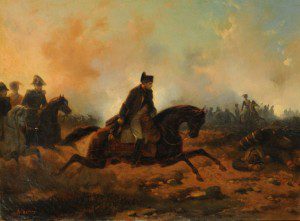
Napoleon at the Battle of Waterloo by Hippolyte Bellangé
I should have won
In September 1815, en route to St. Helena, Napoleon lamented,
Ah! If it [the Battle of Waterloo] were only to be done over again! (1)
Napoleon was amazed that he had lost. On St. Helena in December 1815, he told the Count de Las Cases:
[A]ll was fatal in that engagement; it even assumed the appearance of absurdity; yet, nevertheless [Napoleon] ought to have gained the victory. Never had any of his battles presented less doubt to his mind; and he was still at a loss to account for what had happened. (2)
On June 18, 1816, the first anniversary of the Battle of Waterloo,
[t]he circumstance was mentioned by some one present, and the recollection of it produced a visible impression on the Emperor. ‘Incomprehensible day,’ said he in a tone of sorrow. (3)
Napoleon said to Baron Gourgaud:
‘My regrets are not for myself but for unhappy France! With twenty thousand men less than I had we ought to have won the battle of Waterloo. But it was Fate that made me lose it.’ The Emperor then told why he did not thoroughly understand the battle. (4)
It’s the generals’ fault
In addition to fate, Napoleon found earthly candidates to blame for the loss.
Had it not been for the imbecility of Grouchy, I should have gained the day. (5)
Grouchy, [Napoleon] said, had lost himself; Ney appeared bewildered…D’Erlon was useless; in short, the generals were no longer themselves. If, in the evening, he had been aware of Grouchy’s position, and could have thrown himself upon it, he might, in the morning, with the help of that fine reserve, have repaired his ill success, and, perhaps, even have destroyed the allied forces by one of those miracles, those turns of fortune which were familiar to him, and which would have surprised no one. But he knew nothing of Grouchy; and besides, it was not easy to act with decision amongst the wrecks of the army. It would be difficult to imagine the condition of the French army on that disastrous night; it was a torrent dislodged from its bed, hurling away every thing in its course. (6)
I made a great mistake in employing Ney… I should have placed Soult on my left.… I ought not to have employed Vandamme. I ought to have given Suchet the command I gave to Grouchy.… My ordonnance officers were too young…. I ought to have had in their place men of experience. … Soult (my second in command at Waterloo) did not aid me as much as he might have done.… The men of 1815 were not the same as those of 1792. My generals were faint-hearted men…. I needed a good officer to command my guard. If I had had Bessières or Lannes at its head I should not have been defeated. (7)
Had it not been for the desertion of a traitor, I should have annihilated the enemy at the opening of the campaign. I should have destroyed him at Ligny, if my left had done its duty. I should have destroyed him again at Waterloo if my right had not failed me. (8)
Maybe my fault too

Napoleon After The Battle Of Waterloo by François Flameng
Amidst such recriminations, Napoleon occasionally gave a nod to his own mistakes in the campaign.
If I had remained with the battalion of my Guard on the left of the high road, I might have rallied the cavalry…. Perhaps when I became aware of the immense superiority of the Prussians at Ligny, I ought sooner to have ordered a retreat…. Perhaps I should have done better to have waited another month before opening the campaign in order to give more consistency to the army…. I ought to have had mounted grenadiers in reserve; their charge would have altered the state of affairs. (9)
According to Admiral Pulteney Malcolm, who commanded the North Sea squadron that cooperated with Wellington’s army during the Waterloo campaign, and who later met with Napoleon on St. Helena,
Bonaparte said two causes lost him the battle – Grouchy failing in checking the Prussians, and his great charge of cavalry being made half an hour too soon. (10)
No credit to Wellington
In July 1816 Napoleon told Admiral Malcolm:
Wellington ought to have retreated, and not fought that battle, for had he lost it, I should have established myself in France…. Wellington risked too much, for by the rules of war I should have gained the battle. (11)
The following March he told Dr. Barry O’Meara:
The plan of the battle will not in the eyes of the historian reflect any credit on Lord Wellington as a general. In the first place, he ought not to have given battle with the armies divided…. In the next, the choice of ground was bad; because if he had been beaten he could not have retreated, as there was only one road leading to the forest in the rear. He also committed a fault which might have proved the destruction of all his army, without its ever having commenced the campaign…; he allowed himself to be surprised. On the 15th I was at Charleroi, and had beaten the Prussians without his knowing any thing about it….
[Wellington] certainly displayed great courage and obstinacy; but a little must be taken away even from that, when you consider that he had no means of retreat, and that, had he made the attempt, not a man of his army would have escaped. First, to the firmness and bravery of his troops, for the English fought with the greatest obstinacy and courage, he is principally indebted for the victory, and not to his own conduct as a general; and, next, to the arrival of Blucher, to whom the victory is more to be attributed than to Wellington, and more credit due as a general; because he, though beaten the day before, assembled his troops, and brought them into action in the evening. I believe, however, that Wellington is a man of great firmness. The glory of such a victory is a great thing; but in the eye of the historian, his military reputation will gain nothing by it. (12)
Put it down to fate
By November 1816, Napoleon was no longer expressing astonishment at his defeat. Indeed, he now claimed to have had a premonition of failure. He said to Las Cases:
It is very certain that during the events of 1815, I relinquished the anticipation of ultimate success: I lost my first confidence. Perhaps I found, that I was wearing beyond the time of life at which fortune usually proves favourable; or, perhaps, in my own eyes…the spell that had hung over my miraculous career was broken; but, at all events, I felt that something was wanting. Kind fortune no longer followed my footsteps…; she was now succeeded by rigid fate, who took ample revenge for the few favours which I obtained, as it were, by force. It is a remarkable fact, that every advantage I obtained at this period, was immediately succeeded by a reverse…. I gained the brilliant victory of Ligny: but my lieutenant robbed me of its fruits. Finally, I triumphed even at Waterloo, and was immediately hurled into the abyss. Yet I must confess that all these strokes of fate, distressed me more than they surprised me. I felt the presentiment of an unfortunate result. Not that this in any way influenced my determinations and measures; but the foreboding certainly haunted my mind. (13)
Fate, or destiny, became Napoleon’s official explanation. Baron Gourgaud left St. Helena in 1818. Shortly thereafter he published a book called The Campaign of 1815, an account of the Waterloo campaign based in large part on notes dictated by Napoleon. Gourgaud billed it as a “simple but faithful recital of facts,” noting that “the Emperor Napoleon [had] been pleased to communicate to me his opinion on the principal events of the Campaign.”
Napoleon, with an army alarmingly inferior in numbers, met his enemy, in this fatal campaign, with almost equal forces on every point of contest. By his ability alone he everywhere established an equilibrium: the enemy, surprised in his cantonments, with his troops scattered over a circuit of twenty leagues, was compelled to engage before his forces were united; and finally, to fight the last battle in a position in which his total ruin was inevitable had he been beaten.
All the probabilities of victory were in favour of the French. The combinations were excellent, and every event appeared to have been provided for: but what can the greatest genius perform against destiny? Napoleon was conquered. (14)
You can read Gourgaud’s book, which includes Napoleon’s detailed observations on the campaign, for free on Google Books.
For more about the Battle of Waterloo, see the excellent series of posts on Adventures in Historyland. And if you are curious about what might have happened if Napoleon had gone on to fight another battle, read Napoleon in America.
You might also enjoy:
The Duke of Wellington: Napoleon’s Nemesis
Were there Canadians at the Battle of Waterloo?
What if Napoleon won the Battle of Waterloo?
Why didn’t Napoleon escape to the United States?
Could Napoleon have escaped from St. Helena?
What were Napoleon’s last words?
How were Napoleonic battlefields cleaned up?
- Elizabeth Wormeley Latimer, Talks of Napoleon at St. Helena with General Baron Gourgaud (Chicago, 1903), p. 31.
- Emmanuel-August-Dieudonné de Las Cases, Mémorial de Sainte Hélène: Journal of the Private Life and Conversations of the Emperor Napoleon at Saint Helena (London, 1823), Vol. I, Part 2, p. 6.
- Mémorial de Sainte Hélène, Vol. II, Part 4, p. 252.
- Talks of Napoleon at St. Helena with General Baron Gourgaud, p. 187.
- Barry E. O’Meara, Napoleon in Exile, Vol. 1 (Philadelphia, 1822), p. 249.
- Mémorial de Sainte Hélène, Vol. I, Part 2, pp. 6-7.
- Talks of Napoleon at St. Helena with General Baron Gourgaud, pp. 185-188.
- Mémorial de Sainte Hélène, Vol. II, Part 4, pp. 252-253.
- Talks of Napoleon at St. Helena with General Baron Gourgaud, pp. 187-188.
- Clementina E. Malcolm, A Diary of St. Helena (1816, 1817): the Journal of Lady Malcolm, edited by Sir Arthur Wilson (London, 1899), p. 31.
- Ibid., pp. 30-31.
- Barry E. O’Meara, Napoleon in Exile, Vol. 1 (Philadelphia, 1822), pp. 299-301.
- Mémorial de Sainte Hélène, Vol. IV, Part 7, pp. 143-45.
- Gaspard Gourgaud, The Campaign of 1815; or, a Narrative of the Military Operations which took place in France and Belgium during the Hundred Days (London, 1818), p. vi.

Hussard de Chamboran by Henri Félix Philippoteaux. Pierre Viriot joined the Chamboran hussars in 1791.
Pierre Viriot was a promising French soldier who wound up on the bad side of both the Napoleonic and the Bourbon regimes. His career was undone by his honourable involvement in the trial of the presumed kidnappers of French Senator Clément de Ris. Viriot’s sad tale shows the power of Napoleon’s police to ruin a man’s life.
A young hussar
Pierre François Viriot was born on September 20, 1773 in Nancy, in northeastern France. His father, also called Pierre, had distinguished himself as a soldier in the Seven Years’ War. His mother, Jeanne Françoise Lemaure (or Lemort), gave birth to at least 11 children and was particularly long-lived, dying at the age of 95 (or 101) in 1827.
At age 15 Viriot entered a military training school at Pont-à-Mousson. At age 17, in January 1791, he enlisted in a regiment of hussars at Chamboran. After two campaigns in the Moselle, Viriot was sent to the Vendée, in the west of France. He fought against the royalists known as Chouans. In 1793, he married Marie-Françoise-Constance Calonne. They had four sons.
The Clément de Ris affair
By the fall of 1800, Pierre Viriot, then age 27, was a captain of hussars. He bore the scars of 14 wounds – five from swords and nine from firearms. One of them had taken out his right eye. He might have gone on to a distinguished career in the Grande Armée. Instead, a temporary appointment forever scarred his life. Viriot was named to a court charged with judging the presumed kidnappers of French Senator Dominique Clément de Ris.
On September 23, 1800, Clément de Ris had been robbed and abducted from his home, the Château de Beauvais, near Azay-sur-Cher, in full view of his wife and servants. The brigands imprisoned him in a cave for 17 days. They then set him free in a clearing, from which he returned home. First Consul Napoleon Bonaparte, who had appointed Clément de Ris to the Senate, instructed the Minister of Police, Joseph Fouché, to find the guilty parties.
Unbeknownst to Napoleon, Fouché had arranged the kidnapping himself. Hoping that Napoleon would be defeated in the war against the Austrians, Fouché had been conspiring with French Foreign Minister Talleyrand and others to remove the First Consul from power. Clément de Ris had been promised a place in the new government, and Fouché had engaged in a long correspondence with him on the subject. This left Clément de Ris in possession of documents that could seriously compromise Fouché once Napoleon returned victorious from the Battle of Marengo (June 14, 1800). Fouché staged the kidnapping as a cover to retrieve the papers.
Having paid off his thugs, Fouché needed to find scapegoats to appease Napoleon. Ten people were arrested and charged. A special court at Tours recommended the death penalty for former royal army officers Davin Mauduisson, Nicolas Canchy and Étienne Gaudin. All of the accused had strong alibis. They begged to confront Clément de Ris directly, but the senator had made a profitable reconciliation with Fouché and deemed it beneath his dignity to appear at the trial.
Their cases were sent to a special criminal tribunal at Angers, on which Viriot had been called to serve. The president of the court confided to his fellow judges that, in light of the evidence, “a condemnation was impossible.” However, he insinuated that it would be dangerous to displease the government by setting free “men who were its professed enemies.” If not actually guilty, they had, “as old Chouans, deserved death a hundred times in other circumstances.” (1)
Viriot disagreed. He wrote a series of notes pointing out the solidity of the men’s alibis and inconsistencies in the witnesses’ testimony. He rode to Paris to plead the cause of the accused before the government. Viriot met with Josephine Bonaparte, the Minister of Justice, and Generals Mortier and Junot, all to no avail. By the time he returned to Angers, the three men were dead. The verdict had been given on November 2, 1801. The execution took place the following day.
Dismissal
In February 1802 Pierre Viriot received notice that, by order of the Consuls, he had been dismissed from the army. He obtained an audience with Napoleon, who asked him why he hadn’t agreed with his fellow judges’ opinion.
Viriot said, ‘I followed the instinct of my conscience.’
‘That may be,” said Napoleon, ‘but the law required you to sign the verdict.’
Viriot replied, ‘The law did not oblige me to dishonour myself.’ (2)
Viriot petitioned to be returned to his position. In 1805 he succeeded in getting Marshal Lefèvre and Joseph Bonaparte to take up his case. Though he was not formally reinstated, Viriot was given several missions in Germany, and served on General Rapp’s staff during the Battle of Austerlitz. Thereafter the Prince of Isembourg engaged him as a military instructor for a regiment he was raising for Napoleon and conferred on him the title of Lieutenant-Colonel. On returning to France, Viriot tried without success to get this title confirmed by the Ministry of War. Finding himself again without employment, he haunted the barracks at Metz, where he and his wife lived. He sometimes went to Paris, begging continually to be restored to his rank, offering at his own expense to “equip ten men, and provide two horses for the artillery-train.” (3)
Viriot’s chance came in January 1814. France was on the point of being invaded by the Sixth Coalition, and the threatened departments were authorized to raise volunteer corps of guerrilla sharpshooters. Pierre Viriot was named a colonel of the force organized in the Meurthe. He distinguished himself harassing allied convoys as they moved towards Paris.
Under the Bourbons
After Napoleon abdicated and Louis XVIII ascended the throne, Pierre Viriot was put in command of a depot at Metz that coordinated the return of soldiers arriving from enemy prisons. However, an ordinance of January 1815 put on half-pay all the officers who did not have a letter of employment from the Ministry of War (see my post about demi-soldes). This included Viriot.
When Napoleon escaped from Elba and returned to France in March of 1815, Pierre Viriot offered his service to the Emperor. He was authorized to raise a corps of 1,000 infantry and 300 cavalry in the departments of Meuse, Moselle, Meurthe and Vosges. After Napoleon’s defeat at the Battle of Waterloo and the restoration of the Bourbons to power, Viriot’s corps was disbanded. He was given another position, but held it only until September 1815, when he was arrested and imprisoned on suspicion of being “author, leader, and accomplice of a plot to unite armed bands to fall openly on the rear-guard of the enemy’s troops, when evacuating French territory, and pillage their baggage and treasure.” (4) One of Fouché’s agents may have set him up. In August 1816, Viriot was condemned to 10 years of banishment followed by 10 years of police supervision. On appeal, in January 1817, the banishment was reduced to six months’ imprisonment.
Once free, Viriot wrote to the Ministry of War to relate his grievances and ask to be reinstated in the army. He spoke of his past service, of his honour, and of his sons who had been killed fighting for France at Smolensk and Leipzig. He received a negative reply. Viriot renewed his appeals, accompanied with recommendations from Marshals Davout and Oudinot and Generals Rapp and Belliard, but the bureaucracy refused to revisit its decision. Fouché, though long gone, had ensured that at the beginning of Viriot’s dossier was placed a copy of a report dated 1802, in which Viriot was presented as an
intriguer, who has long been away from the army, and who has been clever enough to pass off the shooting accident which deprived him of his right eye as a wound received in war; one of those people who hang on to all parties and use all events for their own advantage.
According to the report, Viriot had committed “embezzlements and extractions” and had taken money from the accused in the Clément de Ris trial in exchange for a promise to secure their acquittal. (5)
In 1820 Pierre Viriot was arrested on suspicion of being involved in the August 19th “French Bazaar” conspiracy, an alleged military plot to overthrow the government. He was acquitted by the Court of Peers. By then he may have accepted the sordid role of informant to the royalist police. Perhaps the regime enticed him with the prospect of future reintegration. Or cooperation may have been the price of having his 1816 sentence reduced. (6) Viriot would have been of some value as a spy, as he still retained friendships with his Bonapartist colleagues, and was also in contact with the Marquis de Lafayette. It is during this period that we find him among the demi-soldes plotting with General Piat in Napoleon in America.
After the Bourbons
During the July Revolution of 1830, Pierre Viriot sprang into action at Nanterre, near Paris. He raised the tricolour, formed a national guard and prevented bloodshed between them and a detachment of cuirassiers. A letter from the inhabitants of Nanterre congratulated him for his “wisdom, prudence and energy.” (7)
On October 15, 1830 Viriot addressed a letter to France’s new ruler, King Louis Philippe:
It is to the king of the French, to the citizen king, that I address myself to obtain reparation for long and numerous injustices suffered for the cause of liberty and my country.
I can still devote many years of service to my country; I ask to be returned to activity.
I dare say that my name is not without some glory. If my services were an item of disfavour to the old government, if I was surrounded by informers, persecuted, imprisoned, ruined, arbitrarily deprived of the grade acquired through 25 years of service and at the price of 14 wounds, I hope that, under a prince who is an honest man, justice will be rendered to me. (8)
Viriot then offered a defence of his actions in the Clément de Ris trial.
The evidence proved no charge against the accused, nevertheless, they were sentenced to death. I cannot say what means of seduction were used with my colleagues, what offers and what threats were made; … examples of corruption are unfortunately too frequent. Strong in my conviction, I refused to sign the iniquitous verdict; I loudly proclaimed the innocence of the accused, … I made known the true culprits, and exposed the entire plot, but my voice was stifled, and the unfortunate men paid with their lives for a mistake made by the agents of a powerful man…. If I couldn’t save them, I at least have the consolation of having employed all my efforts. (9)
His request for reinstatement was denied. In 1831, Viriot offered to raise a French corps to go the aid of Belgium, whose revolution was under threat by Holland. He was told this was not needed. In 1848, he begged to be put on half-pay. Since he had been deprived of his rank, he had received neither pay nor pension. In 1851 he petitioned French President Louis-Napoléon (Napoleon’s nephew, who became Napoleon III), but received no reply. Viriot moved from Nanterre to Livry, where he lived in a cottage in the woods with his wife, who had stuck with him through all his trials.
There are still some persons at Livry who remember having seen these two old people, of whose history they were ignorant. They called Viriot ‘Colonel,’ though they were surprised that there was no red ribbon in his button-hole. He passed his time in gardening, or in arranging his papers, which he never tired of re-perusing. (10)
Pierre Viriot died at Livry on June 10, 1860 at the age of 86.
For more about the kidnapping of Senator Clément de Ris, see Paul Davenport’s Discovering France blog. Honoré de Balzac’s novel Une ténébreuse affaire (A Murky Business) was inspired by the affair.
You might also enjoy:
Demi-soldes, the Half-Pay Napoleonic War Veterans
General Jean-Pierre Piat, Staunch Bonapartist
Barthélemy Bacheville: Napoleonic Soldier, Outlaw & Perfumer
Charles Fabvier: Napoleonic Soldier & Greek Hero
How did Napoleon escape from Elba?
- Frederic Lees, Romances of the French Revolution, Vol. 1 (London, 1908), p. 349.
- Germain Sarrut and B. Saint-Edme, Biographie des hommes du jour, Vol. 6 (Paris, 1841), p. 90.
- Romances of the French Revolution, p. 352.
- Ibid., p. 354.
- Ibid., pp. 354-56.
- Jean-Marie Thiébaud and Gérard Tissot-Robbe, Les Corps Francs de 1814 et 1815 (Paris, 2011), p. 445.
- Biographie des hommes du jour, Vol. 6, p. 99.
- Ibid., pp. 99-100.
- Ibid., p. 100.
- Romances of the French Revolution, p. 361.

Jeune fille en buste by Pierre-Narcisse Guérin, 1794, one of the earliest works showing a woman with coiffure à la Titus
In an earlier post I looked at Napoleon in America character Barthélemy Bacheville, who was described in an 1816 police report as being “coiffed à la Titus.” This got me wondering: what does a Roman emperor have to do with hairstyles in early 19th-century France?
Talma as Titus
The Titus in question turns out not to be Emperor Titus, who ruled the Roman Empire from 79 to 81 A.D., but rather Titus Junius Brutus, elder son of Lucius Junius Brutus, who supposedly founded the Roman Republic around 509 B.C. The latter Titus is a character in the play Brutus by the French Enlightenment writer Voltaire. The play is about Titus’s participation in the Tarquinian conspiracy, for which Lucius Junius Brutus (the “Brutus” in the title) condemns his son to death.
Brutus first appeared on the French stage in 1730. It was revived during the French Revolution, when there was an enthusiasm for interpreting classic plays in light of current circumstances. During the opening performance at the Comédie-Française in Paris on November 17, 1790, there was pandemonium in the theatre when the actor playing Brutus cried, “Gods! Give us death rather than slavery!” (1)

Talma playing the role of Titus in Voltaire’s Brutus
On May 30, 1791, the 13th anniversary of Voltaire’s death, Brutus was performed at the royalist Théâtre de la Nation and at the rival Théâtre de la République, established by the actor François-Joseph Talma. (Talma would later become Napoleon’s favourite actor and one of Pauline Bonaparte’s lovers.) Jacques-Marie Boutet de Monvel played Brutus. Talma played Titus. Both were costumed in the garb of ancient Rome. Talma’s hair was cut short, in the style of a Roman bust.
When he appeared, the public…welcomed him with several bursts of applause. Eight days later, all the young people of Paris had their hair cut short, and from that evening dates the fashion of styling one’s hair à la Titus. (2)
Good for the guillotine

Madame Fouler (Henriette Victoire Elisabeth d’Avrange), comtesse de Relingue, with coiffure à la Titus, by Louis Léopold Boilly, 1810
Another explanation traces the coiffure à la Titus to the bals des victimes (victims’ balls), which reputedly took place after the Terror (1793-94). According to this, the hairstyle was intended to express solidarity with those who had been guillotined (the hair of the condemned was chopped off to make sure the blade went cleanly through the neck).
One of the most fashionable and brilliant kinds of assembly was called Le Bal des Victimes, the condition of entrance to which was the loss of a near relative by the guillotine. Between the country-dances [the dancers] said, ‘We dance on the tombs,’ and a favourite dress for the hair was adopted from the way in which [that of the guillotine victims] had been arranged immediately before execution. (3)
There is, however, little if any contemporary evidence that the bals des victimes in fact took place. The story did not became popular until the 1820s. Historian Ronald Schechter terms the balls a “marginal rumor hardly mentioned by contemporaries [that entered] the historiographical canon as an unquestioned fact. … Victims’ ball tales grew primarily out of the literary soil of ‘guillotine romanticism’ and the fantastic in the second quarter of the nineteenth century.” (4)
Harmful to health?

Portrait of a woman (perhaps Sophie de Bawr) with coiffure à la Titus, by Louis Léopold Boilly, 1810
The coiffure à la Titus was a short and choppy cut. Bangs were left long over the forehead, and the hair was cropped to the top of the neck in the back. Initially popular with Republican men, by the mid-1790s the hairstyle was also sported by women. To imagine what a change in style this marked, think of the big hair, long wigs and elaborate coiffures of the ancien régime.
Critics complained that the look was unfeminine and harmful to health.
Examine the inconveniences of the coiffure à la Titus and you will see that short, unpowdered hair exposes the scalp to all the vicissitudes of the atmosphere; that the necessity of washing the head to maintain cleanliness, be it with cold water, be it with hot water, which produces cold when it evaporates, must multiply the effects…and give rise to irregular perspiration…. (5)
This, it was believed, could cause inflammation, migraines, conjunctivitis, dental cavities, earaches, sore throats, etc.
Beginning around 1800, the coiffure à la Titus began to assume a more refined appearance. Perfumed pomades were used to define curls and create a tousled effect. Flowers and ribbons were sometimes added. Popular during the French Revolution, Titus hair remained in style through the years of the Directory, the Consulate and Napoleon’s Empire. In 1802, a London paper noted that “nearly two-thirds of the women of fashion” in Paris “wear their own hair or wigs à la Titus.” (6)
Praise for Titus hair
In 1810, a French hairdresser named J.N. Palette fulsomely praised the style.
How many people have not had the advantage of having, so to speak, the face framed by the arrangement of hair! How many have a wide forehead and the temples too exposed! The [coiffure à la] Titus agreeably covers these faults. How many more do not have the fine and regular features, or certain facial expressions, that the Titus gives to those who are without! How many people, finally, have the misfortune to be born with defective traits or are ravaged by smallpox, and become quite tolerable with Titus? For many, it stops Time….

Portrait of a man with coiffure à la Titus, by Louis Léopold Boilly
Titus has all these advantages; the proof is in the style’s longevity; ladies are rarely wrong about what is advantageous to them; as for me, I dare prophesy that it will never disappear entirely. However, it must be admitted that the Titus is not a noble hairstyle, neither imposing nor showy, but it is the most likable: it is an everyday style, because ladies would rather please than be admired. To please is the perpetual desire of persons of that sex, and the coiffure à la Titus is useful, if not essential, to the majority.
The exception is only for young people to whom it gives the air of a woman before their time. Any kind of crimp on the forehead and the temples produces the same effect. This exception also extends to very fresh faces that have fine, delicate traits and are full of expression. …
A perfect face has no need of Titus; it would be profane to cover a handsome forehead, pretty temples and perfect eyebrows: the ancients taught us to respect these kinds of beauty. But where did they find them? One can cite such and such painter or sculptor who employed twenty models to make one. Thus I return to my text: Titus is the coiffure par excellence. This statement is so true that all the hairstyles that have been most successful in all the ages are those that have something in common with the Titus. As long as there have been scissors, have we kept long hair around the face? …

One might credit First Consul Napoleon Bonaparte with coiffure à la Titus in this portrait by Louis Léopold Boilly
Indeed, what could be less agreeable and more embarrassing than long flowing hair? … It hinders movement and thereby removes grace. … Finally, when the hair is long, one braids it, one rolls it, thereby reducing the head almost as if it were à la Titus. … Why does one need the difficulty of maintaining long and annoying hair, when one can procure it when one desires? Wigs are resources for showy days. …
I do not mean to say… that women should have their hair cut like men, but a styled Titus, forming waves that the air can stir and flowing curls to which the least movement gives play: that is what gives expression to the physiognomy and seems to animate the coldest face; a disordered arrangement in which art is hidden; it covers a defect and allows what is advantageous to be seen; it is thus that one can say that a woman à la Titus is a rose in bloom. (7)
With the restoration of the Bourbons to the French throne in 1815, there was a return to more elaborate hairstyles, suggestive of pre-Revolutionary times. Police were known to profile men still wearing their hair à la Titus, thus the comment in the report on Bacheville.
You might also enjoy:
Napoleon’s Hair and its Many Locks
François-Joseph Talma, Napoleon’s Favourite Actor
10 Interesting Facts about Napoleon Bonaparte
How Pauline Bonaparte lived for pleasure
Barthélemy Bacheville: Napoleonic soldier, outlaw & perfumer
Was Madame de Genlis Napoleon’s spy?
What did Napoleon’s wives think of each other?
- Kenneth N. McKee, “Voltaire’s Brutus During the French Revolution,” Modern Language Notes, Vol. 56, No. 2 (Feb. 1941), p. 102.
- Adolphe Jullien, Histoire du costume au Théâtre (Paris, 1880), p. 307.
- Archibald Alison Bart, History of Europe from the Commencement of the French Revolution in MDCCLXXXIX to the Restoration of the Bourbons in MDCCXV, 9th edition, Vol. III (Edinburgh and London, 1854), p. 224.
- Ronald Schechter, “Gothic Thermidor: The Bals des victimes, the Fantastic, and the Production of Historical Knowledge in Post-Terror France,” Representations, No. 61, Special Issue: Practices of Enlightenment (Winter 1998), pp. 82, 88.
- Bibliothèque Physico-Économique, Instructive et Amusante, 6th edition, Vol. 1807 (Paris, 1807), pp. 123-125.
- The Times (London, England), April 21, 1802.
- N. Palette, “Éloge de la coiffure à la Titus,” in Paul Lacroix, Recueil curieux de pièces originales rares ou inédites en prose et en vers sur le costume et les revolutions de la mode en France (Paris, 1852), pp. 287-291.

Barthélemy Bacheville
In an earlier post I looked at the demi-soldes, France’s half-pay veterans of the Napoleonic Wars, many of whom appear as characters in Napoleon in America. Captain Barthélemy Bacheville is a particularly interesting example of the species. A great admirer of Napoleon, Bacheville fought in most of the Emperor’s campaigns and followed him into exile on Elba. This meant he returned to France with Napoleon when the latter escaped from Elba. Bacheville thus started off on a bad footing with the Bourbons after Napoleon’s 1815 defeat. Things got worse from there.
A grenadier of the Old Guard
Barthélemy Bacheville was born around 1780 in Trévoux, France, north of Lyon. His parents were merchants. Though his family thought he was destined for an industrial career, Bacheville instead joined the French army. From 1802 to 1808 he served with an infantry regiment in Italy. Selected to join a regiment of grenadiers of the Imperial Guard, he fought in Spain from 1808 to 1811. He then embarked on Napoleon’s disastrous 1812 Russian campaign, and had his feet and nose frozen during the retreat from Moscow.
Bacheville, who hugely admired Napoleon, provides insight into how the Emperor retained his soldiers’ devotion.
Napoleon saw us constantly, and his words, distributing blame or praise, were a force that gave strength to the weak, health to the sick, hope to everyone. … One of the great talents of the Emperor was to raise men in their own eyes, and then to enjoin them, under the pain of falling under his contempt, to maintain themselves at that height or he would replace them.
I cannot marvel enough at the effect that he produced on us, even when an unheard-of setback struck the first blow to his infallibility, and he wanted us to be persuaded of his talent. … [A]s soon as he spoke, it was the cold that was wrong, and he who was right. He marched almost always on foot in the middle of us, leaning on a large baton and often giving his arm to Murat. He happened, like any other man, to fall; he got up laughing, said something about his plans for vengeance and victory in the next campaign, and continued on his route without being, or at least without appearing to be, beaten by the unbelievable catastrophe that was the fruit of the expedition by which he had hoped to finish his work. (1)
In 1813, Bacheville was on campaign in Saxony. He fought at the Battles of Lützen, Bautzen, Dresden and Leipzig. Wounded by a bullet in the head during the Battle of Château-Thierry in 1814, he was subsequently among 30 grenadiers of the Old Guard who took a Prussian battalion sheltered at a farm. Upon seeing the approaching bayonets, the Prussians lowered their arms. When Napoleon later asked the Prussian commander why his men had surrendered, he said, “It was necessary to yield; your grenadiers are not men, they are lions!” (2)
Promoted to captain, Bacheville was one of the soldiers who accompanied Napoleon during his exile on Elba in 1814-15.
I approached [Napoleon] often and very close, and I swear that except for M. de Pradt, in his last work, no one has spoken justly of him, whether that is because they didn’t understand him, or because they lied to please, which I’m inclined to believe; because one only had to see him on the inside to know that he was good, obliging, easy even, and made to be loved, because he himself knew how to love. … Napoleon mixed often with us, he watched our games, shared our conversation…. (3)
From Elba to outlaw
When Napoleon escaped from Elba, Barthélemy Bacheville returned to France with him. He fought at the Battle of Waterloo, along with his younger brother Antoine. After Napoleon’s final abdication, the Bacheville brothers were put on inactive service (see my post about the demi-soldes). In November 1815, they returned to their hometown of Trévoux. In December, a ministerial ordinance deprived Bacheville of his half-pay and retrograded him to a second lieutenant for having taken part in Napoleon’s return. Bacheville was indignant.
We had been authorized to follow Napoleon; the French government had given us three years to return to France before losing our rights as citizens; finally, we had been permitted to recognize Napoleon as our chief, and we had to treat him as Emperor, although he had abdicated the power that he had in France. Did they permit us to follow him only not to obey him? I never received such a warning. … We did our duty, you have nothing to reproach us for, and to not employ us is all that you have the right to do to us. (4)
In March 1816, during a visit to his mother’s hometown of Villefranche, Bacheville was suspected of conspiring against the government. When gendarmes attempted to arrest him, Bacheville fired on them with his pistol. He and Antoine fled to Switzerland.
The minister of police authorized a reward of 1,200 francs for the arrest of either brother (2,400 francs for both). Barthélemy Bacheville was described as a
lieutenant of the ex-Old Guard, decorated with the cross of the Legion of Honour, age 34 or 35 years; height of 5 feet, 6 or 7 inches, brown hair and eyebrows, coiffed à la Titus, nose a bit short and pointed, brown beard, oval face, beautiful blue eyes, medium mouth, slightly pointed chin, ruddy complexion, slightly trimmed moustache, swagger, head high, slight lisp, well-proportioned build. (5)
If you’re curious about that coiffure à la Titus, see this post.
On July 9, 1816, the court condemned the Bachevilles in their absence. Antoine was sentenced to two years in prison and Barthélemy to death by guillotine.
The brothers continued their flight across Germany and Poland to Moldova, where they were finally allowed to settle. Barthélemy gave lessons in weapons handling and French, and Antoine in mathematics. In April 1818, Barthélemy left for Constantinople, with the intention of finding passage to the United States and joining the Champ d’Asile, an ill-fated colony of Bonapartists in Texas (see my post about Charles Lallemand).
Unable to find a boat to take him to America, Bacheville journeyed to Smyrna. He hoped to meet up with General Savary, but the latter was in Trieste. Instead Bacheville was persuaded to enter the service of Ali Pasha, the governor of part of the Ottoman Empire. Ali wanted to organize an army on the Napoleonic model. Arriving at Ali’s court in Janina, Bacheville found himself enrolled in a band of assassins. He escaped to Ragusa (Dubrovnik), and then to Trieste, where he was believed to be a spy.
Bacheville continued on to Rome, where he met with Napoleon’s mother, Letizia Bonaparte. She welcomed him warmly and gave him 200 francs. Bacheville also called on Napoleon’s brothers Louis and Lucien. They gave him letters of recommendation to take to Joseph Bonaparte, who was living in the United States, for which Bacheville still hoped to embark.
In January 1819, Bacheville journeyed to Florence and then to Livorno, where a friend from Lyon advised him that there was a good chance of having his sentence overturned. Bacheville’s family was petitioning the Chamber of Deputies and the minister of war towards this end. Abandoning his plan to sail for America, Bacheville remained in Italy, waiting for word that it was safe to return to France. While there he worked on concocting a “cosmetic water” called eau des odalisques, which he later – in May 1820 – patented. The water was composed, among other things, of alcohol, rose water, cream of tartar, vanilla, dried orange peel and cinnamon. It could be used in a rub or a lotion, or to perfume baths, and as a gargle for freshening the mouth. (6)
In September 1819, Bacheville received the news he had been waiting for. He returned to Lyon, where he spent a brief spell in prison. On November 22, the court ruled that there had been insufficient evidence to convict him and ordered him set free. He hoped to share the good news with Antoine, but sadly, this was not to be. In December, Barthélemy learned that Antoine, who had travelled to Egypt, Persia and Arabia, had died in the desert (actually at Muscat, in Oman).
An object of special surveillance
Barthélemy Bacheville wrote a book about his and Antoine’s experiences, which was published in 1822 in Paris. According to Bacheville, the purpose of the book was not to promote himself, but to illustrate “blatant and barbaric injustices of interest to all citizens,” and to show “all that one can suffer for liberty, without ceasing to cherish it.” (7) It was also part of his campaign to get back pay for the years he was on the run, which the government continued to deny him. The Marquis de Lafayette provided a supportive letter, included in the front of the book.
As the police kept Bacheville under surveillance, we are able to follow him past the end of his book. In the fall of 1822, which is when he meets with General Piat in Napoleon in America, Barthélemy Bacheville was living at Palais-Royal, no. 82, on the third floor, above a tavern called l’Univers.
We are persuaded that this house must be an object of special surveillance, given that the tavern in question serves as the pretext for gathering a large number of inactive officers, who, pretending to frequent it, actually go to Mr. Bacheville’s, where it appears that secret meetings take place. (8)
By January 1825 he had moved at least a couple of times.
Bacheville is a bachelor, has no fixed revenue, however makes large expenses; he occupies himself with manufacturing what is called ‘beauty water.’ He is a hothead who publicly and everywhere he goes, paints the reign of Bonaparte as a golden age. (9)
In October 1826, the police reported:
Bacheville still lives at rue des Filles-Saint-Thomas, no. 13. There he has a maid and a servant, lives the life of a man of ease, is a businessman, buying credit from the state, and occupying himself above all with speculation at the Bourse. For this he is associated with M. Corréard, a former bookseller. These individuals have made big profits in this type of speculation; at least it is very positive that Bacheville just paid 500 francs to someone named Guérin, an amount that wasn’t due until three months later. (10)
By September 1827, Bacheville was living with his sister at rue de Faubourg-Poissonière, no. 1, and had become of less concern to the authorities.
We see nothing, at present, reprehensible in the conduct and relations of this individual. However, he is attacked with frequent bouts of insanity. (11)
When the July Revolution of 1830 removed Bourbon King Charles X from the French throne, Barthélemy Bacheville returned to military service. He was named chef de bataillon and given command of Fort l’Écluse in eastern France. In 1832, Bacheville became commander of the citadel of Montpellier, where he died on February 27, 1833.
To read Barthélemy Bacheville’s memoirs (Voyages des Frères Bacheville en Europe et en Asie, available only in French), visit the Internet Archive.
You might also enjoy:
The Tragedy of Colonel Pierre Viriot
General Jean-Pierre Piat, Staunch Bonapartist
Restoration Policeman and Spymaster Guy Delavau
How did Napoleon escape from Elba?
The Palais-Royal: Social Centre of 19th-Century Paris
- Barthélemy Bacheville, Voyages des Frères Bacheville en Europe et en Asie, 2nd Edition (Paris, 1822), pp. 20-21.
- Ibid., pp. 24-25.
- Ibid., p. 36.
- Ibid., pp. 59-60.
- Bibliothèque historique ou Recueil de matériaux pour servir à l’histoire du temps, Vol. 6 (Paris, 1819), p. 107.
- M. Christian, Description des machines et procédés spécifiés dans les brevets d’invention, de perfectionnement, et d’importation, Vol. 11 (Paris, 1825), pp. 316-317.
- Voyages des Frères Bacheville en Europe et en Asie, pp. vii, 6.
- Guy Delavau and M. Franchet, Le Livre Noir de Messieurs Delavau et Franchet, Vol. I (Paris, 1829), p. 131.
- Ibid., p. 133.
- Ibid., p. 136.
- Ibid., p. 142.

“Well, my old friend, here you are on half-pay,” quips a well-armed rioter of the July 1830 Revolution to the Bourbon ex-king, Charles X, depicted in priest’s garb and carrying meagre provisions. Source: gallica/bnf.fr / Bibliothèque nationale de France
What happened to Napoleon’s officers after he was defeated at the Battle of Waterloo? In 1815-16, some 20,000 officers who had served under Napoleon were removed from active service, given reduced salaries and placed under tight restrictions. They became demi-soldes, France’s half-pay veterans of the Napoleonic Wars.
Proscribed by the Bourbons
During the First Restoration (April 6, 1814 to March 20, 1815), most of the officers who had served under Napoleon were allowed to keep their positions. The constitutional Charter of 1814 guaranteed to all active and retired officers and soldiers the preservation of their ranks, honours and pensions. After Napoleon escaped from Elba and reached Paris without the army firing a shot against him, the Bourbons became less forgiving. Many royalists believed that Napoleon’s return to power was the result of a military conspiracy. Soon after the start of the Second Restoration (July 8, 1815), the government took measures to deal with officers considered loyal to Napoleon.
On July 24, 1815, King Louis XVIII issued the following ordinance:
Article I. The generals and officers who betrayed the king before the 23rd of March [the date Louis XVIII – then in refuge at Lille – laid off the French army en masse], or who attacked France and the government with force and arms, and those who by violence gained possession of power, shall be arrested and brought before competent courts-martial, in their respective divisions; namely: Ney, Labedoyere, the two brothers Lallemand [Charles and Henri], Drouet d’Erlon, Lefebvre-Desnouettes, Ameilh, Brayer, Gilly, Mouton-Duvernet, Grouchy, Clausel, Laborde, Debelle, Bertrand, Drouot, Cambronne, Lavalette, Rovigo.
Article 2 named a further 38 officers – including Pierre-François Réal – who were given three days to leave Paris and
retire into the interior of France, to the places which our minister of general police shall indicate to them, where they shall remain under his superinspection, until the chambers decided as to which of them ought either to depart the kingdom, or be delivered up to prosecutions before the tribunals. Those who shall not repair to the spot assigned to them by our minister of general police shall be immediately arrested. (1)
For a summary of the fate of the individuals proscribed by this ordinance, see the Arc de Triomphe website.
The Bourbons canceled promotions and decorations bestowed during the Hundred Days, dramatically reduced the size of the army, and replaced imperial officers with royalist favourites. A military commission was convened to examine the conduct of all officers who had served under Napoleon, classify them according to their political sentiment, and place them into one of 14 categories. This determined their fate and the amount (if any) of their pensions. There was no right of appeal. Between September 1815 and December 1816, approximately 20,000 Napoleonic officers were removed from active service. Only 5,000 were retained. (2)
Life as a demi-solde
Affected officers kept their rank, but their salary was typically half (or less) of what they had formerly received, thus earning them the nickname of demi-solde (half-pay). No longer entitled to wear their uniforms, they were often found in a civilian redingote (long coat), hiding a threadbare uniform underneath, and sporting the ribbon of the Legion of Honour.
To prevent them from gathering together, the demi-soldes were required to return to the department in which they were born. They could not travel without permission from the local mayor. They could not own a gun without a special waiver. They could not marry without permission. During the early months of the Restoration, the demi-soldes were forbidden to look for work. This further alienated them from the civilian population. They had to report to the local police every two weeks. The police opened their mail, and kept watch on their activities and visitors. Though men on inactive service could not enjoy the benefits of military life, they remained on call for return to active duty. This could come at short notice, or never.
Men who had fought valiantly to defend their country were now reduced to a state of inactivity, left waiting for further orders, often without pay and condemned to near-indigence. It was an unenviable plight. (3)
A poem, La Demi-Solde, published in 1819 by an inactive captain, complains bitterly.
I am on half-pay? Get away from me;
Whoever is unhappy must be outside the law.
They no longer recognize the sons of Victory,
Except under the unworthy name of brigands of the Loire.
A friend, suspected of having greeted me,
Occupied a position? He is removed.
I live alone, retired? I conspire in the shadow.
I receive my friends? They increase their number.
And the police hasten to this gathering,
Which will put the whole department in insurgency.
They soon prepare the feast of the anniversary
Of the return of this king that we cherish as a father;
And they take very great care not to invite me,
To accuse me later of not helping with it.
To persecute us everything becomes legitimate;
We still exist, and that is our crime.
They no longer want an army, and especially of Frenchmen.
France is guarded by Switzerland at great expense. (4)
Although the demi-soldes gained a reputation as restless grumblers and conspiratorial Bonapartists, the majority of them did not fit this description. (5) Some were quite willing to serve in the royalist army, either out of conviction or financial necessity, and pushed to be reinstated. Most accepted that their military career was over. Giving up their right to half-pay, they turned to another career, in trade, industry, farming or a profession. Knowing, for the most part, how to read and write in a society where over half of the population was illiterate, many inactive officers became clerks, notaries, lawyers, teachers, or local administrators. Less educated men moved easily into the ranks of the gendarmes. Some demi-soldes emigrated to the United States and became involved in the Vine and Olive Colony and the Champ d’Asile. In 1817, the demi-soldes numbered 15,639. By 1823, there were only 5,404. (6)
Lady Morgan relates an encounter between an English officer and a man driving a team of horses through a French village. The “driver displayed a costume at once military and civil – his waggoner’s frock contrasting with a large cocked hat.” In a rather churlish conversation, the Englishman learned that the Frenchman had fought against him in the same engagement in Spain. When the Englishman inquired about the driver at the village inn, the innkeeper replied:
He is one of our disbanded officers; it is captain B-, a brave man! ‘tis a great pity! – but this is the way things are going in our poor France. (7)
Gathered round the table d’hôte
Some inactive officers, such as General Jean-Pierre Piat, were actively opposed to the crown. In Paris, the police maintained a close watch on places where disaffected veterans gathered to sing subversive songs and raise their glasses to Napoleon. The stories of the officers Piat conspires with in Napoleon in America came to me from the police record, as did the location of their meeting.
29 March 1823 – There is, in rue Notre-Dame-Des-Victoires, a table d’hôte where they receive only men known for their revolutionary principles, and in which the regulars are primarily officers on half-pay. This table d’hôte, where the price is fixed at 2 fr. 50 cent. per person, is owned by a decorated captain of the ex-Imperial Guard, who goes by the name of Saint-Victor. This officer himself has the worst disposition. …
8 May 1823 – On the second floor, the table d’hôte is usually comprised of 16, 18 or 20 guests of all sorts, officers, bank clerks, etc. …. Monsieur Saint-Victor is a member of the Legion of Honour and receives a pension of 1,600 francs a year as a captain on half-pay and an officer of the Legion. He has, in his neighbourhood, the reputation of not much liking the government, but of those frequenting his house, we have heard or seen nothing reprehensible. (8)
7 May 1822 – Monsieur Michel Vitez is around 34 years old. He says he is a former captain of the Polish Lancers, and a master of languages. They say that he left the hospital, and before entering he had students, to whom he gave lessons in town. Now he doesn’t have any. He appears very unhappy. He says he is requesting a pension from the French government…. They say he received from the Ministry of War, three or four months ago, 300 francs, which enabled him to dress himself and pay for part of his food. He is now reduced to begging, and goes, for this purpose, to very important people, principally M. Vibray, peer of France, M. Laborde…and others. He saw the Grand Chaplain, who promises to give him a place. He has a compatriot who is, he said, a cook for the king.
Vitez visits many soldiers, and frequently goes to the École Militaire; he is also often with a retired senior officer. They say that sometimes his head wanders and that the unfortunate position he is in puts him in this state. …
5 July 1822 – [Vitez] visits the homes of the Duke of Bassano, M. Laborde and M. Tarayre…to ask for help. When he makes these requests, he never fails to say that he is in extreme indigence thanks to the injustice of the ministry, which refuses him a military pension to which he claims he has acquired rights. …
We think…[Vitez] is not dangerous…that he couldn’t even serve as a tool of factions; but the confinement of this man would be a service rendered to public tranquillity. (9)
26 March 1826 – Monsieur Dubroc…captain of the ex-Imperial Guard…is a very rich man, with very bad thoughts, but is, even so, an officer of the Parisian National Guard. It is fair to say that, according to the report on his probity, his reputation is good. (10)
Antoine Dubroc had earlier been a demi-solde at Besançon.
Barthélemy Bacheville offers a particularly interesting example of a demi-solde, as described in this post.
As for the sad tale of Pierre Viriot, see this post.
You might also enjoy:
What happened to the Bonapartists in America? The Story of Louis Lauret
What did Americans think of the Napoleonic exiles?
Virginie Ghesquière: A Female Napoleonic Soldier
What did Napoleon say about the Battle of Waterloo?
How did Napoleon escape from Elba?
How were Napoleonic battlefields cleaned up?
- Christopher Kelly, History of the French Revolution and of the Wars Produced by that Memorable Event, Vol. II (London, 1820), p. 207.
- Jean Vidalenc, Les demi-solde: Étude d’une catégorie sociale (Paris, 1955), p. 24.
- Alan Forrest, The Legacy of the French Revolutionary Wars (Cambridge, 2009), p. 66.
- Le Chevalier L.-G.-D.-T. D.-T., La Demi-Solde (Paris, 1819), pp. 10-11.
- Les demi-solde: Étude d’une catégorie sociale, p. 58.
- Ibid., p. 36.
- Sydney Morgan, France (Philadelphia, 1817), pp. 10-11.
- Guy Delavau and M. Franchet, Le Livre Noir de Messieurs Delavau et Franchet, Vol. IV (Paris, 1829), pp. 210-211.
- Ibid., pp. 301-302.
- Ibid., Vol. III, p. 194.
Napoleon Bonaparte died at 5:49 p.m. on May 5, 1821 on St. Helena, an isolated island in the South Atlantic. Given the number of people surrounding the fallen Emperor during his final days, there should be a clear record of Napoleon’s last words. But, as with most things involving Napoleon, there are several accounts of his dying hours and differences regarding what he actually said.

The Death of Napoleon by Charles de Steuben
What the witnesses said
Napoleon’s second valet, Louis Étienne Saint-Denis, describes the state of Napoleon’s attendants during Napoleon’s final night.
The Emperor had been in bed for forty-odd days, and we who had been constantly with him, waiting on him, were so tired, and needed rest so much, that we could not control our sleepiness. The quiet of the apartment favored it. All of us, whether on chairs or sofas, took some instants of rest. If we woke up, we hurried to the bed, we listened attentively to hear the breath, and we poured into the Emperor’s mouth, which was a little open, a spoonful or two of sugar and water to refresh him. We would examine the sick man’s face as well as we could by the reflection of the light hidden behind the screen which was before the door of the dining room. It was in this way that the night passed. (1)
Saint-Denis does not give us Napoleon’s last words. All he says on the matter is that Napoleon “could only speak a few words, and with difficulty.” (2)
Napoleon’s Grand Marshal, General Henri Bertrand, did hear some last words early in the morning of May 5th.
From three o’clock until half-past four there were hiccups and stifled groans. Then afterwards he moaned and yawned. He appeared to be in great pain. He uttered several words which could not be distinguished and then said ‘Who retreats’ or definitely: ‘At the head of the Army.’ (3)
Napoleon’s doctor Francesco Antommarchi confirms a couple of these.
The clock struck half-past five [in the morning], and Napoleon was still delirious, speaking with difficulty, and uttering words broken and inarticulate; amongst others, we heard the words, ‘Head…army,’ and these were the last he pronounced; for they had no sooner passed his lips than he lost the power of speech. (4)
Louis-Joseph Marchand, Napoleon’s first valet, also records Napoleon’s last words. They differ somewhat from those heard by Bertrand and Antommarchi.
The hiccups that had appeared at intervals became much more frequent, and delirium set in; the Emperor pronounced a lot of inarticulate words that were translated ‘France,… my son,… The army…’ One can conclude with absolute certainty that his last preoccupation, his last thoughts were for France, his son, and the army. These were the last words we were to hear. (5)
General Charles de Montholon provides yet another last word.
The night was very bad: towards two o’clock delirium became evident, and was accompanied by nervous contractions. Twice I thought I distinguished the unconnected words, France – armée, tête d’armée – Josephine…. (6)
Witness credibility
In assessing these accounts, we have to consider the reliability of the witnesses, when their accounts were written (i.e., around the time of Napoleon’s death or much later), and their motives for publishing them. For a discussion of the validity of the various Napoleonic memoirs, see “The Truth About Memoires” by Max Sewell on The Napoleon Series website. In general, Bertrand’s and Marchand’s memoirs are considered much more credible than those of Antommarchi and Montholon.
Why might Napoleon’s attendants have doctored his last words?
Napoleon had always been a master of propaganda, and he spent his last years consciously crafting how he would be remembered by posterity. Those around him were well aware of that. They wanted to perpetuate that image. They may also have wanted to promote their own interests.
Army
In light of the above, we can come to some conclusions.
- Napoleon slipped into an incoherent state early in the morning of May 5, 1821. It was hard for his attendants to make out his last words.
- Napoleon’s quoted last words were probably not a single connected phrase, but rather words that could be deciphered from generally inarticulate utterances.
- Napoleon said (in French; he did not speak English) something about the army. On this, all four witnesses agree. Three agree that he said “head” and “army”; two that he said “head of the army” (tête d’armée).
- According to two witnesses, Napoleon said something about France.
- Napoleon may have said (in French) “who retreats,” “my son,” and/or “Josephine.”
Bertrand implies he is less sure about Napoleon saying “who retreats” than he is about Napoleon saying “at the head of the army.” He is, however, a very credible source, and his account comes directly from his diary, written at the time. “Who retreats” is not a phrase that enhances Napoleon’s image or serves Bertrand in any way. It is thus most likely an accurate recording of what Bertrand thought he heard Napoleon say.
Marchand includes “my son” among Napoleon’s last words. Marchand was devoted to Napoleon. He knew that the Emperor would have wanted his final words to be consistent with his image – one of dedication to France and the army. He was also acutely conscious of Napoleon’s love for his son, the King of Rome, to whom Marchand’s mother had been a nurse (see my post about Napoleon’s son). Marchand was undoubtedly straining to hear the boy mentioned in Napoleon’s last words, sure that the child was, as he says, among the Emperor’s last preoccupations. Bertrand confirms this by writing (probably after talking to Marchand):
During the night [of May 4] the Emperor had spoken the name of his son before saying ‘A la tête de l’Armée.’ The day before he had twice asked, ‘Comment s’appelle mon fils?’ [What is my son’s name?] and Marchand had replied, ‘Napoléon.’ (7)
As for Napoleon’s first wife Josephine, only Montholon includes her in Napoleon’s last words. Montholon wrote his memoirs some 20 years after Napoleon’s death, when he was imprisoned in the fortress of Ham. He was there with Louis-Napoléon (the future Napoleon III), who was the son of Napoleon’s brother Louis and Josephine’s daughter Hortense. Montholon and Louis-Napoléon had been captured during one of the latter’s attempted coups. It is not unreasonable to suspect that Montholon wanted to honour his friend and rally the French to Louis-Napoléon’s cause by showing that Napoleon’s last thought was for Louis-Napoléon’s grandmother. Thus, although “Josephine” is often cited as one of Napoleon’s last words, it is actually the least probable of them.
Here is a picture to sum this all up.

In Napoleon in America, Napoleon fictionally avoids death by escaping from St. Helena and landing in New Orleans on May 5, 1821, where he embarks on new adventures.
You might also enjoy:
What happened to Napoleon’s body?
10 Interesting Facts About Napoleon Bonaparte
Vignettes of Napoleon’s Final Months
How was Napoleon’s death reported in the newspapers?
Napoleon’s Funeral in Paris in 1840
10 Napoleon Bonaparte Quotes in Context
- Louis Étienne Saint-Denis, Napoleon from the Tuileries to St. Helena, translated by Frank Hunter Potter (New York and London, 1922), pp. 272-273.
- Ibid., p. 272.
- Henri-Gatien Bertrand, Napoleon at St. Helena: The Journals of General Bertrand from January to May of 1821, deciphered and annotated by Paul Fleuriot de Langle, translated by Frances Hume (Garden City, 1952), p. 232.
- Francesco Antommarchi, The Last Days of the Emperor Napoleon, Vol. II (London, 1825), pp. 152-153.
- Louis-Joseph Marchand, In Napoleon’s Shadow (San Francisco, 1998), p. 678.
- Charles de Montholon, History of the Captivity of Napoleon at St. Helena, Vol. III (Philadelphia, 1847), p. 106.
- Bertrand, Napoleon at St. Helena, p. 234.

The 1848 French Revolution: Lamartine in front of the Hôtel de Ville of Paris on February 25, 1848, by Henri Félix Emmanuel Philippoteaux
Jean-Pierre Piat features in Napoleon in America because of his involvement in a Bonapartist plot against the government of Louis XVIII of France. In real life Piat was a courageous French soldier and devoted Bonapartist who was viewed with suspicion by the Bourbon regime. Late in his life Piat helped Napoleon’s nephew, Louis-Napoleon, rise to power after the 1848 French Revolution.
A brave soldier
Jean-Pierre Piat was born in Paris on June 6, 1774. By January 1792 he was a sub-lieutenant in a French infantry regiment. He started out with the Army of the North and quickly earned a reputation for bravery. Piat subsequently fought in Italy and in Egypt, where he was shot in the face during the siege of Cairo and received another ball to his right knee during the Battle of Alexandria in 1801. Piat returned to France, then served in Italy, Spain and Germany, rising through the ranks and suffering a number of wounds. After Piat’s skilled performance at the Battle of Wagram in 1809, Napoleon made him a Baron of the Empire. Piat fought in the Russian campaign, and then in Saxony. In April 1813 he was promoted to the rank of general.
Put on inactive service during the First Restoration, Piat rejoined the Army of the North in March 1815, after Napoleon’s return to Paris. At the Battle of Ligny, on June 16, 1815, General Piat was badly wounded when his horse was killed underneath him.
Conspiring against the Bourbons
Following Napoleon’s 1815 abdication, Jean-Pierre Piat was again placed on inactive service (see my post about the demi-soldes). A known Bonapartist, he was under close surveillance by the Bourbon regime. In March 1823, Piat was arrested with two companions on his way from Bayonne to Bordeaux on suspicion of being the ringleader of a plot to subvert French soldiers on the Spanish frontier. He was released and no further action was taken against him. In April 1824 he retired from the army.
In August 1825, the police reported that Jean-Pierre Piat lived in Champigny-sur-Marne and often received old Napoleonic soldiers, including General Bertrand Clausel (who had operated a general store in Alabama with Charles Lefebvre-Desnouettes), Colonel Jean-Marie Varlet (a wealthy Bonapartist involved in an 1820 conspiracy against the Bourbons) and Captain Barthélemy Bacheville. Piat was said to be recruiting for the Spanish liberals. The police believed that he retired to the country to avoid surveillance, and noted that he often came to Paris incognito. He was said to have a mediocre fortune. They also noted that Piat had to look after his aged mother and father, as well as a sister who had mental problems. (1)
Rehabilitation
The July 1830 Paris Revolution, which ejected Charles X from the French throne and brought Louis-Philippe to power, marked a change in Piat’s fortune. In March 1831 he was taken out of retirement and given command of the subdivisions in the department of Var. Two years later he moved to a similar post in the department of Hautes-Alpes. In 1837 Piat retired, apparently due to his age. He moved to Nogent-en-Marne.
The French Revolution of 1848 gave the then 74-year-old Piat yet another chance to serve the Bonapartes.
[T]he partisans of the empire, the friends of Louis Napoleon, those of his family, and some old followers of the emperor, grouped themselves around General Piat. This devoted adherent, at the first news of the abdication [of Louis-Philippe], had run to the Hotel de Ville to defend the rights of the imperial family; but instead of making himself heard, he had been almost torn to pieces by the furious republicans, who dreaded the influence which the great name still possessed over the popular mind. (2)
Piat was one of the organizers of the Society of December 10, which advanced the cause of Louis-Napoleon (son of Napoleon’s brother Louis), who was elected president of the Republic of France on December 10, 1848. Piat helped to found newspapers, including Le Napoléonien, designed to spread Louis-Napoleon’s ideas and increase his popularity. Louis-Napoleon, who became Napoleon III, rewarded Piat by making him a senator on March 27, 1852. Jean-Pierre Piat served in the Senate until his death on April 12, 1862, at the age of 87. He is buried in the cemetery of Saint-Maurice (formerly Charenton-Saint-Maurice), which is now part of the southeastern suburbs of Paris.
You might also enjoy:
The Moral Courage of General Foy
Barthélemy Bacheville: Napoleonic Soldier, Outlaw & Perfumer
The Tragedy of Colonel Pierre Viriot
- Guy Delavau and M. Franchet, Le Livre Noir de Messieurs Delavau et Franchet, Vol. III (Paris, 1829), pp. 349-351.
- Edward Roth, Life of Napoleon III (Boston, 1856), p. 333.

1822 map of the Yucatán peninsula in Mexico. Isla Mujeres (not shown) is near “Cankum I.” in the upper right-hand corner. Dzilam de Bravo appears as V. de Silan, east of Santa Clara (S. Clara).
George Schumph, who meets with Napoleon in Charleston in Napoleon in America, is one of those shadowy figures about whom little is known. A native of Quebec, he is remembered in the historical record because of his association with the New Orleans-based pirates, Pierre and Jean Laffite. Thanks in part to Schumph’s testimony, we have the details of Pierre Laffite’s death.
In New Orleans
George Bankhead Schumph was a Canadian sailor. He may have been involved in the Champ d’Asile, the 1818 Bonapartist attempt to form an armed colony in Texas, which I wrote about here and here. Based on a list provided by Charles Lallemand, the Louisiana Courier of May 19, 1820 names “Schumphs” as one of the men at the Champ d’Asile.
By that time, Schumph was working with the Laffites. On March 7, 1820, after sailing from the brothers’ base at Galveston, Schumph landed with Pierre Laffite at New Orleans on the Pegasus, a schooner that had once been a United States gunboat. (1) When Jean Laffite abandoned Galveston in May 1820, George Schumph was one of the men who went with him.
Attack in Mexico
The following year Schumph was Pierre Laffite’s master-at-arms, privateering near Mexico’s Yucatán peninsula. On June 17, 1821, off Campeche, they captured the schooner Constitution, which was sailing from Cadiz to Veracruz. On the ship they found 1,200 barrels of liquor, 900 bottles of oil, lace and leather goods, and silver worth $50,000 to $60,000. Wanting to dispose of the merchandise, Pierre made a deal with a man named Clemente Cámera on Isla Mujeres near Cancún. Cámara could keep half the goods for his own use in return for $6,500 and his commitment to sell the rest in Campeche.
In October, Pierre delivered most of the cargo to Cámera’s small farm. Pierre, his mistress Lucia Allen, and his men stayed at the farm while Cámera took some of the goods to Campeche. Around 10 p.m. on October 30, they heard a small group of men approaching. When the leader identified himself as Miguel Molas, commanding a dozen soldiers and civilian volunteers, Laffite’s men fired on them. Though Molas was wounded, his men soon forced the attackers back. A few privateers were killed and others wounded. Those who could get away, including George Schumph, ran into the interior or escaped in a canoe. Molas loaded five prisoners, including Pierre Laffite and Lucia Allen, onto his boats.
When Molas embarked for the mainland at dawn, he found Laffite’s fully armed vessel in his path. Molas ran his boats ashore. Most of his men panicked and fled once the privateers opened fire. Outnumbered by his prisoners, Molas was compelled to abandon them on the beach.
Laffite collected his scattered party, including Schumph, and boarded a small fishing boat. They sailed northwest around the peninsula to a protected lagoon known as Las Bocas, about 10 miles from the village of Dzilam de Bravo. Pierre was extremely ill with a fever, and perhaps wounded. Though his companions tended him as best they could, he died on November 9. The next day, Schumph and the others took Pierre’s body into Dzilam de Bravo. Schumph asked permission from the mayor to bury Laffite in the churchyard of Santa Clara of Dzidzantún, an old Franciscan convent. Pierre Laffite was laid in the ground “with honor” and with appropriate words from the curate. (2)
George Schumph was arrested shortly thereafter on suspicion of complicity with pirates. In particular, he was thought to have been involved in the gun battle on Isla Mujeres. Trying to explain his connection with Pierre Laffite without incriminating himself as a pirate, Schumph testified that he was a Canadian merchant who had come to the island to discuss some business with Laffite when Molas attacked. To explain his lack of travelling papers, Schumph said he had jumped into the water to escape the attack and thus left his trunk behind, with his passport in it. He was held for several weeks until he agreed to provide information on the location of hidden Laffite prize goods. On December 4, Schumph was released. (3)
After that Schumph disappears from history. He may have gone to Columbia with Jean Laffite to serve as a corsair. (4) As for his origins, in his testimony of November 1821, George Schumph is listed as age 26, a native of Quebec and a bachelor. This means he would have been born around 1795.
On a message board of the Ancestry genealogical website, there is reference to a George Christian Schump or Christian-Adolf Schumpfe (born in 1753), who came to Quebec from Enkirch, Germany. He married Marie-Monique Samson. One of their eight children was named George Burkard, baptized on February 17, 1796. Marie-Monique died young, and George was raised in an orphanage in Les Îles-de-la-Madeleine, Quebec. (5) Though it’s impossible to be certain, the similarity of the names (George Bankhead Schumph vs George Burkard Schump), approximate birth year (1795 vs 1796) and location (Quebec) suggest they could be the same person.
You might also enjoy:
Jean Laffite: Mexican Gulf Pirate and Privateer
Pirate Consorts: Marie & Catherine Villard
General Charles Lallemand: Invader of Texas
General Jean Joseph Amable Humbert: Soldier, Lothario, Filibuster
- William C. Davis, The Pirates Laffite: The Treacherous World of the Corsairs of the Gulf (Orlando, 2005), p. 428.
- Ibid., p. 454.
- The circumstances surrounding Pierre Laffite’s death and Schumph’s involvement are recounted in Davis, The Pirates Laffite, pp. 452-455.
- Isidro A. Beluche Roma, “Privateers of Cartagena,” The Louisiana Historical Quarterly, Vol. 39, No. 1 (January 1956), p. 87.
- http://boards.ancestry.ca/thread.aspx?mv=flat&m=23&p=surnames.schumpp Accessed March 20, 2015. There is more information about the Schumph (or Jomphe) family on the Genealogy.com website: http://www.genealogy.com/forum/surnames/topics/chiasson/410/.

General Maximilien Sébastien Foy by Horace Vernet
General Maximilien Sébastien Foy was a model of military and civic virtue. A courageous soldier during the French Revolutionary and Napoleonic Wars, he refused to kowtow to Napoleon. Following Napoleon’s defeat, General Foy became an eloquent defender of liberty in the Chamber of Deputies. Foy was modest, hardworking and a man of integrity. He was greatly respected in France, as shown by the tributes paid to him and his family upon his death.
A soldier, not a judge
Maximilien Sébastien Foy was born on February 3, 1775 in Ham, France, the youngest of five children. His father Sébastien Florent Foy, a former soldier, died when Foy was four, so he was raised by his mother, Élisabeth Wisbeck. Noted at a young age for his intelligence and prodigious memory, Foy was educated at the College of Soissons and at the artillery school of La Fère. He was commissioned as an artillery officer at the age of 17, and served in Flanders. Suspected of sympathizing with the Girondins, in 1794 Foy was called before a revolutionary tribunal, stripped of his rank and sentenced to prison. Thanks to the death of Robespierre, he did not have to stay there long. Foy fought in the subsequent French campaigns in Germany, Switzerland and Italy.
In the spring of 1798 (or in 1803 – sources differ), Foy refused an appointment as an aide-de-camp to Napoleon Bonaparte. In early 1804, when Foy was asked to secure the signatures of his corps on a document congratulating Napoleon for thwarting an assassination plot, he said:
I will congratulate the First Consul as much as he likes on having escaped a conspiracy against his life, but I will never sign. I will never make my officers sign an address which designates such or such individuals as authors or chiefs of this conspiracy because I am a soldier and I am not a judge. (1)
Later that year, Foy refused to vote in favour of Napoleon assuming the title of Emperor. He had no particular hostility towards Napoleon. However, like the Marquis de Lafayette, Foy was an advocate of liberty. He believed in the rule of law, rather than the rule of an emperor.
Such slights did not go unnoticed. Foy went for nine years without promotion, though he continued to serve in the army with distinction and was many times wounded. In 1808, Foy finally became a general. He spent the next six years campaigning in Portugal and Spain. In the final battle at Orthez in February 1814, he was captured after being hit in the shoulder by the splinter from a shell.
After Napoleon’s 1814 abdication, Foy served under Louis XVIII’s reign as an inspector-general of infantry. When Napoleon escaped from Elba and returned to France in early 1815, Foy declared his support for the Emperor only after Napoleon had reached Paris. General Foy commanded an infantry division at the Battles of Quatre Bras and Waterloo. He later made clear that had been fighting for France, not for Napoleon.
Nineteen-twentieths of those who drew the sword during the hundred days in defence of their country had in no respect contributed to the success of the 20th of March [Napoleon’s return to Paris from Elba]: they marched, as their fathers had marched twenty-three years before, at the cry of Europe combined against France. Would you have liked it better if, for the first time, we had halted in front of our enemies and demanded how many of them there were? (2)
General Foy received the 15th wound of his career at Waterloo, when his shoulder was hit by a musket ball during the combat around Hougoumont farm. According to one of his men:
He had been wounded at about five in the afternoon, and the wound had not been dressed. He suffered severely, but his moral courage was unbroken. (3)
Leader of the opposition
After Napoleon’s 1815 abdication, General Foy retired from military service. He began to write his History of the War in the Peninsula, which was published after his death.
In 1819 General Foy was elected to the Chamber of Deputies. Known for his eloquent defence of liberty, he became the acknowledged leader of the opposition.
He had the exterior, the bearing and gestures of an orator, a vast memory, a powerful voice, eyes sparkling with intelligence and a chivalrous tournure about the head. His swelling forehead kindled with enthusiasm or contracted with anger…. Often he was seen to spring impulsively from his seat and scale the tribune, as if he was advancing to victory. When there, he flung forth his words with a haughty air, like Condé flinging his baton of command over the redoubts of the enemy. (4)
Foy believed in working through the Chamber to defend the constitutional Charter of 1814, which he saw as a bulwark against both despotism and anarchy. As he told his fellow deputies in March 1821, they must ensure
that the liberties in [the Charter] are not just vain words, and that its dispositions are observed…. The fundamental principle of the Charter is equality before the law. Any law that attacks that sacred dogma, essential to French existence and fundamental to social order, is in itself contrary to the Charter. (5)
When the ultra-royalists, led by the Count of Artois, gained the upper hand, Foy became increasingly critical of the government. As in Napoleon in America, he was invited to join plots against the Bourbon regime. His critics accused him of provoking sedition, but royal prosecutors were unable to find sufficient evidence to implicate him in any conspiracy.
General Foy died of an aneurism of the heart in Paris on November 28, 1825, at the age of 50. To read his last words, click here. He was given a public funeral. At least 20,000 citizens (one source says 100,000) followed his coffin from the church to Père Lachaise cemetery in a heavy rain. The procession lasted four hours.
Foy was survived by his wife, Élisabeth Augustine Daniels (1790-1868), whom he had married in 1806, and their five young children: Blanche Hélène (born March 6, 1814); Maximilien Sébastien Auguste, called Fernand (June 21, 1815); Tiburce (Aug. 26, 1816); Isabelle Joséphine (Feb. 28, 1818); and Maximilien Sébastien Frédéric (March 12, 1822). As Foy died a poor man, a public appeal was undertaken to assist the family, raising a large sum in a few weeks.
You might also enjoy:
Napoleon and the Marquis de Lafayette
General Jean-Pierre Piat, Staunch Bonapartist
Demi-soldes, the Half-Pay Napoleonic War Veterans
Assassination Attempts on Napoleon Bonaparte
- P.F. Tissot, Discours du Général Foy, Vol. I (Paris, 1826), p. xxiii.
- London Quarterly Review, Vol. 64, No. 128 (October 1839), p. 240.
- Edward Creasy, The Fifteen Decisive Battles of the World: From Marathon to Waterloo, 12th edition (London, 1862), p. 602.
- London Quarterly Review, Vol. 64, No. 128 (October 1839), p. 240.
- Discours du Général Foy, Vol. I, pp. 294-295.

Napoleon Bonaparte as a Lieutenant Colonel of the Corsican National Guard (1792) by Henri Félix Emmanuel Philippoteaux
On Easter Sunday in 1792, a quarrel between children erupted into a gunfight that pitted Napoleon and his battalion against the residents of Napoleon’s hometown of Ajaccio, Corsica. In an act of treason, Napoleon took advantage of the disturbance to attempt to neutralize his adversaries and capture the Ajaccio citadel from the French garrison.
Corsica in 1792
In April 1792, Napoleon Bonaparte was a 22-year-old first lieutenant on leave from his French artillery regiment. Technically, he was AWOL, as he had neglected to request an extension of his leave, which expired the preceding December. It was the fourth in a series of extended leaves Napoleon had spent on Corsica since 1786, helping his widowed mother Letizia deal with family affairs, and working with his brother Joseph to advance the Bonaparte family in island politics.
Though Louis XVI was still king, the French Revolution was in progress and the royal family was under house arrest. Corsica – which was under French rule – was divided among those who favoured the revolutionaries, those who favoured the royalists, and those who favoured independence. The president of the department of Corsica was Pasquale Paoli, a former independence fighter who had been supported by the Bonapartes, though Napoleon and his brothers were increasingly identified with the revolutionary party. Paoli’s supporters were split between those who wanted independence and those who supported revolutionary France. Though the royalists were no longer politically in charge of Corsica, they still, through the army, had support in key strongholds, including Ajaccio.
To avoid having to rejoin his regiment, Napoleon used bribery and intimidation to get himself elected, on March 31, as a lieutenant colonel of the 2nd Battalion of Corsican Volunteers (the Corsican National Guard). He was posted in Ajaccio, where the population was largely pro-church and royalist, and thus hostile to the National Guard, which was pro-revolution.

Port of Ajaccio, Corsica, late 18th–early 19th century
Easter Sunday
On Easter Sunday, April 8, 1792, a group of priests who had refused to swear an oath of loyalty to the French republic held a service at an officially dissolved convent in Ajaccio. They announced that a religious procession – in practice, a political demonstration – would be held the next day. Around 5 p.m. that afternoon, in the rue de la Cathédrale of Ajaccio, some girls playing sbriglie (a version of the bowling game ninepins) began to quarrel. Two sailors, cousins of the girls, got involved in the argument. One called the other “porco” (pig) and “coglione” (idiot). (1) The insulted party draw his dagger. Witnesses stripped him of his weapon, but he soon reappeared with a pistol.
Hearing the noise, a dozen National Guard volunteers arrived on the scene. They arrested one of the men and attempted to search a passing mason, who protested against the search, seizing the gun of the soldier who threatened him. The mason’s brother came running with a pistol and fired on the Guardsmen. The Guardsmen returned fire, grievously wounding one of the men. The locals fired back from neighbouring windows, and the Guardsmen retreated to their quarters.
Upon hearing the shots, Napoleon gathered six or seven National Guard officers and rushed to the cathedral. There they were confronted by an armed group of men. Napoleon tried to talk the locals into lowering their weapons, but several shots were fired and a National Guard lieutenant was killed. Napoleon and his men fled to a nearby house, then escaped through the back to the seminary. The residents of Ajaccio ran through the streets with guns and stilettos in hand, firing on buildings and Guardsmen, and shouting “Down with barrettes! Down with épaulettes!” (2)
The local council decided to investigate the situation and punish the guilty, but was not until 10 p.m. that the judge went to the cathedral. Napoleon accused the municipal officials of inaction.
They give no movement, they don’t even beat the générale [the roll of the drum that calls the troops together in an alert], or raise the red flag, and when night arrives, the magistrates who are supposed to be awake while the citizens sleep, go to sleep when everyone is awake. (3)
Napoleon and the other lieutenant colonel in command of the battalion declared that since the town was in insurrection, the National Guard had the right to protect itself by firing on the Ajacciens. The next day (Monday, April 9), after occupying strategic positions, they started laying siege to the town. Around 7 a.m. they fired on people leaving the cathedral after mass, killing a widow and a 13-year-old girl. Several others were hit, including an abbot who was wounded so badly that he died the following day.
Napoleon’s battalion and the townspeople remained at a standoff for the next several days, as hundreds more National Guardsmen arrived as reinforcements. Negotiators went back and forth, ceasefires were arranged and broken, and shots were fired, though nobody else was killed or wounded. Arguing that his men were in mortal danger, Napoleon tried to convince the commanding officer of the 42nd Infantry Regiment, which held the town citadel, to permit the Guardsmen access to the citadel, or at least access to the ammunition there. When the French commandant refused, there was talk of kidnapping him. Napoleon also tried unsuccessfully to convince the troops in the citadel to defect. The National Guard prevented anyone from entering or leaving Ajaccio. They killed cattle, ravaged orchards and blocked access to the town fountains. Bread and wood started to run short.
The Directory of the department sent two commissioners to sort out the mess. They entered Ajaccio on Monday, April 16, and prohibited everyone from carrying arms. They sent the National Guard battalions back to their villages, ordered Napoleon and his fellow commanding officer to Corte to meet with Paoli, and had 34 of the townspeople imprisoned.
The aftermath
Napoleon wrote up his version of events. He accused the population of Ajaccio, “made up of cannibals,” of having mistreated, insulted and assassinated the National Guard volunteers. He assured the Directory that his men were forced to defend themselves against a premeditated plot, and that, on April 9 it was the Ajacciens who opened fire. He did not say anything about the dead and wounded caused by his battalion.
In this terrible crisis in which we found ourselves, energy and audacity were called for; a man was needed who, if he were asked, after his mission, would swear to having transgressed no law and would be in the position to reply, like Cicero or Mirabeau: I swear that I have saved the Republic. (4)
Though the affair showed Napoleon to be energetic and resourceful, it also revealed less appealing traits. As Philip Dwyer notes in his excellent biography of Napoleon, the young lieutenant colonel incited regular French troops to revolt, used local authorities in his cause, opened fire on a civilian population and laid siege to his home town.
And for what? To avenge the death of an officer shot in cold blood before the cathedral or to avenge the insults he and his men had suffered? … Buonaparte’s first instinct, despite being an officer of the royal army and a commander in the National Guard, was to think of revenge, to punish his adversaries. But it would be unwise to simply reduce his actions to the Corsican ‘vendetta’…. This episode has to be seen as part of a local political struggle in which two factions…were vying with each other for dominance. Buonaparte, who represented pro-revolutionary Corsicans, was attempting to use his power to neutralize the adversary, conservative Corsicans who remained loyal to the Catholic Church. (5)
All of the documents from the commissioners, the Directory of the department, and the town condemned Napoleon and his battalion. Napoleon had to go to Paris to defend himself. On July 8, 1792, the Minister of War wrote that, having carefully examined the dossier, he found that Napoleon and his fellow lieutenant colonel had promoted the unrest and the excesses of the troops they commanded. Both were “infinitely reprehensible,” and if their crimes had been military they would have been court-martialed. (6) However, since both civilian and military personnel were involved, the case had to be referred to the Ministry of Justice. That Ministry, occupied with more pressing matters, did not follow up. As the government was short of trained officers, the affair was forgotten. On July 10 – two days after being blamed for the disturbance – Napoleon was informed that he would be reinstated in the 4th Artillery Regiment with promotion to the rank of captain.
You might also enjoy:
Napoleon and the Veronese Easter
Napoleon’s Mother, Letizia Bonaparte
Joseph Bonaparte: From King of Spain to New Jersey
What did Napoleon say about the Battle of Waterloo?
What if Napoleon won the Battle of Waterloo?
5 Easter Traditions No Longer Practiced
A Sailor’s Easter in California in 1835
- Arthur Chuquet, La Jeunesse de Napoléon, Vol. II: La Révolution (Paris, 1898), p. 268.
- Ibid., p. 269.
- Ibid., p. 270.
- Ibid., p. 290.
- Philip Dwyer, Napoleon: The Path to Power (New Haven & London, 1997), pp. 90-91.
- Ibid., p. 97.

Gilbert du Motier, the Marquis de Lafayette by Ary Scheffer, 1824
Major General Gilbert du Motier, the Marquis de Lafayette, was a hero of both the American and French revolutions. Though Lafayette initially hoped that Napoleon would serve the cause of liberty, he was soon disillusioned. His low-key opposition and refusal to accept office under the Consulate and Empire made the Marquis de Lafayette a continuing thorn in Napoleon’s side.
Imprisoned for the Revolution
Marie-Joseph Paul Yves Roch Gilbert du Motier de Lafayette was born in Chavaniac, France, on September 6, 1757 to a wealthy noble family. At the age of 13, he joined a company of the king’s musketeers. In 1773, he was posted to the regiment of Noailles as a sub-lieutenant. His marriage was arranged to Marie Adrienne Françoise de Noailles. He moved in with the Noailles family, who were connected with the French royals. Lafayette trained at the riding school of Versailles with the dauphin (Louis XVI), the Count of Provence (Louis XVIII), and the Count of Artois (Charles X). Although he and his wife regularly attended Marie Antoinette’s balls, Lafayette did not care for the frivolousness of court life.
In 1777, the Marquis de Lafayette sailed to North America to assist the Americans during their revolutionary war against Britain. Back in France, he was elected to the Estates-General of 1789. He helped write the “Declaration of the Rights of Man and of the Citizen.” After the storming of the Bastille, Lafayette became commander-in-chief of the National Guard. He tried to maintain order and protect the rule of law as radicals gained in influence.
In 1792, Lafayette denounced the Jacobins and other radicals. A warrant was put out for his arrest. He fled from France, but was captured by the Austrians, who imprisoned him in Olmütz for his role in the French Revolution. His wife and two daughters were eventually allowed to join him.
The nagging question of liberty
In 1797, the Directory instructed then General Napoleon Bonaparte to negotiate the release of the prisoners at Olmütz as part of the Treaty of Campo Formio. This Napoleon did, earning Lafayette’s gratitude. Lafayette’s view of Napoleon was not entirely rosy, however. In October 1799, not long before Napoleon’s coup d’état of 18 Brumaire, the Marquis de Lafayette wrote to a friend:
Bonaparte thinks only of his own ambition, and until now has not found glory in serving liberty…. He will risk no personal advantage for the sake of liberty; he has proved that his soul could quite happily watch and even cooperate in its violation. If, however, his fame and his ambition demand that he put himself forward in defence of the cause, he will do so. His wish must be to establish the Republic on a solid foundation of liberty and justice. (1)
The Marquis de Lafayette and Napoleon met several times when Napoleon was First Consul. They had an extended conversation at Joseph Bonaparte’s estate on October 2, 1800, during a party to celebrate the signing of the Treaty of Mortefontaine between France and the United States. Part of the discussion reportedly went as follows:
Napoleon: ‘You must have found the French looking very coldly upon liberty.’
Lafayette: ‘Yes, but they are in a condition to receive it.’
Napoleon: ‘They are much disgusted, the Parisians, for example. The shopkeepers want no more of it.’
Lafayette: ‘It’s not lightly, General, that I’ve used this expression. I do not ignore the effect of the crimes and follies which have profaned the name of liberty; but the French are, perhaps, more than ever in a state to receive it. It is for you to give it; it is from you that it is expected.’ (2)
By now you will have gathered that liberty was a bit of sticking point between Napoleon and Lafayette. Still, they remained on friendly terms. As Napoleon gradually began to admit exiles back into France, Lafayette asked for the names of his friends and relatives to be removed from the list of proscribed persons. Napoleon granted this request. Napoleon also (through intermediaries) invited Lafayette to join the Senate and offered him the position of ambassador to the United States, but Lafayette refused.
Lafayette replied that the silence of his retreat was the maximum of his deference; that if Bonaparte had been willing to be of service to liberty, he would have been devoted to him, but that he could neither approve nor associate himself with an arbitrary government. (3)
Lafayette continued to hope that Napoleon would balance his ambition with support for liberty. When Lafayette congratulated Napoleon on surviving the “infernal machine” assassination attempt of December 24, 1800, Napoleon told him:
You may disapprove of this government, think me a despot; … you will see one day whether I am working for myself or for posterity… But in the end, I am master of this government, I, whom the revolution, whom you, whom all the patriots have placed where I am; and if I brought these people [the royalists] here, it would be to deliver you to all their vengeance. (4)
As Lafayette continued to plump for liberty, his relations with Napoleon soured. In the spring of 1802, Napoleon said,
‘I must tell you, General Lafayette, and I see with regret that, by your manner of expressing yourself on the acts of the government you give to its enemies the weight of your name.’ Lafayette replied, ‘What better can I do? I live in retirement in the country, I avoid occasions for speaking; but whenever anyone comes to ask me whether your regime conforms to my ideas of liberty, I shall answer that it does not; for, General, I certainly wish to be prudent, but I shall not be false.’ (5)
Lafayette’s vote against Napoleon’s establishment of the consulship for life marked a complete break between the two. Lafayette explained his vote in these terms:
I cannot vote for such a magistracy until public liberty has been sufficiently guaranteed; then I will give my voice for Napoleon Bonaparte. (6)
He provided a more extended rationale to Napoleon in a letter dated May 20, 1802.
General – When a man who is deeply impressed with a sense of the gratitude he owes you, and who is too ardent a lover of glory to be wholly indifferent to yours, connects his suffrage with conditional restrictions, those restrictions not only secure him from suspicion, but prove amply that no one will more gladly than himself behold in you the chief magistrate for life, of a free and independent republic. The 18th Brumaire saved France from destruction; and I felt myself reassured and recalled by the liberal declarations to which you have connected the sanction of your honor. In your consular authority, there was afterwards discerned that salutary dictatorial prerogative, which, under the auspices of a genius like yours, accomplished such glorious purposes; yet less glorious, let me add, than the restoration of liberty would prove. … The people of this country have been acquainted with their rights too long to forget them forever; but perhaps they may recover and enjoy them better now, than during the period of revolutionary effervescence. And you, by the strength of your character, and the influence of public confidence, by the superiority of your talents, your power, and your fortune, in re-establishing the liberties of France, can allay all agitations, calm all anxieties, and subdue all dangers. When I wish, then, to see the career of your glory crowned by the honors of perpetual magistracy, I but act in correspondence with my own private sentiments, and am influenced exclusively by patriotic considerations. But all my political and moral obligations, the principles that have governed every action of my life, call on me to pause, before I bestow on you my suffrage, until I feel assured, that your authority shall be erected on a basis worthy of the nation and yourself. (7)
The Marquis de Lafayette retired to his rural estate of La Grange, east of Paris. In 1804, Joseph Bonaparte again made an attempt to get Lafayette on side by offering him an elevated rank in the Legion of Honour. Lafayette refused, saying it was the chivalry of an order of things contrary to his principles.
Irritated by Lafayette’s refusal to support his government, Napoleon refused to promote Lafayette’s eldest son George above the level of lieutenant. George had repeatedly distinguished himself in the army, particularly at the Battle of Eylau. George and Lafayette’s son-in-law Louis de Lasteyrie – similarly discriminated against – both quit the French army in September 1807.
The Marquis de Lafayette did not bend in his politics. Napoleon continued to regard him with suspicion. In an 1812 discussion in which Napoleon criticized the men of the Revolution, he said:
Gentlemen, this is not aimed at you; I know your devotion to the power of the throne; everybody in France is corrected. I was thinking of the only man who is not – Lafayette; he has never retreated an inch. You see him quiet now; well, I assure you that he is ready to begin again. (8)
Nailing the coffin
Though the Marquis de Lafayette had misgivings about the return of the Bourbons in 1814, he found Louis XVIII preferable to Napoleon. When Napoleon escaped from Elba and landed in France in 1815, Lafayette rushed to Paris to oppose the Emperor’s return.
I had no faith in the conversion of Napoleon, and I saw better prospects in the awkward and pusillanimous ill-will of the Bourbons than in the vigorous and profound perversity of their adversary. (9)
Lafayette refused to serve in Napoleon’s new government, but allowed himself to be elected to a seat in the Chamber of Deputies. When Lucien Bonaparte begged the deputies to support Napoleon after his defeat at Waterloo, Lafayette responded:
Who shall dare to accuse the French nation of inconstancy to the Emperor Napoleon? That nation has followed his bloody footsteps through the sands of Egypt and through the wastes of Russia; over fifty fields of battle; in disaster as faithfully as victory; and it is for having thus devotedly followed him that we now mourn the blood of three millions of Frenchmen. (10)
Lafayette pressed for Napoleon’s abdication. When it was finally offered, Lafayette was part of the deputation sent to the Tuileries Palace to thank Napoleon for this act. Lafayette later said:
We found him, upon this occasion as upon many others, acting out of the ordinary rules of calculation; neither affecting the pathetic dignity of fallen greatness, nor evincing the uncontrollable dejection of disappointed ambition, of hopes crushed, never to revive, and of splendor quenched, never to rekindle. We found him calm and serene – he received us with a faint and gracious smile. He spoke with firmness and precision. I think the parallel for this moment was that when he presented his breast to the troops drawn out against him, on his return from Elba, exclaiming, ‘I am your emperor, strike if you will.’ There have been splendid traits in the life of this man, not to be reconciled to his other modes of conduct – his character is out of all ordinary keeping and to him the doctrine of probabilities could never, in any instance, be applied. (11)
The Marquis de Lafayette under the Restoration
In 1819, the Marquis de Lafayette was again elected as an opposition member of the Chamber of Deputies. Though this put him on the same side as the Bonapartists, he continued to criticize Napoleon privately. He had little patience for the Champ d’Asile, the Bonapartist colony in Texas, for which the French newspaper La Minerve was raising money. Instead he urged his friends to contribute to a collection for the relief of indigent exiles, a “more useful” enterprise than “gifts to Texas where surely no one is hungry.” (12)
By 1820, Lafayette was pessimistic about what could be accomplished in the Chamber. Just as he does in Napoleon in America, Lafayette became involved in liberal plots to overthrow the Bourbons. He lent his name and his money to enterprises that had little chance of success. Most notably, in December 1821, Lafayette and his son George started out in their carriage to join a planned rising at Belfort in Alsace. Lafayette’s longtime servant Bastien (Sebastien Wagner), who also appears in Napoleon in America, joined them.
When the general saw his old servant Bastien enter the carriage, he said, ‘Bastien, George and I are about to risk our heads; I ought to warn you that in accompanying us you may be risking your own.’ Bastien replied, ‘I know it, General. I know what we are about to do; but don’t let that disturb you; I am going on my own account; moreover, these opinions are also mine.’ (13)
Warned en route that the plot had been discovered, Lafayette diverted the carriage to a nearby town. He stayed with a friend and concocted a plausible excuse for the trip. Though the government tried to implicate Lafayette in the conspiracy, witnesses shielded him. Lafayette also became involved in Charles Fabvier’s plans to subvert the French forces headed for Spain in 1823.
During his tour of the United States in 1824, Lafayette visited Joseph Bonaparte in New Jersey, and met Achille Murat, the son of Napoleon’s sister Caroline. After the July 1830 Revolution dethroned Charles X, Joseph wrote to Lafayette – who was again head of the National Guard – asking for abolition of the law that exiled the Bonapartes from France. He also suggested that Napoleon’s son, Napoleon II, could be called to the throne. Lafayette replied:
The Napoleon system was resplendent with glory, but it was stamped with despotism, aristocracy, and slavery.… Besides, the son of your wonderful brother has become an Austrian prince, and you know very well what the cabinet of Vienna is. For these reasons, my dear Count, and notwithstanding my personal feelings towards you, it was impossible for me to wish for the re-establishment of a throne which the Hundred Days had shown was incorrigible in its tendency to former errors. (14)
Gilbert du Motier, the Marquis de Lafayette, died on May 20, 1834, at the age of 76. Click here to read about his final days and his last words. The Marquis de Lafayette is buried in Picpus Cemetery in Paris.
You might also enjoy:
Lafayette’s Visit to America in 1824-25
The Moral Courage of General Foy
Simon Bernard, Napoleon’s General in the US Army
Lucien Bonaparte, Napoleon’s Scandalous Brother
Charles Fabvier: Napoleonic Soldier & Greek Hero
Assassination Attempts on Napoleon Bonaparte
- Étienne Charavay, Le Général Lafayette, 1757-1834 (Paris, 1898), p. 374.
- Bayard Tuckerman, Life of General Lafayette, Vol. II (London, 1889), p. 152.
- Ibid., p. 154.
- Le Général Lafayette, 1757-1834, p. 384.
- Life of General Lafayette, Vol. II, p. 158.
- Le Général Lafayette, 1757-1834, p. 385.
- Life of Lafayette (Boston, 1835), p. 103.
- Life of General Lafayette, Vol. II, p. 174.
- Ibid., p. 184.
- Life of Lafayette, pp. 113-114.
- Sydney Morgan, France (Philadelphia, 1817), Part 2, p. 132.
- Sylvia Neely, Lafayette and the Liberal Ideal 1814-1824 (Carbondale and Edwardsville, 1991), p. 98.
- Life of General Lafayette, Vol. II, p. 209.
- Bernard Sarrans, Lafayette, Louis-Philippe, and the Revolution of 1830, Vol. I (London, 1832), pp. 224-225.
In addition to his legitimate son (Napoleon II, who appears in Napoleon in America), Napoleon had two stepchildren and at least two illegitimate children: the wastrel Charles Léon Denuelle and the accomplished Alexandre Colonna Walewski. Here’s a look at Napoleon’s illegitimate children.
Charles Léon Denuelle

Napoleon’s illegitimate son, Charles Léon Denuelle
Though Napoleon claimed he had only seven mistresses, he probably had at least 21. One of these was Eléonore Denuelle de La Plaigne. Napoleon met her in 1805, when she was a beautiful 18-year-old reader in the employ of Napoleon’s sister, Caroline Bonaparte Murat (Eléonore was also the mistress of Caroline’s husband Joachim).
In April 1806 Eléonore obtained a divorce from her husband, who was in prison for forgery. Napoleon set her up in a house on Rue de la Victoire in Paris. On December 13, 1806, she gave birth to Napoleon’s first child, a boy. Napoleon was delighted, as this proved he was not responsible for his wife Josephine’s infertility. When Eléonore asked for permission to name the boy Napoleon, he agreed to half the name. So the baby was christened Léon, and the birth certificate read: “Son of Demoiselle Eléonore Denuel, aged twenty years, of independent means; father absent.” (1)
Eléonore’s liaison with Napoleon ended shortly after Léon’s birth. In 1808 Napoleon arranged for her to marry an infantry lieutenant. Eléonore’s husband was killed during the Russian campaign in 1812. In 1814, she married Charles de Luxbourg, a Bavarian diplomat.
Meanwhile, young Léon was taken from his mother’s care and entrusted to a series of nurses, paid for by Napoleon. Léon was brought up under the last name of Mâcon, a recently deceased general of whom Napoleon thought highly. According to Napoleon’s valet Constant:
the Emperor tenderly loved [his] son. I often fetched him to him; he would caress and give him a hundred delicacies, and was much amused with his vivacity and his repartees, which were very witty for his age. (2)
Once Napoleon’s legitimate son, the King of Rome, was born, Léon received much less attention, although Napoleon continued to provide for the boy and remained fond of him. In March 1812, the Baron des Mauvières – the father-in-law of Napoleon’s private secretary, Baron de Méneval – was appointed Léon’s guardian. This provided a discreet way for Napoleon to manage the funds he was settling on the child. In June 1815, after Napoleon’s defeat at the Battle of Waterloo and subsequent abdication from the French throne, eight-year-old Léon (with Méneval) joined Napoleon at the Château de Malmaison before the latter’s departure for Rochefort and exile to St. Helena.
Léon attended a succession of Parisian boarding schools, with the expectation that he might have a legal career. In his instructions to the executors of his will, Napoleon wrote, “I should not be sorry were little Léon to enter the magistracy, if that is to his liking.” (3) Napoleon also bequeathed 300,000 francs to Léon, for purchase of an estate. This legacy did not immediately happen, as the amount was to be taken from money Napoleon claimed was due to him from the “gratitude and sense of honour” of his stepson Eugène de Beauharnais and his widow Marie Louise. Neither of them came up with the funds, despite a lawsuit by Napoleon’s executor Charles de Montholon.
In 1821, Méneval assumed Léon’s guardianship. This soon became a headache for him, as it had been for his father-in-law, not least because Léon’s taste for luxury and pleasure far exceeded his pocket money of 12,000 francs a year. Méneval hired a tutor, whom Léon disliked. In January 1823, Léon escaped from his tutor while at the theatre and fled to Mannheim, in Baden, where Eléonore and her husband were living. By 1826, Léon was back in Paris and living on his own.
Contemporaries commented on how much Léon looked like Napoleon. According to a British observer, Léon was “tall, five feet six at least, an upright, handsome figure of a man … His origin was stamped upon his face, he was physically the living portrait of the great captain.” (4)
Léon told his uncle Joseph Bonaparte that he possessed “a trifling popularity which I owe to a glorious resemblance.” (5) With his imperial visage, his large income, and his taste for pleasure, Léon cut a conspicuous figure.
He was the prey of parasites and gamblers, an intrepid plunger himself, though sometimes a bad player. (6)
In February 1832, after losing 16,000 francs in a card game and failing to pay up, Léon fought a duel in the Bois de Vincennes against Charles Hesse, a Prussian-born British officer. Though Hesse fired first, Léon’s shot struck Hesse in the chest and killed him. Léon was charged with deliberate manslaughter. A jury acquitted him.
This experience did not deter Léon from gambling. After a brief, undistinguished stint in the National Guard, by 1838 he had wound up (twice) in the debtors’ prison of Clichy. A police report of January 1840 described his living arrangements.
The Comte Léon lives at the Hôtel de Bruxelles, Rue du Mail. He has for mistress a woman of vicious life, living and cohabiting with a married man named Lesieur, a clerk at the War Office, who has deserted his lawful wife for this concubine, who treats him in the most indecent fashion. This self-styled Mme Lesieur follows the practice of magnetism, the proceeds of which business is devoured, as likewise Lesieur’s allowance, by the Comte Léon. … All the tenants of the house are indignant at the scandalous behaviour of the Comte Léon and the woman. (7)
Around this time Léon resolved to visit his uncle Joseph to ask him for money. Méneval warned Joseph:
Léon is going to London, and asks me to give him a letter for you. … He has known reverses of fortune, the details of which I only know imperfectly; if you deign to hear what he has to say, he will tell you the facts himself. They have been caused by the independent attitude he has chosen to assume towards the advice of those who wish him well, and from his own inexperience. He appears to have many schemes in hand and to overestimate his resources, as also the value of a supposed protection exercised on his behalf by the late Archbishop of Paris with Cardinal Fesch. He is a man of enterprising temper, whom prudence and a spirit of rectitude do not always govern. (8)
Joseph decided not to receive Léon based, among other things, on a rumour that Léon was a spy in the pay of King Louis Philippe’s government. Léon’s cousin, Louis Napoleon (son of Napoleon’s brother Louis) also refused to see him. Léon provoked Louis Napoleon into fighting a duel on Wimbledon Common, which was called off only when the police arrived. Léon returned to France, where he survived by begging, borrowing and pursuing lawsuits, including two against his mother.
Something of Léon’s way of life can be gleaned from a February 1848 letter he wrote to General Gourgaud, who had briefly been with Napoleon on St. Helena:
M. Caillieux has insisted on my paying or leaving his house immediately; I was forced to quit my lodgings a few minutes after, with the only garment I had to my back. He has ruthlessly detained my trunk, in which I had packed all my worldly goods, and my papers, as well as a picture of value representing the Emperor at Waterloo. … I am sleeping for the time being in a miserable furnished room at 20 sous a day, where I am very uncomfortable. I am going to beg you, my dear General, to be so kind as to lend me a little money to buy a bed, and I will pay you back as soon as ever I can. I shall be very grateful to you for the loan. (9)
In 1849, Léon founded the Société Pacifique, the object of which was “to organize a series of productive works that may provide the French People with the means of living by the labour of their hands.” (10) He unsuccessfully petitioned the National Assembly for one million francs to support the scheme, which proposed such things as the installation of economical kitchens.
When Louis Napoleon became Napoleon III of France, he refused to see Léon. He did, however, in 1854 decree that the dispositions in Napoleon’s will should be carried out. Léon was given a yearly income of 10,000 francs. Among other things, Léon opened an ink manufactory. He also milked his half-brother Alexandre Walewski (see below) for funds.
Napoleon’s illegitimate son, Charles Léon Denuelle, in his later years
On June 2, 1862, Léon, at the age of 55, married 31-year-old Françoise Fanny Jonet, the daughter of his former gardener. Four of their children lived past infancy: Charles (born Oct. 24, 1855), Gaston (June 1, 1857), Fernand (Nov. 26, 1861) and Charlotte (Jan. 17, 1867).
The family settled at Pontoise, northwest of Paris. Léon died there on April 14, 1881, at the age of 74, of stomach or bowel cancer. He was buried in a pauper’s grave in the local cemetery, marked with a black wooden cross. His remains were later dug up to make room for others. Charles Léon Denuelle has living descendants.
Alexandre Colonna Walewski

Alexandre Walewski in 1832, school of George Hayter
Alexandre Florian Joseph Colonna Walewksi was born in Walewice, near Warsaw, on May 4, 1810 to Napoleon’s Polish mistress, Countess Marie Walewska. Marie became pregnant when she was living near Schönbrunn Palace in Vienna, where Napoleon was temporarily residing. When Marie asked to go to Paris to have the baby, Napoleon told her to return to her husband and give birth in his house. Constant writes:
She was delivered of a son who bore a striking resemblance to His Majesty. This was a great joy for the Emperor. Hastening to her as soon as it was possible for him to get away from the château, he took the child in his arms, and embracing it as he had just embraced the mother, he said to him: ‘I will make thee a count.’ (12)
In 1810, Marie and the baby moved to Paris. Napoleon installed them in a house and provided for them, though he ended his affair with Marie in view of his impending marriage to Archduchess Marie Louise of Austria.
In September 1814, when Napoleon was in exile on Elba, Marie (by now divorced) visited him there with then four-year old Alexandre. Napoleon played hide-and-seek with the boy and rolled around with him in the grass. Napoleon reportedly said to Alexandre, “I hear you don’t mention my name in your prayers.” Alexandre admitted he didn’t mention Napoleon, but he did remember to say “Papa Empereur.” Napoleon said to Marie, “He’ll be a great social success, this boy: he’s got wit.” (13)
Along with Méneval and Léon, Marie and Alexandre joined Napoleon for a final farewell at Malmaison in June 1815. In 1816, Marie married her lover, the Count d’Ornano. The following year, when Alexandre was seven, she died. The boy’s uncle ensured that he received a good education.
Shortly before his death in 1821, Napoleon wrote:
I wish Alexandre Walewski to be drawn to the service of France in the army. (14)
This proved prophetic. When Alexandre was fourteen, he refused to join the Russian army (Poland was then under Russian rule). He instead fled to London, and then to Paris. When Louis-Philippe ascended the French throne in 1830, he sent Alexandre to Poland. The leaders of the 1830-31 Polish uprising dispatched Alexandre to London as their envoy. According to Charles Greville, Alexandre “was wonderfully handsome and agreeable, and soon became popular in London society.” (15)
On December 1, 1831, Alexandre married Lady Catherine Montagu, the daughter of the 6th Earl of Sandwich. They had two children: Louise-Marie (born Dec. 14, 1832) and Georges-Edouard (Mar. 7, 1834), both of whom died in infancy. Catherine died shortly after her son’s birth, in April 1834.
Back in France, Alexandre became a naturalized French citizen and joined the French army. He fought in Algeria as a captain in the French Foreign Legion, resigning his commission in 1837 to become a journalist, playwright and diplomat. On November 3, 1840, Alexandre had a son, Alexandre-Antoine, with French actress Elisabeth Rachel Félix, who also had a son with Arthur Bertrand.
On June 4, 1846, Alexandre married Maria Anna di Ricci, the daughter of an Italian count. They had four children: Isabel (b. May 12, 1847, died in infancy), Charles (June 4, 1848), Elise (Dec. 15, 1849) and Eugénie (Mar. 30, 1856).
After his cousin Louis Napoleon came to power as Emperor Napoleon III, Alexandre served as a French diplomat in Italy, and then as French ambassador to London. He arranged for Napoleon III to visit London in 1855, and for Queen Victoria to make a return visit to France.
In 1855, Alexandre became France’s Minister of Foreign Affairs and, in 1860, the French Minister of State. He also served as a senator and, later, as president of the Corps Législatif. In 1866, he was named a Duke of the Empire. Alexandre Walewski died of a stroke or a heart attack at Strasbourg on September 27, 1868, at the age of 58. He is buried at Père Lachaise Cemetery in Paris. Alexandre Colonna Walewksi has numerous living descendants.
Napoleon’s illegitimate son, Alexandre Colonna Walewski, in 1860
Napoleon’s other illegitimate children?
According to Napoleon’s valet Constant:
This child [Léon] and that of the beautiful Pole [Alexandre]…are, with the King of Rome, the only children the Emperor had. He never had any daughters, and I think he would not have liked to have any. (16)
This has not stopped speculation that Napoleon had other illegitimate children. Émilie de Pallapra claimed that she was Napoleon’s daughter, resulting from a brief liaison in Lyon between her mother Françoise Marie de Pellapra and the Emperor. However, the alleged timing of their tryst is incompatible with Émilie’s birth date in November 1805.
As noted in my post about Charles de Montholon, Napoleon was probably the father of Albine de Montholon’s daughter Joséphine Napoléone, born on St. Helena on January 26, 1818. Little Joséphine died in Brussels on September 30, 1819.
You might also enjoy:
Napoleon II: Napoleon’s Son, the King of Rome
Napoleon’s Children: Eugène & Hortense de Beauharnais
10 Interesting Facts About Napoleon’s Family
Living Descendants of Napoleon and the Bonapartes
What did Napoleon’s wives think of each other?
- Joseph Turquan, The Love Affairs of Napoleon (New York, 1909), p. 249.
- Louis Constant Wairy, Memoirs of Constant, translated by Elizabeth Gilbert Martin, Vol. II (New York, 1907), pp. 157-158.
- Hector Fleischmann, An Unknown Son of Napoleon (New York, 1914), p. 88.
- Ibid., pp. 156-157.
- Ibid., p. 157.
- Ibid., p. 158.
- Ibid., p. 178.
- Ibid., pp. 182-183.
- Ibid., pp. 212-213.
- Ibid., p. 216.
- The Love Affairs of Napoleon, p. 249.
- Memoirs of Constant, Vol. II, p. 183.
- Christopher Hibbert, Napoleon: His Wives and Women (London, 2002), p. 222.
- An Unknown Son of Napoleon, p. 88.
- Charles C.F. Greville, The Greville Memoirs, Vol. II (London, 1874), p. 104.
- Memoirs of Constant, Vol. II, p. 158.
In addition to his legitimate son (Napoleon II, who appears in Napoleon in America), Napoleon had two stepchildren and at least two illegitimate children. In the first of a two-part post about Napoleon’s children, I focus on his stepchildren: Eugène and Hortense de Beauharnais.
Napoleon’s stepson, Eugène de Beauharnais

Eugène de Beauharnais by Andrea Appiani, 1809
When Napoleon married Josephine in 1796, she already had two children: Eugène, born on September 3, 1781; and Hortense, born on April 10, 1783. Their father, Alexandre de Beauharnais, was executed in 1794 during France’s Reign of Terror.
Napoleon described his first meeting with Eugène as follows:
A boy of twelve or thirteen years old presented himself to me and entreated that his father’s sword [confiscated when the citizens of Paris were disarmed following the riots of 13 Vendémiare (Oct. 5, 1795)]…should be returned. I was so touched by this affectionate request, that I ordered it to be given to him. This boy was Eugene Beauharnois [sic]. On seeing the sword, he burst into tears. I felt so much affected by his conduct, that I noticed and praised him much. A few days afterwards, his mother came to return me a visit of thanks. I was much struck with her appearance, and still more with her esprit. This first impression was daily strengthened, and marriage was not long in following. (1)
Like his father and his stepfather, Eugène became a soldier. He served as an aide-de-camp to Napoleon during the Italian campaign and in Egypt, where he was in the uncomfortable position of having to witness Napoleon’s affair with Pauline Fourès. In 1802 Eugène was promoted to general, and, in 1804, he became a Prince of the Empire. In 1805, when Napoleon was crowned King of Italy, he appointed Eugène as his viceroy. Though Napoleon was genuinely fond of Eugène and considered him the most capable and reliable member of his family, he did not spare him from the micromanagement to which he subjected all of his appointees. Something of the flavour of their relationship can be gleaned from this exchange in August 1805.
Napoleon wrote to Eugène from Boulogne:
I cannot find words to tell you how displeased I am at your behaviour in expressing an opinion concerning my conduct; this is the third time in the space of one month. You had no right to mangle my laws concerning the finances of Italy (they bore my signature) and to make others. … What is the good of my writing you advice if you have already made up your mind to act before you get my reply? If you value my esteem and my affection you must never, under no pretext whatever (no! not even if the moon threatens to fall upon Milan), do anything which lies outside your province…. Do not be afraid that this little incident will prevent me doing justice to your fine qualities; I want to keep my good opinion of you….
Eugène replied:
Your Majesty’s birthday was kept yesterday throughout your kingdom. I was delighted to see the genuine enthusiasm displayed by the Milanese. … However, I could not forget that Your Majesty was displeased with me; and I was certainly, although I entered heart and soul into their rejoicings, the saddest of all those who kept the fête of Saint Napoleon.
Napoleon added to his next communication with Eugène:
PS – I am convinced that you are genuinely fond of me; rest assured that I love you. (2)
Searching for a suitable wife for Eugène, Napoleon settled on Princess Augusta Amelia of Bavaria, who was already engaged to Crown Prince Charles of Baden. To persuade Augusta’s father of the wisdom of breaking that engagement, Napoleon made Bavaria a kingdom. He also offered Eugène’s second cousin Stéphanie de Beauharnais as a wife for Charles of Baden. To sweeten the deal for the latter, Napoleon officially adopted Stéphanie on March 3, 1806, named her a French princess, and provided her with a rich dowry and trousseau.
On January 12, 1806, Napoleon officially adopted Eugène de Beauharnais. Eugène renounced any rights to inherit the crown of France, but was added to the line of succession to the Italian throne. Two days later, Eugène married Augusta. They had a happy marriage and produced seven children, six of whom lived to adulthood. Eugène’s children married into the royal families of Portugal, Sweden, Brazil and Russia.
Eugène, along with Hortense, more than once played the role of intermediary between Napoleon and Josephine, helping to keep that marriage together until December of 1809. When compelled to announce to the French Senate that his parents had finally separated, Eugène said:
My mother, my sister and myself owe everything to the Emperor. To us he has been a true father. In us shall he at all times find devoted children, submissive subjects. (3)
Eugène administered Italy well and distinguished himself commanding the Italian forces during the 1809 campaign. He also served admirably during the retreat from Moscow, when he had to replace Napoleon’s brother-in-law Joachim Murat as overall commander. Despite entreaties from his father-in-law to join the coalition against France, Eugène remained faithful to Napoleon and fought to keep the Austrians out of Italy in 1813-1814.
After Napoleon’s 1814 abdication, Eugène renounced all political activity. He moved to Bavaria to join his wife’s family. Keeping a promise to his father-in-law, he did not join Napoleon during the Hundred Days, something that Napoleon did not hold against him. Napoleon reportedly said, “Eugène has never caused me a moment’s sorrow.” (4)
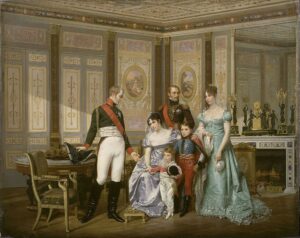
Tsar Alexander I of Russia with Josephine de Beauharnais, her son Eugène, her daughter Hortense, and Hortense’s children Napoleon Louis (the taller one) and Louis Napoleon (future Emperor Napoleon III) at the Château de Malmaison in 1814, by Jean Louis Victor Viger du Vigneau, painted circa 1863-70
Eugène became the Duke of Leuchtenberg and the Prince of Eichstädt. He lived as a Bavarian prince, managing his fortune and his estates. Eugène de Beauharnais died on February 21, 1824 in Munich, at the age of 42, from a series of brain hemorrhages. He is buried in St. Michael’s Church, Munich.
Napoleon’s stepdaughter, Hortense de Beauharnais

Hortense de Beauharnais by Anne-Louis Girodet de Roussy-Trioson, 1808
Eugène’s sister Hortense was 13 when Josephine married Napoleon. Hortense went to Madame Campan’s school at St. Germain, near Paris. Napoleon’s sister Caroline Bonaparte was also a student there, as was Hortense’s cousin Émilie de Beauharnais and James Monroe’s daughter Eliza.
Describing how Hortense helped to reconcile Napoleon to an unfaithful Josephine on his return from Egypt in 1799, Laure Junot wrote:
Bonaparte was, at this period, much attached to Eugène Beauharnais, who, to do him justice, was a charming youth. He knew less of Hortense; but her youth and sweetness of temper, and the protection of which, as his adopted daughter, she besought him not to deprive her, proved powerful advocates and overcame his resistance. (5)
Napoleon and Josephine decided that Hortense should marry Napoleon’s brother Louis, even though the two didn’t particularly like each other. As discussed in my post about Louis, the marriage, which took place on January 4, 1802, was miserable. Reflecting on it during his exile on St. Helena, Napoleon said:
There were faults on both sides. On the one hand, Louis was too teasing in his temper, and, on the other, Hortense was too volatile. … Hortense, the virtuous, the generous, the devoted Hortense, was not entirely faultless in her conduct towards her husband. This I must acknowledge in spite of all the affection I bore her, and the sincere attachment which I am sure she entertained for me. Though Louis’s whimsical humours were in all probability sufficiently teasing, yet he loved Hortense; and in such a case a woman should learn to subdue her own temper, and endeavour to return her husband’s attachment. Had she acted in the way most conducive to her interest, she might have avoided her late lawsuit, secured happiness to herself and followed her husband to Holland. Louis would not then have fled from Amsterdam, and I should not have been compelled to unite his kingdom to mine—a measure which contributed to ruin my credit in Europe. Many other events might also have taken a different turn. (6)
Hortense and Louis had three children: Napoleon Charles (b. Oct. 10, 1802), Napoleon Louis (Oct. 11, 1804) and Louis Napoleon (the future Napoleon III, born April 20, 1808). When four-year-old Napoleon Charles died on May 5, 1807, Napoleon thought that Hortense – who was by then Queen of Holland – was spending too much time grieving. He wrote to her on May 20:
My daughter – Every thing which reaches me from the Hague informs me that you are unreasonable. However legitimate may be your grief it should have its bounds. Do not impair your health. Seek consolation. Know that life is strewed with so many dangers, and may be the source of so many calamities, that death is by no means the greatest of evils. Your affectionate father. Napoleon. (7)
In a letter to Josephine on May 24, he added:
I see with pain that your grief is still unabated, and that Hortense has not yet arrived. She is unreasonable, and does not merit that one should love her, since she loves only her children. (8)
On June 2, he followed up with another letter to Hortense:
My daughter – You have not written me a word in your well-founded and great affliction. You have forgotten every thing, as if you had no other loss to endure. I am informed that you no longer love – that you are indifferent to every thing. I perceive it by your silence. This is not right, Hortense. It is not what you promised me. Your child was every thing to you! Your mother and I, are we nothing then? Had I been at Malmaison, I should have shared your anguish, but I should have also wished that you would restore yourself to your best friends. Adieu, my daughter! Be cheerful. We must learn resignation. Cherish your health, that you may be able to fulfill all your duties. My wife is very sad, in view of your condition. Do not add to her anguish. (9)
By 1810 Hortense and Louis were largely living apart. She began a relationship with Charles de Flahaut, who was rumoured to be Talleyrand’s illegitimate son. In September 1811, Hortense secretly gave birth to Flahaut’s son, Charles Auguste Louis Joseph, the future Duke of Morny, in Switzerland. Only Eugène, de Flahaut’s mother (who raised the child) and Hortense’s closest companions were aware of the pregnancy.
Like Eugène, Hortense remained part of the Imperial court even after her parents’ separation and Josephine’s death in 1814. After his final abdication in June 1815, Napoleon stayed at Malmaison with Hortense while he arranged for safe conduct to Rochefort. It was there that Hortense gave Napoleon the diamond necklace that Louis Marchand pulls out in Napoleon in America.
With the return of Louis XVIII to France, Hortense was compelled to go into exile. In 1817, she moved to the estate of Arenenberg in Switzerland, where she devoted herself to the education of her sons and entertained in her Parisian-style salon. Hortense was a talented singer, pianist and composer. There is a lovely video of soprano and pianist Paula Bär-Giese performing some of Hortense’s songs at Arenenberg.
Hortense de Beauharnais died at Arenenburg on October 5, 1837, at the age of 54. She is buried next to her mother in the Saint-Pierre-Saint-Paul church in Rueil-Malmaison.
You might also enjoy:
Napoleon II: Napoleon’s Son, the King of Rome
Napoleon’s Illegitimate Children: Léon Denuelle & Alexandre Walewski
10 Interesting Facts About Napoleon’s Family
Living Descendants of Napoleon and the Bonapartes
What did Napoleon’s wives think of each other?
- Barry E. O’Meara, Napoleon in Exile: or A Voice from St. Helena (Philadelphia, 1822), p. 116.
- Violette M. Montagu, Napoleon and his Adopted Son: Eugène de Beauharnais and His Relations with the Emperor (New York, 1914), pp. 124-126.
- Marie-Anne Adélaide Le Normand, Historical and Secret Memoirs of the Empress Josephine, translated by Jacob M. Howard, Vol. II (Philadelphia, 1848), p. 309.
- Napoleon and his Adopted Son, p. 375.
- Laure Junot, Memoirs of the Duchess d’Abrantès (New York, 1832), p. 212.
- Emmanuel- Auguste-Dieudonné de Las Cases, Mémorial de Sainte Hélène: Journal of the Private Life and Conversations of the Emperor Napoleon at Saint Helena, Vol. II (London, 1823), pp. 306-307.
- John S.C. Abbott, Confidential Correspondence of the Emperor Napoleon and the Empress Josephine, (New York, 1857), p. 168.
- Ibid., p. 168.
- Ibid., pp. 176-177.

René Savary, Duke of Rovigo by Robert Lefèvre, 1814
French soldier, diplomat and police minister René Savary, the Duke of Rovigo, has the reputation of being one of Napoleon’s most bloodthirsty aides. Though Napoleon could, and did, count on Savary to carry out any number of dark deeds, Savary was not by nature an evil person. He seems to have been motivated by a desire for wealth and by a genuine devotion to Napoleon. Savary’s involvement in the death of the Duke of Enghien meant that he was not trusted by the Bourbons after Napoleon’s defeat. He was later rehabilitated for a brutal stint as commander of the French forces in Algeria.
An object of preference
Anne Jean Marie René Savary was born on April 26, 1774 in Marcq, a village in the Ardennes department of northern France. He was the third son of cavalry officer Ponce Savary and his wife, Victoire Loth de Saussay. Savary’s mother died when he was seven, leaving the boys to grow up under their father’s rigorous discipline at the château de Sedan, a medieval fortified castle. Savary’s oldest brother was at the military school at Brienne at the same time as Napoleon. He also served with Napoleon as an artillerist in the regiment of La Fère.
René Savary was educated at the College of St. Louis in Metz. In 1790, at the age of 16, he joined the French cavalry regiment in which his father had served. He immediately saw action in the suppression of a mutiny at the garrison of Nancy.
Savary fought in several campaigns of the French Revolutionary Wars.
Steeled against fatigue, abstemious by habit, having already made some display of temerity, and being gifted by nature with a good memory, I had become an object of preference to my chiefs, when there was some hazardous enterprise to execute. (1)
Savary became an aide-de-camp to General Louis Desaix. He accompanied Desaix on Napoleon’s Egyptian campaign. Describing the charge of the mamelukes at the Battle of the Pyramids, Savary wrote:
Although the troops that were in Egypt had been long inured to danger…every one present at the battle of the Pyramids must acknowledge, if he be sincere, that the charge of those ten thousand mamelukes was most awful, and that there was reason, at one moment, to apprehend their breaking through our formidable square, rushing as they did upon them with a confidence which enforced a sullen silence in our ranks….
It seemed as if we must inevitably be trampled…under the feet of this cavalry of mamelukes, who were all mounted upon splendid chargers richly caparisoned with gold and silver trappings, covered with draperies of all colours, and waving scarfs, and who were bearing down upon us at full gallop, rending the air with their cries. (2)
General Desaix was killed at the Battle of Marengo in Italy in June 1800. Savary retrieved his body and broke the news to Napoleon.
I found the general stretched upon the ground completely stripped of his clothes, and surrounded by other naked bodies. I recognised him, notwithstanding the darkness, owing to the thickness of his hair, which still retained its tie.
I had been too long attached to his person to suffer his body to remain on this spot, where it would have been indiscriminately buried with the rest.
I removed a cloak from under the saddle of a horse lying dead at a short distance, and wrapped General Desaix’s body in it, with the assistance of an hussar, who had stayed on the field of battle, and joined me in the performance of this mournful duty. He consented to lay it across his horse, and to lead the animal by the bridle as far as Gorrofolo, whilst I should go to communicate the misfortune to the First Consul, who desired me to follow him to Gorrofolo, where I gave him an account of what had taken place. He approved what I had done, and ordered the body to be carried to Milan for the purpose of being embalmed. (3)
Napoleon’s aide
Impressed by Savary’s loyalty to his commanding officer, Napoleon made Savary his aide-de-camp. In 1801, René Savary was appointed commander of the elite gendarmes guarding the First Consul. He became a friend of Napoleon’s family. Savary was frequently invited to Josephine’s country estate of Malmaison, where he played in theatrical productions.
On February 27, 1802, Savary married Marie-Charlotte-Félicité de Faudoas-Barbazan de Segnanville, a 17-year-old classmate of Josephine’s daughter Hortense. Like Josephine, Félicité was a Creole, born in the French Caribbean. The couple went on to have seven children: Hortense Josephine (born in 1802), Léontine (1804), Louise (1807), Marie Charlotte (1811), Napoléon Marie René (1813), Anne Charlotte (1814), and Marie François Tristan (1816). Neither spouse was faithful. One of Savary’s mistresses was Madame du Cayla, later the mistress of Louis XVIII. Félicité also had a lover, Sébastiani, who is believed to have fathered her youngest son, the writer and adventurer Gustave Aimard.
In late 1803 Savary helped uncover the plot by Georges Cadoudal and Jean-Charles Pichegru to assassinate Napoleon. Like Pierre-François Réal, Savary’s reputation was tarnished by the subsequent arrest and execution, on March 21, 1804, of a Bourbon prince, the Duke of Enghien, on trumped-up charges. Savary was present at Enghien’s court-martial, but did not participate in it. The unanimous verdict was death. The presiding general said afterwards that he had tried to write to Napoleon with an appeal for mercy, but someone (understood to be Savary) had intervened to prevent the dispatch, an accusation Savary denied. Savary’s biographer, Thierry Lentz, says that no one could have saved Enghien; Napoleon wanted him dead. (4) Savary commanded the firing squad. General Henri Betrand’s wife Fanny later told Neil Campbell, the British commissioner who accompanied Napoleon to Elba, that
Savary ordered a lantern to be tied to the Duke d’Enghien’s breast, in consequence of his requesting that the soldiers would not fail in their shots. (5)
In 1805, René Savary, now a general, returned to the battlefield as Napoleon’s aide-de-camp. He undertook special diplomatic missions for Napoleon and organized a ring of spies for him. Savary was at the Battles of Austerlitz and Friedland. He assured the security of Warsaw, was named governor of Konigsburg, and in 1807 became an envoy extraordinaire to St. Petersburg. Upon returning to Paris, he returned to the elite gendarmerie. Savary accumulated a fortune as Napoleon rewarded him handsomely for his services. “He is a man,” said Napoleon, “that one must continually corrupt.” (6) At the same time, Napoleon knew that Savary would refuse him nothing.
If I ordered Savary to part with his wife and his children, I’m sure he would not hesitate. (7)
In 1808, Savary was named Duke of Rovigo. That same year Savary was sent to Spain, where he helped Napoleon remove the Spanish Bourbons from the throne.
In 1810, Napoleon appointed Savary Minister of Police, replacing Joseph Fouché. As such, Savary gained a reputation for censorship, cynicism and brutality. Savary stuck with Napoleon right up until the latter’s exile to Elba in April 1814. He was among the first to welcome Napoleon back when he returned to France in 1815. During the Hundred Days, Savary was appointed inspector-general of the gendarmerie. He remained with Napoleon after the defeat at Waterloo, and was among those pressing Napoleon to give himself up to England, rather than try to escape to the United States. Savary sailed to Plymouth with Napoleon on HMS Bellerophon. During this voyage he was described as “a very fine looking man, about 50, with a countenance expressive of superior talents.” (8)
Though he wanted to, Savary was not allowed to accompany Napoleon to St. Helena. Like Charles and Henri Lallemand and Charles Lefebvre-Desnouettes, Savary was among those proscribed by the French ordinance of July 24, 1815. This meant he was wanted for arrest and trial (under pain of death) for his actions during the Hundred Days. Recounting Savary’s despair at being separated from Napoleon, Charles de Montholon wrote:
He loved the Emperor with all his heart, and with such affection, that I can compare it to nothing else than that of a dog for his master. (9)
Napoleon later said on St. Helena:
Savary is a man of good heart, and a brave soldier. … He loves me with the affection of a son. (10)
Seeking rehabilitation
René Savary, with Charles Lallemand, was interned for several months at Malta. He escaped in April 1816, apparently with the English government’s agreement, and went to Turkey. On December 24, 1816, he was condemned to death in absentia by a French court. Savary wrote to Austrian Foreign Minister Clemens von Metternich asking for asylum. He reminded Metternich that he had been of assistance to Napoleon’s wife, Marie Louise, who was the daughter of Austrian Emperor Francis I. Savary was granted permission to live at Gratz in Stiria, where his wife visited him. French authorities became alarmed, however, when they heard rumours that Savary might be plotting to try to place Napoleon’s and Marie Louise’s son, the King of Rome, on the French throne. Austria acceded to French demands to expel Savary. In June 1819 he moved to London.
Meanwhile Savary’s wife had been trying to obtain a reversal of her husband’s sentence. In late 1819 Savary returned to France and surrendered. He was tried in a court-martial on December 27, 1819, and was found not guilty. There were probably negotiations between him and the French government to allow his acquittal in exchange for an agreement not to publish his memoirs. In light of Savary’s relationship with Madame du Cayla, these could have compromised King Louis XVIII as well as others.
Savary settled with his family on his estate at Nainville, outside of Paris. Not content with saving his neck, Savary thought he should be able to reclaim his previous privileges as a French officer. Instead he was put on half pay and transferred to reserve duty. Concerned about his diminished fortune, Savary pestered members of the royal administration who had served with him during the Consulate and Empire. He wanted full reintegration into the army and a dignified command. Madame du Cayla intervened on his behalf. Savary was granted several audiences with Louis XVIII, who was interested in finding out whether Savary could tell him anything about liberal or Bonapartist plots against his rule. As you will see in Napoleon in America, Savary may have been playing both sides.
Savary thought his turn had come when France was getting ready to intervene in Spain in 1823. He imagined that the French army had need of his knowledge of the country. He wrote to the Minister of War seeking a commission. The response was a polite refusal that invoked both the memory of the Duke of Enghien and Savary’s role during the Hundred Days. Savary persisted, pressing Prime Minister Villèle, to no avail. Though friends advised him not to, in the fall of 1823 he published his account of the Enghien affair. This excused both himself and Napoleon. He blamed Talleyrand for the Duke’s death. Talleyrand rallied Louis XVIII to his side, and the king forbade Savary from entering the Tuileries Palace. In December 1823 Savary was permanently retired from the army.
Savary turned to writing his memoirs, which he published in multiple volumes in 1828-1829. They are distinctly Bonapartist. Of Napoleon, he wrote:
No man ever did so much good, or met with so much ingratitude. Great stress will be laid upon the sacrifices which humanity had to endure and the wars which it was not in his power to avert, but no notice will be taken of the service which he exclusively conferred…. [H]is brilliant career remains to defend him; it is exclusively the offspring of his genius and his immortal works will long remain as objects of comparison difficult of attainment for those who shall attempt to imitate him; whilst Frenchmen will consider them as the proudest records in their history. They will also serve as an answer to all those attacks which a spirit of revenge never ceases to direct against them, and when time, which analyzes everything, shall have disarmed resentment, Napoleon will be held up to the veneration of history as the man of the people, as the hero of liberal institutions. (11)
René Savary after the 1830 Revolution
After a year in Italy, Savary and his wife returned to Paris after the July 1830 Revolution. Charles X had abdicated, and the new king, Louis-Philippe, did not hold the senior Bourbons’ grudge. Savary again asked to be reintegrated into the army. In December 1831 Savary was named governor of the French possessions in Africa and commander of the occupying army in Algeria. He quarrelled with his subordinates and ruled as a despot. In 1833, Savary, a heavy smoker, developed a sore throat that turned out to be cancer of the larynx. He lost his voice and returned to France, where he died on June 2, 1833. René Savary is buried at Père Lachaise cemetery in Paris.
Madame de Rémusat summed him up as follows:
Savary, the object of general terror, despite his conduct…was not fundamentally a bad man. His dominant passion was a taste for money. Without any military talent…he had to dream of making his fortune by means other than those employed by his companions in arms. He saw a way forward in following the system of cunning and denunciations that Bonaparte favoured, and having once been introduced to it, it was not possible for him to think of retiring. He was better than his reputation…. He had reasons to know Bonaparte and tremble before him. When he was minister, he dared allow himself some shadow of resistance, and thus showed himself accessible to a certain desire to recommend himself to public opinion…. The emperor carefully cultivated among men all shameful passions; under his reign, they were particularly productive. (11)
There is no biography in English of René Savary. Thierry Lentz has written a fine one in French: Savary: le séide de Napoléon (Fayard, 2001). You can read extracts of Savary’s memoirs (in English) on the War Times Journal website. His full memoirs are available for free on the Internet Archive.
You might also enjoy:
Napoleon’s Policeman, Pierre-François Réal
General Charles Lallemand: Invader of Texas
Why didn’t Napoleon escape to the United States?
Assassination Attempts on Napoleon Bonaparte
Gustave Aimard, the Frenchman Who Wrote Westerns
- Anne Jean Marie René Savary, Memoirs of the Duke of Rovigo Illustrative of the History of the Emperor Napoleon, Vol. I (London, 1828), p. 6.
- Ibid., p. 157.
- Ibid., pp. 181-182.
- Thierry Lentz, Savary: le séide de Napoléon (Paris, 2001), pp. 120-121.
- Neil Campbell, Napoleon at Fontainebleau and Elba (London, 1869), p. 295.
- Paul de Rémusat, ed., Mémoires de Madame de Rémusat, Vol. II (Paris, 1880), p. 245.
- Ibid., p. 245.
- “Buonapartiana,” The Gentleman’s Magazine and Historical Chronicle, Vol. 85 (London, December 1815), p. 517.
- Charles Tristan Montholon, History of the Captivity of Napoleon at St. Helena, Vol. 1 (Philadelphia, 1846), p. 113.
- Barry E. O’Meara, Napoleon in Exile; or A Voice from St. Helena, Vol. I (New York, 1853), p. 163.
- Memoirs of the Duke of Rovigo, Vol. IV, pp. 185-186.
- Mémoires de Madame de Rémusat, Vol. II, pp 245-247.
Louisa Adams, the wife of John Quincy Adams, was the first foreign-born First Lady of the United States. Louisa was literate, a fashionable dresser, and had polish and charm thanks to many years spent in Europe. She used her social skills to make up for her husband’s inadequacies. In 1815, Louisa Adams made a dangerous journey to join her husband in Paris, in which she encountered the effects of the Napoleonic Wars firsthand.
Louisa Adams by Charles Robert Leslie, 1816
Born in London
Louisa Catherine Johnson was born in London, England, on February 12, 1775, to an American father – Joshua Johnson, a Maryland merchant – and an English mother, Catherine Nuth. Louisa was the second of eight children. She grew up in London and in Paris, where her family took refuge from 1778 to 1783, since her father sided with the Patriots during the American Revolution. As a result, Louisa spoke French fluently.
Louisa got to know John Quincy Adams in 1795, when he was on a temporary diplomatic assignment in London. Her father was the American consul in the city. They had met twice before, when they were children. It was not a particularly romantic courtship. When Adams was unexpectedly promoted to the post of American minister to Portugal, he had to choose between marrying Louisa earlier than they had planned, or postponing the wedding for three years. At first, he opted for the latter. To Louisa’s suggestion that he might place their happiness before his career plans, he replied, “My duty to my country is in my mind the first and most imperious of all obligations; before which every interest and every feeling inconsistent with it must forever disappear.” (1)
Louisa’s father intervened. The couple was married on July 26, 1797, at the Church of All Hallows by the Tower in London. Instead of Portugal, Adams was posted to Prussia. He and Louisa lived in Berlin for four years. In 1801, they moved to Massachusetts, where their three sons were born: George in 1801, John in 1803 and Charles Francis in 1807.
A diplomatic wife
In 1809, Adams was appointed the first ever United States minister (ambassador) to Russia. Louisa and Charles accompanied him to St. Petersburg. Young George and John were left to be schooled in the United States, under the care of Adams’ parents. Adams made this decision without consulting Louisa, who was understandably distraught when she found out.
As discussed in my post about Dorothea von Lieven, diplomatic wives could be invaluable aids to their husbands’ missions in early 19th century Europe. Though not as politically interested or as involved as Dorothea, Louisa Adams was a great help to her husband in Russia. Her cordiality compensated for his lack of social graces. She became a favourite of Tsar Alexander and his wife.
The Adams’ marriage, though not overwhelmingly happy, could be considered a success. Adams wrote in his diary on July 26, 1811:
I have this day been married fourteen years, during which I have to bless God for the enjoyment of a portion of felicity, resulting from this relation in society, greater than falls to the generality of mankind and far beyond anything that I have been conscious of deserving. Its greatest alloy has arisen from the delicacy of my wife’s constitution, the ill health which has afflicted her much of the time, and the misfortunes she has suffered from it. Our union has not been without its trials, nor invariably without dissensions between us. There are many differences of sentiment, of tastes and of opinions in regard to domestic economy, and to the education of children, between us. There are natural frailties of temper in both of us; both being quick and irascible, and mine being sometimes harsh. But she has always been a faithful and affectionate wife, and a careful, tender, indulgent, and watchful mother to our children, all of whom she nursed herself. I have found in this connection from decisive experience the superior happiness of the marriage state over that of celibacy, and a full conviction that my lot in marriage has been highly favored. (2)
Some of Louisa’s episodes of ill health were occasioned by pregnancies and miscarriages. When Adams wrote the above passage, Louisa was eight months pregnant with their daughter, also named Louisa, who was born on August 12, 1811. Sadly, the little girl died a year later, on September 15, 1812.
In Napoleon’s footsteps
In April 1814, John Quincy Adams was summoned to Belgium to take part in the United States negotiations with Britain to end the War of 1812. When the Treaty of Ghent was completed, he moved to Paris to await official notice of his new appointment as the US minister to Great Britain. He wrote to Louisa, inviting her to join him.
On February 12, 1815, Louisa Adams began a harrowing 2,000 mile journey from St. Petersburg to Paris with 7-year-old Charles, a governess and two servants. They followed, in part, the route Napoleon’s Grande Armée had taken during its retreat from Russia two years earlier. Louisa found signs of the Napoleonic Wars everywhere.
The season of the year at which I travelled, when earth was chained in solid fetters of ice, did not admit of flourishing description, but the ways were rendered deeply interesting by the fearful remnants of men’s fury. Houses half burnt, a very thin population, women unprotected, and that dreary look of forlorn desertion which sheds its gloom around on all objects, announcing devastation and despair. (3)
At Kustrin we found a tolerable house, but were not allowed to go within the fort. To my utter astonishment I heard nothing but the praises of the gallantry of Napoleon and his officers, and great regret at the damage done to this beautiful fortress; and learnt that from thence I should travel over the most beautiful road in the world which had been completed by his order, and that it would all have been finished in the same way if the Allies had not driven him away. The desolation of this spot was unutterably dismal; and the guarded tone of the conversation, the suppressed sighs, the significant shrug, were all painful indications of the miseries of war, with all its train of horrors. The Cossacks! the dire Cossacks! were the perpetual theme, and the cheeks of the women blanched at the very name. (4)
At Hanau, she observed, about a mile before the town, “several small mounds marked with crosses on the sides of the road, like graves. We entered on a wide extended plain, over which, as far as the eye could reach, were scattered remnants of boots, clothes, and hats or caps, with an immense quantity of bones bleaching in all directions in a field which appeared to have been newly ploughed. My heart throbbed and I felt a sensation of deadly sickness with a fear that I should faint, guessing where I was….” (5)
By the time Louisa reached Strasbourg, she was exhausted.
My health was dreadful and the excessive desire which I felt to terminate this long and arduous journey absolutely made me sick. I had been absent a year from my husband and five long, long years and a half from my two eldest-born sons, whom I had left in America with their grandparents. War had intervened and free communication, in addition to the accustomed impediments from the climate, had conduced to add to my anxieties. Every letter had brought me accounts of the loss of near and dear relatives whom I never more should see…and nothing but the buoyant hope of soon embracing those long separated and loved, sustained me through the fatigue and excitement to which I was necessarily exposed. (6)
While Louisa Adams was making her way across the continent, Napoleon escaped from exile on Elba. He, too, was headed for Paris. Once in France, Louisa’s little group, in its Russian carriage, found themselves in the midst of Imperial Guards hastening to join the Emperor. Mistaking them for Russians, the soldiers threatened to tear Louisa and her party out of the carriage and kill them. Louisa presented her passports to an officer. He told the troops she was an American going to meet her husband in Paris. The soldiers shouted, “Vive les Americains!” They wanted her to cry “Vive Napoléon!”, which she did, waving her handkerchief out the carriage window. (7)
The undisciplined troops accompanied Louisa to the next post house, with orders to fire if the carriage went any faster than a walk. “In this way we journeyed; the soldiers presenting their bayonets at my people with loud and brutal threats every half hour. The road lined on each side for miles with intoxicated men, rife for every species of villainy, shouting and vociferating: ‘Á bas Louis dix huit! Vive Napoléon!’” (8) A rumour spread that she was one of Napoleon’s sisters hurrying to join him.
Louisa Adams reached Paris on March 23, three days after Napoleon. (For more about John Quincy Adams and Napoleon, see my earlier post.)
A political wife

Louisa Adams by Charles Bird King, circa 1821-1825
On May 23, 1815, John Quincy and Louisa Adams (with young Charles) left France for a two-year stay in London, which they both loved. Their sons George and John, whom Louisa had not seen for six years, joined them. In 1817, they returned to the United States, where John Quincy became secretary of state. Louisa applied herself to advancing his career.
Though she was by nature timid, Louisa Adams delighted in society and enjoyed entertaining. She regularly gave dinner parties for members of Congress. In early 1820, she started hosting Tuesday night “sociables,” to which women were also invited. These were large parties – the first attracted some 200 guests – complete with food, card-playing, music and dancing. As we see at her sociable in Napoleon in America, Louisa often provided entertainment herself. She had a good singing voice and played the harp and the piano.
In addition to being a regular source of fun during the Washington winters, Louisa’s sociables served the political purpose of winning friends and allies for her husband. Introducing a social innovation, Louisa added a subscription aspect to her gatherings. Guests were invited not to a single occasion, but to a whole series of sociables. Those accepting the invitation were expected to attend only that set of parties throughout the season. Though other Cabinet families imitated her, Louisa’s events remained the most popular. The Adams’ home on F Street ranked with the White House as a social centre.
Massachusetts Congressman Elijah Hunt Mills described one such gathering in December 1820:
On Tuesday evening I went to Mrs. Adams’s, where I found forty or fifty people of different sexes collected from all parts of the Union, and crammed into a little room just large enough to contain them when standing up in groups. I went about half-past eight, made a bow to Mrs. Adams, had a few minutes’ conversation with her husband, drank a cup of tea, conversed an hour with whomsoever I could find in the crowd, took some ice-cream, and returned home about ten o’clock; and a more unsocial and dissonant party I have seldom been in, even in this wilderness of a city. On Thursday I dined at the same house, and as the party consisted mostly of people with whom I am well acquainted, I passed the time very pleasantly. … Mrs. Adams is, on the whole, a very pleasant and agreeable woman; but the Secretary has no talent to entertain a mixed company, either by conversation or manners. He is, however, growing more popular, and, if he conducts with ordinary prudence, may be our next president. I have not yet been to any other parties, nor do I feel any inclination so to do. (9)
Giving a sense of the political value of the sociables, John Quincy Adams wrote in February 1821:
My wife had this evening her weekly tea party which was very numerously attended. Among the company was Henry Brush of Ohio…. In the course of the evening he told me, commencing rather abruptly the conversation, that he had made up his mind that I was the most suitable person for the next Presidency…I told him that I was obliged to him for his good opinion, but that four years was too long a term to look forward for candidates on that occasion….. (10)
Louisa Adams and the Jackson Ball
Despite his protests, John Quincy Adams wanted the presidency. Louisa Adams fully supported his quest. In the run-up to the 1824 presidential election, they calculated that hosting a grand ball for Andrew Jackson, on the 10th anniversary of his victory at the Battle of New Orleans, would be a coup. Louisa threw herself into preparations. She cleared the furniture out of two stories of the house. She took doors off their hinges and rearranged the rooms, turning John Quincy’s library and study into a ballroom. She had pillars installed to prop up the second floor, where dinner would be served. She wove garlands and wreaths, designed patterns to be chalked onto the dance floor, and hired members of the Marine Band to play. To guide the way to the house, bonfires were lit for two blocks around.
At half past seven…the guests began to arrive in one continual stream so that in one hour even the staircase…began to be thronged. [Louisa and John Quincy Adams] took our stations near the door that we might be seen by our guests and at the same time receive the general. (11)
Even the curmudgeonly Elijah Hunt Mills wrote, on January 9, 1824:
I went last night, for the first time this season, to an evening party at Mr. Adams’s. It was a party given, as you know, in honor of General Jackson. He was kind enough to insist on my going in a carriage with him. We arrived about eight o’clock, and such a crowd you never witnessed. Eight large rooms were open, and literally filled to overflowing. There must have been at least a thousand people there ; and so far as Mrs. Adams was concerned, it certainly evinced a great deal of taste, elegance, and good sense. I wandered, or rather pushed my way, through all the rooms, gazed on the crowd, came round to the supper-room about half-past nine, and left there about ten. Many stayed till twelve and one. I am good for nothing, to describe such a scene in detail; but it is the universal opinion that nothing has ever equalled this party here, either in brilliancy of preparation or elegance of the company. (12)
Unfortunately, Jackson himself decided to enter the 1824 presidential campaign. He won a plurality of the electoral votes, but not enough to prevent the election going to the House of Representatives to make the final decision. The House elected John Quincy Adams president, after Henry Clay (the third leading candidate) threw his support behind Adams. Louisa was too ill to attend her husband’s inaugural ball.
For Louisa Adams’ life as First Lady (1824-1829) and afterwards, see her biography on the National First Ladies’ Library website.
Louisa Adams died of a heart attack in Washington on May 15, 1852, at the age of 77. She is buried beside her husband in the United First Parish Church in Quincy, Massachusetts.
You might also enjoy:
John Quincy and Louisa Adams: Middle-Aged Love
When Louisa Adams Met Joseph Bonaparte
John Quincy Adams and Napoleon
The New Year’s Day Reflections of John Quincy Adams
The Inauguration of John Quincy Adams
John Quincy Adams’ Swimming Adventures
John Quincy Adams’ Report Upon Weights and Measures
John Quincy Adams and the White House Billiard Table
How to Make Small Talk in the 19th Century
- Worthington Chauncey Ford, ed., Writings of John Quincy Adams, Vol. 2 (New York, 1913), p. 109.
- Charles Francis Adams, ed., Memoirs of John Quincy Adams, Vol. 2 (Philadelphia, 1874), pp. 282-83.
- Brooks Adams, ed., “Mrs. John Quincy Adams’s Narrative of a Journey from St. Petersburg to Paris in February, 1815,” Scribner’s Magazine, Vol. 34 (July-December 1903), p. 453.
- Ibid., p. 454.
- Ibid., pp. 457-458.
- Ibid., p. 460.
- Ibid., p. 461.
- Ibid., p. 462.
- Proceedings of the Massachusetts Historical Society, Vol. 19 (Sept. 1881), p. 28.
- Memoirs of John Quincy Adams, Vol. 5, p. 305.
- Catherine Allgor, Parlor Politics: In Which the Ladies of Washington Help Build a City and a Government (Charlottesville and London, 2000), p. 180.
- Proceedings of the Massachusetts Historical Society, 19 (Sept. 1881), p. 40.

Jerome Napoleon Bonaparte
Jerome Napoleon Bonaparte was the son of Napoleon’s youngest brother Jérôme and Baltimore socialite Elizabeth (Betsy) Patterson. As Napoleon had broken up his parents’ marriage before Jerome was even born, Napoleon never acknowledged the boy as a Bonaparte. Despite Betsy’s best efforts to raise her son as a European of rank and fortune, Jerome preferred life in the United States.
Raising a potential prince
Jerome Napoleon Bonaparte was born on July 7, 1805 in Camberwell, which was then a separate town south of London in the United Kingdom. His mother brought him to the United States a few months after his birth. Jerome spent his childhood under the care of Betsy and her father, the wealthy Baltimore merchant William Patterson. Betsy nicknamed Jerome “Bo.” She also called him “Cricket.” Though the Pattersons were Protestants, Betsy had Jerome baptized as a Catholic, hoping that the Bonapartes might one day acknowledge him in the imperial line of succession.
Betsy believed that Jerome should receive an education suitable to a person of high status. He took his early schooling at Mount St. Mary’s College in Emmitsburg, Maryland. When Jerome was 14, Betsy moved to Geneva and placed him in a school there. One gets a sense of the boy’s life from a letter Betsy wrote to her father in April 1820.
The French Chargé at Amsterdam refused me a passport for [Bo] to travel through France.… [H]e said his resemblance to the emperor was so striking that it would expose me to great inconvenience in that country….
[T]his child has more conversation and better manners, a more graceful presentation than other children of his age…and I am constantly tormented with the fear of seeing him spoiled by the compliments paid him in society. … He has grown taller and much better looking; he is thought very handsome, but I do not myself think him by any means a beauty, and regret that others tell him so, as it is a kind of praise which never made any one better or happier. …
Bo has written to you for money to buy a horse, which I beg you not to send him. He pretends it will be more economical for him to keep a horse than for me to pay nine francs per week for riding lessons; but I prefer paying twice that sum rather than allow him to ride about the country. …
Bo has lessons of every kind. His hours of recreation are filled by dancing, fencing and riding…. He speaks French very fluently, as he takes all his lessons in this language, the knowledge of which I always considered highly important in his circumstances. (1)
Meanwhile, Bo was keen to get back to the United States. He wrote to his grandfather: “Since I have been in Europe I have dined with princes and princesses and all the great people in Europe, but I have not found a dish as much to my taste as the roast beef and beef-steaks I ate in South Street” (at his grandfather’s house). In another letter he added,
I never had any idea of spending my life on the continent; on the contrary as soon as my education is finished, which will not take me more than two years longer, I shall hasten over to America, which I have regretted ever since I left it. (2)
Marriage hopes
Betsy pinned her hopes for Bo’s future on his education and a good marriage, and on the Bonaparte connection. After Napoleon’s death in May 1821, it became Betsy’s project to get her son recognized by the Bonaparte family and thereby secure some funds for him. To this end she took Jerome to Rome for the winter of 1821-22, where he charmed his grandmother, Letizia Bonaparte, and his aunt Pauline Borghese. In December 1821 Jerome wrote to his grandfather:
I have been received in the kindest manner possible by my grandmother, my uncles, and aunts, and cousins, and all my nearest and most distant relations, who are in Rome. We mean to stay here during the winter.… I have been so much occupied in looking for apartments for mamma, making tight bargains, and seeing my relations that I have not had time to see anything of Rome, except St. Peter’s celebrated church, which I have seen but superficially. (3)
While Jerome was in Rome, the Bonapartes conceived the idea of marrying him to Joseph Bonaparte’s youngest daughter Charlotte. Here is Betsy’s take on the proposition, from a letter she wrote to her father in January 1822:
As I plainly see, it is the only sure way of relieving myself of the expense he occasions me and I can ill afford. … I do, indeed, regret that there is no one of the whole [Bonaparte] connection rich enough to allow me twelve hundred dollars a year for Bo’s maintenance. … He has resumed his family name, which piece of vanity may give me some trouble about his passports. … I can only say I have spent my time and money on this boy. (4)
Jerome wrote to his grandfather at the same time.
My grandmother and my aunt and uncle talk of marrying me to my uncle’s, the Count of Survilliers’ daughter, who is in the United States. I hope it may take place, for then I would return immediately to America to pass the rest of my life among my relations and friends. Mamma is very anxious for the match. My father is also, and all of my father’s family, so that I hope you will also approve of it. (5)
Just as he does in Napoleon in America, Jerome arrived in April 1822 at Joseph Bonaparte’s estate in Bordentown, New Jersey, with instructions to charm Charlotte and her father. Though Joseph liked the boy, whom he had met once before, he preferred to marry Charlotte to a cousin formally recognized as a Bonaparte.
A Bonaparte at Harvard
With a Bonaparte marriage off the cards, Betsy’s next plan for Bo’s advancement was to get him enrolled at Harvard. After eight months’ preparation under a tutor in Lancaster, Mass., Jerome Napoleon Bonaparte was admitted to Harvard in February 1823. He requested and received an exemption from having to attend Protestant services in the college chapel.
I would appear very inconsistent, if, after having stayed away from their church for upwards of a year, I were to go there now; and as I have been brought up a Catholic, I would not wish to change my religion; and moreover, my grandmother and several of my father’s family being great devotees, they would think it a crime were I to enter a heretical church. (6)
Jerome was suspended for three months in 1824 for an incident involving drinking with members of his college club. He took advantage of the break in his studies to meet with the Marquis de Lafayette, who was then visiting Boston.
Jerome graduated from Harvard in 1826 with a law degree. Encouraged by his mother, he went back to Italy for another visit with the Bonapartes. This time he finally got to meet his father, with whom he had been in correspondence. Jérôme Sr. was not keen on the visit, fearing it that it might be construed by the royal courts of Württemberg and Russia as an attempt to invalidate Jérôme’s marriage to Princess Catharina of Württemberg. Despite this, the visit went well. Bo wrote to his grandfather in December 1826: “From my father I have received the most cordial reception, and am treated with all possible kindness and affection.” (7) Still, he pined for home. A month later he wrote:
I have now been three months with my father: two in the country, and one month at Rome. He continues always very kind to me; but I see no prospect of his doing anything for me. … My father is very anxious for me to remain with him altogether, but I cannot think for a moment of settling myself out of America, to whose government, manners, and customs I am too much attached and accustomed, to find pleasure in those of Europe, which are so different from my early education. … [W]ith my father I am living in a style which I cannot afford, and to which, if I once became accustomed, I should find it very difficult to give up; moreover, I am now of an age in which I must think of doing something for myself, and America is the only country where I can have an opportunity of getting forward. (8)
In 1827 Jerome Napoleon Bonaparte returned to the United States. In November 1829, to his grandfather’s satisfaction and his mother’s chagrin, he married a wealthy Baltimore girl, Susan May Williams (b. 1812). Her father was one of the founders of the first intercity railroad company in the United States, the Baltimore and Ohio Railroad. Susan came with a $200,000 dowry. William Patterson gave the newlyweds Montrose Mansion.
Jerome’s father and the Bonaparte relatives congratulated Jerome on the marriage. Betsy reconciled herself to it.
I tried to give him the ideas suitable to his rank in life; having failed in that, there remains only to let him choose his own course. … When I first heard that my son could condescend to marry any one in Baltimore, I nearly went mad. Every one told me that it was quite impossible for me to make him like myself, and that, if he could endure the mode of life and the people in America, it was better to let him follow his own course than to break off a marriage where there was some money to be got, and leave him to marry a person of less fortune. I have no dislike to the woman he has married. … I must try and content myself by the reflection that I did all I could to disgust him with America. (9)
The American farmer

Jerome Napoleon Bonaparte in his old age
With his fortune now assured, Jerome devoted himself to the management of his large estate and the cultivation of his farm. An 1842 newspaper article noting Jerome’s chairmanship of a committee of a Maryland Agricultural Society (“to award premiums for the best show of horses”), dubbed him “the American farmer.” (10) He was, by all accounts, an amiable and polished man.
Jerome and Susan had two sons, Jerome Napoleon Bonaparte II, born on November 5, 1830, and Charles Joseph Bonaparte, born on June 9, 1851.
During the reign of King Louis Philippe, Jerome and Susan were allowed to visit Paris, but only under the name of Patterson. This they did in 1839.
When Jerome’s cousin Louis Napoleon (the son of Louis Bonaparte) ascended the French throne as Napoleon III, he invited Jerome and his eldest son to visit France. They arrived in Paris in June 1854 and dined with the Emperor at the Palace of Saint Cloud. Napoleon III restored the right of Jerome and his descendants to use the Bonaparte name; however, they were denied any rights of affiliation and continued to be excluded from the line of succession. Recognizing Jerome Napoleon Bonaparte as a true prince of the family would have made Jérôme Sr.’s children with Catharina of Württemberg illegitimate.
Napoleon III also invited Jerome’s son, Jerome Napoleon II, who had studied at the US Military Academy at West Point and served in Texas with the Regiment of Mounted Riflemen, to join the French army. Jerome Napoleon II resigned from the US Army and proceeded to Crimea as a French lieutenant of dragoons. He also fought in Algeria, in Italy and in the Franco-Prussian War before returning to the United States. He was highly decorated for his services.
Jerome Napoleon Bonaparte died of throat cancer on June 17, 1870, at the age of 64. One obituarist noted:
Efforts have been made to induce him to assert his claims to the family honors; but being of a modest and unambitious nature, he preferred to cultivate corn and cabbages to entering the arena of French politics. (11)
A later journalist observed:
Mr. Bonaparte was a gentleman of refined taste and culture. His late residence in Baltimore is probably the most interesting in the South, and in Napoleonic portraits, curiosities and relics, it is, perhaps, the most interesting in America. One room in the house is entirely devoted to Bonaparte. (12)
Jerome Napoleon Bonaparte is buried in Loudon Park Cemetery in Baltimore. His father had died in 1860, without making any provision for him in his will. His mother and his wife outlived him. Jerome Napoleon Bonaparte II married the granddaughter of Daniel Webster, had two children, and died in 1893. His younger brother Charles graduated from Harvard and served in President Theodore Roosevelt’s cabinet as US Secretary of the Navy and, later, as US Attorney General. He helped create the Bureau of Investigation, the precursor to the FBI. Charles died childless in 1921.
You might also enjoy:
Elizabeth Patterson Bonaparte, Napoleon’s American Sister-in-Law
Joseph Bonaparte: From King of Spain to New Jersey
Charlotte Bonaparte, Napoleon’s Artistic Niece
How Pauline Bonaparte Lived for Pleasure
Napoleon’s Mother, Letizia Bonaparte
Living Descendants of Napoleon and the Bonapartes
10 Interesting Facts About Napoleon’s Family
- Eugène Lemoine Didier, The Life and Letters of Madame Bonaparte (New York, 1879), pp. 63-64.
- Ibid., p. 74.
- Ibid., p. 84.
- Ibid., pp. 87-88.
- Ibid., p. 87.
- Ibid., p. 117.
- Ibid., p. 195.
- Ibid., p. 198.
- Ibid., p. 221.
- The North American And Daily Advertiser (Philadelphia), Nov. 2, 1842.
- Daily Evening Bulletin (San Francisco), June 18, 1870, p. 2.
- “The Baltimore Bonapartes,” Scribner’s Monthly, Vol. X, No. 1 (May 1875), p. 8.

Elizabeth Patterson Bonaparte by Gilbert Stuart, 1804
Elizabeth Patterson Bonaparte was a Baltimore belle who wrote that “nature never intended me for obscurity.” (1) She became an international celebrity when she married Napoleon’s youngest brother Jérôme. When Napoleon convinced Jérôme to abandon her, Betsy (as she was known) became America’s most famous single mother.
From Mademoiselle Patterson to Madame Bonaparte
A hustler with a high opinion of herself, Elizabeth Patterson Bonaparte had a brilliant social career and a very long life, though her letters do not leave the impression of a kind or a happy person. As an early biographer wrote:
This Baltimore girl, married at eighteen and deserted at twenty, seems to have possessed the savoir vivre of Chesterfield, the cold cynicism of Rochefoucauld, and the practical economy of Franklin. (2)
Elizabeth Patterson was born on February 6, 1785, the eldest daughter of wealthy Baltimore merchant William Patterson and his wife Dorcas Spear, who ultimately had 13 children. In the fall of 1803 Betsy met Napoleon’s youngest brother Jérôme Bonaparte at the home of Samuel Chase, one of the Maryland signers of the Declaration of Independence. Jérôme, a feckless 19-year-old lieutenant in the French navy, had left his warship in Martinique to visit the United States, though Napoleon had denied him permission to do so.
Betsy was beautiful, witty and ambitious. She spoke fluent French. Jérôme was smitten. He proposed soon after they met. Elizabeth’s father gave his reluctant consent only when Elizabeth threatened to elope. She reportedly declared that she would “rather be the wife of Jérôme Bonaparte for an hour, than the wife of any other man for life.” (3) They were married on December 24, 1803 by John Carroll, the first Catholic bishop in the United States.
The couple were the toast of Baltimore society. Betsy courted publicity, not least through her fondness for wearing thin, low-cut gowns. These were then the fashion in France, but were considered revealing by American standards. An observer at her wedding reported, “all the clothes worn by the bride might have been put in my pocket.” (4) Jérôme and Betsy toured Washington and the northeastern states, meeting “one continual round of hospitality and brilliant entertainment” in Philadelphia, New York, Boston, Albany and elsewhere. They were one of the first couples to honeymoon at Niagara Falls.
Napoleon’s reaction
When Napoleon learned of the marriage, he was furious. He had in mind a dynastic alliance for his brother, not a union with a commoner. He cut off Jérôme’s allowance and ordered him to return to France alone. Arguing that Jérôme was a minor who could not marry without the consent of his guardians, Napoleon prohibited recognition of the marriage in France and insisted that it be annulled. Thinking that if Napoleon could meet Betsy in person, he would change his mind, Jérôme and his now pregnant wife sailed for Europe in early 1805. An attempt to leave in the fall of 1804 had been thwarted when their ship was wrecked by a storm near Philadelphia. When they reached Lisbon, a French guard refused to allow Betsy to land. Napoleon had forbidden “Mademoiselle Patterson” to set foot on French soil. Betsy told Napoleon’s emissary:
Tell your master that Madame Bonaparte is ambitious, and demands her rights as a member of the imperial family. (5)
The couple agreed that Jérôme would go to Milan to try to placate Napoleon. Napoleon refused to see Jérôme. He wrote to him on May 6, 1805:
Your union with Mademoiselle Patterson is null, alike in the eyes of religion and of the law. Write Mademoiselle Patterson to return to America. I will grant her a pension of 60,000 francs during her lifetime, on condition that she will under no circumstances bear my name, – she has no right to do so owing to the non-existence of her marriage. You must give her to understand that you are powerless to change the nature of things. Your marriage being thus annulled by your own consent, I will restore to you my friendship and continue to feel for you as I have done since your infancy, hoping that you will prove yourself worthy by the efforts you make to acquire my gratitude and to distinguish yourself in my armies. (6)
Excluded from the ports of continental Europe, Betsy sailed to England to have the baby. She arrived at Dover on May 19, 1805. Prime Minister Pitt had to send a military escort to keep back the crowd. On July 7, Betsy gave birth to Jerome Napoleon Bonaparte at Camberwell, near London.
Napoleon threatened to remove Jérôme senior from the line of succession, to refuse to pay his large debts, and to ban him from France and all its territories. Lacking the backbone of his brother Lucien, of whose marriage Napoleon also disapproved, Jérôme caved in. Although Jérôme sent Betsy letters saying he was as attached to her as ever, after leaving him at Lisbon Betsy never saw her husband again, except for a chance encounter in 1822. Their marriage was declared invalid in the French courts (Pope Pius VII refused to annul it). In 1807, Napoleon rewarded Jérôme by making him King of Westphalia, and married him off to Princess Catharina of Württemberg.
In search of rank and fortune
Elizabeth Patterson Bonaparte and the baby (whom she nicknamed “Bo”) returned to Baltimore, where Betsy continued to call herself Madame Bonaparte. Refusing to melt quietly into the background, she adopted French manners, was active in society, and made clear to others that she considered the United States inferior to Europe. Desiring financial and legal independence, she filed for divorce from Jérôme in the United States. This was granted by a special act of the Maryland legislature. The pension promised by Napoleon was paid to her until his first abdication in 1814.
After Napoleon’s final abdication in 1815, Betsy went to England. She settled in Cheltenham, leaving Bo at school in Maryland. In addition to believing that there was an accumulation of bile on her liver, which required a change of climate, Betsy considered England more congenial to her beauty and talents. Shortly after arriving, she wrote to her father that she was happy to be in a country where she was “cherished, visited, respected and admired.”
I am in the first society in Europe, and that, too, for my personal merits; for, without vanity I may say so, since I have neither rank, fortune, nor friends of my own, willing to assist or protect me. I acknowledge that the standing I possess in this country is highly flattering, and that it is not surprising I should prefer people of rank and distinction who are willing to notice me. Their attentions are very gratuitous, for I am a very poor stranger, and a very unfortunate one on many accounts. (7)
Betsy also fancied that she might find a husband in Europe. She scolded her father for suggesting to an acquaintance that she had gone to England against the wishes of her friends.
In Europe a handsome woman who is likely to have a fortune may marry well; but if it gets about that her parents are dissatisfied with her, they will think she will get nothing by them, and if she had the beauty of Venus and the talents of Minerva, no one will marry her…. The reputation of your fortune would be a great advantage to me abroad… I beg that, whatever you may think, you will say nothing and especially write nothing about me, unless it be something likely to advance me. (8)
After a visit to Paris, Betsy returned to Baltimore in the summer of 1816. In May 1819, she again sailed for Europe, this time with Bo, whom she placed at a school in Geneva. According to Bo, they lived modestly.
Mamma lives now in town, in the cheapest way possible, on account of the troubles in Baltimore. She has no man-servant, but one single woman, who does the business of waiter and femme de chamber. (9)
At the same time, Betsy kept up her social life. Bo wrote to his grandfather in November 1820:
Mamma goes out nearly every night to a party or a ball. She says she looks full ten years younger than she is, and if she had not so large a son she could pass for five and twenty years old. She has a dancing-master and takes regularly three lessons a week, and has done so for the last six months; is every day astonished at the progress she makes and is fully determined to dance next winter. She constantly regrets that she had not danced at Paris. (10)
Betsy and the Bonapartes
While they were in Geneva, Betsy learned that Pauline Bonaparte desired to see her and Bo in Rome. It was suggested that Pauline, who had no living children of her own, might even make a financial provision for Bo. Though Betsy’s obsession with rank and fortune extended to her son, and she was determined to secure for him the status to which she believed he was entitled, she was under no illusion about the Bonapartes. She was concerned that taking Bo to see Pauline carried the risk of
exposing him to the danger of contracting habits of expense entirely unsuitable to my means of expenditure, at the same time losing the most valuable part of his life in idleness; the consequence would be that, after having spoiled him, he would be left to me to support. I cannot say that I have least reliance upon that family….
My resolution is uninfluenced by personal feelings, never having felt the least resentment toward any individual of that family, who certainly injured me, but not from motives which could offend me; I was sacrificed to political considerations, not to the gratification of bad feelings, and under the pressure of insupportable disappointment became not unjust. (11)
Despite her misgivings, Betsy decided to spend the winter of 1821-22 in Rome. She took Bo with her. In letters to her father, she was frank about her motives.
I am desirous to profit by every remote chance of wealth for him, and at the same time conscious that a good education is the only certain advantage I can command for him. I wish to make him acquainted with the old lady [Bo’s grandmother, Letizia Bonaparte]….”
My desire was to defer this experiment until he was two years older, but as the old lady and the princess may not live so long, it has been urged to me that I was allowing an occasion to escape which might be irrecoverable hereafter.… I can only add that I am grateful to the kind Providence which withheld from me the care of a larger family and amidst all the trials and disappointments which have fallen to my share I take comfort to myself that I have only one child. (12)
Betsy was probably also swayed by a letter she had received in the spring of 1821 from Jérôme. This made clear that he had no intention of providing for Bo.
I have had a letter from [Bo’s] father, in which he informs me that his fortune is not sufficient to provide for his present family [his children with Catharina], who will be taken care of by their mother; that I might have known his character too well to suppose he ever thought of laying by a fortune; and that the little he did save he has been cheated out of by the persons he trusted. I believe he is not as bad-hearted as many people think and that many of his faults and much of his bad conduct proceed from extravagance and folly, which are indeed, the source of evil, both to their possessors and to those about them. (13)
The visit appeared initially to be a success. Letizia and Pauline were quite taken with Bo. They conceived the idea of providing for him by having him marry Joseph Bonaparte’s youngest daughter, Charlotte. Pauline even promised to throw some capital into the deal. Having visited Joseph in the United States, and knowing him to be wealthy, Betsy gladly consented. There was just the slight matter of convincing Joseph. To this end, the Rome Bonapartes advised Betsy to send Bo to America to plead his own cause with his uncle, and to impress his handsome person and attractive manners upon Charlotte. Betsy was specific in her instructions to her father in Baltimore:
I do not think it absolutely necessary for me to go out, as I should think you might do everything I could do. The principal and only thing is to see [Bo] will not be left without any provision if [Charlotte] dies before him, or that he will not be entirely dependent on her as long as she lives. They tell me here Joseph means to give a hundred thousand dollars on the marriage. If he does not secure the whole or any part to her, there is nothing to be said, as the money becomes her husband’s. But if he means to tie it up, I wish at least fifty thousand to be settled on my son. There is no knowing how marriages may turn out – women may treat husbands ill, leave them, die before them, but if a good provision be made for the husband, there is nothing lost by risking a marriage. I shall, if absolutely necessary, go out, when I receive Joseph’s letters, although it will be horridly inconvenient to me; and if he tells me his project is to give them a hundred thousand dollars without restriction, there is only for you to see it is so. … His daughters are the best matches in Europe – in point of both money and connection…. I will never consent to [Bo] marrying any one but a person of great wealth. He knows I can only recognize a marriage of ambition and interest, and that his name and rank require it….
If the marriage takes place, he must live with his uncle in America. My health, and the taste I have for European society, render it quite impossible for me to live near them, as probably they will continue in Philadelphia. I hope and trust, my dear sir, that you will have the goodness to attend to the security of a maintenance for the boy…. Do not talk of the fifty until you find how they mean to arrange the hundred thousand. (14)
Disappointments
Here is where fact meets fiction, as Bo arrived at Joseph’s estate of Point Breeze in April 1822, just as he does in Napoleon in America. And although it’s Napoleon who nixes the match in the novel, in real life Joseph did the same, provoking a stoical reaction from disappointed Betsy.
I am sorry to find there is little chance of what I destined for [Bo’s] advancement, but nothing is surprising on the part of those people. The only thing left is for me to put this by with the rest of my earthly trials and to console myself by the consciousness of having lost nothing by my own folly. (15)
Before returning to Geneva in the spring of 1822, Betsy visited Florence, where she by chance encountered Jérôme and Catharina in the gallery of the Pitti Palace. They did not say a word to each other.
Putting her hopes for Bo’s future on his education, Betsy enrolled Bo at Harvard, though she continued to hope that her son would come in for a share of his grandmother’s money when she died. She even employed an agent to ferret out the details of Letizia’s will. When Pauline died in 1825, Betsy was delighted to learn that she had left 20,000 francs to Bo.
In 1826, Betsy encouraged Bo to go to Rome to see his Bonaparte relatives again, and to meet his father for the first time. She wrote to her father:
I confess that I am not at all of the opinion that expectations of future wealth are worth running after, but it is certain that they have it in their power to leave legacies, and that I shall be much blamed if I do not put the boy in the way of getting mentioned in their wills. (16)
Betsy was bitterly disappointed when she learned in 1829 that Bo was going to be married to Susan May Williams, a well-to-do American from Baltimore. She wrote (ironically, in light of her own marriage):
I had endeavored to instil into him, from the hour of his birth, the opinion that he was much too high in birth and connection ever to marry an American woman. … I would rather die than marry any one in Baltimore, but if my son does not feel as I do upon this subject, of course he is quite at liberty to act as he likes best. As the woman has money…I shall not forbid a marriage which I never would have advised. … I hope most ardently that she will have no children; but, as nothing happens which I desire, I do not flatter myself with an accomplishment of my wish on this subject. (17)
Bo and Susan had two sons, Jerome Napoleon Bonaparte II (born in 1830) and Charles Joseph Bonaparte (born in 1851).
Grumpy old age
Elizabeth Patterson Bonaparte continued to move between Europe and the United States, preferring the former. She grew in bitterness as she aged. Betsy confessed in her correspondence her boredom, depression and disappointment, although she kept up her social engagements and continued to move in the highest circles. She was preoccupied with money, with position, and with her appearance.
When William Patterson died in 1835 he left Betsy a relatively small portion of his estate.
The conduct of my daughter Betsey has through life been so disobedient that in no instance has she every consulted my opinions or feelings; indeed, she has caused me more anxiety and trouble than all my other children put together, and her folly and misconduct have occasioned me a train of expense that first and last has cost me much money. (18)
Betsy was heartened by the French revolution of 1848 and the prospect of a Bonaparte return to power. She wrote to a friend in March 1849:
The emperor hurled me back on what I most hated on earth – my Baltimore obscurity; even that shock could not divest me of the admiration I felt for his genius and glory. I have ever been an imperial Bonaparte quand même, and I do feel enchanted at the homage paid by six millions of voices to his memory, in voting an imperial president. (19)
When Bo’s cousin Napoleon III ascended the French throne in 1852, he formally acknowledged that Elizabeth Patterson Bonaparte’s descendants were legitimate Bonapartes. However, he denied them any claim to imperial rank. Upon Jérôme’s death in 1860, Betsy made a fruitless appeal to the French court for a share in her ex-husband’s estate.
Elizabeth Patterson Bonaparte spent the last 18 years of her life in a Baltimore boarding house. By then she had accumulated a fortune of about 1.5 million dollars, of which she spent only a few thousand per year. She reportedly said, “Once I had everything but money; now I have nothing but money.” (20) She outlived Bo, who died on June 17, 1870. In 1875, a journalist wrote:
Madame Bonaparte is still living in Baltimore, at the age of ninety years. She says she has no intention of dying until she is a hundred. She has been to Europe sixteen times, and contemplates another trip this summer. This old lady has more vivacity and certainly more intelligence than many of the leading women of fashion of the present day. She expresses her opinion upon all subjects with great freedom, and sometimes with bitterness. She has little or no confidence in men; and a very poor opinion of women: the young ladies of the present day, she says, all have the ‘homo mania.’ All sentiment she thinks a weakness. She professes that her ambition has always been – not the throne, but near the throne. (21)
Elizabeth Patterson Bonaparte died on April 4, 1879, at the age of 94. Her funeral was held at her daughter-in-law’s house and was attended by only the immediate family and a few friends. She was buried in Baltimore’s Green Mount Cemetery, under the epitaph: “After life’s fitful fever she sleeps well.” Her will divided her estate between her grandsons.
In the realm of strange but true, in 1825 Betsy’s sister-in-law Marianne – widow of her brother Robert – married Richard Wellesley, elder brother of the Duke of Wellington, thus connecting the Bonaparte and Wellesley families in a roundabout way.
For more about Elizabeth Patterson Bonaparte
Betsy’s story has long captured American imaginations. It was the basis for a 1908 play by Rida Johnson Young called Glorious Betsy, which became a silent film in 1928 and was remade as a musical called “Hearts Divided” in 1936. Novels about Betsy include The Golden Bees: The Story of Betsy Patterson and the Bonapartes by Daniel Henderson (1928), The Purple Trail by Elizabeth Scott McNeil (1930), No Hearts to Break by Susan Ertz (1937), Tide of Empire by Bates Baldwin (1952), The Amazing Mrs. Bonaparte by Harnett T. Kane (1963), and The Ambitious Madame Bonaparte by Ruth Hull Chatlien (2013). Biographies include Bewitching Betsy Bonaparte by Alice Curtis Desmond (1958), Betsy Bonaparte: The Belle of Baltimore by Claude Bourguignon-Frasseto (2002), Betsy Bonaparte by Helen Jean Burn (2010), Elizabeth Patterson Bonaparte: An American Aristocrat in the Early Republic by Charlene Boyer Lewis (2012), and Wondrous Beauty: the Life and Adventures of Elizabeth Patterson Bonaparte by Carol Berkin (2014). For an entertaining free read it is hard to beat Betsy’s letters in The Life and Letters of Madame Bonaparte by Eugène Lemoine Didier (1879). The Maryland Historical Society has an excellent website based on its exhibit, “Elizabeth Patterson Bonaparte: Woman of Two Worlds.”
You might also enjoy:
Jerome Napoleon Bonaparte, Napoleon’s American Nephew
Joseph Bonaparte: From King of Spain to New Jersey
Charlotte Bonaparte, Napoleon’s Artistic Niece
How Pauline Bonaparte Lived for Pleasure
Living Descendants of Napoleon and the Bonapartes
Visiting Niagara Falls in the Early 19th Century
Fanny Fern on Marriage in the 19th Century
- Eugène Lemoine Didier, The Life and Letters of Madame Bonaparte (New York, 1879), p. 45.
- Ibid., p. viii.
- Ibid., p. 8.
- Ibid., p. 8.
- Ibid., p. 25.
- Ida M. Tarbell, ed., Napoleon’s Addresses: Selections from the Proclamations, Speeches and Correspondence of Napoleon Bonaparte (Boston, 1896), p. 83.
- The Life and Letters of Madame Bonaparte, p. 43.
- Ibid., pp. 43-44.
- Ibid., pp. 67-68.
- Ibid., p. 74.
- Ibid., pp. 57-58.
- Ibid., pp. 63, 79.
- Ibid., p. 75.
- Ibid., pp. 90-93.
- Ibid., p. 104.
- Ibid., p. 174.
- Ibid., pp. 218-220.
- Ibid., pp. 244-245.
- Ibid., p. 253.
- Ibid., p. 262.
- “The Baltimore Bonapartes,” Scribner’s Monthly, Vol. X, No. 1 (May 1875), p. 8.
Napoleon Bonaparte was a voracious reader. He had a personal librarian, he always travelled with books, and he took a great interest in constructing the ultimate portable library to accompany him on his military campaigns. Napoleon’s taste in books was primarily classical. He had some lifelong favourite authors, including Plutarch, Homer and Ossian. What else did he like to read?

Napoleon reading
Napoleon’s love of books
According to his classmate (and later secretary) Louis Bourrienne, Napoleon read avidly from an early age. Whenever they had free time at the military school at Brienne:
[Napoleon] would run to the library, where he read with great eagerness books of history, particularly Polybius and Plutarch. He also especially liked Arrian, but had little taste for Quintus Curtius. (1)
At the École Militaire in Paris and as a young artillery officer, Napoleon continued to read classical scholars, as well as more recent French and Italian authors. He also read a number of English works in translation. An idea of his favourites might be judged by what he chose to bring with him during a leave of absence in Corsica in 1786-87. His brother Joseph recounted:
[Napoleon] was then a passionate admirer of Jean-Jacques [Rousseau]; … a fan of the masterpieces of Corneille, Racine and Voltaire. He brought the works of Plutarch, Plato, Cicero, Cornelius Nepos, Livy and Tacitus, translated into French; and those of Montaigne, Montesquieu and Raynal. All of these works filled a trunk larger than the one that contained his toiletries. I don’t deny that he also had the poems of Ossian, but I do deny that he preferred them to Homer. (2)

The Dream of Ossian by Jean Auguste Dominique Ingres, 1813, commissioned by Napoleon
Napoleon soon parted ways with Rousseau, but his admiration for Ossian continued throughout his life. He even reads Ossian in Napoleon in America. Ossian’s cycle of epic poems was published by the Scottish poet James Macpherson beginning in 1760. Though Macpherson claimed the material originated from ancient Gaelic sources, many – including Samuel Johnson – criticized the work as a forgery, written by Macpherson himself.
When Napoleon learned, on St. Helena, that the wife of British Admiral Sir Pulteney Malcolm hailed from Scotland, he asked her if she knew Ossian’s poems.
[Napoleon] said he admired them very much, particularly Darthula, and inquired if the controversy about their authenticity was decided; and whether Macpherson had really written them. He laughed on her replying with quickness, that Macpherson was not capable of writing them. She said the Highland Society had done everything possible to investigate and had proved their authenticity beyond a doubt…. She said [the poems] had been more admired on the Continent than in England. He exclaimed with energy: ‘It was I, – I made them the fashion. I have been even accused of having my head filled with Ossian’s clouds.’ (3)
Napoleon’s librarians and libraries
Napoleon’s appetite for reading books continued as he rose in power. In 1798, about to depart on the Egyptian campaign, he gave Bourrienne a list of books he wanted in his camp library. These included works in Sciences and Arts (e.g., Treatise on Fortifications), Geography and Travels (e.g., Cook’s Voyages), History (e.g., Thucydides, Frederick II), Poetry (e.g., Ossian, Tasso, Ariosto), Novels (e.g., Voltaire, Héloïse, Goethe’s Sorrows of Young Werther and 40 volumes of “English novels”), and Politics and Morals (the Bible, the Koran, the Vedas, etc.). (4)
In 1800, Napoleon appointed Louis Ripault, an antiquarian who was a member of the Egyptian expedition, as his personal librarian. When Ripault proved to be too liberal, he was replaced in 1804 by an elderly Italian historian, Carlo Denina, author of The History of the Revolutions of Italy, which Napoleon had read as a student. In 1807, Denina was succeeded by the librarian Antoine-Alexandre Barbier.
Napoleon expected his librarian to be on call at all hours to read to him, to report on new books, to find sources of information on particular subjects, and to summarize content. Dissatisfied with the camp libraries formed for his use, in July 1808 Napoleon dictated from Bayonne instructions for Barbier to create a purpose-built travelling library.
The Emperor wants a portative library of thousand volumes in 12mo., printed in good type, without margin, and composed as nearly as possible of 40 volumes on religion, 40 of epics, 40 of plays, 60 of poetry, 100 of novels, 60 of history, the remainder, to make up the 1,000, of historical memoirs.
The religious works are to be the Old and New Testament, the Koran, a selection from the works of the Fathers of the Church, works respecting the Arians, Calvinists, a Mythology, &c.
The epics are to be Homer, Lucan, Tasso, Telemachus, the Henriade, &c. (5)
Among the novels were to be the masterpieces of Fielding, Richardson and Le Sage.
For the 1809 campaign against Austria, Barbier prepared a substantial library, arranged in a series of large mahogany cases, which could be opened up into instant bookshelves (the cases were later exchanged for leather ones, considered more durable). Dissatisfied that some books had to be omitted because of their bulk, Napoleon in June 1809 sent instructions from Vienna for Barbier to compose an even larger travelling library of historical works, in even smaller size.
His Majesty would wish the volumes of such a library to reach three thousand, all 18mos, like the works of the collection in 18mo for the Dauphin, having four to five hundred pages each, and printed with Didot’s fine type, on thin vellum paper. The 12mo takes up too much space; and besides, the books printed in this form are almost all poor editions. The three thousand volumes should be put in thirty cases, having three rows, each row containing thirty-three volumes. This collection…should be divided into five or six parts: 1. Chronology and Universal History; 2. Ancient History by original writers, and Ancient History by modern writers; 3. History of the Lower Empire by original writers, and History of the Lower Empire by modern writers; 4. General and Particular History, like Voltaire’s Essays, etc.; 5. Modern History of the States of Europe, of France, Italy, etc.. In this collection must be Strabo, D’Anville’s Ancient Atlas, the Bible, some History of the Church…. When these three thousand volumes of History are finished, they will be followed by three thousand more of Natural History, of Voyages, of Literature, etc. (6)
Barbier estimated the work would take six years to complete and would cost between 5.4 and 6.5 million francs. The project was never carried out. Meanwhile, the existing library was improved from time to time. For example, from Vitebsk during the Russian campaign in August 1812, Barbier was told:
The Emperor desires to have some amusing books. If there be any new novels which are good, or older ones which he does not know, or memoirs of light reading, you will do well to send them, for we have leisure moments here which are difficult to fill up. (7)
During the retreat from Moscow, a number of boxes of books from Napoleon’s travelling library were burned by the French.
Napoleon reading books in exile
During his exile on Elba in 1814, Napoleon maintained a library of “a considerable number of volumes.” He allowed no one to enter the room, which also served as an office, except his secretary and the floor polisher. (8)
In late June 1815, after the defeat at Waterloo, Napoleon was at Malmaison contemplating escape to the United States. He instructed General Henri Bertrand to write to Barbier for “works upon America,” a report on everything published on the subject of his campaigns, “and in addition, several works on the United States.” The library was to be consigned to an American firm, “who will have it transported to America from Havre.” (9)
Napoleon did not make it to America. Instead, he gave himself up to the British, who banished him to St. Helena. On seeing an Englishman reading Milton’s Paradise Lost on board the Northumberland, the ship that conveyed him to exile, Napoleon reportedly said:
Your British Homer lacks taste, harmony, warmth, naturalness. Read again the poet of Achilles. Devour Ossian. Those are the poets who lift up the soul, and give to man a colossal greatness. (10)
Napoleon had plenty of time to read on St. Helena, and he developed a large library there. He brought with him on the Northumberland “six small mahogany cases containing what was called a field library, provided by M. Barbier, the Emperor’s librarian. These crates consisted of good works, and were of great assistance in fighting the boredom of such a lengthy crossing.” (11)
This was supplemented by the arrival, in June 1816, of the bulk of Napoleon’s library. Emmanuel de Las Cases reported:
The Emperor sent for me about three o’clock. He was in the topographical cabinet, surrounded by all the persons of his suite, who were engaged in unpacking some boxes of books which had arrived by the Newcastle. The Emperor himself helped to unpack, and seemed to be highly amused with the occupation. (12)
More books were brought by visitors, or sent to Napoleon by sympathizers, including England’s Lady Holland. One of the gifts, the three-volume Life of Marlborough by William Coxe, resulted in the dismissal of British orderly officer Engelbert Lutyens, as described in my post “General Bonaparte vs. Emperor Napoleon.”
It was customary in the evenings for Napoleon to read out loud to his companions, or for one of them to read to him. His librarian on St. Helena, the valet Louis Étienne Saint-Denis, wrote:
The Emperor was infinitely fond of reading. The Greek and Roman historians were often in his hands, especially Plutarch. … He often read Rollin. The history of the middle ages, modern history, and particular histories occupied him only casually. The only religious book which he had was the Bible. He liked to read over in it the chapters which he had heard read in the ruins of the ancient cities of Syria. They painted for him the customs of those countries and the patriarchal life of the desert. It was, he said, a faithful picture of what he had seen with his own eyes. Every time that he read Homer it was with a new admiration. No one, in his view, had known what was truly beautiful and great better than this author; consequently he often took him up again and read him from the first page to the last. The drama had great charms for the Emperor. Corneille, Racine, Voltaire, often had one or two acts of their pieces read aloud. He preferred Corneille to the others, in spite of his imperfections…. Sometimes he would ask for some comedy which he had seen played, and from time to time a piece of poetry, for instance, ‘Vert-Vert’ [by Gresset]. He also took pleasure in reading some parts of Voltaire’s Essai sur les moeurs et l’esprit des nations, as well as some articles from the Dictionnaire Philosophique of the same author. Novels helped him to relax and broke the seriousness of his habitual occupations. Gil Blas, Don Quixote and a small number of others would be read by him. Those of Mesdames de Staël, Genlis, Cottin, Souza, etc. he read over sometimes, but the novels which he could not bear were those of Pigault Lebrun…. He had nearly always under his eyes all the works relative to the military art and the campaigns of the great captains…. It was only by chance that he took up a scientific work; books of this sort were only occasional. (13)
It was while he was on St. Helena that Napoleon read his brother Lucien’s Charlemagne.
What ability; what time and labour; thrown away! Twenty thousand verses – some few of them good verses – but the whole colourless, aimless, and resultless. (14)
 What happened to Napoleon’s library?
By 1821, when Napoleon died, his library consisted of 1,814 volumes, 1,226 of which had been shipped from England. (15) In his will, Napoleon directed Saint-Denis to take care of “four hundred volumes, selected from those in my library of which I have been accustomed to use the most” and to convey them to his son, the King of Rome (Napoleon II), when he reached the age of 16. Napoleon’s companions took what they liked from the rest of his books. The remainder were purchased by the bookseller Bossange and Co., which organized an auction by Sotheby’s in London on July 23, 1823.
The catalogue listed 123 items, 10 of which were letters signed by Napoleon. A few volumes were given to members of Napoleon’s family. When General Bertrand died, all but about a dozen of the volumes belonging to his estate were sold for scrap. Even if you don’t understand French, you will be able to decipher some of the titles remaining, as well as those listed in the auction catalogue, in La Bibliothèque de Napoléon à Sainte Hélène by Victor Advielle (Paris, 1894).
For more about Napoleon’s book reading habits, see the three-part article on “Napoleon the Reader” by Ira Grossman on the Napoleon Series: “The Early Years”; “The Imperial Years”; “The Final Years”. Margaret Rodenberg has written a lovely piece about Napoleon’s reading habits on St. Helena on her Finding Napoleon website.
You might also enjoy:
Napoleon in Historical Fiction
10 Interesting Facts About Napoleon Bonaparte
10 More Interesting Napoleon Facts
What did Napoleon like to wear?
What did Napoleon like to eat and drink?
What was Napoleon’s favourite music?
10 Napoleon Bonaparte Quotes in Context
What were Napoleon’s last words?
Was Madame de Genlis Napoleon’s spy?
- Louis Antoine Fauvelet de Bourrienne, Mémoires de M. de Bourrienne sur Napoléon, le Directoire, le Consulat, l’Empire et la Restauration, Vol. I (Paris, 1829), p. 33.
- Du Casse, ed., Mémoires et Correspondance Politique et Militaire du Roi Joseph, Vol. I (Paris, 1855), pp. 32-33.
- Clementina E. Malcolm, A Diary of St. Helena (1816, 1817): the Journal of Lady Malcolm, edited by Sir Arthur Wilson (London, 1899), pp. 24-25.
- Bourrienne, Mémoires, Vol. II, pp. 49-50. Constituted by French general and scholar Louis Caffarelli du Falga with the help of the economist Jean-Baptiste Say, the Egyptian campaign library consisted of about 320 volumes, over half of them historical.
- A. Bingham, ed., A Selection from the Letters and Despatches of the First Napoleon, Vol. II (London, 1884), p. 400.
- “Book Collectors,” Lippincott’s Magazine of Literature, Science and Education, Vol. VII (Philadelphia, 1871), pp. 310-311.
- A Selection from the Letters and Despatches of the First Napoleon, Vol. III, p. 167.
- Louis Étienne Saint-Denis, Napoleon from the Tuileries to St. Helena, translated by Frank Hunter Potter (New York and London, 1922), p. 75.
- A Selection from the Letters and Despatches of the First Napoleon, Vol. III, p. 412.
- Edward Edwards, Libraries and Founders of Libraries (London, 1865), p. 139.
- Louis-Joseph Marchand, In Napoleon’s Shadow (San Francisco, 1998), p. 333. It’s not clear what the books consisted of. Marchand refers to Napoleon taking notes on Lacratelle, a French historian and journalist.
- Emmanuel-August-Dieudonné de Las Cases, Mémorial de Sainte Hélène: Journal of the Private Life and Conversations of the Emperor Napoleon at Saint Helena (London, 1823), Vol. II, p. 275.
- Napoleon from the Tuileries to St. Helena, pp. 188-190.
- Libraries and Founders of Libraries, p. 139.
- In Napoleon’s Shadow, p. 333.

Jacques Laffitte
Jacques Laffitte was a financier and politician who rose from poverty to become one of France’s richest citizens. Considered one of the creators of modern public credit in France, Laffitte also opened the road for French international investment banking. Napoleon trusted Laffitte’s ability with money, as well as his integrity, though Laffitte’s leanings were more republican than imperial. A supporter of the 1830 July Revolution, Jacques Laffitte ran into trouble when Louis-Philippe ascended the throne.
From rags to riches
Jacques Laffitte was born in Bayonne, France, on October 24, 1767. He was one of ten children of a poor carpenter. With little formal education, Laffitte began working as his father’s apprentice. He was subsequently employed as a clerk by a Bayonne notary, and then by a Bayonne merchant who had an interest in banking and insurance. On the latter’s recommendation, in 1787 Laffitte obtained a position as a clerk in the banking house of Perrégaux in Paris.
In May 1801 Laffitte married Marine Françoise Laeut, the daughter of a merchant and ship’s captain. They had one daughter, Albine, born on May 12, 1805. She later married the Prince of Moskowa, the eldest son of Napoleon’s Marshal Ney. Laffitte’s younger brother Jean Baptiste married Antoinette Lefebvre-Desnouettes, the sister of Napoleonic General Charles Lefebvre-Desnouettes.
Jacques Laffitte proved to have an aptitude for banking and rose to become a partner in his firm. When Perrégaux died in 1808, Laffitte succeeded him as head of the business. The bank of Perrégaux, Laffitte et Cie., already one of the most prominent in Europe, became the bank of J. Laffitte et Cie.
Jacques Laffitte and Napoleon
In 1809 Laffitte became regent of the Bank of France and, in 1814, its governor. Before leaving France after his 1815 abdication, Napoleon left the remnants of his fortune – almost six million francs – in Laffitte’s hands. He supposedly said to the banker,
I know you did not like my government, but I know you are an honest man. (1)
Though Laffitte looked after Napoleon’s fortune during the Emperor’s exile on St. Helena, he was not the firmest supporter of Napoleon’s regime. The Bourbons happily made use of Laffitte’s services. It was clear to Laffitte that the restoration of France’s public credit after the Napoleonic Wars depended on a favourable attitude on the part of foreign investors and speculators. He became involved in floating securities to pay off the French debts to the allies. He also lent the French treasury 10 million francs from his own funds.
In 1816 Laffitte was elected as a member of the Chamber of Deputies for the Seine. Though Laffitte was associated with the more liberal members of the Chamber, King Louis XVIII appointed him to his finance commission. In 1819, however, as a result of his vigorous defence of liberty of the press and the electoral law of 1817, Laffitte lost his position as governor of the Bank of France.
During this decade Laffitte entered into investment banking. In 1817 and 1818 he became the leading ally and subcontractor of Barings of London and Hope & Co. of Amsterdam. He experienced extraordinary success and accumulated one of the largest fortunes in France, estimated at between 25 and 30 million francs. In 1818 he purchased the magnificent château of Maisons-sur-Seine. Vincent Nolte described a visit there in 1822:
M. Lafitte, as usual, led the conversation…he spoke out whatever came into his head, interrupting others, and starting countless topics that had nothing to do with the matter in hand. On reaching the drawing rooms we found Madame Lafitte, with her only daughter, now the Princess de la Moskowa, and several gentlemen, most of them opposition deputies in the chamber, among them M. Cassimir Perrier and M. Grammont…. M. Lafitte, whose talkativeness had yet found no obstacle, rattled away. He told a great deal about the ‘hundred days’ and said he had never admired Napoleon; and that during the time when he was daily sent for and consulted by the emperor, he had learned to know him well, and had discovered that he possessed the art of making himself popular in the highest degree. (2)
The Russian ambassador to France, Count Pozzo di Borgo, described Laffitte as “a vain man, unruly and surrounded by what is most suspicious in Paris, but whom it would be difficult to exclude, even if the court and the government exerted themselves to try.” (3)
Revolution and embarrassment
After the death of Louis XVIII in 1824, Jacques Laffitte became increasingly impatient with the reactionary policies of his successor, Charles X. Laffitte financed liberal publications that encouraged revolt. When this came to fruition in the July 1830 revolution in Paris, he was one of the deputies sent to the Tuileries Palace to negotiate with the king’s government. He was also a member of the group that offered the crown to the Duke of Orléans, who became King Louis-Philippe. Alluding to Britain’s Glorious Revolution of 1688, Laffitte reportedly launched Louis-Philippe’s candidature for the throne with the words, “William must replace the Stuarts.” (4) Laffitte became president of the Chamber of Deputies. In this capacity he received Louis-Philippe’s oath to the new constitution.
Despite his initial support for the new regime, Laffitte gained little from it. He was one of the chief victims of a financial depression that began in 1827 and lasted until 1832. In March 1831, Louis-Philippe dismissed his bankrupt finance minister and council president.
[Lafitte’s] day-dream was republican monarchy. Vain and honest…he thought himself equal to the direction of public affairs; and, judging of others by his own rectitude of purpose, he imagined it would not be difficult to find honest colleagues to direct the mass, and that the mass would readily fall into their notions. The short rule of M. Lafitte was sufficient to convince the public that he did not possess the necessary talents for government, and to prove to him that able men are more corrupt than he had considered them to be. When his pecuniary misfortunes arrived, and he gave in his resignation as minister, it was generally supposed that they alone led to this decision.….
[H]e had an additional motive for anger, in the contempt of his talents which Louis-Philippe did not attempt to conceal, and the little sympathy which was shewn to him in his calamity. No two men ever differed more in character than Louis-Philippe and Lafitte. The former carries prudence to an excess and is exceedingly reserved in his manner of expressing himself; the latter, although of the most simple habits as regards his own personal enjoyments, was generous to prodigality in the distribution of his wealth amongst others. When in prosperity, his château at Maisons Lafitte was a sort of open house; and parties were given there weekly to several hundred persons. Honest tradesmen of every description…found no difficulty in obtaining loans from him, even without interest; and to the poor he was a friend and benefactor…. M. Lafitte is a thoroughly good man; but he never was, and never can be, a distinguished statesman. (5)
Laffitte memorably mounted the tribune in the Chambers and asked the forgiveness of men and heaven for having contributed to the success of the July Revolution.
When he recovered, Laffitte forged ahead with a new endeavour. In 1837 he founded La Caisse Général du Commerce et de l’Industrie, more commonly known as Caisse Laffitte. The bank was similar to Nicholas Biddle’s Second Bank of the United States, insofar as both were a cross between commercial and investment banks. Through the Caisse, Laffitte helped to finance and organize industrial and railroad enterprises. Laffitte addressed the shareholders when the bank opened:
It is not without emotion that I find myself restored to these labors, and about to crown, with an undertaking worthy of my best efforts, a career in which I have perhaps done some good. I forget many past mishaps, and all the bitterness of political life, which promised nothing to my ambition, and the burden of which I only accepted from devotion to my country. The future had compensation in reserve for me; and the second of October, 1837 – the day on which I resume my business – consoles me for the nineteenth of January, 1831 – the day on which I left it. (6)
Jacques Laffitte died on May 26, 1844 at the age of 76. He is buried at Père Lachaise Cemetery in Paris.
Jacques Laffitte appears as Napoleon’s French banker in Napoleon in America. He should not be confused with Jean Laffite, the pirate who rescues Napoleon from St. Helena in the novel.
You might also enjoy:
The Count of Artois, Charles X of France
General Charles Lefebvre-Desnouettes: Unhappy in Alabama
Vincent Nolte: Reminiscences of an Extraordinary Businessman
Stephen Girard, America’s Napoleon of Commerce
Nicholas Biddle, Proud American
- Henry Theodore Tuckerman, Essays, Biographical and Critical: Or, Studies of Character (Boston, 1857), p. 86.
- Vincent Nolte, Fifty Years in Both Hemispheres (London, 1854), p. 264.
- Sylvia Neely, Lafayette and the Liberal Ideal 1814-1824 (Carbondale and Edwardsville, 1991), p. 65.
- Munro Price, The Perilous Crown: France Between Revolutions, 1814-1848 (London, 2007), p. 191.
- “A Newspaper Editor’s Reminiscences,” Fraser’s Magazine for Town and Country, Vol. 22 (October 1840), pp. 416-417.
- Essays, Biographical and Critical, p. 90.

Adam Albert von Neipperg, circa 1820
Adam Albert von Neipperg was an Austrian nobleman, soldier and diplomat who seduced Napoleon’s second wife, Marie Louise, while Napoleon was in exile on Elba. Charged with this task by Marie Louise’s father, Emperor Francis I of Austria, Neipperg discouraged Marie Louise from joining her husband and eventually erased any feelings of loyalty Marie Louise had towards Napoleon. Count von Neipperg had three children with Marie Louise. He then quietly married her after Napoleon’s death. Together they proved to be relatively popular governors of the Duchy of Parma.
Soldier and diplomat
Adam Adalbert (Albert or Albrecht) von Neipperg was born on April 8, 1775 in Vienna. He came from an old noble family whose fiefdom was centred in Schwaigern, in the Württemberg Valley. His father, Count Leopold von Neipperg, was a diplomat in Vienna who invented, in 1760, a letter-copying machine that is sometimes considered the first working typewriter. His mother was his father’s third wife, Countess Marie von Hatzfeld-Wildenburg. Napoleon’s private secretary Baron Méneval claims that Neipperg was actually the product of a liaison between Marie and a French officer in Paris. (1)
Adam Albert von Neipperg was educated in Stuttgart and in Strasbourg. At the age of 15, he joined the army. Fighting against the French in the Austrian Netherlands (present day Belgium) in 1794, he was seriously wounded. A bayonet slash resulted in the loss of his right eye. Neipperg was left for dead on the battlefield. The French found him when they came to bury the bodies. Released in a prisoner exchange after his recovery, Neipperg participated in the assault on Mainz in 1795. From 1796 he served in Italy, where he fought against the French during the Battle of Marengo, among other engagements.
When Napoleon delivered the death blow to the Holy Roman Empire in 1806, he gave Neipperg further cause to dislike him. The County of Neipperg, which for 40 years had been a state of the Holy Roman Empire, was annexed to the Kingdom of Württemberg. That same year Neipperg married an Italian countess, Teresa von Pola (b. 1778-1815). It is sometimes claimed that he seduced her away from her husband, though that may be mixing her up with another Italian noblewoman, with whom he supposedly also had an affair. Neipperg and Teresa had four sons: Alfred (b. 1807), Ferdinand (1809), Gustav (1811) and Erwin (1813).
Napoleon’s valet, Louis Étienne Saint-Denis, wrote that Count von Neipperg met Napoleon and Marie Louise in May 1812 at Dresden.
M. de Neipperg, the Emperor [Francis’s] aide-de-camp, came from his sovereign to inquire after Napoleon’s health. The Emperor [Napoleon] was at breakfast, and I think that the Empress was present. M. de Neipperg was a man in full manhood, and rather tall; he spoke French very well and appeared very distinguished. He was blind in one eye, over which he wore a bandage. He wore the uniform of a colonel of Hussars. (2)
Count von Neipperg soon became appreciated for his diplomatic talents. Appointed Austria’s ambassador to Sweden, he encouraged Crown Prince Carl John – otherwise known as Napoleon’s Marshal Jean Bernadotte – to join the new coalition against Napoleon. This Sweden did in 1813. Neipperg rejoined the Austrian army and was attached to the headquarters of Field Marshal Schwarzenberg in Bohemia. Neipperg’s skill in defending the Bohemian border and his actions during the siege of Leipzig resulted in his promotion to lieutenant field marshal in October 1813.
Returning to diplomatic work, in January 1814 Neipperg negotiated the terms by which the King of Naples, Joachim Murat (husband of Napoleon’s sister Caroline), joined the anti-Napoleon forces. Though successful in this mission, Neipperg subsequently failed to convince Napoleon’s stepson, Eugène de Beauharnais, to abandon the Emperor.
The seduction of Marie Louise
Notwithstanding his earlier accomplishments, Adam Albert von Neipperg is best known for his next assignment. This came soon after Napoleon’s April 1814 abdication. Marie Louise had left Paris in March with her son, the King of Rome (Napoleon II), and arrived at her father’s court in Vienna. Intending to join Napoleon in exile on Elba, she requested permission to take the waters at Aix-les-Bains. Neipperg met Marie Louise outside Aix, ostensibly as her escort, but really as her father’s agent. He had been recommended for the task by Schwarzenberg. Austrian Foreign Minister Clemens von Metternich provided the following instructions.
With all necessary tact, the Count von Neipperg must turn [Marie Louise] away from all ideas of a journey to Elba, a journey which would greatly upset the paternal feelings of His Majesty, who cherishes the most tender wishes for the well-being of his well-loved daughter. He must not fail, therefore, to try by any means whatsoever to dissuade her from such a project…and, if the worst comes to the worst and all his efforts prove vain, he will follow the Duchess to the island of Elba. (3)
Neipperg reportedly said (probably apocryphally), “In six weeks, I will be her best friend, and in six months her lover.” (4) If he did say this, he underestimated his skills. Shortly after Neipperg joined her in July, Marie Louise wrote to Napoleon:
I am very satisfied with General Neipperg whom my father has put close to me. He speaks of you in an agreeable manner, such as my heart could desire, for I have need to talk of you during this cruel separation; when can I at last see you, embrace you? I very much desire it. (5)
She still wanted to join Napoleon on Elba, and Napoleon urged her to come. But Neipperg’s charms began to work their magic. By August he was writing to Metternich that “[t]he idea of the journey [to Elba] seems to inspire more fear than a desire to be reconciled with her husband.” (6)
Adam Albert von Neipperg was 16 years older than Marie Louise, and a charming, intelligent man. Méneval – who had accompanied Marie Louise on Napoleon’s behalf – wrote:
The behaviour of Count Neipperg was that of a circumspect man. His usual expression was kind, mixed with eagerness and gravity. His manners were polite, insinuating and flattering. He possessed pleasant talents; he was a good musician. Active, clever, unscrupulous, he knew how to conceal his guile under a guise of simplicity; he expressed himself well and also wrote well. He combined with much tact a very observant mind; he had the art of listening and of giving thoughtful attention to the words of his interlocutor. At one moment his face would assume a caressing expression, at another his glance sought to guess thoughts. He was as clever in penetrating the designs of others as he was prudent in managing his own. Combining an appearance of great modesty with a deep foundation of vanity and ambition, he never talked about himself. He was brave in war; his many wounds showed that he had not spared himself. (7)
On September 5, 1814, Marie Louise cheerfully left Aix to return to Vienna with Neipperg. They took a leisurely journey through Switzerland, during which they became lovers. To provide a public excuse for his constant presence at Marie Louise’s side, Neipperg was formally appointed as her chamberlain.
When Napoleon escaped from Elba and returned to France in March of 1815, Neipperg left Marie Louise to command an Austrian corps in Italy. He also briefly participated in the occupation of France. On his return, Marie Louise was delighted to see him. She wrote to a friend on December 18, 1815:
They celebrated my 24th birthday here with a charming concert, which was a surprise that I knew about for a fortnight; but what was a true surprise and what made me happy was the arrival of von Neipperg, who came in three days and three nights from Venice. I was pleased to see him again, because he is one of my good friends and they are few in this world. (8)
Grand Master of the Court of Parma
In structuring post-Napoleonic Europe, the Congress of Vienna made Marie Louise the Duchess of Parma. Leaving her son in Vienna, she moved to Parma in April 1816. Count von Neipperg became her chief advisor, particularly on foreign and military affairs. He ensured that there was no chance of Marie Louise being exploited by the Bonapartists. Thus Louis Mailliard is stonewalled by Neipperg when he tries to visit Marie Louise on Napoleon’s behalf in Napoleon in America.
Marie Louise and Neipperg governed more liberally than most other rulers in Italy. Some suggest that this was due more to weakness of character than to deliberate policy. Passing through Parma in 1826, the Bonapartist Count d’Hérrison wrote:
M. Neipperg, generalissimo of the troops of the Duchy, and privy councillor, placed by Austria close to the daughter of its sovereign, in the interests of the happiness of Marie Louise, acquits himself equally well of his brilliant, as of his secret mission. He governs Marie Louise and the State to the satisfaction of the one and the indifference of the other. He is affable and very accessible. (9)
On May 1, 1817, Marie Louise gave birth to their daughter, Albertine Marie. On August 8, 1819, their son, Wilhelm Albrecht, was born. On August 15, 1821, they had a third child, Mathilde, who died in 1822. The births and baptisms were kept as secret as possible. Chateaubriand quipped that Neipperg “had dared to lay his eggs in the eagle’s nest.” (10) The Duke of Reichstadt (as Napoleon’s son was known in Austria) had no idea that he had young half-siblings. Marie Louise pretended even to her own father that the children were not born until after her morganatic marriage with Neipperg. They were wed on September 7, 1821. Neipperg’s wife had died in 1815, and Napoleon died in May 1821, making the marriage possible, though it was not widely announced.
Although the Duke of Reichstadt did not learn about his mother’s second marriage until after Neipperg’s death, he did come to know Adam Albert von Neipperg as Grand Master of the Court of Parma. Neipperg joined Marie Louise on her visits to the imperial family every summer at the Château of Persenbeug. Franz became friends with Neipperg’s son Gustav (by all accounts a scamp) and played with him during vacations.
In September 1827 the Duke of Reichstadt wrote to Neipperg, who apparently encouraged the boy to keep up his French:
I thank you, General, for your advice relative to the French language. Rest assured that you have not sown such seed on fallow soil. There is every conceivable reason to encourage me to perfect myself….in the language in which my father delivered his commands in all his battles, in which he glorified his name, and left us most instructive recollections in his incomparable Memoirs on the art of war. It was his will, furthermore, expressed in his dying moments, that I should never be lacking in gratitude toward the nation in which I was born. (11)
Alphonse de Lamartine chronicled his impressions of the Court of Parma in 1827.
[Marie Louise] speaks of the past as of an historical epoch, which has no concern with herself, or with the present. The Empress and the Duchess of Parma are two beings absolutely separated in her; she is far from regretting anything, for she is happy in her new relations…. Neipperg, favourite and husband of the Duchess, is at the head of the whole Government. A man with wit, a man with sense, he rules the Court and the little states of the Duchess with much ability. Though he is a foreigner, and an all-powerful favourite, he is popular and esteemed. (12)
Adam Albert von Neipperg died in Parma on February 22, 1829 (many 19th century sources say December 22, 1828), after a period of illness following a trip to Vienna with Marie Louise. He was 53 years old.
Four years later, in February 1834, Marie Louise married her new chamberlain, Count Charles René de Bombelles. She died on December 17, 1847, at the age of 56. Click here to see a photo of Marie Louise taken earlier that year. Marie Louise is buried in the Imperial Crypt of the Capuchin Church in Vienna, along with other Habsburg family members. The Duchy of Parma returned to the rule of the House of Bourbon-Parma, leaving the way open for Louise d’Artois, granddaughter of Charles X of France, to become Duchess of Parma.
Neipperg’s and Marie Louise’s daughter Albertine, the Countess of Montenuovo (Italian for Neipperg) married Luigi Sanvitale, an Italian nobleman in 1833. She died in 1867. Her brother Wilhelm, the Count (later Prince) of Montenuovo, joined the Austrian army. He participated in the counterinsurgency battles of 1848 in Italy and Hungary, earning – like his father – the rank of lieutenant field marshal. He married Countess Juliane Batthyány-Strattmann and died in 1895.
You might also enjoy:
Francis I of Austria: Napoleon’s Father-in-Law
Marie Louise of Austria, Napoleon’s Second Wife
The Marriage of Napoleon and Marie Louise
Napoleon II: Napoleon’s Son, the King of Rome
What did Napoleon’s wives think of each other?
How did Napoleon escape from Elba?
Morganatic Marriage: Left-Handed Royal Love
- Claude François Méneval, Napoleon et Marie-Louise, Vol. III (Paris, 1845), p. 389.
- Louis Étienne Saint-Denis, Napoleon from the Tuileries to St. Helena, translated by Frank Hunter Potter (New York and London, 1922), pp. 16-17.
- Norman Mackenzie, The Escape From Elba: The Fall & Flight of Napoleon, 1814-1815 (London, 2007), p. 131.
- Napoleon from the Tuileries to St. Helena, p. 17.
- The Escape From Elba, p. 132.
- Ibid., p. 132.
- Napoleon et Marie-Louise, Vol. II, pp. 166-167.
- Correspondance de Marie Louise, 1799-1847 (Vienna, 1887) p. 181.
- Edith E. Cuthell, An Imperial Victim, Marie Louise, Vol. II (London, 1911), p. 249.
- Napoleon from the Tuileries to St. Helena, p. 17.
- Octave Aubry, Napoleon II: The King of Rome, translated by Elisabeth Abbott (London, 1933), pp. 159-160.
- An Imperial Victim, Marie Louise, Vol. II, pp. 251-252.

The Sisters Zénaïde and Charlotte Bonaparte by Jacques-Louis David, 1821. Charlotte is on the left, behind Zénaïde. Painted in Brussels, the sisters are reading a letter from their father Joseph, who is in America.
Charlotte Bonaparte – the daughter of Napoleon’s brother Joseph – was intelligent and cultivated, with a romantic temperament. Known for her talent as an artist, Charlotte lived with her father in the United States for three years, where she drew and painted a number of landscapes. In Europe, she studied with Jacques-Louis David and with Louis-Léopold Robert, who killed himself when his passion for her was not requited. Constrained by Napoleon’s will to marry her cousin, Charlotte made the best of the situation, though her short marriage ended in sorrow. She herself died in sad circumstances at a relatively young age.
A Bonaparte princess
Charlotte Napoléone Bonaparte was born in Mortefontaine, France on October 31, 1802. She was the second child of Napoleon’s brother Joseph Bonaparte and his wife Julie Clary. Charlotte’s sister Zénaïde had been born a year earlier. In appearance, Charlotte took after her mother: small and thin and not considered a beauty, though she did have lovely large, dark eyes. In temperament, she was more like her father, with a zest for life and a passion for art and literature.
Charlotte, who was known to her family as Lolotte, grew up at her father’s country estate in Mortefontaine and at the family’s house in Paris. Apart from spending three months in Naples in 1808, Charlotte, Zénaïde and Julie stayed in France while Joseph was king of Naples and then of Spain. Joseph adored his daughters and missed them. He also considered their dynastic possibilities. Joseph, who thought he should be recognized as Napoleon’s successor instead of his younger brother Louis’s eldest son, wrote to Julie from Naples on March 22, 1806:
If it would enter among the Emperor’s arrangements to marry Zénaide or Lolotte with Napoléon [Louis’s son, whom Napoleon wanted to adopt], instead of a stranger, I would be happy since, by adopting our nephew, the Emperor could amass on him all his affections without my honour being wounded…. It is more than likely that we will not have any boys: in that case, what would be more glorious for me than to centre all my affections on the same child, who would also become mine? I think you could say a few words to the Emperor about it, if he offers you the opportunity….
I would give all the empires in the world for a cuddle of my big Zénaïde and a cuddle of my little Lolotte. (1)
Charlotte Bonaparte was not yet 13 when her father escaped to the United States after Napoleon’s 1815 abdication. Julie and the girls remained in Paris until they, too, were forced into exile. They went first to Frankfurt, where they lived until 1820. They then moved to Brussels. Though life was not as luxurious as it had been, Charlotte – who started drawing lessons at an early age – had the good fortune to study in Brussels under Jacques-Louis David, considered to be one of the best painters of the time.
Countess of Survilliers
Joseph asked Julie to join him in America, or at least to send him one or both of their daughters. Though the bit about Louis Mailliard arriving with her is fictional, Charlotte’s appearance in the United States in Napoleon in America is not. Her ship docked in Philadelphia on December 21, 1821. An observer wrote:
The path to the carriage that awaited the princess was covered with a carpet. The dock was full of people anxious to see a princess in the flesh. She was very young, vivacious and, I believe, feeling free from the strict surveillance of her governess and of her devoted physician, Dr. Stokoe, exalted at the sight of the crowd. She took off the fur hat that she had worn during the crossing, to respond to the many greetings, and it fell out of her hands into the Delaware. She immediately took the captain’s from the bulwark and waved it. Then she put it on her head, where she kept it until arriving at the hotel.
The next day she returned to the ship…with a new hat for the captain, which she attempted herself to place on his head, telling him she would keep his as a souvenir of the cordial reception that the inhabitants of Philadelphia had given her, and of the incident that had deprived her of her own. (2)
She was also said to have been “quite captivated” by the captain’s good looks. (3)
As Joseph Bonaparte called himself the Count of Survilliers, Charlotte Bonaparte became known as the Countess of Survilliers. Joseph worried that life at his Point Breeze estate in Bordentown, New Jersey, would seem dull to a young person accustomed to living in Europe’s grand cities. He sought to keep Charlotte busy. He took her to upstate New York, where they visited Niagara Falls; to Ballston Spa, where they stayed at the Sans Souci Hotel; and to Schooley’s Mountain Spring in New Jersey, where they stayed at Belmont Hall.
Charlotte also dodged idleness thanks to her love of drawing and painting. Shortly after her arrival in the United States she wrote to her mother that she had painted a small landscape, her first one in oil – a view from her Point Breeze window. In the spring of 1822 she submitted a painting entitled “Landscape and Waterfall” to an exhibit at the Pennsylvania Academy of the Fine Arts. The following spring the Academy exhibited 10 of her drawings and, in 1824, two of her landscapes. In January 1823 Joseph commented in a letter to Julie that Charlotte worked all the time on her painting. (4) He often took her to the Athenaeum in Philadelphia.
Joseph and Charlotte received many visitors. Charlotte became good friends with one of Stephen Girard’s three orphaned nieces, Caroline, the sister of Henriette Lallemand. She was also friends with Joseph and Emily Hopkinson and their daughter Elizabeth. Charlotte was, apparently, oblivious to the fact that her father had a mistress (Annette Savage) living nearby, and that he had two young daughters in the United States: one of them (also named Charlotte) born, and another one killed, in a tragic accident at Point Breeze, during Charlotte’s stay there.
Joseph continued to be concerned about finding appropriate spouses for his daughters, the subject of much correspondence between him and Julie. Adhering to the instructions in Napoleon’s will that his nieces and nephews should marry amongst themselves to conserve the Bonaparte wealth, it was agreed that Zénaïde would marry her cousin Charles (the son of Lucien Bonaparte) and that Charlotte would marry her cousin Napoleon-Louis (the son of Louis). As shown in Napoleon in America, there was an effort on the part of Joseph’s mother Letizia and his sister Pauline to have Charlotte wed Jerome (Bo) Patterson Bonaparte, the son of Napoleon’s youngest brother Jérôme and his American-born first wife, Elizabeth (Betsy) Patterson (more about them in future posts). However, as Napoleon had never recognized that marriage, or Bo’s credentials as a Bonaparte, Joseph did not fancy the idea. Joseph also considered and discarded the possibility of a marriage between Charlotte and one of his sister Caroline’s sons, Achille and Lucien Murat.
Return to Europe
In view of her impending marriage and her mother’s poor health, Charlotte Bonaparte returned to Brussels in August 1824, after Zénaïde and Charles had come to stay with Joseph. She was accompanied by two of Joseph’s servants, who were charged with attending to the sale of Joseph’s château of Prangins in Switzerland to raise money for Charlotte’s dowry. Charlotte and Julie obtained passports to depart for Italy, where most of the Bonapartes were living.
On July 24, 1826 in Florence, Charlotte and Napoleon-Louis were married. Betsy Patterson Bonaparte, who was bitterly disappointed that her efforts to promote a union between Bo and Charlotte had come to naught, uncharitably wrote to her father from Florence in October:
Bo’s cousin Charlotte we found married to her other cousin, who, by all accounts, was forced by her perseverance into the match. The young man, they say, showed no small reluctance to marry this hideous little creature… They are living with his father near Florence, and she is said to be a vixen. (5)
The newlyweds divided their time between Florence, where Julie and Louis lived, and Rome, where Zénaïde and Charles had established themselves on their return from America. Pauline Bonaparte, who died in June 1825, had bequeathed the Villa Paolina to Napoleon-Louis, knowing he was going to marry Charlotte.
Napoleon-Louis was two years younger than his wife. At first Charlotte found him immature and he found her rather humourless, but they grew to love each other. Sadly, they did not have long to enjoy married life. On March 17, 1831, Napoleon-Louis died while fighting for the insurgents who were trying to drive the Austrians out of Italy. The official cause was listed as measles, but he may have suffered a bullet wound. Charlotte had disapproved of his revolutionary activities.
After her husband’s death, Charlotte lived with her mother at the Villa Serristori in Florence. In late 1832, she went to London to visit Joseph, who was temporarily living near Regent’s Park. She considering going back to America with him, but, as she was in poor health, decided against the Atlantic crossing. She returned to Florence in October 1833.
Love and death

Charlotte Bonaparte, self-portrait, 1834
Throughout her time in Europe, Charlotte Bonaparte continued to develop her artistic talents. In Rome, she studied drawing, painting and lithography with the Swiss artist Louis-Léopold Robert, a friend of her husband. Robert fell in love with Charlotte and they reputedly had a brief affair. Upon Napoleon-Louis’s death, Robert entertained hopes of marrying her. The fact that his passion was not reciprocated added to the woes that led him to commit suicide in Venice on March 20, 1835. Charlotte wrote to Robert’s brother:
It is with tears that I write you. How much I reproach myself for not having written him more at Venice, for not having encouraged him more to come to Florence! … I have many regrets…. I counted so much on the attachment of your excellent brother. (6)
Charlotte’s salon in Florence attracted a lively group of writers, poets and painters. Among the visitors Charlotte received there was a young, married Polish aristocrat, Count Potocki, who is said to have become her lover. In 1838 Charlotte became pregnant. To hide the pregnancy from her mother, she went to stay with Zénaïde and Charles in Rome.
Keen not to give birth where she was known, in February 1839 Charlotte sailed with her physician for Genoa, intending to have the baby there. A storm compelled the ship to land at Leghorn, from where they proceeded overland. With the bumping of the carriage, Charlotte began to hemorrhage. They stopped at Sarzana, where Charlotte underwent a caesarean section. The baby died shortly after birth. Soon after, on March 2, 1839 (probably in the night, as some sources say March 3), Charlotte herself died from loss of blood. She was 36 years old.
Julie was devastated. She remained in her room for a month, speaking to no one. In May she wrote:
In losing the adorable angel who has been taken from me, I lost all the charm and happiness of my life. (7)
Joseph, who was in Philadelphia, learned of Charlotte’s death in April. He was not told the true cause. His brother Jérôme wrote that she had died of an aneurysm. Charlotte’s will left 100,000 francs – the bulk of her estate – to her father. Zénaïde and Charles pleaded with Joseph to take only a third of this amount and to leave the remainder to their eight children. They argued that Charlotte had been very close to her nephews and nieces and wanted to do as much as possible for them. Zénaïde wrote:
Do not be astonished therefore, if I, who have never asked you for anything, entreat you to interpret my sister’s will in a manner more favorable for them. I know very well that what you inherit will, unhappily, one day be theirs, but above all it is now that we need the income from the capital. (8)
She added that Julie had already given her share to the children.
Charlotte’s remains were transported to Florence and entombed in the Basilica of Santa Croce. The inscription reads: “Here lies / Charlotte Napoléone Bonaparte / Worthy of her name / 1839.” Many of her drawings and watercolours are in the Museo Napoleonico in Rome. You can see some of Charlotte Bonaparte’s American drawings on the New York Public Library digital gallery.
You might also enjoy:
Joseph Bonaparte: From King of Spain to New Jersey
Elizabeth Patterson Bonaparte, Napoleon’s American Sister-in-Law
Jerome Napoleon Bonaparte, Napoleon’s American Nephew
Achille Murat, the Prince of Tallahassee
Christine-Egypta Bonaparte, Lady Dudley Stuart
Was Madame de Genlis Napoleon’s spy?
Living Descendants of Napoleon and the Bonapartes
- A. du Casse, ed., Mémoires et Correspondence Politique et Militaire du Roi Joseph, Volume 10, (Paris, 1854), pp. 400-402.
- Georges Bertin, Joseph Bonaparte en Amérique: 1815-1832 (Paris, 1893), pp. 258-259.
- M. Woodward, Bonaparte’s Park, and The Murats (Trenton, N.J., 1879), p. 78.
- Patricia Tyson Stroud, The Man Who Had Been King: The American Exile of Napoleon’s Brother Joseph (Philadelphia, 2005), p. 99.
- Eugène Lemoine Didier, The Life and Letters of Madame Bonaparte (New York, 1879), p. 188.
- Joseph Bonaparte en Amérique, p. 272.
- Ibid., p. 279.
- The Man Who Had Been King, p. 195.

“God be praised! The devil takes him!” The Duke of Wellington, playing with a pair of diavolo sticks, tosses Napoleon into the air, 1815. © The Trustees of the British Museum. French Canadians were firm supporters of Britain during the Napoleonic Wars.
I have been blogging about the historical characters in Napoleon in America in order of their appearance in the novel (here’s a list of those blogged about thus far). We now reach the point in the tale where Jean-Baptise Norau, from Saint-Constant, Quebec, arrives at Pierre-François Réal’s home in Cape Vincent wanting to see Napoleon. As I already wrote about Jean-Baptiste when discussing the history behind my short story “A Petition for the Emperor,” I will instead take a broader look at how Napoleon was viewed by French Canadians in the early 19th century.
This topic has already been masterfully covered by Serge Joyal in Le Mythe de Napoléon au Canada Français (Del Busso, 2013). If you read French, I highly recommend this book. Even if you don’t understand French, you will enjoy the stunning illustrations.
Fans of the ancien régime
Though Napoleon tends to be idolized today in French Canada, this was not the case when he was in power. Napoleon became First Consul of France in 1799, roughly 40 years after the Conquest, which is the term given to the British acquisition of New France (Canada) during the Seven Years’ War (1756-63). Any Canadian nostalgia for France was thus nostalgia for the Bourbons and the ancien régime.
French Canadians were stupefied by the execution of King Louis XVI and Marie Antoinette in 1793. This reaction was shared by seigneurs and habitants alike. In their view, the French had committed the most odious crime. The sin was compounded by the Revolution’s treatment of the Catholic Church. The abolition of the clergy’s privileges, the confiscation of their property, the massacre of priests and the despoliation of churches were regarded as sacrilege by pious Canadians. Many of the affected clergy fled to Lower Canada (Quebec). They gave a needed boost to the flagging colonial church and brought firsthand tales of the Terror.
French Canadians regarded Napoleon as the inheritor of the Revolution that had guillotined their king and overturned their altars. Political and religious authorities took advantage of this sentiment to combat the ideas of the Revolution and to solidify support for the British regime. The colony was full of articles, pamphlets and caricatures denouncing Napoleon. He was portrayed as a usurper and a tyrant aspiring to universal empire. He waged incessant war against England and her allies and menaced peace in Canada. England, the champion of the well-being and liberty of all Canadians, was combating Bonaparte’s ambitions with courage and tenacity.
Napoleon the anti-Christ
These portrayals sprang as much from local church authorities as from the British colonial government. Joseph-Octave Plessis, the Bishop of Quebec from 1806 until his death in 1825, was one of the French Emperor’s most ardent critics. He was fully on board in helping the British Governor ensure that French Canadian clergy and parishioners remained loyal to their British sovereign. More than half of Plessis’s circulars and pastoral letters were devoted to the anti-Napoleon cause. Here is an example from March 1810:
[Napoleon] has repaid with ingratitude and cruelty the paternal condescension of the Sovereign Pontiff. Hardly had [Pope Pius VII] returned to Italy when [Napoleon] aspired to constrain him, not only to close the ports of his States to the vessels of enemies of France, but to again declare him the enemy of all the nations with whom France wants to make war. The just horror of the common Father at this proposition, and his peremptory refusal to agree to it, were the pretexts the ambitious conqueror used to plunder him…. The perfidious hand that overthrew the thrones of Naples and Etruria and prepares to overthrow those of Spain and Portugal, has dared, in a sacrilegious attempt, to do the same to the chair of Saint Peter. The Pope has been removed from the list of Sovereigns, his States invaded, his person insulted and proscribed….
Under the special protection of Heaven, we are, in this part of the world, sheltered from the scourge that elsewhere devastates the Church of Jesus Christ; by the beneficence and sound policy of the Government under which Providence has placed us, the Holy Religion that we profess rejoices in this happy land. (1)
And this from 1812:
Divine Providence has been liberal towards you, when she permitted you to become subjects of a government that protects your security, your religion, your fortunes; of a government that alone has maintained her honour and her glory in the midst of the debris of all the others; of a government with which oppressed people, dethroned sovereigns and the innumerable victims of the ambition and perfidy of an insatiable conqueror come to find asylum and the means of recovering their ravaged liberty and of defending the little that remains to them. It is in the breast of this paternal government that you live. (2)
Such pronouncements – promulgated from pulpits across the colony – had an effect on public opinion. Outside of Quebec, Montreal and Trois-Rivières, French Canadians lived in isolated pockets and had little communication with the outside world. Largely illiterate, they relied on their parish priests for news.
Little room for dissent
Anti-Napoleon positions were also taken by the French Canadian political elite. In 1809, Denis-Benjamin Viger, a deputy in the Lower Canada House of Assembly whose anti-revolutionary opinions regularly appeared in the newspapers, published a long pamphlet denouncing Napoleon’s dictatorial character. Viger’s cousin and fellow deputy Louis-Joseph Papineau was also, at the time, an enthusiastic monarchist. As Speaker of the House of Assembly in 1815, Papineau rejoiced at Napoleon’s downfall and joined in elegies addressed to “the illustrious Duke of Wellington.” (3)
All of the French-language newspapers in Lower Canada were opposed to Napoleon. They rivalled English papers in their denunciations of him. Anti-Napoleon songs, poems and plays appeared. French Canadians contributed to voluntary public subscriptions to financially support England when she was threatened with invasion, and to erect a monument commemorating England’s victory at the Battle of Trafalgar. Nelson’s column in Montreal was built in 1809, over 30 years before the one in London. Almost half of the Montreal donors were French Canadians. They contributed 18% of the total amount raised, suggesting that a good number of the contributors were not from the seigneurial class, but were less exalted members of society giving the small amounts they could afford. (4) French Canadians feared that if Napoleon beat the British he would pillage Canada and then do what he had done with the Acadians in Louisiana – sell them to the United States.
The anti-Napoleon chorus coming from the Governor and his entourage, the clergy, the leaders of the House of Assembly, the newspapers and the seigneurial elite left little room for dissent, although there were isolated examples of it. Some Canadians served in the French army under Napoleon. Others, left at home, had a sneaking admiration for Napoleon’s military skill. The writer Philippe Aubert de Gaspé quotes his father recounting how he appeared as a “bad subject” at a dinner at the Governor’s residence in Quebec in late 1805, when the impending Battle of Austerlitz was on everyone’s mind.
All the English declared that Alexander, with his terrible Cossacks, was going to wipe out the army of the usurper. I dared to say that I had every reason to fear a different result; that the genius of Bonaparte had triumphed up til now over the Austrian armies, which I considered the best troops in Europe, and that Tsar Alexander’s hordes of undisciplined barbarians would be a meagre accessory to the allied forces. The most civilized cried out in indignation and the others laughed frankly in my face. The blood boiled in my veins. (5)
Earlier that year, Jean-Baptiste Norau senior (the father of the Jean-Baptiste in Napoleon in America) had delivered to France a petition signed by twelve Montreal-area residents asking for Napoleon’s help in shaking off “the yoke of the English” (see the story behind “A Petition for the Empire”).
In 1807, Governor James Craig became erroneously convinced that the French Canadians were ready to revolt. He put out a call for the arrest of a Frenchman named Cazeau or Cassino for having tried to raise the Canadians in favour of Napoleon. But the vast majority of French Canadians were loyal British subjects. They had no desire to revolt.
Napoleon’s view of Canada
After some early, vague intimations of support for Canadian sedition (urged by Talleyrand), Napoleon displayed little interest in French Canada, which he predicted would one day fall into the hands of the United States. (6) He in fact wanted to maneuver the Americans into declaring war on England and tempt them into taking Canada, something they attempted during the War of 1812. In January 1815, Napoleon told a British visitor to Elba that the American war against Canada (during which French Canadians fought heroically on the British side)
was about nothing – a few feet more or less of lake. He then…observed, that [the British] should one day or other lose Canada; adding – ‘Of what great consequence is it to England, with her numerous colonies?’ (7)
Napoleon expressed a related sentiment when he was later in exile on St. Helena. He told a British visitor that
England would be better without Canada, it keeps her in a prepared state for war at a great expense and constant irritation; but it is a point of honour to keep it, and therefore nothing can be said. (8)
From ogre to myth
Joyal argues that the real Canadian winner of the Napoleonic Wars was the Catholic Church, and that French Canadians missed the start of the industrial era in part because of Napoleon’s continental blockade. His book goes on to show how the myth of Napoleon in French Canada emerged after Napoleon’s death, and was adapted to serve political, social, religious and cultural ends. Nostalgia for a past that didn’t actually happen became part of French Canadian identity. The myth of Napoleon lives on, integral to the collective unconscious of the Quebecois.
For more about relations between the French and the British in Lower Canada during the Napoleonic Wars, see my short story “Dr. Sym Goes to Heaven.”
You might also enjoy:
A Tomb for Napoleon’s Son in Canada
Were there Canadians at the Battle of Waterloo?
Canada and the Louisiana Purchase
Songs about Napoleon Bonaparte
- Têtu and C.-O. Gagnon, Mandements, Lettres Pastorales et Circulaires des Évêques de Québec, Vol. 3 (Quebec, 1888), pp. 53-54.
- Ibid., p. 95.
- Serge Joyal, Le Mythe de Napoléon au Canada Français (Montreal, 2013), p. 114.
- Ibid., p. 137.
- Philippe Aubert de Gaspé, Mémoires (Quebec, 1885), p. 205.
- Le Mythe de Napoléon au Canada Français, p. 11.
- John Henry Vivian, Minutes of a Conversation with Napoleon Bonaparte During His Residence at Elba (London, 1839), pp. 23-24.
- Clementina E. Malcolm, A Diary of St. Helena (1816, 1817): the Journal of Lady Malcolm, edited by Sir Arthur Wilson (London, 1899), p. 94.
Earlier I looked at Napoleon in alternate history, of which Napoleon in America is one example. The books on that list are also examples of Napoleon in historical fiction. This week I’ll delve more into that category.

Illustration by Vesper L. George from The Boy Life of Napoleon (1895): “He tossed his dry bread to the shepherd boys.”
Challenges of writing about Napoleon
While a vast number of novels are set in the Napoleonic era, relatively few have Napoleon as the main character. There are at least four challenges facing anyone who wants to write historical fiction about Napoleon.
- The sheer volume of material about him. A prospective author needs to do a huge amount of research.
- As most of Napoleon’s adult life is thoroughly documented – complete with ready-made dialogue from period memoirs and correspondence – there is little room left for authors to sketch their own imagining of events. A fiction writer may find it more satisfying to take Napoleon into alternate history, or to make the main character someone else in Napoleon’s entourage, where there is more scope for invention.
- The difficulty of coming to terms with a very complex character. Notwithstanding the volume of material about Napoleon (or perhaps because of it), it is impossible to fully conceive what he was thinking and feeling. A writer can feel presumptuous making the attempt.
- Most readers hold preconceptions about Napoleon. People already know Napoleon and his story, or think they do.
Fiction by Napoleon
In 1795, Napoleon himself wrote a novella called Clisson et Eugénie, about the doomed romance between a soldier and his lover. It is widely acknowledged as being a fictionalized account of Napoleon’s relationship with Eugénie Désirée Clary, whose sister Julie married Napoleon’s brother Joseph. Napoleon never sought to publish the work. Peter Hicks and Emilie Barthet of the Fondation Napoléon compiled the multiple, fragmented drafts into a composite whole for publication in French (Fayard) in 2007 and in English (Gallic Books) in 2009.
Historical fiction books about Napoleon
I am looking at books that focus on Napoleon, rather than books about other characters that are set in the Napoleonic era (see below). In addition, apart from Foa’s early novel, I am concentrating on books written for adults.
Napoleon and the Queen of Prussia: An Historical Novel by Luise Mühlback, translated by Francis Jordan (1867) – Covers the period beginning immediately after the Battle of Jena-Auerstädt in 1806 and ending with the death of Prussia’s Queen Louise in 1810. Here is Napoleon talking to Talleyrand after meeting Queen Louise at Tilsit in 1807:
‘Talleyrand,’ he said, after a pause. ‘I have wronged this lady. She is an angel of goodness and purity, she is a true woman and a true queen. It was a crime for me to persecute her. Yes, I confess that I was wrong in offending here. On merely hearing the sound of her voice I felt vanquished, and was as confused and embarrassed as the most timid of men. My hand trembled when I offered her the rose. I have slandered her, but I will make compensation!’ He resumed his walk rapidly; a delicate blush mantled his cheeks, and all his features indicated profound emotion. Talleyrand, looking as cold and calm as usual, still stood at the door, and seemed to watch the emperor with the scrutinizing eye of a physician observing the crisis of a disease.
Luise Mühlbach was the pen name of Clara Mundt (1814-1873), a German writer of popular historical fiction.
Napoleon and Blücher: An Historical Novel by Luise Mühlback, translated by Francis Jordan (1867) – Dramatizes the period from May 1812 to Napoleon’s first abdication in April 1814, again paying particular attention to the Prussian perspective. A sample:
‘It is true, they call me a mad hussar,’ said Blücher, shrugging his shoulders, ‘and Bonaparte, as I read somewhere the other day, calls me even a drunken hussar. Well, no matter! Let them say what they please. And, moreover, they are all, to some extent, justified in making such assertions; for I cannot deny that the years of waiting, during which I was obliged to swallow my grief, really made me a little mad, and with sobriety I never intend to meet Bonaparte; but, for all that, it is unnecessary for me to be drunk with wine. I am still intoxicated with joy that we have at length been allowed to attack the French, and God grant that I may never awaken from this intoxication!’
Napoleon and the Queen of Prussia and Napoleon and Blücher were originally published in German as part of a “Napoleon in Germany” quartet in 1859-1861. I have not been able to find English versions of the first book, Ratstatt und Jena, or the fourth book, about Napoleon and the Congress of Vienna. Mühlback also wrote novels about Napoleon’s wife Josephine, and Josephine’s children Eugène and Hortense.
The Boy Life of Napoleon, Afterwards Emperor of the French by Eugénie Foa, adapted by Elbridge S. Brooks (1895) – An account of Napoleon’s life originally written for French children by Eugénie Foa as part of Les Petits Guerriers, contes historiques pour la jeunesse (1857). It was subsequently adapted and extended for American boys and girls by Elbridge S. Brooks, who praised Madame Foa in the preface as follows:
Her tone is pure, her morals are high, her teachings are direct and effective. She has, besides, historical accuracy and dramatic action….
Eugénie Foa (1796-1852) was the first professional Jewish woman author.
Courtship by Command: A Story of Napoleon at Play by Maltida Maria Blake (1897) – The courtship in question is the one Napoleon mandated between Princess Augusta of Bavaria (sister of Princess Caroline Augusta, who later married Napoleon’s future father-in-law Emperor Francis I) and his stepson Eugène de Beauharnais, the son of Josephine.
‘She ruins me with her extravagance,’ murmured the Emperor plaintively, and Augusta thought it a very good joke. ‘I hope,’ he added jestingly, as he saw her smile, ‘that you will not run up such bills for the Viceroy of Italy, Augusta, as Josephine does for me.’
Folk-Tales of Napoleon: Napoleonder and The Napoleon of the People by Alexander Amphiteatrof and Honoré de Balzac, translated with an introduction by George Kennan (1902) – “Napoleonder,” a Russian folk tale about Napoleon’s career, was put into literary form or edited by Alexander Amphiteatrof and first appeared in the St. Petersburg Gazette of December 13, 1901. “The Napoleon of the People” is a chapter from Honoré de Balzac’s 1833 novel The Country Doctor. It purports to be the story of Napoleon’s life and career as related to a group of French peasants by one of his old soldiers, thus illustrating French folk beliefs about Napoleon’s unusual powers and destiny.
The Thunderer: A Romance of Napoleon and Josephine by E. Barrington (1927) – Napoleon is depicted as a lover and a husband in this fictionalized and idealized view of his relationship with Josephine. E. Barrington was a pseudonym for Elizabeth Louisa Moresby (1862-1931), who became the first prolific female fantasy writer in Canada.
The Road to Glory: A Biographical Novel of Napoleon by Frederick Britten Austin (1935) – Tells the story of Napoleon’s first Italian campaign from Napoleon’s perspective, including his imagined thoughts.
Forty Centuries Look Down: A Biographical Novel of Napoleon by Frederick Britten Austin (1936) – Austin follows up with a dramatization of Napoleon’s Egyptian campaign and his troubled relationship with Josephine. Much of the dialogue consists of Napoleon’s adapted correspondence.
Le Fils de l’aigle, Napoléon II [Napoleon and His Son] by Pierre Nezelof, translated by Warre Bradley Wells (1937) – Covers events from Napoleon’s divorce of Josephine and his marriage to Marie Louise, through the birth of the King of Rome (Napoleon II) right up to the latter’s death in 1832.
Alone Among Men by Marjorie S. Coryn (1947) – Set in 1799, the year of Napoleon’s return from Egypt and of the coup d’état that made him First Consul of France, this novel concentrates on Napoleon’s relationship with Josephine and the intrigue that brought him to power. It is the third book in a Napoleonic series by Coryn: Goodbye, My Son (1943) provides a history of the Bonaparte family from the perspective of Napoleon’s mother Letizia; and The Marriage of Josephine (1945) dramatizes the latter’s life.
Why Waterloo? by Alan Patrick Herbert (1952) – Tells the story of Napoleon’s exile on Elba, his escape and return to France, and the events leading up to his final defeat at the Battle of Waterloo.
The Emperor’s Ladies by Noel B. Gerson (1959) – Napoleon’s marriage to Marie Louise is the primary focus of this novel, which looks at Napoleon as a husband and a father. It begins with his divorce from Josephine, takes into account his affair with Marie Walewska, and ends with his defeat at the Battle of Waterloo in 1815.
The Last Love by Thomas B. Costain (1963) – Napoleon and Betsy Balcombe, the teenaged daughter of an East India Company official, become friends during Napoleon’s exile on St. Helena. The book includes flashbacks to Napoleon’s youth and campaigns.
The Eagle and the Rock by Frances Winwar (1963) – This fictionalization of Napoleon’s life, told in the words of a boyhood friend, opens with Napoleon’s death on St. Helena and then looks back at his youth and early military service, through his triumphs and defeats, right up to his final departure from France.
Madame Casanova by Gaby Von Schönthan (1969) – Originally published in German in 1968, this is a fictional account of the rise and fall of Napoleon, involving a childhood lover from Corsica who becomes his lifelong enemy.
My Brother Napoleon: The Confessions of Caroline Bonaparte by Frank W. Kenyon (1971) – Told from the perspective of Napoleon’s sister Caroline, this novel dramatizes Napoleon’s rise to power and years of triumph.
Napoleon Symphony by Anthony Burgess (1974) – Subtitled “A Novel in Four Movements,” this book interprets Napoleon’s career as a mock heroic opera in a pattern borrowed from Beethoven’s Third “Eroica” Symphony.
The Napoleon Quartet by Max Gallo (1997) – A four book novelization of Napoleon’s life, published in French by Robert Laffont in 1997 and in English by Macmillan in 2004/05. Le Chant du depart [The Song of Departure] covers Napoleon’s first 30 years. Le Soleil d’Austerlitz [The Sun of Austerlitz] takes him from 1799, when he became First Consul, to his victory at Austerlitz in 1805. L’Empereur des rois [The Emperor of Kings] goes from 1806 to the 1812 invasion of Russia. L’Immortel de Sainte-Hélène [The Immortal of Saint Helena] begins with the faltering Russian campaign and ends with Napoleon’s death in 1821.
The Napoleonic Trilogy by Patrick Rambaud (1997-2003) – Conveys the drama and horror of the decline of Napoleon’s empire in a series of three novels. La Bataille [The Battle] reconstructs the bloody Battle of Essling in 1809. Il Neigeait [The Retreat] opens after the Battle of Borodino and deals with Napoleon’s time in Moscow and the retreat from Russia. L’Absent [Napoleon’s Exile] covers the events of 1814 and Napoleon’s exile on Elba.
The Wellington and Napoleon Quartet by Simon Scarrow (2006-2010) – A four-book series that tells the story of Napoleon and the Duke of Wellington (mostly in alternate chapters) from their birth until the Battle of Waterloo and its immediate aftermath. Young Bloods covers 1769 to 1796; The Generals 1796-1804; Fire and Sword 1804-1809; The Fields of Death 1809-1815.
The Strange Death of Napoleon Bonaparte by Jerry Labriola (2007) – In this suspense novel, an American historian and international treasure hunter is commissioned by the Parisian Gens de Vérité to determine if Napoleon was murdered, and, if so, how and by whom?
Napoleon’s Rabbit Farmer by Robert Jackson (2012) – A fictionalized account of Napoleon’s exile on St. Helena, opening with the last cannon shots at Waterloo and ending with the Boulogne coup attempt of his nephew, the future Napoleon III.
The Conversation: The Night Napoleon Changed the World by Jean d’Ormesson, translated by Timothy Bent (2013) – Imagines a conversation between Napoleon and his political ally Second Consul Jean-Jacques Cambacérès in 1804, in which they ruminate on the merits and flaws of democratic government. Napoleon tries to rally Cambacérès in support of his quest to become emperor of France.
The Hundred Days by Joseph Roth (2014) – Originally published in 1935 as Die Hundert Tage, this book provides a fictionalized account of the period spanning Napoleon’s escape from Elba to his final defeat at the Battle of Waterloo, told from two perspectives: that of Napoleon himself and that of a devoted palace laundress who loves him.
Black Rock by Louise Hoole (2014) – Narrated largely by Napoleon’s ghost, this is a historical whodunit that opens with the autopsy of Napoleon’s body on St. Helena and climaxes with the disinterment of that same body some twenty years later.
Destiny: A Novel of Napoleon & Josephine by Bertram Fields (2015) – Recounts the tempestuous love story of Napoleon and Josephine.
Betsy and the Emperor by Anne Whitehead (2015) – Brings to life Napoleon’s years on Saint Helena, focusing on the Balcombe family and Betsy Balcombe’s relationship with Napoleon.
Napoleon’s Last Island by Tom Keneally (2016) – Another recreation of Betsy Balcombe’s friendship with Napoleon, her enmities and alliances with his court, and her coming of age during her years with them on St. Helena.
Finding Napoleon: A Novel by Margaret Rodenberg (2021) – After Napoleon goes into exile on St. Helena, he and his lover, Albine de Montholon, plot to escape and rescue his young son.
See my article on Napoleon in alternate history for other historical fiction books about Napoleon.
Historical fiction set in the Napoleonic era
What about books about Josephine and other people connected with Napoleon, in which Napoleon appears in a secondary role? Fortunately, others have tried to keep track of this broad category, though the lists are not necessarily up to date or exhaustive. Will Caine maintains a “Napoleon in Fiction” list on WorldCat. The Fondation Napoléon includes some historical fiction titles in its regular reports on new Napoleonic books. The Napoleon Series includes a number of historical fiction reviews.
You might also enjoy:
10 Interesting Facts About Napoleon Bonaparte
10 More Interesting Napoleon Facts
What did Napoleon like to read?
What did Napoleon like to eat and drink?
10 Napoleon Bonaparte Quotes in Context
What were Napoleon’s last words?

Pierre-François Réal by Charles Willson Peale, around 1824
Pierre-François Réal was an ardent French Revolutionist who helped Napoleon seize power and then served in key police positions throughout Napoleon’s reign. His supporters called him a champion of liberty who defended the rights of the falsely accused. His detractors regarded him as a hypocritical monster, responsible for many deaths. After Napoleon’s fall, Réal found exile in the United States. He built a “cup and saucer” house in Cape Vincent, New York, and may have sought to rescue Napoleon from St. Helena.
A Jacobin lawyer
Pierre-François Réal was born in the village of Chatou, near Paris, on March 28, 1757. He was the third of 12 children, the son of a gamekeeper. Thanks to a bishop’s charity, Réal received a good education at the Collège Sainte-Barbe in Paris, equipping him for a career as a lawyer.
As one of the electors to select deputies for the Estates-General of 1789, Réal became an early supporter of the French Revolution. He started off as a fervent Jacobin. In 1792, he was appointed public prosecutor of the Revolutionary tribunal created to deal with the insurrection of August 10, which resulted in the fall of the French monarchy. Réal’s politics moderated as the Revolution progressed. He became a collaborator of Georges Danton. According to Réal’s supporters,
Whatever the errors of Réal in this period, they included no barbaric acts; and, without betraying the interests of liberty, which he considered sacred, whenever it was in his power to render services, he rendered them with alacrity, and gained for several victims of this period the recognition of rights that were infringed when their services were no longer needed. (1)
In March 1794 Réal was arrested, along with Danton and others, and imprisoned in the Palace of Luxembourg. Thanks to the fall of Maximilien Robespierre on 9 Thermidor (July 27, 1794), which ended the Reign of Terror, Réal escaped the guillotine.
Under the Directory, Réal aligned himself with Paul Barras (the lover of Rose de Beauharnais, who became Napoleon’s wife Josephine) and Joseph Fouché (who became Napoleon’s minister of police). Réal published a patriotic newspaper, was named historiographer of the Republic, defended those accused of Jacobin conspiracy, and eventually took a position in the Department of the Seine. He also began his association with Napoleon, through Josephine. Réal had opposed the conviction of her first husband, General Alexandre de Beauharnais, for which she was grateful. Both Fouché and Réal played important roles in the coup d’état of 18 Brumaire (November 9, 1799), which brought Napoleon to power.
Napoleon’s policeman
Napoleon considered Pierre-François Réal trustworthy and capable. He made Réal a councillor of state in the justice section, where he participated in the drafting of the Civil Code, or Code Napoléon. In 1804, Réal was responsible for conducting the investigation into the plot by Georges Cadoudal and Jean-Charles Pichegru to assassinate Napoleon. This affair led to the arrest and execution, on March 21, 1804, of a Bourbon prince, the Duke of Enghien, on trumped-up charges. The episode is described in “The d’Enghien Affair: Crime or Blunder” by Tom Holmberg on The Napoleon Series.
This stain on Napoleon’s career also tarnished Réal’s. On March 20, Napoleon had directed his Secretary of State to write to Réal, ordering him to proceed to Vincennes to personally interrogate the Duke of Enghien, and then to report the results to him. The letter arrived at Réal’s house late in the evening. Réal, exceedingly tired, had forbidden his valet to wake him until early morning, so he didn’t read the letter until then. Setting out with haste, he ran into René Savary, who informed him that the execution had already taken place. Napoleon’s secretary Méneval reports what happened at Malmaison, where Napoleon was waiting.
Savary related the sentence and its execution in a few words. On hearing that the Duc d’Enghien had asked to see him, the First Consul, without asking for any of those details of which he was usually so greedy, interrupted Savary to ask what had become of Réal, and to know if he had not gone to Vincennes. Hearing that he had not gone there, Napoleon remained silent, walking up and down his library, with his hands crossed behind his back, until the moment when M. Réal was announced. After listening to the latter’s explanation, and having exchanged a few words with him, he fell back into his reverie, and then, without expressing a word either of approval or of blame, he took his hat and said: ‘It is well,’ leaving M. Réal surprised, and to some extent disturbed by his manner. (2)
Charles Ingersoll cites Joseph Bonaparte’s account, corroborated by Réal:
Napoleon, who was enraged at it, thought that the Jacobins had trifled with him, and that Réal’s excuse was fabricated to cover their plan, to throw the whole odium of their measures on the First Consul. That was the cause of his anger and rage against Réal – but the mischief was done. (3)
Napoleon was not angry enough to dispose of Réal. Shortly thereafter, the French Empire was divided into four police districts. Réal was placed in charge of the largest and most important of these, covering northern, western and part of eastern France. In 1808, Napoleon made Réal a count of the Empire, an ironic position for this formerly fierce republican.
Réal’s wealth rose along with his standing. In 1799, he had purchased the château of Ennery. He now acquired the château of Boulogne, on the banks of the Seine outside the Bois de Boulogne (the property was later purchased by the banker James Rothschild).
In her memoirs, Réal’s lover Victorine de Chastenay describes an evening at Boulogne:
The soiree was magnificent. In the salon there was music: Mme. Lacuée [Réal’s daughter] sang with her charming voice; one of her young friends sang after her, Plantade accompanied. The windows were open, and in the garden, on a terrace, M. Réal, looking through a telescope, showed me the moons of Jupiter, and roamed the extended sky. (4)
All was not light and love, however. Around 1790, Réal had married Marguerite Agnès Pérignon (born circa 1770). They had two children, a son born around 1790 and a daughter, Eulalie Françoise, born around 1791. Their son became a sublieutenant in the dragoons and was killed at the Battle of Pultusk in December 1806.
The Emperor could not say a word of condolence to this despairing father, who truly was his victim. It was when [Réal] could show himself that the Empress [Josephine] took care to erase this cruel injury; she took M. Réal aside as soon as she perceived it, and spoke to him as a devoted friend whose maternal heart each day also suffered from mortal worries…. The unhappy ones closeted themselves, and when they reappeared, their grief hid itself and finally evaporated. (5)
After this, Réal’s devastated wife – who apparently blamed Napoleon and her husband for the death – “renounced all the vanities of this world” and distanced herself from Réal. (6)
His opponents called Réal a hypocrite: on the surface a good and likeable man; underneath cruel and rapacious.
The highway assassin is preferable to the fearful and hypocritical Réal; you are on your guard against the first, and the second, with the appearance of virtue, makes you fall into his traps. (7)
When Napoleon abdicated in 1814, Réal was ejected from his post. When Napoleon returned to power in March 1815, he made Réal the prefect of police of Paris – a prestigious post in which Réal enjoyed considerable independence and reported directly to Napoleon.
Exile in New York
After Napoleon’s final defeat, Pierre-François Réal was compelled by an edict of July 24, 1815 to leave Paris for house arrest in a distant part of the country. Réal went to Belgium, ostensibly to grow hops on an estate he reportedly bought near Aalst. He was considered a troublemaker and could not get permission to extend his stay there. He sold his French property and bought 1,700 acres of land at Cape Vincent, in northern New York State. The seller was Jacques Donatien Le Ray de Chaumont, a French-born American citizen and land speculator. Chaumont had sold a large tract of nearby land to Joseph Bonaparte.
In 1816, Réal embarked for New York with his nephew, Jean François Roland de Bussy, and his nephew’s family. He was also accompanied by his secretary, Jean-Claude-Charles Pichon, an amateur astronomer whose last name is sometimes mistakenly given as “Pigeon” in American sources. Réal’s wife, with whom a police report said he was on bad terms, remained in France. The ship landed in August.
On Gouvello Street in Cape Vincent, Réal built an octagon-shaped dwelling crowned with a cupola and tower, which became known as the “cup and saucer house,” owing to its resemblance to an inverted cup placed in a saucer. He furnished it richly, devoted one of the rooms to Napoleonic memorabilia, and used another as a laboratory for undertaking scientific experiments with Pichon. This is the house where Napoleon stays with Réal in Napoleon in America. Much like the legend behind Napoleon House in New Orleans, it was rumoured that Réal plotted with Joseph Bonaparte to rescue Napoleon from St. Helena, and that the house was intended to become the Emperor’s residence once his escape had been achieved. Henri Lallemand wrote to his wife Henriette on November 13, 1821, that Real’s farm was a “very nicely situated at the junction of Lake Ontario and the St. Lawrence River, good land and a fine house.” (8)
Réal also held land in the Vine and Olive colony in Alabama, which the United States Congress had granted to the French exiles, but he never lived there. Tradition has it that Réal was the person who proposed the name Demopolis for the main settlement on the Vine and Olive grant.
Instead Réal spent his time building up his farm and making occasional forays into mechanics and applied chemistry with Pichon. A number of exiled Bonapartists wound up in the Cape Vincent area, which was just as well, as Réal wrote to Joseph Bonaparte that his “overly old ears” would never understand English. (9)
Back in France, Réal’s wife and daughter were busy seeking a pardon for him from King Louis XVIII. Their request was accompanied by a petition signed by the Marquis de Lafayette and other members of the opposition, as well as by attestations from royalists to whom Réal had been helpful. On May 26, 1819, the king agreed to recall those who would openly promise loyalty to him. France’s ambassador to the United States, Jean-Guillaume Hyde de Neuville, was authorized to issue Réal and his companions the necessary passports. Réal told Joseph Bonaparte that the restoration of his rights in France brought back all his memories and nostalgia for “the state of splendor, glory and happiness in which France had once found herself” under Napoleon. (10)
Pierre-François Réal did not, however, immediately return. He had invested heavily to develop agriculture on his farm in Cape Vincent and wanted to recoup his investment. Also, he may not have been keen to rejoin his wife. Her death, on November 8, 1826, prompted him to dispose of his American property and return to France. As Réal was in poor health, his daughter Eulalie came to accompany him home. They arrived in Le Havre on May 29, 1827. According to a police report, Réal was said to have lost most of his fortune on “bad speculations” in the United States. (11) Though Napoleon left Réal 100,000 francs in his will, the latter may never have received this amount.
Réal spent the remainder of his days in Paris studying chemistry with Pichon. After the July 1830 Revolution, he briefly advised the new prefect of police. He also wrote his memoirs, published anonymously under the title Indiscrétion, 1798-1830: souvenirs anecdotiques et politiques tirés du portefeuille d’un fonctionnaire de l’Empire.
Pierre-François Réal died in Paris on May 7, 1834. He was buried with military honours at Père Lachaise cemetery in Paris. Simon Bernard was a pallbearer.
Réal’s daughter Eulalie, who in 1808 had married Baron Jean Lacuée de Saint-Just, became a widow the same year her father died. In October 1836, she received a marriage proposal from the French writer Marie-Henri Beyle, better known as Stendhal. She declined and instead married the engineer Léonor Fresnel in December 1836.
The cup-and-saucer house was destroyed by fire on October 14, 1867. In honour of its French heritage, Cape Vincent hosts an annual French Festival, complete with a Napoleon-led parade.
You might also enjoy:
Napoleon’s Henchman René Savary, the Duke of Rovigo
Joseph Bonaparte: From King of Spain to New Jersey
General Charles Lallemand: Invader of Texas
What did Americans think of the Napoleonic exiles?
5 People Driven to America by the Napoleonic Wars
- Théodore Bourg Saint-Edme, Biographie des lieutenans-généraux, ministers, directeurs-généraux, préfets de la Police en France (Paris, 1829), p. 401.
- Claude-François de Méneval, Memoirs to Serve for the History of Napoleon I, From 1802 to 1815, translated by Robert H. Sherard, Vol. I (London, 1895), pp. 261-262.
- Charles J. Ingersoll, History of the Second War between the United States of America and Great Britain, Second Series, Vol. 1 (Philadelphia, 1853), p. 221.
- Victorine de Chastenay, Mémoires de Madame de Chastenay, 1771-1815, Vol. II (Paris, 1897), p. 234.
- Ibid., p. 55.
- Ibid., p. 134.
- Lewis Goldsmith, The Secret History of the Cabinet of Bonaparte (London, 1810), p. 606.
- Eric Saugera, Reborn in America: French Exiles and Refugees in the United States and the Vine and Olive Adventure, 1815-1865, translated by Madeleine Velguth (Tuscaloosa, 2011), p. 349.
- Louis Bigard, Le comte Réal, ancien Jacobin (Versailles, 1937), p. 175.
- Reborn in America, p. 349.
- Ibid., p. 350.

Lucien Bonaparte by François-Xavier Fabre
Lucien Bonaparte was Napoleon’s most articulate brother, and the only one unwilling to subordinate himself to Napoleon. Politically ambitious, he played an indispensable role in Napoleon’s rise to power. Lucien refused to give up his wife when Napoleon demanded, thus – unlike his siblings – he never sat on a throne. He spent most of the imperial years in exile with his large family, nursing his literary vanity.
Quick and impulsive
Born in Ajaccio, Corsica on May 21, 1775, Lucien Bonaparte was the third of Charles and Letizia Bonaparte’s eight children (see the Bonaparte family tree). He was educated in mainland France at the College of Auton, the military school in Brienne and the seminary in Aix-en-Provence.
When Lucien arrived at Brienne in 1784, Napoleon (then age 15) described him as follows:
He is 9 years old, and 3 feet, 4 inches, and 6 lines tall. He is in the sixth class for Latin, and is going to learn all the subjects in the curriculum. He shows plenty of good disposition and has good intentions. It is to be hoped he will turn out well. He is in good health, is a big upstanding boy, quick and impulsive, and he is making a good start. He knows French well, and has forgotten all his Italian. (1)
A taste for politics
With an appetite for politics, Lucien Bonaparte soon abandoned his clerical studies and became a fervent Jacobin, of which neither Napoleon nor Letizia approved. In letters of the time, Lucien wrote that he possessed “the courage to commit tyrannicide” and that he would “die with a dagger in my hand.” (2) He led a campaign against the Corsican patriot leader Pasquale Paoli, accusing him of being a tyrant, thus bringing the feud between the Bonapartists and the Paolists to a head.
Laure Junot described Lucien Bonaparte at age 22 as:
tall, ill-shaped, having limbs like the field-spider’s, and a small head, which, with his small stature, would have made him unlike the other Bonapartes, had not his physiognomy proved the relationship…. Lucien was very near-sighted, which made him half-shut his eyes and stoop his head. This defect would therefore have given him an unpleasing air, if his smile, always in harmony with his look, had not imparted something agreeable to his countenance. Thus, though he was rather plain than otherwise, he pleased generally. He had a very remarkable success with females who were themselves very remarkable, and that long before his brother arrived at power. With respect to understanding and talent, Lucien always displayed abundance of both. (3)
After being named commander of the Army of the Interior, Napoleon attempted to find a place for Lucien as a war commissary, but Lucien soon tired of this post. He preferred politics to the army. In 1798, he was elected as a French deputy, despite being below the constitutionally required minimal age.
The next year, Lucien was named president of the Council of Five Hundred. Though his election was a gesture of esteem for Napoleon, who had just returned from Egypt, Lucien regarded the appointment as an acknowledgement of his own merit. Lucien’s new position was fortunate for his brother. Lucien played a pivotal role in the coup d’état of 18 Brumaire (November 9, 1799), in which Napoleon came to power as First Consul. Lucien’s quick thinking saved the day for Napoleon. His role as Council president gave the coup an appearance of legality. At one point Lucien supposedly took a sword, pointed it at Napoleon’s heart, and swore to plunge it into his brother’s chest if he ever threatened the liberty of the French. Rewarded with the position of Minister of the Interior, Lucien falsified plebiscite results in favour of Napoleon’s formal election. He also, in 1799, published a novel called The Indian Tribe, or Edouard and Stellina.
Lucien annoyed Napoleon, however, by publishing a subversive pamphlet that made too overt a comparison between Napoleon and Caesar. Lucien was hoping to be named Napoleon’s successor if Napoleon gained the right to appoint his own heir. Napoleon removed Lucien from his ministerial post and instead made him France’s ambassador to Spain. There he further vexed Napoleon in negotiations over the secret (second) Treaty of San Ildefonso and the subsequent Convention of Aranjuez, which returned the Louisiana Territory to France (Lucien later opposed Napoleon’s sale of Louisiana to the United States). Napoleon wrote to Lucien in June 1801:
I have not told you what I thought of your treaty of peace, because I dislike saying disagreeable things. Joseph [Bonaparte], who was with me when I received it, will tell you what a really painful impression it made on me. You negotiate a great deal too fast. (4)
Marriage without permission
This was nothing compared to the sparks that flew between the brothers over the issue of Lucien’s wife. On May 4, 1794, without seeking permission from his family, Lucien Bonaparte had married Christine Boyer, the illiterate daughter of an innkeeper. Christine and Lucien had two children: Charlotte (b. 1795) and Christine-Egypta (1798). In 1800, Lucien’s wife, Christine, died.
Around 1799 Lucien began writing love letters – initially under the pen name of Romeo – to Juliette Récamier, a beautiful Parisian socialite. They were not literary masterpieces, as he himself admitted.
These letters are not the fruits of long labor. I do not dedicate them to immortality. They are not the offspring of either eloquence or genius, but of the truest passion. They are not written for the public, but for a beloved woman. They reveal my heart. It is a faithful glass, wherein I am fond of seeing myself incessantly. I write as I feel, and I am happy in writing. May these letters interest her for whom I write! May she with pleasure recognize herself in the portrait of Juliette, and think of Romeo with that delicious agitation which is the precursor of sensibility! (5)
Juliette showed the letters to her husband and proposed to forbid Lucien entrance to their house. He told her it would be imprudent to affront the First Consul’s brother, though she must keep him at a respectable distance. After finally accepting that his gallantries were going nowhere, Lucien asked Juliette to return the letters. She refused to give them up.
Lucien had better luck with Alexandrine de Bleschamp, wife of the banker Hippolyte Jouberthon, who died in 1802. Lucien’s and Alexandrine’s first son, Charles Lucien, was born on May 24, 1803. They married five months later, on October 26. They went on to have eight more children: Letizia (b. 1804), Jeanne (1807), Paul (1808), Louis (1813), Pierre (1815), Antoine (1816), Alexandrine (1818) and Constance (1823).
Snatched from a brilliant destiny
On learning of the marriage, Napoleon was furious. He had hoped to partner Lucien with a Bourbon Spanish princess. The brothers also quarrelled, in 1804, over the imperial succession, in which Lucien could enter the line for the throne but his children could not. Lucien moved to Rome, renouncing any further role in imperial affairs. Napoleon wrote to their brother Jérôme:
Lucien prefers a disgraced woman, who bore him a child before he had married her, and who was his mistress while her husband was at St. Domingo, to the honour of his own name and family. I can only mourn over such an amount of mental alienation, in a man on whom Nature has bestowed much talent, and who has been snatched from a brilliant destiny by his unexampled selfishness, which has carried him far from the path of honour and duty. (6)
In 1807 Napoleon said he was prepared to restore Lucien’s rights as a French prince, and to recognize his daughters as his nieces, as long as Lucien divorced his wife or annulled the marriage. If, afterwards, Lucien wished to live with “Madame Jouberthon,” Napoleon would raise no objection. Lucien did not accept this compromise.
Lucien was also not interested in Napoleon’s suggestion that his oldest daughter Charlotte, then age 12, should marry Crown Prince Ferdinand of Spain. Napoleon wrote to Joseph from Milan on December 17, 1807:
I saw Lucien at Mantua, and had with him a conversation of several hours…. His notions and his expressions are so different from mine that I can hardly make out what it is that he wants…. It appeared to me that there was in Lucien’s mind a contest between opposite feelings, and that he had not sufficient strength to decide in favour of any one of them. I exhausted all the means in my power to induce him, young as he is, to devote his talents to my service and to that of his country. If he wishes to let me have his daughter, she must set off without delay, and he must send me a declaration putting her entirely at my disposal: for there is not a moment to lose, events are hastening on, and my destiny must be accomplished….
Tell Lucien that I was touched by his grief and by the feelings which he expressed towards me; and that I regret the more that he will not be reasonable and contribute to his own comfort and to mine. (7)
When France annexed the Papal States and imprisoned Pope Pius VII (with whom Lucien was friends), Napoleon again found Lucien troublesome. In March 1808, Napoleon wrote to Joseph:
Lucien is misconducting himself at Rome, even going so far as to insult the Roman officers who take my side, and is more Roman than the Pope himself. I desire you will write for him to leave Rome, and retire to Florence or Pisa…. [I]f he refuses to take this course, I only await your answer to have him removed by force. His conduct has been scandalous; he is my open enemy, and that of France. If he persists in these opinions, America will be the only refuge left him. I thought he had some sense, but I see he is only a fool. How could he remain in Rome after the arrival of the French troops? Was it not his duty to retire into the country? And not only this, but he sets himself up in opposition to me. There is no name for his conduct. I will not permit a Frenchman, and one of my own brothers, to be the first to conspire, and act against me, with a rabble of priests. (8)
In 1810, Lucien Bonaparte attempted to sail with his family to the United States. They were captured by the British, who allowed them to live at Ludlow, and later at Thorngrove mansion in Grimley, Worcestershire. Lucien settled easily into the life of an English country gentleman. He turned his home into a salon and took a keen interest in astronomy, as well as in his children’s education. Hoping to make a literary reputation for himself, he composed an epic poem about Charlemagne, published in London in 1814 to an indifferent reception. He also wrote a drama and a couple of comedies, which were performed in a private theatre before 200 neighbours.
When Napoleon abdicated in 1814, Lucien wrote to Pius VII requesting a papal title. He returned to Rome as the Prince of Canino, the wealthiest of Napoleon’s brothers except Joseph.
Is the Prince of Canino a Frenchman?
During Napoleon’s exile on Elba, the attitude of both brothers softened. When Napoleon returned to Paris in March 1815, Lucien decided to join him, arriving on May 9. After Napoleon’s defeat at Waterloo, with the Chamber of Deputies and the Chamber of Peers considering whether to depose the Emperor, Lucien advised Napoleon to dissolve the Chambers. Instead Napoleon sent Lucien to address them. He hoped Lucien’s oratorical skills would help him repeat the stunt he had pulled off on 18 Brumaire.
Lucien Bonaparte took the podium of the Deputies and said, among other things:
It is not Napoleon that is attacked; it is the French people. And a proposition is now made to this people, to abandon their Emperor; to expose the French nation before the tribunal of the world, to a severe judgment on its levity and inconstancy.
The Marquis de Lafayette rose from his seat and addressed Lucien directly:
Who shall dare to accuse the French nation of inconstancy to the Emperor Napoleon? That nation has followed his bloody footsteps through the sands of Egypt and through the wastes of Russia; over fifty fields of battle; in disaster as faithfully as victory; and it is for having thus devotedly followed him that we now mourn the blood of three millions of Frenchmen. (9)
Lucien bowed respectfully and sat down. It was Lucien to whom Napoleon dictated his abdication in favour of his son, Napoleon II.
In the Chamber of Peers, Lucien tried to save the succession for the Bonapartes, envisioning himself as regent to his nephew.
The only question before the chamber is whether France be a free and independent nation or not? Politically the emperor is dead…. The emperor has abdicated: still, live the emperor! Such is the basis on which a constitutional monarchy should repose.
One of the Peers asked:
Upon what grounds does the Prince of Canino propose a sovereign to the French people? Is the Prince of Canino a Frenchman? Who says he is? He has no avowed title beyond that of a Roman prince.
Lucien interrupted:
He reproaches me with not being a Frenchman. I am one in sentiments at least! We are all placed here by the constitutions of the Empire, and our oath in favour of Napoleon II ought not to be the subject of deliberation, but of a manifesto, which cannot be made too soon, if we wish to avoid civil war. (10)
The debate continued, but the Peers did not accept Lucien’s proposal.
After Napoleon’s exile
With Napoleon destined for St. Helena, the allies allowed Lucien Bonaparte to return to Rome, on the condition that he remain in the Papal States. Lucien said,
I cannot conceive why they treat me as a prisoner; I, who have always opposed the ambitious designs of my brother, and who in this last instance was only induced to revisit France for the purpose of bringing him back to more moderate views. (11)
In 1816, Lucien applied for passports to go to the United States, but the request was rejected by the Allies. He resigned himself to life in Italy, where we find him in Napoleon in America. His situation was comfortable, though his revenue tended to lag behind his expenses. Besides Alexandrine and the children, he had the company of his mother, his brother Louis, his sister Pauline and uncle Joseph Fesch, who were also in Rome. He owned considerable property, and the grounds around Canino were particularly rich in Etruscan remains, which he devoted himself to excavating. He maintained a museum and a gallery, which included some valuable finds. In 1819 he published another long poem, Cyrneide, or Corsica Saved. Nearing death on St. Helena, Napoleon expressed the desire for Lucien “to cease writing poetry and to busy himself with writing a history of the Revolution and of the Emperor’s reign. As he was a worker he could easily write some fifteen or twenty volumes on the subject.” (12) In 1824, Pope Leo XII made Lucien Bonaparte Prince of Musignano.
Lucien’s political aspirations were not entirely extinguished. In 1833, he travelled to London to meet with his brother Joseph, who had arrived there in the summer of 1832. Joseph had hoped to help his nephew, Napoleon II, gain the French throne, but was unable to proceed with the plan because his nephew died while Joseph was en route from the United States. During the meeting Lucien expressed his desire for the Bonapartes to return to France whatever the cost, a position Joseph did not share. Joseph’s secretary Louis Mailliard wrote of the meeting that “everything Lucien says about France is not very brilliant,” and “he’s a man who speaks well but who is of no use.” (13) The initiative slipped from the older Bonapartes to Louis’s son, Louis Napoleon (Napoleon III).
Lucien Bonaparte died of stomach cancer at Viterbo, Italy on June 29, 1840, at the age of 65. Alexandrine died in 1855.
You might also enjoy:
Christine-Egypta Bonaparte, Lady Dudley Stuart
Joseph Bonaparte: From King of Spain to New Jersey
Louis Bonaparte, Napoleon’s defiant puppet
How Pauline Bonaparte lived for pleasure
Elisa Bonaparte Baciocchi, Napoleon’s Capable Sister
10 Interesting Facts about Napoleon’s Family
Morganatic Marriage: Left-Handed Royal Love
Living Descendants of Napoleon and the Bonapartes
- M. Thompson, ed., Letters of Napoleon (Oxford, 1934), p. 1.
- Steven Englund, Napoleon: A Political Life (New York, 2004), p. 51.
- Laure Junot, Memoirs of the Duchess d’Abrantès (New York, 1832), p. 167.
- Léon Lecestre, ed., New Letters of Napoleon I, translated by Mary Lloyd (New York, 1898), p. 13.
- Isaphine M. Luyster, ed., Memoirs and Correspondence of Madame Récamier (Boston, 1867), p. 16.
- New Letters of Napoleon I, p. 25.
- The Confidential Correspondence of Napoleon Bonaparte with His Brother Joseph, Sometime King of Spain, Vol. 1 (London, 1855), pp. 279-280.
- New Letters of Napoleon I, p. 73.
- Life of Lafayette (Boston, 1835), pp. 113-114.
- Memoirs of the Private and Political Life of Lucien Bonaparte, Prince of Canino II (London, 1818), pp. 114-116.
- Ibid., p. 121.
- Henri Bertrand, Napoleon at St. Helena: The Journals of General Bertrand, January-May 1821, deciphered and annotated by Paul Fleuriot de Langle, translated by Francis Hume (Garden City, 1952), p. 203.
- Peter Hicks, “Joseph Bonaparte and the ‘Réunion de famille’ of 1832-33,” La Revue, 2010/2, No. 8, p. 40.

Archduke Franz Karl of Austria, 1827
Though he merits only a sentence in Napoleon in America, Archduke Franz Karl of Austria loomed large in the brief life of Napoleon’s son, the Duke of Reichstadt.
A dull fellow
Born on December 17, 1802, in Vienna, Franz Karl was the 10th child of Holy Roman Emperor Francis II (Francis 1 of Austria). His mother was Francis’s second wife, Prince Maria Theresa, a member of the Naples branch of the House of Bourbon. She died when Franz Karl was four.
As his parents were first cousins on both sides, Franz Karl was not particularly favoured in the intellectual department. Neither was he physically strong. He was generally regarded as rather odd and dull.
Uncle of Napoleon II
When he was 11, Franz Karl’s oldest sister, Marie Louise, arrived in Vienna from Paris with her three-year-old son, Napoleon II. With Napoleon in exile, and Marie Louise off to become Duchess of Parma, the boy was left to be raised in his grandfather’s court. He became known as Franz and was given the title of Duke of Reichstadt.
Because Franz Karl was the youngest prince in the family (his younger brother Johann had died in 1809, and he had two younger sisters, one of whom was mentally disabled), young Franz became his habitual companion. They played together, went riding together, accompanied each other on family holidays, and sat together at the imperial table. One gathers that the boy’s governor, Maurice Dietrichstein, did not entirely approve of the distractions and penchant for exaggeration encouraged by “dear Uncle Franz.” (1)
Husband of Princess Sophie
On November 4, 1824 in Vienna, Franz Karl married Princess Sophie of Bavaria, the younger half-sister of his father’s fourth wife, Caroline Augusta. Strong-willed and intelligent, Sophie was initially disappointed with the husband chosen for her. She may have been swayed by the opinion of her mother, Queen Caroline of Bavaria:
He is a good fellow and wants to do well. He asks everyone for advice, but he’s really terrible…. He would bore me to death. Every now and then I would want to hit him. (2)
Sophie was also ambitious. She realized that her husband was not first in line to the throne. This position fell to Franz Karl’s older brother, Ferdinand. However, as Ferdinand was disabled, it was not out of the question that her husband might someday become emperor. She gradually warmed to Franz Karl, especially as he showered her with gifts of clothes and jewellery.
Sophie also became very fond of Franz, the Duke of Reichstadt, six years her junior. The two greatly enjoyed each other’s company and there were rumours, most likely untrue, that they had an affair. Sophie called Franz her “dear, good old fellow.” (3)
After five miscarriages during their first five years of marriage, Sophie and Franz Karl eventually had six children, four of whom lived to adulthood: Franz Joseph (b. 1830), Ferdinand Maximilian (1832), Karl Ludwig (1833) and Ludwig Viktor (1842).
Both Sophie and Franz Karl kept Franz company during his final illness. Franz Karl was one of the people at his bedside when Franz died. Sophie, who had just given birth to Ferdinand Maximilian, was deeply affected by Franz’s death.

Kaiserhaus by Leopold Fertbauer, 1826. From left to right: Empress Caroline Augusta; Emperor Francis I; Napoleon II of France, Duke of Reichstadt; Princess Sophie of Bavaria; Marie Louise, Duchess of Parma; Archduke Ferdinand; and Archduke Franz Karl.
Father of two emperors
After Francis I died in March 1835, Franz Karl served as a not particularly active member of the governing council that ruled the Austrian Empire on behalf of his brother Ferdinand.
In September 1835, the Duke of Nassau wrote from Silesia to Austrian Chancellor and Foreign Minister Clemens von Metternich:
I can assure you in all sincerity that the Archduke Franz Karl obtained here a complete triumph; I see him often, and I really don’t believe an accomplished man of the world could better conduct himself. (4)
In December 1848, when Ferdinand resigned, Sophie urged Franz Karl to give up his claim to the throne in favour of their eldest son, Franz Joseph. This he did, somewhat reluctantly. In 1864, their second son also became an emperor: Maximilian I of Mexico, as a result of the French conquest of that country by Napoleon III, the son of Napoleon’s brother Louis. Poor Maximilian’s reign was much shorter than that of his brother, who ruled Austria until 1916. Maximilian was executed in Mexico in 1867.
Sophie died on May 28, 1872. Archduke Franz Karl died on March 8, 1878, age 75. He is buried in the Imperial Crypt of the Capuchin Church in Vienna. In 1914, the assassination of their grandson, Archduke Franz Ferdinand, sparked the outbreak of World War I.
You might also enjoy:
Napoleon II: Napoleon’s Son, the King of Rome
Francis I of Austria: Napoleon’s Father-in-Law
Marie Louise of Austria, Napoleon’s Second Wife
Caroline Augusta, Empress of Austria
Maurice Dietrichstein, Governor of Napoleon’s Son
Clemens von Metternich: The Man Who Outwitted Napoleon?
Of Sealing Wax and Emperor Francis
Foot Washing by a Habsburg Empress
Dangers of Walking in Vienna in the 1820s
- Jean de Bourgoing, Papiers Intimes et Journal du Duc de Reichstadt (Paris, 1927), p. 17.
- Gordon Brook-Shepherd, Royal Sunset: The Dynasties of Europe and the Great War (Garden City, 1987), p. 118.
- Edward de Wertheimer, The Duke of Reichstadt (London, 1906), p. 410.
- Richard Metternich, ed., Mémoires, Documents et Écrits Divers laissées par le Prince de Metternich, Vol. 6 (Paris, 1884), p. 61.
Caroline Augusta was a Bavarian princess who became Empress of Austria thanks to an arranged marriage with Emperor Francis I. Much younger than her husband, she became a “second mother” to Francis’s grandson, Franz, who happened to be Napoleon’s son.

Caroline Augusta of Bavaria, Empress of Austria, around 1816
Victim of politics
Caroline Augusta of Bavaria was born in Mannheim to a German noble family on February 8, 1792. Her mother, Princess Augusta Wilhelmine of Hesse-Darmstadt, died when Caroline was four years old. Her father Maximilian, a member of the Bavarian House of Wittelsbach and a general in the Austrian army, remarried. In 1806, due to an alliance with Napoleon Bonaparte, he became King of Bavaria.
The elevation of Bavaria to a kingdom was part of a bargain in which Caroline’s older sister Augusta married Napoleon’s stepson, Eugène de Beauharnais, the son of Napoleon’s first wife, Josephine.
Caroline Augusta’s marriage was also arranged, at age 16, to 26-year old Prince William of Württemberg. They wed on June 8, 1808 in Munich. Her husband regarded it as a purely political match. He reportedly told Caroline that they were victims of politics. He avoided her as much as possible, and the marriage was never consummated. In 1814, after Napoleon’s abdication rendered the reason for the union moot, the marriage was annulled. This left Caroline, a devout Catholic, free to marry again without the threat of excommunication.
Empress of Austria
Caroline Augusta’s second match was also a political marriage, but a step up. On October 29, 1816, at the Church of St. Augustin in Vienna, she married Francis I, Emperor of Austria. She was Francis’s fourth wife, and 24 years his junior. Having three times become a widower, Francis thought he deserved a younger wife. His brother, Grand Duke Ferdinand III of Tuscany, was also vying for Caroline Augusta’s hand.
Britain’s ambassador to Austria, Charles Stewart, described Caroline Augusta to British Foreign Minister Lord Castlereagh as follows.
The Empress is only twenty four years of age, although her appearance denotes her at least past thirty. Every one gives her the highest character for her amiable temper, and manners, and innumerable good qualities; but her Imperial Majesty’s appearance is certainly not prepossessing, after her predecessor, whose peculiar grace and affability were so very striking. (1)
Another English diplomat, Frederick Lamb, said Caroline Augusta was “ugly, clever and amiable, and as the Emperor expresses it: ‘She can stand a push, the other was nothing but air.’” (2)
The new Empress was popular with the Austrian people. She took an interest in their welfare and founded several hospitals and residences for the poor. Under the influence of her religiosity, a devotional air pervaded the court.
Napoleon II’s second mother
In the absence of children of her own, Caroline Augusta became attached to Francis’s grandson, Napoleon II, who was known in Austria as Franz, the Duke of Reichstadt. Franz was the son of Napoleon and Francis’s daughter Marie Louise. He had been moved to the Viennese court in 1814, at age 3. Caroline Augusta adored young Franz, whom she nicknamed Fränzchen, as she calls him in Napoleon in America. Pious, well-educated and good-hearted, Caroline tried to bring warmth and enlightenment to the boy’s life.
In a letter to Franz’s governor, Maurice Dietrichstein, dated July 17, 1821, the tutor Mathias de Collin described the Empress as the boy’s “protectress.” (3) Marie Louise wrote that same year: “He [Franz] is the idol of my father and of the Empress, who is like a second mother to him.” (4) In letters, Caroline Augusta addressed Franz as “Dearest Frankie” and “my dear little son.” She signed herself “Your very loving grandmother.” (5)
Caroline Augusta took a keen interest in Franz’s education. She – along with her husband – liked to sit in on his exams.
Our Empress was as distinguished by her education as by her cast of mind and the nobility of her sentiments; her affection for our young prince was extremely useful to his progress; she often kept him near her, liked to talk with him, to cultivate his reason through enlightened conversation. She often made him her reader; he thus went through works in which she taught him to discuss composition and judge its merits, while commenting with tact and finesse. (6)
Whether Franz enjoyed this attention is hard to say. We catch glimpses of Caroline Augusta in his diary, as in this entry of August 23, 1823.
After lunch we went on horseback to Kleehof. My grandmother again rode ‘Little Regent,’ who, the other day on the way to Mariataferl, suddenly balked and would not go forward…. Behind my grandfather came Uncle Anton, and behind him Uncle Ludwig, then my mother and I behind [Marie Louise’s lady in waiting]. As it was beginning to grow cool, Colonel Eckard trotted up with my grandfather’s overcoat. Grandmother told the postilion who was riding beside her to help grandfather put it on, and as she pulled her horse up too sharply, he reared and stumbled. … I pulled up my horse and jumped to the ground. We all ran to my grandmother. Fortunately she had not hurt herself, having only skinned her arms a little, and she immediately mounted another horse. (7)
Caroline Augusta and Emperor Francis gave Franz a Catholic book of prayers, Saintes Harmonies by Joseph Stanislaus Albach. They wrote this inscription, followed by their names:
In every event of your life, in each inner struggle of your soul, may God give you His light and His strength. That is the ardent prayer of two who love you. (8)
Franz told his friend, Anton von Prokesch-Osten:
This book is very dear to me. These lines, written by parents whom I respect and cherish, are priceless to me. (9)
Neither Caroline Augusta, nor Emperor Francis, were with their grandson when he died in 1832 at the age of 21.
Caroline Augusta as Empress Dowager
Emperor Francis died three years later, leaving Caroline Augusta a widow at the age of 43. Melanie Metternich, the wife of Austrian Chancellor and Foreign Minister Clemens von Metternich, described visiting the bereaved Empress on April 7, 1835.
She was pale and haggard. She spoke to me in touching terms of our adored Emperor… She told me that she almost died the night he was carried to his room in the chapel where he was to be exposed. She talked much about the Emperor’s last moments. … The courage she displayed gives strength. (10)
Caroline Augusta became the Empress Dowager of Austria. She remained close to the imperial household, especially since her half-sister, Sophie, was married to Francis’s son, the Archduke Franz Karl. Their son, Franz Joseph, ascended the imperial throne in 1848.
Caroline Augusta, Empress Dowager of Austria
Caroline Augusta died on February 9, 1873, one day after her 81st birthday. She is buried in the Imperial crypt of the Capuchin Church in Vienna.
You might also enjoy:
Napoleon II: Napoleon’s Son, the King of Rome
Francis I of Austria: Napoleon’s Father-in-Law
Marie Louise of Austria, Napoleon’s Second Wife
Maurice Dietrichstein, Governor of Napoleon’s Son
Clemens von Metternich: The man who outwitted Napoleon?
Archduke Franz Karl of Austria
Adam Albert von Neipperg, Lover of Napoleon’s Wife
Of Sealing Wax and Emperor Francis
Foot Washing by a Habsburg Empress
Dangers of Walking in Vienna in the 1820s
- Sabine Freitag and Peter Wende, eds., British Envoys to Germany, 1816-1866, Vol. 1 (Cambridge, 2000), p. 470.
- http://en.wikipedia.org/wiki/Caroline_Augusta_of_Bavaria Accessed Oct. 31, 2014.
- Edward de Wertheimer, The Duke of Reichstadt (London, 1906), p. 291.
- Ibid., p. 410.
- Ibid., p. 410.
- Guillaume-Isidore de Montbel, Le Duc de Reichstadt (Paris, 1836), p. 130.
- Ibid., p. 238.
- Jean de Bourgoing, Papiers Intimes et Journal du Duc de Reichstadt (Paris, 1927), pp. 61-62.
- Montbel, Le Duc de Reichstadt, p. 238.
- Richard Metternich, ed., Mémoires, Documents et Écrits Divers laissés par le Prince de Metternich, Vol. 6 (Paris, 1884), p. 11.
What if Napoleon won the Battle of Waterloo? What if he defeated Russia in 1812? What if he escaped from exile on St. Helena? Napoleon in America is part of a long tradition of alternate history books about Napoleon Bonaparte. In fact, the first novel-length alternate history was about Napoleon. The Napoleonic era offers many opportunities for divergence from the historical timeline, and authors have let their imaginations roam. Here are some of the results.

The retreat of Napoleon from Russia by Victor Adam. What if Napoleon had defeated the Russians?
Alternate history books about Napoleon
I am looking at books that focus on Napoleon, rather than books about other characters that are set in an altered Napoleonic scenario. The descriptions are brief, to avoid spoilers.
Histoire de la Monarchie universelle: Napoléon et la conquête du monde (1812–1832) [History of the Universal Monarchy: Napoleon and the Conquest of the World (1812-1836)] by Louis-Napoléon Geoffroy-Château (1836, revised in 1841 as Napoléon Apocryphe) – What if Napoleon pursued and defeated the Russian army in 1812?
Histoire de ce qui n’est pas arrivé [History of What Never Happened] by Joseph Méry (1854), a novella published in Les Nuits d’Orient: contes nocturnes. Translated by Brian Stableford as The Tower of Destiny (2012) – What if Napoleon captured the citadel at Acre and pressed on with his quest to vanquish Britain by capturing India?
It May Happen Yet: A Tale of Bonaparte’s Invasion of England by Lawrence Edmund (1899) – What if Napoleon invaded England in 1805?
Victoire à Waterloo [Victory at Waterloo] by Robert Aron (1937) – What if Napoleon won the Battle of Waterloo?
The Eagle Flies from England by Edward Atiyah (1960) – What if Charles and Letizia Bonaparte fled to Britain in 1769 and Napoleon was born a British subject?
La Mort de Napoléon [The Death of Napoleon] by Simon Leys (1986) – What if Napoleon escaped from St. Helena and returned to France? (reissued in 2015 by New York Review Books)
Chroniques du désespoir [Chronicles of Despair] by Roland C. Wagner (1991) – What if various small things happened differently, beginning in the 14th century, until, finally, Napoleon won at Waterloo?
The Napoleon Options: Alternate Decisions of the Napoleonic Wars edited by Jonathan North (2000) – Not a novel, but an anthology of essays looking at a range of Napoleonic “what ifs.”
Napoleon’s Waterloo Campaign: An Alternate History (2 volumes) by Steven Marthinsen (2003) – What if Marshal Grouchy responded to the urging of his subordinate commanders and marched to the sound of the guns at Waterloo?
Napoleon’s Wolf by Scott Langley (2008) – What if, in 1820, Lord Thomas Cochrane launched a plan to rescue the exiled emperor and place him on a South American throne? (There is also a sequel: The River Wolf.)
La Victoire de la Grande Armée [The Victory of the Grand Army] by Valéry Giscard d’Estaing (2010) – What if Napoleon retreated from Moscow before winter and drew the Russian army into battle?
Napoléon: L’Exil en Amérique [Napoleon: Exile in America] by Ginette Major (2 volumes, 2010, 2011) – What if Napoleon took refuge in the United States after his 1815 abdication?
Napoléon – Résurrection by Martial and Nicolas Mutte (2013) – What if the facts of Napoleon’s death are not as they appear, and his remains are not buried in the Invalides?
Napoleon in America by Shannon Selin (2014) – What if Napoleon escaped from St. Helena and wound up in the United States in 1821?
A Set of Lies by Carolyn McCrae (2015) – What if the British Secret Service convinced Napoleon to work with them after his 1815 defeat, substituting a double for him on St. Helena?
The Emperor of California by Scott Freheit (2015) – What if Napoleon escaped from St. Helena and wound up in California?
The Dimenois by J.W. Clennett (2016) – What if France colonized Van Diemen’s Land (Tasmania) and Napoleon escaped there instead of dying on St. Helena?
Napoleon Victorious: An Alternative History of the Battle of Waterloo by Peter Tsouras (2018) – What if Napoleon had won the Battle of Waterloo?
Needing Napoleon by Gareth Williams (2021) – What if a present-day history teacher travelled back in time to meet Napoleon and perhaps alter the outcome of the Battle of Waterloo.
More Napoleon alternate history
If you search for Napoleon on Uchronia, you’ll find a list of Napoleon-related alternate history essays and short stories, as well as novels.
Napoleon is a popular topic in online alternate/alternative history discussions. For example, check out the timelines on the Alternate History Wiki. A number of Napoleon alternate history scenarios have appeared on YouTube. See also my posts: “What if Napoleon won the Battle of Waterloo?” and Alternate History by Napoleon (regarding his own alternate history speculations).
If you like alternate history in movies, the 2001 film “The Emperor’s New Clothes” was based on Simon Leys’ novel (above). The 2003 film “Monsieur N” suggests that Napoleon escaped from St. Helena to the United States.
You might also want to read “Liberty, Tyranny, Empire and Republic: Napoleonic Alternate History” by Tyler Bugg on Alternate History Weekly Update.
And you might enjoy:
What did Napoleon like to read?
10 Interesting Facts About Napoleon Bonaparte
10 More Interesting Napoleon Facts
10 Napoleon Bonaparte Quotes in Context
Napoleon in Historical Fiction
Alternate History Books by Women
Alternate History Books by Canadians

Maurice Dietrichstein (Moritz von Dietrichstein) by Joseph Kriehuber, 1828
Little did Napoleon realize, when releasing Major Maurice Dietrichstein from a French prison in 1800, that the Austrian nobleman would one day be responsible for the education of his son, Napoleon II. More a musical connoisseur than a military man, Dietrichstein became the child’s governor after Napoleon’s 1815 defeat and remained in that capacity until the boy’s death in 1832. Though Dietrichstein was a strict taskmaster with impossibly high expectations, Franz (as Napoleon II was called in Austria) was grateful for the pains his governor took with his education.
An Austrian soldier
Count Maurice Dietrichstein (Moritz Joseph von Dietrichstein) was born on February 19, 1775 in Vienna to a Bohemian noble family. His father was Prince Karl Johann von Dietrichstein-Proskau-Leslie. His mother, Princess Maria Christina, was a friend of Empress Maria Theresa.
In 1791, Dietrichstein joined the Austrian army. He took part in the campaigns of 1793-97 against Revolutionary France. In 1798 he was appointed aide-de-camp to General Karl Mack, who had been put in command of the Neapolitan army. When Mack – fleeing from his own mutinous troops – was taken prisoner by the French, Dietrichstein shared the general’s captivity in Paris. Upon Mack’s escape in April 1800, the French released Dietrichstein. It is said, perhaps apocryphally, that Dietrichstein went to the Palace of Saint-Cloud to thank First Consul Napoleon Bonaparte in person. (1)
Connoisseur and composer
This marked the end of Maurice Dietrichstein’s military career, for which he was probably not suited in the first place. He returned to Vienna where, on September 22, 1800, he married Countess Thérèse von Gilleis (b. 1779). They had five children, three of whom lived past infancy: Maurice (b. 1801), Ida (1804) and Julie (1807).
The Dietrichsteins’ home became a centre for Vienna’s intelligentsia and beau monde. A cultured and well-educated man, Dietrichstein himself was an able composer. He studied with the Abbé Stadler and composed vocal music, both sacred and secular, as well as a number of dances. In 1811, he published 16 settings of Goethe’s poems to music, dedicating them to the poet, who praised their “charm” and “original character.” (2) Dietrichstein organized concerts for Beethoven, whom he revered. He was also a patron of Schubert, who dedicated his Opus 1 (D. 328), Erlkönig, to Dietrichstein.
A frustrated (and frustrating) governor
It is not surprising that this high-minded, learned gentleman was recommended by Baron von Hager, head of the Habsburg secret police, as governor for the grandson of Emperor Francis I. When three-year-old Napoleon II, the King of Rome (later Duke of Reichstadt), arrived in Vienna with Marie Louise in 1814, he was accompanied by a suite of French caregivers. Fearing that these women exercised too much French influence on the boy, and that they might be party to a kidnapping attempt, Francis I had them dismissed. The Countess de Montesquiou (the boy’s governess) left in March 1815, Madame Soufflot (the under-governess) and her daughter Fanny in October 1815, and Madame Marchand (the boy’s nurse, and the mother of Napoleon’s valet, Louis-Joseph Marchand) in 1816.
“They talked to him of nothing but Paris, of his Court, his bedroom as a child,” complained Dietrichstein, who took up his post in June 1815. (3) Maurice Dietrichstein would make no such mistake. His task was to raise the child as an Austrian prince, though he held in the back of his mind that he might also be educating a future ruler of France. Dietrichstein undertook this job with the utmost diligence. Whether his temperament was ideal for the position is questionable. One has the sense that boy and man exasperated each other. Franz was bored by the things Dietrichstein most valued, the study of Latin and literature and music. He preferred dreaming of being a soldier, as when Dietrichstein finds him doodling in Napoleon in America.
In December 1817 Dietrichstein wrote to Marie Louise, who was living in Italy as the Duchess of Parma:
Indifference, frivolity and heedlessness are his main faults. They are a hard test for our patience, which we do not lose, but they often make our efforts useless. (4)
In 1819 Dietrichstein forwarded to Marie Louise a letter young Franz had written to her, with the comment:
Thank Heaven, he has written this letter all by himself, after a great many quarrels with me, all of which, of course, end in my victories; though I would willingly forgo them if only I could observe that the prince were winning over his mistakes…but he is still too much ruled by a spirit of contradiction. (5)
Dietrichstein was assisted by tutors, primarily Jean-Baptiste Foresti, a former military officer, and Mathias de Collin, a professor of history and philosophy. Though they, too, commented on Franz’s idleness and obstinacy, they recognized the boy’s good qualities. Forestri wrote to Dietrichstein in 1823:
Your Excellency generally finds all strange children good and amiable; other people who see ours for the moment only extol him as an angel, yes an angel… So I should advise you to examine the matter more closely. (6)
Perhaps taking this advice to heart, Dietrichstein did find moments of pride. In November 1824 he wrote to Marie Louise of his then 13-year-old charge:
Everyone admires his appearance, his demeanour, in a word all his movements. His politeness is exquisite. For example, during a waltz with Princess Liechtenstein, he learned that Prince Schonberg had previously engaged her but had yielded to him. He at once begged the prince to take the second half of his dance. … After the ball I had the honour of dining with him at the table of the Queen [of Bavaria], who talked with me at length and her one topic was the prince, who delights her. In brief, it is the general opinion that he has the making of an accomplished prince. He sparkles with wit, his conversation is finesse itself, and the consideration he has for everyone…give him an ease that is far beyond his age. Just before going to bed, he threw his arms about me and said, ‘Well, were you satisfied with me?’… Precisely because he is so lovable in society everyone thinks that he must be perfect in all respects. (7)
Maurice Dietrichstein saw Franz for an hour every day. He had other tasks. In 1819 he was appointed the musical director of the imperial court. In 1821 he also became director of the court theatres. He relinquished both posts in 1826 when he was appointed director of the court library.
The frustrations associated with his primary appointment did not go away. In August 1826 Dietrichstein wrote to Franz, in reply to a letter he had received from the boy:
If you really regard me as your greatest benefactor, and this I am, in so far that for eleven years I have devoted to your education, in every respect, an attention which should have already borne splendid fruits, if you would respond to it in some degree – if you give me such an honourable title and at the same time really feel it, how is it possible that your words and actions, your conduct in and outside your household, is daily at variance with such sentiments? How can you, at fifteen!!! – for the pleasure of astonishing me, which was no doubt your object, write me a letter full of corrections and proofs of habitual carelessness, of bombastic notions, disregarding all commonly accepted forms, extending even to your signature? (8)
The two quarrelled in June 1830 when Franz expressed his desire not to be a decorative prince, but a real officer. Dietrichstein objected he was too immature and not well enough educated. They soon made up. In his diary Franz wrote:
I was in perfect agreement with the Count, and in the course of the journey [from Schönbrunn to Graz] I acquired an absolute conviction as to his affection for me and the soundness of his views as to my future. (9)
Dietrichstein did have an eye on the future of his prince, especially in light of the 1830 July Revolution in France. He wrote to Emperor Francis warning that the transfer of the Duke of Reichstadt to a provincial garrison involved a risk of “lessening his importance in the eyes of the French.” (10) In this, he was at odds with Austrian Foreign Minister Clemens von Metternich, who wanted to keep the boy’s profile as low as possible.
For all his time and care with the young man, Maurice Dietrichstein was not present at Schönbrunn Palace when the Duke of Reichstadt died on July 22, 1832, at the age of 21. He had gone to Würzburg to be present for the birth of his daughter Julie’s first child. Despite their clashes, Franz seemed to have fond feelings for his governor. In September 1831, Franz wrote to Dietrichstein:
My heart’s gratitude is as imperishable as the pains you took with my education. (11)
Coda
Maurice Dietrichstein continued as court librarian until 1845. In this capacity he succeeded in acquiring the original score of Mozart’s Requiem, among other things. He was also the director of the imperial cabinet of medals and antiquities from 1833 to 1848.
Count Maurice Dietrichstein died on August 27, 1864 in Vienna at the age of 89. He was predeceased by his daughter Ida in 1822, his son Maurice in 1852, and his wife Thérèse in 1860. Dietrichstein was buried in the Hietzinger cemetery in Vienna.
For a list of some of Dietrichstein’s compositions, see LiederNet.
You might also enjoy:
Napoleon II, Napoleon’s Son, the King of Rome
The Death of Napoleon’s Son, the Duke of Reichstadt
Francis I of Austria: Napoleon’s Father-in-Law
Marie Louise of Austria, Napoleon’s Second Wife
Adam Albert von Neipperg, Lover of Napoleon’s Wife
Clemens von Metternich: The Man who Outwitted Napoleon?
Dangers of Walking in Vienna in the 1820s
- Répertoire des Connaissances Usuelles: Dictionnaire de la Conversation et de la Lecture, Vol. 36 (Paris, 1837), p. 276.
- Otto Biba, “Goethe’s Presence in the Vienna Music Scene of his Era,” in Lorraine Byrne, ed., Goethe: Musical Poet, Musical Catalyst (Dublin, 2004), p. 20. Dietrichstein was one of the founding members of the Gesellschaft der Muskifreunde in Vienna.
- Dorothy Julia Baynes [Dormer Creston], In Search of Two Characters: Some Intimate Aspects of Napoleon and His Son (London, 1945), p. 229.
- Jean de Bourgoing, Papiers Intimes et Journal du Duc de Reichstadt (Paris, 1927), p. 16.
- Ibid., p. 18.
- Edward de Wertheimer, The Duke of Reichstadt (London, 1906), p. 292.
- Papiers Intimes et Journal du Duc de Reichstadt, pp. 27-28.
- The Duke of Reichstadt, pp. 296-297.
- Papiers Intimes et Journal du Duc de Reichstadt, p. 166.
- Octave Aubry, Napoleon II: The King of Rome, translated by Elisabeth Abbott (London, 1933), p. 240.
- The Duke of Reichstadt, p. 454.
Louise Marie Thérèse d’Artois lived a life marked by murder, revolution and exile. Born a French princess of the Bourbon line, Louise spent the majority of her years separated from France. When she finally obtained (through marriage) a kingdom in the form of the Duchy of Parma, it was torn from her by war.

Mademoiselle
Louise Marie Thérèse d’Artois (the little girl twirling across the grass at the Palace of Saint-Cloud in Napoleon in America) was born on September 21, 1819 at the Élysée Palace in Paris. She was the oldest living child of Charles Ferdinand, Duke of Berry, and Maria Carolina, daughter of the King of the Two Sicilies. Two older siblings had died shortly after birth. Her great-uncle, Louis XVIII (after whom she was named), was king of France and her grandfather, the Count of Artois, was heir to the French throne. Had Louise been a boy, she would have been in line for the crown herself.
To get around the Salic Law – which barred female succession – there was talk of arranging a marriage between Louise and Ferdinand Philippe d’Orléans, the eldest son of the Duke of Orléans. He was expected to become king if the elder line of Bourbons failed to produce an heir. The 10-year-old Ferdinand Philippe is reported to have said, when he heard the first discharges of cannon announcing the baby’s birth (three volleys for a princess, fifteen for a prince), “Either my wife or my King has come into the world.” (1)
This project became unnecessary upon the birth of Louise’s younger brother Henri in September 1820. In the meantime, Louise’s father had been murdered – stabbed in February by a fanatical anti-monarchist outside the Paris Opera.
When Louis XVIII died in 1824 and Louise was told that her grandfather had become King Charles X, she said, “King! Oh! That indeed is the worst of the story.” (2)
The Duchess of Berry was not the most attentive mother, so Louise spent a lot of time with her childless aunt, Marie-Thérèse, the Duchess of Angoulême. The two were devoted to each other.
Known popularly as “Mademoiselle,” Louise – like her brother – was the subject of charming anecdotes and the instigator of numerous good works. These were intended to endear her to the people of France. In 1827, Louise – with her aunt – laid the cornerstone of the church of Saint-Jean-Baptiste de Grenelle in Paris, resulting in the naming of a street (rue Mademoiselle) after her. In 1829, she joined her mother on a visit to Dieppe.
Her arrival was announced by the noise of cannon and the sound of bells. The…sub-prefect of the city made a complimentary address to her. She responded in the most gracious manner, ‘I know how much you love my mother, and I loved you in advance.’ …
On leaving, Mademoiselle said to the Dieppois: ‘My friends, I will come back next year, and I will bring you my brother.’ (3)
Exile

Louise Marie Thérèse d’Artois, about 1840
Louise Marie Thérèse d’Artois never returned to Dieppe. As described in my post about Henri, the royal family went into exile after the 1830 July Revolution in Paris. Chateaubriand was charmed by 13-year-old Louise when he visited the Bourbons in Prague in 1833.
Mademoiselle looks a bit like her father: her hair is blonde; her blue eyes have a fine expression; small for her age, she is not as grown as her portraits make her out to be. Her whole person is a mixture of child, girl and princess: she looks, lowers her eyes, smiles with a naïve coquetry mixed with art; one doesn’t know whether to tell her fairy tales, declare oneself to her, or speak to her with the respect due a queen. Princess Louise combines agreeable talents with much education: she speaks English and begins to know German well; she even has a slight foreign accent, and exile already marks her language. (4)
Duchess of Parma
On November 10, 1845, at Schloss Frohsdorf, near Vienna, Louise married her cousin Ferdinando Carlo, the hereditary Prince of Lucca. The groom was four years younger than the bride and not keen on the match. However, his father – with an eye on Louise’s substantial dowry – threatened to cut off his allowance if he didn’t go through with the wedding. Fortunately, Louise and Ferdinando Carlo wound up getting along. They had four children: Margherita (1847-1893), Roberto (1848-1907), Alicia (1849-1935) and Enrico (1851-1905).
In 1847, when Napoleon’s wife Marie Louise died, her hold on the Duchy of Parma (granted by the Congress of Vienna) ended. The Duchy reverted to its previous rulers, the Bourbon-Parma line. When revolution broke out in Parma the following year, Ferdinando Carlo and Louise spent a brief exile in England. When Ferdinando Carlo’s father abdicated in 1849, Ferdinando Carlo and Louise became the Duke and Duchess of Parma.
Any happiness they may have had there was short-lived. On March 26, 1854, while Ferdinando Carlo was walking on the street in Parma, an anarchist stabbed him in the stomach with a dagger. The mortally wounded Duke died the next day. Louise served as regent for her young son, Roberto, until the family was ousted during the Second Italian War of Independence in 1859.
Exiled again
The Marquis of Normanby, who encountered Louise and her children at a hotel in Mantua shortly after they left Parma, wrote:
The Duchess was, as she has always been in the most anxious moments of her eventful life, calm and composed, while the children clung with the gentle impulse of their tender years to those whose faces were connected with quieter and happier times. Her Royal Highness entered into all the details of the last days…. ‘Hélas!’ she said, ‘j’en suis accoutumée – c’est la quatrième fois; mais ces pauvres enfans!’ [I am used to it – it’s the fourth time; but these poor children!] (5)
When she was temporarily able to return to Parma, Louise wrote to her children:
God be thanked! … I never could have believed, my Treasures, that there was room in my heart for greater happiness than I experienced when at your birth I first pressed you to my bosom. Well, that ineffable happiness was surpassed by what I experienced yesterday when I again found myself amidst my faithful Parmese. … And in all this joy, what a double delight it was to me to hear repeated a thousand and a thousand times the beloved name of my Roberto! And what an obligation does this entail, upon you, my dearest son, to fulfil strictly your duties towards your subjects, when you see to what dangers so many thousands of these brave Parmese have exposed themselves to keep their oath of fidelity to you! (6)
But Roberto did not get the chance. Louise was again compelled to leave Parma. She and the children moved to Venice, under Austrian protection. Any hope of regaining their kingdom disappeared in 1860, when all of central Italy was annexed by Piedmont.
Louise Marie Thérèse d’Artois died of typhus fever on February 1, 1864, in the Palazzo Giustinian in Venice. She was 44 years old. Her brother Henri was with her. She was buried in the Bourbon crypt of the Church of the Annunciation of Mary, in the Kostanjevica Monastery in Nova Gorica, Slovenia. Louise has many descendants. For starters, her son Robert had 24 children, including Zita, the last Empress of Austria-Hungary.

Louise Marie Thérèse d’Artois with her children, early 1860s
You might also enjoy:
Henri d’Artois, Unready to be King
The Duke and Duchess of Angoulême
The Count of Artois, Charles X of France
When the King of France Lived in England
Photos of 19th-Century French Royalty
- Arthur Léon Imbert de Saint-Amand, The Duchess of Berry and the Court of Louis XVIII, translated by Elizabeth Gilbert Martin (New York, 1898), p. 128.
- Arthur Léon Imbert de Saint-Amand, The Duchess of Berry and the Court of Charles X, translated by Elizabeth Gilbert Martin (New York, 1892), p. 4.
- Ibid., pp. 271, 275.
- François-René de Chateaubriand, Mémoires d’outre-tombe, New Edition, Vol. VI (Paris, 1910), p. 79.
- Constantine Henry Phipps, Marquis of Normanby, An Historical Sketch of Louise de Bourbon, Duchess-Regent of Parma (London, 1861), pp. 10-11.
- Ibid., pp. 12-13.

Henri d’Artois, Duke of Bordeaux, circa 1833
Henri d’Artois, Duke of Bordeaux and Count of Chambord, was the last representative of the senior branch of the French Bourbon kings. Born to great fanfare as a presumed heir of the French throne, he lost his royal privilege when his grandfather, King Charles X, was compelled to abdicate in 1830. Henri lived the rest of his life in exile. When he did have the opportunity to reclaim his throne, he didn’t take it.
Duke of Bordeaux
Born on September 29, 1820 at the Tuileries Palace in Paris, Henri d’Artois was the son of Charles Ferdinand, Duke of Berry, and Maria Carolina, daughter of the King of the Two Sicilies. The Duke of Berry had been assassinated seven months earlier, so Henri’s birth was regarded as a miracle, since it meant the senior Bourbon line would continue.
Henri’s great-uncle, King Louis XVIII of France, had no children. Henri’s grandfather, the Count of Artois, was first in line to the throne. The Count of Artois’s son, the Duke of Angoulême – elder brother of the Duke of Berry – was second. Since the Duke of Angoulême didn’t have any children, Henri was Angoulême’s presumed heir. Henri did have an older sister Louise, but the Salic Law prohibited her, or any other woman, from succeeding to the throne.
Echoing the celebrations that attended the birth of Napoleon’s son nine years earlier, there were grand festivities across France. There was also a “protestation” attributed to the Duke of Orléans – head of a junior branch of Bourbons, whose position in the line of succession had been bumped by Henri’s arrival – alleging that the child was not the Duchess of Berry’s. For details, see “The Birth of the duc de Bordeaux” by François Velde.
Henri was given the title of Duke of Bordeaux, in honour of the city that had been first to proclaim the Bourbons after the overthrow of Napoleon.
[W]hen the little Duc de Bordeaux was exhibited to the public on the day of his christening – after having been baptized in water brought from the Jordan by Chateaubriand – the enormous crowd under the balcony of the Tuileries, where the child was held up by his nurse, raised such acclamations as forced even the sceptical Louis XVIII to borrow a pocket-handkerchief from Madame du Cayla. (1)
A national public subscription was set up to buy the baby an estate worthy of his rank. This resulted in the purchase of the Château de Chambord, near Blois.

The Duchess of Berry presents her son Henri d’Artois, Duke of Bordeaux, to the French court, by Charles Nicolas Lafond, 1821
Darling of loyal subjects
The little boy bouncing on the Duchess of Angoulême’s lap in Napoleon in America was the royalists’ pride and joy.
He was a pretty boy, with fair hair and blue eyes, very docile, and with a sweet smile, which he had been taught to display to everybody. Lamartine and Victor Hugo both rhymed odes to him; the writers in the Drapeau Blanc and Quotidienne, which were the principal Royalist organs of the day, vied with one another in their invention of anecdotes which described him as always saying or doing good things; and by these means the boy became really a darling of loyal subjects. (2)
As an example of the anecdotes, it is said that when Henri d’Artois was three or four years old he came across a worker scrubbing an outdoor salon that was about to be painted. Seeing the man sweating, Henri asked the man if the work was tiring. On being told that it was, Henri asked his attendant for a coin. He gave this to the man, telling him to buy something to refresh himself, and to drink to his health. (3)
It is also claimed that in 1824, when Louis XVIII was dying and Henri was brought to his bedside, the King laid a hand on the child’s head and said to the Count of Artois (who was about to become Charles X),
Brother, be ruled by the thought of this boy’s welfare; do nothing that will lose him his crown. (4)
One of Charles X’s first acts upon ascending the throne was to name his grandson colonel of a regiment of Hussars. Once a week the regiment paraded before Henri in the Cours du Carrousel. On these occasions, subjects were allowed to come forward and thrust petitions into the child’s hands, so Henri could be associated with acts of royal clemency. One assumes these people were carefully vetted beforehand. Not only were all of the petitions received by Henri granted; there was also fear that the boy could be assassinated, like his father. There was a strong rivalry between partisans of the King of Rome (Napoleon’s son) and those of the Duke of Bordeaux (the Bourbon heir). Each side feared the other would knock off their young prince.
Henri had more years than the King of Rome to enjoy his childhood in the French court. Still, the idyll ended before Henri’s 10th birthday. On August 2, 1830, in response to the July Revolution in Paris, Charles X abdicated in favour of the Duke of Angoulême. Twenty minutes later, Angoulême abdicated in favour of Henri. Louis Philippe, the Duke of Orléans, was chosen as regent and charged with announcing to the Chamber of Deputies Charles X’s desire to have his grandson succeed him. This Louis Philippe did not do. Instead, at the urging of liberal deputies, he accepted the crown himself. French Legitimists (supporters of the senior Bourbons) hold that Henri reigned as King Henri V for seven days, before Louis Philippe’s swearing in as King of the French on August 9.
Count of Chambord
As the dethroned royals journeyed to Cherbourg, the port from which they would embark for England,
the little Duc de Bordeaux…stood at the window of a coach with his sister blowing pretty kisses to the crowds. The boy had not been informed as to what had happened; he was in high glee at hearing himself addressed as King and Majesty, and the rigid observance of Court etiquette during the journey kept him from guessing that he was going into exile. (5)
For two years the Bourbons lived at Holyrood Palace in Edinburgh. The Duke of Bordeaux could be seen riding about the city in a chaise driven by postilions with white cockades. In 1832, in response to reform agitation in Britain, the family moved to Prague. That same year – in a plan reluctantly condoned by Charles X – Henri’s mother, the Duchess of Berry, secretly returned to France to try to spark a Legitimist uprising in the Midi and the Vendée in favour of her son. The plan failed. The Duchess was arrested and sent to prison at Blaye, where it became clear that she was pregnant. She confessed to having privately married an Italian nobleman, Count Lucchesi-Palli. She was released from prison shortly after the birth of a daughter in May 1833.
Charles X refused to allow the Duchess of Berry to rejoin Henri and Louise, though she was allowed occasional supervised visits with the children. Visiting the Bourbons in 1833, Chateaubriand said the children had the appearance of “two gazelles hidden in the ruins.” (6) Chateaubriand attended Henri’s riding lesson.
Henri is thin, agile, well made; he is blond; he has blue eyes with a something in the left eye that resembles the look of his mother. His movements are brusque; he talks to you with frankness; he is curious and questioning; he has none of the pedantry that one gives him in the newspapers; he is a true little boy like all little boys of age 12. I complimented him on his fine appearance on a horse: ‘You haven’t seen anything,’ he told me. ‘You should see me on my black horse; he is wicked as a devil; he kicks, he throws me to the ground, I get back on, we jump the fence.’ (7)
In 1835 the family moved to Gorizia, on the Slovenian-Italian border. Here Charles X died. Henri’s riding career was curtailed in 1841 when he was thrown from his horse and fractured his left thigh. This left him permanently lame, disappointing adherents who wanted him to appear in military pageants. Known as the Count of Chambord, Henri travelled through Austria, Germany and Italy, visiting the royal courts. Sir Robert Gordon, the British ambassador in Vienna, wrote to a friend:
The young King of France has been here amusing everybody. People do not know what to make of him. The other night, speaking to the Emperor, he said something so incredibly simple that the Emperor looked hard at him twice, expecting he was going to smile. (8)
Upon the Duke of Angoulême’s death in 1844, Henri became the senior Bourbon claimant to the French throne. In November 1846, Henri married his wealthy second cousin, Archduchess Maria Theresa of Austria-Este, daughter of the Duke of Modena. The Duchess of Angoulême chose the bride because the House of Austria-Este was the only royal family not to have recognized Louis Philippe’s monarchy. Henri would have preferred to marry his wife’s younger sister, Maria Beatrix.
In 1848, when news of Louis Philippe’s fall reached him, Henri was in Venice visiting his mother. Though a number of French deputies were ready to rally around Henri, he did not take advantage of the situation, leaving the way clear for Louis Napoléon Bonaparte, the son of Napoleon’s brother Louis, to become “Prince-President” of the Second Republic. Voicing the sentiments of some disappointed Legitimists, the Marquis de la Rochejacquelein said of Henri, “He is a clown, a coward.” (9)
Henri continued to maintain a small but stately court at the castle of Frohsdorf near Vienna, to which the family had moved. Henri inherited Frohsdorf when the Duchess of Angoulême died in 1851. When Louis Napoléon became Napoleon III, he treated Henri with respect, hoping to conciliate his followers. Though some Legitimists rallied to the Second Empire, a majority remained faithful to Henri d’Artois. The Count of Chambord lived in cheerful retirement, a bon vivant with a taste for hunting and travel.
Cold feet
In the years immediately following the collapse of the Second Empire in 1870, the royalists had a majority in the National Assembly. The Orléanists agreed to support Henri’s claim to the throne. They hoped that on his death he would be succeeded by their claimant, Philippe d’Orléans, the Count of Paris. With both the Legitimists and the Orléanists behind him, prospects for Henri finally ascending the throne looked bright. Royal coaches were even built for his triumphal entry to Paris (click here to see photos of them). But Henri and his wife proved reluctant to leave their cosy set-up for the possibility of revolutionary horror. Also, although they had no children, they were not keen on paving the way for an Orléanist succession. In 1873, after initially appearing to accept the royalists’ offer, Henri said he would provide no guarantees that he accepted the tricolour flag and the principles of the French Revolution. Sticking to the principle of divine right, he would not become “king of the Revolution.” Adolphe Thiers called Henri d’Artois “the French Washington,” the man who founded the republic. (10)

Henri d’Artois, Count of Chambord, photographed by Etienne Neurdein in the 1870s when Henri was in his 50s
Henri d’Artois died on August 24, 1883 in Frohsdorf, Austria, age 62. He was buried in the Bourbon crypt of the Church of the Annunciation of Mary, in the Kostanjevica (Castagnevizza) Monastery in Nova Gorica, Slovenia. The Times observed in its obituary:
[H]istorical truth compels the remark that the Comte de Chambord was never equal to the high destinies which his birth had prepared for him. He may have been born with talents, but his education marred them, while the mental and physical distress he experienced whenever he was instigated to a course involving personal danger surely proved that he was more fitted to wear a cowl than a crown. He will remain known in history as Henry the Unready. Fortune did more for him than she generally does for men of his stamp by offering him her spurned favours two or three times over; but it is, at least, consoling to remember that he never fretted much over the chances which he threw away. He did not pine in exile like Charles X, but had in him much of the philosophical self-contentment of Louis XVIII, with some mixture of the meditativeness which made solitude dear to Louis XVI. When he had to give up the hope of seeing children born to him, he appears to have become secretly indifferent to recovering his throne, and it is only a pity he did not avow this indifference, sparing his devoted followers much trouble and France the many worries that have resulted from useless party strife. (11)
You might also enjoy:
Louise Marie Thérèse d’Artois: Mademoiselle of France
The Duke and Duchess of Angoulême
The Count of Artois, Charles X of France
When the King of France Lived in England
Photos of 19th-Century French Royalty
- “The Comte de Chambord, Obituary Notice, Saturday, August 25, 1883,” in Eminent Persons: Biographies Reprinted from the Times, Vol. III (London, 1893), p. 121.
- Ibid., p. 122.
- Vie Anecdotique du Duc de Bordeaux: depuis sa naissance jusqu’à ce jour (Paris, 1832), p. 71.
- “The Comte de Chambord, Obituary Notice, Saturday, August 25, 1883,” p. 122.
- Ibid., p. 124.
- François-René de Chateaubriand, Mémoires d’outre-tombe, New Edition, Vol. VI (Paris, 1910), p. 79.
- Ibid., pp. 91-92.
- “The Comte de Chambord, Obituary Notice, Saturday, August 25, 1883,” p. 129.
- Ibid., p. 133.
- Ernest Lavisse, Philippe Sagnac, Histoire de France contemporaine depuis la revolution jusqu’à la paix de 1919: Le déclin de l’empire et l’établissement de la 3e république (1859-1875) (Paris, 1921), p. 323.
- “The Comte de Chambord, Obituary Notice, Saturday, August 25, 1883,” p. 139.

Dorothea Lieven by Sir Thomas Lawrence, circa 1813
Sharp-eyed, sharp-tongued and a diplomatic force to be reckoned with, Princess Dorothea Lieven became another one of my favourites when researching Napoleon in America. As the wife of the Russian ambassador to Great Britain from 1812 to 1834, Dorothea had easy access to royalty, ministers, diplomats and politicians. This, combined with her considerable social skills and political acumen, gave her more influence than any other woman of the time. Her letters provide scintillating commentary on the notable persons and events of the post-Napoleonic years.
At home with the Tsar
Dorothea Lieven was born Dorothea von Benckendorff on December 17, 1785 in Riga (Latvia), which was then part of Russia. (1) Her father, General Christopher von Benckendorff, was the military governor of Livonia, which encompassed parts of modern-day Estonia and Latvia. Her mother, Anna Juliane Schilling von Cannstatt, was a dear friend of Maria Feodorovna, who became Empress of Russia. When Anna died in 1797, she commended her four children to the care of the Empress, who undertook the charge conscientiously.
Dorothea was educated at the Smolny Institute in St. Petersburg, a school for daughters of the nobility. On February 24, 1800, at the age of 14, she wed 25-year old Count Christopher von Lieven, a dull, dutiful Livonian military officer whose family had close ties to the imperial family. Though it was an arranged marriage, Dorothea seems initially to have been in love with her husband. This later settled into esteem rather than passion. They had five children: Magdalena (b. 1804 – died in infancy), Paul (1805), Alexander (1806), Constantine (1807), George (1819) and Arthur (1825, named after the Duke of Wellington).
Count Lieven was with Tsar Alexander I during the Battle of Austerlitz against Napoleon in 1805, and at the signing of the Treaty of Tilsit in 1807. In 1808, he was assigned to the Russian foreign office. In 1809, he was sent to represent Russia at the Prussian court. In 1812, as Napoleon prepared to invade Russia, Lieven was appointed ambassador to the Court of St. James’s.
Ambassadress to London
An extrovert with a dread of being bored, Dorothea Lieven became a fashionable leader of London society. Her invitations were highly sought. She was the first foreigner to be elected a patroness of Almack’s Assembly Rooms, an exclusive London club, where she is credited with introducing the waltz to England.
Her cleverness was generally recognised, but her tact was shown rather in her fastidiousness than by her geniality, and the impression she produced was that she was as fully conscious of her own superiority as she was of the inferiority of those with whom she was brought in daily contact. (2)
Dorothea’s friend, Harriet Granville (daughter of the Duchess of Devonshire), wrote:
She always has an entourage; she can keep off bores, because she has the courage to écraser [crush] them…. The pleasantest women…in my opinion, go constantly to her. (3)
It was not only women who sought Dorothea’s company. Not considered a great beauty, Dorothea relied on her wit and skill as a conversationalist to fascinate men. She cultivated relationships with those most capable of advancing the interests she wanted to promote. In general, she wanted to maintain friendly relations between Russia and Great Britain, and weaken anyone who might thwart Russia’s cause. She was an autocrat who detested revolution and democracy, although she was a strong advocate for Greek independence, as Russia benefited from the decline of the Ottoman Empire.
Dorothea developed close friendships with the Prince Regent (who became King George IV), Lord Castlereagh, the Duke of Wellington, George Canning, Lord Grey, the Earl of Aberdeen, Lord Palmerston and others. Her salon welcomed members of the Government and of the Opposition. Her enthusiasm for her favourites tended to rise and fall in accordance with their influence and position, a fact that was not lost on those she cast aside.
Dorothea spent considerable time at the Royal Pavilion in Brighton, where she first makes her appearance in Napoleon in America. According to her, George IV boasted in 1823 that “I have never had a more interesting conversation in my life than I had this morning with Madame de Lieven.” (4)
In 1818 Dorothea began an affair with Austrian foreign minister Clemens von Metternich. As they rarely saw each other, their romance was more a meeting of the minds than a physical ardour. She wrote him letters full of political gossip, to which he responded rather less fulsomely. When Dorothea learned that Metternich had used some of her missives in an official report, she wrote:
I am overwhelmed by the honour you do them. Did I give you any news? I never know what I write to you; I tell you everything at random. They must make an odd collection, my letters to you, and the relationship between us is in itself odd. As a result of seeing one another for a week, two years ago, here we are engaged in an intimate correspondence which ought to imply a whole lifetime of daily contacts. Some day, if our letters are read, people will wonder what we were about – whether it was love or politics. It is not a question of passing the time, for you have none to waste. In fact, I do not really know what we are at. I see no great danger in continuing our romance, for we shall remain five hundred leagues apart; and, since we have enough intelligence for this kind of amusement, let us go on. (5)
The affair ended in 1826, when Dorothea learned that Metternich was seeing a younger, more attractive woman.
As the recipient of the confidences of all these men and their wives and mistresses, Dorothea wielded considerable political and social power. Russian Foreign Minister Count Nesselrode looked to Dorothea to keep him informed of English public opinion and the sentiments of English politicians.
The methodical and laborious despatches of Prince Lieven would have availed little to shape Russian diplomacy had they not been supplemented by his wife’s keener appreciation of passing events, and by the personal judgment which she brought to bear upon the leading men of the Cabinet and the Opposition. (6)
In October 1825 Tsar Alexander I wrote to Nesselrode:
It is a pity that Countess Lieven wears skirts; she would have made an excellent diplomat. (7)
British ministers used Dorothea to find out what was happening in other countries, and to communicate things to the Tsar and Metternich that they didn’t want known through other channels. Her friends also turned to her as a source of political information. Wellington told her everything that was going on in the Cabinet, just as she was starting up a correspondence with the leader of the Opposition, Lord Grey. The appointment of Lord Palmerston as Foreign Secretary in 1830 was partly due to Palmerston’s friendship with Dorothea, who lobbied Lord Grey on his behalf.
Neither bookish nor intellectual, Dorothea wrote chatty, informative letters, with a heaping dose of cattiness. Here she is to Metternich in December 1821, about George IV and his mistress:
Since we left Brighton, the King has seen nobody. Love which allows nothing to interfere with it is all very fine; but how extraordinary when its object is Lady Conyngham! Not an idea in her head; not a word to say for herself; nothing but a hand to accept pearls and diamonds with, and an enormous balcony to wear them on. Is it really possible to be in love with a woman who accepts diamonds and pearls? (8)
Some called her a gossip-monger and a spy, though she was playing a role that was common in diplomatic circles.
Madame de Lieven lived before the days of telegraphy, when personality played a far more important role in politics, and diplomacy required prompt and independent action on the part of Ambassadors…. Ambassadors’ wives played their part according to their powers. Madame de Lieven’s role in this respect differed but slightly from that of others similarly placed, but she brought to its discharge rare qualities – a shrewd and ever active mind, an unquenchable curiosity, and the power of extracting confidences even from those who distrusted her. (9)
In 1826, when Nicholas I ascended the Russian throne, Dorothea’s brother became head of the Russian secret police and her eldest son was appointed to the Russian mission to the United States. Her husband received the title of Prince, thus Dorothea became Princess von Lieven.
In 1834, a diplomatic stand-off with Lord Palmerston led Tsar Nicholas I to recall Prince Lieven to Russia. The Times published a scathing editorial about Dorothea’s “appetite for meddling in politics, and assuming the direction of every Cabinet in Europe”:
There never figured on the Courtly stage a female intriguer more restless, more arrogant, more mischievous, more (politically, and therefore we mean it not offensively) odious and insufferable than this supercilious Ambassadress. She fancied herself ‘a power.’ She was, however, more frequently a dupe, the dupe of her own artifices reacted upon by those of others. (10)
Love in Paris
Back in Russia, Prince Lieven become governor and tutor of the Tsar’s son, who later became Alexander II. Dorothea took up her duties as lady-in-waiting to the Empress. She was miserable at having to leave her life and friends in London. Life got tragically worse in 1835 when her two youngest sons died: George on February 20 and Arthur on March 23. In September Dorothea moved to Paris without her husband.
Just as she had in London, Dorothea submerged herself in the beau monde and gave birth to a popular salon. In 1837 she became the mistress of François Guizot, a widowed historian and politician who served as foreign minister of France from 1840 to 1848. As a result, Prince Lieven cut off Dorothea’s allowance. Shortly thereafter Lieven made a tour of Southern Europe with the tsar-to-be, during which he was seized with a sudden illness. He died in Rome on January 10, 1839, leaving Dorothea free to pursue her romance. Though Guizot and Dorothea never lived together and never married, theirs was a genuine and lasting love match. For more about their relationship, see the François Guizot website.
Dorothea Lieven died of “inflammation of the chest” on January 27, 1857 in Paris, age 71. In accordance with her wishes, she was buried in a velvet dress, with a diadem on her brow, at the Lieven family estate of Mežotne, south of Riga, next to her sons George and Arthur.
The Times eulogized Dorothea Lieven as
the confidential correspondent of three Czars, of three Empresses, of Grand Chancellors, Chamberlains, and Governors of Russian provinces without number – a woman who exercised in her time as much political and social influence, and perpetrated as much political mischief, as any lady of the generation to which she belonged. …
We trust we have seen the last of these female diplomatists. Apart from her political intrigues, Madame de Lieven was a woman of accomplishment, attainment and esprit; a good linguist, an excellent musician, a good historian – she possessed talents and attainments which in the humblest station must have raised her to importance. (11)
A letter to the editor responded:
Her political influence was exercised for no petty or personal objects; she played a part in the great game of politics because her position had placed it within her reach, and her tastes were gratified and excited by success until politics became the predominant interest of her life. …
It has been well said of Princess Lieven, that she had the clearness and virility of man’s intellect with the tact of women’s – the grace of her sex without its frivolity, and the elegance of the highest breeding without its formality. These were the secrets of her influence, and I believe she had no others. Her knowledge of affairs was not profound, and her interests were always more keenly excited by persons than by things; but in the management of those personal relations which fill so large a part in human affairs she has never been surpassed. (12)
You might also enjoy:
Lord Liverpool was Not a Ninny
The Duke of Wellington: Napoleon’s Nemesis
Charades with the Duke of Wellington (in which Dorothea Lieven plays a game of charades)
When the King & Queen of the Sandwich Islands Visited England (in which Dorothea Lieven makes some cruel remarks)
- December 17 is Dorothea’s birthday according to the Gregorian calendar. As Russia used the Julian calendar until 1918, Dorothea Lieven was born on December 28 in her native land.
- Lionel G. Robinson, ed., Letters of Dorothea, Princess Lieven, during her Residence in London, 1812-1834 (London, 1902), p. viii.
- Leveson Gower, ed., Letters of Harriet Countess Granville, 1810-1845 (London, 1894), Vol. I, p. 221.
- Peter Quennell, ed. The Private Letters of Princess Lieven to Prince Metternich, 1820-1826 (New York, 1938), p. 220.
- Ibid., p. 27.
- Letters of Dorothea, Princess Lieven, p. xvi.
- Karl Robert Nesselrode, Lettres et Papiers du Chancelier Comte de Nesselrode, 1760-1856, Vol. XI (Paris, 1904), p. 149.
- The Private Letters of Princess Lieven to Prince Metternich, p. 145.
- Letters of Dorothea, Princess Lieven, p. xvii.
- The Times (London, England), May 23, 1834, p. 5.
- The Times (London, England), January 29, 1857, p. 7.
- The Times (London, England), February 2, 1857, p. 5.

Napoleon as First Consul, by Jean-Auguste-Dominique Ingres. Napoleon is hiding one of his beautiful hands.
There’s no shortage of Napoleon Bonaparte facts. Here are 10 you may not be aware of. They struck me as interesting when I was writing Napoleon in America.
1. Napoleon couldn’t carry a tune.
Louis-Joseph Marchand, Napoleon’s valet from 1814 to 1821, wrote:
[T]he Emperor, should he start to sing, which he sometimes did while thinking of something else…was rarely in tune and would repeat the same words for 15 minutes. (1)
Betsy Balcombe, whom Napoleon befriended when he was in exile on St. Helena, described how he regaled her with “Vive Henri Quatre”:
He began to hum the air, became abstracted, and, leaving his seat, marched round the room, keeping time to the song he was singing…. In fact Napoleon’s voice was most unmusical, nor do I think he had any ear for music; for neither on this occasion, nor in any of his subsequent attempts at singing, could I ever discover what tune it was he was executing. (2)
2. Napoleon loved licorice.
Louis Constant Wairy, Napoleon’s valet from 1800 to 1814, noted that every morning, after Napoleon finished washing, shaving and dressing, “his handkerchief, his snuffbox, and a little shell box filled with licorice flavored with aniseed and cut very fine, were handed to him.” (3)
Betsy Balcombe attributed Napoleon’s rather discoloured teeth to “his constant habit of eating liquorice, of which he always kept a supply in his waistcoat pocket.” (4)
According to Hortense Bertrand, the daughter of General Henri Bertrand and his wife Fanny, Napoleon carried a mixture of licorice-powder and brown sugar in his pockets as a remedy for indigestion. (5) He also used it as a remedy for colds.
When Napoleon was dying, he wanted to drink only licorice-flavoured water.
He asked me for a small bottle and some licorice, poured a small quantity, and told me to fill it with water, adding that in the future he wished to have no other beverage but that. (6)
3. Napoleon cheated at cards.
Napoleon hated to lose at cards, chess or any other game, and took pains to avoid doing so. Laure Junot wrote:
It was usually the most laughable thing in the world to see him play at any game whatever: he, whose quick perception and prompt judgment immediately seized on and mastered everything else which came in his way, was, curiously enough, never able to understand the manoeuvres of any game, however simple. Thus, his only resource was to cheat. (7)
French diplomat Louis Antoine Fauvelet de Bourienne, Napoleon’s former private secretary, observed:
In general he was not fond of cards; but if he did play, Vingt-et-un was his favourite game, because it is more rapid than many others, and because, in short, it afforded him an opportunity of cheating. For example, he would ask for a card; if it proved a bad one he would say nothing, but lay it down on the table and wait till the dealer had drawn his. If the dealer produced a good card, then Bonaparte would throw aside his hand, without showing it, and give up his stake. If, on the contrary, the dealer’s card made him exceed twenty-one, Bonaparte also threw his cards aside without showing them, and asked for the payment of his stake. He was much diverted by these little tricks, especially when they were played off undetected; and I confess that even then we were courteous enough to humour him, and wink at his cheating. (8)
Napoleon’s mother Letizia would call him out on such stunts, as noted in this description of evenings during Napoleon’s exile on Elba:
When Napoleon was losing at cards he cheated without scruple, and all submitted with such grace as they could muster, except the stern Corsican lady, who in her decided tone would say, ‘Napoleon, you are cheating.’ To this he would reply: ‘Madame, you are rich, you can afford to lose, but I am poor and must win.’ (9)
The young Betsy Balcombe also challenged Napoleon during a game of whist.
Peeping under his cards as they were dealt to him, he endeavoured whenever he got an important one, to draw off my attention, and then slyly held it up for my sister to see. I soon discovered this, and calling him to order, told him he was cheating, and that if he continued to do so, I would not play. At last he revoked intentionally, and at the end of the game tried to mix the cards together to prevent his being discovered, but I started up, and seizing hold of his hands, I pointed out to him and the others what he had done. He laughed until the tears ran out of his eyes, and declared he had played fair. (10)
4. Napoleon liked snuff.
This was commented on by many observers, although they differed as to whether Napoleon was a huge snuff-taker or simply a sloppy one.
Constant wrote:
It has been said that His Majesty took a great deal of tobacco, and that in order to be able to take it more quickly and frequently, he put it in a waistcoat pocket lined with skin for this purpose; these are so many errors; the Emperor never put tobacco in anything but his snuff-boxes, and though he consumed a great deal, he took but very little. He brought his pinch to his nostrils as if simply to smell it, and then he let it fall. It is true that the place where he had been was often covered with it; but his handkerchiefs, incontrovertible witnesses in such matters, were scarcely soiled…. He often contented himself with putting an open snuff-box under his nose to breathe the odor of the tobacco it contained…. His snuff was raped very large and was usually composed of several kinds of tobacco mixed together. Sometimes he amused himself by feeding it to the gazelles he had at Saint-Cloud. They were very fond if it.” (11)
Count de Las Cases, one of Napoleon’s companions on St. Helena, said:
The Emperor, it is well known, was in the habit of taking snuff almost every minute: this was a sort of a mania which seized him chiefly during intervals of abstraction. His snuff-box was speedily emptied; but he still continued to thrust his fingers into it, or to raise it to his nose, particularly when he was himself speaking. (12)
5. Napoleon loved long, hot baths.
Again, this was something frequently commented on. In Bourienne’s words:
His partiality for the bath he mistook for a necessity. He would usually remain in the bath two hours, during which time I used to read to him extracts from the journals and pamphlets of the day, for he was anxious to hear and know all that was going on. While in the bath, he was continually turning on the warm water, to raise the temperature, so that I was sometimes enveloped in such a dense vapour that I could not see to read, and was obliged to open the door. (13)
6. Napoleon had beautiful hands.
Napoleon was proud of his hands, and he took great care of his fingernails. Betsy Balcombe wrote, “His hand was the fattest and prettiest in the word; his knuckles dimpled like those of a baby, his fingers taper and beautifully formed, and his nails perfect.” (14)
Napoleon’s valet Louis Étienne Saint-Denis thought Napoleon’s hands “were of the most perfect model; they resembled the beautiful hands of a woman.” (15) Saint-Denis also noted that Napoleon never wore gloves unless he was going out on horseback, and even then he was more likely to put them in his pocket than on his hands.
Even Germaine de Staël – a notable opponent of Napoleon – commented:
I recollect once being told very gravely by a member of the Institute, a counsellor of state, that Bonaparte’s nails were perfectly well made. Another time a courtier exclaimed, ‘The first consul’s hand is beautiful!’ (16)
7. Napoleon couldn’t stand the smell of paint.
Napoleon had an acute sense of smell, and one of the things that bothered him was paint. When he learned that Longwood House, to which he was to move on St. Helena, smelled strongly of paint:
He walked up and down the lawn, gesticulating in the wildest manner. His rage was so great that it almost choked him. He declared that the smell of paint was so obnoxious to him that he would never inhabit a house where it existed. (17)
Las Cases corroborates this story and adds:
In the Imperial palaces, care had been taken never to expose him to it. In his different journeys, the slightest smell of paint frequently rendered it necessary to change the apartments that had been prepared for him; and on board of the Northumberland [the British vessel that took Napoleon to St. Helena] the paint of the ship had made him very ill…. [At Longwood] the smell of the paint was certainly very slight; but it was too much for the Emperor. (18)
8. Napoleon was superstitious.
Napoleon was superstitious and he did not like people who regarded superstition as a weakness. He used to say that none but fools affected to despise it. (19)
A Corsican through and through, Napoleon believed in omens, demons and the concept of luck. He disliked Fridays and the number 13. He considered December 2 – the day of his coronation in 1804 and of his victory at the Battle of Austerlitz in 1805 – one of his lucky days. Upon the occurrence of remarkable incidents, either good or bad, he habitually crossed himself.
9. Napoleon liked to pinch people.
Constant wrote:
M. de Bourrienne, whose excellent Memoirs I have read with the greatest pleasure, says somewhere that the Emperor in his moments of good humour would pinch his intimates by the tip of the ear; I have my own experience that he pinched the whole of it, and often both ears at once; and that with a master hand. (20)
[H]e squeezed very roughly…he pinched hardest when he was in the best humor. Sometimes, as I was entering his room to dress him, he would rush at me like a madman, and while saluting me with his favorite greeting: ‘Eh bien, monsieur le drôle?’ would pinch both ears at once in a way to make me cry out; it was not even rare for him to add to these soft caresses one or two slaps very well laid on; I was sure then of finding him in a charming humor all the rest of the day, and full of benevolence. Roustan, and even Marshal Berthier, Prince de Neufchâtel, received their own good share of these imperial marks of affection; I have frequently seen them with their cheeks all red and their eyes almost weeping. (21)
Laure Junot added:
When Bonaparte indulged in raillery he did not use the weapon with a very light hand; and those he loved best often smarted under the blow. Though Junot was a particular favourite of his during the consulate and the first years of the empire, yet he frequently selected him as the object of some coarse joke; and if accompanied by a pinch of the ear, so severe as to draw blood, the favour was complete. (22)
Even the young were not spared. Betsy Balcombe described how, when playing blind man’s bluff, “the Emperor commenced by creeping stealthily up to me, and giving my nose a very sharp twinge; I knew it was he both from the act itself and from his footstep.” (23)
Betsy also wrote that Napoleon handled the Montholons’ six-week old baby (Lili) “so awkwardly, that we were in a state of terror lest he should let it fall. He occasionally diverted himself by pinching the little creature’s nose and chin, until it cried.” (24)
10. Napoleon never felt his heart beat.
According to Constant:
A very remarkable peculiarity is that the Emperor never felt his heart beat. He has often said so both to M. Corvisart [Napoleon’s doctor] and to me, and more than once he had us pass our hands over his breast, so that we could make trial of this singular exception; we never felt any pulsation. (25)
If you enjoyed these Napoleon Bonaparte facts, you might also enjoy:
10 More Interesting Napoleon Facts
10 Myths About Napoleon Bonaparte
What did Napoleon like to wear?
What did Napoleon like to read?
What did Napoleon like to eat and drink?
What was Napoleon’s favourite music?
What were Napoleon’s last words?
10 Napoleon Bonaparte Quotes in Context
10 Interesting Facts About Napoleon’s Family
- Louis-Joseph Marchand, In Napoleon’s Shadow (San Francisco, 1998), p. 88.
- Lucia Elizabeth Balcombe Abell, Recollections of the Emperor Napoleon, during the First Three Years of His Captivity on the Island of St. Helena (London, 1844), pp. 25-26.
- Louis Constant Wairy, Memoirs of Constant on the Private Life of Napoleon, his Family and his Court, translated by Elizabeth Gilbert Martin (New York, 1907), Vol. I, p. 331.
- Abell, Recollections of the Emperor Napoleon, p. 22.
- Lees Knowles, A Gift of Napoleon (London, 1921), p. 18.
- Marchand, In Napoleon’s Shadow, p. 636.
- Laure Junot Abrantès, Memoirs of the Duchess D’Abrantès (New York, 1832), p. 208.
- Louis Antoine Fauvelet de Bourienne, Private Memoirs of Napoleon Bonaparte (Philadelphia, 1831), Vol. I, p. 219.
- Norwood Young, Napoleon in Exile: Elba (London, 1914), p. 233.
- Abell, Recollections of the Emperor Napoleon, p. 49.
- Constant Wairy, Memoirs of Constant on the Private Life of Napoleon, his Family and his Court, Vol. II, p. 10.
- Emmanuel-August-Dieudonné de Las Cases, Mémorial de Sainte Hélène: Journal of the Private Life and Conversations of the Emperor Napoleon at Saint Helena (London, 1823), Vol. II, p. 232.
- Bourienne, Private Memoirs of Napoleon Bonaparte, Vol. I, p. 269.
- Abell, Recollections of the Emperor Napoleon, p. 41.
- Louis Étienne Saint-Denis, Napoleon from the Tuileries to St. Helena, translated by Frank Hunter Potter (New York and London, 1922), p. 277.
- Anne-Louise-Germaine de Staël, Ten Years’ Exile (London, 1821), p. 60.
- Abell, Recollections of the Emperor Napoleon, p. 90.
- Las Cases, Mémorial de Sainte Hélène, Vol. I, pp. 14-16.
- Armand Augustin Louis de Caulaincourt, Napoleon and His Times (Philadelphia, 1838), Vol. I, p. 173.
- Constant Wairy, Memoirs of Constant on the Private Life of Napoleon, his Family and his Court, Vol. I, p. 210.
- Ibid., pp. 335-336.
- Laure Junot Abrantès, Memoirs of the Duchess D’Abrantès, p. 54.
- Abell, Recollections of the Emperor Napoleon, pp. 73-74.
- Ibid., pp. 100-101.
- Constant Wairy, Memoirs of Constant on the Private Life of Napoleon, his Family and his Court, Vol. I, p. 319.

General Simon Bernard by Édouard Baille
In an illustration of Napoleon’s “career open to all talents,” Simon Bernard rose from modest origins to become an engineering general in the Grande Armée. He attracted Napoleon’s personal attention when, as a young officer, he had the nerve to give the Emperor unsolicited advice about campaign plans. After Napoleon’s 1815 defeat, Bernard spent 15 years as a military engineer in the United States Army, where he had a huge impact on America’s coastal defences.
Impressing Napoleon
Simon Bernard was born in Dole, France on April 28, 1779, the son of a plasterer. Educated thanks to the charity of monks, Bernard proved a keen and intelligent student. He was admitted to the École Polytechnique in Paris (the same school attended by Henri Lallemand). He then went to the Engineering School at Metz. In 1796 Bernard became a sub-lieutenant in the French army and was posted to the Army of the Rhine. He subsequently served in Italy.
In 1805, Simon Bernard came to Napoleon’s attention, as described by Napoleon’s secretary, Bourrienne:
At the commencement of the campaign of Austerlitz a circumstance occurred from which is to be dated the future of a very meritorious man. While the Emperor was at Strasburg he asked General Marescot, the commander-in-chief of the engineers, whether he could recommend from his corps a brave, prudent and intelligent young officer, capable of being intrusted [sic] with an important reconnoitering mission. The officer selected [was Simon] Bernard…. Bernard set off on his mission, advanced almost to Vienna and returned to the headquarters of Ulm. Bonaparte interrogated him himself, and was well satisfied with his replies; but not content with answering verbally the questions put by Napoleon, Captain Bernard had drawn up a report of what he had observed and the different routes which might be taken. Among other things he observed that it would be a great advantage to direct the whole army upon Vienna, without regard to the fortified places; for that once master of the capital of Austria, the Emperor might dictate laws to all the Austrian monarchy…. After reading the report…the Emperor flew into a furious passion. ‘How,’ cried he, ‘you are very bold, very presumptuous! A young officer to take the liberty of tracing out a plan of campaign for me! Begone, and await my orders.’ …
[A]s soon as the young officer had left the Emperor all at once changed his tone. ‘That,’ said he, ‘is a clever young man; he has taken a proper view of things. I shall not expose him to the chance of being shot. Perhaps I shall sometime want his services. Tell Berthier to dispatch an order for his departure for Illyria.’ (1)
Bernard, who had been looking forward to the Austrian campaign, regarded the Illyrian posting as a punishment. When the campaign was over, Berthier (Napoleon’s chief of staff) did not include Bernard’s name on the list of engineers recommended for promotion. Napoleon himself wrote it in at the top.
In 1812, Simon Bernard again entered Napoleon’s radar. In search of information about Ragusa (Dubrovnik), Napoleon interrogated several generals. Still feeling he was lacking the details he required, Napoleon sent for General Dejean, who had replaced Marescot as chief engineer. Bourienne picks up the tale:
‘Have you any one of your officers,’ [Napoleon] asked, ‘who is well acquainted with Ragusa?’ Dejean, after a little reflection, replied, ‘Sire, there is a chef de bataillon, who has been a long time forgotten, but who knows Illyria perfectly.’ – ‘What’s his name?’—‘Bernard.’ – ‘Ah! … Bernard! I remember that name. Where is he?’ – ‘At Antwerp, Sire, employed in the fortifications.’ – ‘Let a telegraphic despatch be immediately transmitted, desiring him to mount his horse and come in all speed to Paris.’ (2)
A few days later Bernard told Napoleon everything he wanted to know.
The Emperor [then] entered into details respecting the system of fortification adopted at Antwerp, referred to the plan of the works, criticised it, and showed how he would, if he besieged the town, render the means of defence unavailing. The new colonel explained so well how he would defend the town against the Emperor’s attack, that Bonaparte was delighted, and immediately bestowed upon the young officer a mark of distinction, which, as far as I know, he never granted but upon that single occasion. The Emperor was going to preside at the Council of State and desired Colonel Bernard to accompany him, and many times during the sittings he asked him for his opinion upon the points which were under discussion. On leaving the council Napoleon said, ‘Bernard, you are my aide-de-camp.’ (3)
In that capacity Bernard participated in the Russian campaign of 1812. His leg was wounded during the retreat from Leipzig in 1813. Later that year Bernard superintended the defence of Torgau while it was under siege. In March 1814, he was made a baron of the Empire and promoted to the rank of general.
After Napoleon’s 1814 abdication, Simon Bernard served under Louis XVIII. When Napoleon returned to France after his escape from Elba, Bernard joined him. He took part in the Battle of Waterloo. When Napoleon was again forced to abdicate, Bernard stayed with him. He accompanied Napoleon to Rochefort. Had the British allowed it, he would have been happy to share Napoleon’s exile.
Explaining his admiration for Napoleon, Simon Bernard later told a French traveller:
He possesses, perhaps, the most profound genius of this century, and in all probability, the best organized that ever came from the Creator’s hands; nothing was unknown to him; nor did he ever confide in any one but at the moment of the execution of his plans, having always deliberated and decided upon himself upon what was most expedient to be done. (4)
Serving the United States
With Napoleon imprisoned on St. Helena, Bernard was at a loose end. Though Bernard’s name was not on the list of proscribed officers, the Minister of War advised him to leave France for his own safety. Fortuitously the United States government was looking for a French military engineer to help improve America’s coastal fortifications. The War of 1812 had proved the feebleness of the existing defences, and French officers had superior training.
Under a resolution of Congress, President James Madison issued a commission, dated November 16, 1816, appointing Simon Bernard as an “assistant in the corps of engineers of the United States, with the rank of Brigadier-General by brevet.” James Monroe (then Secretary of State) wrote to General Andrew Jackson on December 14, 1816:
You have heretofore, I presume, been apprized that General Bernard, of the French corps of engineers, under the recommendation of General Lafayette and many others of great distinction in France, had offered his services to the United States, and that the President had been authorized by a resolution of Congress to accept them, confining his rank to the grade of the chief of our corps…. It required much delicacy in the arrangement, to take advantage of his knowledge and experience in a manner acceptable to himself, without wounding the feelings of the officers of our own corps, who had rendered such useful services, and were entitled to the confidence and protection of their country. The arrangement adopted will, I think, accomplish fully both objects. The President has instituted a Board of Officers, to consist of five members, two of high rank in the corps, General Bernard, the engineer at each station (young Gadsden for example at New Orleans) and the naval officer commanding there, whose duty it is made to examine the whole coast and report such works as are necessary for its defense to the Chief Engineer, who shall report the same to the Secretary of War, with his remarks, to be laid before the President…. In this way it is thought that the feelings of no one can be hurt. We shall have four of our officers in every consultation against one foreigner – so that if the opinion of the latter becomes of any essential use, it must be by convincing his colleagues when they differ that he has reason on his side. I have seen General Bernard, and find him a modest unassuming man, who preferred our country in the present state of France to any in Europe, in some of which he was offered employment, and in any of which he may probably have found it. He understands that he is never to have command of the corps, but always will rank second in it. (5)
General Simon Bernard arrived in the United States with his wife Anne Joséphine Von Lerchenfeld, whom he had married in Bavaria in 1809, and their two young daughters, Pauline (b. 1812) and Sophie (b. 1815). A son, Charles, born in 1810, had died in 1812. In New York in 1820 they had another son, named Columbus.
Bernard adapted well to life in the United States. He enjoyed his work, though there were uncomfortable moments, as his presence in the US army was regularly contested by some of the officers who worked with him. Secretary of War John C. Calhoun supported Bernard and got his projects approved by Congress. Bernard came to admire his new country. In April 1818 he wrote to a friend in France:
This country, my dear Huard, offers much food for thought to a man of quality, a statesman, or a philosopher. A man of quality sees that work is the only true source of domestic happiness and public wealth. Here there are none of those governmental parasites who shamelessly embrace the ideas and extravagances of anyone who will give them employment at the expense of the exploited working people. A statesman sees that public opinion is supreme, that it alone can determine the character of an administration good for both individuals and society. I say ‘administration’ rather than ‘government’ because here we have an administration subordinate to the individual’s self-interest as determinant of his actions. (6)
The Board of Engineers – on which Bernard was the senior member – studied the entire US coastline, made a series of detailed surveys and transmitted a report to Congress with recommendations for a comprehensive system of coastal defences. James Monroe (by this time President) endorsed the plan, arguing in his second inaugural address (1821) that fortifications were “the best expedient that can be resorted to to prevent war.” (7) The Board’s work soon extended to making recommendations for communications through the interior of the country, including improving navigation on the Ohio and Mississippi rivers, as well as roads and canals and other “internal improvements.”
Simon Bernard is best known for designing Fort Monroe in Virginia, the largest stone fort in America. He also designed Forts Adams, Hamilton, Macon and Morgan. In addition, Bernard taught at the US Military Academy at West Point, which is where Henri Lallemand tries to persuade him to join Napoleon’s force in Napoleon in America.
Though he was content in the United States, Bernard never abandoned his French roots or his adoration for the Emperor. Meeting Bernard in Washington in 1825, Prince Bernhard of Saxe-Weimar Eisenach noted:
With General Bernard I conversed for a long while on the science of military engineering…. The general said also a great deal about the importance of Anvers and gave me many interesting explanations of Napoleon’s designs in fortifying that place. Finally the conversation turned on the battle of Waterloo, at which the General had been present as aid to the Emperor. Tears came into the eyes of this gallant man while speaking of his former master. (8)
Once, when passing Joseph Bonaparte’s New Jersey estate during the course of his duties, Bernard indicated that he would not stop because of the sensitivity of his official position. But just as he went past the Point Breeze gate, Bernard saw Joseph getting into his carriage and could not resist the urge to visit for an hour or two.
Back in France
Simon Bernard was delighted when the July Revolution of 1830 overthrew Charles X in France. On July 8, 1831 he wrote to President Andrew Jackson:
Should my humble services have repaid partially what I owe to a great people, which, on all occasions, has shown to me so much liberality and confidence, I remain conscious, that those services will secure to me an honorable place in the estimation of my countrymen in France.
Now aware that the noble task to which I have been associated is completed within the agency assigned to me, and conscious that the present unsettled state of Europe, and the political independency of my native country, place me under the moral obligation to tender once more my humble services to France, I beg of you, most respectfully, to accept of my resignation.
The habits of my family raised in this land of peace and happiness; my feelings of devotion towards so many generous and hospitable friends; my sense of gratitude towards the members of the administration, render this determination most painful to me; but it is a sacrifice which I owe to the cause of this age of turmoil and political struggle. (9)
Bernard and his family returned to France, where he was welcomed by King Louis Philippe and tasked with preparing plans for the fortification of Paris. In 1834, Bernard was made a French peer. He served as Minister of War from September 1836 to March 1839. General Simon Bernard died in Paris on November 5, 1839 at the age of 60. He was buried in the cemetery of Montmartre. On learning of his death, President Martin Van Buren directed all US army officers to wear mourning for thirty days.
For more about Simon Bernard’s impact on America’s defences, see “American Gibraltars: Army Engineers and the Quest for a Scientific Defense of the Nation, 1815-1860,” by Todd A. Shallat in the Winter 2008 issue of Army History. Bernard’s US appointment was recommended by the Marquis de Lafayette, who stopped at Fort Monroe during his tour of the United States in 1824. You can read about that stop in “Lafayette’s Visit to Fort Monroe in 1824 as Guest of the Nation” by historian Robert Kelly.
You might also enjoy:
Napoleonic General Henri Lallemand: Improving the US Artillery
Napoleon and the Marquis de Lafayette
Lafayette’s Visit to America in 1824-25
General Charles Lallemand: Invader of Texas
What did Americans think of the Napoleonic exiles?
- Louis Antoine Fauvelet de Bourrienne, The Life of Napoleon Bonaparte, Vol. II (London, 1831), p. 380.
- Ibid., p. 381.
- Ibid., pp. 381-82.
- Edouard Montulé, A Voyage to North America, and the West Indies, in 1817 (London, 1821), p. 50.
- Niles’ Weekly Register, Vol. 26, May 15, 1824, p. 166.
- Georges Bertin, Joseph Bonaparte en Amérique: 1815-1832 (Paris, 1893), p. 199.
- Stanislaus Murray Hamilton, ed., The Writings of James Monroe, Vol. VI, 1817-1823 (New York, 1902), pp. 165-166.
- Carl Bernhard of Saxe-Weimar Eisenach, Travels Through North America, During the Years 1825 and 1826, Vol. 1 (Philadelphia, 1828), p. 183.
- Niles’ Weekly Register, Vol. 41, Oct. 1, 1831, pp. 92-93.

Henri Dominique Lallemand
Though overshadowed by his hotheaded older brother Charles, Henri Lallemand was a skilled Napoleonic officer whose influence on artillery practice was felt in the United States, which is where he sought exile after Napoleon’s 1815 defeat. Henri did not accompany Charles to the Champ d’Asile in Texas, but was keenly involved in planning and equipping the ill-fated expedition. His much younger wife Henriette was the niece of America’s richest man, Stephen Girard.
An inspiring officer
Henri Dominique Lallemand was born on October 17, 1777 in Metz, France, where his father owned a wig-making shop. Like his brother Charles Lallemand, Henri was keen on a military life. He studied at the École Polytechnique, near Paris, and became an artillery officer.
Henri Lallemand fought in Egypt, Spain and Germany, and built a reputation as a sound organizer and trainer at his regiment’s depot at Metz. However, it wasn’t until 1809 at Wagram that he really distinguished himself on the battlefield.
His battery was part of a massed battery that traded shots for hours with the Austrian guns opposite. Lallemand’s leadership was of a high order and his gunners kept firing despite mounting losses. (1)
Napoleon rewarded him by making him a Baron of the Empire in 1810.
During the Russian campaign in 1812, Lallemand showed inspiring leadership at Smolensk and Borodino. He also commendably tried to keep his guns moving during the retreat. As chief of staff of the Imperial Guard artillery, he fought at Lutzen, Bautzen and Leipzig.
Largely due to his personal efforts, 166 guns were brought back across the Rhine. (2)
In 1814, Lallemand became a general. He played a key role in the battles of Brienne, Montmirail and Laon. After Napoleon’s first abdication, Lallemand unenthusiastically served under King Louis XVIII.
When Napoleon escaped from Elba in 1815, Henri Lallemand joined the unsuccessful plot of his brother and Charles Lefebvre-Desnouettes to seize the artillery depot of La Fère for the Emperor. He was arrested and imprisoned. Released when Napoleon entered Paris, Lallemand was made second-in-command of the Imperial Guard artillery. When General Desvaux was killed during the Battle of Waterloo, Lallemand assumed full command. Wounded during the final stages of the battle, he followed the army back to Paris, where Napoleon abdicated for the final time.
Knowing he would be tried for treason, Henri Lallemand escaped to England under the false name of General Cotting. A French court sentenced him to death in absentia. Lallemand sailed from Liverpool to Boston, arriving in 1816.
Love in the United States
Lallemand became part of Joseph Bonaparte’s entourage and settled in Philadelphia. There he met and fell in love with the niece of Stephen Girard, the richest man in the United States.
Henriette (or Henrietta) Maria Girard (also called Harriet), was born on June 21, 1802 in Burlington, NJ. She was the daughter of Girard’s older brother Jean, who died in 1803. Her mother, Eleanor (McMullin) Girard, died in 1807. Henriette and her two older sisters, Antoinette and Caroline, went to live with their rich uncle. She must have been an attractive prospect for the exiled Napoleonic officer, who was over twice her age.
Lallemand became a shareholder in the Society for the Cultivation of the Vine and Olive, which successfully petitioned Congress for a grant of land in Alabama to establish a colony for the French exiles. Charles Lallemand – who arrived in the United States in 1817 – was president of the Society. Together the brothers came up with a scheme to sell the Alabama land grants to finance an armed expedition to Texas, which was then under Spanish rule.
A duel
Shortly before his wedding, Henri Lallemand “had words” with another French exile: François-Louis Taillade, notable for serving – without distinction – as commander of Napoleon’s fleet on Elba. Taillade was associated with a group of French emigrants who were opposed to the Lallemands’ Texas expedition. They thought the escapade would harm their relations with the Americans and remove any chance of obtaining pardons from France. “The most vile insults” were exchanged, and Taillade challenged Lallemand to a duel. Lallemand sent Henriette a farewell note, which he dated “the day of my death.”
On the eve of my marriage, a fatal duel has transformed my nuptial bed into a tomb. (3)
The two were arrested by local constables before they could fight. Followed by a crowd, they were led through Philadelphia in police custody and taken before a magistrate who made them post a substantial bond.
Henri and Henriette Lallemand were married on October 28, 1817 in Philadelphia. Louis Lauret was the best man. The witnesses included Stephen Girard, Joseph Bonaparte, Charles Lallemand and Emmanuel de Grouchy (the French Marshal whom Napoleon blamed for his defeat at Waterloo).
Two months later — having extracted a $4,000 letter of credit from Stephen Girard — Lallemand left his new wife to sail to New Orleans with his brother. There they sought additional recruits and bought supplies and equipment for the Texas expedition. Henri wrote to Girard:
Perhaps you will say it is a weakness to be too fond of one’s wife. Possibly it is; but for all that I shall not apologize for loving her a great deal and finding it a hardship to be separated from her. Anyhow, though I may be madly in love with her, my love will never make a fool of me; for you see that I can leave her when my business renders it necessary. (4)
He added that he was “the architect of the fortune which I acquired in France and, to restore that fortune, I am ready to go through danger, trouble and privation.” (5)
In fact, Henri did not go on to Texas with Charles to found the Champ d’Asile. He stayed in New Orleans with the aim of providing logistical support to the expedition. But the money ran out in April 1818 and Henri returned to Philadelphia to plead with Girard, who refused to extend more credit. After this he seems to have given up on the expedition. The French consul-general noted in June that Henri
has neither booked passage back to New Orleans…nor is he seeking, at least ostensibly, to recruit adventurers to go to Mexico. (6)
Treatise on Artillery
On August 27, 1819, Henri’s and Henriette’s daughter, Caroline Adelaide Stephanie, was born. Henri occupied himself with writing a two-volume Treatise on Artillery, which War Secretary John C. Calhoun helped him publish in 1820. The following year the US army adopted the treatise as its standard manual – something referred to in Napoleon in America when Lallemand tries (on Napoleon’s behalf) to entice Simon Bernard to leave the US military. When the Marquis de Lafayette visited the United States in 1824, he was surprised to see artillerists near Boston using perfect imitations of French guns.
The militia of Massachusetts are indebted to [Henri Lallemand] for great improvements in their artillery; and he has left a treatise on the subject…in which it is true he has only reproduced in part the regulations already known and practised in France, but which he has admirably adapted to the use of those for whom he wrote. (7)
Henri Lallemand died in Bordentown, NJ (possibly at Joseph Bonaparte’s house) of dysentery on September 15, 1823, a month short of his 46th birthday. Stephen Girard had a tomb built for him in the Holy Trinity Catholic cemetery in Philadelphia.
Henriette’s life after Henri
Joseph Bonaparte invited Henriette – who became good friends with Joseph’s daughters Charlotte and Zénaïde – and her daughter to stay at his house. Girard also offered her a permanent home with him in Philadelphia. She appears to have stayed there until 1829, when she married John Yardley Clark, a prominent Philadelphia physician and a widower with a four-year-old son.
Henriette and her new husband had three children: Roma (died in infancy), Henry and Florence. For many years they lived in Paris.
Her home was a centre of attraction to Americans abroad and to the best French people, and many from England and other places. Her brilliant conversational powers and fine education brought her in contact with the nobility, and made her a general favorite not only in Parisian society but in other capitals of Europe. She was also an accomplished linguist, and her extensive travels in Europe gave to her conversation an interest that drew around her a charmed circle of friends. (8)
They returned to America around 1853, with Clark in failing health. He died in 1863. Henriette died in Philadelphia on July 26, 1880. She was in poor health for the last 20 years of her life. Three years before her death she had a paralytic stroke, from which she never recovered.
Henri’s and Henriette’s daughter Caroline – who received a bequest of $20,000 in Stephen Girard’s will – married a Frenchman with the last name of de St. Marsault (some sources say he was the Count de Saint-Marsault, but I’ve found no primary evidence of that).
You might also enjoy:
General Charles Lallemand: Invader of Texas
Stephen Girard, America’s Napoleon of Commerce
Simon Bernard, Napoleon’s General in the US Army
General Charles Lefebvre-Desnouettes: Unhappy in Alabama
What happened to the Bonapartists in America? The story of Louis Lauret
Joseph Bonaparte: From King of Spain to New Jersey
- Mark Adkin, The Waterloo Companion (Mechanicsburg, PA, 2001), p. 292.
- Ibid., p. 292.
- Rafe Blaufarb, Bonapartists in the Borderlands: French Exiles and Refugees on the Gulf Coast, 1815-1835 (Tuscaloosa, 2005), pp. 91-92.
- Patricia Tyson Stroud, The Man Who Had Been King: The American Exile of Napoleon’s Brother Joseph (Philadelphia, 2005), p. 29.
- Blaufarb, Bonapartists in the Borderlands, p. 101.
- Ibid., p. 102.
- A. Levasseur, Lafayette in America in 1824 and 1825; or Journal of a Voyage to the United States, Vol. 1, translated by John D. Godman (Philadelphia, 1829), p. 62.
- “The Late Mrs. Girard-Clark,” The New York Times, July 29, 1880.

Stephen Girard by JR Lambdin, from a portrait painted by Bass Otis in 1832
Stephen Girard was a French-born, Philadelphia-based merchant, banker, land speculator and philanthropist who became one of the richest Americans of all time. The leading business titan of his day, he personally saved the US government from financial collapse during the War of 1812. Girard was a friend of Napoleon’s brother, Joseph Bonaparte, who dined with him regularly. One of Napoleon’s generals, Henri Lallemand, married Girard’s niece, Henriette. Thus Girard makes a small but important appearance in Napoleon in America, where his money is of use to the former French emperor.
A French youth
Stephen Girard was born on May 20, 1750 near Bordeaux, France. He was the second of Pierre and Anne Girard’s ten children. Pierre was a well-to-do sea captain and merchant who had been honoured by King Louis XV for saving a ship in the Brest squadron from a fire caused by the English in 1744.
Young Stephen received a rudimentary education. His studies were interrupted by a terrible accident when he was eight years old. A splinter from some wet oyster-shells thrown onto a bonfire landed in his right eye, destroying its sight.
The grief and pain attending the catastrophe was heightened by his playmates’ subsequent thoughtless ridicule of his altered face, leaving so great an impression upon the sensitive young lad’s mind that he vividly remembered it to the day of his death. (1)
Girard’s mother died in April 1762, just before the boy’s 12th birthday. In 1764, Girard went to sea. Starting as an apprentice pilot on one of his father’s ships bound for Saint-Domingue, Girard soon learned how to handle and command a ship, and how to buy and sell cargo.
Mariner and merchant
In 1773, at age 23, Stephen Girard was licensed as a captain in the French merchant marine. The following year he sailed to New York. He bought a part interest in a vessel and traded in the West Indies.
In May 1776, the British blockade of the American colonies drove Girard into the port of Philadelphia, where the Declaration of Independence was being finalized. Since it was nearly impossible to get shipping insurance, Girard decided to stay there and engage in the profitable business of selling supplies to the Americans. Girard’s decision to remain was swayed by the fact he’d become smitten with beautiful 18-year old Mary Lum, a shipbuilder’s daughter. He married her on June 6, 1777. With the British about to capture Philadelphia, Girard and Mary moved to a small farm in Mount Holly, New Jersey. They remained there until the British evacuated the city. On October 27, 1778, Girard officially became a citizen of the Commonwealth of Pennsylvania.
Girard traded mostly with ports in France and Saint-Domingue, where his brother Jean lived. In 1787, Jean came to Philadelphia to manage the business while Girard went back to sea for a year. Over the years Girard developed a sizable trading fleet, supplementing his own ships by chartering the vessels of others. Though his ships and cargoes were often confiscated during the French Revolutionary and Napoleonic Wars, his profits soared. Girard had an acute business sense, took smart risks, and worked extraordinarily hard. Vincent Nolte gives a sense of how Girard built his fortune:
His frugality bordered on avarice. Sailors’ fare was to him the best, and the freighting of vessels his favorite pursuit. The success which attended his exertions at length became unexampled; for he never had his ships insured, but always chose skilful and experienced Captains, thus saving himself the heavy expense of taking out insurance policies, and continued acting on this principle, gradually increasing his capital, more and more, until it had finally swelled to an enormous amount. Illiterate, as a French common sailor must and needs be, and scarcely able to write his own name, he called all his ships after the great authors of his native country, and thus enjoyed the sensation of beholding the American flag waving above a Montesquieu, a Voltaire, a Helvetius, and a Jean Jacques Rousseau. (2)
The madness of Mary Girard
Sadly, as Girard’s fortune grew, his marriage went downhill. By 1785, Mary began to exhibit signs of depression, violent paranoia and possibly alcoholism. This led eventually to a diagnosis of insanity. In August 1790, Girard had Mary committed to the Pennsylvania Hospital as an incurable lunatic. While there, in March 1791, Mary gave birth to a baby girl – also named Mary — whom Girard may, or may not, have fathered. The baby was sent to be nursed in the country, where she died at the age of a few months. Interestingly, Dr. Benjamin Rush – the doctor who committed Mary to the hospital – wrote, in a lecture entitled “On the Pleasures of the Mind”:
A lady in this city was cured of madness, by the birth and suckling of a child. Her husband took her child from her lest it should contract its mother’s disease; in consequence of which her madness returned. (3)
A footnote says the lady in question was Mary Lum Girard.
Yellow fever hero
In 1793, Philadelphia – which was then the capital of the United States – was hit by a yellow fever epidemic that killed 5,000 of the city’s residents. To escape the disease, most wealthy citizens fled. Stephen Girard stayed. He volunteered to supervise the running of the Bush Hill hospital. Dr. Jean Deveze wrote:
[N]ot satisfied with contributing by his wealth alone to the relief of his fellow-citizens, [Girard] attended them in person also; [he] went every morning to the hospital at Bush-hill, where his first care was not only to direct, but to inspect into the provisions and arrangements of the house; after which he visited the apartments of the sick: the unfortunate persons in the greatest dangers were those who first attracted his attention. He approached them with that philanthropy that proceeds from the heart alone, and which must give the greater lustre to his generous conduct: he encouraged, took them by the hand, and himself administered the medicines I prescribed. I even saw one of the diseased, who having nauseated his medicine, discharged the contents of his stomach upon his benefactor. What did Girard then do? … He wiped the patient’s cloaths [sic], comforted [him,]…arranged the bed, [and] inspired him with courage, by renewing in him the hope that he should recover. (4)
After the epidemic, Girard was publicly acclaimed as a hero.
The banker who saved the United States
Despite the uncertainties of shipping worldwide, Stephen Girard continued to expand his trade routes – to the East Indies, China and South America, as well as Europe and America. His business continued to prosper. By 1811 he was one of the richest men in America – the “Napoleon of commerce.” (5) He was also the largest shareholder in the country’s national bank, the First Bank of the United States. When Congress defeated the motion to renew the bank’s charter, Girard bought the bank and its assets. He reopened it as “Girard’s Bank.” Stephen Girard immediately became America’s most powerful banker.
Girard’s Bank became the principal source of government credit during the War of 1812 against Britain. In 1813, the US Treasury ran out of money to prosecute the war and the government attempted to raise $10 million. Girard personally covered five million dollars. He also convinced David Parish – using money borrowed from Girard – to subscribe a further three million (John Jacob Astor covered the remaining two million). These three men – all foreign-born – probably saved the United States from losing the war.
After the war, Girard became a large stockholder in, and one of the directors of, the Second Bank of the United States.
The Bonaparte connection
Girard’s wife Mary died on September 13, 1815 at the age of 56. As per Girard’s instructions, she was buried in the lawn on the north side of the Philadelphia Hospital, in an unmarked grave. The site was covered by a clinic erected in 1868. Attempts over the last 20 years to have a tombstone placed at the hospital have proven unsuccessful.
Though Mary spent the last 25 years of her life in the hospital (during which time Girard tried unsuccessfully to divorce her) and Girard remained childless, he did not lack female company. He took a mistress, Sally Bickham. He also took Sally’s younger brother Martin into his care, treating him as a son and introducing him to the business world. In 1796, Sally left to marry another man. Shortly after her departure, Girard took another mistress: Polly Kenton, a laundress, twenty-six years his junior.
Girard also took in his three nieces, the daughters of his brother Jean, who died in 1803. Their mother died in 1807, leaving the young girls orphaned. Antoinetta, Caroline and Henrietta (Henriette) went to live in Girard’s Water Street home. He also educated and cared for two sons of another brother, Etienne.
When Joseph Bonaparte came to the United States in 1815, he became friends with Stephen Girard. Joseph introduced Girard and his nieces to other Napoleonic exiles in the Philadelphia area. In 1817, Henriette married one of these men: artillery general Henri Lallemand, the brother of Charles Lallemand. The Lallemand brothers drew on a $4,000 letter of credit from Stephen Girard to purchase arms and equipment for the Champ d’Asile – their failed attempt to establish a Bonapartist military colony in Texas in 1818.
Stephen Girard’s final years
Though Stephen Girard could have lived a life of ease, luxuriating in his wealth, he remained a hands-on businessman for as long as he was physically able. He became a land speculator and invested in coal mining and railroading. He also worked on his farm, which he purchased at the southern end of Philadelphia in 1797. Girard visited it almost every day, and did much of the manual labour himself. He had two stalls in the South Second Street Market, where his produce was sold. Every year he reared, fattened and killed up to 200 oxen for the provisioning of his ships. He once wrote:
When I rise in the morning my only effort is to labor so hard during the day that when night comes I may be enabled to sleep soundly. (6)
In 1830, Stephen Girard was knocked down by a horse and wagon while crossing the street in Philadelphia. The wheel ran over the left side of his face, cutting his cheek and ear and damaging his good eye. Despite his eighty years, he got up and walked unassisted to his nearby house. The wound was worse than initially thought and he was confined to bed for some time. Girard did recover and was able to return to work at the bank, but was increasingly feeble. The following year he caught the flu, which developed into pneumonia, which proved fatal. Stephen Girard died on December 26, 1831 at the age of 81. Click here to read his last words.
Girard was given a huge public funeral by the city of Philadelphia. Many appreciative tributes were made regarding all he had done for the city and its inhabitants. He was buried in the vault he had built for Henri Lallemand (who predeceased him) in the Holy Trinity Catholic cemetery.
At the time of his death, Girard was the wealthiest man in America. He left most of his fortune to charitable and municipal institutions. This included an endowment to establish a boarding school for “poor, white, male orphans” in Philadelphia. Girard’s will was contested by some of his relatives (not Henriette and her sisters, who were among the defendants), but was upheld by the US Supreme Court in 1844. The case was considered a stinging defeat for Daniel Webster, who represented the plaintiffs. The boarding school opened as Girard College in 1848. Girard’s remains were re-interred there in a marble sarcophagus in the vestibule of Founder’s Hall.
Nicholas Biddle paid tribute to Girard in 1833 when the cornerstone was laid:
We all remember and most of us knew him. Plain in appearance, simple in manners, frugal in all his habits, his long life was one unbroken succession of intense and untiring industry. Wealthy, yet without indulging in the ordinary luxuries which wealth may procure – a stranger to the social circle – indifferent to political distinction – with no apparent enjoyment except in impelling and regulating the multiplied occupations of which he was the centre – whose very relaxation was only variety of labour, he passed from youth to manhood, and finally to extreme old age, the same unchanged, unvarying model of judicious and successful enterprise. At length men began to gaze with wonder on this mysterious being, who, without any of the ordinary stimulants to exertion, urged by neither his own wants, nor the wants of others – with riches already beyond the hope of avarice, yet persevered in this unceasing scheme of accumulation; and possessing so much, strove to possess more as anxiously as if he possessed nothing. They did not know that under this cold exterior, and aloof in that stern solitude of his mind, with all that seeming indifference to the world and to the world’s opinions, he still felt the deepest sympathy for human affliction, and nursed a stronger, yet a far nobler and wiser ambition to benefit mankind, than ever animated the most devoted follower of that world’s applause. His death first revealed that all this accumulation of his laborious and prolonged existence was to be the inheritance of us and our children – that for our and their comfort, the city of his adoption was to be improved and embellished, and above all, that to their advancement in science and in morals, were to be dedicated the fruits of his long years of toil. (7)
You might also enjoy:
Joseph Bonaparte: From King of Spain to New Jersey
Napoleonic General Henri Lallemand: Improving the US artillery
Vincent Nolte: Reminiscences of an Extraordinary Businessman
Nicholas Biddle, Proud American
Napoleon’s Banker, Jacques Laffitte
5 People Driven to America by the Napoleonic Wars
- Henry Atlee Ingram, The Life and Character of Stephen Girard, 4th edition (Philadelphia, 1887), p. 20. This story of how Girard lost his sight may be a fabrication – he may actually have been blind in one eye since birth, or a very early age. See Thomas J. DiFilippo, Stephen Girard: The Man, His College and Estate, 2nd edition (1999), http://www.girardweb.com/girard/bookcover.htm, accessed August 31, 2014.
- Vincent Nolte, Fifty Years in Both Hemispheres, or Reminiscences of the Life of a Former Merchant, translated from the German (New York, 1854), p. 144.
- Eric T. Carlson, Jeffrey L. Wollock, Patricia S. Noel, eds., Benjamin Rush’s Lectures on the Mind (Philadelphia, 1981), pp. 610-611.
- Jean Deveze, An Enquiry Into and Observations Upon the Causes and Effects of the Epidemic Disease which Raged in Philadelphia (Philadelphia, 1794), p. 26.
- William Mason Cornell, The History of Pennsylvania from the Earliest Discovery to the Present Time (New York, 1879), p. 509.
- Ingram, The Life and Character of Stephen Girard, p. 143.
- Account of the Proceedings on Laying the Corner Stone of the Girard College for Orphans on the 4th of July, 1833: Together with The Address Pronounced on that Occasion at the Request of the Building Committee, by Nicholas Biddle (Philadelphia, 1833), pp. 11-12.

Charles Jared Ingersoll
Charles Jared Ingersoll was a prominent 19th century Philadelphia lawyer, member of Congress and writer. A good friend of Napoleon’s brother Joseph Bonaparte, Ingersoll was known for his lively conversation, his admiration for his country, and his eccentric dress.
A Princeton dropout
Charles Jared Ingersoll was born in Philadelphia on October 3, 1782. His father, the lawyer Jared Ingersoll, had been a delegate to the Continental Congress and signed the US Constitution for Pennsylvania. His mother, Elizabeth Pettit, was the daughter of Charles Pettit, a wealthy New Jersey lawyer and merchant who had served as an aide to Governor William Franklin, Benjamin Franklin’s son, and had also been a member of the Continental Congress. One of Ingersoll’s early recollections was of the funeral of Benjamin Franklin in 1790.
As might be expected given this background, Ingersoll grew up in a stimulating home. Well-known political figures often visited his father. Ingersoll had several opportunities to observe President George Washington. On at least one occasion, he dined at the presidential table.
In 1796 Ingersoll entered Princeton University. His professors “were much struck with his quickness in learning; but he was still very young, was rather lacking in application, and his youthful spirits were at times too strong to bear the restraints of college discipline.” (1) He dropped out after three years. He then studied law under private tutors and was admitted to the Philadelphia bar in June 1802.
Ingersoll’s impressions of Napoleon
Almost immediately thereafter, Charles Jared Ingersoll sailed for Europe. He did a tour of the continent, accompanied by Rufus King, the American minister to London. While in France, Ingersoll met Napoleon’s brother Joseph Bonaparte at the home of the American minister, Robert Livingston, who was negotiating the Louisiana purchase. Ingersoll also saw Napoleon reviewing his troops and at the opera. He described the then-First Consul as:
thin and pallid, with a mild and languid Italian expression…. His personal appearance then was perhaps most remarkable for its extreme dissimilitude to his colossal character: not only uncommonly small, but looking still more diminutive and young, owing to a smooth, almost beardless, and unpretending countenance, without anything martial or imposing in his air or manner. He looked, I thought, like a modest midshipman. His height was but five feet two inches, French measure, equal to five feet seven inches English or American. Between Bonaparte as I saw him, slender, pale and small, and the Emperor Napoleon, grown fat and stout, there must have been considerable difference of appearance. (2)
Ingersoll’s admiration for Napoleonic France was dampened when he witnessed the sudden and apparently causeless arrest of a man by a group of soldiers – something he recounts in Napoleon in America. In later years, influenced by his friendship with Joseph Bonaparte, Ingersoll found redeeming features in the Emperor.
Napoleon, apart from rabid ambition, was a model of domestic, particularly matrimonial virtues, far exceeding most of not only the royalty, but the aristocracy of Europe…. Nor were all the evils of his undeniable despotism so injurious to France as the Bourbon restoration….
Bonaparte, vainest man of the vainest nation, failed in all but what it preferred…. Capable of intense abstraction, with never surpassed reasoning faculty, imbued with mathematical investigation, Bonaparte either never had, or lost the power of patience; had no fortitude, but was a creature of passion; worked, raged, ruled, narrated, and expired prematurely, the most perplexing illustration of the vanity of human wishes.
Posterity will account weakness what contemporaries impute as wickedness. Less sanguinary, not more rapacious than most of them, of his immensity scarce a wreck remains. By unequalled victories enormously aggrandized, his empire subjugated, was reduced below royal or republican France; and of all his achievements, what remains? Not founder, but chief European builder of popular election, the permanent result of his career is representative government.” (3)
Proud American
After a visit to England, Charles Jared Ingersoll returned to the United States in 1803. The following year, on October 18, he married Mary Wilcocks (b. Jan. 2, 1784), the daughter of Alexander and Mary (Chew) Wilcocks, and the granddaughter of colonial Pennsylvania’s chief justice Benjamin Chew. Announcing the event to Rufus King, he wrote, “I am a very young man, and a very poor one, but I hope you won’t think I am committing a rash act.” (4)
Ingersoll and Mary had nine children: Charles Jr. (born in 1805), Alexander (1807), Harry (1809), John (1811), Benjamin (1813), Elizabeth (1815), Edward (1817), Ann (1822) and Samuel (died in infancy). They made their home in Philadelphia and spent their summers at a 20-acre property called Forest Hill, about four miles north of Germantown, Pennsylvania (it’s now part of Philadelphia).
As was the case with his friend Nicholas Biddle, Ingersoll’s time in Europe made him a staunch defender of the United States. A writer of plays, poetry and political pamphlets, Ingersoll published articles in which he criticized the tendency (prevalent among old Federalists, such as his father) to idolize England. He told his countrymen that they were, in general, the equals of Europeans and, in some respects, their superiors. He thought America’s future would be great and her influence on the world enormous. In 1811 he wrote to President James Madison that
want of self-respect, an unjust self-appreciation, has always struck me, since my return from Europe, as a defect in the American people. (5)
Ingersoll supported the War of 1812 against England. He later wrote a four-volume history of it.
The life of the party
Like his father and grandfather, Charles Jared Ingersoll decided to combine his legal career with a political one. He was elected to Congress as a Democratic-Republican for 1813-1815, and served as chairman of the House Committee on the Judiciary. He did not stand for re-election, having been appointed as the US district attorney for Pennsylvania, a position he held from 1815 to 1829.
Ingersoll spent a lot of time in Washington. He was unaccompanied by Mary, though he was always keen to have his children visit. He enjoyed parties and political conversations, about which he was quite chatty in his correspondence and diary. Here’s a sample from February 14, 1823:
Every Tuesday Evening during the Session Mr. [John Quincy] Adams sees company, and every assembly is a dancing one as indeed all their large evening parties are here. There was a large one at Mr. Calhoun’s last night. There was one at Taylor’s on Monday – and week before last I believe there was one every evening…. [T]he rain has kept me in my chamber till now two o clock, which, by the bye, is not long after breakfast in Washington. Mr. Adams gave us a very good dinner yesterday, there were 4 servants in waiting; and as he gives such dinners at least once a week, I believe, during the session, I dare say the President [James Monroe] is right in thinking that $6000 a year does not pay for all his hospitality. It seems to me that the dinner giving system has increased very much since I first knew this great watering place – will you let me call it – where amusement is a business, a need, to which almost every body is given up from 5 o’clock till bedtime. All the Secretaries give dinners & balls frequently, I fancy weekly, and many other persons who, I should think, can ill afford it. The court & bar dine to-day with the President. In my opinion a Judge should never dine out in term time except on Saturday or Sunday, if then. In England I am told they hardly ever do; and I fancy the pillars of Westminster hall would marvel much if they could see the Supreme court of the U. S. begin a day’s session, aye, after robing & taking their places, by receiving from the Marshal their cards of invitation and taking up their pens to answer them before the list of cases is called for hearing. (6)
Ingersoll was much in demand as a guest.
In conversation he eminently excels, and is the delight of every dinner party; he is extensively acquainted with English and French literature, an excellent classical scholar, quick in quotation, and fond of drawing comparisons; he is curious in seeking the motives of men and has frequently given me the key of the characters of those around us with much acuteness and felicity; and I have ever found him inclined to praise rather than to censure. He has no secrets, and can keep none; the only error in his nature being an uncontrollable impulse to utter at once, regardless of time and place, the thing he feels or knows or even suspects…. [T]he breast of Ingersoll is guiltless of all wilful malice, and free from all vindictive passions; but happier would he be had he more cunning to be more discreet. (7)
He was also something to look at.
His eccentricity, especially in dress, is proverbial. Sometimes he is dressed ‘a la mode,’ sometimes his coat seems an heirloom from his ancestry, and sometimes, while his vest is of exquisite fashion, his hat is too shabby to discard. (8)
During these years, Ingersoll became a good friend of Joseph Bonaparte, who was living part-time in Philadelphia. Ingersoll writes extensively of Joseph and the Bonapartes in the first volume of his History of the Second War between the United States of America and Great Britain. He concludes:
Joseph was born for peace and quiet; Napoleon for war and tumult…. Like Napoleon, vain as an Italian or Frenchman, more vain than an Englishman or American, though a better republican, as regarded equality, than either the English or Americans, he was less republican in his ideas of personal liberty. In England, he would have been a Whig, in this country, a disciple of Washington…. Eclipsed by Napoleon, Joseph looked small beside that giant. (9)
Back in Congress
In 1830, Charles Jared Ingersoll served as a member of the Pennsylvania House of Representatives. In 1837, he was a member of the state constitutional convention. After two failed attempts to get elected to Congress (1837 and 1838), he succeeded in 1841. Serving until 1849, he became chairman of the House Committee on Foreign Affairs. His younger brother Joseph Reed Ingersoll – who was married to Mary’s sister Ann Wilcocks – also served in Congress from 1835-37 and 1841-49, as a Whig (Ingersoll was a Democrat).
In 1846, Ingersoll charged his political foe, Daniel Webster, the former Secretary of State, with three counts of official misconduct. Webster was exonerated by a House Committee. The following year, Webster led the Senate in turning down President James Polk’s appointment of Ingersoll as US minister to France. Ingersoll retired from political life and devoted his remaining years to writing.
Charles Jared Ingersoll died in Philadelphia on May 14, 1862 of inflammation of the lungs. He was 79 years old. Ingersoll was buried in the Woodlands cemetery. His obituary notice for the American Philosophical Society, of which he was a member, noted:
Physically, he was slightly made, but of well-turned form and most gentlemanlike appearance. It is said…that when elected to Congress in 1813, then thirty-one years of age, his appearance was so youthful that the doorkeeper at first discredited his assertion that he was a member, and refused him admittance. He looked all his life many years younger than he really was. In his eightieth year he might well have passed for a man of fifty, erect, agile, scarce a hair turned gray or tooth lost. He possessed indeed a most excellent constitution, which he had preserved by the strictest temperance in meat and drink, and by regular exercise…. He retained his intellectual faculties in full vigor up to the time of his death. He was a free and attractive conversationalist, and one could rarely leave a company of which he had been a part, without carrying with him something well thought or well said by him. An Ex-President of the United States…used to say that, when in the vein, Mr. Ingersoll was the most agreeable man he had ever met at a dinner-table. He was affable and courteous to all who approached him…. He was ardent and outspoken as to his political opinions, and thereby gave a handle to his opponents to represent him as radical and extreme, which he never was. (10)
Ingersoll’s son-in-law, the diarist Sidney George Fisher (married to Elizabeth), observed:
His intellect was not of a high order, but he wrote & spoke with ease, animation, and earnestness & was witty at times, generally sarcastic, clever, pointed, odd, never eloquent or profound…. His talents were of a kind that lead to worldly success but not to durable fame. (11)
Ingersoll’s wife Mary died three months later, on August 28, 1862 at the age of 78. She suffered from a debilitating illness during the last five years of her life.
You might also enjoy:
Joseph Bonaparte: From King of Spain to New Jersey
Nicholas Biddle, Proud American
Henry Clay, A Perfect Original
John Quincy Adams and Napoleon
John Quincy Adams’ Swimming Adventures
- William M. Meigs, The Life of Charles Jared Ingersoll (Philadelphia, 1900), p. 29.
- Charles Jared Ingersoll, History of the Second War between the United States of America and Great Britain, Second Series, Vol. 1 (Philadelphia, 1853), p. 142.
- Ibid., pp. 159, 421-22.
- Meigs, The Life of Charles Jared Ingersoll, p. 38.
- Ibid., p. 45.
- Ibid., pp. 122-123.
- Sarah Mytton Maury, The Statesmen of America in 1846 (London, 1847), pp. 313-315.
- Meigs, The Life of Charles Jared Ingersoll, p. 310 (quoting an article published in 1841).
- Ingersoll, History of the Second War between the United States of America and Great Britain, Second Series, Vol. 1, pp. 416-17.
- Proceedings of the American Philosophical Society Held at Philadelphia for Promoting Useful Knowledge, Vol. IX (Philadelphia, 1865), p. 270.
- Sidney George Fisher, A Philadelphia Perspective: The Civil War Diary of Sidney George Fisher, edited by Jonathan White (New York, 2007), p. 149.
What did Napoleon look like? A silly question, you might think. Napoleon is one of the most painted and sculpted persons in history. When Matt Dawson was designing the cover for Napoleon in America, we agreed he didn’t have to show Napoleon’s face – the hat and coat would be enough. But remove those props and are you sure you’d recognize Napoleon if you met him on the street?
Reasons for thinking it’s hard to know what Napoleon really looked like
1. The artists didn’t have Napoleon as a model.
Napoleon rose to prominence when he began winning battles as commander of France’s Army of Italy in 1796. Artists who were eager to meet the demand for images of the conquering general didn’t necessarily know what he looked like. Their paintings and drawings were based on second-hand descriptions, or on pure imagination. For example, we can be pretty sure Napoleon didn’t look like this.

Buonaparte generalissimo de la Republiqua di Franci in Italia, September 1, 1796, by I. Marcelli (engraver S. Grobileti). Bibliothèque nationale de France.
This is perhaps slightly closer.

Buonaparte, ca. 1796, by Hilaire Le Dru (engraver Pierre Charles Coqueret). Bibliothèque nationale de France.
But it got bastardized in copies, such as this one, which points to a problem with paintings of Napoleon based on other artists’ work. Like the game of telephone, what you start out with is not necessarily what you wind up with. (Click here to see more weird pictures of Napoleon.)
Even Jacques-Louis David’s famous portrayal of Napoleon crossing the Alps was not based on a sitting. Though Napoleon knew what he wanted in the painting (including a horse, rather than the mule on which he actually made the crossing), he had neither the time nor the patience to pose for it. This conversation supposedly took place between artist and subject:
Napoleon: ‘[Pose?] For what good? Do you think that the great men of antiquity of whom we have images posed?’
David: ‘But I am painting you for your century, for the men who have seen you, who know you: they will want to find a resemblance.’
Napoleon: ‘A resemblance! It isn’t the exactness of the features, a wart on the nose which gives the resemblance. It is the character of the physiognomy, what animates it, that must be painted. Certainly Alexander never posed for Apelles. Nobody knows if the portraits of great men resemble them. It is enough that their genius lives there.’ (1)
David later realized that he had got Napoleon’s eyes and mouth wrong, which he corrected in a subsequent version of the painting (he produced five different versions).

Napoleon crossing the Alps by Jacques-Louis David (original version)
A lot of paintings of Napoleon were done after his death. Those artists obviously didn’t use him as a model. This includes Delaroche’s well-known painting of Napoleon after his 1814 abdication, which was actually painted in 1845.

Napoleon Bonaparte abdicated at Fontainebleau, by Paul Delaroche, 1845
It also includes most paintings of Napoleon’s exile on St. Helena, such as the painting in the background of my website banner – St. Helena 1816, Napoleon dictating to Count Las Cases the Account of his Campaigns, by Sir William Quiller Orchardson.
2. Napoleon fashioned his image.
Napoleon was a master propagandist. Even when artists had Napoleon as a model, the final results were not necessarily an accurate reflection of the man they were looking at. When Antoine-Jean Gros painted Napoleon at Milan in 1796, he couldn’t get Napoleon to sit still. Josephine finally had to take Napoleon on her knees and hold him there for several minutes. (2) This did not give Gros sufficient time with his model, though Count Lavallette said the resultant painting was a good likeness.
The painting represents Napoleon at the bridge at Arcole (Arcola). Though Napoleon was not the first to raise the French flag on the bridge (he copied General Pierre-François Augereau), did not actually cross the bridge, and failed to rally his men to him (Napoleon got pushed into a water-filled ditch as his troops rushed to retreat) – one would never guess this from the painting.

Bonaparte on the bridge at Arcole, by Antoine-Jean Gros
As you may have gathered from Napoleon’s conversation with David, Napoleon was consciously cultivating his image as a great man. How he was represented artistically – as the victorious general, the saviour of the Revolution, the clement ruler, the man of peace, depending on the circumstance – was a big part of this. As Philip Dwyer, in his excellent two-volume biography of Napoleon says, “a true likeness was never the object of Napoleonic portraiture.” (3)

Napoleon in his imperial robes, by François Gérard, 1805. Like most paintings of Napoleon, this is an exercise in iconography rather than realism.
3. People who knew Napoleon well said his portraits didn’t fully capture him.
Betsy Balcombe, the daughter of the East India Company official at whose home Napoleon stayed when he first arrived on St. Helena, became a good friend of Napoleon and had many opportunities to observe him in unguarded moments. She wrote:
The portraits of him give a good general idea of his features; but his smile, and the expression of his eye, could not be transmitted to canvas, and these constituted Napoleon’s chief charm. (4)
Louis-Joseph Marchand, who served as Napoleon’s valet from 1814 to 1821, wrote:
Nothing…in the portraits I have seen of the Emperor matched the fine head I had before my eyes, except for David’s portrait; and the etching has something heavy about it that the Emperor did not have. Chaudet’s bust, in my opinion, must serve as model. (5)

Napoleon in his study, by Jacques-Louis David, 1812
Charles Jared Ingersoll, a friend of Napoleon’s brother Joseph (presumably echoing what Joseph told him), wrote:
Probably of no one that ever lived have so many likenesses been taken as of Napoleon, on canvas, in marble, ivory, and on other substances; which generally bear some resemblance of feature and form; but it was extremely difficult to portray or delineate Napoleon’s look. Its mobility was beyond the reach of imitation. (6)
What is the best likeness of Napoleon?
So what did Napoleon look like? The bust by Antoine-Denis Chaudet referred to by Marchand portrays Napoleon along the lines of an ancient Roman emperor. It became the official sculpted likeness of Napoleon. Twelve hundred marble versions were produced in Italy, for distribution throughout the Empire. These models were prodigiously copied, not always faithfully. Though Chaudet’s bust may bear a closer resemblance to Napoleon than David’s painting (which Napoleon quite liked), one suspects there was some image-doctoring involved.

Bust of Napoleon by Antoine-Denis Chaudet
For what Napoleon really looked like, perhaps we should listen to the member of his family who knew him best. According to Joseph Bonaparte’s friend Nicholas Biddle, Joseph said “the best likeness” of Napoleon was a miniature portrait that he had in his possession in the United States. (7) The artist George Catlin made a copy of this portrait for Biddle. The copy now belongs to The Andalusia Foundation (object #2006.01.05). Personally I think Napoleon looks a bit like Jeff Daniels in it.

Copy by George Catlin of the miniature portrait that Joseph Bonaparte said was “the best likeness” of Napoleon. Photo courtesy of The Andalusia Foundation. Used with permission.
For more about what Napoleon looked like, there are a huge number of written descriptions by people who saw him first-hand. Tom Holmberg has collected some of these on the Napoleon Series website. For an intriguing argument that many of the artists who painted Napoleon fused their own features with his, see this article by Simon Abrahams.
You might also enjoy:
Napoleon’s Hair and its Many Locks
10 Interesting Facts About Napoleon Bonaparte
10 More Interesting Napoleon Facts
What did Napoleon like to wear?
What did Napoleon like to read?
What did Napoleon like to eat and drink?
What was Napoleon’s favourite music?
10 Napoleon Bonaparte Quotes in Context
What were Napoleon’s last words?
Napoleon in Historical Fiction
With thanks to Usman Sheikh, whose question in the Napoleonic Historical Society Facebook group got me thinking about this topic, and to Connie Houchins, Executive Director of The Andalusia Foundation, for advising me of the location of the Catlin miniature and giving me permission to use the image.
- Antoine-Claire Thibaudeau, Histoire Générale de Napoléon Bonaparte, Vol. 6 (Paris, 1828), p. 330.
- Antoine Marie Chamant, Mémoires et souvenirs du comte Lavallette, Vol. 1 (Paris, 1831), p. 193.
- Philip Dwyer, Citizen Emperor: Napoleon in Power (New Haven & London, 2013), p. 38.
- Lucia Elizabeth Balcombe Abell, Recollections of the Emperor Napoleon, during the First Three Years of His Captivity on the Island of St. Helena (London, 1844), p. 21.
- Louis-Joseph Marchand, In Napoleon’s Shadow (San Francisco, 1998), pp. 90-91.
- Charles J. Ingersoll, History of the Second War between the United States of America and Great Britain, Second Series, Vol. 1 (Philadelphia, 1853), p. 148.
- Nicholas and Edward Biddle, “Joseph Bonaparte as Recorded in the Private Journal of Nicholas Biddle,” The Pennsylvania Magazine of History and Biography, Vol. 55, No. 3 (1931), p. 216.

Joseph Hopkinson by Thomas Sully
A 19th-century lawyer, musician, writer, politician and judge, Joseph Hopkinson was one of Joseph Bonaparte’s closest friends and neighbours in the United States. He also composed the lyrics to America’s unofficial national anthem. Hopkinson’s wife Emily had a sharp wit and a talent for art and writing.
A bright young lawyer
Joseph Hopkinson was born in Philadelphia on November 12, 1770. His father was Francis Hopkinson, a lawyer, writer, musician and patriot who signed the Declaration of Independence and may have designed the American flag. His mother was Nancy (Ann) Borden, the daughter of Joseph Borden, a prominent New Jersey judge. In 1774, Francis and Ann moved to Bordentown, New Jersey. The town was named after Ann’s grandfather. Young Joseph spent a lot of time there and later inherited the family home.
After attending his father’s alma mater, the University of Pennsylvania, Joseph Hopkinson studied for the bar. In 1791, he began practicing law in Philadelphia.
On February 27, 1794, Joseph Hopkinson married Emily Mifflin (b. 1774), the daughter of Pennsylvania Governor Thomas Mifflin and his wife Sarah Morris. Emily was a brilliant young Philadelphian, with talent as an artist and as a writer. The marriage cemented the couple’s place in America’s top political and social circles. Between 1794 and 1816 they had 14 children, of whom nine lived to adulthood: Thomas, Francis, Elizabeth, John, Alexander, James, Oliver, Edward and Joseph.
As a young lawyer, Hopkinson established his reputation in some of the most famous trials of the day. In 1795 he defended the men charged with treason in the Whiskey Rebellion. In 1799 he successfully represented Founding Father Benjamin Rush in a libel suit against journalist William Cobbett (whom Joseph Archambault later worked for). Cobbett accused Dr. Rush, an avid practitioner of blood-letting, of killing more patients than he saved. In 1805 Hopkinson defended Supreme Court Justice Samuel Chase during his impeachment trial, argued before the United States Senate.
Joseph Hopkinson and “Hail Columbia”
One of the things Joseph Hopkinson was renowned for during his lifetime was writing “Hail Columbia.” This was the de facto national anthem of the United States for most of the 19th century. It remained a contender until 1931, when “The Star-Spangled Banner” officially gained the title. “Hail Columbia” is now the official Vice Presidential anthem. Set to the music of “The President’s March,” which had been composed by Philip Phile for George Washington’s first inauguration in 1789, “Hail Columbia” debuted at Philadelphia’s New Theatre on April 25, 1798, sung by Gilbert Fox. In 1841, Hopkinson described how the song came to be.
It was written in the summer of 1798 when war with France was thought to be inevitable. Congress was then in session in Philadelphia, deliberating upon that important event, and acts of hostility had actually taken place. The contest between England and France was raging, and the people of the United States were divided into parties for the one side or the other, some thinking that policy and duty required us to espouse the cause of republican France, as she was called; while others were for connecting ourselves with England, under the belief that she was the great preservative power of good principles and safe government….
A young man belonging to [the theatre], whose talent was as a singer…[whom] I had known…when he was at school…called on me one Saturday afternoon, his benefit being announced for the following Monday. His prospects were very disheartening; but he said if he could get a patriotic song adapted to the tune of the ‘President’s March,’ he did not doubt of a full house; that the poets of the theatrical corps had been trying to accomplish it, but had not been successful. I told him I would try what I could do for him. He came the next afternoon; and the song, such as it is, was ready for him. The object of the author was to get up an American spirit, which should be independent of, and above the interests, passions, and policy of both belligerents: and look and feel exclusively for our own honour and rights. No allusion is made to France or England, or the quarrel between them: or to the question, which was most in fault of their treatment of us: of course the song found favour with both parties, for both were Americans; at least neither could disavow the sentiments and feelings it inculcated. Such is the history of this song, which has endured infinitely beyond the expectation of the author, as it is beyond any merit it can boast of, except that of being truly and exclusively patriotic in its sentiments and spirit. (1)
You can listen to “Hail Columbia” here:
Emily Hopkinson’s wit

Emily Mifflin Hopkinson by Thomas Sully, 1808
Though she adopted a traditional wifely role, Emily shared her husband’s interests in politics, art, music and literature. She had a sarcastic wit, which annoys Napoleon in Napoleon in America. Under the pseudonym Beatrice, Emily became a correspondent to the Philadelphia political and literary magazine The Port Folio (which Nicholas Biddle later edited). Here is a sample from one of her letters to the editor in 1802.
Mr. Oldschool, I was really amused and I hope instructed in perusing the profound observations of your correspondent Leander…upon the insensibility of the ladies of Philadelphia. He appears so admirably calculated, from his nervous and energetic style, to call forth all our sex’s tender sensibilities, that I ardently wish he will continue his literary productions for our special benefit….
By the bye, dear Mr. Oldschool, we ladies did expect now and then to see something else besides our faults portray’d in your paper, and did hope to have found in you somewhat of a champion, as well as monitor. But alas! you permit us to be essay’d, riddled, rebussed and epigrammatized: ridiculed by dull wits, and snarled at by sullen ones, without once taking up our cause and defending our venial follies. To be sure, your Lounger now and then gives a lash to the fashionable and current absurdities of the other sex, but still I perceive an evident partiality to the beaux. As the lion said to the man, let us be the carvers, and we will make the woman superior to the man. One would imagine you to be a rusty, musty old bachelor, that have in your time experienced the effects of some cruel beauty’s inconstancy, and are secretly enjoying all the malignant spleen of your Leanders, &c. &c. …
I have half a mind, Mr. Oldschool, to invite you myself to one of those ridiculous entertainments, called tea parties, where you can judge for yourself on which side the deficiency of entertainment lies. (2)
Both Emily and her husband wrote poetry, which appeared in The Port Folio. They hosted a lively Philadelphia salon and mentored artists and writers. An avid supporter of the arts, Joseph Hopkinson served for many years as the president of the Pennsylvania Academy of Fine Arts. He was also vice president of the American Philosophical Society and a trustee of the University of Pennsylvania.
Joseph Bonaparte’s friend
In addition to their home in Philadelphia, the Hopkinsons had a small farm in Bordentown. It was here that they got to know Napoleon’s brother Joseph Bonaparte during his exile in the United States. Joseph Bonaparte shared Joseph Hopkinson’s love of art and his interest in literature and politics. They became close friends. In Joseph’s letters of introduction for Hopkinson’s children when they visited Europe, he speaks of Hopkinson as “a great friend and neighbor of mine, and my nearest neighbor in the country.” (3) When Bonaparte returned to Europe in the 1830s, he left Hopkinson in charge of his affairs in the United States and maintained a frequent correspondence with him.
In June 1836, Emily wrote in her diary of Joseph Bonaparte’s (the Count’s) departure for England:
Friday, 24 – … Joe and Elizabeth went over to take leave of the Count – he gave some more parting keepsakes to them. Mr. H came up, brought Judge Baldwin to visit the Count; they went over, received some autographs of Napoleon; all left us in the 3 o’clock boat for town. Mr. H went over at 6 to dine with his friend; a box of wine sent from the Count – every day brings proof of his kindness and liberality….
Sunday, 26th. … Tom…went (raining hard all day) to see our good friend once more; he received us very kindly – talked of the late affray of his young nephews at Rome with great feeling – said if he had not taken his passage and packed up, he would not have gone, at least for some months, until the excitement had subsided…. I took leave of him, not expecting to see his benevolent face again in this world.
Monday, 27th. … The Count took my hand, kissed my cheeks and repeated over and over: ‘I will come back, I will come back.’ …
Tuesday, 28 – … No Point Breeze to go [to] – for the master spirit has fled. (4)
The following month, Hopkinson wrote to Bonaparte:
I am convinced that you will not be able to live in the midst of a nation, however inconstant and harsh their customs, without commanding the respect and the good will of all intelligent and honest men. A man whose life and fortune have always been employed in acts of charity and generosity must be respected and cherished unless the human race becomes universally selfish and perverted.
I have nothing in particular to tell you about us. We continue that quiet and comfortable existence which offers neither variety nor savor enough to those who are accustomed to the excitements of London or of Paris, but which suits us perfectly, and which at the end of the year will procure us probably as many days of contentment, of reasonable satisfaction as the more artificial existence in the European capital would. (5)
In July 1837, Bonaparte sent Hopkinson a book
a copy, which I have found here, of a work printed more than thirty years ago, in which the author expresses himself concerning me in a way which will seem the truth to you, whose indulgent friendship has often expressed itself thus about me…. I thought that you would like…to keep the book, both for its own sake and a little to strengthen you in the good opinion that you have formed of me, and to which I hold infinitely, as that of one of the two men whom I love and respect the most in the United States of America. (6)
Politician and judge
As someone who knew and idolized George Washington, and was a fervent admirer of Alexander Hamilton, Joseph Hopkinson became a staunch Federalist. He represented the party for two terms in the House of Representatives, from 1814 to 1819. Hopkinson was not keen on life in Washington, writing to Emily in 1819:
I begin to feel the fatigue of this session, especially since the labors of the Court are added to those of Congress. This violent exercise of my mind has the usual effect of depriving me of my sleep, for as soon as I get to bed and in the dark, I begin to cogitate and ruminate about the various matters of the past or coming day. Under this pressure I look with great joy to my emancipation and return to what you consider the dullness of Bordentown. To me it will be a most desirous and useful repose. (7)
In 1819, he retired to Bordentown to work on a biography of Alexander Hamilton. In 1821-22, he served as a member of the New Jersey House of Assembly. Joseph Hopkinson returned to Philadelphia in 1823, resuming his legal practice there. He represented Charles Stewart in the latter’s divorce from Delia. In 1828, President John Quincy Adams – a good friend – appointed Hopkinson federal judge for the eastern district of Pennsylvania. Hopkinson’s most notable legacy in this capacity was his 1833 opinion in the case of Wheaton v. Peters, which serves as the basis for American copyright law.
Throughout his life, Joseph Hopkinson regarded the law as a high and serious calling, one uniquely suited to statesmanship. As he told the students at the Law Academy of Philadelphia in 1826, a lawyer
must not consider himself as the mere drudge of a mercenary occupation…he must fix his eye on higher destinies and more important services. He must believe that to his integrity and knowledge and talents, the best interests of his country may hereafter be committed; and he must prepare himself to fulfill these dignified duties with honor and success….
The prize is not to be gained by indolence or vanity…. [H]igh honours and employments…await the lawyer who has given his days and nights to the acquirement of the deep and various knowledge, which brings strength, and fullness, and ornament, to the character and exercise of his profession; and which can be obtained only by long and careful reading, and profound reflection. (8)
Hopkinson added, in words equally apt for our multi-tasking age of digital distractions:
Do not believe that what is called light reading is most suitable to youth; and that graver studies may be reserved for graver years. From the commencement, accustom yourself to books which require close attention, and exercise your faculties of reason and reflection: the mere power of attention, that is, of confining the mind exclusively to one object, to restrain its erratic propensities, is more rare and difficult than is generally imagined. It can be acquired by habit, produced by that sort of reading which makes it necessary; and it will be weakened or lost by a devotion to works whose gossamer pages will not bear the weight of thought, but are skimmed over by the eye, hardly calling for the aid of the understanding to draw from them all they contain.
I do not mean by this recommendation to fasten you down to law and metaphysics; nor to exclude you from the delights of the imagination…. Turn…to those [poets] who have dipped the pen in the human heart; who have consulted the everlasting oracles of nature and truth, and whose works are therefore not of the ephemeral tribe, local, temporary, and transient. These great men have not mistaken the effusions of a brilliant fancy, the facility of graceful expression, for the precious gifts of poetic genius. They float not on the caprice and fashion of a day, but will endure while man remains the same. (9)
In 1837, Joseph Hopkinson was elected to the convention for the amendment of Pennsylvania’s constitution. Though the Federalist Party had by then collapsed, he remained true to its cause.
I am, and always have been, one of this persecuted, despised party. There are, it is true, but few of us left, but we may claim to be sincere at least, for we have had a long and severe trial, when, perhaps, we might have been taken into favor by abandoning our principles. I began with the administration of Washington; I was and am a federalist of that day and school. I have never changed, because I have as yet seen nothing better. (10)
Joseph Hopkinson died on January 15, 1842, age 71. Emily died on December 11, 1850, age 76. They are buried in Christ Church Episcopal Cemetery in Bordentown.
Elizabeth Hopkinson
Elizabeth Borden Hopkinson (b. January 6, 1800), Joseph’s and Emily’s only daughter, had a wide circle of friends and admirers. These included Joseph Bonaparte (true to his interest in her in Napoleon in America), John Quincy Adams and Adams’ wife Louisa. In November 1822, Adams wrote to Hopkinson from Washington.
Mrs. Adams desires to be affectionately remembered to your lady and family and is in eager expectation of the pleasure of seeing Miss Hopkinson here. She was so much delighted with her visit to Bordentown that the remembrance of it yet enlivens the present and will long cheer the future hours of her existence. (11)
Elizabeth married John Julius Keating, the son of Colonel John Keating. Keating came from a family of Irish emigrants who had fled to France to escape religious persecution. At the outbreak of the French Revolution, John Sr. – a French army officer stationed in the West Indies – resigned his commission and moved to Delaware. John Jr. was a lawyer who had a brief career in the Pennsylvania legislature before dying in 1824 at the age of 25. In 1832 Elizabeth married Philadelphia lawyer William Shepard Biddle, Nicholas Biddle’s older brother, who was nearly twenty years her senior. His death in 1835 left Elizabeth widowed a second time. She never remarried. Elizabeth died on September 20, 1891, at the age of 91, outliving all but one of her siblings.
You might also enjoy:
Joseph Bonaparte: From King of Spain to New Jersey
Nicholas Biddle, Proud American
Charles & Delia Stewart: An Ill-Assorted Match
John Quincy Adams and Napoleon
When Louisa Adams Met Joseph Bonaparte
- Rufus W. Griswold, The Poets and Poetry of America: With an Historical Introduction (Philadelphia, 1843), p. 476.
- The Port Folio, Vol, II, No. 18, Philadelphia, April 3, 1802, pp. 97-98.
- Burton Alva Konkle, Joseph Hopkinson, 1770-1842 (Philadelphia, 1931), pp. 328-329.
- Ibid., pp. 335-336.
- Ibid., pp. 336-337.
- Ibid., p. 342. The other was Dr. Nathaniel Chapman.
- Ibid., p. 227.
- Joseph Hopkinson, An Address delivered before the Law Academy of Philadelphia, at the Opening of the Session of 1826-7 (Philadelphia, 1826), pp. 10-11.
- Ibid., pp. 28-29.
- Proceedings and Debates of the Convention of the Commonwealth of Pennsylvania to Propose Amendments to the Constitution, Vol. IV (Harrisburg, 1838), p. 305.
- Worthington Chauncey Ford, ed., Writings of John Quincy Adams, Vol. VII (New York, 1917), p. 329.

Nicholas Biddle by William Inman, 1830s
Nicholas Biddle was a prominent Philadelphia lawyer, politician, man of letters, gentleman farmer and the president of the Second Bank of the United States. He was a friend of Napoleon’s brother, Joseph Bonaparte, when the latter lived in the United States. As a young man, Biddle encountered Napoleon in France. Biddle’s time in Europe persuaded him of the superiority of his own country. He came to ruin in the 1830s Bank War with President Andrew Jackson.
A young genius
Nicholas Biddle was born in Philadelphia on January 8, 1786 to a family whose ancestors had come to America with William Penn. Biddle’s father, Charles, was a wealthy merchant and the vice president of the Supreme Executive Council of Pennsylvania. Young Nicholas was extremely bright. He entered the University of Pennsylvania at age 10. When – upon completion of his coursework – he was denied a degree because he was so young, he went to Princeton, from which he graduated when he was 15. He then studied law.
In 1804 Biddle obtained a position as an unpaid secretary to General John Armstrong, a family friend who had been appointed the United States minister (ambassador) to France. Arriving in Paris in November, Biddle met James Monroe, who was there as a commissioner negotiating the Louisiana Purchase. Biddle also met the Marquis de Lafayette, with whom he formed a lasting friendship.
Views of Napoleon
Nicholas Biddle was thrilled to see Napoleon at a military review. He wrote in his diary on November 18, 1804:
What a sight!! Not fifteen yards from me I beheld ‘the man before whom the world had trembled,’ the hero whose name has sounded in every quarter of the globe & who has rivaled if not excelled all that antiquity can produce of hardy valour and successful enterprise.… On the most majestic, the most elegant white horse I have ever seen, who as he went along the ranks seemed to fly rather than to walk, & who, as he now stood, seemed to regard with tranquil delight the scene before him on a saddle most richly furnished, sat the Emperor. In his dress, he seems to have desired to distinguish himself by simplicity. He had on a pair of white pantaloons, long boots coming over his knees, a plain blue coat, lined with red, two epaulets, and a plain blue cocked hat. He had a small riding whip in his hand. His hair is black & cut very short, he wears no whiskers. His face is somewhat long of a dark olive complexion, his eye hollow, but full of the expressive fire of genius, his nose long & his nostrils somewhat distended & black with the profuse use of snuff. He is now fatter than he has been for some time.…
He seemed somewhat tired of the ceremony. Two or three times he picked his nose very impolitely with his fingers, he gaped, & stroked his face. As soon as the last line passed him he jumped from his horse and came into the Palace…. There was also a diplomatic audience…. The Emperor spoke once in a low tone of voice. His voice is soft and mild. Twice Genl. Mortier laughed to Bonaparte on some occasion, but the Emperor did not smile. (1)
Biddle also attended Napoleon’s coronation on December 2.
I was waked about 7 o’clock by the servant, and when I learnt the hour I was in despair for I was told I must be at the church by six. I made all possible haste sent for a carriage, none was to be found, set off on foot for Notre Dame. Arrived at the door I stood among epaulets & stars myself without sword or stiff collar & after about an hours standing, got in…. I…saw the Emperor before he was crowned in a very thoughtful position seated, bare, & surrounded with the Princes & great officers. The ceremony of coronation the Emperor walked to the other end of the church where was the throne & he took the oath. He then returned to the Pope to present to him the golden bread, and again returned to the throne…. What a sight was this for a philosopher. A little second lieutenant now wielded the Bourbon sceptre, a woman now occupied the place of Antoinette. (2)
In 1805, Biddle toured eastern France, Switzerland and Italy. In 1806, he went to Greece, where he became so enamored of classical literature and architecture that he later became known as “Nick the Greek” by his fellow Americans. Biddle then travelled along the Rhine and through Holland before arriving in England in March 1807. There he served as a temporary secretary to James Monroe, who was then the US minister to Great Britain.
Biddle’s time in Europe convinced him of America’s superiority, both in terms of its physical beauty (something he tries to persuade Napoleon of in Napoleon in America), and in political terms.
[N]o American can compare the institutions of his country with those of Europe without being grateful for its happiness, without exulting in its destiny, without adoring its freedom. (3)
No man admires his country more than I do. The only fault I can discover in its institutions is that remnant of Puritanism which renders our Sundays so sad and almost useless. It is peculiar to England and America… If I were the one great Being I should like to see my creatures gay and happy.… I hope one day to see this rubbed off. (4)
Even Biddle’s early admiration for Napoleon later wore thin. Reflecting back on Napoleon’s coronation, in 1835 Biddle said:
It seemed as if fortune had gathered all her gifts merely to scatter them.… That venerable pontiff, the chief of the Catholic religion, who had come from Rome to bestow on him the crown of Charlemagne, was now despoiled of his own kingdom and imprisoned by him, — that wife, the sharer of his humbler fortunes, and this day the partner of his throne, was divorced by him, and her place filled by a stranger – his kinsmen were all dethroned and banished or executed – the soldiers who had sworn allegiance, betrayed and deserted him – and he, the loftiest and proudest of them all, twice dethroned, twice exiled, perished alone in a wretched island, six thousand miles from the scene of his dominion and glory. That is the great moral lesson of our age. (5)
Marriage and career
In the fall of 1807 Nicholas Biddle returned to the United States, where he continued his legal education. He was admitted to the bar in 1809. Besides his legal interests, Biddle had an affinity for literature and the fine arts. He contributed papers to several publications, including a prominent Philadelphia literary and political magazine called The Port Folio. When the magazine’s founder died in 1812, Biddle took over the editorship for two years, under the pseudonym Oliver Oldschool.
In 1810 Biddle was elected to the Pennsylvania state legislature. He also – at William Clark’s request – began editing the notes from the Lewis and Clark expedition to the Pacific Coast. Fearing he was neglecting his legislative duties by spending too much time on the project, Biddle relinquished his role in the publication in 1811. Thus he is not credited in the History of the Expedition of Captains Lewis and Clark (Philadelphia, 1814), although he did a considerable amount of work on the manuscript.
On October 3, 1811, Biddle married Jane Margaret Craig (b. April 6, 1793), the daughter of a wealthy Philadelphia ship owner and merchant. Though an accomplished and attractive woman, Jane was exceedingly shy and modest. Her mother wrote of her:
She is so afraid of appearing singular or more dressed than other people that almost every other girl in the city is better dressed than she is and she sometimes goes really meanly clad whilst all her elegant clothes are lying in her drawers lest anyone should look at her. (6)
Jane was passionately fond of music. She played the harp and the piano, and was reportedly a good singer, even though she herself did not think so. In 1832 she wrote to her husband regarding one of her musical parties:
I attempted a song, but as usual sung miserably, quavering all the time. (7)

Jane Craig Biddle by Thomas Sully, 1826-27
Nicholas and Jane Biddle had six children: Edward (born in 1815), Charles (1819), John Craig (1823), Margaret (known as “Meta,” 1825), Adele (1828) and Jane (1830). In 1814, Biddle purchased his wife’s family home, Andalusia, from her father’s estate. Located in Bucks County, Pennsylvania, Andalusia was across the Delaware River from Point Breeze, Joseph Bonaparte’s estate in Bordentown, New Jersey. Joseph and the Biddles became friends. Biddle wrote of Joseph in 1818:
[H]e is by far the most interesting stranger that I have ever known in this country. He is free and communicative and talks of all the great events and the great persons of his day with a frankness which assures you of his good nature as well as his veracity. (8)
The Biddles’ homes (Andalusia and a residence on Chestnut Street in Philadelphia) became
the resort of the intellect of the country. John Quincy Adams, Webster, and the great politicians of the nation were entertained at [Biddle’s] dinners, when coruscations of wit, and bright sallies abounding with anecdote and information, were continually occurring to enliven these festive gatherings. They were the most agreeable symposiums imaginable… Mr. Biddle was an able converser, and possessed the great art of bringing out the information of his guests. (9)
Biddle loved to talk. He was an intensely social person and possessed great charm and good humour. He was known for his quips and amusing verses. He was also earnest and ambitious. Vincent Nolte referred to Biddle’s “limitless vanity.… The height to which he mounted made him dizzy; he fancied that his popularity and his moneyed influence could lift him to the presidential chair.” (10)
Nicholas Biddle and the Bank War
In 1814, Nicholas Biddle was elected to a four-year term in the Pennsylvania senate. Jane urged him to run for Congress, but Biddle lost. In 1819, his friend James Monroe – now President of the United States – made Biddle a director of the Second Bank of the United States. In 1822, Biddle became the Bank’s president.
Biddle successfully led the bank until 1832, when President Andrew Jackson vetoed the bill to renew the Bank’s charter. Jackson believed that the Bank – and thus Biddle – held too much power, though other powerful politicians, notably Henry Clay and Daniel Webster, supported the Bank. In 1833, in an attempt to undermine the Bank’s credibility, Jackson withdrew all the government deposits. He continued the “Bank War” until Biddle finally resigned his position in 1839. In 1841, the Bank closed, swallowing Biddle’s personal fortune. The following year Biddle was arrested and charged with fraud.

Set to Between Old Hickory and Bully Nick, a print from 1834 satirizing the conflict between Andrew Jackson (centre right) and Nicholas Biddle (centre left) over the future of the Bank of the United States. Mother Bank stands next to Biddle supporters Daniel Webster and Henry Clay. Jackson supporters Martin Van Buren, Major Jack Downing and a frontiersman stand on the left. The print is sympathetic to Jackson, portraying him as the champion of the common man.
Mother Bank: “Darken his daylights, Nick, Put the Screws to him my tulip!”
Webster: “Blow me tight if Nick ain’t been crammed too much, You see as how he’s losing his wind!”
Downing: “I swan if the Ginral hain’t been taken lessons from Fuller!”
Frontiersman: “Hurrah my old yallow flower of the forest, walk into him like a streak of Greased lightning through a gooseberry bush!”
Though he was acquitted of the charges, Biddle was deeply depressed by the Bank’s failure and his public disgrace. He retired to Andalusia – which, in the 1830s, he had renovated in Greek revival style – and devoted himself to farming. Biddle was a member of the Philadelphia Society for Promoting Agriculture. Andalusia had long been the scene of his agricultural experiments, notably the cultivation of grapes. Biddle was also a member of the American Philosophical Society, the Philadelphia Academy of Fine Arts, the Historical Society of Pennsylvania and the American Philosophical Society. Biddle played an instrumental role in the establishment of Girard College, a boarding school for poor, orphaned or fatherless white boys founded with money bequeathed by Stephen Girard.
Nicholas Biddle died in Philadelphia on February 27, 1844, from clinical depression and bronchitis. He was 58 years old.
Jane never entirely recovered from Biddle’s death. She adored her husband. In 1832, when he persisted in staying at the Bank despite a cholera epidemic in Philadelphia, she wrote:
Would to God I could be near you, could I be certain that the disease would never reach this place I should not hesitate to remain with you in town, for much as I love my children, I often feel that without you the world would be a blank to me. (11)
The affection was reciprocated. Though he possessed at the time one of Philadelphia’s greatest fortunes, Biddle’s will – written in 1832 – consisted only of these words:
All that I possess in the world I hereby bequeath to her whom I most love in it, my dear wife as her sole and absolute property. (12)
Jane died on August 11, 1856, age 63. Jane and Nicholas Biddle are buried in St. Peter’s Episcopal Churchyard in Philadelphia.
You might also enjoy:
Joseph Bonaparte: From King of Spain to New Jersey
Joseph Hopkinson, Joseph Bonaparte’s Great Friend
Charles Jared Ingersoll, a Dinner-Party Delight
Charles & Delia Stewart: An Ill-Assorted Match
Stephen Girard, America’s Napoleon of Commerce
What did Napoleon like to wear?
- Nicholas B. Wainwright, “Glimpses of Napoleon in 1804,” Pennsylvania Magazine of History and Biography, Vol. 102, No. 1 (Jan. 1978), pp. 106- 107.
- Ibid., pp. 107-108.
- Anne Felicity Woodhouse, “Nicholas Biddle in Europe, 1804-1807,” Pennsylvania Magazine of History and Biography, Vol. 103, No. 1 (Jan. 1979), p. 27.
- Ibid., p. 24.
- Nicholas Biddle, An Address Delivered Before the Alumni Association of Nassau-Hall (Princeton, NJ, 1835), p. 7.
- Nicholas B. Wainwright, “Andalusia, Countryseat of the Craig Family and of Nicholas Biddle and His Descendants,” Pennsylvania Magazine of History and Biography, Vol. 101, No. 1 (Jan. 1977), p. 25.
- Ibid., p. 26.
- Edward Biddle, “Joseph Bonaparte as recorded in the Private Journal of Nicholas Biddle,” Pennsylvania Magazine of History and Biography, Vol. 55, No. 14 (1931), p. 208.
- John Jay Smith, Recollections of John Jay Smith (Philadelphia, 1892), p. 206.
- Vincent Nolte, Fifty Years in Both Hemispheres, or Reminiscences of the Life of a Former Merchant, translated from the German (New York, 1854), p. 439.
- Wainwright, “Andalusia, Countryseat of the Craig Family and of Nicholas Biddle and His Descendants,” p. 26.
- Ibid., pp. 26-27.

Henry Clay by John Neagle, 1842
Henry Clay was a formidable 19th century American politician. Clay served as Speaker of the House of Representatives longer than anyone else in the 1800s, and was named one of the greatest senators in US history by a committee chaired by John F. Kennedy. Though Henry Clay never held the country’s highest office, he had as much impact on the United States as most presidents of his era. Clay was a strong supporter of Latin American independence and was also a friend of Joseph Bonaparte, which is how he winds up as a character in Napoleon in America.
Lawyer, planter, politician
Henry Clay was born on April 12, 1777 in Hanover County, Virginia, the seventh of nine children. His father – a Baptist minister – died when Clay was four. His mother remarried and had seven more children. Though he had little formal education, Clay was a sharp lad who showed an aptitude for the law. In 1797, he became a lawyer and moved to Lexington, Kentucky, where he became renowned for his legal skills and courtroom oratory.
On April 11, 1799, Clay married Lucretia Hart. “A very plain and unadmired woman,” she was “kind, good, and above all, discreet” and from a wealthy family. (1) Clay and Lucretia went on to have 11 children. In 1804, Clay began buying land for their plantation, Ashland, which at its largest was over 600 acres and had 60 slaves.
Besides his legal and farming careers, Clay embarked on a political career. In 1803, he was elected to the Kentucky General Assembly. In 1806, he became a senator for Kentucky, even though he was below the constitutionally-mandated age of thirty. In 1811, he became a member of the House of Representatives. Clay was chosen Speaker of the House on the first day of his first session, something never done before or since. Between 1811 and 1825, he spent 10 years as Speaker and greatly increased the power of the office.
Friend of Joseph Bonaparte
Henry Clay was in London in the spring of 1815 when Napoleon escaped from Elba, returned to France and was defeated at the Battle of Waterloo. When, at a dinner party, it was suggested that Napoleon might have escaped to the United States, British Prime Minister Lord Liverpool asked Clay,
‘If he goes there, will he not give you a good deal of trouble?’
‘Not the least, my Lord,’ replied Mr. Clay, with his habitual promptitude – ‘we shall be very glad to receive him; we would treat him with all hospitality, and very soon make of him a good Democrat.’ (2)
Another version of this conversation has Clay saying:
Bonaparte will be quite harmless among us, where individuality is annihilated and an emperor will be a mere individual democrat, without the least monarchical or alarming personal power. (3)
It wasn’t Napoleon, but rather his brother Joseph Bonaparte who fled to the United States later in 1815. Henry Clay was there to greet him. Hotel rooms were in short supply, so Clay insisted that Joseph take his suite, though sources differ on whether this was at the City Hotel in New York or the Mansion House in Philadelphia. (4)
Clay thus became a friend of Joseph Bonaparte. In Napoleon in America, he also becomes a fictional friend of Napoleon. In real life, Clay was not an advocate of the Emperor:
Bonaparte, with his grenadiers, entered the palace of St. Cloud and, dispersing with the bayonet, the deputies of the people, deliberating on the affairs of the state, laid the foundation of that vast fabric of despotism which overshadowed all Europe. (5)
However, Clay thought the British were harsh in exiling Napoleon to St. Helena:
What had been the conduct even of England toward the greatest instigator of all the wars of the present age? The condemnation of that illustrious man to the rock of St. Helena was a great blot on the English name….On that transaction history will one day pass its severe but just censure. (6)
Clay was sympathetic towards the Bonapartists in America. He was in favour of Congress, in 1817, granting land to the Society for the Cultivation of the Vine and Olive for the French exiles to establish a colony in Alabama.
Henry Clay, John Quincy Adams and Latin America
One of the reasons Henry Clay favoured the Vine and Olive Colony was that it would help establish an overland connection to Louisiana. This might help push American claims further west, in Texas, which was then under Spanish rule. Although the United States was officially neutral in the struggle between Spain and her colonies, Clay was strongly in favour of Latin American independence. He believed the Latin American rebels were emulating the great struggle the Americans had carried out against Britain in 1776. He wanted the US to take the lead in assisting them. Secretary of State John Quincy Adams insisted that the new regimes should give evidence of their stability before the US extended assistance or recognition.
In a speech in May 1821, Clay condemned the Administration’s wait-and-see policy. Adams responded on July 4 with a speech in which he said that that American policy was moral support for, but not armed intervention on behalf of, independence movements:
Wherever the standard of freedom and independence has been or shall be unfurled, there will [America’s] heart, her benedictions and her prayers be. But she goes not abroad in search of monsters to destroy. She is the well-wisher to the freedom and independence of all. She is the champion only of her own. She will recommend the general cause by the countenance of her voice, and the benignant sympathy of her example. (7)
Ironically Clay and Adams were thrown together by the 1824 presidential election. Andrew Jackson narrowly won pluralities of the popular and electoral votes, but not the necessary majority of the latter. Under the terms of the Twelfth Amendment, it was left to the House of Representatives to vote on the top three candidates: Jackson, Adams and William H. Crawford (who was put out of the running because of a stroke). Clay had come in fourth, but retained considerable influence as Speaker of the House. Clay’s dislike for Jackson led him to back Adams, who was elected on the first ballot. When Adams appointed Clay as Secretary of State, Jackson’s supporters were outraged and claimed that Adams and Clay had struck a “corrupt bargain.” This allegation contributed to Adams’ loss to Jackson in the 1828 presidential election.
Descriptions of Henry Clay
Henry Clay was a congenial man with a lively wit. He enjoyed drinking, gambling, horse racing and flirting, although he and Lucretia were said to be devoted to each other. John Quincy Adams wrote of Clay:
According to the general rumor, he has more than once won and lost an affluent fortune at the gaming-table…. In politics, as in private life, Clay is essentially a gamester and with a vigorous intellect, an ardent spirit, a handsome elocution, though with a mind very defective in elementary knowledge and a very undigested system of ethics, he has all the qualities which belong to that class of human characters. (8)
English businessman Adam Hodgson observed:
He is a tall, thin, and not very muscular man; his gait is stately but swinging and his countenance, while it indicates genius, denotes dissipation. As an orator Mr. Clay stands high in the estimation of his countrymen, but I cannot say that he possesses much gracefulness or elegance of manner; his eloquence is impetuous and vehement; it rolls like a torrent but like a torrent which is sometimes irregular and occasionally obstructed…yet he has a great deal of fire and vigor in his expression…he very seldom fails to please and to convince. His mind is so organized that he overcomes the difficulties of the most abstruse and complicated subjects apparently without the toil of investigation or the labor of profound research…. The warmth and fervor of his feelings and the natural impetuosity of his character, which seems to be common to the Kentuckians, often, indeed, leads him to the adoption of opinions which are not at all times consistent with the dictates of sound policy. (9)
And the English sociologist Harriet Martineau described Henry Clay thus:
Mr. Clay is a man of an irritable and imperious nature, over which he has obtained a truly noble mastery. His moderation is now his most striking characteristic; obtained, no doubt, at the cost of prodigious self-denial, on his own part, and of that of his friends, of some of the ease, naturalness, and self-forgetfulness of his manners and discourse. But his conversation is rich in information, and full charged with the spirit of justice and kindliness, rising, on occasion, to a moving magnanimity….
Mr. Clay is sometimes spoken of as a ‘disappointed statesman,’ and he would probably not object to call himself so; for it makes no part of his idea of dignity to pretend to be satisfied when he is sorry, or delighted with what he would fain have prevented; but he suffers only the genuine force of disappointment, without the personal mortification and loss of dignity which are commonly supposed to be included in it. He once held the balance of the Union in his hand, and now belongs to the losing party: he more than once expected to be President, and has now no chance of ever being so. Thus far he is a disappointed statesman; but at the same time, he is in possession of more than an equivalent for what he has lost – not only in the disciplined moderation of his temper, but in the imperishable reality of great deeds done. (10)
Later years
Henry Clay had a long and illustrious career. He returned to the Senate for 1831-42 and 1849-52. In 1832 he again stood for the presidency, but lost to Jackson. In 1844, Clay lost again, this time to James K. Polk, in an election that turned on whether Texas should be admitted as a state. Clay was opposed because he believed it would provoke the slavery issue and lead Mexico to declare war. He was proved right, as the US annexation of Texas led to the Mexican-American War of 1846–1848, in which one of Clay’s sons was killed. In addition, the extension of slavery into Texas increased tensions between North and South.
Henry Clay died of tuberculosis on June 29, 1852, at the age of 75. Seven months before Clay’s death, fellow Kentucky lawyer and politician Thomas F. Marshall wrote:
[Clay] owes less of his greatness to education or to art than any man living… He is independent alike of history or the schools; he knows little of either, and despises both. His ambition, his spirit, and his eloquence are all great, natural, and entirely his own…. He has never studied models, and if he had, his pride would have rescued him from the fault of imitation. He stands among men in towering and barbaric grandeur; in all the hardihood and rudeness of perfect originality; independent of the polish, and beyond the reach of art. (11)
Henry Clay’s body was the first to lie in state in the rotunda of the US Capitol. Abraham Lincoln delivered Clay’s eulogy (you can read it here). Clay had an elaborate funeral (for details, see the excellent article by Sarah J. Purcell entitled “All That Remains of Henry Clay” on the Common-Place website). Seven of Clay’s children predeceased him. Clay’s wife Lucretia died in 1864 at the age of 83. She and Clay are both buried in the Henry Clay monument at Lexington Cemetery.
For more about Henry Clay, see the Ashland website. If you’re interested in American history, his career is worth reading about.
You might also enjoy:
Joseph Bonaparte: From King of Spain to New Jersey
John Quincy Adams and Napoleon
Charles Jared Ingersoll, a Dinner-Party Delight
Joseph Hopkinson, Joseph Bonaparte’s Great Friend
The Presidential Election of 1824
A Skeleton City: Washington DC in the 1820s
- Margaret Bayard Smith, The First Forty Years of Washington Society, edited by Gaillard Hunt (New York, 1906), p. 332.
- The Life and Speeches of Henry Clay, Vol. 1 (New York, 1843), p. 99.
- Charles J. Ingersoll, History of the Second War between the United States of America and Great Britain (Philadelphia, 1853), pp. 379-380.
- Ingersoll says it was the Mansion House in Philadelphia (Ibid., p. 380); the Berkeley Men (Charles Edwards Lester and Edwin Williams), in The Napoleon Dynasty: or History of the Bonaparte Family (London, 1853, p. 359) plump for the City Hotel: “On his arrival at New York, [Joseph Bonaparte] found all the hotels thronged with guests; Mr. Jennings of the City Hotel told him that he had given his last suite of rooms to Mr. Clay, who had just returned from the mission to negotiate the Treaty of Ghent. When Mr. Clay heard of the circumstance, he immediately introduced Joseph to his apartments; and as they entered the room where dinner for Mr. Clay’s party had been provided, the American statesman said, “And here is a dinner ready for yourself and your suite.”
- Speeches of Henry Clay Delivered in the Congress of the United States (Philadelphia, 1827), p. 158.
- Ibid., p. 146.
- Niles’ Weekly Register, Vol. XX, July 21, 1821, p. 331.
- Charles Francis Adams, ed., Memoirs of John Quincy Adams, Vol. V (Philadelphia, 1875), pp. 58-59 (April 6, 1820).
- Adam Hodgson, Letters from North America, Vol. 1 (London, 1824), pp. 82-84.
- Harriet Martineau, Retrospect of Western Travel, Vol. 1 (London, 1838), p. 174.
- Letter to the Louisville Journal, Nov. 27, 1851, in W.L. Barre, ed., Speeches and Writings of the Hon. Thomas F. Marshall (Cincinnati, 1858), p. 425.

Captain Charles Stewart by Thomas Sully, 1811-1812
Among the guests at Napoleon’s Point Breeze birthday party in Napoleon in America are Commodore Charles Stewart and his wife Delia, neighbours of Napoleon’s brother Joseph. Stewart was a national hero – the commander of the USS Constitution (“Old Ironsides”) during the War of 1812. Delia was the belle of Boston, with a talent for spending other people’s money. They had one of the worst marriages in early 19th-century America.
A sailor and a socialite
Charles Stewart was born on July 28, 1778 in Philadelphia, to Irish parents. When Stewart was two years old, his father died. His mother married a local merchant and ship owner who introduced young Charles to George Washington, something that apparently made quite an impression on the boy. He also ensured that Stewart received a decent education at the Episcopal Academy in Philadelphia.
When he was 13, Stewart began working as a cabin boy on a merchant ship that sailed to the West Indies. Four years later, he had command of his own ship – a merchantman that traveled to the Far East. At age 19, Stewart joined the US Navy as a lieutenant. Stewart served in the Quasi-War against France and in the First Barbary War. During the War of 1812, he commanded several vessels, most notably the USS Constitution, otherwise known as “Old Ironsides.” Under Stewart’s command, on February 20, 1815, the Constitution captured the British warships HMS Cyane and HMS Levant, propelling Stewart to stardom.
Shortly after assuming command of the Constitution, Stewart met an ambitious Boston socialite named Delia Tudor. Delia was born on January 8, 1787 to one of the most prominent families in New England. Her father, William Tudor, had served as a clerk in the law office of John Adams and as a private secretary to George Washington. According to her brother-in-law, Delia
was imbued with a most remarkable energy of character and she possessed a perseverance which no difficulties could check. She had a large frame and her motions were naturally neither easy nor graceful, but by long and unwearied exertions, she acquired the power of moving and dancing with grace and elegance. The same determination for excellence had enabled her to acquire great power both with the harp and piano…. She…had acquired sufficient knowledge of Latin to read the poets with ease and pleasure, [had] some knowledge of German, and spoke French, Spanish and Italian with fluency. (1)

Delia Tudor Stewart by Gilbert Stuart, about 1815
In 1807, at the age of 20, Delia traveled to Europe, hoping to find a wealthy and well-connected husband. She spent lavishly, moved in fashionable society, and was presented at Napoleon’s court, but did not succeed in marrying. When, in 1812, her brother compelled her to return to Boston due to lack of funds, she was miserable and let everyone know it. Her brother told her the only way to improve her situation was to wed.
Charles Stewart was introduced to Delia as a “very able and gallant officer, holding high rank in the service, as a man of more than common ability, and at the same time very rich.” (2) Unfortunately she “felt a repugnance” toward him.
His manners were coarse and unpolished, though probably not more so than Lord Nelson’s, who he was said to resemble in person. (3)
Her brother, seeing no other prospect for his sister, talked up Stewart’s wealth, generosity and station in society. Eventually Delia allowed Stewart to court her. They were married on November 25, 1813 at Trinity Church in Boston. “Never was a match more ill assorted,” wrote her brother-in-law.
Stewart, possessed of great nautical skill, showed great judgment and determination in command, but he was sensual, fond of gaming and of convivial company, retaining the feelings of the forecastle from which he had been elevated, and neither knowing nor caring anything for the accomplishments of polished life.
[Delia], with a cold temperament and indifferent to the pleasures of the table, placed her happiness in shining in society. (4)
They quarreled on their wedding night and things went downhill from there. Though Stewart had made a modest fortune as a merchantman between the wars, his bank account could not keep pace with Delia’s spending. Hoping to remove his wife from the financial demands of high society, Stewart in 1815 bought a 225-acre estate called Montpelier in Bordentown, New Jersey (the house later became known as “Old Ironsides”). Their children Delia (born in 1816) and Charles (1818) were born there. A third child died shortly after birth.
In 1817, President James Monroe picked Stewart to command the US Mediterranean Squadron. The income Stewart left Delia in his absence was not sufficient to satisfy her tastes, so she began to sell his furniture and other items of value. She found life in Bordentown dull and lonely.
[S]he would become restless, rush up to Boston without an object, and then back again. Her excessive love of admiration made her uneasy, except in society. Fond of flattery, which could not be too gross to be acceptable, she constantly invited it by the excessive flattery she bestowed upon others. (5)
Delia became a frequent guest at the home of her neighbour, Joseph Bonaparte, from whom she also borrowed money.
La Commodora and the Spanish spy
In 1821, when Stewart was named commodore of the newly created US Pacific Squadron, he insisted that his wife come with him, out of fear that leaving her alone could leave him bankrupt. He had an extra cabin built on the upper deck of his ship, the USS Franklin, to accommodate Delia, the children and her maids. According to one of the midshipmen:
Mrs. Stewart was evidently bent upon making a great show among the natives. Her wardrobe was extensive and the talk of the city and amused the New York society not a little, and gave a tone to our preparations and equipment almost regal. I do not pretend to give the list of outfits but they were enumerated and laughed over. I am afraid to name the quantities of dresses, superb costumes for balls and parties. The bills were the astonishment of the Commodore, but they were paid, though the baggage which encumbered the cabins greatly moved his equanimity. I imbibed the impression that one of the reasons he assented to her accompanying him was that of economy; she was known to be an extravagant woman and to leave her behind ruinous, for he was not rich enough to meet a twofold establishment, and concluded it was economy to have her companionship. The marriage was a very unsuitable one and as the peculiarities of Mrs. Stewart’s temper and desire for him to maintain her accordingly increased, he was gradually becoming more and more cynical. (6)
The Franklin set sail October 11, 1821. Behind her back Delia soon earned the nickname of “La Commodora.” She enjoyed playing the role of a grand lady. She would extract money from the officers, often simply to dispense it to the beggars she met in port, who thanked her with great flattery. The crew
generally ceased to respect her though every attention was paid her outwardly…. I was disposed to think at first that the Commodore treated her rather cavalierly if not harshly, but on the whole I am sure he had to exercise great patience and forbearance. If left to herself she would have had all the ship’s officers and crew under her control. A positive order debarred any attention or orders being received from her and boats were prohibited from waiting for her on shore…. Oh she was dreadfully annoying to live with at times and tried his temper not a little. (7)
Stewart had his officers keep track of the money his wife owed, and he diligently repaid her debts. If this had been the worst of it, their marriage might have survived. However, probably due more to lack of judgement than to malice, in the summer of 1822 Delia smuggled a stowaway aboard the Franklin. She met the man, who called himself Madrid or Valdes, in the Peruvian port of Callao, which was under the control of the Patriots – the forces fighting for independence from Spain. Bearing a letter from one of Delia’s friends in Lima, Madrid told Delia he had been a passenger on a ship from Rio de Janeiro, which had been taken by a Patriot cruiser. Without a passport, he faced imprisonment. Delia took pity on him, helped him sneak onto the ship, and ordered her husband’s steward to take care of him. Though several of the officers learned of Madrid’s presence, no one told Stewart about him. When the ship reached Quilca, further south on the Peruvian coast and still under Spanish control, Madrid slipped out one of the portholes and disappeared onshore.
About a year later, when the Franklin again called at Callao (of which the Spanish had regained possession), Madrid appeared on the ship in a Spanish uniform, accompanying the captain of the port, and asked to speak to Delia. A member of the crew recognized him, and Stewart found out what had happened. He was furious. In accordance with official US policy, Stewart’s instructions were to remain strictly neutral in the conflict between Spain and her colonies.
His rage against his wife became unbounded, and he adopted a most original mode of showing it. He determined never to open his lips again to her during the remainder of the voyage, but she was compelled to take her usual seat at table without the least notice from her husband, and…no change was made during the long voyage from the Pacific to New York. (7)
The Franklin arrived in New York on August 29, 1824. In December Stewart met with John Quincy Adams, who advised him he would have to face a court-martial to clear his name of the charge of having carried a Spanish spy aboard his ship, as well as some lesser charges. There were rumours that Delia had accepted a bribe from, or been in love with, the spy. Though encouraged by her family to go and support her husband, Delia remained in Bordentown for the whole 12 months that Stewart was in Washington preparing for his trial. She did not visit him and did not give the children an opportunity to see him. She refused even to answer Stewart’s appeals for an explanation of particular details raised by the case. The court-martial convened on August 18, 1825 and concluded on September 5. Stewart was honorably acquitted of all charges, but was thoroughly embarrassed.
Divorce and aftermath
When Charles Stewart returned to Bordentown he ordered Delia to leave the house, saying he would not sleep under the same roof as her. Delia refused to leave, and would not consent to a separation. Stewart was equally opposed to a reconciliation. He engaged his friend Joseph Hopkinson (another Bordentown resident and friend of Joseph Bonaparte) as his lawyer. When Delia wanted to push the case to court in the hope of getting a better settlement, Hopkinson advised her lawyer that he had evidence that would prevent any court from allowing her more than normal alimony, and would prove that she was not a suitable person to have charge of her children. Hopkinson said,
She has borrowed money of…Joseph Bonaparte and you know what is the understanding when a married woman borrows money of a single gentleman without the knowledge of her husband. (8)
In 1829, Delia finally accepted the terms of the divorce: their daughter would remain with her; their son would stay with Stewart. Stewart would pay all of Delia’s debts incurred prior to 1825 and would pay her $800 per year. Delia took take up residence at her mother’s home in Washington, near Lafayette Square. She continued to call herself Mrs. Commodore Stewart.
On May 31, 1835, in New York, Charles and Delia Stewart’s daughter Delia married John Parnell of Ireland. Delia Stewart Parnell became the mother of the Irish nationalist political leader Charles Stewart Parnell. Delia Stewart later went to Ireland to be with her daughter. She died in Dublin on September 7, 1861, age 74.
Charles Stewart was without orders for five years after the court-martial. Around 1827 he began a long-term relationship with a woman named Margaret Smith, who moved into Montpelier and with whom he had a son, Edward Livingston Smith (he later assumed his father’s last name). From 1830 to 1833, Stewart served on the Board of Navy Commissioners, the principal advisory body to the Navy Secretary. In 1837 he returned briefly to active duty as commander of the USS Pennsylvania, America’s largest sailing man of war. In 1840 he was suggested as a possible Democratic candidate for the presidency.
In addition to serving in various advisory capacities to the Navy, Commodore Stewart was eventually given command of the Philadelphia Navy Yard. It was from this post that he retired in 1861 at the age of 83. In 1862, he was promoted to Rear Admiral on the retired list.
In the years between his commissions Stewart turned to farming, though he did not have much success at it. He was so annoyed at his neighbours’ pigs overrunning his fields and turnip patches that he threatened to shoot every trespassing porker, a sentence he grimly carried out.
A good sailor never made a good farmer. When the proprietor was at home the farm did badly enough; when he was away it did worse. Yet the Commodore was not impoverished. (10)
Charles Stewart died in Bordentown on November 6, 1869 at the age of 91. His funeral was the largest Philadelphia had ever seen. He is buried at Woodlands Cemetery in Philadelphia.
You might also enjoy:
Fanny Fern on Marriage in the 19th Century
Joseph Bonaparte: From King of Spain to New Jersey
Joseph Hopkinson, Joseph Bonaparte’s Great Friend
Elizabeth Patterson Bonaparte, Napoleon’s American Sister-in-Law
- Robert Hallowell Gardiner, Early Recollections of Robert Hallowell Gardiner, 1782-1864 (Hallowell, ME, 1936), p. 167.
- Ibid., p. 168.
- Ibid., p. 168.
- Ibid., p. 169.
- Ibid., p. 170.
- Autobiography of Rear Admiral Charles Wilkes, U.S. Navy, 1798-1877, edited by William James Morgan, David B. Tyler, Joye L. Leonhart, Mary F. Loughlin (Washington, 1978), pp. 114-115.
- Early Recollections of Robert Hallowell Gardiner, p. 172.
- Autobiography of Rear Admiral Charles Wilkes, pp. 165-166.
- Early Recollections of Robert Hallowell Gardiner, p. 176.
- “Old Ironsides,” Hours at Home, Vol. 10 (March 1870), p. 474.
Here are 10 Napoleon Bonaparte quotes that are often taken out of context. Considering the circumstances in which Napoleon said them may put a different spin on them. Note that all of these Napoleon quotes have variants, depending on how the French was translated, and on how the phrases have mutated over the past 200 years.
1. In war, three-quarters turns on personal character and relations; the balance of manpower and materials counts only for the remaining quarter.
Variant: In war, moral power is to physical as three parts out of four.
These words are from Napoleon’s notes entitled “Observations on Spanish Affairs,” which he wrote on August 27, 1808 at the Palace of Saint-Cloud. They were intended for his brother Joseph, whom he had recently installed as King of Spain. The Spaniards were opposed to French rule and the war was becoming savage. Napoleon wrote:
We will not discuss here if the line of the Ebro is good…. All these questions are pointless. We will content ourselves with saying that since we have taken the line of the Ebro, the troops can recover and rest, there is at least the advantage that the country is healthier, being more elevated, and we can wait there until the heat has passed. Above all, we must not abandon this line without a specific plan that leaves no uncertainty about subsequent operations. It would be a great misfortune to abandon this line and then later be obliged to retake it.
In war, three-quarters turns on personal character and relations; the balance of manpower and materials counts only for the remaining quarter. (1)
I have Napoleon say a version of this in Napoleon in America.
2. From the sublime to the ridiculous is but a step.
Variant: There is only one step from the sublime to the ridiculous.

Napoleon retreats from Moscow, by Adolf Northen
Napoleon said this during his retreat from Russia. On December 5, 1812, at Smorgoni, he left the remains of his straggling army under the command of his brother-in-law, Joachim Murat (who also soon abandoned the troops), and hurried ahead towards Paris. On December 10, his sleigh reached Warsaw, where he was greeted by France’s ambassador to Poland, the Abbé de Pradt. After a short meeting, Napoleon dismissed de Pradt, instructing him to return after dinner with two Polish politicians – Count Stanislas Potocki and the minister of finance. De Pradt recounts:
We rejoined him about three o’clock, he had just risen from table.
‘How long have I been at Warsaw? Eight days. No, only two hours,’ he said, laughing, without other preparation or preamble. ‘From the sublime to the ridiculous there is but one step. How do you find yourself, Monsieur Stanislas, and you, Sir, the Minister of Finance?’ To the repeated protests of these gentlemen of the satisfaction they felt at seeing him safe and well after so many dangers, [Napoleon said:] ‘Dangers! Not in the least. I live in the midst of agitation: the more I am crossed, the better I am. It is only sluggish kings who grow fat in their palaces: horseback and camps for me. From the sublime to the ridiculous there is but one step.’ It was clear that he saw himself pursued by the hissing of all Europe, which was to him the greatest possible punishment. (2)
3. You write to me that it is impossible; the word is not French.
Variant: The word impossible is not French. Also misquoted as: The word impossible is not in my dictionary.
This quote comes from a letter that Napoleon wrote from Dresden on July 9, 1813, to General Jean Le Marois, the governor of Magdeburg, a French stronghold in Germany. Napoleon was in trouble. He had lost a large chunk of the Grande Armée in the Russian campaign. Russia and Prussia had pushed into Germany. The British had liberated most of Spain. Napoleon’s soldiers were exhausted. Desertion was high. Ammunition and supplies were scarce. After winning the bloody Battle of Bautzen in late May, Napoleon on June 2 agreed to a two-month truce with the Russian-Prussian coalition.
You might think the quote had something to do with an attempt to stir men for battle. Instead it’s about the delivery of fodder. Here’s what Napoleon wrote:
I received your letter of 6th July. You have 240,000 bushels of oats at Magdeburg. ‘That is impossible,’ you write to me: that is not French. I am displeased with your letter. Immediately send two boats filled with oats for the horses of the Guard, who are dying. The oats will be replaced by what is happening in the country, by the next harvest, and, finally, by what is sent by the 32nd division. (3)
4. What is the throne? A bit of wood gilded and covered with velvet.
Variants: Four pieces of gilded wood covered with a piece of velvet. This wooden frame covered with velvet.
Napoleon said this to the French Legislative Body on January 1, 1814. After that letter to La Marois, things went from bad to worse. Having won the Battle of Leipzig in October 1813, the Allies were ready to carry the war onto French soil. It was no longer a question of trying to save the Empire. Napoleon needed to save his crown. In December he tried to gain political support by convening the Senate and the Council of State with the Chamber of Deputies in a joint session of the legislature. Two committees were elected to study Allied peace proposals, which aimed at cutting France back to its earlier frontiers. On December 28, the Chamber of Deputies presented its report. It criticized Napoleon for continuing the war and for oppressing the French people. Napoleon responded by haranguing the Deputies thus:
Why did you not make your complaints in secret to me? I would have done you justice. We should wash our dirty linen in private, and not drag it out before the world. You call yourselves representatives of the nation. It is not true; you are only deputies of the departments; a small portion of the State, inferior to the Senate, inferior even to the Council of State. The representatives of the people! I am alone the representative of the people. Twice have twenty-four millions of French called me to the throne – which of you durst undertake such a burden? It had already overwhelmed your Assemblies, and your Conventions, your Vergniards and your Guadets, your Jacobins and your Girondins. They are all dead! What, who are you? Nothing – all authority is in the throne; and what is the throne? This wooden frame covered with velvet? No, I am the throne…. France stands more in need of me than I do of France. (4)

Napoleon Bonaparte on board the Bellerophon in Plymouth Sound, by Sir Charles Locke Eastlake, 1815
5. Work is the scythe of time.
After Napoleon was defeated by the allies in 1815, he gave himself up to Britain’s Frederick Maitland, the captain of HMS Bellerophon, which was blockading the French port of Rochefort. (See “Why didn’t Napoleon escape to the United States?”) Maitland ferried Napoleon and his entourage to Plymouth Sound. Napoleon hoped to be allowed to settle in England. On July 31, however, he learned that the British government intended to exile him to St. Helena, a remote island in the middle of the South Atlantic. One of Napoleon’s companions, Count de Las Cases, reported this conversation on board the Bellerophon on August 2, 1815.
I was again sent for by the Emperor; who, after alluding to different subjects, began to speak of St. Helena, asking me what sort of place it could be? Whether it was possible to exist there? And similar questions. ‘But,’ said he, ‘after all, am I quite sure of going there? Is a man dependent on others, when he wishes that his dependence should cease.’ …
‘My friend,’ continued the Emperor, ‘I have sometimes an idea of quitting you, and this would not be very difficult; it is only necessary to create a little mental excitement, and I shall soon have escaped. All will be over, and you can then tranquilly rejoin your families. This is the more easy, since my internal principles do not oppose any bar to it. I am one of those who conceive that the pains of the other world were only imagined as a counterpoise to those inadequate allurements which are offered to us there. God can never have willed such a contradiction to his infinite goodness, especially for an act of this kind; and what is it after all, but wishing to return to him a little sooner?’
I remonstrated warmly against such notions. Poets and philosophers had said that it was a spectacle worthy of the Divinity, to see men struggling with fortune: reverses and constancy had their glory. Such a great and noble character as his could not descend to the level of vulgar minds; he who had governed us with so much glory, who had excited the admiration, and influenced the destinies of the world, could not end like a desperate gamester or disappointed lover. What would then become of all those who looked up to and placed their hopes in him? Would he thus abandon the field to his enemies? … [W]ho, besides, could tell the secrets of time, or dare assert what the future would produce. What might not the mere change of a ministry, death of a Prince, that of a confidant, the slightest burst of passion, or the most trifling dispute bring about?
‘Some of these suggestions have their weight,’ said the Emperor, ‘but what can we do in that desolate place?’ ‘Sire,’ I replied, ‘we will live on the past: there is enough of it to satisfy us. Do we not enjoy the life of Caesar and that of Alexander? We shall possess still more, you will re-peruse yourself, Sire!’ ‘Be it so!’ rejoined Napoleon; ‘we will write our memoirs. Yes, we must be employed; for occupation is the scythe of time. After all, a man ought to fulfil his destines; this is my grand doctrine: let mine also be accomplished.’ Re-assuming this instant an air of ease and even gaiety, he passed on to subjects totally unconnected with our situation. (5)
6. As to moral courage, I have very rarely met with the two o’clock in the morning kind: I mean unprepared courage.
Once on St. Helena, Napoleon had a lot of time to talk and several people to record his musings. This Napoleon quote comes from another conversation with Las Cases, on December 4-5, 1815. Murat and Ney are two of Napoleon’s generals who were executed by the Bourbons in 1815.
‘With respect to physical courage,’ the Emperor said, ‘… it was impossible for Murat and Ney not to be brave, but no man ever possessed less judgment; the former in particular.’ ‘As to moral courage,’ observed he, ‘I have very rarely met with the two o’clock in the morning kind. I mean, unprepared courage, that which is necessary on an unexpected occasion, and which, in spite of the most unforeseen events, leaves full freedom of judgment and decision.’ He did not hesitate to declare that he was himself eminently gifted with this two o’clock in the morning courage, and that, in this respect, he had met but with few persons who were at all equal to him. (6)
7. The Mohammedan religion is the finest of all.
Variant: I like the Mohammedan religion best.
Though Napoleon restored the Catholic Church in France, often read the Bible, and had an uncle who was a cardinal, his personal religious beliefs are best described as agnostic. Napoleon often talked about religion, especially when he was on St. Helena. This quote comes from the memoirs of General Gourgaud, who was one of Napoleon’s companions in exile from 1815 to 1818. According to Gourgaud, Napoleon said:
The Mohammedan religion is the finest of all. In Egypt the sheiks greatly embarrassed me by asking what we meant when we said ‘the Son of God.’ If we had three gods, we must be heathen. …
An Italian prince in church one day gave a piece of gold to a Capuchin who was asking alms to buy souls out of purgatory. The monk, enchanted at receiving so large a sum, exclaimed, ‘Ah, Monsignore, I see thirty souls departing from purgatory and entering paradise!’
‘Do you really see them?’
‘Yes, Monsignore.’
‘Then you may give me back my gold piece, for those souls certainly will not return to purgatory.’
That is how men are imposed upon…. Jesus said he was the Son of God, and yet he was descended from David. I like the Mohammedan religion best. It has fewer incredible things in it than ours. The Turks call Christians idolaters. (7)
8. Women are nothing but machines for producing children.
This should perhaps be added to the list of Napoleon misquotes. Secondary sources differ on their attributions: some say Napoleon wrote this in a letter to his brother Joseph in 1795; others say he said it to General Gourgaud on St. Helena in 1817. I haven’t been able to find the original phrase in the English versions of either of the relevant volumes. The closest was this remark to General Gourgaud on St. Helena:
His majesty told us that when he came back to Paris after his campaign in Italy, Madame de Stäel did everything she could to propitiate him. She even came to the Rue Chantereine, but was sent away. She wrote him a great many letters, some from Italy, some in Paris. She also asked him to a ball, but he did not go. At a fête given by Talleyrand, she came and sat down beside him and talked to him for two hours; finally, she suddenly asked him, ‘Who was the most superior woman in antiquity, and who is so at the present day?’ He answered, ‘She who has borne the most children.’ (8)
9. What then is, generally speaking, the truth of history? A fable agreed upon.
Variant: History is a set of lies agreed upon.
This is another Napoleon Bonaparte quote from his time on St. Helena, as recorded by Count de Las Cases on November 20, 1816.
It must be admitted…it is most difficult to obtain absolute certainties for the purposes of history. Fortunately it is, in general, more a matter of mere curiosity than of real importance. … The truth of history, so much in request, to which every body eagerly appeals, is too often but a word. At the time of the events, during the heat of conflicting passions, it cannot exist; and if, at a later period, all parties are agreed respecting it, it is because those persons who were interested in the events, those who might be able to contradict what is asserted, are no more. What then is, generally speaking, the truth of history? A fable agreed upon. As it has been very ingeniously remarked, there are in these matters, two essential points, very distinct from each other: the positive facts, and the moral intentions. With respect to the positive facts, it would seem that they ought to be incontrovertible; yet you will not find two accounts agreeing together in relating the same fact: some have remained contested points to this day, and will ever remain so. With regard to moral intentions, how shall we judge of them, even admitting the candour of those who relate events? And what will be the case if the narrators be not sincere, or if they should be actuated by interest or passions? I have given an order, but who was able to read my thoughts, my real intentions? Yet every one will take up that order, and measure it according to his own scale, or adapt it to his own plans or system…. And then memoirs are digested, memoranda are written, witticisms and anecdotes are circulated; and of such materials is history composed. (9)
10. My maxim was, la carrière est ouverte aux talents, without distinction of birth or fortune.
Variant: My motto has always been a career open to all talents, without distinctions of birth.
On St. Helena, Napoleon consciously strove to define how posterity would remember him. He said this on March 3, 1817 to Irish surgeon Barry O’Meara, who was sympathetic to him.
In spite of all the libels…I have no fear whatever about my fame. Posterity will do me justice. The truth will be known; and the good which I have done, with the faults which I have committed, will be compared. I am not uneasy for the result. Had I succeeded, I should have died with the reputation of the greatest man that ever existed. As it is, although I have failed, I shall be considered as an extraordinary man: my elevation was unparalleled, because unaccompanied by crime. I have fought fifty pitched battles, almost all of which I have gained. I have framed and carried into effect a code of laws, that will bear my name to the most distant posterity. From nothing I raised myself to be the most powerful monarch in the world. Europe was at my feet. My ambition was great, I admit, but it was of a cold nature…and caused…by events and the opinion of great bodies. I have always been of opinion [sic], that the sovereignty lay in the people. In fact, the imperial government was a kind of republic. Called to the head of it by the voice of the nation, my maxim was, la carrière est ouverte aux talents, (the career is open to talents) without distinction of birth or fortune, and this system of equality is the reason that your oligarchy hate me so much. (10)
You might also enjoy:
10 More Napoleon Quotes in Context
10 Napoleon Quotes About Family
What did Napoleon say about the Battle of Waterloo?
What were Napoleon’s last words?
10 Interesting Facts about Napoleon
10 Myths about Napoleon Bonaparte
What did Napoleon like to read?
What did Napoleon like to eat and drink?
What did Napoleon (really) look like?
- Correspondance de Napoléon Ier publiée par ordre de l’Empereur Napoléon III, Vol. 17 (Paris, 1868), pp. 471-472.
- Abbe de Pradt, Histoire de l’Ambassade dans le Grand Duché de Varsovie en 1812 (Paris, 1815), pp. 214-215.
- Correspondance de Napoléon Ier publiée par ordre de l’Empereur Napoléon III, Vol. 25 (Paris, 1868), p. 479.
- Ida M. Tarbell, ed., Napoleon’s Addresses: Selections from the Proclamations, Speeches and Correspondence of Napoleon Bonaparte (Boston, 1896), pp. 127-129. There are several recorded variants of this speech, which Tarbell lists as having being given in December 1813, though other sources state January 1, 1814.
- Emmanuel-August-Dieudonné de Las Cases, Mémorial de Sainte Hélène: Journal of the Private Life and Conversations of the Emperor Napoleon at Saint Helena, Vol. 1, Part 1 (Boston, 1823), pp. 36-38.
- Ibid., Vol. 1, Part 2, p. 10.
- Gaspard Gourgaud, Talks of Napoleon at St. Helena with General Baron Gourgaud, translated and with notes by Elizabeth Wormeley Latimer (Chicago, 1904), pp. 274, 280. Napoleon also told Gourgaud, “If I had to choose a religion I think I should become a worshipper of the sun. The sun gives to all things life and fertility. It is the true God of the earth.” (p. 273)
- Ibid., p. 244.
- Emmanuel-August-Dieudonné de Las Cases, Mémorial de Sainte Hélène: Journal of the Private Life and Conversations of the Emperor Napoleon at Saint Helena, Vol. 4, Part 7 (London, 1823), pp. 251-252.
- Barry Edward O’Meara, Napoleon in Exile; or, A Voice from St. Helena, Vol. 1 (New York, 1885), p. 249.

Joseph Archambault
Achille and Joseph Archambault are two more names to add to the category of Napoleon’s faithful servants. They joined the imperial household around 1805 and stuck with Napoleon when he went into exile on Elba and on St. Helena. Achille was known for his fast and furious driving. Joseph wound up in the United States, where he ran a hotel in Pennsylvania and became a cavalry major during the American Civil War.
Orphans of Fontainebleau
Achille Thomas Archambault was born in Fontainebleau, France, on October 13, 1792. His younger brother, Joseph Archambault, was born Olivier Agricola Archambault on June 2, 1796. Their mother was Magdelaine Archambault. Their father was Thomas Nicolas Senez, who lived at the same address as Magdelaine but was not married to her. In June 1799, when Magdelaine died, the boys were sent to the hospice of Mont Pierreux to live with their grandmother.
One day in the fall of 1807, Napoleon and his wife Josephine drove by the hospice in an open carriage. Josephine noticed an elderly priest saluting the couple through his window. Napoleon stopped and spoke to the priest, who recounted his sad circumstances resulting from the French Revolution and Terror. Moved, Napoleon offered to double the old man’s pension. He added, “If that should not suffice, I hope you will address yourself to the Empress or to me.” (1) Albert Benhamou, on L’Autre Sainte-Hélène, speculates that it may have been as result of this encounter that the Archambault boys found work in the imperial stables. Other sources state that Achille joined the imperial service in 1805.
Both brothers served Napoleon during his Imperial campaigns, and both went with him into exile on Elba in 1814. There, Achille was named head footman. The Archambaults accompanied Napoleon on his escape from Elba in 1815. They were with him during the Hundred Days and the Battle of Waterloo. The morning of the battle, Achille was one of those left in charge of the Emperor’s carriage. As recounted by the valet Saint-Denis, Achille was unable to save the carriage, but managed to rescue some belongings.
The Emperor’s carriage was taken during the evening. The postilion, Horn, who drove it, not seeing room to extricate it from the carts and other vehicles which obstructed the road, seeing the Prussian cavalry on the point of cutting him off, and besides that seeing cannon balls and bullets falling around him, unhitched his horses, while the first footman, Archambault, took the portfolio and dressing case out of the carriage. This remained where it was, and almost immediately fell into the hands of the Prussians, who pillaged it, as well as Marchand’s, which contained the Emperor’s clothes. (2)
Adventures on St. Helena
The Archambault brothers were among the small number of staff selected to accompany Napoleon into exile on St. Helena in 1815. Achille became the head groom; Joseph was his second. Betsy Balcombe, the daughter of the East India Company employee at whose home Napoleon stayed when he first arrived on the island, recounts:
One day, Achambaud [sic], his groom, was breaking in a beautiful young Arab, which had been bought for the Emperor’s riding. The colt was plunging and rearing in the most frightful manner, and could not be induced to pass a white cloth which had been purposely spread on the lawn to break him from shying. I told Napoleon it was impossible that he could ever ride that horse, it was so vicious. He smiled, and beckoning to Achambaud, desired him to dismount; and then, to my great terror, he himself got on the animal, and soon succeeded in making him not only pass the cloth, but put his feet upon it; and then rode him over and over it several times. Achambaud, as it seemed to me, hardly knew whether to laugh or cry. He was delighted with his emperor’s prowess, but mortified at his managing a horse so easily which he had been trying in vain to subdue. (3)
This notwithstanding, Achille became known for his skill with horses, particularly for driving them fast, the way Napoleon liked. Betsy recollects a ride in Napoleon’s carriage.
[I]t was driven by the fearless Archambaud [sic], with unbroken Cape horses, three abreast, round that most dangerous of roads called the Devil’s Punchbowl. The party occupying the side nearest the declivity seemed almost hanging over the precipice, while the others were, apparently, crushed against the gigantic walls formed by the perpendicular rock. These were drives which seemed to inspire Bonaparte with mischievous pleasure. He added to my fright, by repeatedly assuring me the horses were running away, and that we should all be dashed to pieces. (4)
Though they made it without mishap on that occasion, on another they were not so fortunate.
[W]e proceeded to the carriage…. Madame Bertrand led the way, carrying her baby, little Arthur, followed by my mother, my sister and myself, and General Gourgaud. On being seated, the signal was given, the whip applied to the spirited Cape steeds, and away they tore, first on one side of the track (for road there was none) and then on the other, Madame Bertrand screaming with all her power for Achambaud [sic] to stop; but it was not until a check was put to the velocity of the carriage, by its coming in contact with a large gum-wood tree, that we had any chance of being heard. (5)
There was not much for the Archambaults to do on St. Helena. Napoleon’s stable was small and Napoleon refused to ride beyond the very small area in which he was allowed to travel without an English officer. Achille fell in love with a mulatto named Mary Ann Foss, but Napoleon refused to let them marry.
Achille developed a reputation for drinking and rowdiness. This was not helped by the following incident in 1818, as recounted by a British staff surgeon serving on St. Helena.
Notwithstanding the ruggedness of the surface of our Island, a Race-Course had been traced out at Deadwood…. During the first day’s sport after our arrival, an awkward circumstance occurred on the Course. A certain half-mad and drunken Piqueur of Napoleon, named Archambault, took it into his head to gallop with the ropes, when the Course was cleared and the horses coming up. For this transgression he was pursued by one of the Stewards and horse-whipped out of the forbidden limits. This gentleman knew not that the offender belonged to the Longwood Establishment, or he would, no doubt, have spared his whip; particularly as Napoleon at the time was sitting on a bench outside his residence, looking at the crowd through a glass; and probably interpreted the accidental chastisement his servant received into a premeditated insult to the Master. (6)
By this time, Joseph Archambault had left the island. Wanting to reduce the expense of Napoleon’s household, in October 1816 the British government compelled Napoleon to get rid of some staff. It does not seem to have been for any personal failing that Joseph was selected. Rather, as Napoleon’s valet Marchand notes:
The choice of the people who were to leave Saint Helena could only fall on those whose services were the least necessary to the Emperor….
[T]he two brothers had been driving the Emperor’s carriage, and their position was important in the stables. Additionally, the Emperor found it barbaric to separate two brothers who had devoted their existence to his service. Each of us felt the cruelty in that separation, and in order to avoid it, the grand marshal [Henri Bertrand] submitted the name of a certain Bernard, a servant of his own. The Emperor submitted the name of Gentilini, equally easy to replace in his service. The governor [Hudson Lowe] replied to those requests that Bernard was Flemish and Gentilini Italian; his instructions called for three French servants…. All attempts were fruitless, and the two brothers had to be separated. (7)
Joseph Archambault in America
After landing in Europe, Joseph sailed to New York with Theodore Rousseau, another of the dismissed servants. They arrived in May 1817 and sought out Napoleon’s brother, Joseph Bonaparte, who was living in Bordentown, New Jersey. It is claimed that sewn inside Rousseau’s jacket were letters, a detailed map of St. Helena and a plan to rescue Napoleon from exile. In any case, Joseph Bonaparte was happy to have a direct account of his brother, and offered employment to both men. Joseph Archambault is serving as a groom to Joseph Bonaparte when he makes his brief appearance in Napoleon in America.
On the ship to America, Joseph Archambault met the English radical William Cobbett. Joseph spent a year on Cobbett’s Long Island model farm, teaching French to Cobbett’s son and receiving instruction in scientific agriculture.
In 1819 Joseph Archambault married Susan Sprague. Around 1821, the couple settled in Newtown, Pennsylvania, north of Philadelphia. Joseph established a hardware store, practiced dentistry and possibly veterinary surgery (he apparently studied these at some point), and joined the Bucks County militia. In 1829, Joseph bought the Brick Hotel in Newtown, which he operated for many years. He and Susan had five children: Victor Ebenezer (1819-1893), Achille Lucien (1822-1906), Lafayette (1824-1888), Napoleon Bonaparte (1826-1901), and Roselma Josephine (1832-1914).
In May 1856 Joseph sailed to France to visit Achille. The latter had remained on St. Helena until Napoleon’s death in May 1821. Achille was present at Napoleon’s autopsy. He led Napoleon’s horse, behind Napoleon’s coffin, in the funeral procession. Once back in France, Achille settled at Sannois in the Val-d’Oise. In 1822 he married Julienne Clarisse Boursier. They had two daughters: Euphraise Clarisse (b. 1824) and Josephine Esther (1830). After the Revolution of 1830, which unseated Bourbon King Charles X, Achille got a job as an usher at the Tuileries Palace. In 1840, Achille went on the expedition to retrieve Napoleon’s remains from St. Helena and bring them back to France. Thanks to Napoleon’s nephew, Louis-Napoléon (Napoleon III), becoming ruler of France, Achille finally received the funds he had been bequeathed in Napoleon’s will, as well as the medal of the Legion of Honor. He died in 1858 in Sannois, where he is buried.
Despite being over 65 years old, Joseph Archambault enlisted in the Second Pennsylvania Cavalry during the American Civil War. He was promoted to the rank of major in 1862. He retired to a farm near Doylestown, Pennsylvania, and then to Philadelphia, where he died on July 3, 1874, age 77. His grave is in the Laurel Hill Cemetery in Philadelphia.
Joseph Archambault was the last survivor of the group that accompanied Napoleon into exile on St. Helena. His sword and portrait are in the Mercer Museum in Doylestown. One of Joseph’s granddaughters, Anna Margaretta Archambault (1857 -1956) became a noted American miniature portrait artist.
For more about the Archambault brothers, see John Tyrrell’s excellent two-part post on the Reflections on A Journey to St. Helena blog.
You might also enjoy:
Joseph Bonaparte: From King of Spain to New Jersey
Louis-Joseph Marchand: Napoleon’s Valet and Friend
Louis Étienne Saint-Denis: Napoleon’s French Mameluke
Could Napoleon have escaped from St. Helena?
What happened to Napoleon’s body?
- Memoirs of Constant, First Valet de Chambre of the Emperor, on the Private Life of Napoleon, His Family and His Court, translated by Elizabeth Gilbert Martin, Vol. II (New York, 1907), p. 215.
- Louis Étienne Saint-Denis, Napoleon from the Tuileries to St. Helena, translated by Frank Hunter Potter (New York and London,, 1922), pp. 132-133.
- Lucia Elizabeth Balcombe Abell, Recollections of the Emperor Napoleon, during the First Three Years of His Captivity on the Island of St. Helena (London, 1844), p. 64.
- Ibid., p. 103.
- Ibid., pp. 124-125.
- Walter Henry, Trifles from my Port-Folio, Vol. 1 (Quebec, 1839), p. 224.
- Louis-Joseph Marchand (Proctor Jones, ed.), In Napoleon’s Shadow (San Francisco, 1998), pp. 456, 458.

Painted miniatures of Louis Mailliard and his wife Marguerite Angelique Redet, before 1820
When Joseph Bonaparte arrived in the United States in August 1815, he was accompanied by four people, including his secretary Louis Mailliard. Mailliard served Joseph faithfully for 36 years and became his closest confidant. In 1817 Joseph sent Mailliard on a hunt for buried treasure in Europe.
From Mortefontaine to America
Mailliard was not Joseph Bonaparte’s son, although it is sometimes stated that he was. Louis Hypolite Mailliard was born in Mortefontaine, France, on May 22, 1795. In 1798, Joseph bought the château of Mortefontaine, north of Paris. In 1808, Mailliard entered Joseph’s service. He accompanied Joseph when the latter became King of Spain, and stayed with him through the fall of Napoleon’s Empire. In 1815 he fled with Joseph into exile in the United States.
Mailliard married Marguerite Angelique Redet, whose father was Master of Horse for Joseph’s wife Julie. At some point Marguerite followed her husband to America. Their son Adolphe was born at Point Breeze, Joseph’s estate in Bordentown, New Jersey, on August 5, 1819. Sadly, Marguerite died 10 days later, leaving Mailliard heartbroken. At age two and a half, Adolphe was sent to France to be raised by his grandfather, who sent him to boarding school and college under the name of “Henri Lustre.” (1)
A Swiss treasure hunt
In 1817 Joseph sent Louis Mailliard back to Europe to retrieve a cache of diamonds, papers and money he had buried in 1815, with Mailliard’s help, in a foxhole at his Swiss estate of Prangins. The ship on which Mailliard sailed was wrecked in a storm off the coast of Ireland, but the passengers and crew were saved. Mailliard stopped in Brussels, where – as instructed by Joseph – he tried to persuade Joseph’s wife Julie and their daughters to come to America. Julie demurred, saying her physicians told her she could not stand the sea voyage.
Mailliard continued on to Switzerland and presented himself to a man named Véret, Joseph’s financial administrator. Just as he assumes a disguise for his mission to Europe in Napoleon in America, Mailliard was disguised as an Englishman, complete with a red wig and a fake accent. This was convincing enough to deceive Véret, who laughed when Mailliard revealed his identity.
The two agreed that Mailliard should pose as an English speculator who wanted to prospect for coal at Prangins. Véret hired two unsuspecting workmen to help with the digging. Mailliard instructed them to start at some distance from where he knew Joseph’s treasure was buried. Gradually he brought them closer, and finally to the exact spot, where he had them dig only to a certain depth, after which he dismissed them. That night, he returned with Véret to remove the final layer of dirt and uncover the iron box. Back at Véret’s house, they opened the lid and inventoried the contents against a list Mailliard had brought with him. After drying out the parcels, among which were 16 diamonds worth approximately five million francs, they ascertained that nothing was missing. Mailliard returned to Point Breeze with the treasure. (2)
Joseph Bonaparte’s “right hand”
Louis Mailliard stayed with Joseph until the latter’s death in 1844. Joseph clearly thought highly of him. He wrote to Julie:
I cannot do without [Mailliard]; he is my secretary, my intendant; he is my right hand. (3)
Mailliard kept a journal, which is held at the Yale University Library in New Haven, Connecticut. There are some extracts in an excellent article by Peter Hicks in Napoleonica. La Revue, entitled “Joseph Bonaparte and the ‘Réunion de Famille’ of 1832-33.” Focusing on Joseph’s return to Europe in 1832 and a family meeting in London in 1833, Hicks reports how Mailliard noted the division between Joseph and his nephew Louis-Napoléon (the future Napoleon III).
We don’t see the same for our cause in France. That is unfortunate for the cause. (4)
Mailliard also made clear that Joseph thought little of his brother Lucien:
Lucien is all imagination but without perseverance, changing all the time. (5)
Mailliard was the executor of Joseph’s estate. Joseph noted in his will:
I here declare that no man has more right to my confidence and esteem than Mr. Louis Mailliard…. I would like to show my attachment to him by a great legacy: but his modesty equals his fidelity. I know that what I am about to give him will satisfy him. I bequeath, then, to Mr. Louis Mailliard, the farm of Groveville, near the village of the same name, of about 250 acres, more or less, such as it is, and as I bought it…. This farm, situated in America, forms part of the domain that I have designated for the above. I give and bequeath equally to Mr. Louis Mailliard, six thousand dollars in stock of the Union Canal, of Pennsylvania. (6)
Joseph also left Mailliard an annual lifetime income of $400, a gold watch, and a miniature portrait of himself in the uniform of his guard. He left Mailliard’s son, Adolphe, stock in the Union Canal Company and his silver toilet articles.
Once Louis-Napoléon was on the throne in Paris, Louis Mailliard was instrumental in getting Joseph’s remains returned to France in 1862 (Joseph had specified in his will that he wanted to be interred there). Mailliard retired to Mortefontaine and died in 1872 at the age of 77.
In 1846, Mailliard’s son Adolphe married Ann Eliza Ward, the sister of Julia Ward Howe, author of “The Battle Hymn of the Republic.” Adolphe died in California in 1890.
You might also enjoy:
Joseph Bonaparte: From King of Spain to New Jersey
Achille & Joseph Archambault: Napoleon’s Grooms on St. Helena
Louis-Joseph Marchand: Napoleon’s Valet and Friend
- William Somers Mailliard, The Mailliards of California, A Family Chronicle, 1868-1990 (Berkeley, 1993), p. 26.
- Georges Bertin, Joseph Bonaparte en Amérique: 1815-1832 (Paris, 1893), pp. 51-53.
- E. M. Woodward, Bonaparte’s Park, and The Murats (Trenton, NJ, 1879), p. 98.
- Peter Hicks, “Joseph Bonaparte and the ‘Réunion de famille’ of 1832-33,” Napoleonica. La Revue, 2010/2, No. 8, p. 39.
- Ibid., p. 40.
- Bonaparte’s Park, and The Murats, pp. 90, 95.

Baron Hyde de Neuville by Paulin Guérin
Jean-Guillaume Hyde de Neuville, France’s ambassador to the United States from 1816 to 1822, was a staunch royalist with a heart of gold. A counter-revolutionary who was exiled by Napoleon, he became a doctor, a farmer, a diplomat and a politician who was generous to his opponents. His wife was a noted watercolourist who left many sketches of early 19th century America.
Counter-revolutionary
Jean-Guillaume (John William) Hyde de Neuville was born on January 24, 1776 at La Charité-sur-Loire in France, into a family of English immigrants. His grandfather, Sir James Hyde, was one of the Jacobites who followed the Stuarts into exile after the battle of Culloden in 1746. The de Neuville part of Jean-Guillaume’s name comes from a small estate he and his brother inherited through their mother.
In 1790 Hyde de Neuville was sent to Paris to complete his studies. A royalist from an early age, he was soon distracted by the politics of the French Revolution. He received a military appointment but declined to take it up, being unwilling to take the revolutionary oath. He became active in counter-revolutionary schemes and came under official suspicion.

Anne-Marguerite Hyde de Neuville, self-portrait
On August 23, 1794, at age 18, Jean-Guillaume Hyde de Neuville married Anne-Marguerite-Henriette Rouillé de Marigny. She was older than him, though just how much older is not clear. Both 1749 and 1771 have been suggested as her birth year. She was old enough to remember the festivities accompanying the birth of Princess Marie-Thérèse in 1778. She was also old enough to convincingly disguise her husband as her son when he was a fugitive. Anne-Marguerite was well off and became even wealthier when her father died in 1802, leaving her and her husband the château de l’Estang in Sancerre, as well as property in Paris.
Hyde de Neuville was in England plotting a royalist uprising, with the approval of the Count of Artois, when he learned of Napoleon’s coup of 18 Brumaire (November 9-10, 1799). In late December of that year, he and General Louis d’Andigné met twice with Napoleon (then First Consul) to try to persuade him to restore the Bourbon monarchy. Hyde de Neuville later wrote:
I was deeply moved at the thought of finding myself face to face with the man who held in his hand the destiny of the cause to which I had devoted my life…. The door opened. Instinctively, I looked at the man who came in, short, thin, his hair plastered on his temples, his step hesitating; he was not in the least what I had pictured to myself. I was so much wanting in perception, that I took him for a servant…. He leaned his back against the chimney-piece, raised his head, and looked at me with such an expressive, such a penetrating glance, that I lost all my assurance under the fire of that questioning eye. (1)
At the second meeting, Napoleon
treated us, personally, with every mark of consideration and courtesy, even when he gave way to violent outbursts. His hot temper seemed to me the sort of anger that gives an opportunity of saying anything; an anger, almost voluntary, and under control, if not altogether assumed. I have always thought, since, that there was as much policy, as nature, in Napoleon’s anger. (2)
Napoleon and his police minister Joseph Fouché later became convinced Hyde de Neuville had played a role in the attempt on Napoleon’s life by the infernal machine on December 24, 1800. Hyde de Neuville and his wife concealed themselves at l’Estang. Their property was seized from them. In 1805, hiding near Lyons, Hyde de Neuville studied medicine, which he practiced under the name of Dr. Roland, and undertook some experiments in vaccination.
Exile in America
In an attempt to recover their estate, Anne-Marguerite met with Napoleon in Vienna, after the Battle of Austerlitz. Napoleon agreed to restore their confiscated property, but only if they went into exile in the United States. They left France in March 1806, spent some time in Spain, and arrived in New York in June 1807. They travelled around New York State and went as far west as Tennessee. Hyde de Neuville wrote his sister:
The United States is truly a land of miracles. It is impossible to imagine such astounding and rapid prosperity; and one must penetrate deep into the wilds, as we have done, to learn how quickly industry can make conquests. (3)
They settled in New York and busied themselves with worthy pursuits. Hyde de Neuville studied medicine and agriculture and was elected a member of the Philo-Medical Society of New York. He founded a school for the children of French refugees from Saint-Domingue (Haiti). The American government contributed funds for the school’s construction; Hyde de Neuville organized balls and concerts and edited a monthly literary magazine to support the school’s operation. In 1811 he bought a small estate near New Brunswick, New Jersey, where he reared merinos. General Jean Moreau, then also in exile in the United States, tried to entice Hyde de Neuville to join him in serving with the allies against France, but Hyde de Neuville refused. Though a royalist, he was first and foremost a patriotic Frenchman.
Anne-Marguerite painted watercolours, a number of which she published in a book called American Sketches in 1807.
After Napoleon’s 1814 abdication, Hyde de Neuville and his wife returned to France. Louis XVIII sent Hyde de Neuville to London to attempt to persuade the British government to send Napoleon to a remoter place of exile than Elba. When Napoleon escaped from that island in 1815, Hyde de Neuville accompanied Louis XVIII into exile. Though still a firm royalist, he felt sympathy for Napoleon when the latter was again defeated:
As soon as I saw him in misfortune, an outlaw as I had been myself, I pitied him, and forgot the persecution I had undergone. I was sorry that Napoleon, when in Elba, had not abandoned his terrible design, and accepted the offer I had been empowered to make to him of exile in America. On that virgin soil of liberty, the name of the great Conqueror would have commanded the respect of Europe; it would have been a background worthy of him, and the renunciation of his ambition would have been an heroic end. (4)
Ambassador to the United States

French Ambassador’s home in Washington, by Anne-Marguerite Hyde de Neuville, 1818
Jean-Guillaume Hyde de Neuville was elected as deputy for Nièvre in the Chamber of Deputies. In 1816, he was appointed French minister (ambassador) to the United States. He was warmly received by President Monroe, whom he had met when Monroe was the US minister to France (1794-96).
Aided by the consuls under his supervision, including François Guillemin in New Orleans, Hyde de Neuville kept a close watch over the Bonapartist exiles in the United States. These included Joseph Bonaparte, Charles Lallemand, Charles Lefebvre-Desnouettes and other Napoleonic followers.
I had a delicate mission in the surveillance of the French refugees. The very fact that the Government, and the majority of the inhabitants, accorded unlimited freedom on their territory, exempted the refugees from police supervision. This rendered my position difficult; but as I never shirk a duty, I resolved to be firm, in checking every kind of plot against the Government that I had the honour to represent. I wished to be clear-sighted but just, and to employ severity with extreme reserve. Shall I confess it? I felt deep pity for these Frenchmen, exiled to this land as I had been. Were they not suffering for the crimes and errors caused by the ambition of one man; expiating, far from their families and country, faults, committed it may be, from blindness and fidelity? (5)
In August 1817, Hyde de Neuville received evidence of a supposed plot, connected to Joseph Lakanal, to make Joseph Bonaparte the king of Mexico. He brought this to the attention of US Secretary of State John Quincy Adams, who questioned the plot’s credibility. In April 1818, Hyde de Neuville expressed “much anxiety and alarm” to Adams about Charles Lallemand’s expedition to Texas.
Despite this surveillance, Hyde de Neuville was generous and helpful to his political opponents, knowing firsthand what it was like to be in exile. When he found a portrait of Napoleon by François Gérard at the French legation in Washington, he sent it to Joseph Bonaparte on his own accord (Louis XVIII approved). He came to the relief of his countrymen when requested, and helped many of the exiles return to France. He thought highly of Lefebvre-Desnouettes and persistently advanced pleas for his pardon. In 1817 he wrote to the Duke of Richelieu, then Foreign Minister of France:
I treat the refugees as if they were ill. I disdain to react to what they dare say about the Bourbons, and I consider their insults to my person an honor. I have not denied my advice or services to those who have turned to me, either directly or through the intermediary of friends. (6)
A British observer described Hyde de Neuville as:
a fat, portly gentleman with a broad chest, big head and short neck, which he seems almost incapable of turning ad libitum. He is full of Bourbon importance and French vivacity; has petits soupers every Saturday evening during the winter and spends his summer at the springs, or his country residence, in extolling the virtues of his beloved Louis le desiré. I do not think that M. Neuville, though an amiable and, I understand, a benevolent man, has that kind of talent which would qualify him for the station he holds, or that, in the event of any difficulty arising between this country and France, he could counteract the intrigues of diplomatic ingenuity, or benefit his nation by inducing the American cabinet, though I believe he is highly esteemed, to adopt any measure not manifestly advantageous to the United States. (7)
In 1820 Hyde de Neuville was recalled to France, leaving Washington at the end of May. John Quincy Adams wrote, upon his departure:
I shall probably never see Hyde de Neuville again…. He…was one of the most violent ultra Royalists, and so conspicuous as a leader that the members of that party were for some time called from his name the “Hideux” in derision. His ardor became troublesome to the King and the Bourbon party itself, and he was sent here into honorable and lucrative banishment to let overheated passions evaporate. Soon after his arrival his inflammable temper brought him into a short collision with the Government for a foolish and indecent toast given at Baltimore by Skinner, the Postmaster, a man more hot-headed and wrong-headed than himself, against the King of France. This, however, soon blew over, and his conduct since that time has been unexceptionable, his private life irreproachable, and his social, friendly, kind, and benevolent relations with the various classes of the people exemplary. His wife is a woman of excellent temper, amiable disposition, unexceptionable propriety of demeanor, profuse charity, yet of judicious economy and sound discretion. No foreign Minister who ever resided here has been so universally esteemed and beloved…. He has not sufficient command of his temper, is quick, irritable, sometimes punctilious, occasionally indiscreet in his discourse, and tainted with Royalist and Bourbon prejudices. But he has strong sentiments of honor, justice, truth, and even liberty. His flurries of temper pass off as quickly as they rise. He is neither profound, nor sublime, nor brilliant; but a man of strong and good feelings, with the experience of many vicissitudes of fortune, a good but common understanding, and good intentions biased by party feelings, occasional interests, and personal affections. The diverting part of his character is the conflict between his Bourbon royalism and his republican fancies, involuntarily contracted here from the irresistible fascination of practical freedom…. He now goes home with a professed intention of returning next winter; but I do not expect him, and perhaps ought not to desire that he should come back. To part in peace once in a life with a diplomatic man is as much as can be reasonably anticipated (8)
Regardless of Adams’s desire, after a short stay in Paris – during which Louis XVIII rewarded him with the title of Baron – Hyde de Neuville was back in Washington in early 1821. He had been appointed ambassador to Brazil, but before taking up this appointment he was instructed to finish negotiating a commercial convention with the United States. Thus Hyde de Neuville is the French representative in Washington when Napoleon lands on America’s shore in Napoleon in America.
Adams found him rather a pain to negotiate with:
Mr. Hyde de Neuville came at four and urgently pressed for an answer to his last proposals…. He rambled over the subject of our commercial negotiation, as usual, without coming to any point. (9)
And, a month later:
There is little material difference between us but he is so tenacious upon trifles and adheres so stiffly to his own loose phraseology that it is difficult to come to terms with him. (10)
Life after Washington
The treaty was finally concluded in June 1822. Hyde de Neuville left Washington immediately afterwards. With Brazil in revolt, he could not take up his appointment there, so he and his wife returned to France. In November 1822 he was elected deputy for Cosne. In 1823, he became the French ambassador to Portugal. As such, he helped rescue Portuguese King John VI, who had been imprisoned by his son. In gratitude, John VI gave him the title of Count of Bemposta.
Back in France, Hyde de Neuville was reelected to the Chamber of Deputies in 1824 and 1827. He was among the constitutional royalists close to Chateaubriand. In 1828-29, he served as France’s naval minister. During his term, he showed sympathy for Greek independence, and prohibited the slave trade in France’s American possessions. After the 1830 July Revolution, which ousted Charles X from the French throne in favour of the Orléanist Louis-Philippe, Hyde de Neuville resigned from the Chamber in protest. He retired quietly to l’Étang, where he tended his vineyard, raised sheep and occupied himself with philanthropy. He continued to spend part of every winter in Paris. In 1837, he took an active part in discussions regarding a new treaty of commerce with the United States. In 1841, he petitioned the Chamber in support of free medical care for indigents.
Anne-Marguerite died in September 1849. This would have made her 100 if she was born in 1749, or perhaps a more plausible 78 if born in 1771. Hyde de Neuville wrote that it was:
The heaviest blow that could strike my heart…. I lost the devoted companion of my life, who had been my guide and comforter as well as my happiness. Of such sorrows one does not write. (11)
Jean-Guillaume Hyde de Neuville died in Paris on May 28, 1857 at the age of 81. Notwithstanding his years as an outlaw and an exile, he seems to have kept a sanguine attitude.
Nothing has ever weighed upon my soul, not even trouble. I can say with truth that all the trials I have passed through have not prevented my being constantly happy. (12)
His nieces – he and Anne-Marguerite were childless – compiled his notes into three volumes of memoirs, which were published in French in 1888. An English version was published in 1913, abridged and translated by Frances Jackson, who wrote that her object was:
simply to make known the character of this Knight Errant of modern times, fearless and blameless, who took as his motto through life: ‘Do right, come what may.’ (13)
There is a French biography entitled Jean-Guillaume Hyde de Neuville (1776-1857): Conspirateur et diplomate, by Françoise Watel (Paris, 1997). A large number of Anne-Marguerite’s drawings are owned by the New York Historical Society and a few are in the Stokes Collection at the New York Public Library. You can see some of them on the Early American Gardens blog and even more on my Pinterest page.
You might also enjoy:
François Guillemin: Spying and Scandal in 19th-century New Orleans
Joseph Bonaparte: From King of Spain to New Jersey
General Charles Lallemand: Invader of Texas
General Charles Lefebvre-Desnouettes: Unhappy in Alabama
John Quincy Adams and Napoleon
Joseph Bonaparte and the Crown of Mexico
Assassination Attempts on Napoleon Bonaparte
5 People Driven to America by the Napoleonic Wars
- Frances Jackson, ed. and trans., Memoirs of Baron Hyde de Neuville, Vol. I (Edinburgh and Glasgow, 1913), p. 126.
- Ibid., p. 128.
- Ibid., p. 234.
- Frances Jackson, ed. and trans., Memoirs of Baron Hyde de Neuville, Vol. II (Edinburgh and Glasgow, 1913), p. 57.
- Ibid., p. 81.
- Ines Murat, Napoleon and the American Dream, translated by Frances Frenaye (Baton Rouge, 1981), p. 62.
- W. Faux, Memorable Days in America: Being a Journal of a Tour to the United States (London, 1823), pp. 376-77.
- Charles Francis Adams, ed., Memoirs of John Quincy Adams, Vol. V (Philadelphia, 1875), pp. 136-138 (June 2, 1820).
- Ibid., p. 485 (April 2, 1822).
- Ibid., p. 540 (May 27, 1822).
- Memoirs of Baron Hyde de Neuville, Vol. II, p. 277.
- Memoirs of Baron Hyde de Neuville, Vol. I, p. xv.
- Ibid., p. x.

John Quincy Adams by Gilbert Stuart, 1818
As an American diplomat in Europe during the French Revolutionary and Napoleonic Wars, John Quincy Adams had ample opportunity to observe the effects of Napoleon’s military adventures. Though critical of Napoleon and pleased to see the end of his rule, Adams developed a sneaking admiration for the French Emperor, especially compared to the hereditary rulers of Europe.
A president’s son
John Quincy Adams (pronounced KWIN-zee) was born on July 11, 1767, in Braintree, Massachusetts. He was the son of John Adams – who in 1797 became the second president of the United States – and his wife Abigail.
John Quincy Adams followed in his father’s footsteps. He served as the sixth president of the United States from 1825 to 1829. During the time in which Napoleon in America is set, he was the Secretary of State in President James Monroe’s administration. He held this position from September 11, 1817 to March 4, 1825. There are numerous websites detailing his life and career, so I won’t repeat all that. Suffice to say he was a very accomplished man, and better as a diplomat than as a president. Instead I will focus on his character, and on his view of Napoleon.
Neither very agreeable nor very repulsive
John Quincy Adams possessed great intelligence, eloquence and integrity. He was also pedantic, stubborn and prone to depression. He was an uncomfortable politician, preferring to be more of a citizen-orator like Cicero.
John Spear Smith, who served under Adams at the US legation in Russia, wrote that Adams was
an unfortunate appointment for this court. He has no manners, is gauche, never was intended for a foreign minister and is only fit to turn over musty law authorities. You would blush to see him in any society, and particularly at Court circles, walking about perfectly listless, speaking to no one, and absolutely looking as if he were in a dream…. Dry sense alone does not do at European Courts. Something more is necessary, which something Mr. A. does not possess. (1)
Fortunately Adams’s wife Louisa, whom he married in London in 1797, made up for her husband’s lack of charm.
Congressional librarian George Watterston described Adams as follows:
[N]either very agreeable nor very repulsive…. He is regular in his habits, and moral and temperate in his life. To great talent, he unites unceasing industry and perseverance, and an uncommon facility in the execution of business….
Mr. Adams is extremely plain and simple both in his manners and habilements; and labours to avoid alike the foolery and splendour of ‘fantastic fashion’ and the mean and inelegant costume of affected eccentricity. He is evidently well skilled in the rhetorical art…[yet] with all his knowledge and talent did not attain the first rank among American orators. He wanted enthusiasm and fire; he wanted that nameless charm which, in oratory as well as poetry, delights and fascinates, and leads the soul captive….
[I]n close argumentation, in logical analysis, in amplification and regular disposition, he is said to have been inferior to none…. Mr. Adams has more capacity than genius: he can comprehend better than he can invent and execute nearly as rapidly as he can design…. He has all the penetration, shrewdness, and perseverance necessary to constitute an able diplomatist, united with the capacity to perceive, and the eloquence to enforce, what would conduct to the welfare and interests of his country. (2)
John Quincy Adams kept a detailed diary and wrote lots of letters. These make fascinating reading if you enjoy 19th century history and language. Admirably self-critical, Adams comes across in his writings as a more endearing figure than many of his contemporaries found him. For example, on the occasion of his forty-fifth birthday, he reflected:
Two-thirds of a long life are past, and I have done nothing to distinguish it by usefulness to my country or to mankind. I have always lived with, I hope, a suitable sense of my duties in society, and with a sincere desire to perform them. But passions, indolence, weakness, and infirmity have sometimes made me swerve from my better knowledge of right and almost constantly paralyzed my efforts of good. I have no heavy charge upon my conscience, for which I bless my Maker, as well as for all the enjoyments that He has liberally bestowed upon me. I pray for his gracious kindness in future. But it is time to cease forming fruitless resolutions. (3)
And he wrote this, in 1819:
I am a man of reserved, cold, austere, and forbidding manners; my political adversaries say, a gloomy misanthropist, and my personal enemies, an unsocial savage. With a knowledge of the actual defect in my character, I have not the pliability to reform it. (4)
What John Quincy Adams thought of Napoleon
John Quincy Adams accompanied his father on the latter’s posts as American envoy to France (1778-1779) and to the Netherlands (1780-1782). He also, at age 14, acted as secretary to the US minister to Russia. Adams himself served as US minister to the Netherlands (1794-1797) and Prussia (1797-1801). He was thus familiar with Europe and its diplomacy. Adams learned to speak several European languages, including French.
In 1809, Adams became the US ambassador to Russia. As such, he reported on Napoleon’s 1812 invasion of that country and the disastrous retreat.
It may well be doubted whether in the compass of human history since the creation of the world a greater, more sudden and total reverse of fortune was ever experienced by man, than is now exhibiting in the person of a man whom fortune for a previous course of nearly twenty years had favored with a steadiness and a prodigality equally unexampled in the annals of mankind…. It has pleased heaven for many years to preserve this man and to make him prosper as an instrument of divine wrath to scourge mankind. His race is now run, and his own turn of punishment has commenced. (5)
Adams admired Napoleon’s intelligence and military talent. However, he thought they were overshadowed by flaws in the Emperor’s character. In January 1814 he wrote to his brother from St. Petersburg:
The events of the last two years opened a new prospect to all Europe, and have discovered the glassy substance of the colossal power of France. Had that power been acquired by wisdom, it might have been consolidated by time and the most ordinary portion of prudence. The Emperor Napoleon says that he was never seduced by prosperity; but when he comes to be judged impartially by posterity that will not be their sentence. His fortune will be among the wonders of the age in which he has lived. His military talent and genius will place him high in the rank of great captains; but his intemperate passion, his presumptuous insolence, and his Spanish and Russian wars, will reduce him very nearly to the level of ordinary men. At all events he will be one of the standing examples of human vicissitude, ranged not among the Alexanders, Caesars, and Charlemagnes, but among the Hannibals, Pompeys, and Charles the 12th. (6)
In 1814, Adams was recalled from St. Petersburg to become the chief US negotiator of the Treaty of Ghent. This ended the War of 1812 between the United States and Great Britain. In 1815, he was appointed US ambassador to Britain. Before leaving for London, Adams spent time in Paris, where he learned of Napoleon’s escape from Elba. He was as surprised as anyone. On March 19, 1815 he wrote to his mother:
At the first news of his landing I considered it as the last struggle of desperation on his part. I did not believe that he would be joined by five hundred adherents, and fully expected that he would within ten days pay the forfeit of his rashness with his life. (7)
Adams experienced the Hundred Days firsthand.
I saw [Napoleon] only at the windows of the Tuileries, and once at Mass; and I was present the only evening that he attended at the Théatre Français. The performance was by his direction the tragedy of Hector, one of the best that has been brought upon the French stage since the death of Voltaire…. The house was so crowded that the very musicians of the orchestra were obliged to give up their seats, and retire to perform their symphonies behind the scenes. And never at any public theatre did I witness such marks of public veneration, and such bursts of enthusiasm for any crowned head, as that evening exhibited for Napoleon. I certainly was not among his admirers when he was in the plenitude of his power, and I remember that David, the man after God’s own heart, was forbidden to build a temple to his God, because he had ‘shed blood abundantly and made great wars.’ Napoleon is no fit person to build a temple to the name of the Lord. But ‘neither do the spirits reprobate all virtue base.’ Had the name of Napoleon Bonaparte remained among those of the conquerors of the earth, it would not have been the blackest upon the list; and as to the mob of legitimates, who by his fall have been cast again upon their tottering and degraded thrones, where is the head or the heart among them capable of rising to the admiration of such a character as Hector? (8)
Though Adams was critical of Napoleon, he felt the allied punishment of him – exile to St. Helena – was harsh. He wrote in 1819 (a sentiment he repeats in Napoleon in America):
No agony of sufferance can be too exquisite, no prolongation of torture too excruciating, for the depth and magnitude of his offences against his species; but he is punished by instruments, in a moral point of view, no better than himself – base and ignoble instruments – who, with all his depravity, have none of his redeeming greatness. (9)
Other John Quincy Adams fun facts
In Napoleon in America, you will see reference to the Transcontinental Treaty, also called the Adams-Onís Treaty after its two principal negotiators. This was concluded in 1819 between the United States and Spain, and entered into force in February 1821. Spain turned Florida over to the United States and relinquished claims to Oregon north of the 42nd parallel. In exchange, the US recognized Spanish control over Texas west of the Sabine River, a claim Mexico inherited when it declared independence from Spain.
Adams also largely wrote the Monroe Doctrine of 1823, which warned European nations against meddling in the affairs of the Western Hemisphere.
Aware that his long hours of reading and writing took a toll on his health, Adams was a regular exerciser. He jogged in the winter and swam in the summer. As described by Charles Ingersoll in 1823:
Mr. Adams ascribes his uninterrupted health during the several sickly seasons he has lived in Washington to swimming – he walks a mile to the Potomac for 8 successive mornings from 4 to 7 o’clock according as the tide serves, and swims from 15 to 40 minutes – then walks home again – for the 6 mornings of low tide he abstains – swimming 8 days out of 14. I have no doubt that it is an excellent system. (He is extremely thin.) (10)
Adams swam in the nude. Once he nearly drowned (see John Quincy Adams’ Swimming Adventures).
In 1841, Adams represented the defendants in the Amistad case in the US Supreme Court. He successfully argued that the Africans, who had seized control of a Spanish ship on which they were being transported illegally as slaves, should not be extradited or deported to Cuba (a Spanish colony where slavery was legal), but should be considered free. He did not bill for his services.

Daguerreotype of John Quincy Adams in 1843, the oldest existing photograph of a US president
In 1843, Adams sat for the earliest confirmed photograph still in existence of a US president.
After leaving the Presidency, Adams served as a Congressman for Massachusetts. On February 21, 1848, he collapsed from a massive stroke after exerting himself to oppose a measure in the House of Representatives. He died two days later, on February 23, at the age of 80, in the Speaker’s Room in the Capitol building. Click here to see a sketch made of John Quincy Adams on his deathbed, and to read his last words. Abraham Lincoln (with whom Adams overlapped three months in Congress) served on the Committee of Arrangements for his funeral.
Adams was initially buried in the Congressional Cemetery in Washington, DC. Later he was interred in the family burial ground in Quincy, Massachusetts, called Hancock Cemetery. After Louisa’s death in 1852, their son, Charles Francis Adams, had Adams reinterred with Louisa in the family crypt in the United First Parish Church across the street, next to the remains of John and Abigail Adams.
You might also enjoy:
10 Fun Facts About John Quincy Adams
John Quincy Adams’ Swimming Adventures
The John Quincy Adams Portrait by Gilbert Stuart & Thomas Sully
John Quincy Adams’ Report Upon Weights and Measures
When John Quincy Adams Met Madame de Staël
The Presidential Election of 1824
The Inauguration of John Quincy Adams
John Quincy Adams and the White House Billiard Table
The New Year’s Day Reflections of John Quincy Adams
John Quincy and Louisa Adams: Middle-Aged Love
Louisa Adams, First Foreign-Born First Lady
When Louisa Adams Met Joseph Bonaparte
- Nina Bashkina, David F. Trask, et al., eds, The United States and Russia: The Beginning of Relations, 1765-1815 (Washington, 1980), p. 666.
- George Watterston, Letters from Washington, on the Constitution and Laws; with Sketches of Some of the Prominent Public Characters of the United States (Washington, 1818), pp. 43-47.
- Charles Francis Adams, ed., Memoirs of John Quincy Adams, Vol. II (Philadelphia, 1874), p. 387 (July 11, 1812).
- Charles Francis Adams, ed., Memoirs of John Quincy Adams, Vol. IV (Philadelphia, 1875), p. 388 (June 4, 1819).
- Worthington Chauncey Ford, ed., Writings of John Quincy Adams, Vol. IV (New York, 1914), pp. 411-413 (Nov. 30, 1812).
- Worthington Chauncey Ford, ed., Writings of John Quincy Adams, Vol. V (New York, 1915), pp. 10-11.
- Ibid., p. 291.
- Ibid., pp. 524-525.
- Memoirs of John Quincy Adams, Vol. IV, p. 385.
- William M. Meigs, The Life of Charles Jared Ingersoll (Philadelphia, 1900), p. 122.
Napoleon didn’t say an army travels on its stomach, and he didn’t cross the Alps on a horse.
Napoleon is one of the most quoted people in history, and thus also one of the most misquoted. Here are 10 supposed Napoleon Bonaparte quotes that did not originate with him.
1. God always favours the big battalions.
In 1673 (well before Napoleon’s birth in 1769), French aristocrat and letter writer Madame de Sévigné told a correspondent that Viscount Turenne used to say fortune was for the big battalions. Four years later her cousin, the memoirist Roger de Rabutin wrote, “As a rule God is on the side of the big squadrons against the small ones.” Voltaire and Frederick the Great also repeated this line. Ralph Keyes, in his book The Quote Verifier: Who Said What, Where and When, concludes that this alleged Napoleon Bonaparte quote is actually an old saying, especially favoured by the French. (1)
2. An army travels on its stomach.
The closest comment made by Napoleon was, “The basic principle that we must follow in directing the armies of the Republic is this: that they must feed themselves on war at the expense of the enemy territory.” (2)
3. No plan survives contact with the enemy.
This Napoleon Bonaparte misquote originated with Prussian field marshal Helmuth von Moltke in the mid-19th century. What von Moltke actually wrote was, “[N]o plan of operations extends with any certainty beyond the first contact with the main hostile force.” (3)
4. Able was I ere I saw Elba.
This well-known palindrome first appeared in an American periodical called The Gazette of the Union, Golden Rule and Odd-Fellows’ Family Companion on July 8, 1848, 27 years after Napoleon’s death. According to the article, the editor’s friend, one “J.T.R.” was trying to outdo the palindromes of a “water poet” named Taylor, and came up with the above, as well as “Snug & raw was I ere I saw war & guns.” The paper went on to challenge its readers to “produce lines of equal ingenuity of arrangement with the same amount of sense.” (4) For details of how this quote became attributed to Napoleon, see The Quote Investigator.
5. I gave them a whiff of grapeshot.
Napoleon supposedly said this regarding his dispersal of the mob marching on the National Assembly in Paris on October 5, 1795. The term was actually first used by Thomas Carlyle in The French Revolution (originally published in 1837) describing the use of cannon salvo against crowds. (5)
6. Never ascribe to malice that which is adequately explained by incompetence.
Johann Wolfgang von Goethe, in The Sorrows of Young Werther, first published in 1774, writes “misunderstandings and neglect occasion more mischief in the world than even malice and wickedness. At all events, the two latter are of less frequent occurrence.” (6) Jane West, in her novel The Loyalists (published in 1812), condenses the sentiment to, “Let us not attribute to malice and cruelty what may be referred to less criminal motives.” (7)
7. A constitution should be short and obscure.
French politician and historian Pierre Louis Roederer wrote that he drew up two plans of a constitution for the Cisalpine Republic in Italy in 1802: one very short, leaving much to the President’s discretion; the other long and detailed. He told French Foreign Minister Talleyrand to advise Napoleon to adopt the former, as it was “short and–”; Talleyrand cut him off with, “Yes, short and obscure.” (8)
8. An army of sheep, led by a lion, is better than an army of lions, led by a sheep.
This quote is attributed to many people, going as far back as Alexander the Great.
9. England is a nation of shopkeepers.
Napoleon did say this, but he wasn’t the first to do so. Adam Smith, in The Wealth of Nations (1776), wrote: “To found a great empire for the sole purpose of raising up a people of customers, may at first sight appear a project fit only for a nation of shopkeepers. It is, however, a project altogether unfit for a nation of shopkeepers; but extremely fit for a nation whose government is influenced by shopkeepers.” (9) Napoleon was familiar with Smith’s work. Even earlier, in 1766, Josiah Tucker, Dean of Gloucester, wrote in A Letter from a Merchant in London to his Nephew in North America, “And what is true of a shop-keeper is true of a shop-keeping nation.” (10)

Did Napoleon tell Josephine “Not tonight”? We’ll never know.
10. Not tonight, Josephine.
Not being privy to all of his bedroom utterances, we’ll never know whether Napoleon actually said this to his wife. There is, however, no evidence that he did. The phrase originated in the early 20th century. See The Phrase Finder.
For phrases that did originate with Napoleon, see Napoleon Bonaparte quotes in context, 10 more Napoleon quotes in context, and 10 Napoleon quotes about family. Napoleon’s dialogue in Napoleon in America is a mix of adapted quotations and invention.
You might also enjoy:
10 Myths about Napoleon Bonaparte
10 Interesting Facts about Napoleon Bonaparte
10 More Interesting Napoleon Facts
What did Napoleon like to read?
What were Napoleon’s last words?
What did Napoleon like to eat and drink?
What did Napoleon (really) look like?
Fake News about Napoleon Bonaparte
Able was I ere I saw Elba: 19th-Century Palindromes & Anagrams
- Ralph Keyes, The Quote Verifier: Who Said What, Where and When (New York, 2006), p. 79.
- Ibid., p. 5.
- Ibid., p. xi.
- The Gazette of the Union, Golden Rule and Odd-Fellows’ Family Companion, Vol. IX (New York, 1848), p. 30.
- Thomas Carlyle, The Works of Thomas Carlyle, Vol. IV (London, 1903), p. 314.
- Johann Wolfgang von Goethe, The Sorrows of Young Werther (London and Boston, 1891), p. 1.
- Jane West, The Loyalists: An Historical Novel, Vol. 2 (Boston, 1813), p. 134.
- Pierre Louis Roederer, Oeuvres, Vol. III (Paris, 1854), p. 428.
- Adam Smith, An Inquiry into the Nature and Causes of the Wealth of Nations, Vol. 2 (London, 1778), p. 223.
- Josiah Tucker, A Letter from a Merchant in London to his Nephew in North America (London, 1766), p. 46.
Joseph Bonaparte was in many respects the opposite of his younger brother Napoleon. Amiable and obliging, Joseph was fond of literature, gardening and entertaining. He was perfectly happy to spend his days pottering about his estate. Napoleon, however, had grander plans for his brother, most notably the Spanish throne. After Napoleon’s defeat in 1815, Joseph fled to the United States, where he is credited with bringing European culture to the locals.

Joseph Bonaparte, by Innocent-Louis Goubaud, 1832
Napoleon’s confidant
Joseph Bonaparte was born in Corte, Corsica, on January 7, 1768. He was the oldest of Charles and Letizia Bonaparte’s eight children (for the complete list, see Napoleon’s family tree), and a year and a half older than their second child, Napoleon. Napoleon became closer to Joseph than to any of his other siblings. They spent their early childhood together in Ajaccio. In late 1778, they together left Corsica to go to school in France. Joseph had been marked for the priesthood, so he began classical studies at a college in Autun, while Napoleon went to the military school in Brienne.
Joseph Bonaparte didn’t want to be a priest. He, like Napoleon, wanted to be an artillery officer. When Charles Bonaparte was dying, he made Joseph promise to give up any thought of following a military career and instead return to Corsica to devote himself to family duties. Upon his father’s death in early 1785, Joseph became head of the family. He looked after the farm and vineyard and helped Letizia support his younger siblings. In 1787, on the advice of his great-uncle, Joseph left for Tuscany to enrol at the University of Pisa. The following year he graduated with a law degree. This enabled him to acquire a job in the French-Corsican judicial system.
Joseph and Napoleon worked together to advance family interests and the French Revolutionary cause in Corsica. In 1790, Napoleon – by then an army officer – helped Joseph get elected to the municipal council of Ajaccio.
After coming into conflict with Corsican nationalist leader Pasquale Paoli in 1793, the Bonapartes fled to France. Thanks to the help of a family friend, Joseph was able to get a job as a commissary of the army in the south of France. While staying in Marseilles, Joseph met Marie Julie Clary, the daughter of a wealthy merchant. Though not physically attractive, Julie was intelligent and of good character. Letizia liked her and – with an eye on the young lady’s fortune – thought she would be a good match for her son. On August 1, 1794 Joseph and Julie were married.
Napoleon courted Julie’s younger sister Désirée, but her father decided that one Bonaparte in the family was enough. Napoleon in any case lost interest in Désirée once he became involved with Josephine. Désirée married General Jean Bernadotte. In one of history’s strange twists, she later became the Queen of Sweden.
Philip Dwyer, in his excellent biography of Napoleon, suggests that Napoleon may have shown an interest in Désirée only as means of bringing himself closer to Joseph, who favoured the match. (1) Napoleon certainly loved his brother. In June 1795 he wrote to Joseph:
In whatever circumstances you may be placed by fortune, you know well, my friend, that you cannot have a better or a dearer friend than myself, or one who wishes more sincerely for your happiness. Life is a flimsy dream, soon to be over. If you are going away, and you think that it may be for some time, send me your portrait. We have lived together for so many years, so closely united, that our hearts have become one, and you know best how entirely mine belongs to you. While I write these lines I feel an emotion which I have seldom experienced. I fear that it will be long before we see each other again, and I can write no more. (2)
As Napoleon’s fortunes rose, so did Joseph’s. He briefly accompanied Napoleon on the Italian campaign. In 1797, he was elected as a Corsican deputy in the Council of Five Hundred. Soon after, he was appointed French ambassador to the court of Parma, and then to Rome.
The brothers continued to be close. Napoleon charged Joseph with administering his wealth, looking after family interests and keeping an eye on Josephine when he was away in Egypt. During the Egyptian campaign, Napoleon learned of Josephine’s affair with an officer named Hippolyte Charles. He wrote to Joseph:
You are the only person left to me in this world. Your friendship is very dear to me; if I were to lose this, or if you were to betray me, nothing could keep me from becoming a misanthrope. It is a sad state of affairs when all one’s affections are concentrated upon a single person. You will know what I mean. (3)
Napoleon’s instrument
Joseph Bonaparte, by now a wealthy man, bought a townhouse on the Rue du Rocher in Paris. He also purchased the château and extensive lands of Mortefontaine, some 19 miles north of the city. Joseph and Julie had two daughters (a third died shortly after birth): Zénaïde, born July 8, 1801, and Charlotte (known as Lolotte), born October 31, 1802.
Joseph set about improving his estate. He would have been content to live the life of a country gentleman. As an early 20th century biographer put it:
He had an element of laziness in his character, a disposition to rest and quietly enjoy the good things he possessed in a dignified way. In the debates of the Five Hundred he took little part, and at the end of his term of membership he did not seek re-election. (4)
Napoleon, however, had other plans for his brother. Initially he used him as a diplomat, not because of Joseph’s negotiating skills, but because he could control him. He had Joseph conclude a convention with the United States at Mortefontaine (1800). Joseph also presided over negotiations leading to the Treaty of Lunéville with Austria (1801). He represented France in discussions with the British envoy, Lord Cornwallis, that led to the Treaty of Amiens (1802). Throughout the negotiations Napoleon corresponded with Joseph every day. He also made sure that Joseph had trusted aides who could help him out. Cornwallis said Joseph Bonaparte had
the character of being a well-meaning, although not a very able, man, and whose near connexion with the First Consul might perhaps be in some degree a check on the spirit of chicanery and intrigue which the Minister of the Exterior [Talleyrand] so eminently possesses. (5)
Joseph was not entirely happy with his brother’s constraints. The friction became intense once Napoleon became consul for life (1802) and then Emperor (1804). They clashed over the issue of whom Napoleon – then childless – would name as his successor. Joseph, as the eldest brother, claimed he should be recognized as heir. Napoleon wanted to recognize their younger brother Louis’s eldest son. Joseph refused Napoleon’s offer to make him King of Lombardy if he would waive all claim of succession to the French throne.
King of Naples, then of Spain

Joseph Bonaparte, King of Spain and the Indies, by François Gérard, 1808
In 1806, Napoleon sent Joseph Bonaparte to expel the Bourbon dynasty from Naples and become King of the Two Sicilies. Neither Joseph nor Julie were keen on the idea. Joseph reportedly said to Napoleon:
Leave me to be King of Mortefontaine. I am much happier in that domain, the boundary of which it is true I can see, but where I know myself to be diffusing happiness. (6)
In 1808, Napoleon invaded Spain. He offered Joseph the Spanish throne (after his brother Louis refused it). More accurately, he instructed Joseph to abdicate the throne of Naples (giving it instead to their sister Caroline and her husband Joachim Murat) and go to Spain. Joseph had strong reservations. He wrote to his brother from Vitoria:
I was proclaimed here yesterday. The inhabitants are strongly opposed to the whole thing. The men in office are terrified by the menacing aspect of the people and by the insurgents…. No one has yet told Your Majesty the whole truth. The fact is that not a single Spaniard is on my side, except the few who composed the Junta, and who travel with me. All the rest who preceded me here have hidden themselves, terrified by the unanimous opinion of their countrymen. (7)
The Spanish regarded the French as atheists and foreigners who deserved no mercy. They called Joseph Pepe Botellas (Joe Bottles) for his alleged heavy drinking (in fact Joseph was a light drinker). They also hacked French soldiers to pieces. Joseph tried to conciliate his new subjects through moderate policies, while trying to cope with Napoleon’s stream of contradictory orders from Paris. Napoleon divided Spain into six military districts. He allowed his marshals to exercise independent authority over the areas they controlled, thus undermining his brother’s rule. Joseph asked Napoleon if he could resign; instead, in 1812, he was made Commander-in-Chief of all the forces left in Spain.
On June 21, 1813, Joseph decided to engage the Duke of Wellington in a pitched battle at Vitoria, against Marshal Jourdan’s advice. The French lost. Joseph galloped for the frontier. He had to abandon his baggage train, which contained private papers, paintings removed from the Spanish royal palaces, and other valuables that belonged to the Spanish crown. These were scooped up by the British. You can see these splendid canvases in the collection at Wellington’s former residence, Apsley House, in London.
Joseph returned to Mortefontaine. Napoleon proposed that Ferdinand VII – of the Bourbon family he had removed to put Joseph on the throne – return as King of Spain and that friendship between the two countries be cemented by marriage between Ferdinand and Joseph’s daughter Zénaïde (then age 13). Joseph objected. Under strong pressure, Joseph acquiesced to the transfer of the Spanish crown to the House of Bourbon on the understanding he would retain his title of King Joseph (he never formally abdicated). Ferdinand VII returned to the throne, but Zénaïde was spared.
Exile in America
On March 30, 1814, when the allied troops reached Paris, Joseph Bonaparte and his family fled to Switzerland. He bought an estate at Prangins, between Geneva and Lausanne. When Napoleon escaped from Elba in 1815, Joseph returned to Paris to join him. After Napoleon’s second abdication, when Napoleon was dallying at Rochefort wondering what to do, Joseph gallantly offered to change places with his brother so the latter could board the American brig – the Commerce, of Charleston – Joseph had chartered for his own escape. Joseph left for the United States only when he heard that Napoleon had surrendered to Britain’s Captain Maitland of HMS Bellerophon.
Although the Commerce was twice inspected by British boarding parties, Joseph’s false papers escaped detection. He arrived in New York on August 28, 1815 with his Spanish ordinance officer Unzaga, his interpreter James Carret (an American who had grown up in northern New York State), his cook Francois Parrot, and his secretary Louis Mailliard. It is said that Congressman Henry Clay vacated his hotel suite so Joseph would have a place to stay. Joseph left Julie and the girls in Paris. They later moved to Frankfurt and then to Brussels.
The Americans were impressed at having a king in their midst, but decided to officially ignore him. When Joseph set out for Washington with the intention of meeting President Madison, he was intercepted and told that a meeting could not take place.
Proceeding as far as the tavern twelve miles beyond Baltimore…a person met him there from Washington, semi-officially, to explain that his visit to the seat of government was not only unnecessary, but would not be acceptable. Mr. [James] Monroe, then desiderating the presidency, apprehended, it was said, that a Bonaparte or his followers welcomed at Washington might give umbrage, and, perhaps, prove prejudicial to a candidate. (8)
Trying to remain somewhat incognito, Joseph assumed the title of the Count of Survilliers, after a small property he owned near Mortefontaine. He was able to transfer a large part of his fortune to the United States, where he invested it. He rented a house in Philadelphia and bought an estate called Point Breeze in Bordentown, New Jersey. He also bought a large tract of land in upstate New York, to which he made extensive improvements. The latter contained a 1,200 acre lake which Joseph named Lake Diana, after the goddess of the hunt. It is now known as Lake Bonaparte.
Point Breeze, Joseph Bonaparte’s estate in Bordentown, New Jersey, by Charles B. Lawrence
Joseph’s homes became gathering places for other Napoleonic exiles, including Charles and Henri Lallemand and Charles Lefebvre-Desnouettes. He contributed generously to the French exiles’ Society for the Cultivation of the Vine and the Olive.
As you can see by the guest list at Napoleon’s Point Breeze birthday party in Napoleon in America, Joseph developed friendships with many prominent Americans, including Charles Stewart (his house, “Old Ironsides,” was next door to Point Breeze), Joseph Hopkinson, Nicholas Biddle, Charles Ingersoll and Stephen Girard. He was elected a member of the American Philosophical Society, where he met more of America’s great and good.
Joseph Bonaparte was well thought of in his new country.
His manners were full of grace, elegance and blandness; his heart was full of humane feelings; his mind was well balanced, and all his views of life were moderate and cheerful. Wherever he was known, he was respected; and those who loved him once, loved him always. (9)

Joseph Bonaparte, by Charles Willson Peale, 1820
Although Joseph was rumoured to be involved in plots to rescue Napoleon from St. Helena, nothing specific was ever pinned on him. He similarly stayed clear of Charles Lallemand’s invasion of Texas and other intrigues. According to Joseph’s nephew Louis-Napoleon, while Joseph was living in Bordentown, he was offered the Mexican crown by a deputation of Mexican revolutionaries. Joseph replied:
I have worn two crowns; I would not take a step to wear a third. Nothing can gratify me more than to see men who would not recognize my authority when I was at Madrid now come to seek me in exile, that I may be at their head; but I do not think that the throne you wish to raise again can make your happiness. Every day that I pass in the hospitable land of the United States proves more clearly to me the excellence of republican institutions for America. Keep them, then, as a precious gift from heaven. (10)
Joseph Bonaparte & Point Breeze
On January 4, 1820 Joseph’s house at Point Breeze was destroyed by fire. He was away at the time, and his neighbours rushed in to save as many of his possessions as they could, a fact that deeply touched Joseph.

Joseph Bonaparte’s house at Point Breeze in Bordentown, New Jersey
Joseph rebuilt the house – modelling it after Prangins – and created an extensive park and gardens. He arranged to have much of his furniture, rugs, paintings, tapestries, sculptures, wine and household effects transported from Europe. It was said to be the most impressive house in the United States after the White House. Joseph’s library held the largest collection of books in the country– some 8,000 volumes.
It had its grand hall and staircase; its great dining-rooms, art gallery and library; its pillars and marble mantels, covered with sculpture of marvelous workmanship; its statues, busts and paintings of rare merit; its heavy chandeliers, and its hangings and tapestry, fringed with gold and silver. With the large and finely carved folding-doors of the entrance, and the liveried servants and attendants, it had the air of the residence of a distinguished foreigner, unused to the simplicity of our countrymen. A fine lawn stretched on the front, and a large garden of rare flowers and plants, interspersed with fountains and chiseled animals in the rear. The park…was traversed by nearly twelve miles of drives and bridle-paths, winding through clustering pines and oaks, and planted on every knoll with statuary. (11)
View from the gardens of Point Breeze, print by J. Drayton, 1826
In America Joseph indulged his fondness for reading, art, gardening and entertaining. The grounds of Point Breeze were often open, and he received visitors to the house with generous hospitality. He was especially fond of showing his art gallery, which contained, among other things, a version of the painting of Napoleon crossing the Alps by Jacques Louis David and a copy of Canova’s sculpture of a reclining Pauline Bonaparte. The locals were apparently shocked by Pauline’s nudity. Hoping to encourage the fine arts in the United States, Joseph welcomed artists, neighbours and sightseers. He generously lent from his collection for exhibitions at the Pennsylvania Academy of Fine Arts and other places. It is said he was “one of the most significant catalysts in disseminating European culture and artistic knowledge to early nineteenth century Americans.” (12)
As Joseph’s friend Joseph Hopkinson wrote:
What dethroned monarch has been more fortunate than he to fall in such a way? Generally they have become beggars for aid, or pensioners or prisoners. This is a change rather than a fall. (13)
In 1818 Joseph wrote to Julie that he was unhappy because he was isolated. Around this time he took a mistress, Ann (Annette) Savage, a buxom shop girl. He installed her in a house near Point Breeze. Joseph had been a ladies’ man even before he left France – Julie was aware of and tolerated his affairs. Despite the tut-tutting of the locals, Joseph fathered two children with Annette: Pauline, born in 1819, and Caroline Charlotte, born in 1822. In December 1823, Pauline was killed by a falling jardinière in Joseph’s garden. Shortly after this tragedy Joseph dispatched Anna to Paris, paying her not to publish her memoirs.
Joseph’s and Julie’s daughter Charlotte – who apparently remained unaware of her father’s affair – came to visit him in early 1822. That same year Zénaïde married Lucien Bonaparte’s son, Charles Lucien Bonaparte, an ornithologist. In 1823 they came to live at Point Breeze. Joseph built and decorated a separate house for them, known as the Lake House, connected by tunnel with the main house. Their oldest son, Joseph-Lucien-Charles-Napoleon, was born in Philadelphia on February 13, 1824, followed by a daughter, Alexandrine, on June 9, 1826.
Joseph began an affair with Emilie Lacoste. She was the young (born in 1798) wife of Frenchman Félix Lacoste, who was away in Saint-Domingue. He had left Emilie in residence at Point Breeze as a companion for Charlotte and Zénaïde. It is believed Joseph was the father of Emilie’s twin sons, born on March 22, 1825, of whom only one – Félix-Joseph – survived.
Return to Europe
Charlotte returned to Europe in 1824. In 1826 she married Louis’s son, Napoleon Louis Bonaparte. Charles and Zénaïde left for Europe in 1828. Joseph sorely missed his daughters and his grandchildren. He was tired of exile and still identified with France, having never abandoned the Bonapartist cause. After the July Revolution of 1830, which overthrew Bourbon King Charles X, Joseph pleaded for recognition of the claim of Napoleon’s son, the Duke of Reichstadt, to the French throne. He purchased the French-language liberal American newspaper Le courrier des États-Unis and used it as an organ to promote his case.
Hoping to advance the Bonapartist cause in person, Joseph sailed to Europe in 1832. He gave many of his American friends works from his collection as farewell presents. When his ship docked at Liverpool on July 24, he sadly learned that his nephew, the Duke of Reichstadt, had died two days earlier. During his stay in London Joseph was visited by his former foe, the Duke of Wellington. He repaid the visit to Apsley House, where he was astonished to see Canova’s marble statue of Napoleon. In 1835, Joseph returned to the United States.
Bonapartists now saw Joseph Bonaparte as the rightful holder of the French throne. He did little to advance his claim. He was convinced that only a spontaneous popular movement could restore the Bonapartes. Joseph disapproved of his nephew Louis-Napoleon’s attempted coup at Strasbourg in October 1836. He thought this usurped his own dynastic rights and destroyed any possibility of the Bonapartes being allowed to return to France. When Louis-Napoleon was deported to the United States and attempted to visit Joseph, the latter responded:
You have broken the ties that attach me to you in thinking yourself capable of taking my place and that of your father. From now on I want you to leave me in peace in my retreat. (14)
Joseph Bonaparte went back to England in 1836-37. He returned to the United States for a final visit in 1837-39. He was in Philadelphia when he learned that Charlotte had died in March 1839. Joseph returned to England and rented a house in London’s Cavendish Square. In June 1840 he suffered a serious stroke which paralyzed his right side. He moved to Italy to spend his remaining days with Julie and his brothers. He had another stroke in August 1843. Joseph Bonaparte died on July 28, 1844, at the age of 77. He was buried in the Church of Santa Croce in Florence.
After Joseph Bonaparte’s death
Julie died on April 7, 1845. In 1854, Zénaïde and Charles separated. Zénaïde died later the same year.
Joseph Bonaparte had left Point Breeze to his eldest grandson Joseph. The latter sold the estate’s contents in two spectacular auctions crowded with buyers. Many Americans have (or claim to have) items that belonged to Joseph Bonaparte. A number of local museums, including the New Jersey State Museum, the Athenaeum of Philadelphia and the Philadelphia Museum of Art have some on display. The mansion itself was knocked down by a subsequent owner, as was Joseph’s house in northern New York.
In June 1862, Louis-Napoleon (Napoleon III) had Joseph’s remains interred at Les Invalides in Paris in a ten minute ceremony. Though he had made up with Joseph before the latter’s death, Napoleon III did not bother to attend. The only Bonapartes present were several of Lucien’s daughters who happened to be in Paris.
In 1839, Joseph’s daughter with Annette Savage, Caroline Charlotte, married Zebulon Howell Benton in New York. Taken with the idea of being a king’s son-in-law and a nephew of Napoleon, Benton insisted on a lavish ceremony. He was known for wearing a cocked Napoleon-style hat turned sideways and liked to be photographed with his hand in his coat, emulating Napoleon. He soon exhausted the $30,000 dowry Joseph had provided. Caroline Charlotte, with their five children (two named Zénaïde and Charlotte), eventually left him and taught French in Philadelphia. She died in 1890.
Joseph told Julie, after the Spanish disaster:
In spite of the disagreements that have existed between the Emperor and myself, it is true to say my dear, that he is still the man I love most in the world. (15)
For his part, Napoleon, in exile on St. Helena in 1817, told the British doctor Barry O’Meara:
Joseph, though he has much talent and genius, is too good a man, and too fond of amusement and literature, to be a king. (16)
The only building remaining from Joseph Bonaparte’s time at Point Breeze is the gardener’s house. In 2020, the property was purchased by the State of New Jersey and the City of Bordentown. It is set to become a history and nature centre.
You might also enjoy:
Joseph Bonaparte and the Crown of Mexico
When Louisa Adams Met Joseph Bonaparte
Charlotte Bonaparte, Napoleon’s Artistic Niece
Joseph Bonaparte’s Secretary, Louis Mailliard
Achille Murat, the Prince of Tallahassee
Elizabeth Patterson Bonaparte, Napoleon’s American Sister-in-Law
Jerome Napoleon Bonaparte, Napoleon’s American Nephew
Achille & Joseph Archambault, Napoleon’s Grooms on St. Helena
Taking the Waters at Saratoga Springs and Ballston Spa
Living Descendants of Napoleon and the Bonapartes
- Philip Dwyer, Napoleon: The Path to Power (New Haven & London, 2007), pp. 160-161.
- The Confidential Correspondence of Napoleon Bonaparte with His Brother Joseph, Vol. I (London, 1855), pp. 4-5.
- Ibid., p. 40, July 25, 1798. This letter, in which Napoleon poured out his heart to Joseph, was intercepted by Admiral Nelson’s fleet and published in the London Morning Chronicle. The British – and the French, when they heard of it – made much fun of it.
- A. Hilliard Atteridge, Napoleon’s Brothers (London, 1909), pp. 48-49.
- Charles Ross, Correspondence of Charles, First Marquis Cornwallis, Vol. III (London, 1859), p. 395.
- Laure Junot, Memoirs of the Duchess D’Abrantès, Vol. V (London, 1833), p. 63.
- A. du Casse, ed., Mémoires et Correspondance Politique et Militaire du Roi Joseph, Vol. 4 (Paris, 1854), p. 343 (July 12, 1808).
- Charles J. Ingersoll, History of the Second War between the United States of America and Great Britain, Second Series, Vol. 1 (Philadelphia, 1853), p. 380.
- Charles Edwards Lester and Edwin Williams, The Napoleon Dynasty, or the History of the Bonaparte Family (New York, 1856), pp. 387-388.
- Napoleon III, The Political and Historical Works of Louis Napoleon Bonaparte, Vol. II (London, 1852), p. 143.
- E.M. Woodward, Bonaparte’s Park, and The Murats (Trenton, N.J., 1879), p. 42.
- Wendy A. Cooper, Classical Taste in America, 1800-1840 (Baltimore and New York, 1993), p. 68.
- Burton Alva Konkle, Joseph Hopkinson, 1770-1842 (Philadelphia, 1931), p. 340.
- Patricia Tyson Stroud, The Man Who Had Been King: The American Exile of Napoleon’s Brother Joseph (Philadelphia, 2005), p. 188.
- Ibid., p. 12.
- Barry E. O’Meara, Napoleon in Exile; or A Voice from St. Helena, Vol. 1 (New York, 1885), p. 221.
Narcisse-Périclès Rigaud (Rigau or Rigaux) and his sister Antonia were the children of General Antoine Rigaud, one of Napoleon’s officers. They joined their father in the 1818 Bonapartist attempt to form an armed colony in Texas called the Champ d’Asile (Field of Asylum). Narcisse’s distaste for Charles Lallemand in Napoleon in America stems from his experience at the colony.
General Antoine Rigaud
Antoine Rigaud was born to a family of modest social position at Agen, France on May 14, 1758. In 1779, he joined the French army as an infantry private. Promoted to captain in 1792, he fought in many battles of the French Revolutionary Wars. He subsequently participated in Napoleon’s campaigns in Italy and Austria.
Rigaud acquired a reputation for bravery in combat, attested to by numerous wounds, including a shot through his jaw that left him almost unable to speak. For his service at Austerlitz he was decorated with the cross of the Legion of Honour. In 1807, he was made a general of brigade, and, in 1808, a baron of the Empire.
On February 16, 1788 Antoine Rigaud married Anne-Joseph Loyens, with whom he had three sons:
- Dieudonné – born March 18, 1789, died circa 1850;
- Joseph – born 1792, died 1807 in the service of Napoleon’s household as a page; and
- Narcisse-Périclès – born at Lille on May 20, 1794.
The couple also had two daughters:
- Sophie and
- Antonia.
Anne-Joseph died in 1804. The following year Rigaud senior married Marguerite Probst (1781-1865), with whom he had a daughter, Marguerite Antoinette Eugénie, born on March 21, 1806. She later became the wife of 19th century French politician and industrialist Charles Kestner.
Dieudonné and Narcisse followed in their father’s footsteps and became soldiers. Narcisse graduated from the Saint-Cyr military academy in 1812. As his father’s aide-de-camp, he fought at the Battle of Dresden in August 1813, during which he was wounded. In 1814, Narcisse became a captain.
General Antoine Rigaud was well treated by the Bourbons after Napoleon’s 1814 abdication. Louis XVIII named him head of the Department of the Marne. Nonetheless, Rigaud rallied to Napoleon when the Emperor escaped from Elba in 1815. Rigaud sheltered General Charles Lefebvre-Desnouettes after the failure of the latter’s plot to take the La Fère arsenal with Charles Lallemand. Rigaud also liberally distributed drinks to two passing royal regiments, thus inducing them to desert to Napoleon. He took the money for the drinks – 10,000 francs – from the local civil administration, a charge that was later used against him. (1) Once in Paris, Napoleon confirmed Rigaud’s appointment as commander of the Marne.
In July 1815, after Napoleon’s final abdication, General Rigaud was captured by the Russians at Châlons-sur-Marne. His captors took him to Frankfurt, where he was later freed. Unable to return to France – he was proscribed by the Bourbons in the ordinance of July 24, 1815 – Rigaud went to Sarrebruck. Dieudonné (a cavalry colonel) and Narcisse joined him. The Rigauds began to circulate seditious pamphlets among the French troops stationed across the Rhine River, encouraging them to desert. On May 16, 1816, General Rigaud was sentenced to death in absentia. When the French government began extradition proceedings against him, he fled to the United States with Narcisse and Antonia.
The Champ d’Asile

An idealized depiction of the Champ d’Asile
Arriving in New York in November 1817, the Rigauds joined the Lallemand brothers’ planned expedition to found an armed colony in Texas (then under Spanish control) called the Champ d’Asile. General Antoine Rigaud helped Charles Lallemand recruit colonists from among the expatriate French soldiers along the east coast.
On December 17, 1817, the Rigauds left Philadelphia on a hired ship, the Huntress. They were ostensibly bound for Mobile, but actually headed for Galveston. General Rigaud was in charge of the 80-90 men on board. Once the colonists were in Galveston, pirate Jean Laffite was compelled to put up with them as they outnumbered and outgunned his followers. As the group waited for Charles Lallemand and his men to join them, Rigaud had difficulty maintaining discipline, a harbinger of later troubles.
Once Lallemand reached Galveston in March 1818, the group headed up the Trinity River to the present location of Moss Bluff, south of Liberty. Some of the men went by boat with Lallemand; this group also carried the provisions. The bulk of the force, under Rigaud’s command, took an overland route. Lallemand’s party got lost in the wetlands and took six days to arrive. Rigaud’s men, who had only three days’ rations, went hungry. Food shortages continued over the next two months, until Lallemand worked out a reliable system for bringing food up from Galveston.
Apart from low rations, the colonists had to contend with sickness, raids by Native Americans, and fighting amongst themselves. They also contended with Charles Lallemand’s harsh discipline as they attempted to build a military fort. General Rigaud was second in command. It was said of him:
General Rigaud, although of advanced age, gave way in nothing to the young men. He was to be seen with pick and spade in hand, never losing a moment and regularizing the work of each one. (2)
Antonia was notable for being one of only four women at the Champ d’Asile, among some 150 men (there were also four children).
Even the women displayed a courage and spirit which astonished us and evoked our admiration…. [W]e are forced to admit that the so-called weaker sex possessed a strength which at times abandoned us. (3)
Mademoiselle Rigaud was notable for her tender attachment to her father; she was a model of piety and filial love. One could not set eyes on her without finding himself better, without feeling the desire to be like her, without resolving to imitate her. (4)
The colony’s propaganda could not disguise that life was hard. A number of men died. Others deserted. Lallemand and Rigaud disagreed. When Lallemand got word that Spanish troops were en route from San Antonio to eject them, he ordered the colony disbanded. The survivors arrived at Galveston in July 1818. An anonymous colonist later wrote:
We remained [at the Champ d’Asile] for five months, after which General Lallemand, no doubt seeing his project falling through, or else having lost his taste for the enterprise, had us evacuate the post and return to Galveston. During the two months that the General still remained with us on the island, we did not know which way to turn nor which side to take; for the leaders would not tell us a word of their projects, and I firmly believe that they had nothing else in mind but to abandon us there and to go off, each his own way, after withdrawing the subscription money from France, which actually arrived. Lallemand left for New Orleans, promising us on his word of honor that he would return within forty days with provisions and with troops. The food he left us for that period was just enough to furnish the meager ration of one pound of bread a day and nothing else. He turned the command over to General Rigaud, and from then on disorder and misunderstanding commenced again worse than before. (5)
On Galveston there was a tense stand-off between partisans of Lallemand and those of Rigaud. This was exacerbated when the island was hit by a hurricane in September. The majority of the colonists fell into a neutral third faction that rejected the authority of either general and wanted only to return to the United States. Unfortunately there were not enough ships to take them to New Orleans, or enough provisions for such a trip. The majority decided to try their luck overland. The remainder – including the sick, the women and the children – set sail on an old Spanish sloop provided by Laffite. Once in New Orleans:
how many tears our story caused to flow, we who looked as if we had returned from another world. The women above all, aroused pity, their pale features, melancholy aspect and weakened voices evoking a respect which cannot be described. (6)
As described in my post about Lallemand, squabbling between the Lallemand and Rigaud factions heated up again over the distribution of funds for the colonists from the French newspaper La Minerve. Writing some years later, General Vaudoncourt (who was not at the colony) summarized the Champ d’Asile experience as follows:
Frederic II said…that four Frenchmen couldn’t meet outside their country without fighting and tearing each other apart. This sentence…applied in all its meaning at the Champ d’Asile. General Lallemand, who wanted to dominate everything and didn’t know how to suffer either superiors or equals, began to browbeat and bully General Rigaud. The discord between these leaders spread everywhere; each one wanted to command and none to obey. Improvidence and incompetence presided over the choice and establishment of the colony, and complete scarcity was soon felt. General Lallemand then left the colony to go and find help, which never arrived. During his absence penury and disorder only increased. The unfortunate Rigaud…could remedy nothing…. [He] died of sorrow to see himself the target of the most ignoble and atrocious calumnies…. They even tried to ruin the reputation of his daughter by branding her with an indelible stigma. (7)
Once in Louisiana, the Rigauds settled in St. Martinville. Narcisse set up a business which grew prosperous enough to have two employees. Antonia became a teacher in a private home. General Antoine Rigaud died on September 4, 1820 of yellow fever. According to Dieudonné, Narcisse also died “in exile,” sometime before 1846. (8) Antonia – referred to by Dieudonné as his father’s Antigone – married a man named N. Dubois. She died in Paris on September 1, 1871.
For more about the Champ d’Asile, see the article by Kent Gardien and Betje Black Klier in the Handbook of Texas Online.
You might also enjoy:
General Charles Lallemand: Invader of Texas
What happened to the Bonapartists in America? The Story of Louis Lauret
General Charles Lefebvre-Desnouettes: Unhappy in Alabama
Jean Laffite: Mexican Gulf Pirate and Privateer
What did Americans think of the Napoleonic exiles?
5 People Driven to America by the Napoleonic Wars
- Rafe Blaufarb, Bonapartists in the Borderlands: French Exiles and Refugees on the Gulf Coast, 1815-1835 (Tuscaloosa, 2005), p. 88.
- Hartmann and Millard, Le Texas, ou Notice historique sur le Champ-d’Asile (Paris, 1819), p. 40.
- Ibid., p. 78.
- Ibid., p. 65.
- Jack Autrey Dabbs, “Additional Notes on the Champ-d’Asile,” The Southwestern Historical Quarterly, Vol. 54, No. 3 (Jan. 1951), p. 355.
- Hartmann and Millard, Le Texas, ou Notice historique sur le Champ-d’Asile, pp. 106-107.
- Guillaume de Vaudoncourt, Quinze années d’un proscrit, Vol. 2 (Paris, 1835), pp. 287-288.
- Dieudonné Rigau, Souvenirs des Guerres de l’Empire (Paris, 1846), p. 308.
Charles Lefebvre-Desnouettes was a loyal and gifted Napoleonic cavalry commander. Sentenced to death after Napoleon’s 1815 abdication, Lefebvre-Desnouettes fled to the United States, where he settled on the Vine and Olive colony in Alabama. Despite his wealth, he was miserable and longed to return to France. He finally received permission to do so, only to meet a tragic end on the journey home.

General Charles Lefebvre-Desnouettes
A determined soldier
Charles Lefebvre-Desnouettes was born in Paris on September 14, 1773. The son of a cloth merchant who supplied the French army, Lefebvre-Desnouettes was determined to become a soldier. He ran away from school three times to enlist. The first two times his parents bought his release. The third time they let him go. In December 1789, he succeeded in becoming a light cavalry soldier (chasseur) with the National Guard of Paris. By February 1793 he was a dragoon. He fought in most of the campaigns of the French Revolution.
Lefebvre-Desnouettes proved to be a highly skilled horseman and a capable commander. In early 1800, he became an aide-de-camp to then First Consul, Napoleon Bonaparte. He served with Napoleon at Marengo, fought at Elchingen and Austerlitz, and served in the Prussian campaigns of 1806-07.
In 1806 Lefebvre-Desnouettes married Stéphanie Rollier, fourteen years his junior. Stéphanie was the daughter of a first cousin of Napoleon’s mother, Letizia Bonaparte. As a wedding gift Napoleon gave the couple the house on Rue Chantereine (now Rue de la Victoire) in Paris in which he and Josephine had first lived after their marriage. Napoleon also promoted Lefebvre-Desnouettes to general. By 1808 Lefebvre-Desnouettes was commanding the chasseurs à cheval of the Imperial Guard. Napoleon awarded him the title of Count of the Empire.
Lefebvre-Desnouettes captured
Later in 1808, Lefebvre-Desnouettes was sent to Spain. He conducted the first unsuccessful siege of Saragossa. At the Battle of Tudela in November 1808, his cavalry made a charge that was key to the French victory. Things did not go as well when he fought at the Battle of Benavente on December 29, 1808. Lefebvre-Desnouettes’s horse was wounded and thus unable to carry the general back across the River Esla during the French withdrawal. Lefebvre-Desnouettes was captured, either by a German hussar named Johann Bergmann, or by an English hussar named Levi Grisdale, who later ran an inn in Penrith named the General Lefebvre (for more about Grisdale, see The Wild Peak blog). Napoleon wrote to Josephine on December 31:
Lefebvre has been captured. He took part in a skirmish with 300 of his chasseurs; these idiots crossed a river by swimming and threw themselves in the midst of the English cavalry; they killed several, but on their return Lefebvre had his horse wounded; it was swimming, the current took him to the bank where the English were; he was taken. Console his wife. (1)
Transported to England as a prisoner of war, Lefebvre-Desnouettes spent the next few years in comfortable captivity. He lived on parole at Cheltenham, where Stéphanie was allowed to join him. The couple became extremely popular with the locals.
In 1812, Lefebevre-Desnouettes broke his parole and escaped back to France. Napoleon’s second valet, Louis Étienne Saint-Denis, wrote:
The Emperor was at Saint-Cloud when he received General Lefebvre-Desnouettes, who had escaped from England. The Emperor was at dinner. He received him rather coldly at first, and reproached him with having sacrificed his chasseurs in the affair at Benavente. The general defended himself as well as he could, and then told his experiences from the time he had been made prisoner till his return to France. I think I recollect that it was an English lady who aided his escape. The result of the general’s visit was that the Emperor restored him to the command of his chasseurs. At St. Helena an English officer who had been at Waterloo said, in speaking of the chasseurs of the Guard, that they had been the admiration of the English troops who were opposed to them, and he added, ‘These valiant soldiers were so many lions; they were commanded by General Lefebvre-Desnouettes.’ (2)
The rage of desperation
Lefebvre-Desnouettes fought in the Russian campaign, during which he was wounded. He left the campaign when Napoleon did, following the latter’s carriage back to Paris in a little sleigh. In 1813-14, he commanded the Guard cavalry throughout the campaigns in Germany and France.

General Charles Lefebvre-Desnouettes’s attack at Platow, September 28, 1813. Source: Bibliothèque national de France
When Napoleon bid farewell to the Old Guard at Fontainebleau after his 1814 abdication, he embraced Lefebvre-Desnouettes as representing all of the Guard.
Lefebvre-Desnouettes was well treated by Louis XVIII during the First Restoration. However, upon learning of Napoleon’s escape from Elba in 1815, Lefebvre-Desnouettes went with Charles Lallemand to La Fère to attempt to seize the arsenal for Napoleon. When the plan was found out, Lefebvre-Desnouettes traveled to Compiègne and tried to bring his regiment over to Napoleon. This also failed.
During the Hundred Days, Napoleon again appointed Lefebvre-Desnouettes commander of the chasseurs à cheval of the Imperial Guard. Charles Lefebvre-Desnouettes led his division into action at the battles of Ligny, Quatre-Bras and Waterloo, where he is said to have fought with the “rage of desperation.” (3)
Life in Alabama
Condemned to death by the returning Bourbons, Lefebvre-Desnouettes caught a ship to the United States, disguised as a commercial traveller. He joined the Society for the Cultivation of the Vine and Olive, which – as described in my post about the Bonapartists in America – petitioned Congress to grant the French emigrants land on the Tombigbee River in Alabama. Unlike the Lallemand brothers, Lefebvre-Desnouettes actually settled on the grant. As becomes clear in my novel Napoleon in America, Lefebvre-Desnouettes thought little of Charles Lallemand’s expedition to Texas and refused to take part in it.
Lefebvre-Desnouettes was the wealthiest of the emigrants at Vine and Olive, and the highest-ranking officer in the colony. He was said to be handsome and intelligent, possessed of considerable charm and sound judgement. The French ambassador to the United States, Jean-Guillaume Hyde de Neuville, wrote of him:
His character was admirable, whatever cause he was serving. He was both gentle and firm and devoted, without any display of words, to the man he had followed. (4)
Lefebvre-Desnouettes’s property at Demopolis reportedly included a log cabin, in the centre of which stood a bronze bust or statue of Napoleon, surrounded by swords and pistols and walls draped with imperial flags. He wrote that he had “a commodious house and a good life.” (5) He hoped he would be joined by Stéphanie and their daughter, Charlotte, who had been born after he left France. But Stéphanie was unable to make the crossing.
The Irish writer Sydney, Lady Morgan, visiting Paris in 1817, recalled:
the hotel de Victoire and the accomplished circle I found collected round its graceful and elegant mistress, the Countess Lefebvre-Desnouettes (the Comtesse Desnouettes lived in great retirement during my residence in Paris in consequence of the exile of her husband). This beautiful little pavilion, as it now stands in the midst of its blooming garden, and in the most fashionable quarter of Paris, was presented by the French nation to the modest conqueror of Marengo on his return from the most splendid of his Italian victories. Here General Buonaparte resided until he took possession … of the royal apartments of the Tuileries…. The hotel de Victoire had been presented by Napoleon to his fair cousin, the Comtesse Desnouettes, and it retains all the elegant draperies and furniture which belonged to it when it was presented to himself. Peculiar taste and studied elegance rather than any effort at splendor and magnificence, characterise this pretty bijou. Draperies of lilac and primrose satin, fastened by his own brilliant and fallacious star, are surmounted by arabesque friezes of great delicacy and beauty, and the furniture is appropriately elegant and simple. (6)
With another exiled Napoleonic general, Bertrand Clausel, Lefebvre-Desnouettes for a time ran a general store at the Vine and Olive colony. This proved to be a disaster. Under the operation of an untrustworthy junior officer, the store lost its entire inventory, with money still owed to creditors.
Lefebvre-Desnouettes yearned to return to France. In 1818 he and Stéphanie began working hard to secure his pardon from the French government. On November 1, 1821 he wrote to Hyde de Neuville, imploring him to transmit an enclosed position to Louis XVIII:
Death is a thousand times preferable to my dreary, hopeless existence here. If I am not granted a recall, I shall go present myself to my judges, not in the hope of clearing my name, having no reason to give, but to put an end to all my ills at once. I must admit that I no longer have the courage to endure such a long exile; I feel that I shall find enough of it to die like a Frenchman should die. I shall leave for Europe in four or five months and, one way or another, I shall go to live or die in France. You know what kind of life I have led in this country; except for a journey to Washington, I have not left my fields. In distancing myself from cities, I followed my opinion rather than my inclinations; unfortunate as I was, I had to fell people’s pity or curiosity. I wore myself to the bone with hard field work in a burning climate so as to kill my mind’s activity. Now I have destroyed my strength and health and remain alone with my thoughts. (7)
A tragic end for Charles Lefebvre-Desnouettes
Finally, in early 1822 Lefebvre-Desnouettes obtained permission to return to Europe. On April 1, 1822, he boarded the packet ship Albion bound for Liverpool. Tragically, on April 22 the ship encountered a fierce storm and wrecked on the Irish coast (see my article about the loss of the Albion). Charles Lefebvre-Desnouettes was among the dead. He was 48 years old.
Stéphanie was heartbroken. In 1852 she erected a monument to her husband at Sainte-Adresse, near Le Havre. It is known as the le pain de sucre (sugar loaf) memorial. Stéphanie died in 1880, age 93. As per her request, she was buried in the monument.

The pain de sucre (sugar loaf) monument to Charles Lefebvre-Desnouettes in Sainte-Adresse, France
Charlotte, who inherited the 100,000 francs Napoleon had willed to her father, died in France seven years after her mother. She had married in 1836 and had two children.
The site where Charles Lefebvre-Desnouettes lived in Alabama has been marked with a plaque, inscribed – with an incorrect birth year – as follows:
On this site stood the Alabama home of General Count Charles Lefebvre Desnouettes (1772-1822), friend of Napoleon Bonaparte, General of the French Army, Count of the Empire and leader of the Vine and Olive colony that founded Demopolis in 1817. Desnouettes erected log cabins on this site, one of them being used as a shrine to Napoleon and containing souvenirs of the Emperor’s battles arranged around a bust of Napoleon on a pedestal made in cedar. Desnouettes died in a shipwreck off the coast of Ireland in 1822.
A street in Demopolis is named “Desnouettes.” The name of Charles Lefebvre-Desnouettes is also inscribed on the Arc de Triomphe in Paris.
You might also enjoy:
The Wreck of the Packet Ship Albion
What happened to the Bonapartists in America? The story of Louis Lauret
General Charles Lallemand: Invader of Texas
Jean-Guillaume Hyde de Neuville, a 19th-Century Knight-Errant
What did Americans think of the Napoleonic exiles?
5 People Driven to America by the Napoleonic Wars
- Diana Reid Haig, The Letters of Napoleon to Josephine (Welwyn Garden City, 2004), p. 162.
- Louis Étienne Saint-Denis, Napoleon from the Tuileries to St. Helena, translated by Frank Hunter Potter (New York and London, 1922), pp. 14-15.
- Jesse S. Reeves, The Napoleonic Exiles in America: A Study in American Diplomatic History, 1815-1819 (Baltimore: The Johns Hopkins Press, 1905), p. 28.
- Ines Murat, Napoleon and the American Dream, translated by Frances Frenaye (Baton Rouge, 1981), p. 88.
- Ibid., p. 94.
- Lady Morgan, France, Volume 1 (Philadelphia, 1817), pp. 41-42.
- Eric Saugera, Reborn in America: French Exiles and Refugees in the United States and the Vine and Olive Adventure, 1815-1865 (Tuscaloosa, 2011), p. 356.

1920 painting of Marie Laveau by Frank Schneider, based on an 1835 painting (now lost) by George Catlin
Marie Laveau was a New Orleans Voodoo queen whose life is shrouded in legend. Her magic relied in part on trickery.
The Widow Paris
Marie Laveau was born on September 10, 1801. She was the daughter of the free persons of colour Marguerite Henry D’Arcantel and Charles Laveaux. In 1819, Marie married Jacques Paris, a quadroon. They had two daughters: Felicité, born in 1817, and Marie Angèlie, born in 1822. Both are presumed to have died young.
Jacques died or disappeared sometime between March 1822 and November 1824. Thereafter Marie went by the name the Widow Paris. Like many women of colour, Marie was illiterate. She supported herself as a hairdresser, going to the homes of wealthy white women to style their coiffures. She would have been privy to many secrets, judging by a mid-19th century account of the job.
My avocation calls me into the upper classes of society almost exclusively; and there reigns as many elements of misery as the world can produce.… [N]owhere do hearts betray themselves more unguardedly than in the private boudoir, where the hair-dresser’s mission makes her a daily attendant….
[T]he hair-dresser is everywhere chatted with, and confided to. Indeed, I have often wished I could absent myself from conversations that I knew ought to be confidential, and that I had no business to hear; but I could not tell ladies to shut their mouths, and hence I was much oftener the receptacle of secrets than I desired to be. (1)
By the late 1820s Marie was in a relationship with Christophe Glapion, the descendant of an aristocratic French family and a veteran of the Battle of New Orleans. Between 1827 and 1838 they had seven children, two of whom survived to adulthood: Marie Heloïse (b. 1827) and Marie Philomène (b. 1836). In 1831, the family moved to a Creole cottage on St. Ann Street, between Rampart and Burgundy, that used to belong to Marie’s grandmother. They were prosperous enough to own slaves. It is here that the legend of Voodoo queen Marie Laveau developed.
Voudou in New Orleans
Voodoo, or Voudou, was a religious practice that came to New Orleans from slaves and others of African descent, particularly the refugees from Saint-Domingue (Haiti) in the early 19th century. Marie Laveau reportedly began practicing as a priestess sometime in the 1820s, although it is impossible to say for sure, as the accounts of New Orleans Voudou during this period were written retrospectively. Another alleged priestess, Sanité Dédé (a possibly fictitious character for whom there is no archival record) was first mentioned in 1875. This was in a description of a ceremony said to have taken place some fifty years earlier in the shed of an abandoned brickyard on St. John’s Eve (June 23).
At a given signal the four initiates formed a crescent before Dédé, who was evidently the high-priestess or Voudou queen. She made cabalistic signs over them, and sprinkled them vigorously with some liquid from a calabash in her hand, muttering under her breath.
She raised her hand and Zozo [the drummer] dismounted from his cylinder, and from some hidden receptacle in or behind the large black doll drew an immense snake, which he brandished wildly aloft. I cannot at this distance of time recall to what species the serpent belonged; I only remember its vivid colors, showing like glistering red-and-black lozenges in the lurid, waning light of pyre and sconce.
This snake Zozo handled with the mastery of Psylli, those charmers of serpents on the burning sands of the African Syrtis, of whom Pliny tells us. He talked and whispered to it. At every word the reptile, with undulating body and lambent tongue seemed to acknowledge the dominion asserted over it… [Zozo] now compelled the snake to stand upright for about ten inches of its body, and, like the deadly Naia which figures as a head-piece to Egyptian Isis, its head was horizontally laid. In that position Zozo passed the snake over the heads and around the necks of the initiates, repeating at each pass the words which constitute the name of this African sect, ‘Voudou Magnian.’ (2)
Voudou priestess
There is no record of Marie Laveau as a Voodoo priestess prior to July 1850. That’s when the Daily Picayune reported:
Marie Laveau, otherwise Widow Paris, f.w.c. the head of the Voudou women, yesterday appeared before Recorder Seuzeneau and charged Watchman Abréo of the Third Municipality Guards with having by fraud come into possession of a statue of a virgin worth fifty dollars. (3)
Marie appeared again in the local papers in July 1859, when a neighbour charged that:
Marie and her wenches were continuously disturbing the peace and that of the neighbourhood with their fighting and obscenity and infernal singing and yelling … [in] the hellish observance of the mysterious rites of Voudou … one of the worst forms of African paganism. (4)
Interviews conducted with elderly New Orleans residents during the 1930s, as part of the Louisiana Writers’ Project, brought forth several remembrances of Marie. This included a description of the altar in her front room, which was for “good luck charms, money-making charms, husband-holding charms. On this altar she had a statue of St. Peter and St. Marron, a colored saint.” (5)
In her back room she “had an altar for bad work…[where] she prepared charms to kill, to drive away, to break up love affairs, and to spread confusion. It was surmounted by statues of a bear, a lion, a tiger, and a wolf.” (6)
Marie would hold small, private weekly services at her home, for a racially mixed congregation.
There was a big chair, like they use in church for the bishop, and Marie sat in it at the opening of the meeting. Then she would tell the people to ask for what they want, sprinkle them with rum, and start the dances… I have seen those men turn the women over like a top. They had large handkerchiefs that they would put around the women’s waist, and would they shake! There were more white people at the meetings than colored. The meeting lasted from seven to nine o’clock and they would have things to eat and drink. (7)
Marie also gave private consultations and made and sold gris-gris, like the one she prepares for Napoleon in Napoleon in America. Gris-gris were assemblages of substances used by believers to attain control over others, or to gain success, health, protection, revenge or luck. They could include roots and herbs, peppers, sugar, salt, flavourings, animal parts, graveyard dirt, gunpowder, pins and needles, nails, dolls, candles, incense, holy water and images of the saints.
Magic or trickery?
According to legend, Marie was charismatic, shrewd, beautiful and powerful. She exercised control over the city’s white elite because she knew their secrets from her hairdressing days and because she had a network of informants among their servants. Her “magic” was in part trickery. Again, from the remembrances of the Louisiana Writers’ Project:
[She] had a way with white people… She would get a gal [for a married man] and tell his wife about it… Then she would show the wife how to get her husband back – that would cost plenty of money.… She would…tell the man that his wife was about to find out…and he had better stop it.… In cases like that all she had to do was fool the people. (8)
Her black assistant would
get up early in the morning and kill the snakes, chickens, alligators and other animals and fix the dusts…. [He would] go to people’s houses and learn their business…[and] put cow heads and black cats…on their doorstep…. [They would] get scared and come running to Marie Laveau. She would tell them they were hoodooed and charge them big money for a cure. She already knew all about their affairs. (9)
There are tales that Marie helped prisoners who were headed for the gallows, but these all appeared after her death. Her name was never mentioned in connection with such cases in the contemporary newspaper accounts. None of the Louisiana Writers’ Project interviewees mentioned Marie’s attention to prisoners.
Death of Marie Laveau
Christophe Glapion died insolvent in the summer of 1855. By the 1870s, Marie was old and frail. When a reporter from the Daily Picayune visited her on June 24, 1875, he found her “once a tall, powerful woman…now bent with age and infirmity. Her complexion was a dark bronze and her hair grizzled black, while her trembling hand was supported by a crooked stick.” When asked about her religious practices, she said she no longer served the Voudou spirits but was now “a believer in the holy faith.” (10)
Marie Laveau died on June 15, 1881. Most of New Orleans turned out for her funeral. She was buried in St. Louis Cemetery No. 1. Her cottage on St. Ann Street was demolished in 1903. A double-shotgun house was built on the site in the early 1920s.
You might also enjoy:
Nicolas Girod and the History of Napoleon House in New Orleans
Jean Laffite: Mexican Gulf Pirate and Privateer
Félix Formento and Medicine in 19th-Century New Orleans
François Guillemin: Spying and Scandal in 19th-Century New Orleans
Josephine Lauret, Namesake of a New Orleans Street
Pirate Consorts: Marie and Catherine Villard
Napoleon’s View of Slavery & Slavery in New Orleans
Celebrating July 4th in early 19th-Century New Orleans
Napoleon & New Orleans in 1821
- Eliza Potter, A Hairdresser’s Experience in High Life (Cincinnati, 1859), pp. iv, 68.
- Marie B. Williams, “A Night with the Voudous,” Appleton’s Journal, March 27, 1875, p. 404. Williams was relating the account of a “Professor D–” of New Orleans.
- Caroline Morrow Long, A New Orleans Voudou Priestess: The Legend and Reality of Marie Laveau (Gainesville, 2006), p. 106.
- Ibid., pp. 107-108.
- Ibid., p. 109.
- Ibid., pp. 109-110.
- Ibid., p. 111.
- Ibid., p. 117.
- Ibid., p. 118.
- Ibid., p. 166. Long says that Marie Laveau had always been a practicing Catholic.
While Napoleon Bonaparte condemned the slave trade, he had no strong opposition to slavery. This makes it interesting to imagine how he might have reacted to the slavery he encounters in New Orleans and the other places he visits in my novel Napoleon in America.

A plantation on Saint-Domingue (Haiti), where Napoleon supported the abolition of slavery
Napoleon’s view of slavery
During his first posting as an artillery officer with the La Fère regiment at Valence, Napoleon read one of the most powerful anti-slavery works of the period: the multi-volume Histoire philosophique et politique des établissements et du commerce des Européens dans les deux Indes by the Abbé Guillaume Raynal.
Like most of his European contemporaries, Napoleon was a racist. He referred to Bedouins, native Americans, Pacific Islanders and Africans as “savages” – a term he also applied to Cossacks. He treated the Saint-Domingue-born mixed-race general Alexandre Dumas (father and grandfather of the writers of the same name) with contempt. At the same time, he welcomed mixed-race men into his army in Egypt, and for the expedition to Saint-Domingue (Haiti).
Napoleon based his policies towards slavery on pragmatism. He favoured whatever would most benefit him and France. When he conquered Malta en route to Egypt in 1798, he freed 2,000 Muslim slaves found on the galleys of the Order of Malta. He called on the Turkish governors in Algiers, Tunis and Tripoli to reciprocate the gesture by liberating any Christians who might be found on their galleys. (1) Yet in Egypt Napoleon condoned slavery, hoping to gain the goodwill of the Egyptians.
Although France abolished slavery in its colonies in 1794, this policy had not been fully implemented by the time Napoleon became First Consul in 1799. When insurrection broke out in Saint-Domingue, Napoleon argued that France should renew its commitment to emancipation, because
this island would go for England if the blacks were not attached to us by their interest in liberty…. They will produce less sugar, maybe, than they did as slaves; but they will produce it for us, and will serve us, if we need them, as soldiers. We will have one less sugar mill; but we will have one more citadel filled with friendly soldiers. (2)
Napoleon continued to express his commitment to emancipation even as he sent an expedition to try to overthrow the black leader Toussaint Louverture.
Nonetheless, by a decree of May 20, 1802, Napoleon restored slavery and the slave trade in Martinique and other West Indian colonies (the law did not apply to Guadeloupe, Guyane or Saint-Domingue). Napoleon argued he was “maintaining” slavery, since its formal abolition had not actually been realized. He hoped to encourage the return of French settlers to the colonies, believing they were better able than the blacks to defend French interests against the British. Also, white planters in La Réunion had threatened to secede rather than free their slaves.
When Napoleon returned to France in 1815 after his exile on Elba, he knew that he had to appear to be a more liberal leader. As part of this, he issued on March 29 a decree abolishing the slave trade, which you can read on the Napoleon Series website.
Napoleon and the slave on St. Helena
When Napoleon was in exile on St. Helena, he conversed (via the interpretation of one of his companions, the Count de Las Cases) with an old slave called Toby, who served in the household of the Balcombes, the family in whose pavilion Napoleon resided when he first arrived on the island in 1815. When Napoleon heard how Toby had been captured and enslaved, he reportedly expressed a wish to purchase Toby and send him back to his home country. He said to Las Cases:
What, after all, is this poor human machine? There is not one whose exterior form is like another, or whose internal organization resembles the rest. And it is by disregarding this truth that we are led to the commission of so many errors. Had Toby been a Brutus, he would have put himself to death; if an Aesop he would now, perhaps, have been the Governor’s adviser, if an ardent and zealous Christian, he would have borne his chains in the sight of God and blessed them. As for poor Toby, he endures his misfortunes very quietly: he stoops to his work and spends his days in innocent tranquility…. Certainly there is a wide step from poor Toby to a King Richard. And yet, the crime is not the less atrocious, for this man, after all, had his family, his happiness, and his liberty; and it was a horrible act of cruelty to bring him here to languish in the fetters of slavery. (3)
Slavery in early 19th-century New Orleans

“Sale of estates, pictures and slaves in the rotunda, New Orleans.” Engraved by J.M. Starling after work by William Henry Brooke, 1842.
For Napoleon in America, I had to imagine how Napoleon might have reacted to the slavery he encounters in the places he visits in the novel, starting with New Orleans. New Orleans society at the time (1821) was stratified into three race-based tiers: whites, free people of colour (gens de couleur libres), and slaves.
The whites were a mix of:
- Europeans – primarily French and Spaniards, but also Germans, Italians and others. Examples include Nicolas Girod, Charles Lallemand, Vincent Nolte and Félix Formento.
- Creoles – American-born descendants of the Europeans, typically people of French or Spanish descent born in Louisiana, the West Indies, or Spanish America. Josephine Lauret is an example. Napoleon’s first wife Joséphine was also a Creole, born in Martinique. Note that in the early 19th century “Creole” referred to white people, in distinction to how it is used today.
- Americans – English-speakers, many of whom came to Louisiana after Napoleon sold the territory to the United States in 1803. An example is Jean Laffite’s nemesis, Governor William Claiborne. They were often called Anglo-Americans, to further distinguish them from the primarily French Creoles.
The free people of colour, who were considered legally and socially inferior to whites, included:
- people of mixed white and black ancestry, further divided into mulattos, quadroons and octaroons, depending on the proportion of white blood. Examples include Marie and Catherine Villard.
- people of mixed white and Native American ancestry, also known as mestizos.
- Native Americans and people of mixed black and Native American ancestry.
- free blacks. When Spain ruled Louisiana, it had generous policies regarding the freeing of slaves. Slaves could be freed by their masters voluntarily, or could earn their liberty by serving in the militia. Alternatively, slaves could be bought and freed by a third party, or could buy their own freedom. Technically, an escaped slave (maroon) was also a free person of colour. In 1805, free blacks constituted 19% of New Orleans’ total population of 8,222, and just over 30% of the city’s free coloured population of 5,117. (4)
Slaves were typically black, primarily of African origin. Virtually all well-to-do New Orleanians – whether white or coloured – owned slaves. Some owners used them as servants. Some hired them out for wages. Effective in 1808, there was a ban on importing slaves from outside the United States. However, New Orleans slavery could still be fed by imports from within the country. There was also a thriving trade in smuggled slaves, brought into New Orleans by the Laffite brothers and others.
Slaves among the Saint-Domingue refugees
In 1809 the population of New Orleans doubled with the arrival of three dozen ships from Cuba, carrying over 9,000 refugees from Saint-Domingue. Another 1,000 refugees arrived in 1810. They had fled Saint-Domingue during the slave revolution that culminated in independence from France in January 1804. The troops Napoleon had sent under his brother-in-law, General Leclerc (husband of Pauline Bonaparte), to suppress the insurrection were crushed by disease and the revolutionaries. The refugees first settled in Cuba, which was under Spanish rule. Then Napoleon invaded Spain and, in 1808, placed his brother Joseph Bonaparte on the Spanish throne. In retaliation, the Cuban authorities, who remained loyal to the ousted Spanish king, expelled all French nationals, including the Saint-Domingue refugees.
The refugees were a mix of whites (primarily French and French Creoles), free people of colour, and slaves. Lawrence Powell, in his excellent book The Accidental City: Improvising New Orleans, notes that:
Legally speaking the ‘slaves’ listed on the manifests were probably not slaves. The French National Convention had granted them freedom in law, which Toussaint’s [Haitian] armies then established in fact. Somehow these liberties had been forfeited during passage to Cuba. There are documented cases of so-called friends and guardians, to say nothing of former business associates and creditors, re-enslaving the legally helpless exiles upon arrival in Cuba. (5)
The same thing happened in New Orleans. The Africans who arrived were presumed to be slaves, while the people of colour were presumed to be free.
Congo Square
Slaves were granted Sundays and religious holidays off. On these “free days,” they could sell their crafts and produce – surplus crops, nuts and berries, fish and game, etc. A grass-covered field behind the Vieux Carré (the French Quarter), across Rampart Street at the end of Orleans Street, was the legally designated place for slaves to gather. Originally called the Place de Nègres, by the mid-19th century it was known as Congo Square. It is now part of Louis Armstrong Park. Here slaves congregated to socialize, to buy and sell, and to dance and sing, African-style.
British architect Benjamin Latrobe stumbled upon such a gathering in 1819. Approaching the square, he
heard a most extraordinary noise, which I supposed to proceed from some horse mill, the horses trampling on a wooden floor. I found, however on emerging from the houses onto the Common, that it proceeded from a crowd of 5 or 600 persons assembled in an open space or public square. I went to the spot & crowded near enough to see the performance. All those who were engaged in the business seemed to be blacks. I did not observe a dozen yellow faces. (6)
The crowd was formed into circular groups. In one of these rings, two women were dancing.
They held each a coarse handkerchief extended by the corners in their hands & set to each other in a miserably dull & slow figure, hardly moving their feet or bodies.
In another circle, a dozen women “walked, by way of dancing, round the music in the center.” Latrobe described the drums and other instruments, some of which he drew. Reflecting the general European attitude of the time, he recorded:
A man sung [sic] an uncouth song to the dancing which I suppose was in some African language, for it was not French, & the women screamed a detestable burthen on a single note. The allowed amusements of Sunday have, it seems, perpetuated here those of Africa among its inhabitants. I have never seen anything more brutally savage, and at the same time dull & stupid, than this whole exhibition. (7)
“Rose” in Napoleon in America
Nicolas Girod’s New Orleans slave is the only character in Napoleon in America for whom I had to invent a name. The 1820 US census lists Girod as having a female slave age 26-44, which means she was born before 1795. Girod also had a male slave age 14-25. I decided to make Girod’s female slave one of the Saint-Domingue arrivals, and I named her Rose.
You might also enjoy:
10 Interesting Facts about Napoleon Bonaparte
Nicolas Girod and the History of Napoleon House in New Orleans
Jean Laffite: Mexican Gulf Pirate and Privateer
Pirate Consorts: Marie and Catherine Villard
Napoleon & New Orleans in 1821
- Philip Dwyer, Napoleon: The Path to Power (New Haven and London, 2007), p. 359.
- Philippe R. Girard, The Slaves who Defeated Napoleon: Toussaint Louverture and the Haitian War (Tuscaloosa, 2011), pp. 39-40.
- Emmanuel Auguste Dieudonné Las Cases, Memorial de Sainte-Hélène: Journal of the Private Life and Conversations of the Emperor Napoleon at Saint Helena (London, 1823), Vol. 1, p. 383.
- Kimberly S. Hanger, Bounded Lives, Bounded Places: Free Black Society in Colonial New Orleans, 1769-1803 (Durham & London, 1997), p. 18.
- Lawrence N. Powell, The Accidental City: Improvising New Orleans (Cambridge and London, 2012), p. 337.
- Benjamin Henry Boneval Latrobe, Impressions Respecting New Orleans: Diary & Sketches 1818-1820. Edited with an introduction and notes by Samuel Wilson, Jr. (New York, 1951), p. 49.
- Ibid., p. 51.
Sisters Marie and Catherine Villard were the mistresses of the New Orleans-based pirate brothers Pierre and Jean Laffite. Pierre had at least seven children with Marie. His relationship with her also proved handy for shielding the Laffites’ property from creditors.
Head of a Mulatto Woman (Mrs. Eaton) by Joanna Boyce Wells, 1861. There are no contemporary descriptions of the Villard sisters. No one knows what they looked like.
A pirate’s plaçée
Marie Louise Villard (or Villars) was a free – i.e., not slave – mulatto or quadroon born in New Orleans about 1784. A mulatto was someone of half-African and half-European ancestry. A quadroon was someone of one-quarter African and three-quarters European blood. Marie’s younger sister Catherine (Catiche) was born about 1793 in New Orleans. The Villard family had been in Louisiana since the 1760s. They may originally have come from Saint-Domingue.
According to William C. Davis, who has written the best-researched book about the Laffites (The Pirates Laffite: The Treacherous World of the Corsairs of the Gulf), Pierre Laffite and Marie Villard started their relationship sometime between 1803 and 1805. They may or may not have negotiated a formal plaçage. This was an arrangement in which white men entered into the equivalent of common-law marriages with women of African, Native American or mixed-race descent. The women were not legally recognized as wives, but were known as placées. The man would provide a house and support for his plaçée and their children, even if he also established a white family. The house became the property of the woman and could be passed on to her heirs.
Plaçage flourished in the French and Spanish colonies of North America, especially during the late 18th century. It was commonly practiced in New Orleans, even after Louisiana became part of the United States in 1803. British writer Harriet Martineau, who spent ten days in the city in 1835, described it thus:
The Quadroon girls of New Orleans are brought up by their mothers to be what they have been; the mistresses of white gentlemen…. The girls are highly educated, externally, and are, probably, as beautiful and accomplished a set of women as can be found. Every young man early selects one, and establishes her in one of those pretty and peculiar houses, whole rows of which may be seen in the Remparts. The connexion now and then lasts for life: usually for several years. In the latter case, when the time comes for the gentleman to take a white wife, the dreadful news reaches his Quadroon partner, either by a letter entitling her to call the house and furniture her own, or by the newspaper which announces his marriage. The Quadroon ladies are rarely or never known to form a second connexion. Many commit suicide: more die broken-hearted. Some men continue the connexion after marriage. Every Quadroon woman believes that her partner will prove an exception to the rule of desertion. Every white lady believes that her husband has been an exception to the rule of seduction. (1)
When Pierre met Marie Villard, he already had one son, named Eugene or Pierre, born around 1802, probably in Saint-Domingue. Pierre and Marie had at least seven children together: Catherine Coralie (born 1806 or 1807), Martin Firmin (late 1807 or early 1808), Jean Baptiste (1810), Rosa (1812), Jean (1816 – the earlier Jean may have died), Adele (1819), and Joseph (May 2, 1821). Joseph is the baby Marie is nursing in Napoleon in America.
Pierre used Marie to shield his property from the law. In 1814, when New Orleans merchant Paul Lanusse (the uncle of Louis Lauret) and three other parties obtained a district court judgment against him for almost $10,000 for “money robbed from them,” Pierre claimed he owned “nothing but his industry.” (2) Meanwhile, Marie Villard purchased a house on Dumaine Street, probably with money provided by Pierre.
While the New Orleans cathedral baptism records appear to confirm that Marie Villard was Pierre Laffite’s mistress, there is less evidence connecting Jean Laffite with Marie’s younger sister Catherine Villard. Davis surmises in his book that in 1815 – when the Laffites received a presidential pardon and could resume their public life in New Orleans – Jean started or resumed his involvement with Catherine (Catiche) who also lived in the Dumaine Street house. She became pregnant and gave birth to their son, Jean Pierre, on November 4, 1815. Catiche had given birth to a daughter named Marie on November 10, 1813. It’s not known who the father was. Some speculate it was Jean.
In August 1816, Pierre got Marie to buy a house at the northeast corner of Bourbon and St. Philip Streets for $5,500 (including a mortgage of $1,120). (3) Pierre also bought a female slave from Marie for $500, which he sold on the same day for $900, again using Marie to further his business transactions. (4) In April 1818, Marie sold the Bourbon and St. Philip house to one of Pierre’s associates. She repurchased it in 1819, paying in part with a promissory note guaranteed by Jean Laffite.
Life after the Laffites
In July 1820, Pierre wound up the Laffites’ business in New Orleans before heading to Mexico. Again Marie’s Bourbon and St. Philip house was sold. Pierre moved Marie and the children a few blocks northeast to Esplanade Street in the Faubourg Marigny, a relatively poor suburb where most of the free coloured population of New Orleans lived.
There is reference to a mulatto or quadroon mistress being with Jean at Galveston in 1819, but this may not have been Catiche. In any case, she probably didn’t see Jean after he left Galveston in 1820. The 1822 New Orleans Directory lists Catiche Villard at 74 Hospital Street (now Governor Nicholls Street). There is no listing for Marie Villard, who may have been living with her sister.
Sometime after Pierre’s death in November 1821 (see my post about George Schumph and the Death of Pierre Laffite), Marie Villard married or took a common-law husband by the name of P. Ramos. She died on October 27, 1833 at the age of 48. She is buried in New Orleans in St. Louis Cemetery No. 2.
Catiche took up with Feliciano Ramos (possibly the son of P. Ramos) and had two children with him. Her son with Jean died during a cholera epidemic in New Orleans in October 1832. Catiche died July 2, 1858, around the age of 65.
Marie Villard’s descendants – trying to pass for white
Davis relates a sad coda to the tale of Pierre Laffite and Marie Villard. As Marie was coloured, her descendants could not legally vote or hold office, enlist in military service, marry whites or enjoy a number of other privileges. Through the generations, some of her family tried to pass for white and succeeded. However, one of her granddaughters (Rose Laffite’s daughter), listed as coloured at birth, married a white man who turned out to be a brute. When she left him in 1915, he filed for an annulment, claiming he had just learned his wife had coloured blood, making their marriage illegal. A divorce would have entitled her to half of their property, whereas annulment meant he could keep it all. If she were judged coloured, all her family would also be. They would lose their rights and social status as members of the white community. Hoping to prevent this, they claimed they were not descended from Marie Villard. They vandalized the New Orleans cathedral records, removing the page that listed Rose Laffite’s marriage. However there were two index entries for the marriage (one under the husband, one under the wife). They removed only one and were found out. (5)
For more about Marie Villard, Catiche and the Laffites, see Pauline’s Pirates and Privateers blog and read William Davis’s book.
You might also enjoy:
Nicolas Girod and the History of Napoleon House in New Orleans
Jean Laffite: Mexican Gulf Pirate and Privateer
George Schumph and the Death of Pierre Laffite
Félix Formento and Medicine in 19th-Century New Orleans
François Guillemin: Spying and Scandal in 19th-Century New Orleans
Josephine Lauret, Namesake of a New Orleans Street
Napoleon’s View of Slavery, & Slavery in New Orleans
Celebrating July 4th in Early 19th-Century New Orleans
Napoleon & New Orleans in 1821
- Harriet Martineau, Society in America, Vol. II, Second Edition (London, 1837), pp. 326-327.
- William C. Davis, The Pirates Laffite: The Treacherous World of the Corsairs of the Gulf (Orlando, 2005), p. 137.
- Ibid., p. 290.
- Ibid., p. 315.
- Ibid., p. 481.
Though not much is known about her life, Napoleon in America character Josephine Lauret has a New Orleans street named after her. Quite a lot is known about her parents and grandparents, providing glimpses into the French-Spanish-American dynamic of the late 18th century, particularly in Louisiana.
Daughter of a Revolutionary War officer

Spanish forces led by Bernardo de Gálvez at the siege of Pensacola in 1781, by Augusto Ferrer-Dalmau, 2015. Josephine Lauret’s father, Pierre George Rousseau, helped Gálvez force the surrender of the British garrison.
Josephine’s father, Pierre George Rousseau was born in La Tremblade, France, in 1751. (1) His mother died when he was young. His father brought Pierre and his brother to America sometime before 1764. Rousseau became an officer in the Continental Navy, which was the navy of the United States during the American Revolutionary War.
In 1779, Rousseau was part of a detachment sent to New Orleans to assist Bernardo de Gálvez, governor of Louisiana (then under Spanish rule), in routing the British from Lake Pontchartrain and the Gulf of Mexico. Rousseau helped Gálvez defeat British forces at Manchac, Baton Rouge and Natchez. He played a decisive role in the capture of the English brigantine the West Florida. Renamed the Galveztown, this became Gálvez’s flagship. In command of this vessel, Rousseau helped Gálvez take Mobile in 1780 and Pensacola in 1781, thus ousting the British from their last strongholds in the Gulf. (2)
In 1783 Rousseau married Marie Marguerite Catherine Milhet, an attractive Creole (at the time, Creole meant a person of European descent born in the Americas). She had a good singing voice, which she applied in French, Spanish and English. She saw Rousseau as a rugged soldier “who took his fun where he found it.” (3) Rousseau and Catherine had 12 children, of which Josephine, born in March 1796, was the fifth.
Rousseau continued to serve the Spanish after the Revolutionary War, receiving the rank of infantry captain. During 1786-1788 he was in charge of the northwestern Louisiana post of Natchitoches. He then for many years commanded the Spanish Light Squadron of the Mississippi. The purpose of this collection of galleys, galiots and gunboats was to protect Spanish posts scattered along the Mississippi and to ensure that the river remained a Spanish artery of commerce. After a temporary retirement due to illness, Rousseau in 1800 commanded a ship in the Spanish squadron that recaptured the West Florida fort of San Marcos de Apalache from William Augustus Bowles. Bowles was a Maryland-born, ex-British officer who became the self-styled “Director General and Commander-in-Chief of the Muskogee Nation.” He preyed on Spanish shipping in the Gulf. (4)
In 1800, Napoleon persuaded Spain to secretly cede Louisiana to France. Spain continued to administer the territory until Napoleon sold it to the United States in 1803. Wanting to remain in New Orleans rather than be transferred to Spain or one of her colonies, Rousseau requested his retirement. He died on August 8, 1810 in New Orleans, at the age of 59.
Granddaughter of an original Frenchmen Street Frenchman
Josephine’s mother, Catherine (born in 1767), was the daughter of Joseph Milhet and Margarethe (Margaret, Marguerite) Wiltz. In October 1768 Milhet – a wealthy New Orleans merchant – participated in a rebellion by French, German and Acadian settlers to attempt to stop the French transfer of Louisiana to Spain. The following August, Spanish General Alejandro O’Reilly – an Irishman who joined the Spanish army at age eleven – easily gained control of the colony. (5) On October 25, 1769, Milhet and four of his co-conspirators were executed by a firing squad in the parade ground in front of the Spanish barracks at Fort St. Charles, in the southeast corner of New Orleans. When Bernard de Marigny later built a street in his Faubourg that began near this site, he called it Rue des Françaises – Frenchmen Street – in honour of the executed rebels.
In 1776, Milhet’s widow Margarethe remarried. Her second husband was Captain Jacinto Panis, a Spanish soldier who served under both O’Reilly and Gálvez. Panis is believed to have been in charge of the firing squad that killed Milhet, something Margarethe was said to be unaware of. As she was happy in her second marriage, no one ever enlightened her. (6)
Before the marriage Margarethe had to submit to the test of limpieza de sangre (purity of blood). This was to assure the Spanish crown that her lineage was sufficiently free of Jewish, Muslim, Indian, Black and heretical ancestry to warrant marriage to a Spanish officer. She also had to prove that she, her parents and her grandparents had never committed a crime. Her testimony had to be corroborated by notables from the community. She was expected to produce a suitable dowry, preferably including land and slaves. In February 1776, the Spanish governor of Louisiana, Luis de Unzaga y Amezaga, wrote in support of Margarethe’s petition:
I certify that the interested party has conducted herself respectably, maintaining the best conduct throughout her widowhood, that she is of limpieza de sangre, and that she has a house with twenty-five Negroes as the following documents clearly explain. (7)
After the marriage, Panis bought land along the Mississippi River about a league above New Orleans. When he died in 1786, Margarethe inherited the property. By 1813, as the growing city edged towards her plantation, she decided to subdivide the portion closest to the river and offer city lots for sale. The planned subdivision included a street named Rousseau – after her son-in-law – running parallel to the river, and a street named Cours Panis – after her husband – running perpendicular from the river to the rear of the tract. West of Cours Panis were two streets named Soraparu and Philippe; east of Cours Panis were the streets of Josephine and Adele. (8)
Namesake of Josephine Street in New Orleans
Josephine Street in New Orleans is most likely named after Josephine Rousseau Lauret, Margarethe’s granddaughter, who was 17 years old in 1813. The other street names also appear to have been taken from Margarethe’s granddaughters (i.e., Pierre Rousseau’s and Catherine Milhet’s daughters): Soraparu was the last name of the husband of Josephine’s oldest sister Marie; Philippe was the middle name of Josephine’s second-oldest sister, otherwise known as Felippa; Adele was Josephine’s younger sister, who died in 1818.
After Margarethe’s death, the balance of her plantation became the property of her daughter Catherine. In 1818 Catherine sold her holdings to John Poultney, a New Orleans merchant, for the sum of $100,000. Poultney couldn’t come up with the money. As a result of various legal battles, by 1824 the firm of Harrod and Ogden were the sole holders of the disputed property. They continued to subdivide the plantation and sell more city lots. The name of Cours Panis was changed to Jackson Street and the growing suburb was called Lafayette, after the hero of the American and French Revolutions. The Marquis de Lafayette made a tour of the United States in 1824, during which he visited Catherine Milhet Rousseau.
Wife of Louis Lauret
Josephine married French soldier Louis Lauret in New Orleans early in 1819. They had one daughter, Nicida (born around 1825, died October 6, 1884), who later married and had children. By 1830, when Lauret was living in the Georgia woods, Josephine was no longer with him. She is not mentioned in letters after 1824. Kent Gardien speculates she may have died. (9) However, when journalist Anne Royall encountered Lauret in Savannah in 1826, he must have referred to his wife in a current sense. Royall noted:
Monsieur L-t seems to have been unfortunate since I had the pleasure of seeing him in Philadelphia. He had married! (10)
According to Louisiana death records, a Mrs. J. Lauret died on January 20, 1867, in Orleans Parish at the age of 72. As the age roughly matches, I strongly suspect that this was Josephine Lauret.
Josephine’s older brother Lawrence Rousseau (1790-1866) also had a notable career. He became one of the highest-ranking officers in the US Navy. He served in the War of 1812, the Mexican-American War (1846-1848) and the American Civil War, where he played a key role in putting together the Confederate Navy. (11)
You might also enjoy:
Nicolas Girod and the History of Napoleon House in New Orleans
Jean Laffite: Mexican Gulf Pirate and Privateer
Félix Formento and Medicine in 19th-Century New Orleans
François Guillemin: Spying and Scandal in 19th-Century New Orleans
Pirate Consorts: Marie and Catherine Villard
Napoleon’s View of Slavery & Slavery in New Orleans
Celebrating July 4th in early 19th-Century New Orleans
Napoleon & New Orleans in 1821
Natchitoches, Louisiana: Glimpses from History
- The information in this article about Rousseau comes from Raymond J. Martinez, Rousseau: The Last Days of Spanish New Orleans (Gretna, 2003).
- For more about Gálvez and his role in the American Revolutionary War, see Barbara A. Mitchell, “America’s Spanish Savior: Bernardo de Gálvez,” MHQ: The Quarterly Journal of Military History, November 28, 2012, http://www.historynet.com/americas-spanish-savior-bernardo-de-galvez.htm, accessed April 17, 2014.
- Martinez, Rousseau: The Last Days of Spanish New Orleans, p. 28.
- For more about Bowles, see David H. White, “The Spaniards and William Augustus Bowles in Florida, 1799-1803,” The Florida Historical Quarterly, Vol. 54, No. 2 (Oct. 1975), pp. 145-155.
- For more about the rebellion, see Michael T. Pasquier, “Insurrection of 1768,” KnowLA Encyclopedia of Louisiana, David Johnson (ed.), Louisiana Endowment for the Humanities, 2010. Article published January 24, 2013, http://www.knowla.org/entry.php?rec=762, accessed April 17, 2014. More personal details about the conspirators can be found in Emilie Leumas, “Ties that Bind: The Family, Social and Business Associations of the Insurrectionists of 1768,” Louisiana History: The Journal of the Louisiana Historical Association, Vol. 47, No. 2 (Spring 2006), pp. 183-202. For more about O’Reilly see Samuel Fannin, “Alexander ‘Bloody’ O’Reilly,” History Ireland, Vol. 9, No. 3 ( Autumn 2001), pp. 26-30, http://www.historyireland.com/18th-19th-century-history/alexander-bloody-oreilly/, accessed April 17, 2014.
- Martinez, Rousseau: The Last Days of Spanish New Orleans, p. 27.
- Julia C. Frederick, “A Blood Test Before Marriage: ‘Limpieza de Sangre’ in Spanish Louisiana,” Louisiana History: The Journal of the Louisiana Historical Association, Vol. 43, No. 1 (Winter 2002), p. 80. Frederick observes, “By perpetuating the practice of limpieza de sangre, the Spanish government guaranteed that bachelors in Louisiana’s small military garrison would marry suitable colonial partners who would be ‘appropriate’ anywhere in the empire…. Spain’s strict requirements for marriage ultimately meant that military personnel also tied themselves firmly to the local elite, ensuring loyal support by important colonial settlers.”
- Information about Margarethe’s land comes from “A History of the City of Lafayette” by Kathryn C. Briede (1937), as reprinted in Martinez, Rousseau: The Last Days of Spanish New Orleans, pp. 123-130.
- Kent Gardien, “Take Pity on our Glory: Men of Champ d’Asile,” The Southwestern Historical Quarterly, Vol. 87, No. 3 (Jan. 1984), p. 262.
- Anne Newport Royall, Mrs. Royall’s Southern Tour, or Second Series of The Black Book, Vol. 2 (Washington: 1831), p. 92. For more about Anne Royall, often considered to be the first professional female journalist in the United States, see J.D. Thomas, “Anne Newport Royall: First American Newspaper Woman,” Accessible Archives, March 12, 2012, http://www.accessible-archives.com/2012/03/anne-newport-royall-first-american-newspaper-woman/, accessed April 17, 2014.
- For details, see Jack D.L. Holmes and Raymond J. Martinez, “The Naval Career of Lawrence Rousseau,” Louisiana History: The Journal of the Louisiana Historical Association, Vol. 9, No. 4 (Autumn 1968), pp. 341-354.

General Charles Lallemand, also known as François Antoine Lallemand
Charles Lallemand was a soldier, adventurer and conman who had a distinguished career as a Napoleonic officer. He was a member of Napoleon’s inner circle in the days following the Emperor’s 1815 abdication. Under a French death sentence and unwilling to settle for a quiet life, Lallemand turned to Texas filibustering, Spanish insurgency and a Greek ship-building fiasco before eventually becoming governor of Corsica.
A talented soldier
Charles (François Antoine) Lallemand was born on June 23, 1774 in the town of Metz in northeastern France, the son of a wigmaker. He volunteered to join the French artillery in 1792, when France went to war with Austria. The following year, Lallemand switched to the cavalry.
He caught Napoleon’s attention early on, serving as an aide-de-camp to the young General Bonaparte during the rising of 13 Vendémiaire, and then as a lieutenant in Napoleon’s Italian campaign of 1796-97. Lallemand fought in Egypt as an aide to General Jean-Andoche Junot. He also served in the unsuccessful French expedition to Saint-Domingue under Pauline Bonaparte’s husband, Victor Leclerc.
On his way back from Saint-Domingue, Lallemand stopped in New York. There, in April 1804, he married Marie Charlotte Henriette Lartigue (known as Caroline), the 16-year-old daughter of a wealthy Saint-Domingue landholder. Returning to Europe, Lallemand continued to serve under General Junot. Caroline became a close friend of Junot’s wife Laure. The latter offered this description of Lallemand.
[He] was one of our best actors. I have seen but few good comedians, and of those very few indeed were his equals. His talent was natural, but had been improved by the instructions of Michau, from whom he imbibed a portion of that ease and humour which was the principal charm of Michau’s own acting. (1)
Lallemand’s ease and humour, coupled with his skill on the battlefield, led him rapidly up through the ranks. He commanded various units of dragoons in the campaigns against Austria, Prussia and Russia. He fought in the battles of Austerlitz, Jena and Friedland, among others. He went with Junot to Portugal and fought in the major engagements of the Peninsular War. In 1811, he became a brigadier general.
After the end of the Peninsular War in 1813, Lallemand served under Marshal MacDonald in Germany. He then served under Marshal Davout in defence of the city of Hamburg.
Final months with Napoleon
When Napoleon abdicated in April 1814, Charles Lallemand remained with the French army and entered the service of Louis XVIII. He was stationed in the Aisne. In March 1815, on hearing that Napoleon had escaped from Elba and landed in the south of France, Lallemand and his younger brother Henri joined Charles Lefebvre-Desnouettes (who had served with the Lallemands in Spain) in gathering former units of the Imperial Guard to march on Paris. Their aim was to capture the arsenal of La Fère. The plot was discovered. On March 12 they were arrested on charges of conspiracy and treason. When Napoleon reached Paris he freed the conspirators and rewarded Charles Lallemand with command of the chasseurs à cheval of the Imperial Guard, one of the most prestigious commands in the Grande Armée. He also promoted Lallemand to lieutenant general and made him a baron of the Empire.
Lallemand distinguished himself at the battles of Ligny and Waterloo. He stayed with Napoleon after the latter’s second abdication. Among Napoleon’s advisors, he was the most vociferous in urging Napoleon not to surrender to the British. He thought Napoleon should board a ship that could escape the British and take him to the United States. Napoleon disregarded this advice, giving himself up to Captain Maitland of HMS Bellerophon in the hope he would be allowed to go to England. Instead the British exiled Napoleon to St. Helena. Lallemand pleaded to go with the Emperor, but the British would not allow it. Napoleon’s valet Louis-Joseph Marchand observed:
The Duke of Rovigo (Savary) and General Lallemand … were speaking together of this exclusion that deprived them of sharing the Emperor’s fate. Neither doubted they were about to be handed over to the French government; both appeared disdainful of the death awaiting them. They regretted however not having found death on twenty battlefields, rather than at the hands of Frenchmen on the plain of Grenelle. ‘You know, Savary,’ said General Lallemand, ‘we have escaped death so often that it had to catch up with us sooner or later.’ The tranquility of these two generals speaking of their impending end was reminiscent of something old-fashioned in their character. (2)
Lallemand remained with Napoleon right up until the latter was transferred to HMS Northumberland for the journey to St. Helena. Marchand described the parting.
At the moment of sailing, those Frenchmen who had accompanied the Emperor on the Northumberland and had to leave him embraced him with an outpouring of affection, which attested to the separation being forever. The Duke of Rovigo (Savary) and General Lallemand, spotting me, came to me with tears in their eyes, and shaking my hand affectionately, entrusted the Emperor to my care. (3)
Click here to read Lallemand’s account of Napoleon’s departure.
Napoleon thought highly of Charles Lallemand. He left him 100,000 francs in his will. It’s not clear whether Lallemand ever received any of this. On St. Helena, Napoleon told Irish surgeon Barry O’Meara:
Lallemand, whom you saw in the Bellerophon, was employed by me at Acre as a negotiator with Sidney Smith, during which he displayed considerable address and ability. After my return from Elba he … declared for me in a moment of the greatest danger, and excited a movement of primary importance amongst the troops of his division, which would have succeeded, had it not been for the indecision of Davout and some others who had agreed to join with him, but who failed when the hour of trial arrived. Lallemand [has a great deal of resolution and is capable as an organizer], and there are few men more qualified to lead a hazardous enterprise. He has the feu sacré [sacred fire]. He commanded the chasseurs de la garde at Waterloo, and enfonça some of your battalions. (4)
As he was bidding farewell to the Emperor, Lallemand had his own reasons for wanting to get away. He knew that a French ordinance of July 24, 1815 mandated him to be court-martialed for betraying the King. Lallemand was sentenced to death in absentia. Like Napoleon, Lallemand threw himself upon the mercy of the British. They conveyed him – along with Savary and Nicolas-Louis Planat de la Faye – to Malta in September 1815 and imprisoned him in Fort Manoel.
In April 1816 the prisoners escaped, apparently with the British government’s agreement. Lallemand headed east, to Smyrna and Constantinople. He asked the Ottoman sultan to appoint him as a military instructor to the Turkish army. He was turned down. Lallemand received the same response when he offered his services to the shah of Persia. Back in Constantinople, Lallemand received a letter from his brother, Henri, telling of his arrival in the United States with Napoleon’s brother Joseph Bonaparte and other Napoleonic exiles. In early 1817, Charles Lallemand departed for America.
The Champ d’Asile
Charles Lallemand landed in Boston in April 1817. By that fall, he had become president of the Society for the Cultivation of the Vine and Olive, which – as described in my post about the Bonapartists in America – petitioned Congress to grant the French emigrants land on the Tombigbee River in Alabama.
Lallemand had no interest in settling at the Vine and Olive Colony. Charles wrote to his brother Henri, “I have more ambition than can be gratified by the colony upon the Tombigbee.” (5)
Instead, the Lallemands came up with a scheme to sell the Alabama land grants to finance an armed expedition to Texas, which was then part of Mexico and under Spanish rule. When evidence surfaced of their involvement in a purported plot to put Joseph Bonaparte on the Mexican throne, Charles Lallemand visited Secretary of State John Quincy Adams and “entered into a long explanation of his views and intentions, with a strong denial of his having ever contemplated engaging in any project contrary to the laws of the United States.” (6) Meanwhile, he continued with his plans.
Lallemand fell out with most of the other senior Napoleonic officers in America, who wanted nothing to do with the Texas expedition. In the end, he was joined only by General Antoine Rigaud. On December 17, 1817, Rigaud sailed with the first contingent of would-be settlers from Philadelphia, landing at Galveston Island in early 1818. They were the guests of Jean Laffite, who provisioned the filibusters even while reporting on their activities to the Spanish consul in New Orleans. Some weeks later Charles Lallemand arrived with more officers and munitions. On March 10, the group left for the Texas mainland. They ascended the Trinity River in small boats. They built their fort, the Champ d’Asile (Field of Asylum), at or near the present site of Moss Bluff, south of Liberty.
It is not clear what Charles Lallemand hoped to achieve in Texas. Though he stated that the colony’s purpose was agricultural, it was clearly a military camp. He may have wanted to position himself to influence the Spanish and American governments, both of whom claimed the territory. Kent Gardien and Betje Black Klier, in their article about the Champ d’Asile for the Handbook of Texas Online, report that Lallemand offered his services to Spain, but the viceroy turned him down. An emissary of Lallemand’s claimed to have made an arrangement with insurgent Mexicans to train recruits in Texas, the project to be financed by Mexican mine owners. Lallemand allegedly spoke of the wealth and power the mines would give him, which could perhaps be used to rescue Napoleon from St. Helena.
The settlers were worn down by hunger, disease, attacks by Native Americans, and Lallemand’s iron fist. He and Rigaud quarreled. The colonists divided into partisans of each. Lallemand stationed 20 men around the encampment with orders to shoot anyone who tried to leave. A French official wrote that the fact Lallemand managed to prevent a “general revolt” of his men was “proof of his eminent talents in the art of leading men.” Even so “discontent and disunion manifested themselves” and “duels became frequent and numerous.” (7) One fugitive reported that four men had died at the hands of their comrades. By the beginning of April 1818 only 60 men remained of the 149 who are known to have been at the camp.
Lallemand ordered the Champ d’Asile abandoned when he got word that a Spanish force was on its way to eject the colonists. The survivors reached Galveston in July 1818. Lallemand and a few others obtained passage on a US government ship to New Orleans. The rest of the colonists were left to make their own way back, which they eventually did – after a hurricane – with the assistance of Jean Laffite and General Jean Humbert. Most were in New Orleans by the end of November.
The Lallemands used newspapers controlled by friendly editors, both in France and in the United States, to depict the Champ d’Asile as a peaceful colony of exiled French heroes. The French newspaper La Minerve raised $15,000 in donations to support the colonists. Upon the colony’s dissolution, the paper’s editors asked the governor of Louisiana to appoint a committee to oversee the disbursement of these funds. In March 1819 the committee invited Charles Lallemand to submit a list of those who had been at the colony. He did not respond. In late April 1820, General Rigaud – who would die just five months later – published a letter in the New Orleans paper L’Ami des Lois asking why his former colleague had not furnished the list. Lallemand responded with a letter of his own. Soon the local papers were filled with accusatory exchanges between the Rigaud and Lallemand factions. The following month Lallemand finally provided the desired list. In so doing, he announced that he would forego his share of the funds, to leave more for the other colonists. Only Louis Lauret followed his example.
Though Lallemand had joined the Triple Bienfaisance Masonic Lodge of New Orleans and applied for American citizenship, his credibility suffered from the affair. He was deeply in debt, having in 1819 purchased a house in Metairie and a farm at Bayou Saint Jean, along with slaves, farm equipment and animals. He asked Lauret to secure a loan and then defaulted. Creditors were hounding him and his IOUs were no longer being accepted.
Spain and Greek ship-building
In June 1821 Charles Lallemand left New Orleans, supposedly bound for Havana and then Naples. By the end of the year he was in Philadelphia. On June 10, 1822 he boarded a ship in New York and sailed to Bristol. By 1823 he had formed the volunteer “Legion of French Refugees” to help defend Spain from the invading French army, which aimed to restore the Bourbon Ferdinand VII to the Spanish throne (that part of Napoleon in America is not fiction – read about the invasion here). When the Spanish resistance collapsed, Lallemand retreated to Portugal, where he may have spent time in a Portuguese prison. He lived poverty-stricken in Belgium for a while, and then went to London.
In 1825, Lallemand became the agent for representatives of the insurgent Greek government in London, who wanted to buy warships for their fight against Ottoman rule. He returned to the United States and negotiated with two New York firms for the construction of two frigates to be named Hope and Liberator. As Lallemand – “who did not know a transom from a trunnion” – allowed the ships to be built by “day’s work” rather than by contract, the price (which included enormous commissions) soared from the original quote of $250,000 per ship to $550,000 per ship. (8) The Greeks found themselves without enough funds to pay. The case went to arbitration. It was agreed that one frigate should be sold to pay for the other. Liberator thus became the US Navy’s 44-gun Hudson, for the relative bargain of $233,000. The Greeks took possession of Hope, notwithstanding the crew’s twice-attempted mutiny on the voyage to Greece. This frigate, renamed Hellas, became the flagship of the Greek Navy. For more about this episode, see the article by Ron van Maanen on the Warships Research blog.
In the course of these transactions, tens of thousands of dollars entrusted to Lallemand disappeared. He spent the remainder of the decade running a school in New York.
Rehabilitated in France
In 1830, after the July Revolution ousted Charles X from France, Joseph Bonaparte wanted to press the case for the right of Napoleon’s son, Napoleon II (the Duke of Reichstadt), to succeed to the throne. He put his thoughts in the form of a letter to Charles Lallemand. He entrusted Lallemand with taking the letter to Paris and publishing it for the Chamber of Deputies. According to Charles Ingersoll, Lallemand instead turned the letter over to the new King of France, Louis-Philippe, who told him to burn it because nothing could be done for the Bonapartes. Joseph also entrusted thousands of dollars to Lallemand, which were never accounted for. (9)
Louis-Philippe restored the imperial military grades, so Lallemand was once again a French lieutenant general. Lallemand remained on reasonable terms with Joseph Bonaparte, continuing to serve as his intermediary in Paris until the Duke of Reichstadt’s death in 1832. Lallemand served as the military governor of Corsica (Napoleon’s birthplace) in 1837-38, then as inspector general of cavalry, and final as inspector general of the Saint-Cyr military academy. Charles Lallemand died in Paris on March 9, 1839 at the age of 64. His name is immortalized on the Arc de Triomphe.
Lallemand’s wife – who does not seem to have played a role in his life after 1815 – died on February 20, 1851. They do not appear to have had any children.
You might also enjoy:
Napoleonic General Henri Lallemand: Improving the US artillery
What happened to the Bonapartists in America? The story of Louis Lauret
Narcisse & Antonia Rigaud: Survivors of the Champ d’Asile
What did Americans think of the Napoleonic exiles?
Joseph Bonaparte and the Crown of Mexico
- Laure Junot, Duchess of Abrantès, Memoirs of Napoleon, His Court and Family, Vol. 1 (New York, 1881), p. 471.
- Louis-Joseph Marchand (Proctor Jones, ed.), In Napoleon’s Shadow: Being the First English Language Edition of the Complete Memoirs of Louis-Joseph Marchand, Valet and Friend of the Emperor, 1811-1821 (San Francisco, 1998), pp. 319-320.
- Ibid., p. 330.
- Barry E. O’Meara, Napoleon in Exile; or A Voice from St. Helena, Vol. 1 (London, 1822), p. 511.
- Albert James Pickett, History of Alabama, and Incidentally of Georgia and Mississippi, Vol. 2 (Charleston, 1851), p. 394.
- Charles Francis Adams, ed., Memoirs of John Quincy Adams, Vol. IV (Philadelphia, 1875), p. 18.
- Rafe Blaufarb, Bonapartists in the Borderlands: French Exiles and Refugees on the Gulf Coast, 1815-1835 (Tuscaloosa, 2005), p. 107.
- Samuel G. Howe, An Historical Sketch of the Greek Revolution (New York, 1828), p. 365. I am grateful to Chris Makrypoulias for assistance in researching Lallemand’s involvement in this venture.
- Charles J. Ingersoll, History of the Second War between the United States of America and Great Britain, Second Series, Vol. 1 (Philadelphia, 1853), p. 388.

1934 edition of the memoirs of Vincent Nolte
A 19th-century businessman with an uncanny ability to be in the right place at the right time, Vincent Nolte had a long career on both sides of the Atlantic. He was a merchant, financier, caricaturist, medallion maker and writer. He made and lost more than one fortune, encountered Napoleon, Andrew Jackson, the Marquis de Lafayette, Queen Victoria and other luminaries, and left a highly entertaining book recounting his adventures.
Impressions of Napoleon
Vincent Nolte was born on November 21, 1779 in Leghorn (Livorno, Italy) to German parents. When Nolte was nine, the family moved to his father’s native Hamburg, where young Vincent received his education. In 1795, he returned to Leghorn to apprentice as a clerk in his uncle’s mercantile house. He was there when the French Revolutionary army invaded Italy, then under Austrian rule. In 1796, Nolte beheld the conquering General Napoleon Bonaparte in person.
I saw before me a diminutive, youthful-looking man in simple uniform; his complexion was pallid and of almost yellowish hue, and long sleek jet-black hair, like that of the Talapouche Indians of Florida, hung down over both ears. This was the victor of Arcola! … [A]round his mouth played a constant smile with which the rest of mankind had, evidently, nothing to do; for the cold, unsympathizing glance that looked out of his eyes showed that the mind was busied elsewhere. Never did I see such a look! It was the dull gaze of a mummy, only that a certain ray of intelligence revealed the inner soul, yet gave but a feeble reflection of light. (1)
Napoleon upbraided Nolte’s uncle for appearing in what he mistakenly perceived as a British uniform – an anecdote Nolte recounts to Félix Formento and François Guillemin as they ponder Napoleon’s intentions in Napoleon in America.
In 1797 Nolte returned to Hamburg to work for his father. In 1804, he took employment with a mercantile house in Nantes. Stopping in Paris en route to the new job, Nolte saw the freshly-proclaimed Emperor Napoleon holding a military review at the Place du Carrousel. He observed Napoleon
surrounded by a brilliant staff and uniforms of every description riding up and down through the ranks, then galloping swiftly outside the inner courtyard, in front of the ranks of cavalry ranged along there, amid the shouts of Vive l’Empereur, until his horse suddenly stumbled and fell, and he rolled on the earth, holding the reins of the bridle fast in his hand, but leaped to his feet in a moment, before even a part of his general staff, who came dashing up at full speed, could yield him any assistance. The newspapers observed profound silence in regard to this occurrence, but I must confess that, as I witnessed it, a thought of its ominous character impressed me at once. (2)
As you may have gathered, Nolte was no fan of Napoleon’s, particularly as he felt the Emperor mistreated Nolte’s friend, the French financier Gabriel-Julien Ouvrard.
A Trans-Atlantic businessman
In 1805 Vincent Nolte travelled to the United States as the agent of a commercial house in Amsterdam. He spent the next 35 years going between America and Europe, travelling widely in the United States and living there for years at a time, primarily in New Orleans. He was there during the War of 1812, and fought as a volunteer on the American side in the Battle of New Orleans in January 1815.
Later in 1815 Nolte was back in France, where he saw the Duke of Wellington.
[T]here was no one in all Paris that rode about more fearlessly than the Duke of Wellington: he showed himself everywhere, and usually in a simple blue overcoat, with the red English scarf around his waist, and the usual military chapeau on his head, decorated with a white and red plume. He was generally followed by a single orderly-sergeant on horseback. (3)
Nolte visited the battlefield of Waterloo nine months after the battle. He claimed to have as a guide the same peasant who had guided Napoleon.
Nolte returned to New Orleans in 1816 and started his own commercial house, which speculated in cotton, among other things. Though he was one of the loudest critics of the Laffite brothers during the height of their smuggling escapades, Nolte had few qualms about providing arms and munitions to filibustering expeditions to Texas. He was also the Prussian consul in New Orleans. In 1819 he bought a house at 710 Toulouse Street, now known as the Court of the Two Lions for the figures that crouch atop the gate posts at the courtyard entrance.
Around 1820 Nolte married Lisida Fevé, the daughter of a former French naval officer. He described his wife as “remarkable, not only for her rare beauty, but for good tact – that substitute for a powerful mind which good Nature grants to women.” (4) They had two sons, both of whom died in early adulthood, and three daughters, the youngest of whom died in infancy.
In 1824, Nolte accompanied the Marquis de Lafayette on his voyage up the Mississippi from New Orleans to Natchez.
Where the houses were numerous…the boat would stop and the general would receive the deputations that came on board to greet him….Of course in most instances the speaker was more occupied in exhibiting his cleverness and oratorical talent than with the object of his mission or a desire to give pleasure to the hearer. And the good general had no remedy for this evil, but was compelled to listen attentively to the longest, stupidest, wordiest discourses possible. So soon as the infliction was brought to an end, he always had ready a few suitable and flattering words. The ease with which he performed this task greatly astonished me. I could not refrain one day from asking him how he managed always to reply to the most silly and idealess speeches. ‘My friend,’ he answered, ‘it is not hard. I listen with great attention until the speaker drops something that pleases me, or that gives opportunity for a repartee, and then I think about my reply and arrange it; but all the rest I do not hear a syllable – it all blows over me. (5)
In 1825 Nolte’s firm was caught out by a big drop in the price of cotton. In early 1826 he declared insolvency and had to liquidate his business to pay his creditors.
Vincent Nolte returned to Europe in 1829. He was in Paris during the July 1830 revolution that unseated Charles X of France. Nolte obtained a contract to supply arms to the War Ministry of King Louis Philippe. By 1834 he was ruined in this business thanks to untrustworthy partners. He travelled to Italy, winding up on a steamer with Napoleon’s youngest brother Jerome and the Countess Camerata (Elisa Napoléone Baciocchi), daughter of Napoleon’s dead sister Elisa.
The Countess was a great lump of flesh, with her uncle’s face, only stupified. Jerome appeared to me exactly as the history of 1814 had described him, a man whose personal insignificance rendered the dignity he desired naturally impossible. (6)
Encountering Queen Victoria
Notwithstanding his business career, Vincent Nolte had artistic leanings from an early age and was fond of drawing caricatures. He was a friend of the French painter Paul Delaroche. In 1832, Nolte started a business with Delaroche and others that involved a new method of producing copper-plate engravings. He produced prints that reproduced rare medallions and bas-reliefs.
Now in London, Nolte’s next project was to make a medallion portrait of the young Queen Victoria based on sculptor Henry Weekes’ bust of her – the first of Victoria as Queen.
Weekes told me that when he began, the queen observed that most portrait painters drew her with her mouth open, which was not very becoming, and would he be so good as to shut it a little. Her majesty possesses what is called a ‘rabbit’s mouth;’ that is, the two front teeth project over the under lip. The queen was as positive in her wishes as a large mouthed French lady who once sat to Jarvis, and puzzled him by requesting him ‘to put a little mouse in her face.’ (7)
When Nolte came to present copies of his medallion to the Queen, he found her thus:
The door opened, and a young lady, with a couple of heavy locks fallen about her face, entered hastily, followed by the baroness and two ladies of honor. Yet it was not a hasty step, but rather a waddle, like that – I say it with reverence – of a duck. At the first glance, the uplifted dress permitted me to remark that her instep was not like that of the Venus de Medicis, but on the contrary, that her Majesty was flat-footed. (8)
Unrelated to the medallion, Nolte was imprisoned for debt in Queen’s Bench prison for three and a half months. He was released in time to see Victoria’s coronation procession. Nolte returned to the United States in late 1838. He resumed his role in the cotton business, and was briefly imprisoned for debt in New Orleans. In August 1839 he returned by steamer to Europe. One of his fellow passengers was Achille Murat, son of Napoleon’s sister Caroline.
Murat was a good-natured, jovial fellow, who had forgotten all about his princely youth and gave promise of being enormously fat. (9)
A Raconteur

Donald Woods as Vincent Nolte in Anthony Adverse (1936 film)
Vincent Nolte was thus back in Europe for the 1848 revolutions. Broke, he tried to better his circumstances by writing. He edited a free-trade journal in Hamburg, which had to close for want of means and subscribers. He published works including View of the Commercial World in 1846 and a revised edition of William Benecke’s System of Insurance (Hamburg, 1852). He also penned his memoirs, which were completed in May 1853 in German. The English translation – Fifty Years in Both Hemispheres; or, Reminiscences of a Merchant’s Life – was published in 1854.
A mix of fact and fiction, the memoirs exhibit Nolte’s vanity as well as his storytelling ability and acerbic wit. As you can see from the selections above, Nolte claimed to have been directly involved in almost all the extraordinary events of his time.
As a reviewer in The Athenaeum noted:
Here is a clerk – a financier – a merchant, whose life contains more of adventure, more of variety in scene and of change in fortune, more of intercourse with celebrated men and women, than falls to the lots of hundreds of those whom the world regards as occupying lofty and romantic places. Vincent Nolte, if he tells his story truly, has touched all extremes in life, – been one of the wealthiest and one of the poorest of men. He has been a poor clerk in a poor magazine at Leghorn, and a trusted partner in the house of one of the most princely firms in Europe. One day he is a commercial magnate…another day he is a wanderer and a beggar. Now he is closeted with a minister, and now he is writing squibs and translations for bread. He speculated in cotton, and lent money to the Pope. He intrigued with Opera girls, and mingle in the schemes of Nicholas Biddle. He spat venom at General Bonaparte, and played practical jokes with Audubon, the naturalist. He gave advice in money matters to the Austrian minister, Kübeck, and fought under General Jackson at New Orleans. He was the friend of Lafayette, and a commissary of Louis Philippe…. He was a ship-builder at Pittsburgh, and a prisoner in the Queen’s Bench in London. At New Orleans he received three ships laden with specie, – at Venice he was indebted to the monks for a crust. (10)
Another reviewer sardonically observed:
It was exceedingly improper on the part of Congress to declare war with Great Britain, just as Nolte had taken and furnished his house; but Lord bless you, Congress is always doing something. The fact is, that the war was declared, and our friend had only time to make a hundred thousand dollars or so, break a leg, arrange the affairs of the Bank of New Orleans, fight a duel…and arrange preliminaries for a second…when General Jackson came furiously down upon Louisiana and put a stop to all amusements. (11)
The Athenaeum concludes:
[It is] a volume full of anecdote and gossip, character and humour. Some of the stories are doubtful: many of the facts and figures are open to correction. But the amusing interest of the book is independent of the exactness of facts. (12)
I recommend it to you: https://archive.org/details/inbothhemispheres00noltrich.
Vincent Nolte died in 1856; I’m not sure where. He appears as a character in Anthony Adverse by William Hervey Allen (1933), which was made into a 1936 film starring Frederic March and Olivia de Havilland.
You might also enjoy:
Nicolas Girod and the History of Napoleon House in New Orleans
Jean Laffite: Mexican Gulf Pirate and Privateer
Félix Formento and Medicine in 19th-Century New Orleans
François Guillemin: Spying and Scandal in 19th-Century New Orleans
Josephine Lauret, Namesake of a New Orleans Street
Pirate Consorts: Marie and Catherine Villard
Napoleon’s View of Slavery & Slavery in New Orleans
Celebrating July 4th in early 19th-Century New Orleans
Napoleon & New Orleans in 1821
- Vincent Nolte, Fifty Years in Both Hemispheres; or, Reminiscences of a Merchant’s Life (London, 1854), pp. 28-29.
- Ibid., p. 44.
- Ibid., p. 244.
- Ibid., p. 282.
- Ibid., p. 321.
- Ibid., p. 390.
- Ibid., p. 409.
- Ibid., p. 410.
- Ibid., p. 428.
- The Athenaeum, No. 1399, August 19, 1854, p. 1009.
- Donald MacLeod, “The History of a Cosmopolite,” Putnam’s Monthly, September 1854, p, 328.
- The Athenaeum, No. 1399, August 19, 1854, p. 1013.
François Guillemin was the French consul in New Orleans during the time in which Napoleon in America is set. As part of his job consisted of spying on Napoleon’s followers, Guillemin has his hands full in the book when Napoleon himself arrives in the city. In real life, much of what we know about Guillemin is thanks to his encounters with two other well-known figures: Alexis de Tocqueville and Micaela Almonester, Baroness de Pontalba.
French consul in New Orleans

New Orleans (Faubourg Marigny) in 1821, when François Guillemin was French consul
J.N. (or Jean Armand) François Guillemin was born in France around 1777. He joined the French diplomatic service and wound up in the United States, where he served for a short time with the French consular service at Savannah and Baltimore. In September 1816, Guillemin went to New Orleans on an interim appointment. He stayed on and became the French consul there.
Owing to the Bourbon government’s concern about Bonapartist activity abroad, spying on French citizens in the United States was a flourishing diplomatic activity. On January 1, 1817, Guillemin began to keep records of all French citizens entering the port of New Orleans. He sent these lists – as well as reports about the activities of Bonapartist officers – to the French ambassador, Jean-Guillaume Hyde de Neuville, in Washington, who sent them on to the Duke of Richelieu, who was then Minister of Foreign Affairs in Paris. Consular reports were shared with the Ministry of War (who in turn passed on what they knew about the Napoleonic officers in America) and with the Ministry of Police. De Neuville even worked out a system with the British ambassador for keeping tabs on Frenchmen in America who sought to sneak into Europe on English passports.
Despite the spying, Guillemin appears to have been well thought of. In 1818, the French nun Philippine Duchesne described him as “the most honest, religious, obliging” man. (1) Guillemin remained the French consul in the city until 1832, when he became the French consul in Havana.
Tocqueville’s interlocutor
Alexis de Tocqueville, on his tour of America, visited Guillemin on January 2, 1832, just before the latter’s departure for Cuba. He remarked that Guillemin’s courteous manner “concealed an ego which prefers monologue to conversation.” (2) Still:
Monsieur Guillemin is certainly an able man and, I think, someone of means. All that is exceptional. For incompetence among French agents abroad seems to be the rule. (3)
Guillemin told Tocqueville that Louisiana’s inhabitants were “more concerned with French affairs than with their own.” He thought it important for French manners to be preserved in Louisiana. “In that way, one of the great American doors remains open” to France. He pointed out that almost all the land in Louisiana was still in French (Creole) hands, though big business belonged to the Americans. The French Creoles were no match for the Americans as entrepreneurs because they did not like taking risks and feared bankruptcy as a disgrace. In contrast, the Americans “are eaten up with longing for wealth…come with little to lose and very few of the honorable scruples the French feel about paying their debts.” (4)
When asked whether there was bitterness between the French and the Americans in Louisiana, Guillemin responded:
Each criticizes the other. They do not see each other much, but at bottom there is no real hostility. (5)
Guillemin did not think much of democracy in America:
You have no idea of such Bedlam. The people appoint intriguers without talent to office, while outstanding men seldom achieve it. The legislature ceaselessly makes, alters and repeals the laws… The government is a prey to factions. You see what a state of neglect and dirt the town is in; it has a revenue of a million francs. But much squandering of public money prevails. People say that by widening the franchise one increases the independence of the vote. I think the opposite. In all countries the working classes are at the disposition of those who employ them; and in those where they decide elections, it is the intrigues of a few industrialists that fix the supposed free choice of the people. (6)
He didn’t think this would get in the way of Louisiana’s prosperity, as the government had the merit of being “very weak” and “not hampering any freedom.”
When Tocqueville said he had heard that morality among the coloured population was bad, Guillemin replied:
But how could you expect it to be otherwise? The law in some sort destines women of color to wantonness…. These women, and many others, too, who are not as white as they, have nonetheless by now almost the color and graces of Europe, and have often received an excellent education. And yet the law forbids them to marry into the reigning and wealthy race of whites…. If, without giving rights to the Negroes, the white race had at least admitted into its circle those colored people whose birth and education make them closest to it, it would infallibly have attached them to its cause, for they really are much nearer to the whites than to the blacks; and that would have left nothing but brute force on the side of the Negroes. By rebuffing them, on the other hand, they have given the slaves the one kind of power they lacked in order to become free, that of intelligence and leaders. (7)
Madame de Pontalba’s companion

Micaela Almonester, Baroness de Pontalba, by Frank Schneider, 1927, based on a 19th century miniature
At the time, Guillemin was caught up in something of a moral scandal of his own. In 1831, the wealthy Micaela Almonester de Pontalba (later Baroness de Pontalba) visited her home town of New Orleans and conferred with the French consul as part of the procedure for filing for divorce against her cousin, who was a French citizen. The 54-year-old widower – Guillemin’s wife, Caroline de Pieray, had died in 1817 – became attached to the 35-year-old Micaela. They spent 15 months together. He joined her on a steamboat tour of New York and southeast Canada, even though he was supposed to be leaving for Cuba. Micaela wrote to her aunt regarding Guillemin:
He stays with me at the inn, where we get on marvelously and tells me that he will not go away to the consulate until I leave for the country. We dine at the ship’s common table. Since my arrival, my room is never empty. (8)
Micaela went out of her way to visit Pensacola with Guillemin, then accompanied him for “a tour” to Cuba.
Guillemin’s name became caught up in Micaela’s separation trial. If found guilty of adultery, Micaela would have been subject to a mandatory prison sentence and other penalties. Micaela’s lawyer told a French court that if the judges “had but a portrait of the gentleman, they would see how absurd was the imputation of an improper relationship” between the two. (9) By then, Guillemin who died in 1835, was not around to speak up in the Baroness’s defence. In any case, her husband never succeeded in proving anything except that Micaela “kept company” with Guillemin for several months.
Micaela was eventually granted a legal separation, though not until after her father-in-law shot her four times point blank with a pair of dueling pistols at the family château. In a nice twist of diplomatic affairs, she went on to commission the construction of a mansion in Paris that is today known as the Hôtel de Pontalba and serves as the official residence of the US Ambassador to France. She is also responsible for the construction of the Pontalba Buildings in New Orleans. You can read more about Micaela and Guillemin in Christina Vella’s biography, cited below.
You might also enjoy:
Jean-Guillaume Hyde de Neuville, a 19th-Century Knight Errant
Joseph Bonaparte and the Crown of Mexico
Nicolas Girod and the History of Napoleon House in New Orleans
Jean Laffite: Mexican Gulf Pirate and Privateer
Pirate Consorts: Marie and Catherine Villard
Napoleon’s View of Slavery and Slavery in New Orleans
Napoleon & New Orleans in 1821
- Chantal Paisant, Les années pionnières, 1818-1823 (Paris, 2001), p. 120.
- Christina Vella, Intimate Enemies: The Two Worlds of the Baroness de Pontalba (Baton Rouge, 1997), p. 144.
- The Alexis de Tocqueville Tour: Exploring Democracy in America – Journal entries from Tocqueville’s trip: Interview with Consul Guillemin. http://www.tocqueville.org/la3.htm#0101b. Accessed March 27, 2014.
- Alexis de Tocqueville, Mélanges, Fragments Historiques et Notes sur l’Ancien Régime, la Révolution et l’Empire (Paris, 1865), pp. 295-96.
- Ibid., p. 296.
- http://www.tocqueville.org/la3.htm#0101b. Accessed March 27, 2014.
- Ibid.
- Vella, Intimate Enemies: The Two Worlds of the Baroness de Pontalba, p. 143.
- Ibid., p. 142.
Félix Formento was an Italian who served in Napoleon’s Grande Armée and later became a prominent medical practitioner in New Orleans. He fathered a son who similarly became a doctor and worked for a Napoleon on the battlefield. Formento also holds the distinction of being the Napoleon in America character who lived the longest non-fictional life.

Dr. Félix Formento Junior (1837-1907). Perhaps Formento Senior (1790-1888) looked similar.
A Bonapartist
Félix Formento was born in Piedmont in 1790. He studied medicine at the University of Turin, from which he graduated in 1813. He joined the Grande Armée as a surgeon and served in the last campaigns of the Napoleonic Wars.
After Napoleon’s downfall, Formento went to the United States. With other Bonapartists, he took a plot in the Vine and Olive Colony in Alabama, which he soon sold to join Charles Lallemand’s expedition to establish the Champ d’Asile in Texas (see my post about Bonapartists in America). When that failed, Formento and other ex-colonists wound up on Galveston Island in the company of Jean Laffite. According to a late-19th-century biographer:
While serving in the ‘Champ d’Asile,’ at a time when complete demoralization existed among the remaining few disappointed members of that expedition, Dr. Formento was induced by the famous privateer, Lafitte, to visit his headquarters in some island or locality in the vicinity so as to give his professional services to his daughter, to whom he was greatly devoted. She had been affected for some time with some serious disease – typhoid fever it was thought. Dr. Formento remained for several weeks at Lafitte’s house and was treated with the consideration of a king or, still better, as the savior of the celebrated privateer’s only daughter. After her recovery Lafitte gave the young Doctor many tokens of gratitude, and also provided him with the means of reaching New Orleans, where he arrived during the year 1818. (1)
This has the whiff of an oft-told tale that mutated in the telling. If Formento did attend to someone in Laffite’s household, it was probably a slave or mistress, as Laffite is not known to have had a daughter. And although Laffite would undoubtedly have been grateful to Formento, he helped many Champ d’Asile refugees survive and get to New Orleans, not just the doctor.
Practicing medicine in New Orleans

Advertisement for Dr. de Laferrière’s sulphurous steam-baths, Louisiana Courier, May 1821
Félix Formento established a medical practice and drugstore at the corner of Bourbon and Dumaine Streets. There were about 40 physicians in New Orleans at the time – a mix of French, Creole and Anglo-American doctors, some no more than quacks. Another practitioner encountered in Napoleon in America, Dr. Reynard de Laferrière, advertised his “sulphurous steam-baths” in a manner that made it sound like city residents were in dire need of medical care.
That establishment which for five months back has enjoyed the patronage of the most experienced physicians of Louisiana, is so distributed that each class of society is kept separate.
Those Baths do radically cure Ringworms, the Scurf, the Itch, Ulcers, Leprosy in its first stage, recent Palsy, old Rheumatisms, slow Fevers, the Gout, all the swells produced either by the action of the air, a suppression of perspiration, a repercussion of humor, or a weakness of the fibres.
Combined with proper medicines, those Baths cure in a short time the pains in the bones, and all the diseases of the skin arising from a venereal life. (2)
Dr. de Laferrière probably did no more harm than most physicians. In addition to plant-based medicines (often based on folklore), common remedies included bleeding, emetics (substances that induce vomiting), antimony, quinine and mercury. The same medicines tended to be given to everyone, regardless of the medical condition. There was little understanding of “germs,” and it was commonly thought that most fevers were variations of one basic disease. The idea that “vitiated air” and “an atmospheric predisposition” were responsible for yellow fever still prevailed among the city’s medical practitioners in 1854. (3) European doctors were thought to be ahead of their American counterparts in terms of skills, and were certainly regarded as such by New Orleans’ Creole (European-descended) inhabitants.
In this atmosphere, Félix Formento appears to have developed a good reputation, and at least took something of an evidence-based approach to practice. During a smallpox epidemic in 1825, the Physico-Medical Society of New Orleans (which represented the city’s English-speaking physicians) and the Société Medicale (representing the French-speaking physicians) debated the role of the smallpox vaccine. Did one vaccination provide sufficient protection?
Formento inoculated a number of people who had been vaccinated earlier with ‘variolic matter.’ These patients did not contract smallpox and Formento thus proved the importance of vaccination. (4)
Incidentally, Napoleon was a strong believer in the smallpox vaccine. In 1805, he insisted that all his troops who had not had smallpox must be vaccinated. The following year he extended the vaccination campaign to French civilians.
Formento was lauded for his efforts on behalf of stricken citizens during the city’s 1832 cholera epidemic, which overwhelmed the city’s medical facilities.
In 1834, Formento, an ardent supporter of Napoleon, officially welcomed Dr. François Antommarchi – another Italian who had been Napoleon’s physician during his last years on St. Helena – on his visit to New Orleans. Napoleon did not have a high opinion of Antommarchi, but the latter played up his connection with the Emperor for all it was worth.
Formento’s sound reputation is indicated by the fact that, in 1835, he was listed as one of the charter founders of the Medical College of New Orleans. This reflected a compromise by the state legislature to include French-speaking physicians, who had proposed their own medical school as an alternative to the Anglo-sponsored Medical College.
Return to Italy
In 1836 Félix Formento married a widow, Henriette Palmyre Poullault (maiden name Lauve), who already had a daughter, Elodie, born in 1824. Their son, Félix Junior, was born March 16, 1837. They later had a daughter, Palmyre, and possibly one or two other boys.
Formento, who had by then acquired much wealth, was badly hit by the financial crisis of 1837. He took refuge in the village of Plaquemine, in Iberville Parish, where he continued to work as a physician. Friends soon enticed him back to New Orleans. He stayed there, practicing medicine, until 1851, when he and his family moved back to Turin. Félix Jr. received his medical degree from the University of Turin in 1857. He served as a surgeon in the Franco-Sardinian Army under Napoleon III during the Italian Campaign of 1859 (part of Italy’s war of independence against Austria).
In the spring of 1860 the Formentos returned to the United States. However, in 1862, after New Orleans fell to the Union Army, Formento Sr. again left for Italy. Formento Jr. remained in the United States. He tended to Civil War wounded at the Louisiana Hospital in Richmond, Virginia, and wrote a well-regarded medical pamphlet called Notes and Observations on Army Surgery (New Orleans, 1863). In 1864 he returned to New Orleans where he continued to practice medicine and served on the Louisiana Board of Health.
Félix Formento Sr. died in Pignerol, southwest of Turin, on January 6, 1888, at the remarkable age of 98, still apparently retaining his “brilliant intellect.”
With his great talent as a physician he combined the most precious and amiable qualities of heart and soul. Modest, kind and devoted to his friends, of an unbounded charity, of refined and elegant manners, very dignified in appearance and remarkably handsome, he was to the end, and in spite of many years of absence, remembered by all those who knew him, as a fine type of the old school gentleman physician. (5)
Félix Formento Jr. was elected president of the American Public Health Association in 1891. He died on June 4, 1907.
You might also enjoy:
Remarkable Cases of Longevity in the 19th Century
Drinking Cold Water and Other 19th-Century Causes of Death
Nicolas Girod and the History of Napoleon House in New Orleans
Jean Laffite: Mexican Gulf Pirate and Privateer
François Guillemin: Spying and Scandal in 19th-Century New Orleans
Josephine Lauret, Namesake of a New Orleans Street
Pirate Consorts: Marie and Catherine Villard
Napoleon’s View of Slavery & Slavery in New Orleans
Celebrating July 4th in Early 19th-Century New Orleans
Napoleon & New Orleans in 1821
- Biographical and Historical Memoirs of Louisiana, Vol. 1 (Chicago, 1892), p. 410.
- Courrier de la Louisiane / Louisiana Courier, May 14, 1821.
- John Duffy, ed., The Rudolph Matas History of Medicine in Louisiana, Vol. 2 (Baton Rouge, 1962), p. 183.
- Russell M. Magnaghi, “Louisiana’s Italian Immigrants Prior to 1870,” Louisiana History, Vol. 27, No. 1 (Winter, 1986), p. 51.
- Biographical and Historical Memoirs of Louisiana, p. 411.
Napoleon House is a popular New Orleans restaurant with a storied history. According to legend, Nicolas Girod, the original owner of the building, plotted with pirates to rescue French Emperor Napoleon Bonaparte from exile on St. Helena. The history of Napoleon House inspired my novel Napoleon in America.

Napoleon House, New Orleans, 1904, by William Woodward, The Historic New Orleans Collection, Gift of Laura Simon Nelson, acc. no. 2006.0430.18.
Nicolas Girod and his brothers
Nicolas (or Nicholas) Girod was born in 1747 or 1751 in the Savoy region of France. In the 1770s, he and his brothers Claude François (or François Claude) and Jean François migrated to North America. They settled in New Orleans, which was then under Spanish rule and had a sizable French population. The Girods prospered as importers and merchants. They ran a wholesale and retail store near the levee landing and bought extensive property in the city.

Nicolas Girod
Mayor of New Orleans
Nicolas Girod must have been a popular fellow. In September 1812 he was elected mayor of New Orleans, which was by then part of the United States. His inauguration ceremony was conducted in French because Girod did not speak English. When it was proposed that, as a mayor of an American city, Girod should learn English, he responded that since he was mayor, more citizens should learn to speak French. (1)
Girod was re-elected in September 1814. Several improvements to the city were made during his administration, such as paving the sidewalks with brick gravel and digging the first drainage canal. However, Girod is best remembered for being mayor during the War of 1812, particularly during the Battle of New Orleans, which took place on January 8, 1815. Girod was instrumental in helping General Andrew Jackson organize the locals into militias, in providing military supplies, and in guarding against internal subversion. He was motivated more by hatred for the British than by love for the Americans.
Girod resigned as mayor on September 4, 1815, citing a need to salvage his personal finances. (2) In 1812 he and some partners had set up an early savings and loan organization, to help people finance their homes and businesses. This organization had not done as well as expected. Meanwhile, Girod’s brother Claude died in 1814, leaving Nicolas a property at the corner of St. Louis and Chartres Streets with a “(two) storied house…and dependencies.” (3) Girod built a grand three-and-a-half story Creole townhouse on the site, either adding to the existing house or constructing a new one. The ground floor was occupied by Girod’s store. He lived in the apartments above. The architect may have been Jean-Hyacinthe Laclotte or Barthélémy Lafon. A notable feature was a spiral staircase leading to a cupola on the roof.
The Napoleon House legend
We now arrive at the story that inspired Napoleon in America: namely, that Girod built or furbished the house as a residence for Napoleon, and organized a group of pirates to rescue the former Emperor from exile on St. Helena. Though unsubstantiated, this tale first appeared in print in the late 19th century. It was commonly recounted in the press in the early 20th century, and remains popular today. The following is a typical version, printed in the New York Tribune in 1920.
The news of Napoleon’s exile grieved M’sieu Girod sorely. Perhaps breathing the air of the land of the free made his bold Gallic heart bolder, and it may be that contact with the pioneers of the New World augmented his daring. At any rate he began to saunter down Chartres Street in the evenings, and when at the corner of St. Philip Street would drop into the blacksmith shop kept by Jean and Pierre Lafitte, a couple of retired pirates, who, though now apparently men of peace, still loved any adventure that promised a reasonable chance of killing or being killed.
The Lafittes were intent listeners to the audacious scheme unfolded to them by M. Girod as they conversed amiably before the forge in the evenings. At their recommendations, M. Girod took into his confidence one Dominic You, and plans went immediately into the formative. The plan was simplicity itself, in the telling of it. It was merely to make a quick dash upon St. Helena, overpower the British guards, bear away the Emperor, conduct him to a swift yacht and sail off to America. The energetic Lafittes selected a two-fisted crew to man the fast and comfortably equipped craft provided by the promoter of this brilliant kidnapping enterprise, adding a noted soldier of fortune, Bossière by name, as captain of the Bonaparte rescue expedition. As the work of fitting out the yacht went on, Nicholas Girod furnished his home in all the magnificence required for the abode of an autocrat in a democratic land.
The expedition was all ready to shove off when one fine morning in 1821 a sailing vessel came languidly out of the Gulf and up the Mississippi and dropped anchor in front of the city, bearing as the most important piece of news from the outside world that the captive Terror of Europe had but just died in his island prison. (4)
Versions of the story vary in terms of the pirates involved (Laffite versus You versus St. Ange Bossière). They also vary in terms of when the plotters learned of Napoleon’s death (three days before they were due to sail versus the eve of departure). The rescue vehicle is typically given as a 200-ton schooner called La Séraphine. Though there are records of many proposed missions to rescue Napoleon, there is no direct evidence of this particular plot, and no evidence the Séraphine ever existed. As Mikko Macchione notes in a book about Napoleon House:
This ‘tradition that defies substantiation’ is a deliciously entrenched story. There is no direct proof for it, and no direct proof against it. The story gets incestuously related and re-related back and forth from guidebooks, newspaper travel sections, tourist fodder, public speeches and other public records, so not only does it become ‘fact’ by default, it also becomes difficult to extract what, if anything, really happened. (5)
Girod’s later life
Nicolas Girod served as a New Orleans alderman in 1824-1825, during the administration of Louis Philippe de Roffignac. When Roffignac proposed extending the levees along the Mississippi, the project was opposed by the city council, on the grounds that there were no funds to pay for the work. Girod offered to pay for the extension at his own expense. This shamed the city fathers into authorizing the expenditure.
Girod never married and had no children. When his neighbour J. Chesneau died (likely of yellow fever), Girod became the guardian of Chesneau’s three children. One of them later sued Girod for illegally disposing of his father’s property.
Nicolas Girod died at his home on September 1, 1840, at the age of 89 or 93. He was buried in St. Louis Cemetery No. 2.

Shannon visiting the tomb of Nicolas Girod in St. Louis Cemetery No. 2, New Orleans
Girod’s legacy
Nicolas Girod left hundreds of thousands of dollars to friends and charities. This included $100,000 to the city of New Orleans to be used for the “construction of an edifice, in the parish of Orleans, for the reception and relief of French Orphans, residing in the State of Louisiana.” (6) Legal wrangling over Girod’s estate went all the way to the US Supreme Court. The judges handed down a decision in favour of the heirs of Girod’s brother’s estate, leaving only $28,000 for the city of New Orleans.
Through sound administration, the Girod fund grew. In 1870, construction began on the Girod Asylum, intended as a children’s house of refuge, on Metairie Ridge, behind St. Patrick’s Cemetery No. 3. The Board of Health subsequently examined the buildings. It found that, since the premises were located near a malarial swamp, they were unhealthful and unsuited for the purpose.
Around 1906 (after the swamp had been drained), the buildings were turned over to the Society for the Prevention of Cruelty to Children. The Society used them to establish a home for destitute boys who had been committed to its care by the Juvenile Court. This was the Colored Waifs’ Home, where Louis Armstrong was confined in 1913-1914 and received his early musical instruction.
Girod’s extended family lived in Napoleon House through the remainder of the 19th century. Different parties briefly owned the building in the early 1900s. In 1914, Napoleon House was rented by Joseph Impastato, who ran a grocery store downstairs and lived upstairs with his brothers and sisters. In 1920, he bought the property. The building became a bar and, in the 1970s, a restaurant. Napoleon House remained in the hands of the Impastato family for 101 years. In April 2015, it was sold to New Orleans restaurateur Ralph Brennan.
If you are a Napoleon fan, Napoleon House is definitely worth a visit. You can enjoy delicious food and drink surrounded by pictures of Napoleon and memorabilia related to the history of Napoleon House.
You might also enjoy:
Jean Laffite: Mexican Gulf Pirate and Privateer
Félix Formento and Medicine in 19th-Century New Orleans
François Guillemin: Spying and scandal in 19th century New Orleans
Josephine Lauret, Namesake of a New Orleans Street
Pirate Consorts: Marie and Catherine Villard
Napoleon’s View of Slavery & Slavery in New Orleans
Celebrating July 4th in early 19th-Century New Orleans
Napoleon & New Orleans in 1821
- Sally Asher, Hope and New Orleans: A History of Crescent City Street Names (Charleston, SC, 2014), p. 94.
- Girod served as New Orleans mayor from October 8, 1812 to September 4, 1815, with the exception of a one-month leave of absence from November 6 to December 4, 1812.
- Mikko Macchione, Napoleon House (New Orleans, 2006), p. 54.
- Frank Dallarn, “Fire and Prohibition Rob New Orleans of Its Fame,” New York Tribune, February 8, 1920, p. 7. The first printed record of the plot appeared some 60 years after it purportedly occurred, in Will H. Coleman, Historical Sketch Book and Guide to New Orleans (New York, 1885), pp. 192-193.
- Macchione, Napoleon House, p. 30.
- North American and Daily Advertiser, Feb. 2, 1841.
One of hundreds of Bonapartists who went to the United States after Napoleon’s final defeat, Captain Louis Lauret ended up defrauded, disillusioned and probably wistful for the days of glory with his Emperor, with whom he is reunited fictionally in Napoleon in America.

An idealized depiction of the Champ d’Asile by Joseph Claude Pomel, 1823
A Guard of Honour
Lauret was born in 1797, the son of a police commissioner in Orthez, in southwestern France. Around age 17, he enlisted in the Guards of Honour. These were four regiments that Napoleon created in 1813-14 to reinforce his Imperial Guard cavalry, which had been decimated in Russia. They consisted of volunteers, largely from wealthy families that could equip and mount their sons at their own expense, as the French treasury was empty.
Though initially ill-prepared for combat, the Guards of Honour learned quickly in campaigns in Germany and France. They distinguished themselves in battle at Hanau and Rheims. In 1815, 87 of the Guards of Honour joined Napoleon’s army for the Hundred Days campaign. (1) Coincidentally, Louis Vallin – who appears later in Napoleon in America in command of French soldiers on the Spanish border – served as a second colonel in the 2nd Regiment of the Guards of Honour.
After Napoleon’s final abdication, Lauret and many other Napoleonic soldiers emigrated to the United States. Lauret was a devoted admirer and friend of the Lallemand brothers, who also feature in Napoleon in America. Lauret served as an aide-de-camp to Charles Lallemand, and was the best man at Henri Lallemand’s wedding to Henriette Girard in October 1817.
Vine and Olive Colony
With the Lallemands and other Bonapartists, Lauret joined the Society for the Cultivation of the Vine and Olive. The Society petitioned the US Congress to grant the French exiles land in Alabama, near the present site of Demopolis. In March 1817, Congress passed an act giving them 92,000 acres and a 14-year grace period. During this time they had to plant a “reasonable” proportion in grapes and olives before having to pay for the land at $2 per acre.
Lauret was in Alabama for only a brief time. By December 1817 he – and half the other Bonapartist soldiers of the Vine and Olive Society – had sold his 160-acre allotment (at $1 per acre) to speculators, in a scheme concocted by Charles Lallemand to raise money for a planned invasion of Texas, then under Spanish control. Rafe Blaufarb has written an excellent article about the Vine and Olive Colony for the Encyclopedia of Alabama website.
Champ d’Asile
In 1818 Lauret joined Lallemand’s expedition to Texas. Some 150 Bonapartists built an armed encampment called the Champ d’Asile (Field of Asylum) on the banks of the Trinity River, at or near the present site of Moss Bluff, south of Liberty. Within months the colony collapsed under the pressures of infighting, lack of food, Indian attacks and news of Spanish troops enroute from San Antonio to eject them. The settlers retreated to Galveston, where Jean Laffite helped them return to New Orleans. In France, the liberal press idealized the Champ d’Asile, spreading false, romanticized accounts of the colony. The French newspaper La Minerve raised funds for the colonists, which were eventually dispersed to the survivors. For more about the Champ d’Asile, see the article by Kent Gardien and Betje Black Klier in the Handbook of Texas Online.
In New Orleans, Lauret joined his uncle Paul Lanusse, a prominent merchant. Early in 1819 Lauret married Josephine Rousseau, the New Orleans-born daughter of deceased French-born naval captain, Pierre George Rousseau, who had served in the American and Spanish navies. Lauret and Josephine had one daughter, named Nicida.
Lauret bought land upriver from New Orleans. With a few slaves, he got it under cultivation. In 1820, at Charles Lallemand’s urging, Lauret agreed to advance $860 to Mathieu-Ferdinand Manfredi (another Champ d’Asile veteran) to invest in a warehouse on the Mississippi. Manfredi fled to Havana and died, leaving Lauret in the lurch. Lauret also endorsed a note of Lallemand’s for $2,327, on which Lallemand then defaulted. Lauret said he was “victimized by my complaisance and obliged to pay.” (2)
Lauret must have been quite the idealist, since – even as Lallemand was defrauding him – he generously followed Lallemand’s example in refusing his share of La Minerve’s Champ d’Asile funds, wishing to leave more for the other survivors.
Wandering in the woods
Things went from bad to worse for our gallant Bonapartist. In 1823, four of Lauret’s slaves died. The next year brought floods that inundated his fields. Though Lauret is listed as a “syndic” (representative) of the Upper District during the New Orleans administration of Mayor Louis Philippe de Roffignac (1820-1828), he probably did not serve that long. By 1826 Lauret had given up farming and gone to Philadelphia, where he visited Henriette Lallemand. Later that year he was in Savannah. In 1830, he wrote to Henriette from Bethel, Georgia, where he was apparently living without Josephine:
I have become a man of the woods, wandering in the forests of Georgia. I found a fisherman’s cabin on the banks of a great bayou, and there I passed my summer…. This retreat is inhabitable only until the approach of winter, and I have just left it taking with me all that I possess…. I am on my way to Florida, where I plan to camp out this winter and write my life…. How pleasant I should fine it, Madame, to receive your news. (3)
Although “difficult and disgusting,” this lifestyle allowed Lauret to “avoid the sight of the world, which fills me with horror.” There is no further record of what happened to him. His daughter Nicida eventually married a man named Pierre Jorda and had five children.
If you would like to read more about the Bonapartists in America, I highly recommend Rafe Blaufarb’s Bonapartists in the Borderlands: French Exiles and Refugees on the Gulf Coast, 1815-1835 (2005), as well as Kent Gardien’s article in The Southwestern Historical Quarterly, cited below.
You might also enjoy:
General Charles Lallemand: Invader of Texas
General Charles Lefebvre-Desnouettes: Unhappy in Alabama
Narcisse & Antonia Rigaud: Survivors of the Champ d’Asile
Josephine Lauret: Namesake of a New Orleans Street
What did Americans think of the Napoleonic exiles?
- Ronald Pawly and Patrice Courcelle, Napoleon’s Guards of Honour: 1813-14 (Oxford, 2002), p. 42.
- Kent Gardien, “Take Pity on our Glory: Men of Champ d’Asile,” The Southwestern Historical Quarterly, Vol. 87, No. 3 (Jan. 1984), p. 260.
- Ibid., p. 264.
We must confess that fate, which sports with man, makes merry work with the affairs of this world.
Napoleon Bonaparte